 For Parents

Six and seven years old is the age when children start to actually understand what they’re memorizing — not just repeating sounds, but connecting words to meaning.
If you’re wondering how to teach Quran to a 6–7 year old in a way that sticks, the short answer is: short daily sessions, spoken repetition (talqin), simple explanations of meaning, and consistent gentle review.
This age group learns fastest through listening and repeating, and slowest through pressure and long sessions.
This guide breaks down exactly how to structure those sessions, how much to memorize daily, which surahs to start with, and the mistakes that quietly derail most home memorization plans.
What You’ll Learn in This Article?
- The right daily structure and session length for a 6–7 year old.
- Which surahs to start with and why order matters.
- How to combine memorization with basic meaning, without slowing progress.
- The most common mistakes parents make at this age — and how to avoid them.
- How to know when a child is ready for a Qaida course or a teacher.
How to Teach Quran to a 6–7 Year Old?
The method that consistently works with young children is talqin — the teacher or parent recites a short phrase clearly, and the child repeats it back, several times, before moving to the next phrase.
A session built around four steps keeps this structured and repeatable every day.
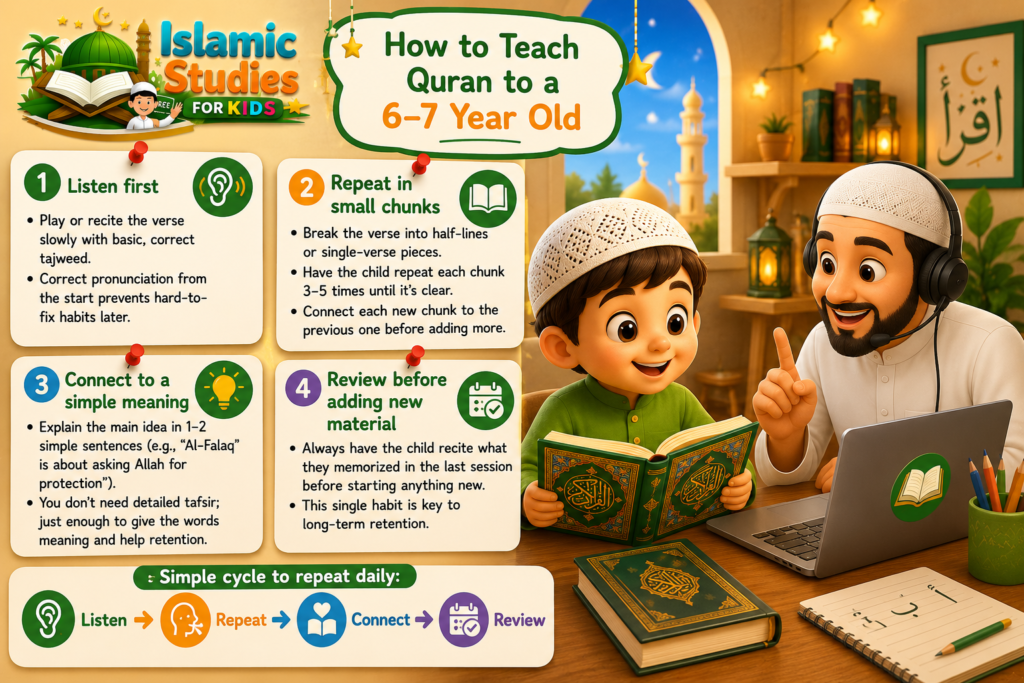
Step 1 — Listen First
- Play or recite the verse slowly, ideally with simplified tajweed rather than no tajweed at all.
- Teaching a child to recite without correct pronunciation from the start creates habits that are much harder to unlearn later.
- This is one of the most common errors in home memorization — and one of the easiest to avoid.
The Tajweed Course for Kids Online and Quran Recitation Course for Kids Online both build correct pronunciation in from the very first lesson.
For a parent-friendly explanation of the key rules, see Tajweed Rules for Kids.
Step 2 — Repeat in Small Chunks
- Break the verse into half-line or single-verse pieces.
- Ask the child to repeat each chunk three to five times until it comes out clean.
- Join it to the previous chunk before adding anything new.
- Trying to memorize a full verse in one pass usually backfires — the child forgets the first half by the time they reach the end.
Step 3 — Connect It to a Simple Meaning
- Explain the general idea in one or two plain sentences — for example, that Surah Al-Falaq is about asking Allah for protection from harm.
- You don’t need to teach tafsir; one sentence that gives the words weight is enough.
- This comprehension layer is what separates a child who retains a surah for years from one who forgets it within months.
Step 4 — Review Before Adding New Material
- Before starting anything new, have the child recite what they memorized in the previous session.
- This single habit — review before new memorization — is the difference between a child who retains a surah for years and one who forgets it within weeks.
Together, these four steps — Listen, Repeat, Connect, Review — form a simple cycle you can run every single day without needing new material or new tricks each time.
Many families find it easier to keep this rhythm consistent when a trained teacher leads the listen-and-repeat portion, so the child hears correct pronunciation every time.
The Quran Memorization Course for Kids Online is built around exactly this cycle.
Experience a Real Classroom
Curious about how we teach? This video offers a glimpse into a real class, showcasing our interactive approach, qualified teachers, and child-friendly learning experience.
Fun & Engaging Islamic Classes for Kids
Start your child’s journey today with interactive lessons designed to make learning Islam loved and easy.
Get Your Child a Free TrialWhich Surahs to Start With and How to Progress?
Start with the shortest surahs from the last section of the Quran — An-Nas, Al-Falaq, Al-Ikhlas, and Al-Kawthar are the standard starting points because they’re short enough for a child to finish in a single sitting, which builds a real sense of accomplishment early.
Once a child has memorized four or five of these, they usually have enough confidence and rhythm to handle slightly longer ones — Al-Kafirun, An-Nasr, Al-Asr — before progressing further into Juz Amma.
For a detailed sequence and phase-by-phase plan, see Juz Amma Memorization for Kids.
Working Toward Juz Amma
A reasonable target for a 6–7 year old, working with a teacher:
- With consistent practice and a structured learning plan, many children are able to complete Juz Amma in about four to five months.
- A pace of one short surah or a small daily portion.
- A fixed weekly review day with no new memorization — just consolidation.
This isn’t a fixed rule — some children move faster, some need more time — but it gives a realistic timeline instead of an open-ended goal.
How Much Should a Child Memorize Each Day?
For a 6–7 year old, two to three lines a day is a realistic starting point — roughly the length of a short surah. As the child’s capacity grows, this can increase gradually to half a page.
Pushing beyond what a child can comfortably retain usually produces the opposite of progress:
- Frustration
- Resistance
- A child who starts dreading the session.
Session length should stay between fifteen and twenty minutes. Ending the session while the child still wants to continue — rather than pushing until they’re exhausted or bored — is one of the more counterintuitive but effective decision rules at this age: stop on a high note, not a low one.
For a complete framework on daily targets and revision, see How to Make Your Child Memorize Quran.
Why Age 6–7 Is a Turning Point for Quran Learning?
At 6–7, most children have finished — or are close to finishing — basic letter recognition, and their attention span has grown from a few minutes to closer to fifteen or twenty.
Memory at this age is genuinely strong; children absorb sound patterns almost effortlessly, which is why repetition-based methods work better here than explanation-heavy ones.
The difference from earlier years is comprehension. A four-year-old can repeat a verse without knowing what a single word means.
A 6–7 year old can grasp a simple idea like “this surah means Allah protects us from harm,” and that understanding makes the memorized text far more likely to stay with them long-term.
For a complete picture of the stages leading up to this one, see When Should Children Begin Learning the Quran? and How to Teach Quran to a 4–5 Year Old.
Because this age sits between pure repetition and real comprehension, the most effective approach blends both — spoken repetition to lock in the sound, and short, plain-language explanation to lock in the meaning. Neither one alone is enough.
Common Mistakes Parents Make When Teaching Quran to Kids This Age
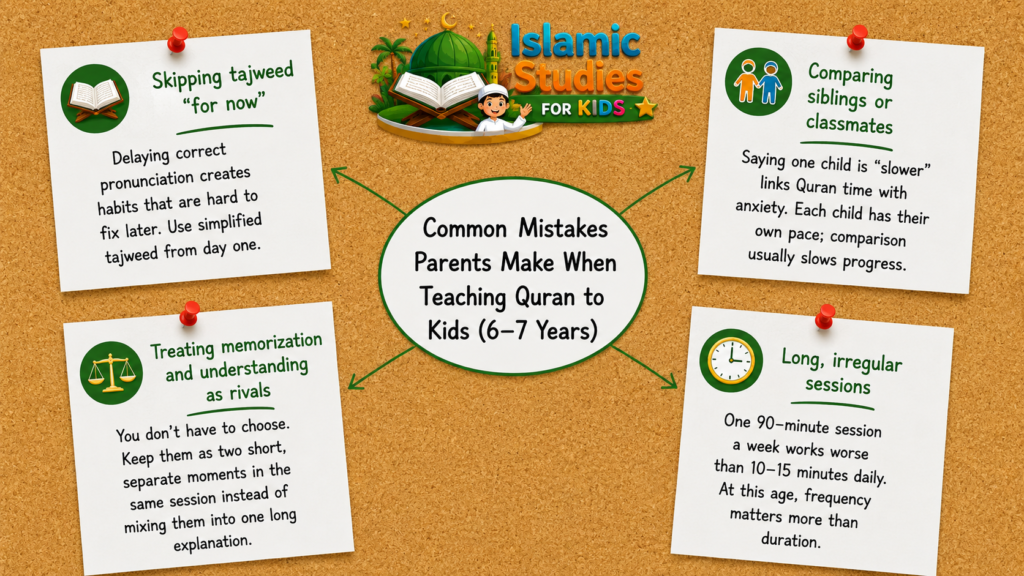
Even well-intentioned parents fall into a handful of patterns that quietly derail progress. Recognizing them early saves months of frustration.
1. Skipping tajweed “for now”
Some parents plan to teach correct pronunciation later, once the child can read fluently.
In practice, this creates pronunciation errors that are far harder to correct after they’ve been repeated hundreds of times. Simplified tajweed from day one is easier than un-teaching bad habits later.
2. Comparing siblings or classmates
Saying a child memorizes slower than a sibling or friend is one of the fastest ways to make a child associate Quran time with anxiety rather than comfort.
Every child’s pace is genuinely different, and comparison rarely speeds anyone up.
3. Treating memorization and understanding as competitors
Some parents feel they must choose between more memorization and more explanation.
They aren’t mutually exclusive — keep them as two separate, short moments in the same session rather than trying to do both at once in a single breath.
4. Long, irregular sessions
A ninety-minute session once a week produces worse retention than fifteen minutes daily.
The child’s memory at this age responds to frequency far more than to duration.
For activity ideas that keep Quran time enjoyable rather than pressured, see Quran Activities for Kids and Islamic Activities for Kids.
Best Practices for Guiding a 6–7 Year Old in Quran Learning at Home
These habits make the biggest practical difference in day-to-day home teaching:
- Keep one dedicated mushaf or reading tool for the child so the visual layout stays familiar.
- Use a calm, encouraging tone — specific praise (“you said that letter so clearly today”) lands better than generic praise.
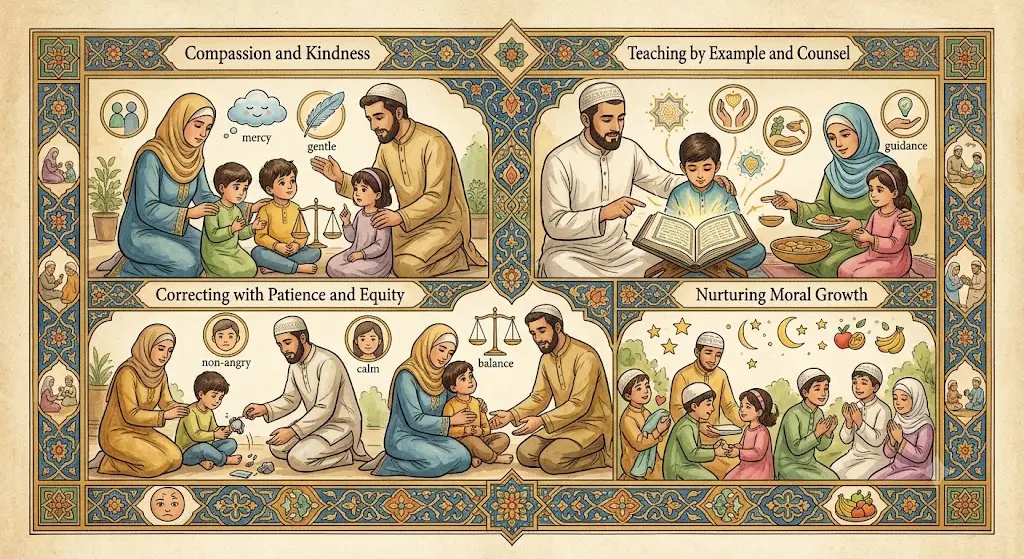
- Let the child see you reading or reciting regularly; children imitate far more than they’re taught.
- Set a fixed weekly review day with no new memorization, just consolidation.
- Use light rewards (stickers, a small treat, a short outing) tied to milestones, not to every single session.
Islamic Worksheets for Kids — Free Printables for Parents includes printable progress charts designed for exactly this kind of milestone tracking.
Read Also: At What Age Can Kids Fast In Ramadan?
When Home Methods Reach Their Limit — and What to Do Next?
These habits work well for building routine, but at some point most families reach a stage where a parent’s own tajweed, patience on a hard day, or simply the calendar makes daily teaching difficult to sustain. That’s a normal point to bring in outside support — not a sign anything went wrong.
Signs it’s time for a structured class or teacher:
- Sessions are turning into daily conflict.
- You’re unsure about your own tajweed.
- Progress has stalled for several weeks despite consistent effort.
A qualified teacher can usually reset the pace within a few sessions — correcting pronunciation the child’s ear has already partly absorbed and rebuilding the habit of enjoying Quran time rather than resisting it.
This is precisely the role the Quran Memorization Course for Kids Online and Noorani Qaida Course for Kids Online are built around.
If you’re also building prayer habits alongside Quran learning, Wudu Steps for Kids and How to Pray for Kids in Islam pair naturally with this stage — since several of the surahs your child memorizes now are the ones they’ll recite in every prayer.
Read Also: What Age Should Kids Learn Arabic
Watch a Sample Lesson from Our Academy
Get a firsthand look at how our students learn Islamic values, Quran, and essential knowledge through engaging and interactive online classes. See why families trust Islamic Studies for Kids Academy.
Fun & Engaging Islamic Classes for Kids
Start your child’s journey today with interactive lessons designed to make learning Islam loved and easy.
Get Your Child a Free TrialRead also: Is It Haram To Force Your Child To Read Quran?
Start Your Child’s Quran Journey the Right Way
Waiting for the “perfect” routine before starting usually means starting later than necessary.
A 6–7 year old’s ability to absorb sound and rhythm is at its peak right now — the structure matters less than starting consistently today.
Islamic Studies For Kids Academy builds daily Quran learning around exactly the method outlined above: short sessions, correct tajweed from the first lesson, simple meaning woven in, and steady weekly review — guided by teachers trained specifically to work with young children.

Watch What Our Graduates Say

Our Islamic Studies Courses Include:
- Islamic Studies for Kids
- Islam Basics for Kids (Beginners)
- 5 Pillars of Islam for Kids
- 6 Pillars of Iman (Faith) for Kids
- Salah (Prayer) for Kids
- Wudu for Kids
- Dua for Kids
- Ramadan for Kids
- Zakat & Sadaqah for Kids
- Hajj for Kids
- Aqeedah (Islamic Belief) for Kids
- Islamic Manners & Akhlaq for Kids
- Good Deeds for Kids
- Cleanliness (Taharah) in Islam for Kids
- Angels in Islam for Kids
- Islamic History for Kids
- Seerah (Prophet’s Life) for Kids
- Prophets Stories for Kids
- Islamic Stories & Morals for Kids
- Fiqh for Kids (Islamic Jurisprudence Basics)
- Hadith for Kids
- Quran Tafseer Course for Kids
- Islamic Holidays & Events for Kids
- Islamic Identity for Kids
- Intensive Islamic Course for Kids
Enroll today and give your child the knowledge, values, and confidence to grow as a practicing Muslim with a strong connection to Allah and His teachings.
Conclusion
Teaching Quran to a 6–7 year old comes down to a simple, repeatable rhythm: listen, repeat in small pieces, connect to a short meaning, and review before adding anything new. Keep sessions short, keep pronunciation correct from the start, and keep comparison out of the room.
Whether you’re managing it at home or working with a teacher, the goal for Quran learning at this age is the same — steady, low-pressure consistency that lets the child build both memorization and a genuine attachment to the Quran over time.
Frequently Asked Questions
Parents at this stage tend to ask a similar set of practical questions once they’ve settled into a routine.
How long should a Quran lesson be for a 6–7 year old?
Fifteen to twenty minutes is the ideal length for this age group. Sessions longer than that tend to lose the child’s attention, and ending while they’re still engaged makes the next day’s session easier to start.
What surahs should a 7-year-old start with?
Start with the shortest surahs from the last section of the Quran — An-Nas, Al-Falaq, Al-Ikhlas, and Al-Kawthar.
Their short length lets a child complete one in a single sitting, which builds early confidence before moving to longer surahs.
Should I teach tajweed from the very beginning?
Yes. Teaching a child to recite without correct pronunciation and correcting it later is far harder than starting with simplified tajweed from lesson one, since incorrect habits become difficult to unlearn once repeated many times.
How much should a 6-year-old memorize per day?
Two to three lines a day is a reasonable starting amount, roughly the length of a short surah, increasing gradually as the child’s memorization capacity grows.
Is online Quran teaching effective for young kids?
Online Quran classes can work well for 6–7 year olds when the teacher is specifically trained to work with young children — holding attention, correcting gently, and keeping sessions short — since children this age typically adapt quickly to screen-based learning when the content itself is engaging.
What if my child keeps forgetting what they memorized?
Forgetting is usually a sign the review step is being skipped, not that the child can’t memorize.
Reviewing previously memorized material before adding anything new, and repeating it in daily prayers, is the most reliable way to make memorization stick long-term.



Leave a Reply