 Islamic Studies
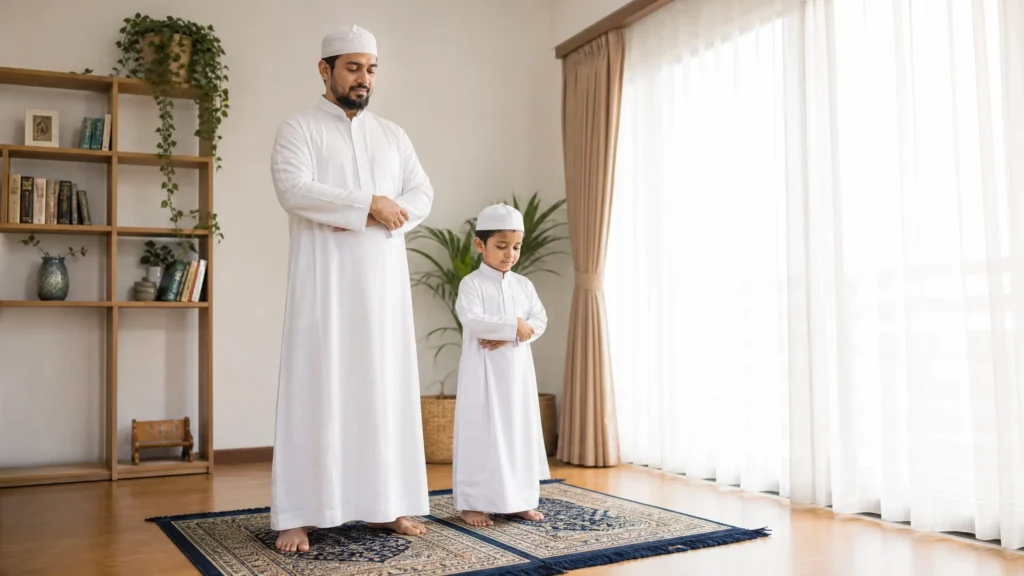
How to pray for kids in Islam is one of the most important questions a Muslim parent will ever answer — not just once, but through years of patient, loving guidance.
Salah is the second pillar of Islam and the first act a Muslim is asked about on the Day of Judgement. Teaching it well is not simply a religious duty; it is one of the greatest gifts a parent can give their child.
What You’ll Learn in This Article?
- Why children need to understand why they pray before learning how.
- The correct age to start teaching Salah and what the Prophet ﷺ instructed.
- A full step-by-step breakdown of Salah positions and words — in Arabic with English translation.
- Practical Wudu teaching methods that children enjoy.
- The most common mistakes parents make — and how to avoid them.
- Proven ways to make prayer a habit children want to keep.
How to Pray for Kids in Islam by Starting With the Why Before the How?
Before a child can love Salah, they need a reason that makes sense to them at their age. Abstract ideas about religious duty rarely move a six-year-old. A connection does.
Tell a young child: “We talk to Allah five times a day because He loves hearing from us — just like you love talking to us.” That one sentence turns prayer from a command into a relationship.
For older children aged 8–12, you can go deeper: Salah is the one moment in the whole day that belongs entirely to them and Allah — no school pressure, no screens, no worries. Just a direct, private conversation with the Creator.
The Prophet Muhammad ﷺ gave parents a clear, graduated timeline:
“مُرُوا أَوْلَادَكُمْ بِالصَّلَاةِ وَهُمْ أَبْنَاءُ سَبْعِ سِنِينَ، وَاضْرِبُوهُمْ عَلَيْهَا وَهُمْ أَبْنَاءُ عَشْرٍ، وَفَرِّقُوا بَيْنَهُمْ فِي الْمَضَاجِعِ”
“Muru awladakum bis-salati wahum abna’u sab’i sineen, wadribuhum alayha wahum abna’u ‘ashr, wafarriqu baynahum fil-madaji'”
“Command your children to pray when they are seven years old, and discipline them for it when they are ten, and separate them in their sleeping arrangements.” (Reported by Abu Dawud, no. 495)
A Practical Framework for Parents From This Hadith
This hadith gives parents a practical framework:
- Ages 3–6 are for watching and imitating.
- Age 7 is when gentle instruction and encouragement begin.
- Age 10 is when consistent practice becomes an expectation.
The progression is wisdom, not harshness — it respects how children actually develop.
Experience a Real Classroom
Curious about how we teach? This video offers a glimpse into a real class, showcasing our interactive approach, qualified teachers, and child-friendly learning experience.
Fun & Engaging Islamic Classes for Kids
Start your child’s journey today with interactive lessons designed to make learning Islam loved and easy.
Get Your Child a Free TrialTeaching Kids Wudu as the Essential First Step in Salah
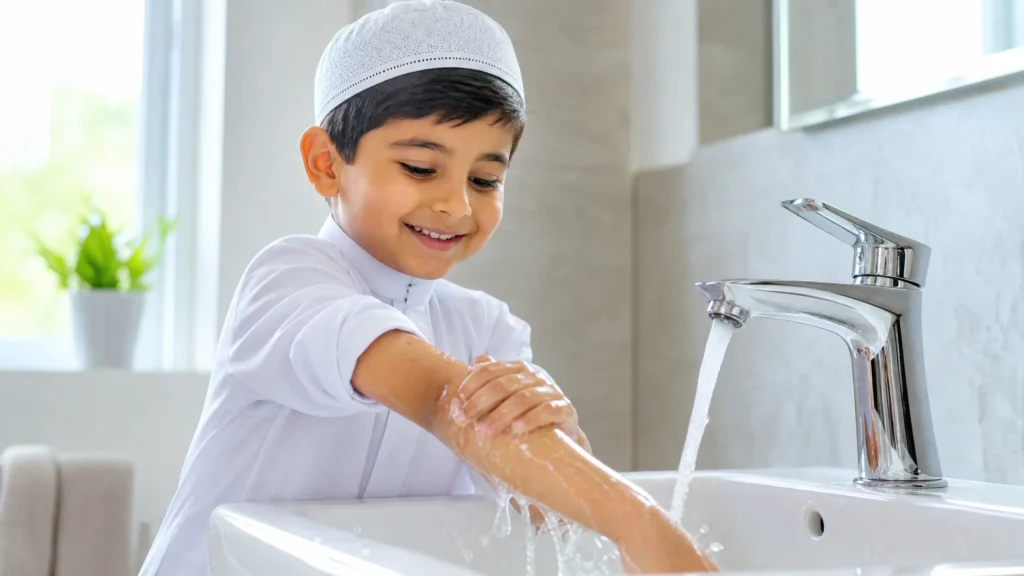
Salah cannot begin without Wudu. The good news is that young children generally love water — which makes this the easiest step to introduce first.
The key mistake parents make is explaining Wudu as a list of rules. Instead, explain it with meaning: “We wash ourselves clean because we are about to stand before Allah, and we want to come to Him at our best.” This makes Wudu feel like preparation for something special, not a chore before a chore.
A Simple Child Friendly Teaching Method You Can Use Today
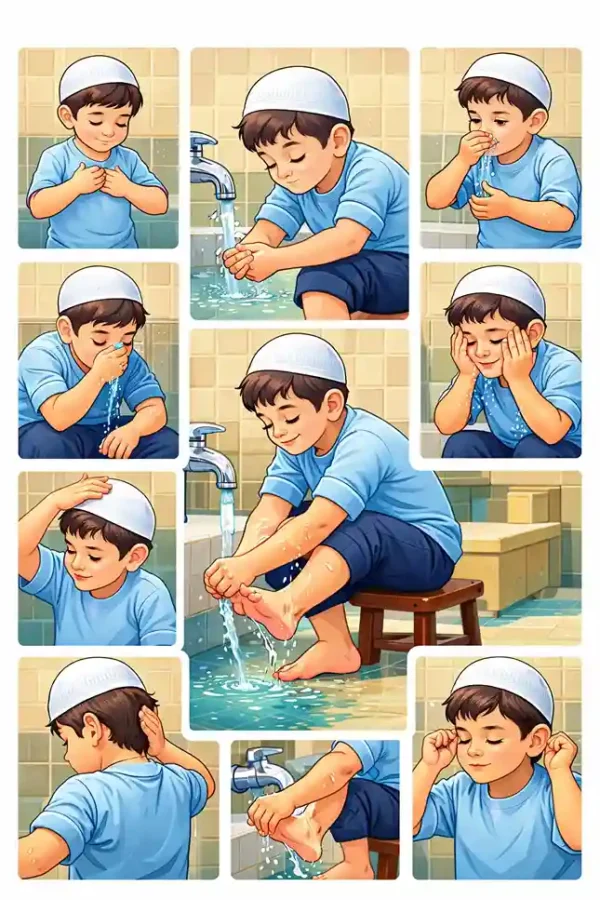
Teach Wudu using the rhyme sequence: “Hands, mouth, nose, face, arms, head, ears, feet — now you’re clean and ready to meet!” For children between the ages of four and seven, songs and rhythms are often more effective than lengthy explanations when learning a sequence
The following table shows the correct Wudu steps alongside language you can use directly with your child:
| Wudu Step | Child-Friendly Explanation |
| Wash hands (3×) | “Clean hands to start our prayer” |
| Rinse mouth (3×) | “Fresh mouth to say Allah’s words” |
| Rinse nose (3×) | “Clean breath for Allah’s house” |
| Wash face (3×) | “A clean face to meet Allah” |
| Wash arms to elbows (3×) | “Up to the elbows, three times each side” |
| Wipe head (once) | “One gentle wipe across the top” |
| Wipe ears (once) | “Clean ears to hear Allah’s words” |
| Wash feet to ankles (3×) | “Last step — then Wudu is done!” |
Print this chart, laminate it, and place it at sink height. Children feel proud using their own chart independently, and that pride motivates daily practice.
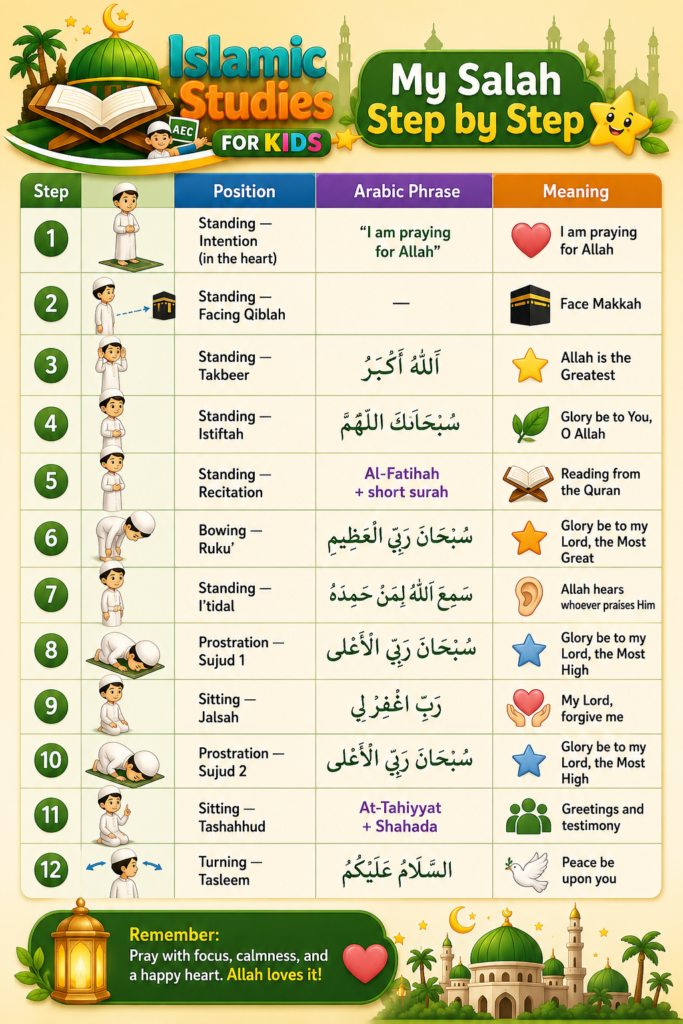
A Complete Step by Step Guide to the 12 Salah Steps for Kids
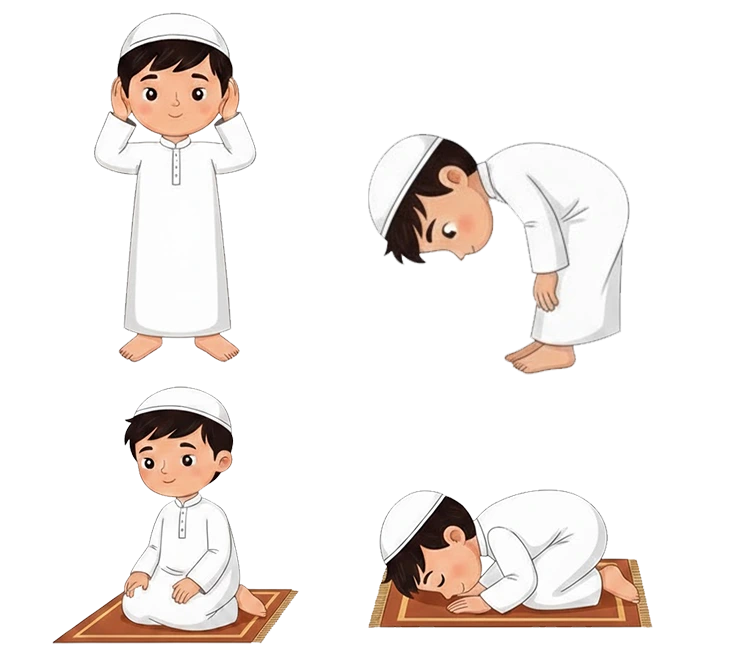
Teaching children how to perform Salah works best when each position is given a name, a meaning, and a simple phrase. Do not teach all ten steps in one sitting.
Introduce two steps at a time over several days, practicing them together before moving to the next pair.
The following steps cover one complete rak’ah (unit of prayer). Most obligatory prayers are 2, 3, or 4 rak’ahs — the steps below repeat for each unit, with the Tashahhud and Tasleem added at the end.
Step 1 — Intention (Niyyah)
The intention is made in the heart, not spoken aloud. Teach children to pause for a moment before prayer and Encourage children to:
pause and say, “I am praying Fajr (or another prayer) for Allah,” helps them become mindful of their intention before beginning Salah.
Step 2 — Facing the Qiblah
The child stands facing the direction of Makkah. In most homes, parents can mark the Qiblah direction with a small sticker on the wall. Children feel more confident when they have a clear visual reference point.
Step 3 — Takbeer al-Ihram (Opening Takbeer)
The child raises both hands to shoulder or ear level and says:
اللَّهُ أَكْبَرُ Allahu Akbar “Allah is the Greatest.”
Then the right hand is placed over the left on the chest. Teach children that this moment is like knocking on a door — they are announcing to themselves that everything else pauses, and this time belongs to Allah.
Step 4 — Du’a al-Istiftah (Opening Supplication)
After the opening Takbeer, the child recites quietly:
سُبْحَانَكَ اللَّهُمَّ وَبِحَمْدِكَ، وَتَبَارَكَ اسْمُكَ، وَتَعَالَى جَدُّكَ، وَلَا إِلَهَ غَيْرُكَ Subhanakal-lahumma wabihamdik, watabarakas-muk, wata’ala jadduk, wala ilaha ghayruck “Glory be to You, O Allah, and praise be to You. Blessed is Your name and exalted is Your majesty. There is no god but You.”
Step 5 — Recitation of Al-Fatihah and a Short Surah
Al-Fatihah is recited in every single rak’ah of every single prayer. It is the most important text for children to memorize correctly before anything else. Teach it in three short segments across one week rather than as one long block.
After Al-Fatihah, the child recites a short surah they know —like:
- Surah Al-Ikhlas (112)
- Al-Falaq (113)
- An-Nas (114) …etc
Allah ﷻ says in the Quran: ﴿ٱقۡرَءُوا۟ مَا تَيَسَّرَ مِنَ ٱلۡقُرۡءَانِ﴾ (Al-Muzzammil: 20) “Iqra’u ma tayassara minal-Qur’an” “Recite what is easy of the Quran.”
This verse is reassurance for both parent and child: Allah asks for what the child can manage, not perfection.
Step 6 — Ruku’ (Bowing)
The child bows forward with a straight back, placing both hands on the knees, and recites three times:
سُبْحَانَ رَبِّيَ الْعَظِيمِ Subhana Rabbiyal-Adheem “Glory be to my Lord, the Most Great.”
Explain to children: “When we bow, we are showing Allah that we know He is greater than everything — greater than school, greater than our worries, Explaining the purpose of every step in prayer transforms Salah from physical movements into a heartfelt act of worship”.
Step 7 — Rising from Ruku’ (I’tidal)
The child straightens up and says:
سَمِعَ اللَّهُ لِمَنْ حَمِدَهُ، رَبَّنَا وَلَكَ الْحَمْدُ Sami’allahu liman hamidah, Rabbana walakal-hamd “Allah hears whoever praises Him. Our Lord, all praise belongs to You.”
Step 8 — Sujud (Prostration)
The child descends to the floor so that seven body parts touch the ground: the forehead and nose, both palms, both knees, and the toes of both feet.
The child recites three times:
سُبْحَانَ رَبِّيَ الْأَعْلَى Subhana Rabbiyal-A’la “Glory be to my Lord, the Most High.”
Teach children that prostration is a beautiful opportunity to feel close to Allah and speak to Him from the heart.
This explanation transforms sujud from the hardest position physically into the most beloved one spiritually — which is exactly what it is.
Step 9 — Sitting Between the Two Sujud (Jalsah)
The child sits upright between the two prostrations and says:
رَبِّ اغْفِرْ لِي Rabbigh-fir li “My Lord, forgive me.”
This brief sitting is often rushed or skipped in teaching — yet it contains one of the most powerful duas a child can learn: a direct personal request for Allah’s forgiveness, made in the middle of every prayer, every day.
Step 10 — Second Sujud
The child repeats the prostration exactly as in Step 8.
Step 11 — Tashahhud (At-Tahiyyat)
After the second rak’ah (and at the end of the final rak’ah), the child sits and recites:
التَّحِيَّاتُ لِلَّهِ وَالصَّلَوَاتُ وَالطَّيِّبَاتُ، السَّلَامُ عَلَيْكَ أَيُّهَا النَّبِيُّ وَرَحْمَةُ اللَّهِ وَبَرَكَاتُهُ، السَّلَامُ عَلَيْنَا وَعَلَى عِبَادِ اللَّهِ الصَّالِحِينَ، أَشْهَدُ أَنْ لَا إِلَهَ إِلَّا اللَّهُ وَأَشْهَدُ أَنَّ مُحَمَّدًا عَبْدُهُ وَرَسُولُهُ
“At-tahiyyatu lillahi was-salawatu wat-tayyibat, as-salamu ‘alayka ayyuhan-nabiyyu wa rahmatullahi wabarakatuh, as-salamu ‘alayna wa ‘ala ‘ibadillahis-salihin, ashhadu alla ilaha illallah wa ashhadu anna Muhammadan ‘abduhu wa rasuluh”
“All greetings, prayers, and good words belong to Allah. Peace be upon you, O Prophet, and Allah’s mercy and blessings. Peace be upon us and upon all of Allah’s righteous servants. I testify that there is no god but Allah, and I testify that Muhammad is His servant and messenger.”
Step 12 — Tasleem (The Closing Salutation)
The child turns their head to the right and says:
السَّلَامُ عَلَيْكُمْ وَرَحْمَةُ اللَّهِ As-salamu ‘alaykum wa rahmatullah “Peace be upon you and the mercy of Allah.”
Then turns to the left and repeats the same words. Prayer is complete.
A Quick Reference Table for the Full Prayer Sequence
The following table gives a quick reference for the full prayer sequence your child can keep nearby during practice:
| Step | Position | Arabic Phrase | Meaning |
| 1 | Standing — Intention | (in the heart) | “I am praying for Allah” |
| 2 | Standing — Facing Qiblah | — | Face Makkah |
| 3 | Standing — Takbeer | اللَّهُ أَكْبَرُ | Allah is the Greatest |
| 4 | Standing — Istiftah | سُبْحَانَكَ اللَّهُمَّ | Glory be to You, O Allah |
| 5 | Standing — Recitation | Al-Fatihah + short surah | Reading from the Quran |
| 6 | Bowing — Ruku’ | سُبْحَانَ رَبِّيَ الْعَظِيمِ | Glory be to my Lord, the Most Great |
| 7 | Standing — I’tidal | سَمِعَ اللَّهُ لِمَنْ حَمِدَهُ | Allah hears whoever praises Him |
| 8 | Prostration — Sujud 1 | سُبْحَانَ رَبِّيَ الْأَعْلَى | Glory be to my Lord, the Most High |
| 9 | Sitting — Jalsah | رَبِّ اغْفِرْ لِي | My Lord, forgive me |
| 10 | Prostration — Sujud 2 | سُبْحَانَ رَبِّيَ الْأَعْلَى | Glory be to my Lord, the Most High |
| 11 | Sitting — Tashahhud | At-Tahiyyat + Shahada | Greetings and testimony |
| 12 | Turning — Tasleem | السَّلَامُ عَلَيْكُمْ | Peace be upon you |
The Number of Rak’ahs in Each of the Five Prayers
Once a child can complete one rak’ah, they need to know how many to perform for each prayer. The following breakdown is the essential reference:
| Prayer | Time | Rak’ahs |
| Fajr | Before sunrise | 2 |
| Dhuhr | Midday | 4 |
| Asr | Afternoon | 4 |
| Maghrib | After sunset | 3 |
| Isha | Night | 4 |
A practical teaching note: start by having your child practice Fajr — two rak’ahs make it the most manageable prayer to learn from start to finish without fatigue.
Once Fajr feels natural, move to Maghrib (three rak’ahs), then to the four-rak’ah prayers.
Practical Methods That Work for Teaching a Child to Pray in Islam
Teaching salah for kids is not only about transmitting correct movements — it is about building a relationship with prayer that lasts a lifetime. The methods below are grounded in what child development and Islamic guidance both confirm works.
- Pray together, not separately
Say “Come pray with me” rather than “Go pray.” That one word change — with instead of go — shifts prayer from an assignment to a shared experience.
Children who pray beside a parent they love connect prayer to warmth and belonging, not obligation.
- Use a laminated prayer chart
A simple five-box daily chart — one box for each Salah — gives children aged 6–12 visible proof of their own consistency. Seeing a complete row of checkmarks at the end of the day creates genuine satisfaction.
This method works because children are motivated by visible progress, not abstract virtue.
| Day | Fajr | Dhuhr | Asr | Maghrib | Isha |
| Saturday | ✓ | ✓ | ✓ | ✓ | ✓ |
| Sunday | ✓ | ✓ | — | ✓ | ✓ |
| Monday | ✓ | — | ✓ | ✓ | ✓ |
- Never correct during prayer itself
If your child loses their place, giggles, or makes a mistake mid-prayer, let it go and continue. Correct gently and kindly after the prayer ends.
Interrupting Salah to correct a child trains them to associate prayer with anxiety and criticism — the opposite of what you want.
- Give children their own prayer space
A small prayer rug that belongs only to them, placed in a consistent spot, makes the prayer space feel special and personal.
Children are territorial by nature — ownership of the space encourages ownership of the habit.
- Reward effort, not perfection
A child who prays two prayers today and three tomorrow is making genuine progress. Praise the attempt consistently. The Prophet ﷺ said:
“إِنَّ اللَّهَ لَا يَمَلُّ حَتَّى تَمَلُّوا، وَأَحَبُّ الأَعْمَالِ إِلَى اللَّهِ أَدْوَمُهَا وَإِنْ قَلَّ” “Inna Allaha la yamall hatta tamalluu, wa ahabbu al-a’mali ila Allahi adwamuha wa in qall” “Allah does not tire until you tire, and the most beloved deeds to Allah are the most consistent ones, even if they are small.” (Reported by Al-Bukhari, no. 6465, and Muslim, no. 782)
Start your child on the path to Islamic Studies with Islamic Studies for Kids Academy — where experienced teachers guide children through Salah, Wudu, Quranic recitation, and Islamic values in age-appropriate, engaging lessons designed for children aged 4–15.
Mistakes to Avoid When Teaching Kids to Pray in Islam
Most parents make the same small set of errors when teaching Salah — and each one creates exactly the resistance they are trying to avoid.
The most common mistake is the following:
1. teaching through pressure before teaching through love.
A child who is pushed to pray before they feel any connection to it learns to associate Salah with conflict. Build the emotional connection first — the compliance follows far more easily.
2. Skipping the meaning of each position
It is equally damaging. A child who memorizes movements without knowing what ruku’ means, or why sujud brings them close to Allah, is performing a sequence — not praying.
Spend one minute explaining each position before teaching the Arabic.
Read Also: Islamic Civilization and the Golden Age for Kids
3. Inconsistency from adults in the home
It is perhaps the most quietly destructive mistake of all. A child who is told to pray while their parent scrolls a phone in the next room receives a clear message: prayer is for children, not for adults who are serious about life.
Your own visible Salah habit is the most powerful teaching method available to you — more than any book, chart, or app.
Read Also: Can Kids Fast in Ramadan?
4. Finally, rushing to all five prayers at once
overwhelms children and sets them up to fail. Begin with one or two prayers daily and add more as each one becomes familiar.
The Prophet ﷺ instructed parents to command prayer at seven — a gentle beginning. The expectation of full consistency does not arrive until ten.
Read Also: What to Do in Ramadan for Kids?
Watch a Sample Lesson from Our Academy
Get a firsthand look at how our students learn Islamic values, Quran, and essential knowledge through engaging and interactive online classes. See why families trust Islamic Studies for Kids Academy.
Fun & Engaging Islamic Classes for Kids
Start your child’s journey today with interactive lessons designed to make learning Islam loved and easy.
Get Your Child a Free TrialYour Child Is Learning the Movements — But Is Salah Becoming Theirs?
There is a difference between a child who prays because they are told to, and a child who prays because they feel something when they do. The first habit fades the moment the parent stops watching. The second lasts a lifetime.
That shift — from compliance to conviction — is what structured Islamic learning builds.
Fiqh for Kids Course Online
Salah is not just movements and Arabic phrases. It has conditions, pillars, and rulings a child needs to understand to pray correctly — not just repeatedly.
The Fiqh for Kids Course covers the legal rulings governing daily worship for children ages 4 to 15: Taharah, Salah, Sawm, and Zakat, at a depth matched to each child’s age.
Delivered in English. Private 1-on-1 sessions. Al-Azhar certified tutors.
Book Your Child’s Free Trial Class

Islam Basics for Kids Course Online
If your child is just starting their Islamic journey, the Islam Basics Course is the natural entry point — covering Tawheed, the Five Pillars, Wudu and Salah steps, foundational Seerah, and daily Islamic manners, all in one structured curriculum for ages 4 to 15.
Every session taught by Al-Azhar certified tutors who hold traditional Ijazah and train specifically in teaching children — not adult learners.
What Families Say After the First Semester
Children enrolled at Islamic Studies for Kids Academy don’t just memorize Salah — they begin to own it:
- Children asking when prayer time is — without being reminded.
- Correct Wudu sequence performed independently from memory.
- Children explaining to siblings why each position matters.
- Salah becoming a moment they protect, not a chore they delay.

Watch Graduate Stories From Real Families
Our Islamic Studies Courses Include:
- Islamic Studies for Kids
- Islam Basics for Kids (Beginners)
- 5 Pillars of Islam for Kids
- 6 Pillars of Iman (Faith) for Kids
- Salah (Prayer) for Kids
- Wudu for Kids
- Dua for Kids
- Ramadan for Kids
- Zakat & Sadaqah for Kids
- Hajj for Kids
- Aqeedah (Islamic Belief) for Kids
- Islamic Manners & Akhlaq for Kids
- Good Deeds for Kids
- Cleanliness (Taharah) in Islam for Kids
- Angels in Islam for Kids
- Islamic History for Kids
- Seerah (Prophet’s Life) for Kids
- Prophets Stories for Kids
- Islamic Stories & Morals for Kids
- Fiqh for Kids (Islamic Jurisprudence Basics)
- Hadith for Kids
- Quran Tafseer Course for Kids
- Islamic Holidays & Events for Kids
- Islamic Identity for Kids
- Intensive Islamic Course for Kids
Enroll today and give your child the knowledge, values, and confidence to grow as a practicing Muslim with a strong connection to Allah and His teachings.
Fun & Engaging Islamic Classes for Kids
Start your child’s journey today with interactive lessons designed to make learning Islam loved and easy.
Get Your Child a Free TrialConclusion
Teaching how to pray for kids in Islam is a gradual, layered process — and that is exactly how it should be. Begin with the meaning behind Salah, then introduce Wudu as an enjoyable ritual, then walk through each prayer position with its Arabic words and English translation. Add the five daily prayers one by one as each stage becomes comfortable.
The Prophet’s ﷺ instruction to begin at seven and expect consistency by ten is not arbitrary — it maps precisely onto how children develop emotionally and cognitively. Use that window wisely: build love first, then habit, then understanding. A child who prays imperfectly but willingly today will grow into an adult who prays with full understanding tomorrow.
Every moment you spend praying alongside your child is itself an act of worship. The best teacher of Salah is not a course or a book — it is a parent who prays.
Frequently Asked Questions
At what age should I start teaching my child to pray in Islam?
The Prophetic guidance is to begin encouraging Salah at age seven and to hold children consistently accountable by age ten.
Before seven, the focus is on exposure and positive association — letting children watch prayer, join in casually, and understand that Salah is a beloved part of daily life, not a formal lesson.
What is the first thing to teach a child about Salah?
Teach Wudu first, before any prayer positions or Arabic phrases. Salah is not valid without purification, and Wudu is the most practical starting point — it is physical, repeatable, and most young children enjoy it. Once Wudu is consistent, begin introducing the prayer positions one or two at a time.
How many steps are in Islamic prayer for kids?
A single rak’ah (unit of prayer) has ten positions: intention, facing the Qiblah, opening Takbeer, opening supplication, recitation of Al-Fatihah and a short surah, Ruku’, rising from Ruku’, two prostrations with a sitting between them, and the closing Tashahhud and Tasleem. Different prayers require 2, 3, or 4 rak’ahs.
What do you say in each position of Salah?
Each position has a specific phrase: Allahu Akbar at the opening, Al-Fatihah and a surah while standing, Subhana Rabbiyal-Adheem in Ruku’, Sami’allahu liman hamidah when rising, Subhana Rabbiyal-A’la in sujud, Rabbigh-fir li while sitting between prostrations, and At-Tahiyyat with the Tashahhud at the end.
How do I make Salah enjoyable for my child instead of a burden?
Pray with your child rather than sending them to pray alone. Give them a prayer rug that belongs only to them. Use a daily chart so they can track their own progress.
Explain what each position means in one simple sentence. Reward consistency with praise and small tokens of recognition. The goal at every age is for Salah to feel like a conversation with Allah — not a performance for parents.
Can children pray if they haven’t memorized all the Arabic words yet?
Yes. Children can begin praying while still learning. They recite what they know correctly — at minimum, Al-Fatihah — and add phrases as they memorize them.
The obligation is to try sincerely, not to be perfect. Allah ﷻ says: ﴿فَٱتَّقُوا۟ ٱللَّهَ مَا ٱسۡتَطَعۡتُمۡ﴾ (“Fattaqullaha mas-tata’tum” — “So fear Allah as much as you are able.” — At-Taghabun: 16). Gradual, honest effort is exactly what is asked.



Leave a Reply