 Islamic Studies

Can kids fast in Ramadan? It’s the question almost every Muslim parent asks as the blessed month approaches — especially when children beg to join the adults at the Suhoor table or insist they can “do it too.”
The short answer is: children are not required to fast, but gradually introducing them to fasting is not only permissible — Islamic scholarship and child health experts both encourage it.
This guide walks you through the Islamic ruling, the right age to start, how to do it safely, and what to feed your child to make their first fasting experiences positive and lasting.
What You’ll Learn in This Article?
- The clear Islamic ruling on whether kids can fast in Ramadan.
- At what age children can start fasting and what to realistically expect.
- How to introduce Ramadan fasting for kids gradually and safely.
- Nutrition guidelines for Suhoor and Iftar for fasting children.
- Warning signs parents must never ignore.
- Practical tips for teaching kids about Ramadan fasting with love, not pressure.
Can Kids Fast in Ramadan? What Islam Says
Fasting becomes obligatory only at puberty. This is not just a parenting guideline — it is a clear ruling in Islamic jurisprudence.
The Prophet ﷺ said: “The pen is lifted from three: the sleeper until he wakes, the child until he reaches puberty, and the insane person until he regains his mind.” (Abu Dawud, authenticated by Al-Albani)
No child before puberty bears a religious obligation to fast. However, Islamic scholars are unanimous that parents should gradually encourage children to practice fasting well before that age — so that by the time fasting becomes obligatory, it feels natural rather than sudden.
What the Scholars Say
Two scholars define this question more clearly than any other — one from the classical tradition, one from the modern era. Both point in the same direction:
1. Imam al-Nawawi stated in Al-Majmu’: when a child is capable of fasting, the guardian must instruct him to do so from age seven — provided he is discerning — and may discipline him for leaving it at age ten. This mirrors exactly how prayer is introduced: gently at seven, reinforced at ten.
2. Ibn ‘Uthaymin clarified that some parents prevent their children from fasting in the name of mercy, when in truth, genuine mercy is teaching children the practices of Islam and building love for worship in their hearts. If the child can fast without hardship, the guardian should not fall short in encouraging it.
The key principle across all scholarly opinion is this:
| Obligation | Fasting is not obligatory on children before puberty |
| Responsibility | Training them for it is a parental duty |
| Condition | It must never cause harm to the child’s health |
At What Age Can Kids Fast? A Practical Age Guide
At what age can kids fast is one of the most searched questions by Muslim parents, and the answer involves both Islamic guidance and health science. The two are not in conflict — they reach the same practical conclusion through different routes.
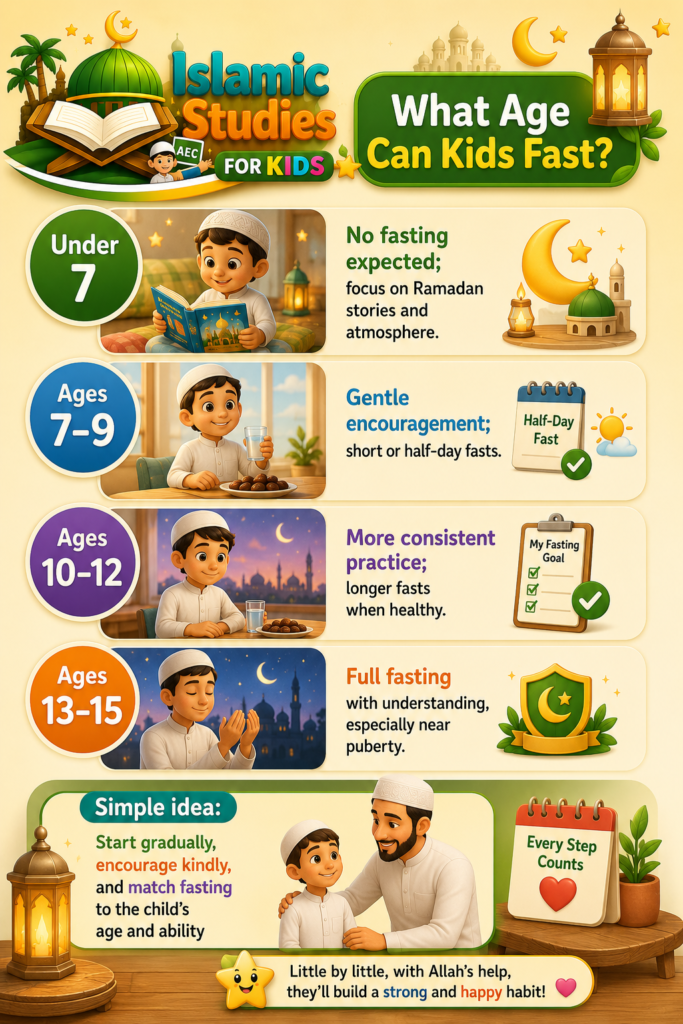
Here is a clear overview of what is appropriate at each developmental stage:
| Age Group | Islamic Guidance | What to Aim For |
| Under 7 | No expectation to fast | Awareness of Ramadan through atmosphere and stories |
| Ages 7–9 | Begin gentle encouragement | A few fasting hours; half-day fasts on good days |
| Ages 10–12 | More consistent practice | Extended or full-day fasts when healthy and willing |
| Ages 13–15 | Approaching or at puberty | Full fasting with understanding of its meaning |
From a health perspective, Dr. Majdouleen Jamal Shaheen notes that:
- Children aged 5–7 can be introduced to fasting through short experiences of a few hours.
- Children aged 8–10 begin to understand fasting more deeply and can attempt longer periods such as from Suhoor to Dhuhr or Asr.
- From age 11 and above, children are generally physically and mentally capable of a full day’s fast, provided their nutritional needs are properly met.
The critical point both Islamic scholars and health professionals agree on: never force it, and always monitor the child’s physical state.
Experience a Real Classroom
Curious about how we teach? This video offers a glimpse into a real class, showcasing our interactive approach, qualified teachers, and child-friendly learning experience.
Fun & Engaging Islamic Classes for Kids
Start your child’s journey today with interactive lessons designed to make learning Islam loved and easy.
Get Your Child a Free TrialHow to Introduce Fasting for Kids in Islam Through the Gradual Method?
Fasting for kids in Islam works best when it is introduced as an invitation, not an obligation. The Companions of the Prophet ﷺ used to have their children fast on the Day of Ashura. When a child cried from hunger, they would give them a toy made of wool to distract them until Iftar.
This hadith, recorded in the two Sahihs, is the earliest recorded example of training children to fast — and it involved both gentleness and creative distraction, not pressure.
A common parenting mistake is treating a broken or incomplete fast as a failure. If your child fasts until 2pm and needs to eat, the right response is: “Masha’Allah — you fasted for so many hours. That is something to be proud of.” Celebrating the attempt builds the willingness to try again.
Here is a practical step-by-step training framework:
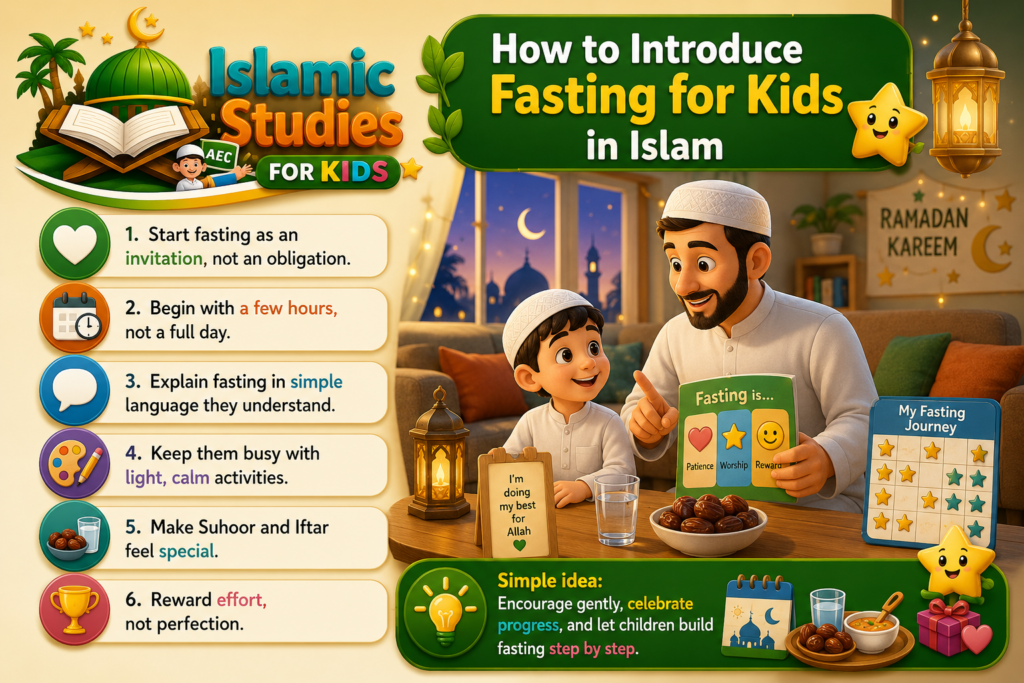
Step 1: Start with a Few Hours, Not a Full Day
Let the child fast for a set number of hours — from Suhoor to Dhuhr, for example, or from Dhuhr to Maghrib. Agree on the goal together beforehand.
This gives the child a sense of achievement they can repeat and extend over time.
Step 2: Explain the Why in Language They Understand
Young children need the purpose explained simply. For younger children, try this explanation: “Ramadan teaches us to be patient, grateful, and generous by giving up food for a few hours each day for the sake of Allah.”
Connecting fasting to things they already know — waiting before eating dessert, being patient when something is delayed — makes the concept of self-control feel familiar rather than foreign.
Step 3: Keep Them Occupied During the Day
Hunger feels more intense when children are bored. Encourage light activities:
- Reading
- Educational games
- Helping prepare Iftar
- Listening to Islamic stories.
Physical exertion should be minimized, especially in warm weather or if the fast is long.
Step 4: Make Suhoor and Iftar Feel Special
Let children participate in preparing both meals. Give them a role: choosing one Suhoor food item, placing the dates on the Iftar table, or making the dua to break the fast together.
Children who contribute to these moments feel genuine ownership over the spiritual experience.
Step 5: Reward Effort, Not Perfection
Words of encouragement and small, meaningful rewards build confidence without creating pressure.
Acknowledge what the child completed, never focus on what they couldn’t. This single principle determines whether a child grows up eager to fast — or dreading it.
Islamic Studies for Kids Academy helps children build genuine Islamic identity through age-appropriate lessons that cover Ramadan, Quran, and Islamic values. Sessions run 20–30 minutes and fit naturally around your family’s Suhoor and Iftar schedule. Book your child’s free trial lesson.

A Nutrition Guide for Kids Fasting in Ramadan at Suhoor and Iftar
Ramadan fasting for kids is safe when nutrition is managed properly. The two meals — Suhoor and Iftar — carry most of the responsibility for keeping a fasting child energized, hydrated, and healthy throughout the day.
What to Include in Suhoor?
Suhoor is the most important meal for a fasting child. It should sustain energy for several hours and minimize thirst. Build the meal around:
| Food Group | Examples |
| High-fibre carbohydrates | Whole grain bread, oats, brown rice |
| Quality protein | Eggs, lean meat, nut butter, dairy |
| Fruits and vegetables | Cucumber, banana, yoghurt with fruit |
| Healthy fats | Olive oil, avocado, nuts |
Avoid salty, fried, or spicy foods at Suhoor — they increase thirst significantly during fasting hours. Reduce sugary foods as they spike and then crash energy, increasing hunger.
Prioritize fluids: a glass of water, milk, or natural juice alongside the meal.
How to Break the Fast at Iftar?
Following the Prophet’s ﷺ Sunnah, begin Iftar with dates and water. Dates are nutritionally dense — rich in fibre, calcium, iron, potassium, phosphorus, and magnesium — and quickly restore energy after fasting hours.
After the initial dates and water, do not rush to a large meal. A practical Iftar sequence for children:
- Dates and water or milk.
- A warm, light soup — lentil soup is ideal, as it is fluid-rich, easy to digest, and provides protein and minerals.
- A fresh salad for vitamins, minerals, and hydration.
- A moderate main meal — do not encourage children to overeat to compensate; this causes bloating and discomfort.
Divide Iftar into phases rather than one large sitting. Children’s stomachs are smaller, and gradual eating is both more comfortable and healthier.
Hydration as the Most Important Factor
Dehydration is the primary risk for fasting children. Encourage maximum water intake during the hours between Iftar and Suhoor. Avoid carbonated drinks.
If a child shows signs of severe thirst, dizziness, headache, or confusion during fasting hours, break the fast immediately — no question.
Read Also: What to Do in Ramadan for Kids?
Watch a Sample Lesson from Our Academy
Get a firsthand look at how our students learn Islamic values, Quran, and essential knowledge through engaging and interactive online classes. See why families trust Islamic Studies for Kids Academy.
Fun & Engaging Islamic Classes for Kids
Start your child’s journey today with interactive lessons designed to make learning Islam loved and easy.
Get Your Child a Free TrialRead Also: Islamic Civilization and the Golden Age for Kids
Health Conditions That Mean Children Should Not Fast
Before encouraging any child to fast, confirm they are in good health. Children with the following conditions should not fast without explicit medical advice:
- Diabetes or blood sugar regulation issues.
- Anaemia or iron deficiency.
- Kidney problems.
- Any condition requiring regular medication during the day.
- Underweight or nutritional deficiency.
Monitor any child who fasts for signs of dehydration, extreme fatigue, persistent headache, or fainting. These are signals to stop the fast immediately and provide food and water.
Read Also: How to Teach Kids to Pray in Islam?
The Child Who Understands Ramadan Will Always Come Back to It
Some children fast for years and never feel the month. Others fast once — and carry it with them forever.
The difference is never willpower. It is always understanding.
At Islamic Studies for Kids Academy, children aged 4 to 15 don’t just learn what to do in Ramadan — they learn what it means, why Allah commanded it, and how it connects to everything else in their faith.

Three courses connect directly to everything this month is about:
1. Islam Basics for Kids Course
For the child just starting their Islamic journey, this is where everything begins. Tawheed, the Five Pillars, Wudu, Salah, and daily Islamic manners — built in one structured curriculum so your child enters Ramadan with a foundation, not just enthusiasm.
2. 5 Pillars of Islam for Kids Course
Sawm is the fourth pillar — and a child who understands all five experiences fasting completely differently. This course gives children the full picture of why Ramadan was ordained, where it sits in their faith, and what Allah asks of them when they fast.
2. Dua for Kids Course
Every fasting child needs the duas that belong to this month. This course teaches the Iftar dua, morning and evening adhkar, and the supplications children need for everyday life — with meaning, not just memorization.
A child who says the Iftar dua understanding every word isn’t just breaking a fast. They’re speaking directly to Allah.
Nurture Your Child’s Islamic Knowledge with Our Islamic Studies for Kids Academy
Help your child build a strong Islamic foundation through engaging, age-appropriate, and interactive lessons designed to inspire faith, good character, and a love for Islam. Our experienced teachers guide children step by step, making Islamic learning enjoyable, practical, and easy to understand. Whether your child is just beginning or looking to deepen their knowledge, our comprehensive courses provide the perfect learning journey.
Our Islamic Studies Courses Include:
- Islamic Studies for Kids
- Islam Basics for Kids (Beginners)
- 5 Pillars of Islam for Kids
- 6 Pillars of Iman (Faith) for Kids
- Salah (Prayer) for Kids
- Wudu for Kids
- Dua for Kids
- Ramadan for Kids
- Zakat & Sadaqah for Kids
- Hajj for Kids
- Aqeedah (Islamic Belief) for Kids
- Islamic Manners & Akhlaq for Kids
- Good Deeds for Kids
- Cleanliness (Taharah) in Islam for Kids
- Angels in Islam for Kids
- Islamic History for Kids
- Seerah (Prophet’s Life) for Kids
- Prophets Stories for Kids
- Islamic Stories & Morals for Kids
- Fiqh for Kids (Islamic Jurisprudence Basics)
- Hadith for Kids
- Quran Tafseer Course for Kids
- Islamic Holidays & Events for Kids
- Islamic Identity for Kids
- Intensive Islamic Course for Kids
Enroll today and give your child the knowledge, values, and confidence to grow as a practicing Muslim with a strong connection to Allah and His teachings.
Fun & Engaging Islamic Classes for Kids
Start your child’s journey today with interactive lessons designed to make learning Islam loved and easy.
Get Your Child a Free TrialConclusion
Can kids fast in Ramadan? Yes — with the right approach, the right age expectations, and the right nutrition, fasting becomes one of the most formative spiritual experiences in a Muslim child’s life.
Fasting is not obligatory before puberty, but introducing it gradually — from a few hours at age 7 to full days approaching puberty — is both an Islamic responsibility and a gift parents give their children. The Companions did it. The scholars recommended it. And done with love and patience, it works.
The goal is never a completed fast on the first attempt. The goal is a child who grows up wanting to fast — because Ramadan was always a celebration in their home, not a test they were expected to pass before they were ready.
Health always comes first. A well-nourished child who fasts enthusiastically for half a day gains far more than a pressured child who completes a full fast with resentment. Suhoor, hydration, and realistic expectations make all the difference.
Frequently Asked Questions
Can kids fast in Ramadan before they reach puberty?
Fasting is not obligatory on children before puberty. However, Islamic scholars strongly encourage parents to gradually train children to fast — beginning around age 7 — so that fasting feels natural by the time it becomes obligatory at puberty.
The condition is that it must not harm the child’s health or cause undue hardship.
At what age can kids start fasting in Ramadan?
Most scholars recommend beginning gentle encouragement from age 7, with brief fasting periods of a few hours. Children aged 8–10 can attempt half-day or extended fasts.
From age 11 onwards, children are generally capable of a full day’s fast, provided they are healthy and willing. Every child is different — physical readiness matters more than the number.
Is it safe for children to fast in Ramadan?
Fasting for kids in Ramadan is safe when introduced gradually and managed nutritionally. Key factors are a nutritious Suhoor, proper hydration between Iftar and Suhoor, and monitoring for signs of dehydration or fatigue during the day.
Children with health conditions such as diabetes, anaemia, or underweight should not fast without medical guidance.
What should fasting children eat for Suhoor?
Suhoor for fasting children should include high-fibre carbohydrates such as whole grains, quality protein from eggs, meat, or dairy, and plenty of fluids.
Avoid salty, fried, and sugary foods — they increase thirst and cause energy crashes. A filling, balanced Suhoor is the single most important factor in a safe, comfortable fast for a child.
What if my child wants to fast but gives up halfway through?
Do not treat it as failure. If your child fasts until midday and needs to eat, acknowledge the hours they completed with genuine praise: “Masha’Allah — you did so well.”
Celebrating the attempt rather than the outcome builds the confidence and willingness to try again the next day, and the next year.
Does eating accidentally during a fast break a child’s fast?
The Prophet ﷺ said that whoever forgets and eats or drinks should continue fasting, for Allah has fed them. This applies to adults and is an important comfort for children who are learning.
Teaching this ruling to children before they attempt fasting removes the anxiety and panic they sometimes feel when they accidentally drink water — and allows them to continue their fast calmly and confidently.


Leave a Reply