 Islamic Studies
Have you ever wondered why Islam places such a high reward on raising daughters? At a time in history when baby girls were buried alive, the Prophet Muhammad ﷺ stood against an entire culture and declared that daughters are among Allah’s greatest gifts. That wasn’t a small statement — it was a revolution.
Whether you’re a mother raising a daughter, a parent expecting a baby girl, or simply curious about what Islam teaches on this topic, this article walks you through the Quranic verses, authentic hadiths, and practical lessons that show just how honored daughters are in Islam.
What You’ll Learn in This Article
- What the Quran says about daughters and how Islam ended pre-Islamic attitudes toward girls
- The specific hadiths promising Paradise and protection from Hellfire for those who raise daughters well
- How the Prophet ﷺ treated his own daughter Fatimah (may Allah be pleased with her) and what that teaches us as parents
- What the “3 daughters in Islam hadith” actually says, and whether it applies to one daughter too
- Practical ways to raise daughters with the love and values Islam encourages
What the Quran Says About Daughters?
The Quran directly addresses — and firmly condemns — the pre-Islamic attitude toward daughters. Understanding this context makes the Islamic ruling on daughters even more powerful.
Before Islam, the pagan Arabs considered the birth of a daughter a source of shame. The Quran describes their reaction vividly:
وَإِذَا بُشِّرَ أَحَدُهُم بِالْأُنثَىٰ ظَلَّ وَجْهُهُ مُسْوَدًّا وَهُوَ كَظِيمٌ * يَتَوَارَىٰ مِنَ الْقَوْمِ مِنْ سُوءِ مَا بُشِّرَ بِهِ أَيُمْسِكُهُ عَلَىٰ هُونٍ أَمْ يَدُسُّهُ فِي التُّرَابِ أَلَا سَاءَ مَا يَحْكُمُونَ
“When one of them is given news of a female child, his face darkens and he is filled with grief. He hides himself from the people because of the bad news he has been given — should he keep her with disgrace or bury her in the earth? Evil indeed is the judgment they make.” — Surah An-Nahl ( Quran 16:58–59)
This verse is not just a description of the past — it is a direct rebuke. Allah (may Allah be pleased with him) called this judgment “evil,” which means rejecting or resenting a daughter is, in Islamic terms, a moral failing.
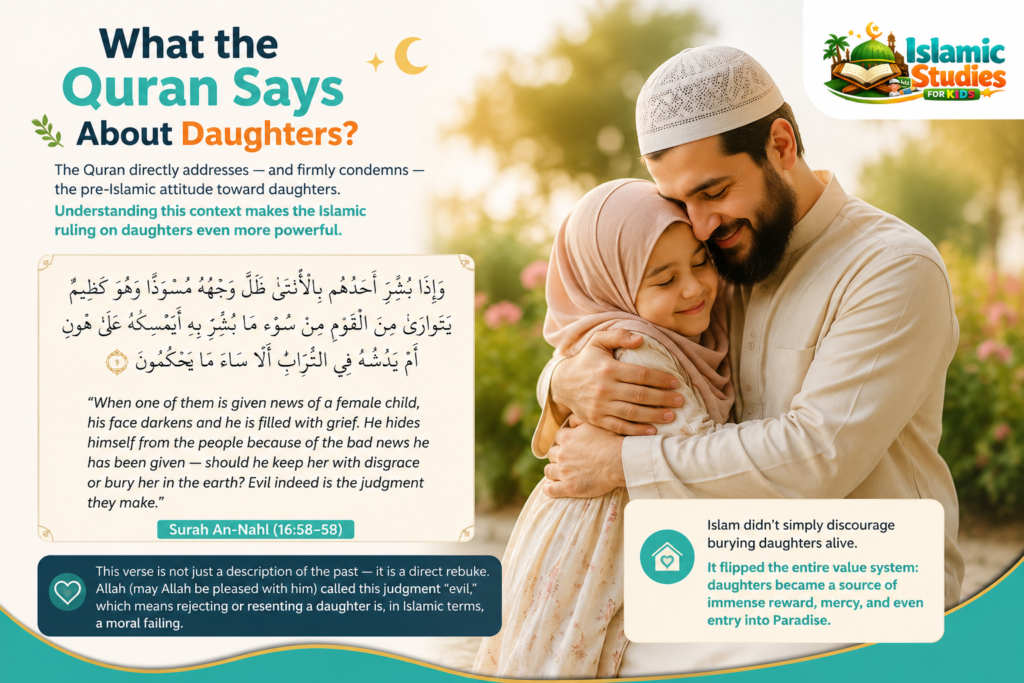
Islam didn’t simply discourage burying daughters alive. It flipped the entire value system: daughters became a source of immense reward, mercy, and even entry into Paradise.
The Hadiths on the Blessings of Daughters
The hadiths of the Prophet ﷺ on daughters are among the most tender and specific in all of Islamic tradition. They are not general encouragements — they name exact rewards for exact acts of care.
Here are the key hadiths, with both Arabic and English, so children and mothers can learn them together:
1. Protection from the Hellfire
Aishah(may Allah be pleased with her) reported:
“مَنِ ابْتُلِيَ مِنَ الْبَنَاتِ بِشَيْءٍ، فَأَحْسَنَ إِلَيْهِنَّ كُنَّ لَهُ سِتْرًا مِنَ النَّارِ”
“Whoever is tested with daughters and is kind to them, they will be a shield for him against the Fire.” (Sahih Muslim, Hadith 2629)
Notice the word “tested” — this is the Prophet ﷺ speaking directly to parents who find raising daughters challenging. The reward is not just for those who find it easy. It is especially for those who persevere with patience and love.
2. The 3 Daughters in Islam Hadith — and What It Means for You
Jabir ibn Abdullah (may Allah be pleased with him) reported:
“مَنْ كَانَ لَهُ ثَلَاثُ بَنَاتٍ يُؤْوِيهِنَّ، وَيَرْحَمُهُنَّ، وَيَكْفُلُهُنَّ — وَجَبَتْ لَهُ الْجَنَّةُ الْبَتَّةَ”
“Whoever has three daughters and he accommodates them, shows mercy toward them, and supports them — Paradise is definitely guaranteed for him.”
A companion then asked: what if someone has only two daughters?
The Prophet ﷺ replied: the same reward applies to two daughters as well. Those present believed that had someone asked about one daughter, the answer would have been the same. — (Authenticated by Al-Albani)
This is one of the most remarkable guarantees in all of Islamic parenting guidance. Three acts unlock it: giving them a home (accommodation), showing mercy (emotional warmth), and supporting them (provision and care). These are not extraordinary heroic acts — they are the day-to-day work of a loving parent.
3. Closeness to the Prophet ﷺ on the Day of Judgment
Anas ibn Malik (may Allah be pleased with him) reported that the Prophet ﷺ said:
“مَنْ عَالَ جَارِيَتَيْنِ حَتَّى تَبْلُغَا، جَاءَ يَوْمَ الْقِيَامَةِ أَنَا وَهُوَ كَهَاتَيْنِ — وَضَمَّ أَصَابِعَهُ”
“Whoever supports two girls until they reach maturity, he and I will come on the Day of Resurrection like this” — and the Messenger of Allah ﷺ joined his fingers to illustrate closeness. (Sahih Muslim)
Picture that: standing beside the Prophet ﷺ on the Day of Judgment, close as two fingers side by side — earned by raising two daughters with love.
4. A Shield on the Day of Resurrection
Uqbah ibn Aamir (may Allah be pleased with him) reported:
“مَنْ كَانَ لَهُ ثَلَاثُ بَنَاتٍ، فَصَبَرَ عَلَيْهِنَّ، وَأَطْعَمَهُنَّ، وَسَقَاهُنَّ، وَكَسَاهُنَّ مِنْ جِدَتِهِ — كُنَّ لَهُ حِجَابًا مِنَ النَّارِ يَوْمَ الْقِيَامَةِ”
“Whoever has three daughters and is patient towards them, feeds them, gives them drink, and clothes them from his wealth — they will be a shield for him from the Fire on the Day of Resurrection.” — (Authenticated by Al-Albani)
Across all four of these hadiths, one pattern is unmistakable: patience + daily care + kindness = a guaranteed place in Paradise or direct closeness to the Prophet ﷺ. The rewards scale down to even one daughter. There is no minimum threshold of daughters required to earn Allah’s mercy.
Want to help your child understand these concepts in a structured, engaging way? Explore Islamic studies basics for kids — a great starting point for families building Islamic knowledge at home.
How the Prophet ﷺ Treated His Own Daughter?
The Prophet ﷺ did not only speak about the value of daughters — he demonstrated it through his relationship with his daughter Fatimah(may Allah be pleased with her), known as Al-Zahraa.
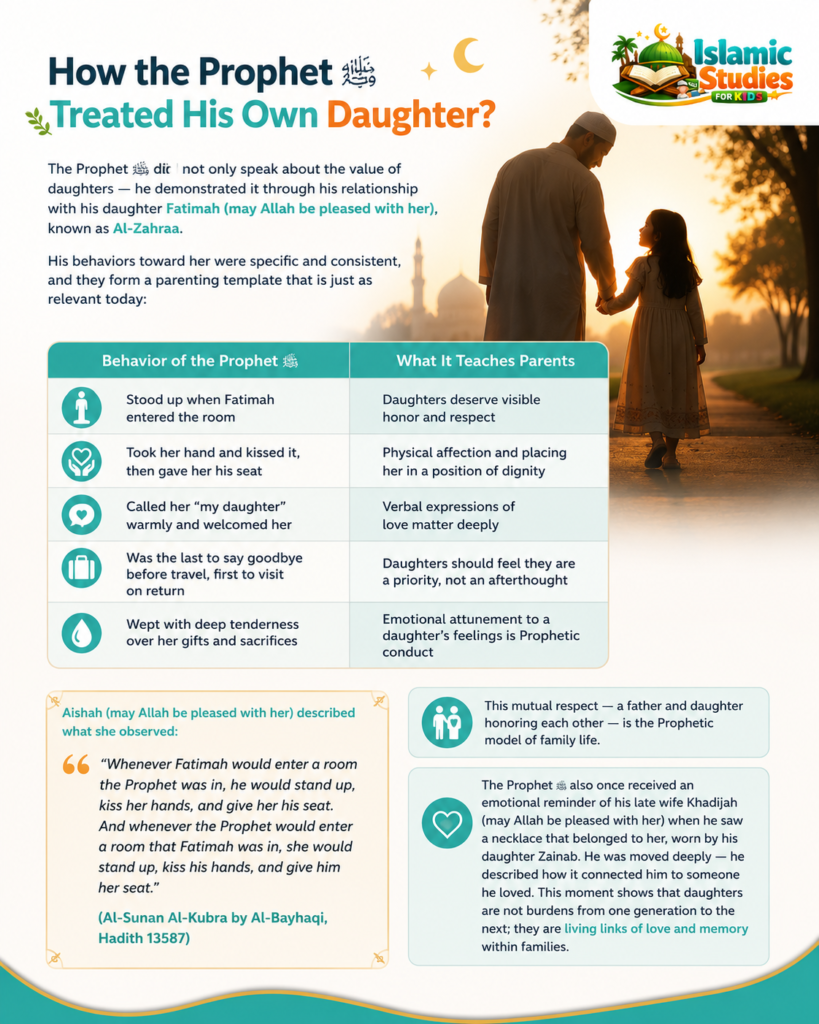
His behaviors toward her were specific and consistent, and they form a parenting template that is just as relevant today:
| Behavior of the Prophet ﷺ | What It Teaches Parents |
| Stood up when Fatimah entered the room | Daughters deserve visible honor and respect |
| Took her hand and kissed it, then gave her his seat | Physical affection and placing her in a position of dignity |
| Called her “my daughter” warmly and welcomed her | Verbal expressions of love matter deeply |
| Was the last to say goodbye before travel, first to visit on return | Daughters should feel they are a priority, not an afterthought |
| Wept with deep tenderness over her gifts and sacrifices | Emotional attunement to a daughter’s feelings is Prophetic conduct |
Aishah (may Allah be pleased with her) described what she observed:
“Whenever Fatimah would enter a room the Prophet was in, he would stand up, kiss her hands, and give her his seat. And whenever the Prophet would enter a room that Fatimah was in, she would stand up, kiss his hands, and give him her seat.” (Al-Sunan Al-Kubra by Al-Bayhaqi, Hadith 13587)
This mutual respect — a father and daughter honoring each other — is the Prophetic model of family life.
The Prophet ﷺ also once received an emotional reminder of his late wife Khadijah (may Allah be pleased with her) when he saw a necklace that belonged to her, worn by his daughter Zainab. He was moved deeply — he described how it connected him to someone he loved. This moment shows that daughters are not burdens from one generation to the next; they are living links of love and memory within families.
Read also: What Does the Quran Say About Parents?
Experience a Real Classroom
Curious about how we teach? This video offers a glimpse into a real class, showcasing our interactive approach, qualified teachers, and child-friendly learning experience.
Fun & Engaging Islamic Classes for Kids
Start your child’s journey today with interactive lessons designed to make learning Islam loved and easy.
Get Your Child a Free TrialWhy Daughters Are a Blessing, Not a Burden?
Even in Muslim communities today, some families quietly feel disappointment at the birth of a daughter. The Prophet ﷺ was aware this feeling would persist — which is why he addressed it so directly and so repeatedly.
The key points worth internalizing as a parent or teaching to your children:
- Allah is the One who grants children. The Quran reminds us that Allah gives daughters to whom He wills and sons to whom He wills (Quran 42:49). No parent “earns” a son or a daughter — both are gifts from Allah.
- Daughters continued the Prophet’s own lineage. The Prophet ﷺ had no surviving sons. His entire family lineage — his grandchildren Al-Hasan and Al-Husain — came through his daughter Fatimah. If daughters were a lesser blessing, Allah would not have made them the continuation of His Prophet’s family.
- The Prophet called daughters “rawda” — flowers to be cherished. When one father was told his wife had given birth to a girl and his face changed in disappointment, the Prophet ﷺ said:
“الْأَرْضُ تُقِلُّهَا، وَالسَّمَاءُ تُظِلُّهَا، وَاللهُ يَرْزُقُهَا — وَهِيَ رَيْحَانَةٌ تَشَمُّهَا”
“The earth carries her, the sky shades her, and Allah provides for her — she is a rose for you to smell.” (Makarim al-Akhlaq, p. 219)
A rose. Not a liability. Not a challenge. A flower with fragrance — something you lean toward, not away from.
Looking for guided Islamic learning for your child that builds on these values from an early age? Islamic Studies for Kids offers structured, age-appropriate content that makes these lessons stick.
Practical Ways to Raise Daughters the Islamic Way
The hadiths don’t just promise rewards — they describe the actions that earn those rewards.
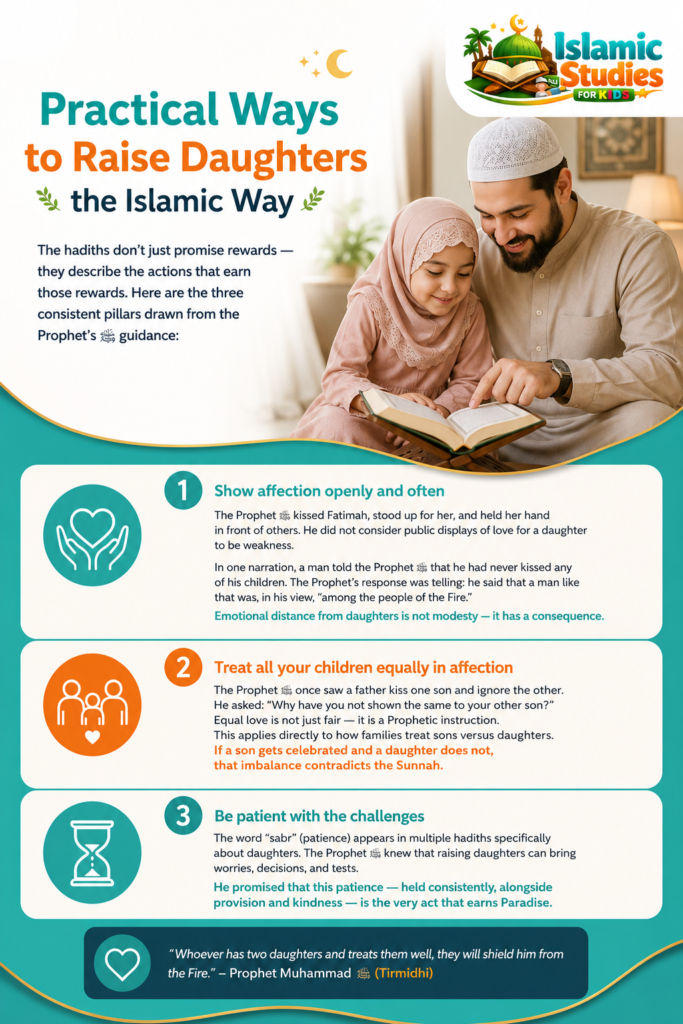
Here are the three consistent pillars drawn from the Prophet’s ﷺ guidance:
1. Show affection openly and often
The Prophet ﷺ kissed Fatimah, stood up for her, and held her hand in front of others. He did not consider public displays of love for a daughter to be weakness. In one narration, a man told the Prophet ﷺ that he had never kissed any of his children. The Prophet’s response was telling: he said that a man like that was, in his view, “among the people of the Fire.” Emotional distance from daughters is not modesty — it has a consequence.
2. Treat all your children equally in affection
The Prophet ﷺ once saw a father kiss one son and ignore the other. He asked: “Why have you not shown the same to your other son?” Equal love is not just fair — it is a Prophetic instruction. This applies directly to how families treat sons versus daughters. If a son gets celebrated and a daughter does not, that imbalance contradicts the Sunnah.
3. Be patient with the challenges
The word “sabr” (patience) appears in multiple hadiths specifically about daughters. The Prophet ﷺ knew that raising daughters can bring worries, decisions, and tests. He promised that this patience — held consistently, alongside provision and kindness — is the very act that earns Paradise.
Mistakes to Avoid When Raising Daughters
Even though Islam honors daughters, cultural habits sometimes contradict the teachings of the Quran and Sunnah.
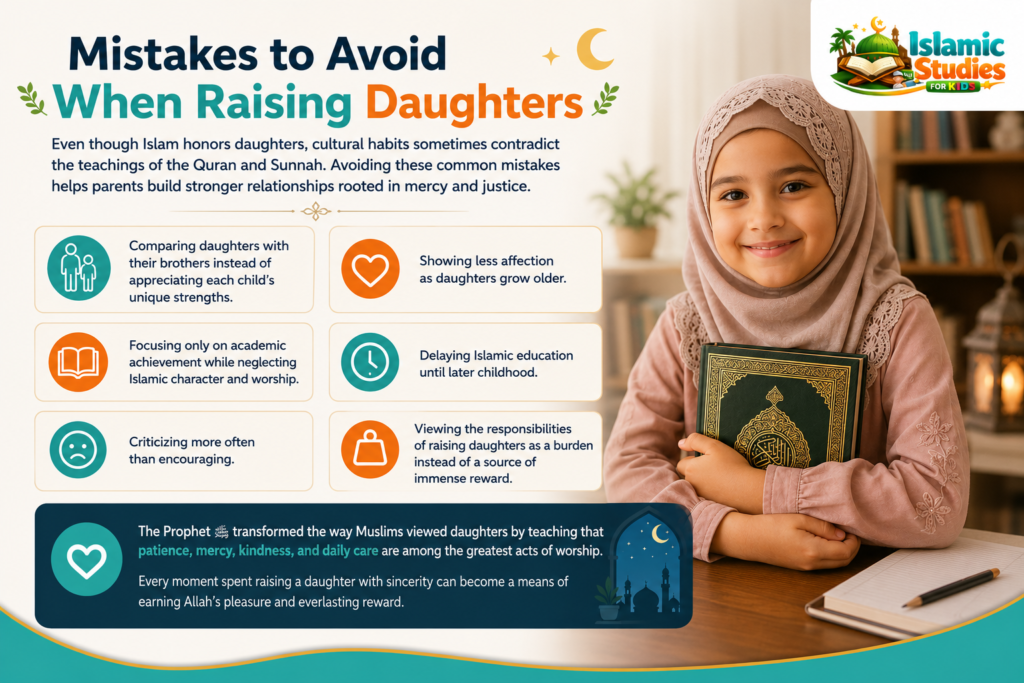
Avoiding these common mistakes helps parents build stronger relationships rooted in mercy and justice.
- Comparing daughters with their brothers instead of appreciating each child’s unique strengths.
- Showing less affection as daughters grow older.
- Focusing only on academic achievement while neglecting Islamic character and worship.
- Delaying Islamic education until later childhood.
- Criticizing more often than encouraging.
- Viewing the responsibilities of raising daughters as a burden instead of a source of immense reward.
The Prophet ﷺ transformed the way Muslims viewed daughters by teaching that patience, mercy, kindness, and daily care are among the greatest acts of worship. Every moment spent raising a daughter with sincerity can become a means of earning Allah’s pleasure and everlasting reward.
Read also: What Does Islam Say About Discipline of a Child?
Watch a Sample Lesson from Our Academy
Get a firsthand look at how our students learn Islamic values, Quran, and essential knowledge through engaging and interactive online classes. See why families trust Islamic Studies for Kids Academy.
Start Your Child’s Islamic Journey Today
If these lessons have inspired you to help your child grow up with a deep love and understanding of Islam, the next step is making that learning consistent and engaging.
At Islamic Studies for Kids, we offer structured Islamic education for children and support for mothers who want to raise children grounded in the Quran and Sunnah.
[Book your child’s free trial lesson today →]

Our Islamic Studies Courses Include:
- Islamic Studies for Kids
- Islam Basics for Kids (Beginners)
- 5 Pillars of Islam for Kids
- 6 Pillars of Iman (Faith) for Kids
- Salah (Prayer) for Kids
- Wudu for Kids
- Dua for Kids
- Ramadan for Kids
- Zakat & Sadaqah for Kids
- Hajj for Kids
- Aqeedah (Islamic Belief) for Kids
- Islamic Manners & Akhlaq for Kids
- Good Deeds for Kids
- Cleanliness (Taharah) in Islam for Kids
- Angels in Islam for Kids
- Islamic History for Kids
- Seerah (Prophet’s Life) for Kids
- Prophets Stories for Kids
- Islamic Stories & Morals for Kids
- Fiqh for Kids (Islamic Jurisprudence Basics)
- Hadith for Kids
- Quran Tafseer Course for Kids
- Islamic Holidays & Events for Kids
- Islamic Identity for Kids
- Intensive Islamic Course for Kids
Enroll today and give your child the knowledge, values, and confidence to grow as a practicing Muslim with a strong connection to Allah and His teachings.
Fun & Engaging Islamic Classes for Kids
Start your child’s journey today with interactive lessons designed to make learning Islam loved and easy.
Get Your Child a Free TrialConclusion
The blessings of daughters in Islam are not symbolic or vague — they are specific, documented, and extraordinary. From the Quran’s condemnation of those who resented daughters, to the hadiths promising Paradise, protection from Hellfire, and closeness to the Prophet ﷺ himself, the Islamic position on daughters is one of the most beautiful and countercultural teachings in religious history.
The Prophet ﷺ modeled it in his own home: standing for Fatimah, kissing her hand, weeping out of love for her. He called daughters “flowers to smell,” not burdens to bear.
If you have a daughter — or you are raising one — you are already holding a key to Jannah in your hands. The work is patience, affection, and daily care. The reward is promised by Allah’s own Prophet ﷺ.
Frequently Asked Questions
What does the Quran say about daughters?
The Quran in Surah An-Nahl (16:58–59) directly condemns the pre-Islamic practice of resenting daughters and burying them alive, calling it evil judgment. The Quran also reminds believers that it is Allah alone who grants children — sons or daughters — and that both are blessings to be received with gratitude.
What is the hadith about 3 daughters in Islam?
The “3 daughters hadith” is reported by Jabir ibn Abdullah (may Allah be pleased with him). The Prophet ﷺ said that whoever has three daughters, accommodates them, shows mercy to them, and supports them is guaranteed Paradise. When asked about two daughters, the Prophet confirmed the same reward applies. Scholars hold that even one daughter carries this promise for a parent who raises her with love and care.
What are the virtues of having daughters in Islam?
The virtues include: protection from Hellfire (Sahih Muslim 2629), a guaranteed place in Paradise (authenticated by Al-Albani), and standing beside the Prophet ﷺ on the Day of Judgment like two fingers side by side (Sahih Muslim). These rewards apply to parents who provide, show mercy, and are patient with their daughters.
Is it haram to feel sad about having a daughter?
While feelings themselves are not sinful, expressing sadness or treating a daughter as less valuable than a son contradicts the clear guidance of the Prophet ﷺ. He rebuked those who changed their demeanor upon hearing of a daughter’s birth and encouraged parents to celebrate and be grateful.
Did the Prophet Muhammad ﷺ have daughters?
Yes. The Prophet ﷺ had four daughters: Zainab, Ruqayyah, Umm Kulthum, and Fatimah (رضي الله عنهن). His lineage continued through Fatimah, whose sons Al-Hasan and Al-Husain are the grandchildren of the Prophet ﷺ. The continuation of his family through a daughter is itself one of the clearest signs of the honor Islam grants to daughters.
How should Muslim parents celebrate the birth of a daughter?
Islamic scholars recommend expressing joy, offering congratulations to the family, making du’a for the newborn, and performing the aqiqah. The Prophet ﷺ himself expressed happiness at the birth of his daughter Fatimah and called her “Rayhana” — a fragrant flower — signaling that celebration is the Sunnah response.


Leave a Reply