 Stories
Have you ever wondered why Islam places honoring parents right next to worshipping Allah? The answer is written clearly in the Quran — and it is one of the most important lessons a Muslim child can learn early in life.
What does the Quran say about parents? In short: it commands kindness, gentle speech, gratitude, and obedience in all good matters — and it repeats this message 7 times across different surahs, each time teaching us something deeper.
This guide walks parents and children through the key Quran verses about parents in clear, simple language — with the full Arabic text (with diacritics), English meaning, and surah references — so you can read them together, understand them, and live by them.
What You’ll Learn in This Article
- How many times the Quran mentions honoring parents — and why it matters
- The most important Quran verses about parents, with Arabic and English
- What “do not say uff to your parents” actually means for children today
- How the prophets modeled birr al-walidayn for us in the Quran
- A short dua your child can memorize from the Quran right now
What Does the Quran Say About Parents?
The Quran’s message about parents is not a suggestion — it is a divine decree, and Allah placed it directly beside the command to worship Him alone. This ranking is deliberate and powerful.
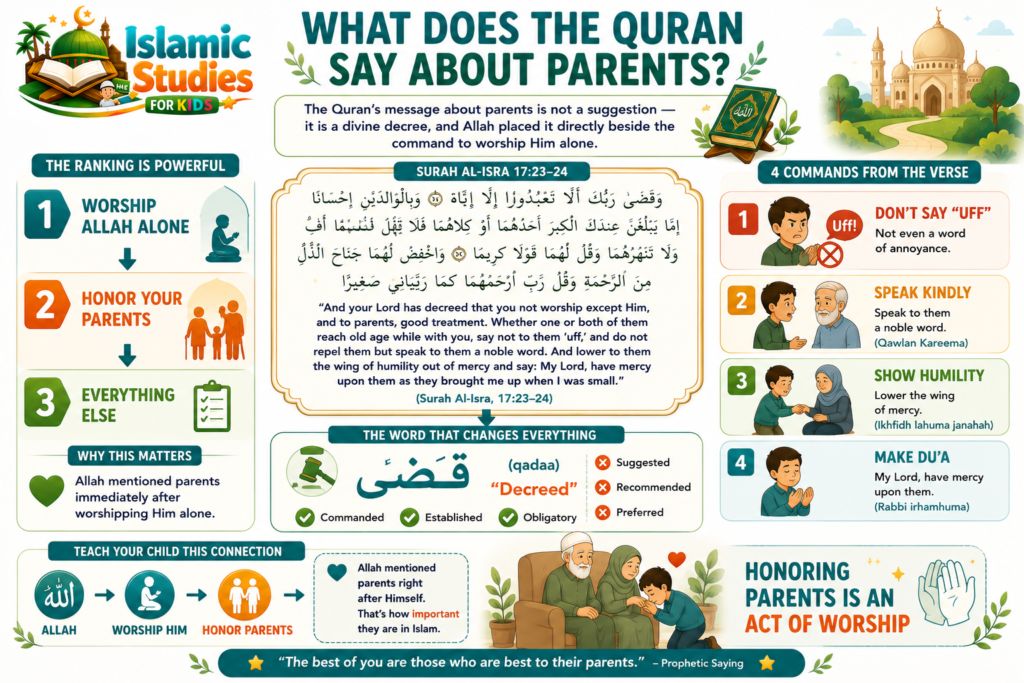
The clearest and most comprehensive Quran verse about parents appears in Surah Al-Isra:
وَقَضَىٰ رَبُّكَ أَلَّا تَعْبُدُوٓا۟ إِلَّآ إِيَّاهُ وَبِالْوَٰلِدَيْنِ إِحْسَٰنًا ۚ إِمَّا يَبْلُغَنَّ عِندَكَ ٱلْكِبَرَ أَحَدُهُمَآ أَوْ كِلَاهُمَا فَلَا تَقُل لَّهُمَآ أُفٍّ وَلَا تَنْهَرْهُمَا وَقُل لَّهُمَا قَوْلًا كَرِيمًا ❋ وَٱخْفِضْ لَهُمَا جَنَاحَ ٱلذُّلِّ مِنَ ٱلرَّحْمَةِ وَقُل رَّبِّ ٱرْحَمْهُمَا كَمَا رَبَّيَانِى صَغِيرًا
“And your Lord has decreed that you not worship except Him, and to parents, good treatment. Whether one or both of them reach old age while with you, say not to them ‘uff,’ and do not repel them but speak to them a noble word. And lower to them the wing of humility out of mercy and say: My Lord, have mercy upon them as they brought me up when I was small.”
— (Surah Al-Isra, 17:23–24)
Notice that Allah uses the word قَضَىٰ (qadaa) — “decreed” — which carries the weight of a firm ruling, not a recommendation. Honoring parents is placed at the same level of seriousness as worshipping Allah alone.
When you teach this verse to your child, point out this connection: “Allah mentioned parents right after Himself. That’s how important they are in Islam.”
How Many Times Does the Quran Mention Honoring Parents?
The Quran addresses birr al-walidayn — kindness and dutifulness to parents — 7 times, spread across 7 different surahs. Four of those occurrences use the exact phrase “وَبِالْوَالِدَيْنِ إِحْسَانًا” paired directly with the command to worship Allah alone.
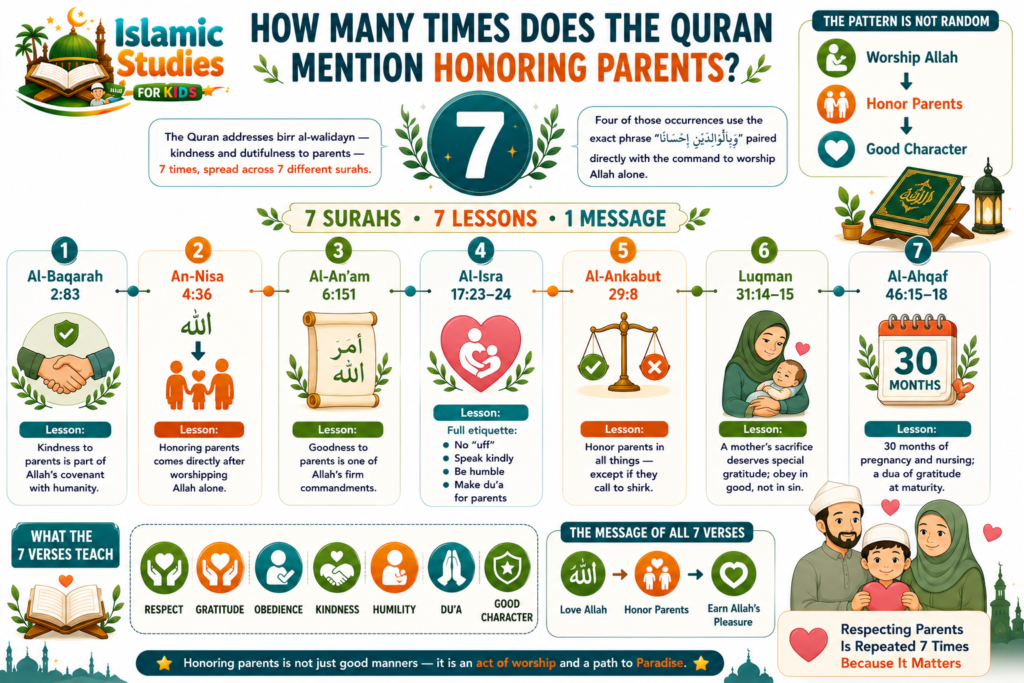
The repetition across 7 surahs is itself a lesson for children: this is not a minor point in Islam. It is a core pillar of Muslim character. Here is a clear overview of every occurrence:
| Surah & Verse | Key Teaching |
| Al-Baqarah 2:83 | Kindness to parents is part of Allah’s covenant with humanity |
| An-Nisa 4:36 | Honoring parents comes directly after worshipping Allah alone |
| Al-An’am 6:151 | Goodness to parents is one of Allah’s firm commandments |
| Al-Isra 17:23–24 | Full etiquette: no “uff,” gentle speech, humility, dua for parents |
| Al-Ankabut 29:8 | Honor parents in all things — except if they call to shirk |
| Luqman 31:14–15 | A mother’s sacrifice deserves special gratitude; obey in good, not in sin |
| Al-Ahqaf 46:15–18 | 30 months of pregnancy and nursing; a dua of gratitude at maturity |
The Quran Verse That Forbids Saying “Uff” to Parents
“Uff” (أُفٍّ) is the Arabic word for the smallest sound of annoyance or impatience — the equivalent of sighing heavily, rolling your eyes, or muttering “ugh” when asked to do something. Most people assume the Quran’s commands about parents refer to big acts of disobedience. This verse corrects that assumption immediately.
Allah chose to prohibit the minimum — which means everything above it is even more serious:
فَلَا تَقُل لَّهُمَآ أُفٍّ وَلَا تَنْهَرْهُمَا وَقُل لَّهُمَا قَوْلًا كَرِيمًا
“Say not to them ‘uff,’ and do not repel them, but speak to them a noble word.”
— (Surah Al-Isra, 17:23)
If the Quran prohibits the tiniest sign of disrespect, everything greater — raising your voice, arguing back rudely, ignoring a parent’s call — is far more serious in the sight of Allah. For children, this verse is easy to relate to. Ask your child: “Have you ever sighed when Mum asked you to stop your game? That sigh is exactly what the Quran is talking about — and Allah is asking us to do better.” This practical framing helps children connect an ancient Quranic command to their real daily moments.
Quran Verses About Respecting Parents — What Each One Teaches
Each of the 7 Quran verses about parents adds something specific. Here are the most important ones explained simply for children and mothers:
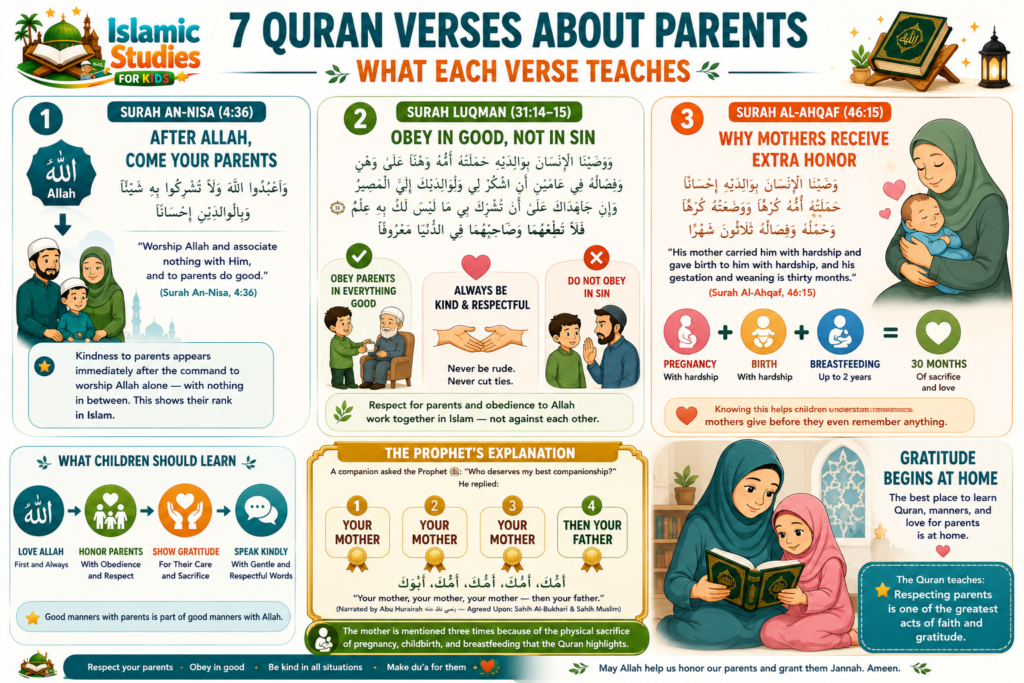
Surah An-Nisa (4:36) — After Allah, Come Your Parents
وَٱعْبُدُوا۟ ٱللَّهَ وَلَا تُشْرِكُوا۟ بِهِۦ شَيْـًٔا ۖ وَبِٱلْوَٰلِدَيْنِ إِحْسَٰنًا
“Worship Allah and associate nothing with Him, and to parents do good.”
— (Surah An-Nisa, 4:36)
Kindness to parents appears immediately after the command to worship Allah alone — with nothing in between. This verse is a powerful tool to help children understand the rank of their parents in Islam.
Surah Luqman (31:14–15) — Obey in Good, Not in Sin
وَوَصَّيْنَا ٱلْإِنسَٰنَ بِوَٰلِدَيْهِ حَمَلَتْهُ أُمُّهُۥ وَهْنًا عَلَىٰ وَهْنٍ وَفِصَٰلُهُۥ فِى عَامَيْنِ أَنِ ٱشْكُرْ لِى وَلِوَٰلِدَيْكَ إِلَىَّ ٱلْمَصِيرُ ❋ وَإِن جَٰهَدَاكَ عَلَىٰٓ أَن تُشْرِكَ بِى مَا لَيْسَ لَكَ بِهِۦ عِلْمٌ فَلَا تُطِعْهُمَا وَصَاحِبْهُمَا فِى ٱلدُّنْيَا مَعْرُوفًا
“And We have enjoined upon man care for his parents. His mother carried him, weakness upon weakness, and his weaning is in two years. Be grateful to Me and to your parents; to Me is the final destination. But if they endeavor to make you associate with Me that of which you have no knowledge, do not obey them, but accompany them in this world with appropriate kindness.”
— (Surah Luqman, 31:14–15)
This verse gives children a clear rule: obey and honor in everything good. In sin, do not obey — but never be rude, and never cut ties. Treat them with kindness regardless. Respect for parents and obedience to Allah are not opposites in Islam — they work together.
Surah Al-Ahqaf (46:15) — Why Mothers Deserve Extra Honor
وَوَصَّيْنَا ٱلْإِنسَٰنَ بِوَٰلِدَيْهِ إِحْسَٰنًا ۖ حَمَلَتْهُ أُمُّهُۥ كُرْهًا وَوَضَعَتْهُ كُرْهًا ۖ وَحَمْلُهُۥ وَفِصَٰلُهُۥ ثَلَٰثُونَ شَهْرًا
“And We have enjoined upon man goodness to his parents. His mother carried him with hardship and gave birth to him with hardship, and his gestation and weaning is thirty months.”
— (Surah Al-Ahqaf, 46:15)
The Quran’s mention of thirty months — the combined period of pregnancy and nursing — helps children grasp how much a mother gives before they even remember anything. For a child, knowing this makes gratitude feel natural rather than forced.
The Prophet Muhammad ﷺ confirmed this emphasis when a companion asked who deserved his best companionship:
“أُمُّكَ، ثُمَّ أُمُّكَ، ثُمَّ أُمُّكَ، ثُمَّ أَبُوكَ”
“Your mother, then your mother, then your mother, then your father.”
— Narrated by Abu Hurairah (رضي الله عنه), recorded in Sahih al-Bukhari, 5971 and (Sahih Muslim, 2548)
The mother is named three times before the father — because of the physical sacrifice of pregnancy, childbirth, and breastfeeding that the Quran specifically highlights.
Mothers who want to deepen their own Quranic connection while modeling it for their children can explore the Hifz program at Islamic Studies for Kids Academy — a structured path to memorizing the Quran at home, at your own pace.
Read also: Quranic Verses on Child Upbringing Every Muslim Parent Needs to Know
Experience a Real Classroom
Curious about how we teach? This video offers a glimpse into a real class, showcasing our interactive approach, qualified teachers, and child-friendly learning experience.
Fun & Engaging Islamic Classes for Kids
Start your child’s journey today with interactive lessons designed to make learning Islam loved and easy.
Get Your Child a Free TrialQuran on Obeying Parents — The Prophets Show Us How
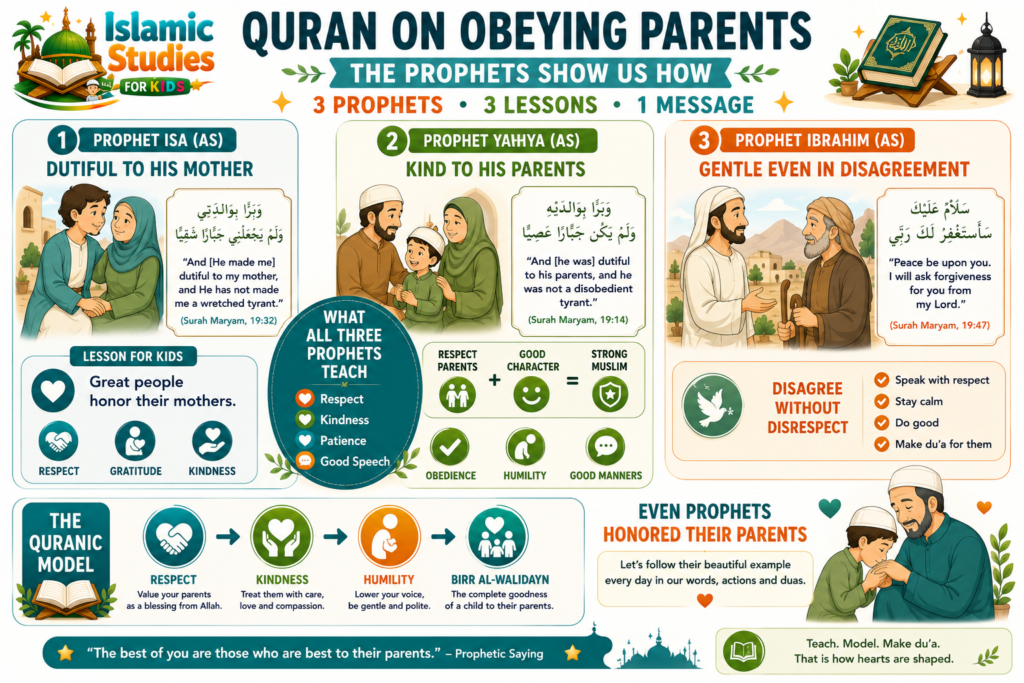
One of the most effective ways the Quran teaches birr al-walidayn is through the examples of prophets. These are not just historical stories — they are living models Allah placed in the Quran for every generation to follow.
Here are three prophet examples that work especially well for children:
Prophet Isa (AS) — dutiful to his mother
Allah quotes Prophet Isa (AS) in Surah Maryam describing himself:
وَبَرًّۢا بِوَٰلِدَتِى وَلَمْ يَجْعَلْنِى جَبَّارًا شَقِيًّا
“And [He made me] dutiful to my mother, and He has not made me a wretched tyrant.”
— (Surah Maryam, 19:32)
A prophet — one of the greatest men who ever lived — described himself as dutiful to his mother. For a child, this is a powerful model: even prophets honored their parents.
Prophet Yahya (AS) — praised by Allah for his birr
Allah praises Yahya (AS) in Surah Maryam with these words:
وَبَرًّۢا بِوَٰلِدَيْهِ وَلَمْ يَكُن جَبَّارًا عَصِيًّا
“And [he was] dutiful to his parents, and he was not a disobedient tyrant.”
— (Surah Maryam, 19:14)
Notice that being kind to parents is paired with not being arrogant or rebellious — the Quran teaches that birr al-walidayn and good character are inseparable.
Prophet Ibrahim (AS) — gentle even when his father was wrong
Even when Ibrahim’s (AS) father rejected the truth and threatened him, Ibrahim responded with nothing but calmness and love:
سَلَٰمٌ عَلَيْكَ ۖ سَأَسْتَغْفِرُ لَكَ رَبِّىٓ
“Peace be upon you. I will ask forgiveness for you from my Lord.”
— (Surah Maryam, 19:47)
This example teaches older children a vital lesson: you can disagree with a parent on a serious matter and still speak to them with total dignity and warmth.
A Dua Kids Can Memorize Straight from the Quran
One of the most beautiful gifts you can give your child is teaching them the Quran’s own dua for parents. It comes from Surah Al-Isra — the same passage that contains the “do not say uff” command:
رَّبِّ ٱرْحَمْهُمَا كَمَا رَبَّيَانِى صَغِيرًا
“My Lord, have mercy upon them as they brought me up when I was small.”
— (Surah Al-Isra, 17:24)
This dua is short enough for a five-year-old to memorize. Teach your child to say it after every salah. It builds two habits at once: the habit of making dua, and the habit of appreciating parents. Write it on a card and place it beside the prayer mat — memorization happens naturally when children see it daily.
Mothers who want to strengthen their own Tajweed while teaching their children to recite these verses beautifully can find expert guidance in the Tajweed course at Islamic Studies for Kids Academy.
Read also: What Does Islam Say About Discipline of a Child?
Watch a Sample Lesson from Our Academy
Get a firsthand look at how our students learn Islamic values, Quran, and essential knowledge through engaging and interactive online classes. See why families trust Islamic Studies for Kids Academy.
Give Your Child a Strong Islamic Foundation — Start with a Free Trial
Help Your Child Live the Quran’s Values, Not Just Memorize Them
Reading about what the Quran says about parents is a wonderful first step. But children who discuss these verses with a caring teacher, connect them to prophet stories, and revisit them week after week are the children who carry these values into adulthood.
Islamic Studies for Kids Academy offers structured Islamic studies classes designed for children aged 4–15, with:
- Al-Azhar-graduate instructors with 12+ years teaching non-Arabic-speaking children
- Age-appropriate lessons connecting Quran verses to real-life situations children recognize
- Short, focused sessions (20–30 minutes) matched to children’s attention spans
- Prophet stories, duas, and Islamic values taught through interactive discussion — not dry lectures
- Flexible scheduling that fits your family routine
Your child’s first lesson is free. Book it today and see the difference structured, expert-guided Islamic education makes.
Book Your Child’s Free Trial Lesson →
Our Islamic Studies Courses for Kids:
- Quran for Kids
- Noorani Qaida for Kids
- Quran Recitation for Kids
- Tajweed for Kids
- Quran Memorization (Hifz) for Kids
- Quran for Toddlers
- Quranic Arabic for Kids
- Quran Stories for Kids
Fun & Engaging Islamic Classes for Kids
Start your child’s journey today with interactive lessons designed to make learning Islam loved and easy.
Get Your Child a Free TrialConclusion
The Quran addresses parents 7 times across its surahs — in Al-Baqarah, An-Nisa, Al-An’am, Al-Isra, Al-Ankabut, Luqman, and Al-Ahqaf. Each verse adds something specific: the prohibition of even the smallest word of annoyance, the command to speak only kindly, the special sacrifice of mothers across thirty months, and the example of prophets who showed us what birr looks like when it is tested.
What does the Quran say about parents? It says they deserve the best of our words, our patience, our service, and our dua — in their lifetime and after it. Teaching children these Quran verses early, through stories and daily practice, plants values that shape who they become as Muslims.
Start with one verse. One prophet story. One dua after salah. That is enough to begin.
Frequently Asked Questions
Parents and children often have questions about what the Quran says about honoring parents. Here are the most common ones — answered simply and clearly.
How many times does the Quran mention honoring parents?
The Quran mentions honoring parents (birr al-walidayn) 7 times, across Surah Al-Baqarah, An-Nisa, Al-An’am, Al-Isra, Al-Ankabut, Luqman, and Al-Ahqaf. Four of those occurrences use the exact phrase “وَبِالْوَالِدَيْنِ إِحْسَانًا” — paired directly with the command to worship Allah alone.
What is the most important Quran verse about parents?
Surah Al-Isra (17:23–24) is widely considered the most complete. It commands kindness (ihsan), forbids even the word “uff,” instructs noble speech, commands humility and mercy, and includes a dua for parents — all in just two verses.
What does “do not say uff to your parents” mean in the Quran?
“Uff” (أُفٍّ) is the smallest sound of irritation or impatience — a sigh, a grunt, or a dismissive mutter. The Quran in Surah Al-Isra (17:23) forbids even this minimum level of disrespect. For children today, this means no eye-rolling, no heavy sighing, and no muttered complaints when a parent gives an instruction.
Does the Quran say mothers deserve more respect than fathers?
The Quran gives mothers special emphasis because of the physical sacrifices of pregnancy, childbirth, and breastfeeding — described in Surah Luqman (31:14) and Surah Al-Ahqaf (46:15). The Prophet ﷺ confirmed this by naming the mother three times before the father when asked who deserves the most kindness. Both parents are honored in Islam; the mother’s right is given extra emphasis.
Can a child be kind to parents even if the parents ask something wrong?
Yes. Surah Luqman (31:15) addresses this directly: if parents call to something that goes against Allah’s command, do not obey in that specific thing — but continue to treat them with kindness and maintain the relationship with goodness. Respect for parents and obedience to Allah work together in Islam; one does not cancel the other.
Is there a Quran dua children can say for their parents?
Yes. The dua from Surah Al-Isra (17:24) is: “رَّبِّ ٱرْحَمْهُمَا كَمَا رَبَّيَانِى صَغِيرًا” — “My Lord, have mercy upon them as they brought me up when I was small.” Children as young as five can memorize it. Teaching them to say it after every salah builds both the dua habit and genuine gratitude toward parents at the same time.


Leave a Reply