 For Parents

Your child pushes back every time Quran lesson starts, and you’re left wondering if you’re doing something wrong by insisting anyway. This question — is it haram to force your child to read Quran — sits at the center of a real tension many Muslim parents face: religious duty on one side, a child’s resistance on the other.
Many parents searching for how to motivate kids to read Quran without forcing them are really asking whether the two goals — consistency and enjoyment — can coexist at all.
The short answer from Islamic scholarship is reassuring. Requiring your child to learn and read the Quran is not haram. Classical scholars across the major madhabs treated it as a parental obligation, not an overreach, provided the method used is appropriate to the child.
This article walks through the scholarly basis for that ruling, how it compares to compelling children to pray, and how to apply it in a way that builds a lasting love for the Quran rather than resentment toward it.
What You’ll Learn in This Article
- Whether forcing a child to read or memorize Quran is haram, based on classical scholarly rulings
- The Quranic and hadith evidence parents rely on for this duty
- How compelling Quran learning compares to compelling children to pray
- A practical, graduated approach for parents whose child resists
- How to make Quran enjoyable for kids without abandoning consistency
Is It Haram to Force Your Child to Read Quran?
No, it is not haram to require your child to learn or read Quran. Classical Islamic scholarship treats raising children on beneficial religious knowledge as a parental duty, and requiring Quran learning falls squarely within that duty.
This isn’t a fringe opinion. Scholars from the Hanafi, Shafi’i, and Hanbali schools each addressed the question directly, and their conclusions align.
Parents in Western and mixed-culture households often assume that “forcing” a child toward anything religious must be a modern overreach. Classical fiqh treats it the opposite way: it is neglect, not enforcement, that scholars warn against.
1. What the Quran and Hadith Say About Parental Duty
The obligation traces back to Surah At-Tahrim (66:6): “O you who have believed, protect yourselves and your families from a Fire.” Scholars consistently cite this verse as the foundation for a parent’s duty to actively shape their children’s religious formation, not simply hope it happens on its own.

The Prophet ﷺ made the accountability explicit in the hadith recorded by Bukhari and Muslim: every person is a shepherd responsible for their flock, and a man is responsible for the people in his household.
A related hadith recorded by an-Nasa’i in as-Sunan al-Kubra and Ibn Hibban and authenticated by al-Albani, states that Allah will question every shepherd about whether they preserved or neglected what was entrusted to them — down to questioning a man about his household.

2. What Classical Scholars Ruled on Compelling Children to Learn Quran
Quran memorization is classified as fard kifayah — a communal obligation — while the portions needed for valid prayer are fard ‘ayn, an individual obligation on every Muslim. Mar’i ibn Yusuf al-Hanbali stated this distinction plainly in Dalil al-Talib.
Several jurists went further and addressed compulsion by name. Al-Hamawi, in Ghamz ‘Uyun al-Basa’ir, stated that a father may compel (yukrih) his young child to learn Quran, manners, and religious knowledge, because doing so is obligatory upon the parents. Ibn Nujaym’s al-Bahr al-Ra’iq and Ibn ‘Abidin’s Hashiyah record the same position.
Ibn Hajar al-Haytami, in Tuhfat al-Muhtaj, addressed a related debate about disciplining children over religious duties and concluded that because Quran memorization is fard kifayah rather than merely voluntary, it justifies enforcement even more clearly than acts scholars debated over.
Al-Buhuti, writing in the Hanbali school, advised that a father should start his son on Quran early specifically so the child grows accustomed to recitation and keeps it up.
Building a habit like this from the ground up is exactly what a structured Quran Recitation Course for Kids is designed to do — pairing consistent daily practice with a qualified teacher instead of leaving it to inconsistent effort at home.
Read Also:Benefits of Reading Quran for Kids
How Does Compelling Quran Learning Compare to Compelling Prayer?
Scholars frequently anchor the ruling on Quran education to the more familiar ruling on prayer, because the logic is identical: if compulsion is permitted for an individual obligation like prayer, it is at least as justified for a communal obligation like Quran learning.
This comparison matters because most parents already accept without question that they can require their child to pray.
Abu Dawud and Ahmad recorded the Prophet ﷺ saying: “Order your children to pray when they are seven, and strike them for it when they are ten” — a hadith authenticated by al-Albani. This establishes a clear, age-based escalation: instruction first, consequence only later, and only for an established obligation.
If graduated consequence is acceptable for prayer, a fard ‘ayn obligation, scholars reason that requiring Quran learning — which overlaps with prayer through the verses every Muslim must recite — carries at least equal legitimacy. The parallel isn’t a stretch; it’s the same parental accountability applied to two connected duties.
Understanding why certain verses matter more in daily prayer is also where a dedicated Fiqh Course for Kids helps — it gives children the reasoning behind requirements like prayer and Quran recitation, rather than just the rule itself.
Experience a Real Classroom
Curious about how we teach? This video offers a glimpse into a real class, showcasing our interactive approach, qualified teachers, and child-friendly learning experience.
Fun & Engaging Islamic Classes for Kids
Start your child’s journey today with interactive lessons designed to make learning Islam loved and easy.
Get Your Child a Free TrialHow Should Parents Approach This Without Causing Harm?
Having the right to require Quran learning doesn’t answer the practical question every parent actually faces: how do you do it without your child growing to resent it? Scholars offer a clear, step-by-step approach.
1. Start With the Lightest Method First
Scholars are consistent on sequencing: begin with encouragement, praise, and positive modeling before introducing any form of pressure or consequence.
Al-Khadimi’s Bariqa Mahmudiyya recommends praising well-behaved children in front of a resistant one before escalating further — motivating through comparison rather than confrontation. The method should also match the child: some respond to encouragement alone, others need firmer, consistent boundaries from the start.
2. Escalate Only When Needed
Adding structure — a fixed time, a fixed daily portion — often resolves resistance on its own before any consequence is necessary. Only when consistent structure genuinely fails to work should accountability increase, and even then it should rise gradually rather than jumping straight to strict enforcement.
3. Set Expectations Based on the Child’s Ability
Ibn Sahnun’s Adab al-‘Alim wal-Muta’allim notes that a child who struggles to learn should be taught at least what prayer requires, while a capable, quick-learning child should be taught the full Quran.
Scholarly permission to require Quran learning was never meant to apply the same expectation to every child regardless of ability — adjusting the goal, not the requirement itself, is one of the simplest ways of making Quran enjoyable for kids who might otherwise feel set up to fail.
Read Also: How to Teach Quran to a 6–7 Year Old?
4. Don’t Mistake a Child’s Dislike for Proof You’re Wrong
The worry that requiring Quran will cause permanent dislike is speculative, and scholars point out the same logic applies to prayer — yet the Prophet ﷺ still ordered enforcement for prayer at age ten. Given time, the same requirement can just as easily improve a child’s relationship with the Quran, once the routine settles and the satisfaction of visible progress sets in.
Read Also: At What Age Can Kids Fast In Ramadan?
5. Remove Yourself as the Source of Friction When Needed
The parent-child dynamic isn’t always the right setting for correction. A structured Tajweed Course for Kids removes the friction of a parent correcting their own child’s mistakes and replaces it with steady, non-personal feedback from a teacher — while the parent stays responsible for consistency and attendance rather than the correction itself.
Read Also:Information About Quran for Kids
When to Involve a Qualified Teacher Instead of You?
The parent-child dynamic isn’t always the right setting for academic correction — a child often accepts feedback from a teacher more easily than from a parent.
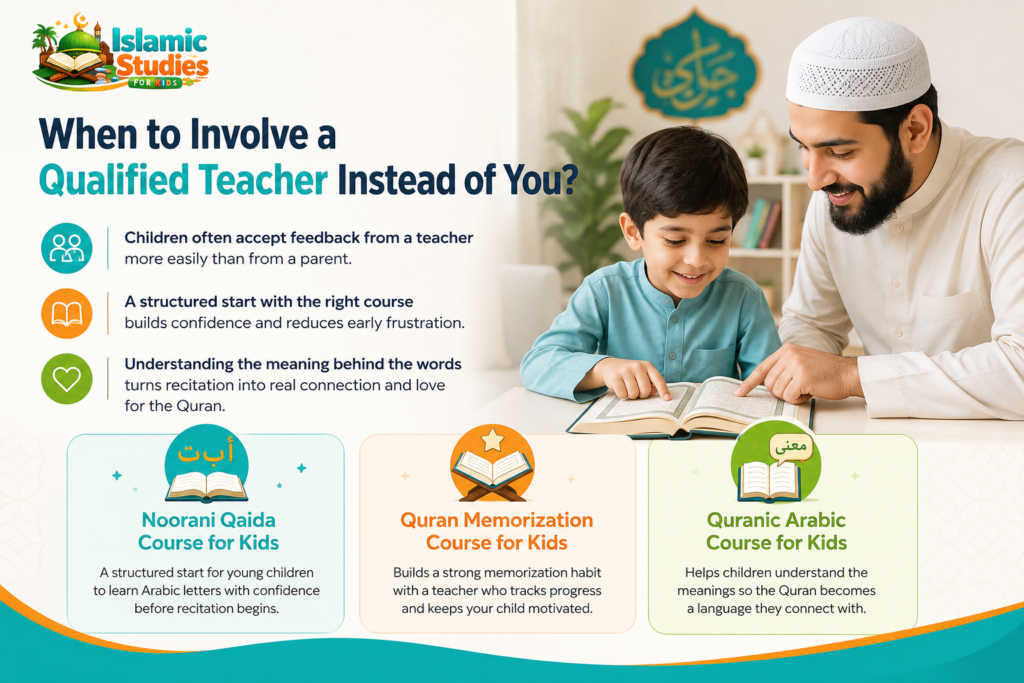
Beginning with the Noorani Qaida Course for Kids gives young children a structured entry point into Arabic letter recognition before recitation begins, which reduces early frustration considerably.
Once a child is reading confidently, a dedicated Quran Memorization Course for Kids keeps the habit consistent with a teacher tracking progress instead of a parent alone.
Understanding the meaning behind the words also reduces resistance — children engage more when Quran stops being sounds to repeat and becomes a language they understand, which is where a Quranic Arabic Course for Kids makes a real difference.
Read Also: What Age Should Kids Learn Arabic
Watch a Sample Lesson from Our Academy
Get a firsthand look at how our students learn Islamic values, Quran, and essential knowledge through engaging and interactive online classes. See why families trust Islamic Studies for Kids Academy.
Fun & Engaging Islamic Classes for Kids
Start your child’s journey today with interactive lessons designed to make learning Islam loved and easy.
Get Your Child a Free TrialStart Your Child’s Quran Journey Today
Requiring your child to learn the Quran is a right scholars affirm clearly — what determines whether it builds love or resistance is the structure and support around it.
Islamic Studies For Kids Academy pairs qualified instructors with age-appropriate methods, so your child experiences consistent progress instead of pressure alone.

Whichever stage your child is at, there’s a course built around them:
- Noorani Qaida Course for Kids: for children just starting to recognize Arabic letters and sounds
- Quran Recitation Course for Kids: for building confident, accurate reading
- Tajweed Course for Kids: for correcting recitation with steady, non-personal feedback from a teacher
- Quran Memorization Course for Kids: for turning consistent daily portions into lasting hifz
- Quranic Arabic Course for Kids: for children who need meaning, not just sound, to stay engaged

Conclusion
Is it haram to force your child to read the Quran? No, classical scholars across the Hanafi, Shafi’i, and Hanbali schools treat requiring Quran learning as a parental duty rooted in Surah At-Tahrim and the Prophet’s ﷺ teaching on responsibility for one’s household. The comparison to enforcing prayer at age ten only strengthens the case.
What separates helpful enforcement from harmful pressure is sequencing: start light, match the method to the child, and involve a qualified teacher when the parent-child dynamic creates friction. Handled this way, requiring Quran learning at Islamic Studies For Kids Academy becomes the foundation for a habit your child keeps for life, not a source of conflict at home.

Frequently Asked Questions
Parents asking whether it’s haram to require Quran learning usually have a handful of follow-up questions about age, method, and discipline. Here are direct answers to the most common ones.
1. Is it haram to force your child to read Quran?
No, it is not haram. Classical scholars across multiple madhabs affirm that requiring a child to learn and read Quran is part of a parent’s religious duty, comparable to requiring them to pray.
2. Can you force kids to learn Quran without harming their love for it?
Yes, when the method matches the child. Scholars recommend beginning with encouragement and positive modeling, escalating only if needed, and keeping Quran time separate from anger or conflict at home.
3. Should I force my child to memorize Quran if they resist?
Initial resistance is common and does not mean the requirement is wrong. Scholars note the same worry applies to enforcing prayer, yet enforcement is still commanded — the goal is graduated, proportionate consistency, not abandonment.
4. How do I motivate my child to read Quran without forcing them?
Small daily portions, visible milestone celebrations, and a qualified teacher who removes tension from the parent-child relationship all reduce the need for direct pressure while keeping the habit consistent.
5. At what age can I start requiring Quran lessons?
Many scholars and educators point to age seven — the same age specified for beginning prayer instruction — as appropriate for establishing consistent, structured Quran learning, with informal exposure starting even earlier.
6. Is disciplining a child for skipping Quran lessons allowed?
Scholars permit measured, age-appropriate consequences for consistent avoidance, similar to the prophetic guidance on prayer at age ten. Discipline must remain proportionate and aimed at building the habit, not punishment for its own sake.



Leave a Reply