 For Parents
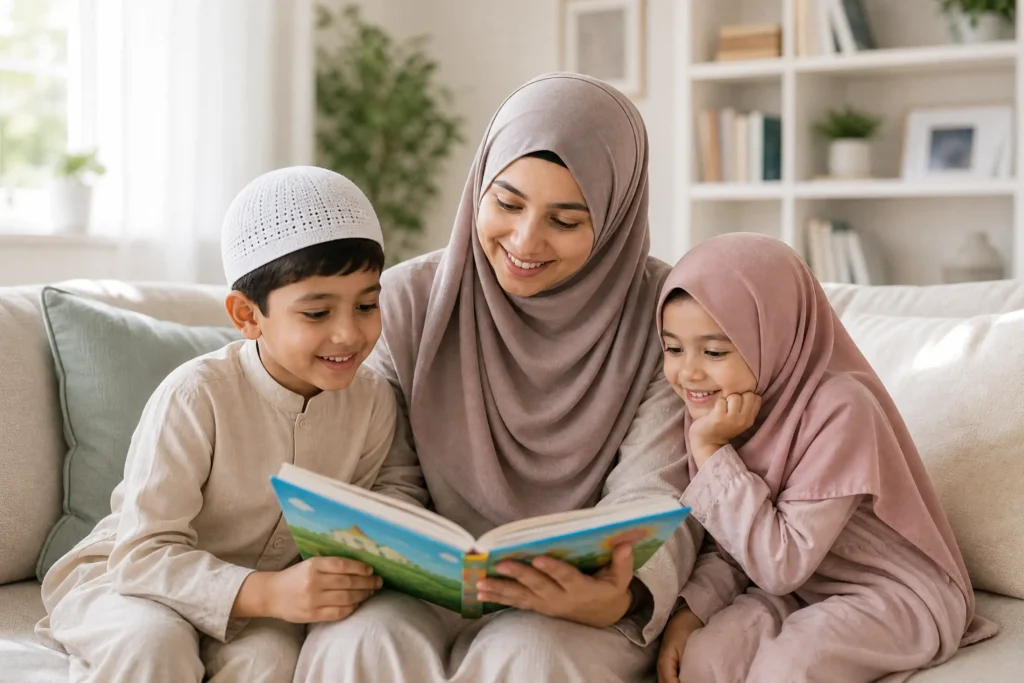
Every day, you recite words in Arabic. In Salah, in du’a, in the Quran — Arabic surrounds Muslim life from its very first moments. But for many Muslim mothers, those words remain sounds without meaning: a sacred language held at arm’s length.
The benefits of learning Arabic for Muslim mothers go far beyond personal enrichment. When a mother learns Arabic, her entire household shifts. Her children hear it at home. Her Salah deepens. Her relationship with the Quran transforms from recitation into genuine conversation with Allah ﷻ. And her role as her children’s first Islamic teacher — a role no one can replace — becomes something she can truly own.
This article explains why Arabic matters so much in Islam, what specifically changes for mothers who learn it, and how to get started regardless of your current level.
1. Arabic Is the Language Allah Chose for Revelation
Arabic is not simply the language Muslims happen to use. It is the language Allah ﷻ chose, deliberately, to reveal His final message.
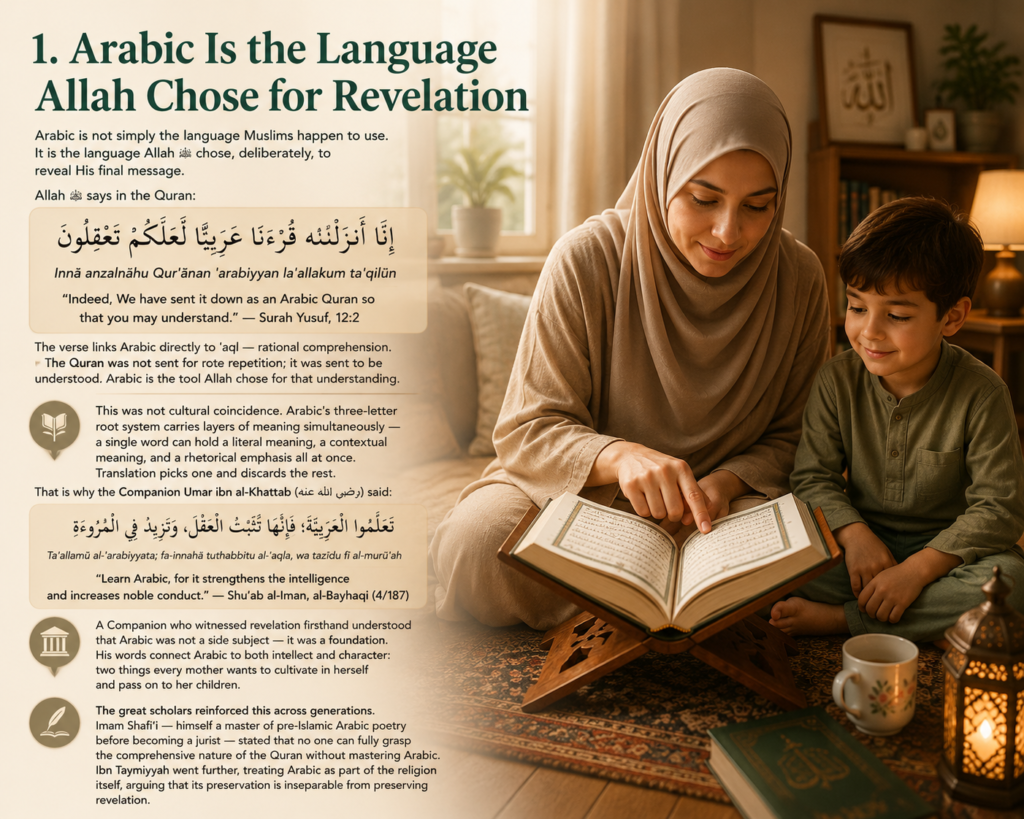
Allah ﷻ says in the Quran:
إِنَّآ أَنزَلْنَـٰهُ قُرْءَٰنًا عَرَبِيًّۭا لَّعَلَّكُمْ تَعْقِلُونَ
Innā anzalnāhu Qur’ānan ‘arabiyyan la’allakum ta’qilūn
“Indeed, We have sent it down as an Arabic Quran so that you may understand.” — Surah Yusuf, 12:2
The verse links Arabic directly to ‘aql — rational comprehension. The Quran was not sent for rote repetition; it was sent to be understood. Arabic is the tool Allah chose for that understanding.
This was not cultural coincidence. Arabic’s three-letter root system carries layers of meaning simultaneously — a single word can hold a literal meaning, a contextual meaning, and a rhetorical emphasis all at once. Translation picks one and discards the rest. That is why the Companion Umar ibn al-Khattab (رضي الله عنه) said:
تَعَلَّمُوا الْعَرَبِيَّةَ؛ فَإِنَّهَا تُثَبِّتُ الْعَقْلَ، وَتَزِيدُ فِي الْمُرُوءَةِ
Ta’allamū al-‘arabiyyata; fa-innahā tuthabbitu al-‘aqla, wa tazīdu fī al-murū’ah
“Learn Arabic, for it strengthens the intelligence and increases noble conduct.” — Shu’ab al-Iman, al-Bayhaqi (4/187)
A Companion who witnessed revelation firsthand understood that Arabic was not a side subject — it was a foundation. His words connect Arabic to both intellect and character: two things every mother wants to cultivate in herself and pass on to her children.
The great scholars reinforced this across generations. Imam Shafi’i — himself a master of pre-Islamic Arabic poetry before becoming a jurist — stated that no one can fully grasp the comprehensive nature of the Quran without mastering Arabic. Ibn Taymiyyah went further, treating Arabic as part of the religion itself, arguing that its preservation is inseparable from preserving revelation.
2. Arabic Learning in Islam Is an Obligation — at Every Level
Do you have to learn Arabic in Islam? The short answer is: some Arabic is obligatory for every Muslim, and more is highly recommended.
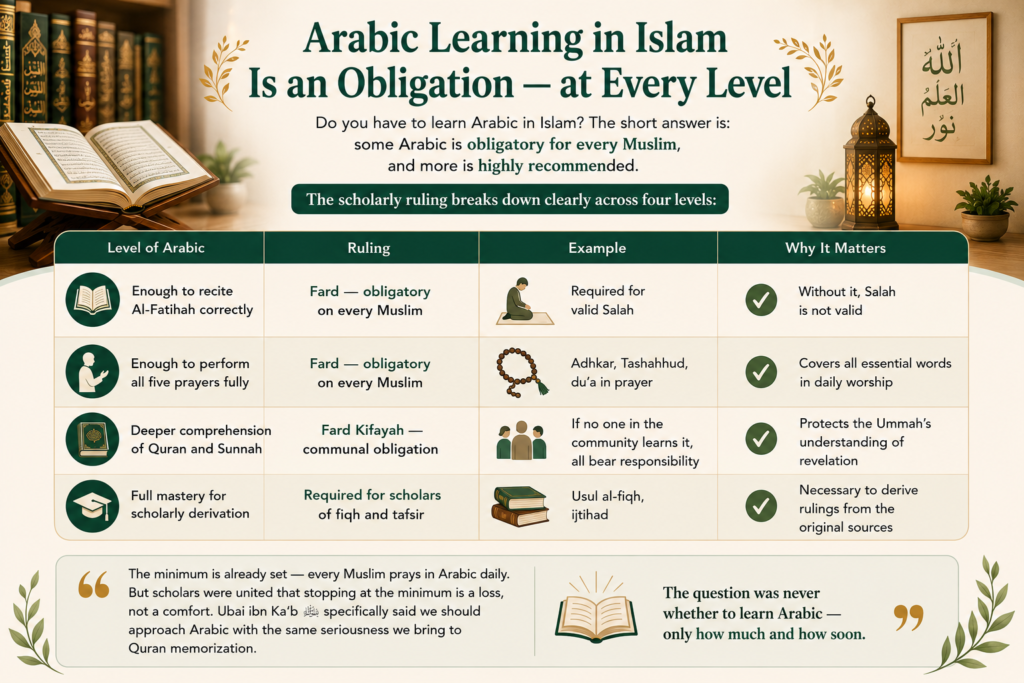
The scholarly ruling breaks down clearly across four levels:
| Level of Arabic | Ruling | Example |
| Enough to recite Al-Fatihah correctly | Fard — obligatory on every Muslim | Required for valid Salah |
| Enough to perform all five prayers fully | Fard — obligatory on every Muslim | Adhkar, Tashahhud, du’a in prayer |
| Deeper comprehension of Quran and Sunnah | Fard Kifayah — communal obligation | If no one in the community learns it, all bear responsibility |
| Full mastery for scholarly derivation | Required for scholars of fiqh and tafsir | Usul al-fiqh, ijtihad |
The minimum is already set — every Muslim prays in Arabic daily. But scholars were united that stopping at the minimum is a loss, not a comfort. Ubai ibn Ka’b specifically said we should approach Arabic with the same seriousness we bring to Quran memorization. The question was never whether to learn Arabic — only how much and how soon.
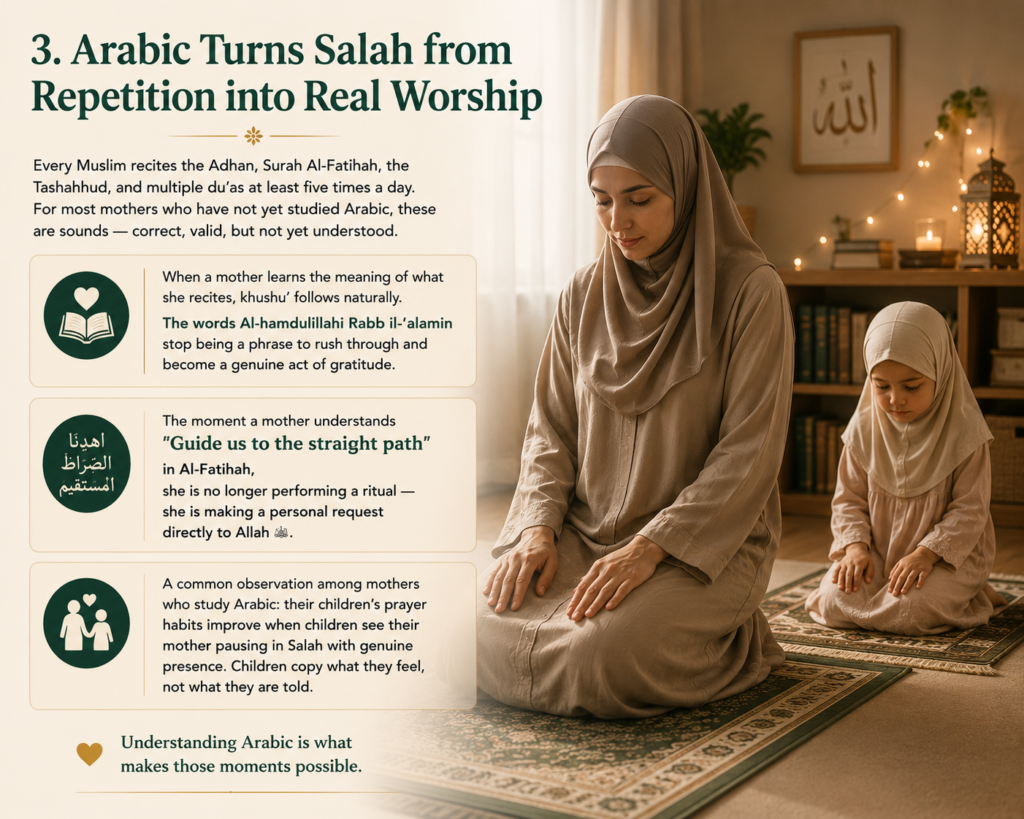
3. Arabic Turns Salah from Repetition into Real Worship
Every Muslim recites the Adhan, Surah Al-Fatihah, the Tashahhud, and multiple du’as at least five times a day. For most mothers who have not yet studied Arabic, these are sounds — correct, valid, but not yet understood.
When a mother learns the meaning of what she recites, khushu’ follows naturally. The words Al-hamdulillahi Rabb il-‘alamin stop being a phrase to rush through and become a genuine act of gratitude. The moment a mother understands “Guide us to the straight path” in Al-Fatihah, she is no longer performing a ritual — she is making a personal request directly to Allah ﷻ.
A common observation among mothers who study Arabic: their children’s prayer habits improve when children see their mother pausing in Salah with genuine presence. Children copy what they feel, not what they are told. Understanding Arabic is what makes those moments possible.
4. Arabic Gives Every Mother Direct Access to the Quran
Without Arabic, every verse passes through someone else’s understanding first. A translation is always one scholar’s reading of one possible interpretation. With Arabic, you can sit with a verse yourself, notice what Allah ﷻ actually said, and return to it at different moments in your life with fresh eyes.
Ramadan illustrates this most clearly. Allah ﷻ says:
شَهْرُ رَمَضَانَ ٱلَّذِىٓ أُنزِلَ فِيهِ ٱلْقُرْءَانُ هُدًۭى لِّلنَّاسِ وَبَيِّنَـٰتٍۢ مِّنَ ٱلْهُدَىٰ وَٱلْفُرْقَانِ
Shahru Ramaḍāna alladhī unzila fīhil-Qur’ānu hudal-linnāsi wa bayyinātin minal-hudā wal-furqān
“Ramadan is the month in which the Quran was revealed as guidance for mankind and as clear signs of guidance and the distinction between right and wrong.” — Surah Al-Baqarah, 2:185
The word furqan — criterion, distinction — carries a depth that English translations cannot fully hold. A mother who knows Arabic reads this verse differently every Ramadan as her understanding deepens.
If you want to begin reading the Quran with genuine comprehension, the Quran courses for mothers at islamicstudiesforkids.com are designed for every level of Arabic background.
Experience a Real Classroom
Curious about how we teach? This video offers a glimpse into a real class, showcasing our interactive approach, qualified teachers, and child-friendly learning experience.
Fun & Engaging Islamic Classes for Kids
Start your child’s journey today with interactive lessons designed to make learning Islam loved and easy.
Get Your Child a Free Trial5. A Mother Who Knows Arabic Becomes Her Children’s First Islamic Teacher
In the Islamic tradition, the mother is called al-madrasah al-ula — the first school. The scholars note that the quality of language a child absorbs at home sets their entire relationship with speech — and with faith — for life.
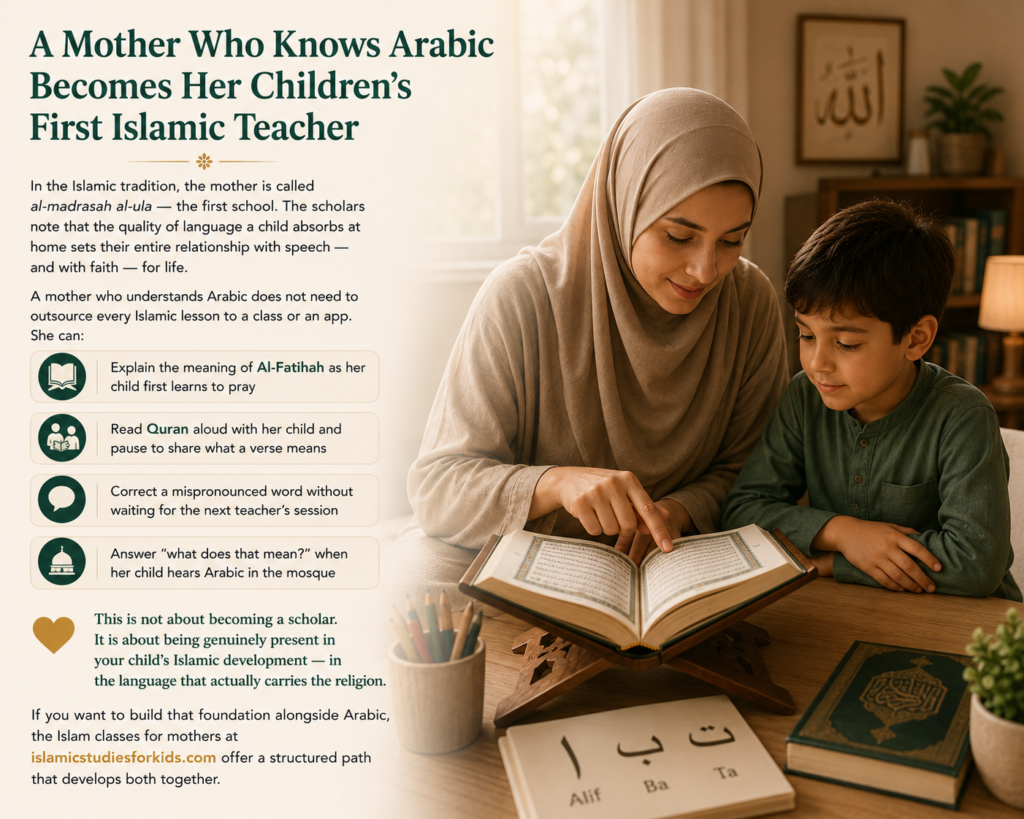
A mother who understands Arabic does not need to outsource every Islamic lesson to a class or an app. She can:
- Explain the meaning of Al-Fatihah as her child first learns to pray
- Read Quran aloud with her child and pause to share what a verse means
- Correct a mispronounced word without waiting for the next teacher’s session
- Answer “what does that mean?” when her child hears Arabic in the mosque
This is not about becoming a scholar. It is about being genuinely present in your child’s Islamic development — in the language that actually carries the religion. If you want to build that foundation alongside Arabic, the Islam classes for mothers at islamicstudiesforkids.com offer a structured path that develops both together.
Read also: How to Manage Islamic Home Learning? A Mother’s Complete Guide
6. Arabic Protects Muslim Families from Weak and Misleading Interpretations
This benefit almost never appears in articles about Arabic — yet it is one of the most practical for mothers raising children in the digital age. Arabic-illiterate Muslims are entirely dependent on whoever produces Islamic content in English, and that content ranges from excellent to deeply misleading.
A mother who knows Arabic can:
- Check a viral “translation” of a verse against what the Arabic actually says
- Recognize when a du’a circulating on social media is not from an authentic source
- Evaluate a speaker’s interpretation against the original text
- Read classical works like Ibn Kathir’s Tafsir, Riyad as-Salihin, and Imam al-Ghazali’s Ihya directly — most of which have never been fully translated
The ability to return to the source is a form of protection. In a time when anyone can post an “Islamic” video, that protection matters enormously for every family.
Read Also: How to Manage Islamic Home Learning?
7. Arabic Opens the Full Fourteen Centuries of Islamic Scholarship
The foundational works of Islam were written in Arabic. Sahih al-Bukhari. Imam an-Nawawi’s Riyad as-Salihin. Ibn Kathir’s Tafsir. Imam al-Shafi’i’s al-Risala. The works of Ibn Taymiyyah and Ibn al-Qayyim. Most exist in partial translations at best. The full library stays in Arabic.
Ibn Shubrumah, the hadith scholar, once said: “Men have never worn a garment more beautiful than Arabic.” (Al-Bayhaqi, Shu’ab al-Iman, Vol. 4, p. 197)
That beauty is not metaphorical. It is the beauty of having direct access to fourteen centuries of scholarship written by people who dedicated their lives to understanding and preserving the religion — entirely in Arabic.
Many of those scholars — Imam al-Bukhari, Sibawayh the founder of formal Arabic grammar, Ibn Sina — were not ethnically Arab. They mastered Arabic because the religion required it. That path remains open to every Muslim mother today.
Read Also: How to Learn Arabic as a Mother?
Where Every Muslim Mother Can Start — A Practical Framework
The question is not really whether to learn Arabic. The question is where to begin.
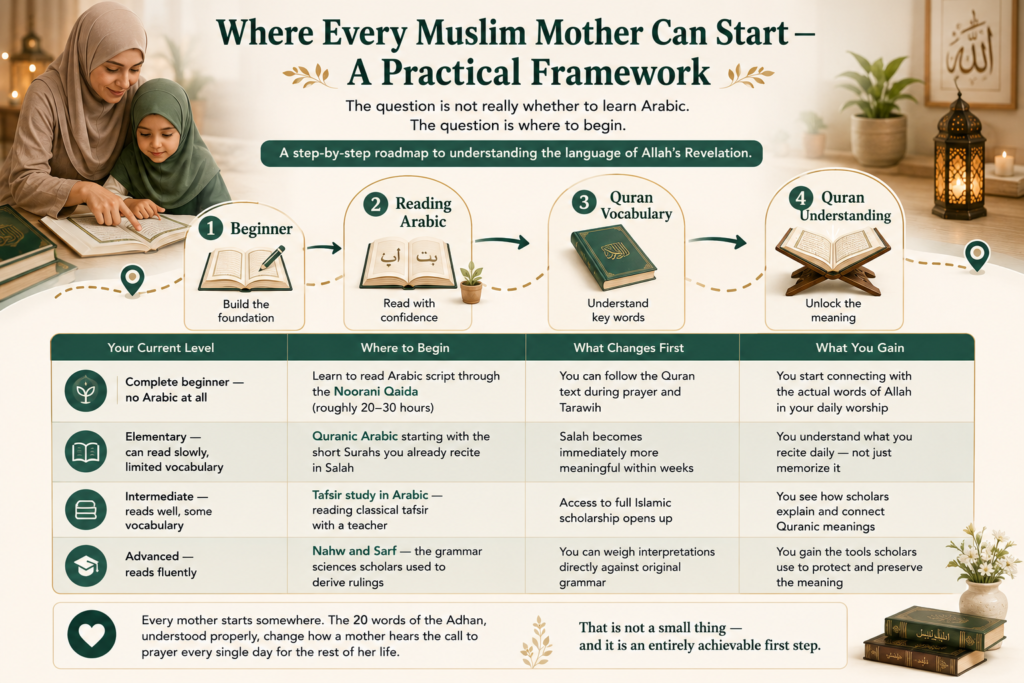
This framework matches your starting point to the most effective first step:
| Your Current Level | Where to Begin | What Changes First |
| Complete beginner — no Arabic at all | Learn to read Arabic script through the Noorani Qaida (roughly 20–30 hours) | You can follow the Quran text during prayer and Tarawih |
| Elementary — can read slowly, limited vocabulary | Quranic Arabic starting with the short Surahs you already recite in Salah | Salah becomes immediately more meaningful within weeks |
| Intermediate — reads well, some vocabulary | Tafsir study in Arabic — reading classical tafsir with a teacher | Access to full Islamic scholarship opens up |
| Advanced — reads fluently | Nahw and Sarf — the grammar sciences scholars used to derive rulings | You can weigh interpretations directly against original grammar |
Every mother starts somewhere. The 20 words of the Adhan, understood properly, change how a mother hears the call to prayer every single day for the rest of her life. That is not a small thing — and it is an entirely achievable first step.
Read Also: How a Mother Can Learn Quran Online?
Watch a Sample Lesson from Our Academy
Get a firsthand look at how our students learn Islamic values, Quran, and essential knowledge through engaging and interactive online classes. See why families trust Islamic Studies for Kids Academy.
Fun & Engaging Islamic Classes for Kids
Start your child’s journey today with interactive lessons designed to make learning Islam loved and easy.
Get Your Child a Free TrialBegin Your Arabic Journey — Your Children Are Watching
islamic studies for kids offers dedicated Arabic courses for mothers — structured around your schedule, designed for non-native speakers, and built to take you from wherever you are right now to genuine Quranic comprehension. You do not need prior knowledge. You just need to begin.
Your children will learn what they see at home. When they see their mother studying Arabic with sincerity, that becomes the example they carry for life.
Our Islamic Studies Courses Include:
- Islamic Studies for Kids
- Islam Basics for Kids (Beginners)
- 5 Pillars of Islam for Kids
- 6 Pillars of Iman (Faith) for Kids
- Salah (Prayer) for Kids
- Wudu for Kids
- Dua for Kids
- Ramadan for Kids
- Zakat & Sadaqah for Kids
- Hajj for Kids
- Aqeedah (Islamic Belief) for Kids
- Islamic Manners & Akhlaq for Kids
- Good Deeds for Kids
- Cleanliness (Taharah) in Islam for Kids
- Angels in Islam for Kids
- Islamic History for Kids
- Seerah (Prophet’s Life) for Kids
- Prophets Stories for Kids
- Islamic Stories & Morals for Kids
- Fiqh for Kids (Islamic Jurisprudence Basics)
- Hadith for Kids
- Quran Tafseer Course for Kids
- Islamic Holidays & Events for Kids
- Islamic Identity for Kids
- Intensive Islamic Course for Kids
Enroll today and give your child the knowledge, values, and confidence to grow as a practicing Muslim with a strong connection to Allah and His teachings.
Conclusion
The benefits of learning Arabic for Muslim mothers are both spiritual and deeply practical. Arabic connects you directly to the Quran as Allah revealed it, transforms Salah from recitation into real worship, and gives you the tools to be your children’s first Islamic educator in the language that carries the entire religion.
The importance of learning Arabic in Islam has been affirmed by the Companions, the classical scholars, and the Quran itself — not as an obligation limited to specialists, but as a living connection every Muslim is invited into. For mothers especially, that invitation carries particular weight: the language you bring into your home is the language your children grow up with.
You do not need to become a scholar to begin. Start with the Surahs you already know. Learn what they mean. Let that understanding settle — and then share it with the people who call you Mama.
Frequently Asked Questions
1. Is it too late for a mother to learn Arabic?
No. Thousands of Muslim mothers begin learning Arabic as adults with no previous experience. Starting with the Arabic alphabet, Noorani Qaida, and Quranic vocabulary allows steady progress. Consistency matters far more than age, and even 10–15 minutes of daily study can lead to meaningful improvement over time.
2. Should I learn Quranic Arabic or conversational Arabic first?
If your goal is to understand the Quran, improve Salah, and teach your children, Quranic Arabic is the best place to start. It focuses on the vocabulary and expressions you encounter daily in the Quran, du’as, and acts of worship.
3. How long does it take to understand the Quran in Arabic?
The timeline depends on your study schedule and goals. Most learners can begin understanding common Quranic words and short Surahs within a few months of consistent study. Achieving deeper comprehension takes longer, but every stage brings immediate benefits to worship.
4. Can I learn Arabic online while taking care of young children?
Yes. Many online Arabic programs are designed specifically for busy mothers. Flexible scheduling, short lessons, and recorded classes make it possible to study around naps, school hours, or after the children go to bed.
5. Do I need to memorize the Quran before learning Arabic?
No. In fact, learning Arabic often makes Quran memorization easier because you begin to understand the meanings of the verses you are memorizing. Comprehension strengthens retention and increases focus during recitation.
6. What is the best first step for a complete beginner?
The best starting point is learning to read Arabic correctly through the Noorani Qaida, then gradually building Quranic vocabulary from the short Surahs you already recite in Salah. This creates a practical foundation that connects reading, understanding, and worship.


Leave a Reply