 For Parents
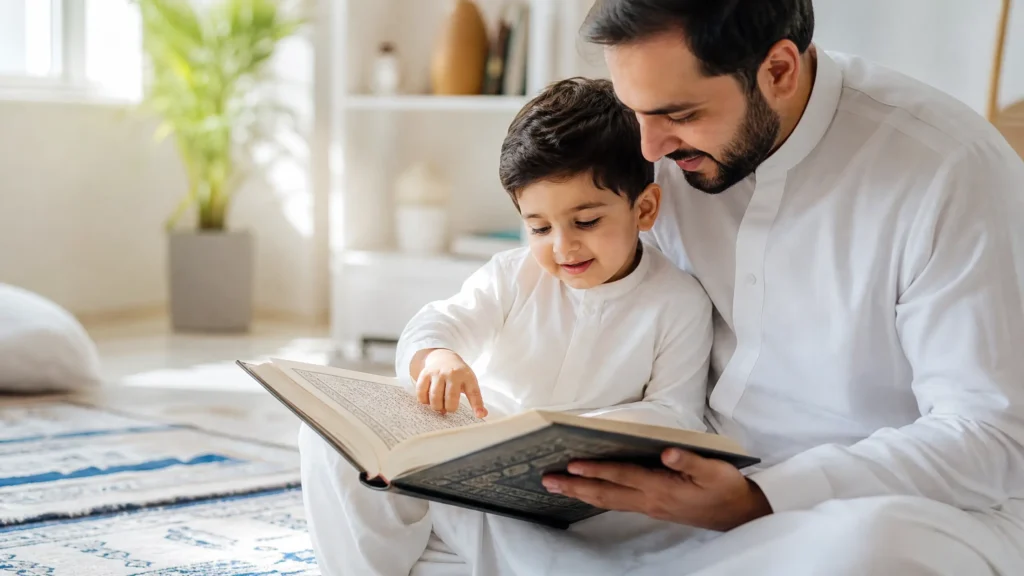
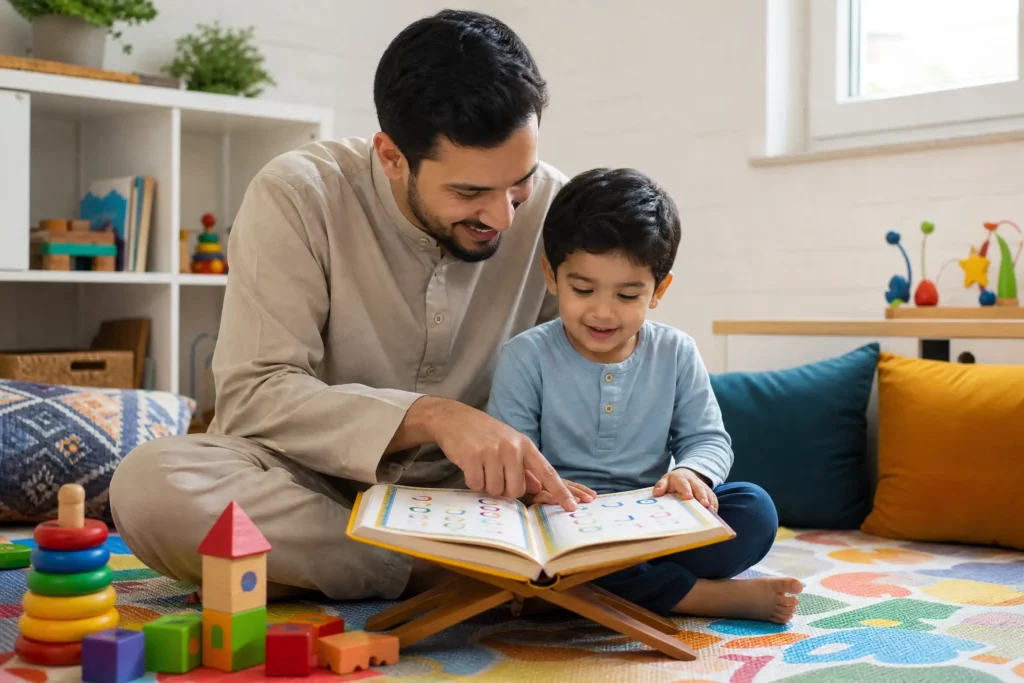
Many parents ask the same question at some point: when should children begin learning the Quran? Some worry that starting too early will overwhelm a young child. Others worry that waiting too long means missing the years when a child’s mind absorbs language and rhythm most easily.
The honest answer is that there is no single fixed age that works for every child. What matters more is understanding the stages a child moves through — from early listening, to letter recognition, to structured memorization — and matching your approach to where your child actually is, not just how old they are.
What You’ll Learn in This Article?
- The ideal age range for starting Quran learning, and why it isn’t one fixed number.
- What happens at each developmental stage, from infancy through age 10.
- The specific readiness signs to look for in your own child.
- Whether children can memorize Quran before they can read.
- The most common mistakes parents make when starting too fast or too slow.
- Practical ways to build a loving, low-pressure learning routine at home.
The Ideal Age to Start Quran Learning
Quran learning for kids works best when it is introduced in layers rather than all at once:
- Early listening can begin from infancy.
- Letter recognition and short surah memorization typically start between ages 3 and 6.
- Formal, structured Hifz (memorization) usually begins between ages 6 and 10.
This timeline reflects both the experience of skilled Quran teachers and established research on how children develop language, memory, and learning skills during early childhood.
Children between roughly 3 and 10 years old have high neuroplasticity — their brains form new memory pathways quickly, which is why they can pick up songs, rhymes, and new languages with far less effort than adults.
The Quran’s repetitive verse structure and rhythmic recitation style fit naturally into this window.
Why Age Alone Isn’t the Full Picture?
A child’s calendar age tells you very little about whether they’re ready to sit through a recitation session or repeat a verse accurately. Readiness depends on:
- Attention span.
- Ability to imitate sounds.
- Emotional comfort with the teacher or parent.
- Genuine curiosity about the Quran.
Two five-year-olds can be in completely different places: one may already be repeating Surah Al-Ikhlas after her mother, while another isn’t yet sitting still for more than two minutes, Both are normal.
The best age to start Quran for kids is really the age at which your specific child shows the readiness signs described in Section 4 of this guide.
The Stages of Quran Learning, Age by Age
Understanding the stages helps you know what to expect and prevents the common mistake of pushing a toddler into memorization drills meant for a seven-year-old.
Each stage below has its own guide for parents who want to go deeper into a specific window.
a. Ages 0 to 3 Building Listening and Familiarity
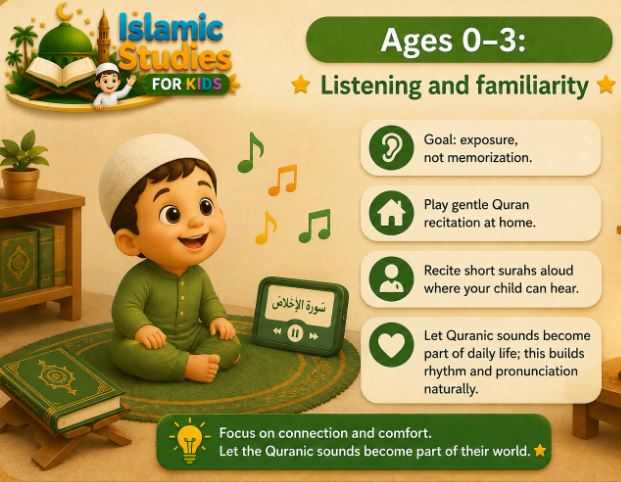
This stage isn’t about memorization at all — it’s about exposure. Building the right environment means:
- Playing Quran recitation softly at home.
- Reciting short surahs aloud in front of your child.
- Letting Quranic sounds become part of their everyday environment.
All three build the auditory foundation that makes later memorization faster. Many parents don’t realize that a child absorbs the rhythm and pronunciation of Arabic simply by being around it repeatedly, long before they can form the words themselves.
See How to Introduce Islam to a 2–3 Year Old for a practical guide to this stage.
b. Ages 3 to 6 Learning Letters Short Surahs and First Words
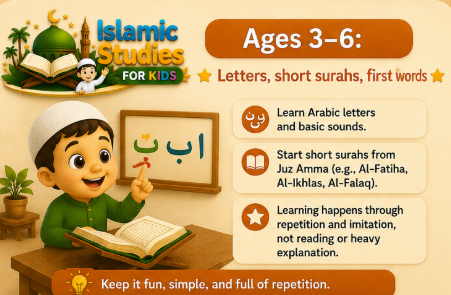
This is typically when children start learning:
- The Arabic alphabet and basic letter sounds.
- Their first short surahs — usually from Juz Amma, such as Al-Fatiha, Al-Ikhlas, and Al-Falaq.
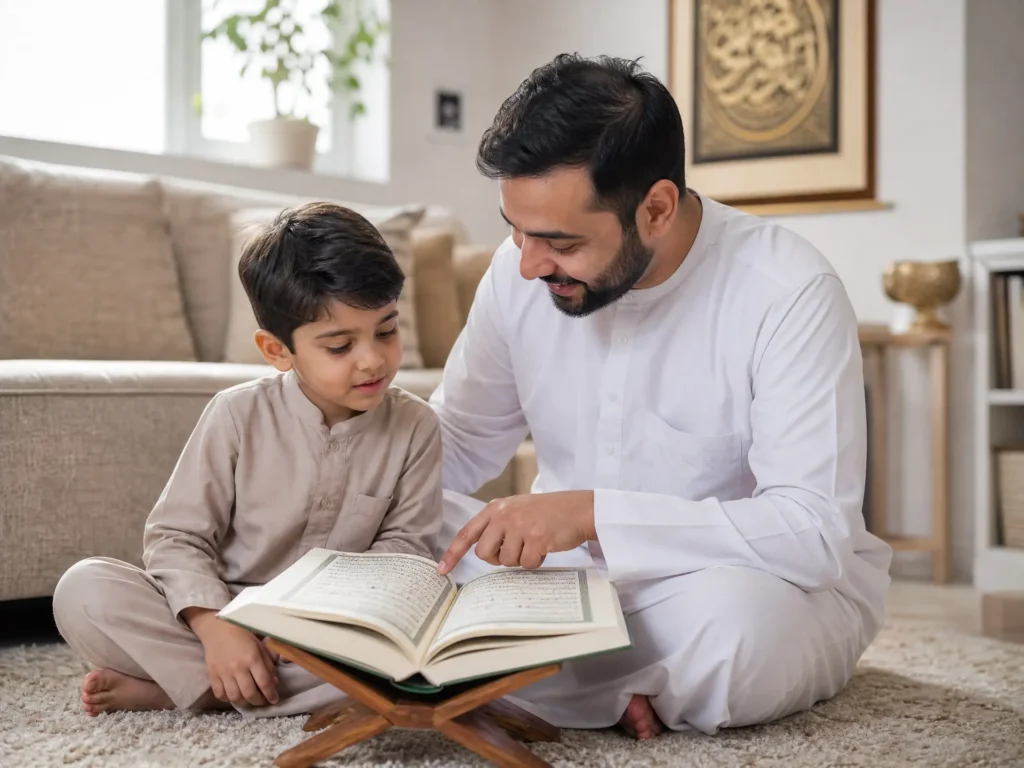
Repetition and imitation drive learning at this stage far more than explanation. A child at this age memorizes through hearing a verse repeated by a parent or teacher and echoing it back, not by reading it independently.
How to Teach Quran to a 4–5 Year Old walks through this stage in detail.
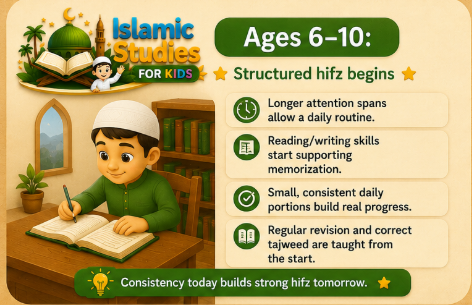
c. Ages 6 to 10 When Structured Hifz Begins
Most Quran teachers consider this the best time to learn Quran for children in a formal, structured way. At this stage:
- Attention spans are longer and children can follow a daily routine.
- School-age reading and writing skills start reinforcing memorization instead of competing with it.
- A small, consistent daily portion — often just a few lines — becomes the foundation of real progress.
- Regular revision is built in from the start, not added as an afterthought.
- Correct Tajweed is taught from the very beginning, since habits formed here tend to stick for life.
See How to Teach Quran to a 6–7 Year Old for the transition into structured sessions, and Juz Amma Memorization for Kids for the recommended memorization sequence at this stage.
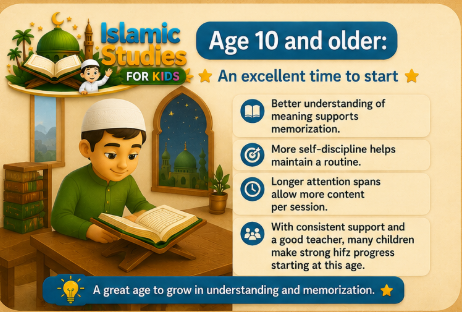
d. Age 10 and Older as an Excellent Time to Start
If a child hasn’t started earlier, this is not a missed window. Memorization at this age comes with its own advantages:
- Stronger logical understanding helps children grasp the meaning behind what they memorize.
- Greater self-discipline makes it easier to maintain a consistent daily routine.
- A longer attention span supports more content per session.
It may take more deliberate effort and stronger revision habits, but many children successfully complete significant portions of Hifz starting at 10, 11, or later — especially with consistent support and a teacher who keeps the process encouraging rather than pressured.
How to Make Your Child Memorize Quran offers a practical framework for this age group.
Families who want structured, age-matched guidance often prefer working with a dedicated Quran academy rather than piecing together a routine alone. Browse the full Quran Course for Kids Online to find the right entry point for your child’s current stage.
Experience a Real Classroom
Curious about how we teach? This video offers a glimpse into a real class, showcasing our interactive approach, qualified teachers, and child-friendly learning experience.
Fun & Engaging Islamic Classes for Kids
Start your child’s journey today with interactive lessons designed to make learning Islam loved and easy.
Get Your Child a Free TrialDo Children Memorize Quran Before Learning to Read?
Yes — young children typically memorize Quran verses through listening and repetition well before they can read Arabic script independently. This is one of the most common questions parents have, because it seems backward compared to how children learn most other subjects.
In practice, a three- or four-year-old repeats a surah after hearing a parent or teacher recite it aloud multiple times, without needing to recognize a single written letter. Reading fluency becomes important later, once a child moves into structured Hifz, because being able to read the text helps with:
- Self-correction during independent recitation.
- Longer-term retention of memorized verses.
- Reciting independently without relying on someone else’s voice.
The Quran Recitation Course for Kids Online bridges this transition from listening-based memorization to reading-based fluency.
Benefits of Learning Quran at a Young Age
Starting early carries advantages beyond memorization speed alone. For a practical look at how to build these benefits into everyday life, see How to Learn Quran for Kids and Quran Activities for Kids.
1. Stronger Long-Term Retention
Memories formed in early childhood, especially ones tied to repetition and emotional connection, tend to be retained more durably than material learned later in life.
Children who memorize Quran early often carry that memorization into adulthood with far less need to relearn it from scratch.
2. Natural Pronunciation and Tajweed Habits
A young child who hears correct Tajweed consistently tends to absorb accurate pronunciation the same way they absorb their native language’s accent — without conscious effort. Correcting mispronunciation later, after habits have set in, is measurably harder than teaching it correctly the first time.
Tajweed Rules for Kids explains how to introduce these rules alongside memorization in a child-friendly way, and the Tajweed Course for Kids Online provides structured instruction from day one.
3. Built-In Discipline and Routine
A daily Quran habit, even just ten minutes, teaches a child structure and follow-through that carries into schoolwork and other responsibilities.
This is a byproduct many parents don’t anticipate going in. For tools to build and track this habit at home, see Islamic Worksheets for Kids — Free Printables for Parents.
Common Mistakes Parents Make When Starting
A few patterns come up repeatedly among families who struggle with this process, and they’re worth naming directly.
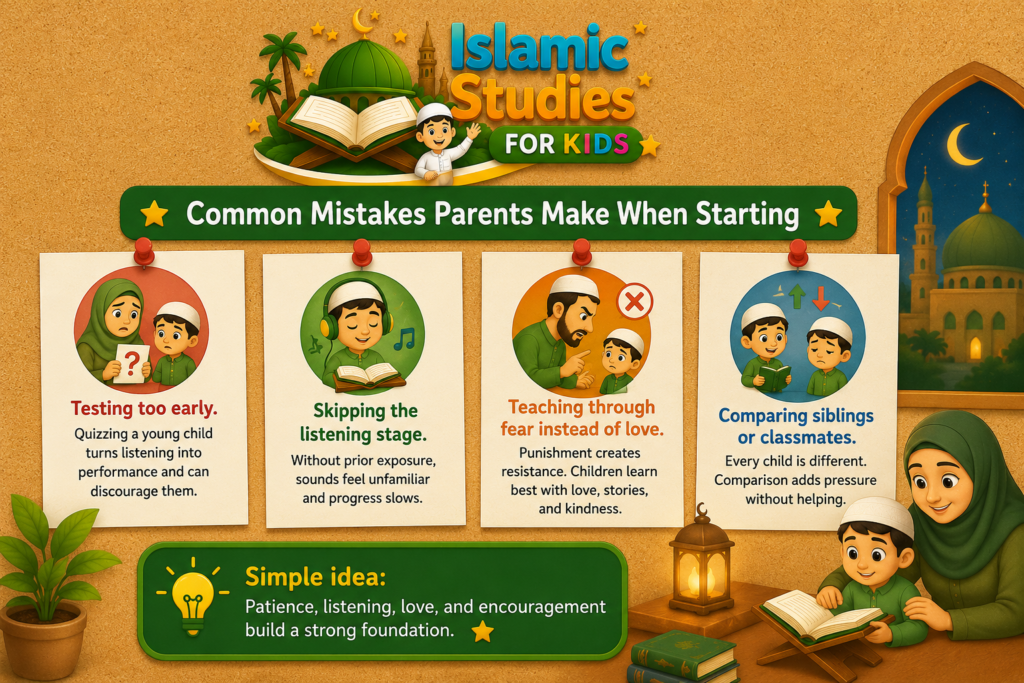
- Testing too early. Quizzing a two- or three-year-old on retention turns a listening stage into a performance, which discourages rather than motivates.
- Skipping the listening stage entirely. Jumping straight into formal lessons without the earlier exposure period often means a child is memorizing unfamiliar sounds instead of recognizable ones, which slows progress.
- Teaching through fear rather than love. Framing the Quran around punishment or consequence tends to build resistance. Children respond far better when the emphasis is on mercy, stories of the Prophets, and the beauty of what they’re learning.
- Comparing siblings or classmates. Two children the same age can be at genuinely different readiness levels. Comparison usually just adds pressure without speeding anything up.
For broader guidance on building a positive Islamic learning environment at home, How to Teach Islam to Kids and teach my child Islam online cover both the mindset and the practical tools.
Signs Your Child Is Ready
Rather than watching the calendar, look for these signs of genuine readiness:
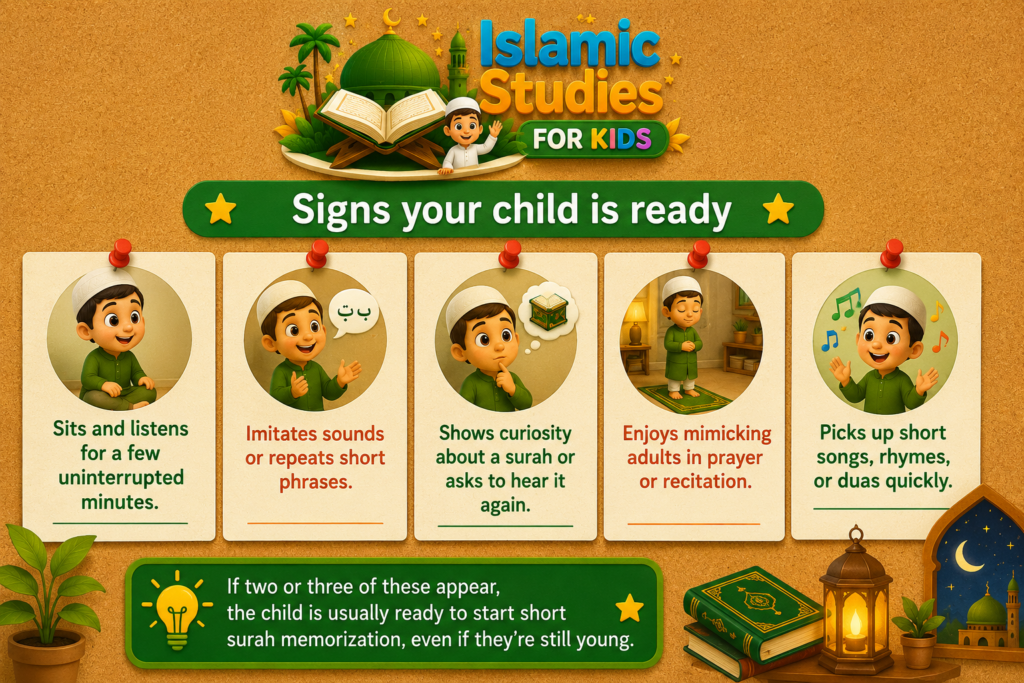
- Sits and listens attentively for at least a few uninterrupted minutes
- Imitates sounds or repeats short phrases after you
- Shows curiosity — asking questions about a surah or wanting to hear it again
- Enjoys mimicking adults during prayer or recitation
- Picks up short songs, rhymes, or duas quickly
When two or three of these are present, most teachers agree a child is ready to move from casual exposure into more structured short-surah memorization — regardless of exact age.
Many parents find it easier to spot these signs with guidance from an experienced teacher who works with children daily and can tell the difference between a child who’s simply shy and one who genuinely isn’t ready yet.
Watch a Sample Lesson from Our Academy
Get a firsthand look at how our students learn Islamic values, Quran, and essential knowledge through engaging and interactive online classes. See why families trust Islamic Studies for Kids Academy.
Fun & Engaging Islamic Classes for Kids
Start your child’s journey today with interactive lessons designed to make learning Islam loved and easy.
Get Your Child a Free TrialWhatever Age Your Child Is Right Now — This Is the Right Time to Start.
Some parents reading this have a 3-year-old who’s never heard structured Quran.
Some have a 9-year-old who still doesn’t know Al-Ikhlas.
Some have a teenager they’re not sure it’s worth trying with anymore.
This article just told you: none of those windows are closed.
What closes the window isn’t age. It’s waiting one more month to find the perfect time.
Islamic Studies for Kids Academy meets your child exactly where they are — whether that’s first Arabic sounds, first surah, or serious Hifz — with a teacher who builds the plan around them, not a fixed curriculum.

Explore the full range of courses:
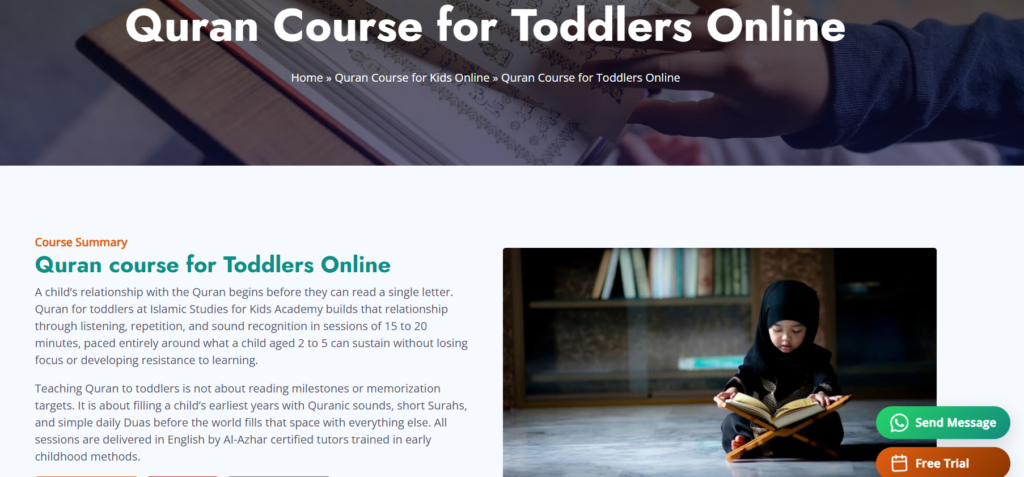
Quran Course for Toddlers Online
For the youngest learners — this course introduces Quranic sounds, rhythm, and short surahs to children who are still in the listening and imitation stage.
No reading required. No pressure. Just the right start, at the right pace.
Noorani Qaida Course for Kids
Before memorization comes the foundation — Arabic letters, sounds, and correct pronunciation built from scratch. This is where children who are starting fresh begin, at any age from 4 to 15. Start the Foundation Through Noorani Qaida Course.
Quran Memorization Course for Kids Online
For children ready to begin structured Hifz — a one-on-one plan built around your child’s pace, with Tajweed corrected live, and a revision system that makes sure nothing they memorize quietly disappears.
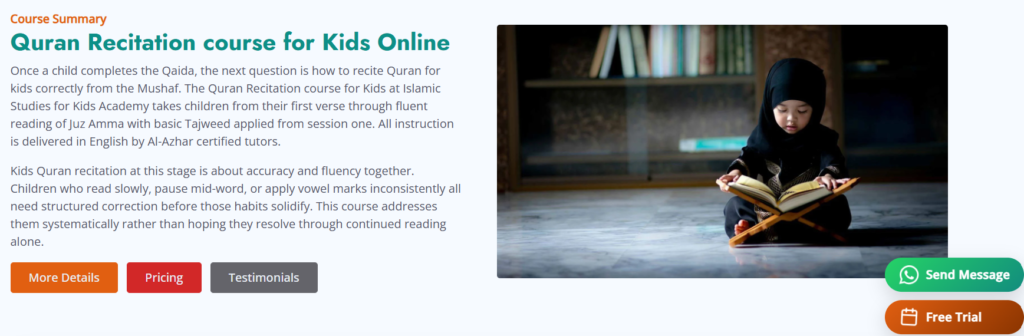
Quran Recitation Course for Kids Online
For children who already know some surahs but have errors in recitation — this course focuses on accuracy, Tajweed, and the confidence to recite in Salah knowing every word is right.
See What Graduates Say

Fun & Engaging Islamic Classes for Kids
Start your child’s journey today with interactive lessons designed to make learning Islam loved and easy.
Get Your Child a Free TrialConclusion
There is no single perfect age to begin — but there is a clear, well-supported sequence: early listening from infancy, letter and short-surah work between ages 3 and 6, and structured Hifz between ages 6 and 10, with success still very achievable afterward.
The real question isn’t when should children begin learning the Quran by the calendar, but whether your child is showing the readiness signs — attention, imitation, and curiosity — that make the process joyful rather than forced.
Start with love, follow the stages, and stay consistent, and the age becomes far less important than the environment you build around it.
Frequently Asked Questions
Parents deciding when and how to start their child’s Quran journey tend to circle back to the same core questions.
What age should kids start Quran?
Most children are ready for short-surah memorization between ages 3 and 6, with structured Hifz typically beginning between ages 6 and 10. Earlier listening exposure can start from infancy without any formal lessons.
What is the best time to learn Quran for children during the day?
There is no single required time, but many families find mornings, right after Fajr prayer, or a quiet slot before bedtime work best, since children tend to focus more easily when they’re not tired or distracted by play.
Do children memorize Quran before learning to read?
Yes. Young children typically memorize through listening and repetition first, and reading fluency becomes important later to support self-correction and independent recitation.
How Children Benefit from Learning the Quran at an Early Age?
Early learners tend to retain memorization longer, develop natural Tajweed pronunciation without needing to unlearn bad habits, and build daily discipline that carries into other areas of life.
Is it too late to start Quran memorization after age 10?
No. Many children successfully complete significant memorization starting at 10 or older. It may require more consistent revision and motivation, but age alone doesn’t close the door.
How to Know When It’s Time to Introduce Quran Lessons?
Look for signs like sitting attentively for a few minutes, imitating recited sounds, asking questions about a surah, or enjoying mimicking prayer — these readiness signs matter more than exact age.


Leave a Reply