 For Parents
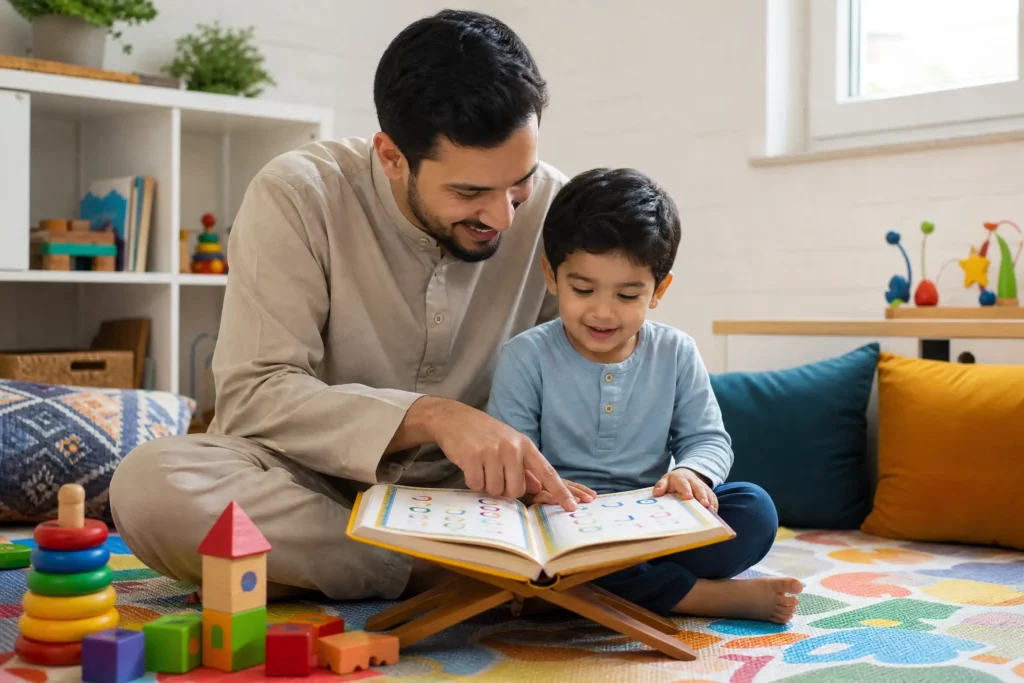
Learning how to teach Quran to a 4–5 year old comes down to one principle: short, joyful, repeated exposure beats long, forced sessions every time.
At this age, a child’s attention span is measured in minutes, not hours, and the goal isn’t how many verses they can recite — it’s whether they associate the Quran with warmth, safety, and love.
What You’ll Learn in This Article?
- Why ages 4 and 5 are considered a golden window for Quran memorization.
- How to teach Quran to a 4 year old versus a 5 year old, since the approach shifts slightly.
- Which tools and approaches actually hold a young child’s attention.
- A sample weekly schedule you can copy and adapt.
- The most common mistakes parents make — and how to avoid them.
How to Teach Quran to a 4 Year Old?
At age four, listening comes before repeating, and comfort comes before correctness. The first weeks should focus on building familiarity with the sound of the Quran — not on testing how much a child can recite.
For the stage that comes just before this, How to Introduce Islam to a 2–3 Year Old covers the listening foundation this guide builds on.
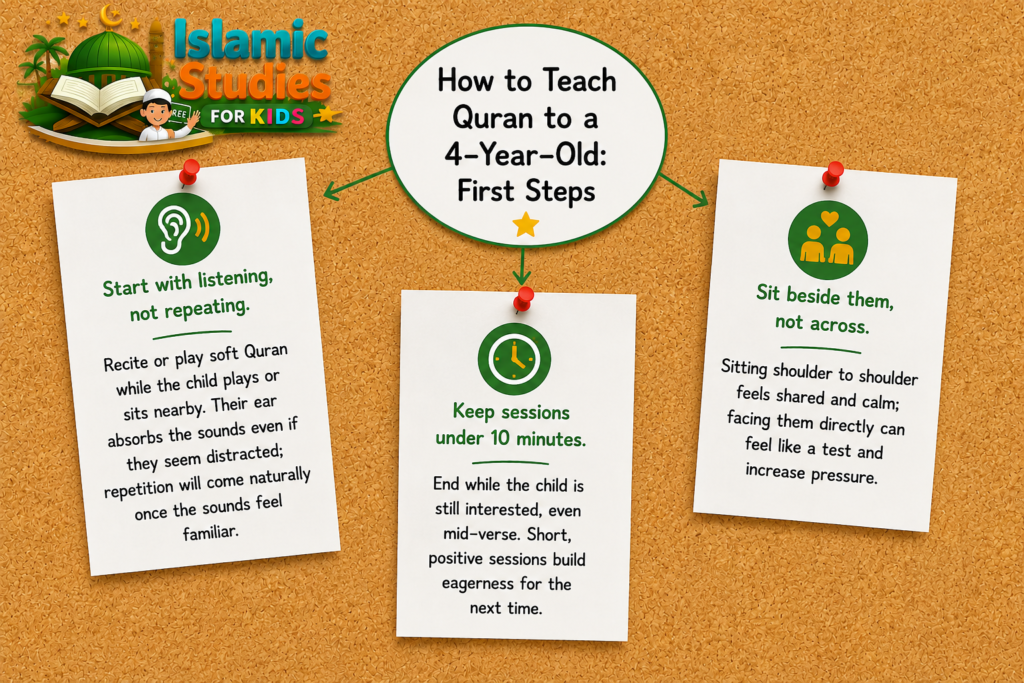
a. Start With Listening, Not Repeating
Many parents ask their four year old to repeat a verse immediately, then feel discouraged when the child mispronounces it or loses interest. A better first step:
- Recite a verse yourself, or play a soft recitation, while the child plays, colors, or simply sits nearby.
- The child’s ear is absorbing rhythm and word patterns even when they look distracted.
- Repetition on the child’s part will follow naturally once the sounds feel familiar — often within one to two weeks of consistent daily listening.
b. Keep Sessions Under 10 Minutes
- A four year old’s working attention for a single focused activity typically runs five to ten minutes.
- Stretching a session to fifteen or twenty minutes doesn’t add more learning — it adds resistance.
- End the session while the child is still interested, even mid-verse — stopping on a high note is what keeps them looking forward to the next session.
Sit beside your child rather than across from them during these sessions. Facing a child directly can feel like a test; sitting shoulder to shoulder while holding the Mushaf or a phone together feels shared, not evaluated.
This small positioning change is one of the most overlooked factors in whether a young child stays relaxed during Quran time.
The Quran Course for Toddlers Online and Noorani Qaida Course for Kids Online are built specifically around this listening-first approach for young learners.
How Can I Teach the Quran to My Five-Year-Old?
Once listening habits are established, five year olds are typically ready for a bit more structure — including early letter recognition and simple meaning. The transition from four to five is gradual, not sudden, and the pace should follow the child rather than the calendar.
1. Introducing the Arabic Letters
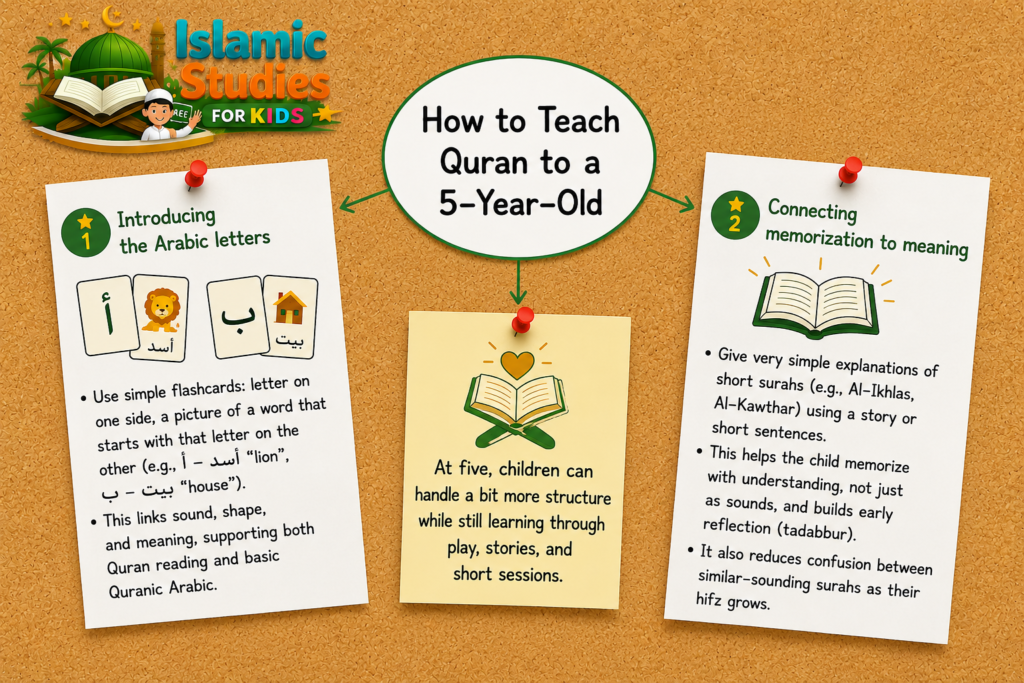
A five year old can begin recognizing individual Arabic letters, both isolated and in their connected forms. What works well at this stage:
- Flashcards with the letter on one side and a simple picture of a word starting with that letter on the other — أ with أسد (lion), ب with بيت (house).
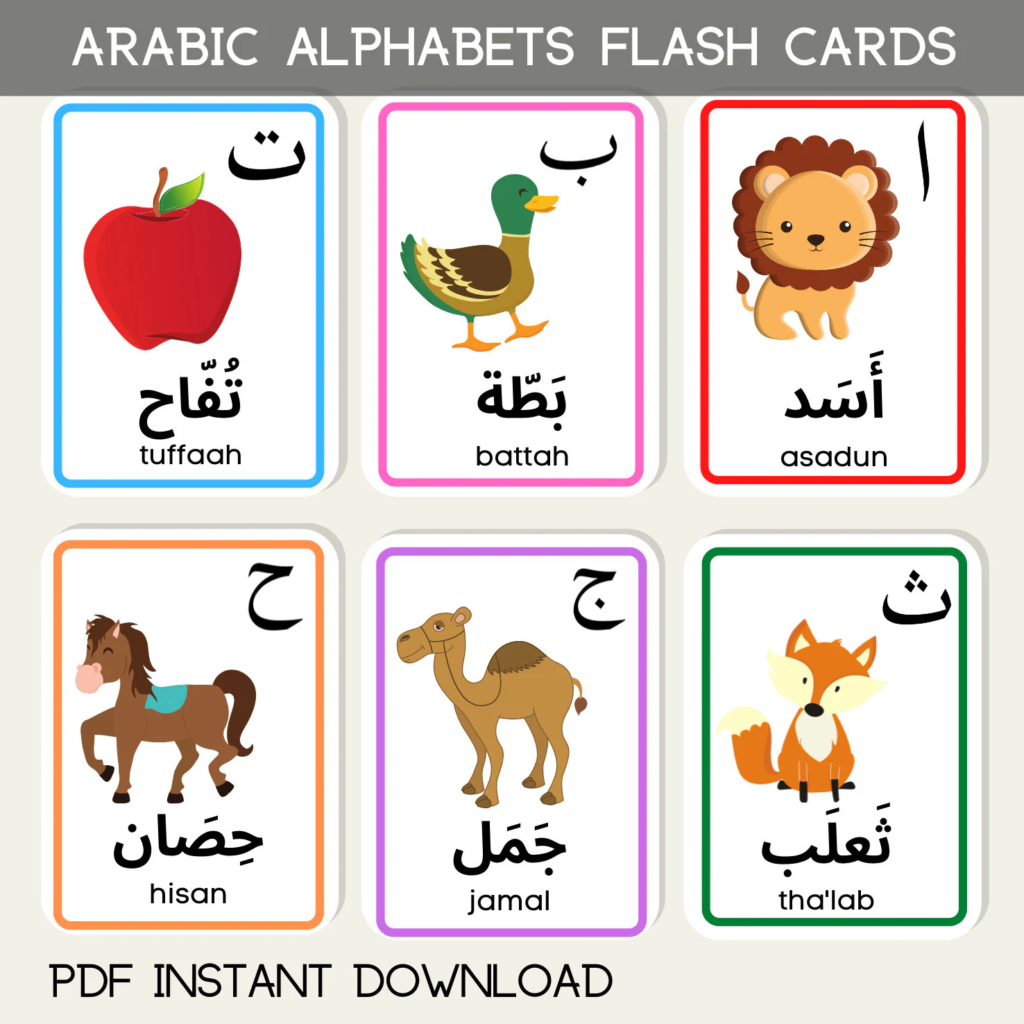
- This pairing helps the child connect sound, shape, and meaning at the same time.
- It supports both Quran reading and general Quranic Arabic literacy later on.
For a structured path from letter recognition into reading fluency, the Noorani Qaida Course for Kids Online and Quranic Arabic Course for Kids Online take children through this progression step by step.
2. Connecting Memorization to Meaning
Five year olds can grasp simple explanations of what a short surah is about, especially when tied to a story:
- Explaining the meaning of Surah Al-Ikhlas or Al-Kawthar in a few simple sentences — before or after memorization — helps the child memorize with understanding rather than as disconnected sound.
- This builds a habit of reflection (tadabbur) that becomes valuable as the child grows.
- It also reduces the chance of confusing similar-sounding surahs later, as memorized content grows in volume.
For story-based approaches that make meaning come alive, the Quran Stories Course for Kids Online pairs narrative with memorization at exactly this age.
Approaches and Tools That Work for Young Learners
Different children respond to different input, and matching the tool to the child’s natural learning style reduces frustration for both parent and child.
For a broader collection of activity ideas, see Quran Activities for Kids and Islamic Activities for Kids.
a. Visual and Auditory Learning Styles
A simple way to tell which your child leans toward: if they can recall a song’s tune before its words, they likely respond well to audio-first methods. If they remember a picture book’s illustrations better than what was read aloud, lead with visual tools.

- Audio-first learners — play recitation during quiet play, use one consistent reciter’s voice, and let repetition of the same audio build recognition before adding any visual element.
- Visual learners — use picture cards with Arabic letters and words, illustrated prophet story books, or verse posters on their bedroom wall.
For curated app recommendations that support both styles, see Islamic Apps for Kids.
b. Reward Systems That Motivate Without Pressure
A simple star chart , like “printable surah”— one sticker per completed verse or short surah — gives a young child a visible sense of progress without turning memorization into a transaction.
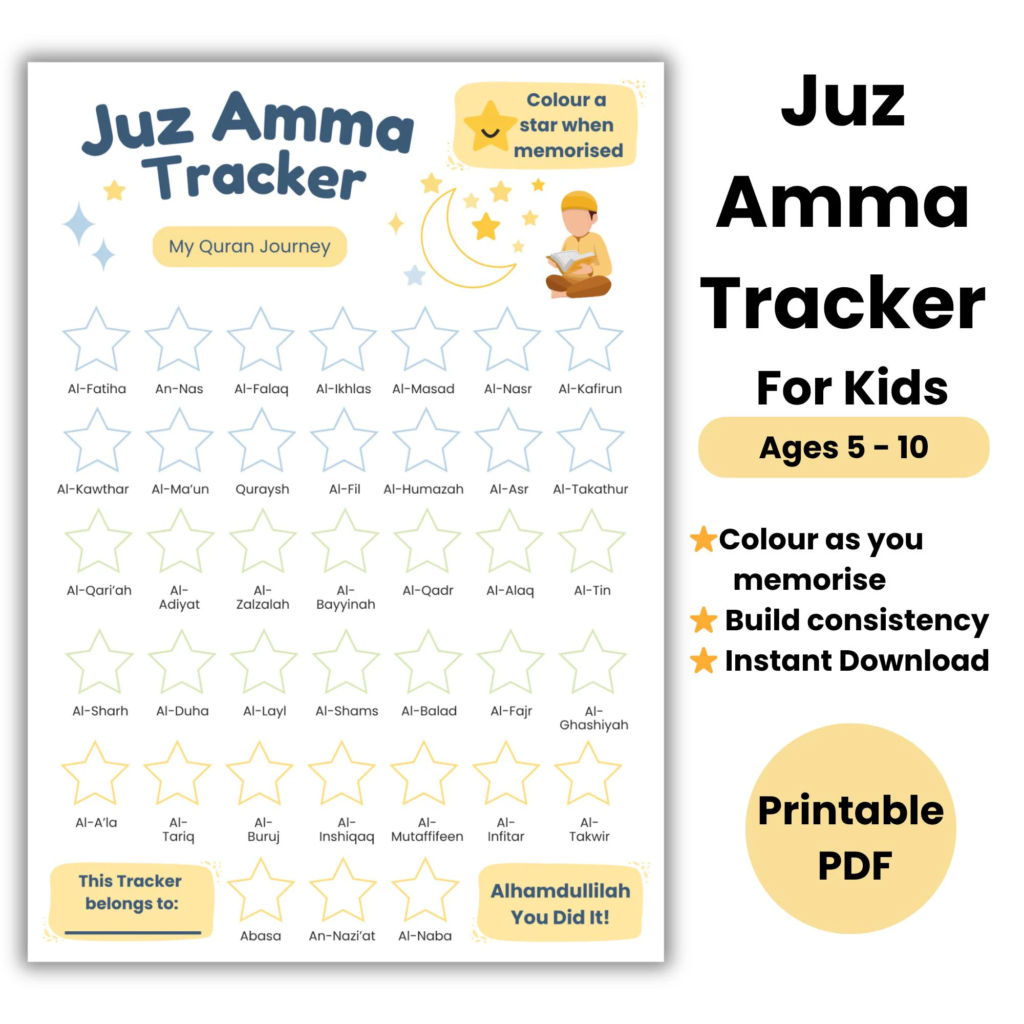
The reward should mark effort, not just perfect recitation; a child who tried to repeat one word deserves the same encouragement as one who recited a full line correctly.
Praise that is specific and immediate (“Ma sha Allah, you said that so clearly”) reinforces the behavior far more than a reward given hours later.
Islamic Worksheets for Kids — Free Printables for Parents includes printable sticker charts designed specifically for tracking Quran progress at home.
Experience a Real Classroom
Curious about how we teach? This video offers a glimpse into a real class, showcasing our interactive approach, qualified teachers, and child-friendly learning experience.
Fun & Engaging Islamic Classes for Kids
Start your child’s journey today with interactive lessons designed to make learning Islam loved and easy.
Get Your Child a Free TrialA Simple Weekly Schedule for Quran Memorization
Having a fixed weekly rhythm removes the daily decision of “should we do Quran today?” — which is often where consistency breaks down.
The schedule below is a starter framework built around short, five-day teaching blocks with built-in review days. Adapt the timing to your family’s routine, but keep the structure intact.
| Day | Focus | Approximate Time |
| Day 1 | Introduce a new verse through listening only | 5–10 minutes |
| Day 2 | Repeat yesterday’s verse together, no new content | 5–10 minutes |
| Day 3 | Add a second verse, linking it to the first | 10 minutes |
| Day 4 | Free listening during play (no seated session) | Background, no set time |
| Day 5 | Full recitation of the week’s verses together | 10 minutes |
| Days 6–7 | Review only — no new memorization | 5–10 minutes each |
Two review days per week matter as much as the new-content days. Skipping review to move faster is one of the fastest ways to lose what a child has already memorized.
For the longer-term memorization sequence that follows this weekly structure, see Juz Amma Memorization for Kids and How to Make Your Child Memorize Quran.
Why Ages 4 and 5 Are the Best Time to Start?
Children between four and six are in what child development research calls a sensitive period for language acquisition — their brains absorb sounds, rhythm, and repeated phrases with far less conscious effort than an older child or adult needs.
For context on how this window fits into the broader Quran learning journey, see When Should Children Begin Learning the Quran?
a. What Makes This Age Golden for Memorization?
A 4 or 5 year old’s brain is still tuned to imitate sound before it fully processes meaning — the same mechanism that lets a young child pick up a nursery rhyme after two or three hearings applies directly to Quranic verses. Key advantages at this stage:
- Reciting a short surah slowly, two or three times, lets the imitation process start naturally without pressure to repeat.
- Daily habits form with the least resistance at this age — a five-minute Quran routine introduced now is far easier to sustain at age eight than one introduced for the first time at eight.
- The brain’s phonetic sensitivity means Arabic sounds are absorbed more naturally than at any later stage.
b. Signs Your Child Is Ready
Readiness isn’t about age alone — it’s about attention and comfort. A child is ready to begin structured listening when they:
- Can sit calmly for a few minutes during a story or song.
- Respond to their name being called gently.
- Enjoy repeated routines like the same bedtime song each night.
If a child resists sitting still for anything, start with pure background listening during play before introducing a seated session.
Common Mistakes to Avoid When Teaching Quran to Young Kids
Even well-intentioned parents fall into a few predictable traps. Recognizing them early prevents months of frustration for both child and parent.
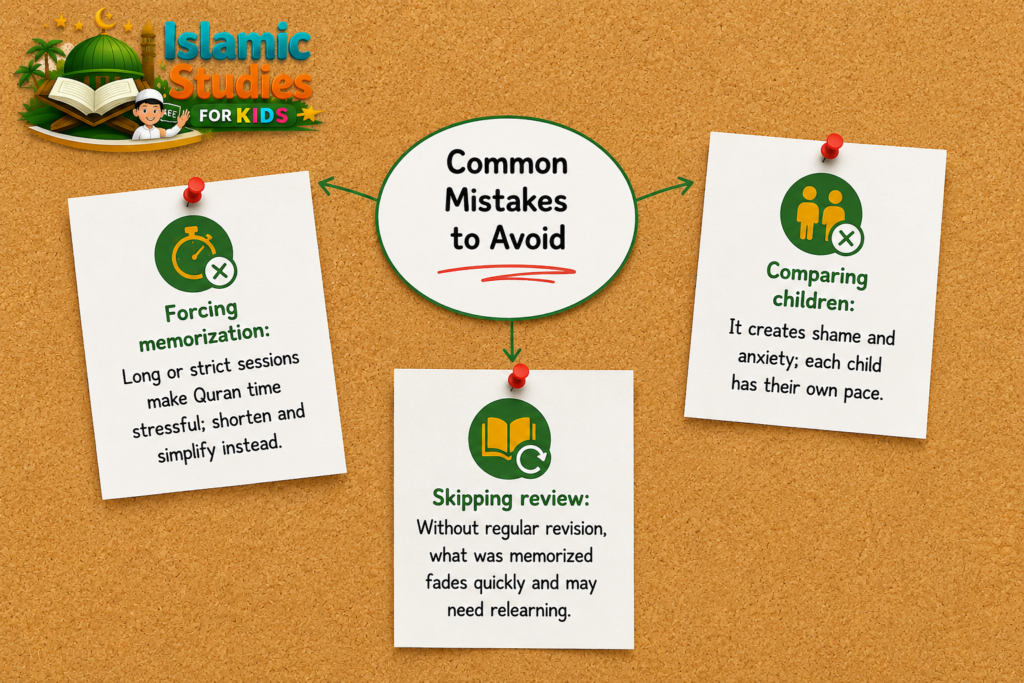
1. Forcing Memorization Instead of Building Interest
- Pushing a child to sit longer than their attention allows teaches the child that Quran time is a source of stress rather than comfort.
- Insisting on a perfect recitation before moving on has the same effect.
- If a session consistently ends in tears or refusal, the session is too long, too early in the day, or too focused on correction.
2. Comparing Siblings or Peers
- Saying a sibling or classmate “memorizes faster” is one of the most damaging habits a parent can fall into at this stage.
- It can breed resentment between children and attaches shame to a process that should feel safe.
- Each child has a different pace, and comparison rarely speeds progress — it usually slows it by adding anxiety.
3. Skipping Review Sessions
- New verses without regular review fade quickly at this age.
- A child who memorized a surah two weeks ago but hasn’t reviewed it since will often need to relearn it almost from scratch.
- Building review days into the schedule, as shown above, protects the time already invested.
Watch a Sample Lesson from Our Academy
Get a firsthand look at how our students learn Islamic values, Quran, and essential knowledge through engaging and interactive online classes. See why families trust Islamic Studies for Kids Academy.
Fun & Engaging Islamic Classes for Kids
Start your child’s journey today with interactive lessons designed to make learning Islam loved and easy.
Get Your Child a Free TrialMost Parents Start With the Right Intention, And the Wrong Method
They sit their four-year-old down. They play a recitation. They ask them to repeat.
The child fidgets. Mispronounces. Loses interest in six minutes.
And the parent assumes the child isn’t ready — when really, the method wasn’t right.
Teaching Quran to a 4–5 year old isn’t about pushing harder. It’s about knowing exactly how a child this age absorbs sound, builds habit, and forms a relationship with the Quran before they even understand a single word.
That knowledge takes years to develop in a teacher. It takes one free session to see it in action.
Students Before and After Islamic Studies Academy
Before Islamic Studies for Kids Academy: Ten minutes of forced repetition. A child who dreads Quran time. A parent who feels guilty.
After: Five minutes. Same child. Humming Al-Ikhlas on the way to school.
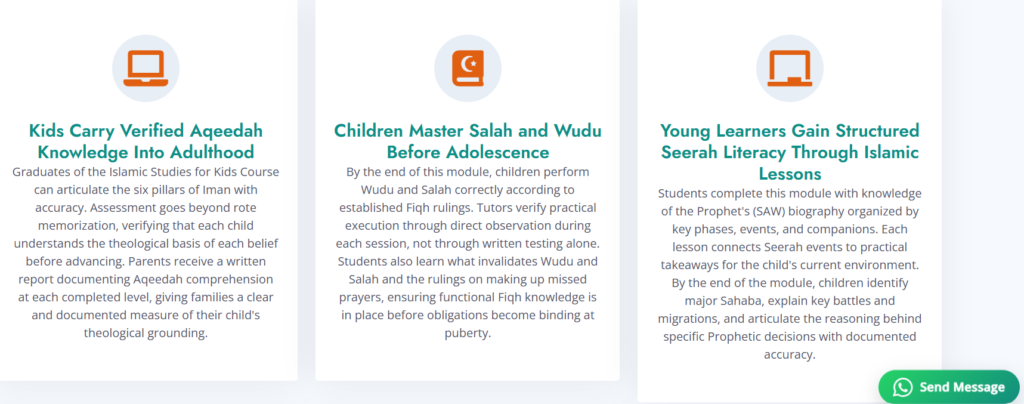
Why Muslim Families Choose Islamic Studies for Kids Academy?
Not every online Islamic course is the same. Here is what families consistently point to after their first semester:
- Al-Azhar certified tutors with traditional Ijazah — not self-taught, not informally trained.
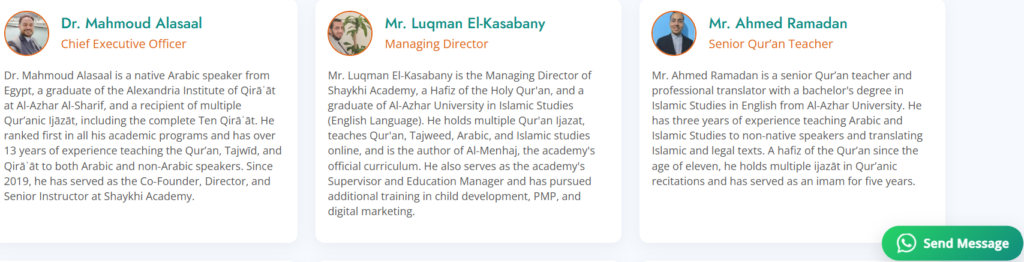
- Private 1-on-1 sessions — always, no exceptions.
- Full English instruction — no prior Arabic needed.
- Female tutors available for girls upon request.
- Flexible scheduling — after school, weekends, any time zone.
- Written progress reports after every completed level.

Our Islamic Studies Courses Include:
- Islamic Studies for Kids
- Islam Basics for Kids (Beginners)
- 5 Pillars of Islam for Kids
- 6 Pillars of Iman (Faith) for Kids
- Salah (Prayer) for Kids
- Wudu for Kids
- Dua for Kids
- Ramadan for Kids
- Zakat & Sadaqah for Kids
- Hajj for Kids
- Aqeedah (Islamic Belief) for Kids
- Islamic Manners & Akhlaq for Kids
- Good Deeds for Kids
- Cleanliness (Taharah) in Islam for Kids
- Angels in Islam for Kids
- Islamic History for Kids
- Seerah (Prophet’s Life) for Kids
- Prophets Stories for Kids
- Islamic Stories & Morals for Kids
- Fiqh for Kids (Islamic Jurisprudence Basics)
- Hadith for Kids
- Quran Tafseer Course for Kids
- Islamic Holidays & Events for Kids
- Islamic Identity for Kids
- Intensive Islamic Course for Kids
Enroll today and give your child the knowledge, values, and confidence to grow as a practicing Muslim with a strong connection to Allah and His teachings.
Fun & Engaging Islamic Classes for Kids
Start your child’s journey today with interactive lessons designed to make learning Islam loved and easy.
Get Your Child a Free TrialConclusion
Teaching Quran to a 4–5 year old works best when the process stays short, calm, and consistent — listening before repeating, five to ten minute sessions, review days built into the week, and encouragement for every small effort.
Whether you’re figuring out how to teach Quran to a 4 year old just starting with sound and rhythm, or how to teach Quran to a 5 year old ready for letters and simple meaning, the underlying principle doesn’t change: build love for the Quran first, and memorization follows naturally.
Frequently Asked Questions
The questions below cover what parents most often ask once they start this process — practical concerns that tend to come up in the first few weeks of teaching.
What is the best age to start teaching a child the Quran?
Most specialists point to ages 4 to 5 as the ideal window, with 4 and 5 being especially effective because children can sit for short sessions and imitate sound easily.
Starting during this window makes daily habits easier to form than starting later.
How long should a Quran session be for a 4 or 5 year old?
Five to ten minutes is enough for most children this age. Longer sessions rarely improve retention and often create resistance, so it’s better to stop while the child is still interested than to push until they disengage.
What approaches can I use to teach Quran to my 4 year old?
Start with listening-only sessions, keep them under ten minutes, sit beside rather than facing your child, and introduce repetition gradually once the verse feels familiar.
Pairing audio with calm playtime also reinforces listening without adding pressure.
How do I introduce the Quran to young kids who resist sitting still?
Begin with background audio during play rather than a seated session. Once the child shows interest in the sound — humming along or repeating a word — that’s the signal to introduce a short, seated listening moment.
Should I focus on memorization or understanding first for a 5 year old?
Both can happen together at this age through simple explanations. Pairing a short surah with a basic story about its meaning helps a 5 year old memorize with understanding rather than as disconnected sound, which supports longer-term retention.
How many verses should a 4 or 5 year old memorize per week?
There’s no fixed number — pace depends on the child. A realistic starting point is one to two short verses per week, with two dedicated review days, rather than measuring progress by verse count alone.



Leave a Reply