 Quran
Quran
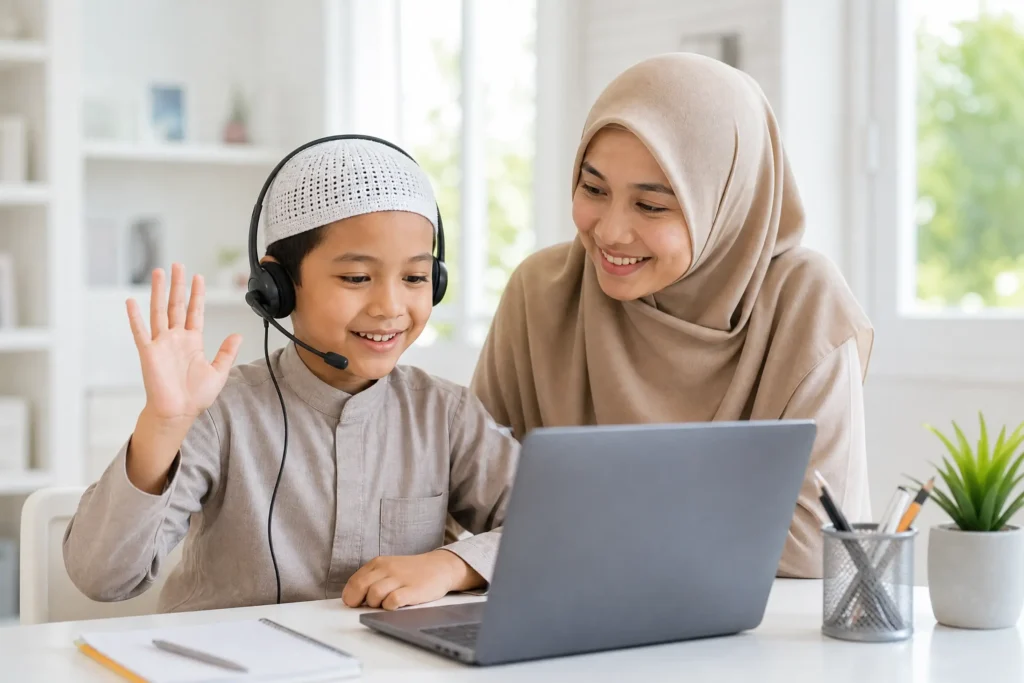
Your child asks you, “Why do we pray?” — and in that moment, you realize you want to give them far more than a quick answer. If you’ve been wondering how to teach my child Islam online, you’re not alone — and the good news is that it’s more achievable today than at any point in history.
Knowing where to start, what to teach at each age, and how to find the right help can still feel overwhelming. This guide gives you a clear, age-by-age plan covering what to teach, when to start, how to choose the right online Islamic school for kids, and how to make learning stick without pressure.
What You’ll Learn in This Article
- At what age to start and what signs show your child is ready.
- What Islamic knowledge to introduce at each age stage.
- How to build Islamic home learning into daily family life.
- How to choose a trustworthy online Islamic school for kids.
- Which apps and resources genuinely help.
When Should You Start to Teach My Child Islam Online?
The short answer is: from birth, informally — and from around age 4–6 with structured learning. Islamic tradition teaches that education begins the moment a child enters the world.
The Prophet ﷺ had the Adhan called in the ear of newborns, and the first phrase early Muslim scholars recommended teaching a child as soon as they could speak was La ilaha illa Allah — repeated seven times.
These are seeds, not lessons. Formal Islamic study, however, depends on each child’s readiness — not a fixed age.
Three Readiness Signals Parents Can Actually Observe
Knowing when to move from informal home exposure to a structured online Islamic school for kids is one of the most common questions Muslim parents face — and most resources skip it entirely. Look for these three signals before enrolling your child in any formal program:
- Sustained attention — Can your child focus on one activity for 10–15 minutes without prompting? If yes, they can handle a structured online session.
- Language comprehension — Does your child ask why questions and understand simple explanations? This signals readiness for basic Aqeedah concepts.
- Imitation behavior — Is your child copying your Salah, your Dua, or your Quran recitation? This is the strongest readiness signal of all — it means they want to participate, not just observe.
Children who show all three signals are ready for an online Islamic school for kids. Children who show one or two benefit most from Islamic home learning — stories, duas, and daily routine — before moving to formal curriculum. For a broader framework on getting started, see the Islam Basics for Kids Course Online.
What to Teach Your Child at Each Age Stage
Most resources on Islamic home learning for kids present content as a flat list — the five pillars, the six pillars of Iman, Quran memorization — without telling parents when each piece is developmentally appropriate. What a three-year-old needs is entirely different from what a ten-year-old is ready for, and teaching them the same way produces frustration on both sides.
The Prophet ﷺ himself demonstrated this principle. He taught a child eating etiquette —
“«بِسْمِ اللهِ، وَكُلْ بِيَمِينِكَ، وَكُلْ مِمَّا يَلِيكَ»
“, “Say Bismillah, eat with your right hand, eat what is near you” (Al-Bukhari and Muslim) — before any theological concept.
a. The Age-Stage Roadmap for Islamic Home Learning
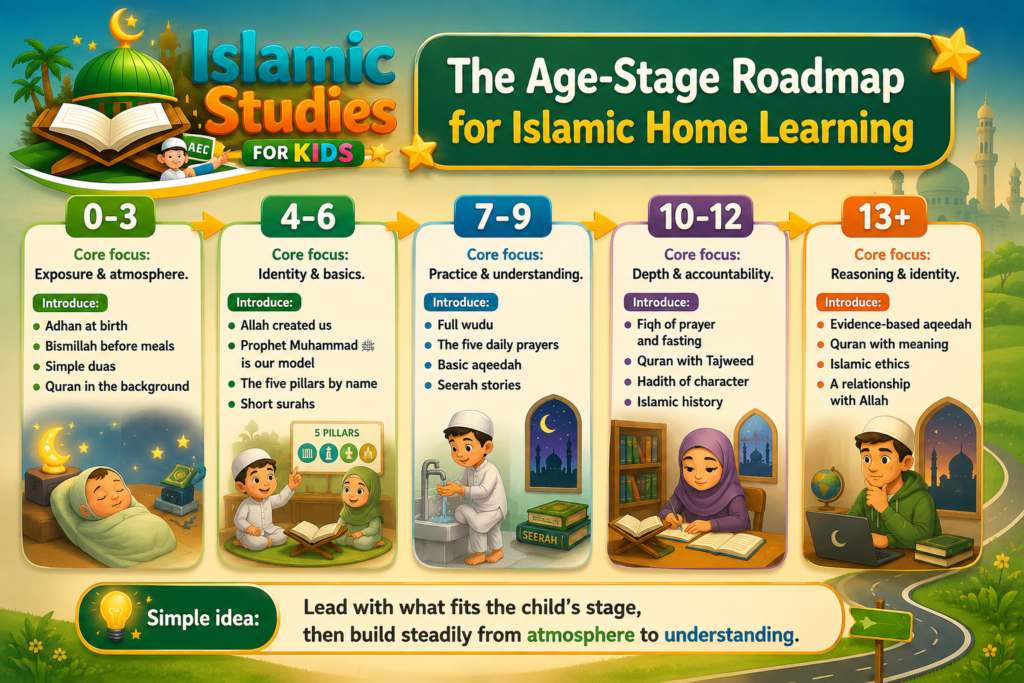
The table below sets out what to prioritize at each stage — not what to exclude, but what to lead with:
| Age | Core Focus | What to Introduce |
| 0–3 | Exposure & atmosphere | Adhan at birth, Bismillah before meals, simple duas, Quran in the background |
| 4–6 | Identity & basics | Allah created us, Prophet Muhammad ﷺ is our model, five pillars by name, short surahs |
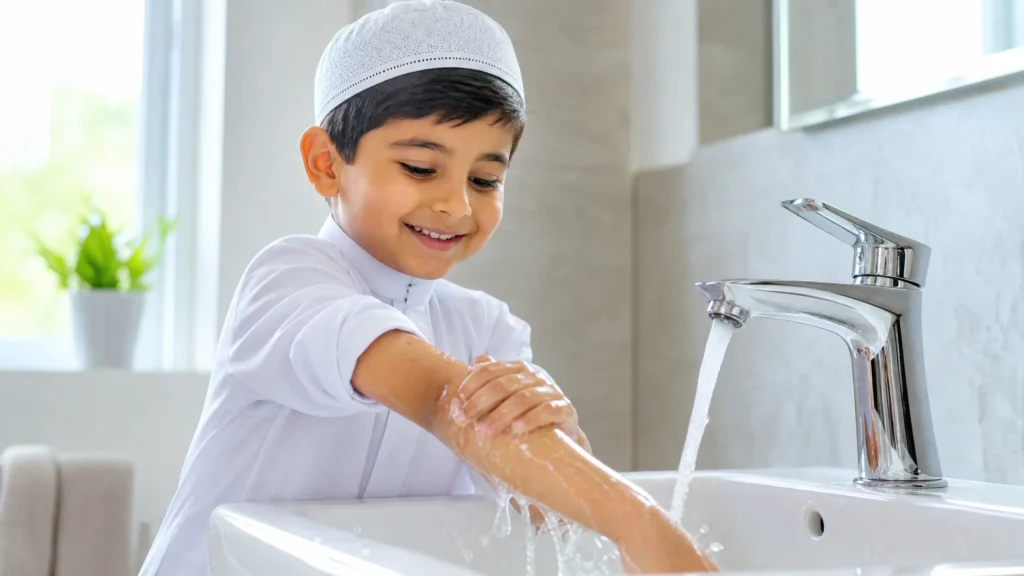
| 7–9 | Practice & understanding | Full Wudu, five daily prayers, basic Aqeedah, Seerah stories |
| 10–12 | Depth & accountability | Fiqh of prayer and fasting, Quran with Tajweed, Hadith of character, Islamic history |
| 13+ | Reasoning & identity | Evidence-based Aqeedah, Quran with meaning, Islamic ethics, relationship with Allah |
For toddlers just starting out, the Quran Course for Toddlers Online is designed specifically for this earliest stage.
b. The Memorization vs. Understanding Debate — Resolved
Parents researching how to teach their child Islam online often encounter two camps: memorize first, or understand first. The classical Islamic position — consistent with how modern child development works — is a middle path: memorization and meaning must be linked from the beginning, but the ratio shifts by age.
- Ages 4–7: 80% memorization, 20% simple meaning. Always pair a short surah or dua with a one-sentence explanation: “Al-Fatiha is the surah we read in every prayer — it means we are asking Allah to guide us.”
- Ages 8–12: 60% memorization, 40% understanding. Introduce simple Tafseer alongside Quran memorization.
- Ages 13+: 40% memorization, 60% understanding. Meaning must lead at this stage — teenagers who don’t understand what they’ve memorized disengage.
The common mistake to avoid: drilling pure memorization with no context for children over ten. It produces teenagers who can recite without knowing why — and who gradually stop caring. For a structured memorization path, see How to Make Your Child Memorize Quran and Juz Amma Memorization for Kids.
Dedicated courses that support this balanced approach: Quran Memorization Course for Kids Online · Quran Recitation Course for Kids Online · Tajweed Course for Kids Online
Experience a Real Classroom
Curious about how we teach? This video offers a glimpse into a real class, showcasing our interactive approach, qualified teachers, and child-friendly learning experience.
Fun & Engaging Islamic Classes for Kids
Start your child’s journey today with interactive lessons designed to make learning Islam loved and easy.
Get Your Child a Free TrialHow to Build Islamic Home Learning Into Daily Family Life
The most effective Islamic home learning for kids does not require extra time — it requires a different lens on time you already spend with your child.
Embedding Islam into moments that already exist is more powerful than scheduling a separate “Islamic study time” that competes with everything else in a busy family day.
The practitioner insight here is sequencing: establish daily routine habits before introducing formal lessons. A child who already says Bismillah automatically and knows the sleep dua approaches structured Islamic study as an extension of what they know — not as something imposed from outside.
For printable tools to support these routines, see Islamic Worksheets for Kids — Free Printables for Parents.
Daily Moments That Become Islamic Learning Opportunities
Every day already contains multiple natural entry points for Islamic home learning. Here is how to use each one without adding pressure:
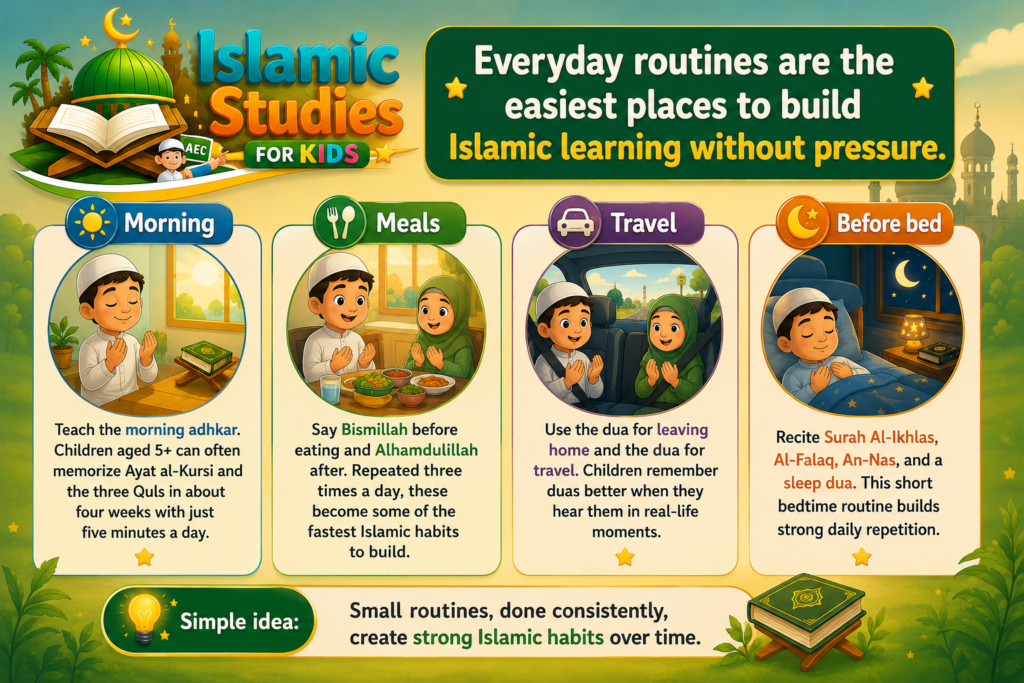
- Morning: Teach the morning Adkhar. Children aged 5+ can memorize Ayat al-Kursi and the three Quls in under four weeks with five minutes daily — the consistency matters more than the duration.
- Meals: Bismillah before eating, Alhamdulillah after. Reinforced three times a day, these become the fastest Islamic habits to form in any child.
- Travel: Dua for leaving the home, dua for travel. Children who hear duas in context remember them better than children who memorize them in isolation.
- Before bed: Surah Al-Ikhlas, Al-Falaq, An-Nas, and a sleep dua. This five-minute bedtime routine gives your child over 1,800 natural repetitions of core Islamic content every year.
For ideas to make these moments more engaging, Islamic Activities for Kids and Islamic Games for Kids offer practical, home-friendly resources.
How to Choose the Right Online Islamic School for Kids
When parents search for an online Islamic school for kids, most focus first on curriculum content. That matters — but it is the second thing to evaluate.
The first is instructor quality. A scholar with deep Islamic knowledge is not automatically a skilled children’s teacher. The two skill sets are different, and the best online Islamic education for kids requires both.
Islamic Studies For Kids Academy offers live, interactive online Islamic education built specifically for children and their mothers — with instructors trained in both Islamic sciences and child-centered teaching methods.
Read Also: Islam Facts for Kids
a. What to Look for in an Online Islamic School for Kids
Not all online Islamic schools for kids deliver the same results. These four criteria separate genuinely effective programs from generic ones:
- Child pedagogy training, not just Islamic credentials — Ask directly: “How do you explain this concept to a six-year-old?” A qualified children’s instructor will answer specifically. A scholar without teaching training will answer theologically — and that gap matters in practice.
- Curriculum sequenced by developmental age — A program that teaches Aqeedah identically to a five-year-old and a twelve-year-old is not serving either. Look for curricula that explicitly adapt content and depth to age stage.
- Transparent learning outcomes per level — “They will know the six pillars of Iman with explanation after this level” is a real outcome. “They will learn Islamic values” is not. Reputable programs state what a child will be able to do or know after each stage.
- A free trial session — Any credible online Islamic school for kids and mothers offers a free trial. This is how parents verify teaching style, child engagement, and platform quality before committing — not from a brochure.
Explore the full course range to find the right fit for your child’s age and stage: Islamic Studies for Kids — Full Course Catalogue
Read Also: Islamic Worksheets for Kids
b. Helpful Apps and Tools to Support Islamic Home Learning
Apps can strengthen your Arabic journey, but they are most powerful when combined with live lessons and real human interaction. A qualified teacher catches recitation errors, adjusts pacing, and builds the child-teacher relationship that sustains long-term motivation — none of which an app can replicate.
For a curated list of what actually works, see Islamic Apps for Kids.
That said, these three tools are genuinely useful for reinforcement between lessons:
- Muslim Kids TV — Animated Islamic content covering Seerah, manners, and Ramadan concepts, suitable for ages 4–12.
- Quran Explorer (Interactive) — Word-by-word Quran with audio, useful for children ages 8+ following along with their lessons.
- Hasanati — Arabic-language app designed to help parents reinforce Quran memorization and daily Islamic habits at home.
Use apps during the 15–20 minutes before bed or after school — not as a substitute for structured learning at the core of your child’s Islamic education.
Read Also: Eid ul Adha for Kids
Watch a Sample Lesson from Our Academy
Get a firsthand look at how our students learn Islamic values, Quran, and essential knowledge through engaging and interactive online classes. See why families trust Islamic Studies for Kids Academy.
Fun & Engaging Islamic Classes for Kids
Start your child’s journey today with interactive lessons designed to make learning Islam loved and easy.
Get Your Child a Free TrialGrowing Together Through Islamic Learning
One of the most powerful things a mother can do for her child’s Islamic education is continue her own.
Children whose mothers are actively learning — reciting Quran, studying Arabic, or attending Islamic classes — internalize Islam as a living practice, not a childhood subject. Islamic Studies For Kids Academy offers dedicated courses for mothers that run alongside their children’s learning:
- Quran Classes for Mothers Online
- Quran Hifz Course for Mothers Online
- Tajweed Course for Mothers Online
- Arabic Classes for Mothers Online
- Islam Classes for Mothers Online
Start Teaching Your Child Islam Online Today
You do not need a madrasa down the street, a background in Islamic scholarship, or hours of spare time each week. You need a clear roadmap, a daily habit, and the right teacher for your child.
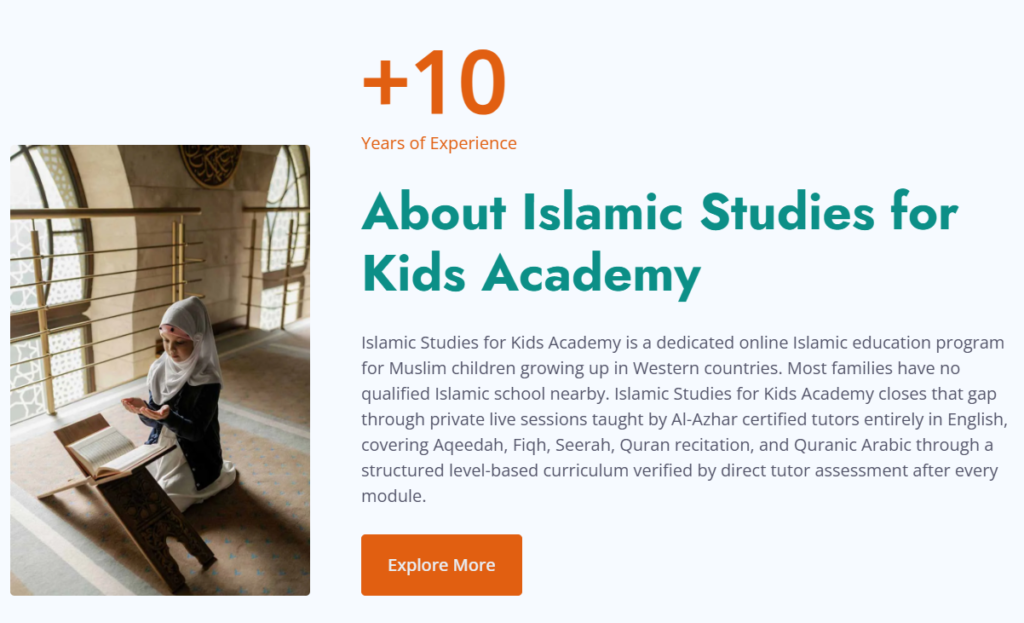
Islamic Studies For Kids Academy connects Muslim children and their mothers with qualified, child-trained instructors for live online Islamic education — covering Quran, Aqeedah, Seerah, Islamic manners, and Arabic fundamentals, all in age-appropriate, engaging sessions designed around how children actually learn.
- Expert instructors trained in both Islamic sciences and child pedagogy.
- Age-appropriate curriculum following the developmental roadmap above.
- Short, focused sessions: 20–30 minutes for young learners.
- Flexible scheduling for families across all time zones.
- Free trial session — no commitment required.
Your child’s Islamic journey starts with a single lesson.

Fun & Engaging Islamic Classes for Kids
Start your child’s journey today with interactive lessons designed to make learning Islam loved and easy.
Get Your Child a Free TrialConclusion
Teaching your child Islam online works best when it follows a clear sequence: informal exposure from birth, daily routine habits woven into family life, and structured online lessons introduced once your child shows genuine readiness signals.
The age-stage roadmap in this guide removes the guesswork — you know what to lead with at four years old, at nine, and at thirteen, rather than trying to cover everything at once.
The most important shift in mindset: Islamic home learning is not a separate subject you add to an already full schedule. It is a lens you place over the moments you already share with your child — meals, bedtime, morning, travel — until Islam feels like the most natural part of who they are.
Frequently Asked Questions
Every parent starting this journey arrives with the same core questions. The answers below are designed to give you clear, practical guidance — whether you are just beginning or looking to strengthen what you already have in place.
1. How early can I start teaching my child Islam online?
Informal Islamic learning starts from birth through the Adhan, Bismillah at meals, and Quran playing in the home. Structured online lessons work best from age 4–5 for most children, once they can sustain 15–20 minutes of focused attention.
The three readiness signals to look for are: sustained attention span, asking “why” questions, and imitating your Islamic practices at home.
2. What should I teach my child about Islam first?
Start with Islamic identity — who is Allah, who is the Prophet ﷺ, and what it means to be Muslim. Then introduce daily duas, short surahs, and the names of the five pillars.
For children under seven, practical behavior — Bismillah, Wudu movements, prayer postures — should come alongside or before abstract theological concepts like the pillars of Iman. See Who is Allah? Explaining to Kids and Wudu Steps for Kids for child-friendly guides on both.
3. Is online Islamic learning effective for young children?
Yes, when sessions are short (20–30 minutes maximum for under-eights), live and interactive, and taught by instructors experienced with children specifically. Passive video watching is far less effective.
The key is a real teacher who responds to the child in the moment — correcting, encouraging, and adjusting to what the child shows them each session.
4. How do I make Islamic home learning consistent without it becoming a struggle?
Attach Islamic learning to routines that already exist — meals, bedtime, leaving the house, morning wake-up — rather than creating a separate study block that competes for time and attention.
Children who experience Islam as woven into daily life rather than as an additional subject develop a far more natural and lasting connection to their faith. Islamic Quotes for Kids offer simple, low-pressure ways to keep the atmosphere alive between lessons.
5. What is the difference between an online Islamic school for kids and an app?
A live online Islamic school provides real-time teacher feedback, correction of Quran recitation errors, personalized pacing, and the accountability structure children need to progress over months and years.
Apps reinforce what a teacher has already introduced but cannot replace the relationship — and it is the relationship that drives long-term engagement with Islam.


Leave a Reply