 Islamic Studies

Every parent has heard it at some point: “Why do I need wudu again?” and finding a simple, meaningful answer isn’t always easy.
That moment is actually the perfect teaching opportunity. Wudu steps for kids are not just about physical cleanliness; they are the first act of worship children perform before standing before Allah, and getting them right matters deeply.
This guide walks you through every wudu step in child-friendly language, explains what is obligatory and what is sunnah, covers the most common mistakes children make, and gives you practical methods to help your child memorize the sequence joyfully — not by pressure, but by understanding.
What You’ll Learn in This Article?
- The complete wudu steps for kids in the correct order, with clear explanation for each.
- The difference between obligatory (fard) steps and recommended (sunnah) steps — and why this distinction matters.
- What breaks wudu and when your child needs to repeat it.
- Practical activities and memory techniques to help children learn wudu quickly.
- The dua after wudu and the hadith about its extraordinary rewards.
The Full Step by Step Guide to Wudu for Kids
Wudu is the ritual purification a Muslim performs before prayer, Quran recitation, and tawaf around the Ka’bah. It involves washing specific parts of the body in a fixed order using clean water, with the intention of worship.
The Prophet ﷺ described wudu as “half of faith” — a statement that shows how central physical and spiritual purity is to a Muslim’s daily life.
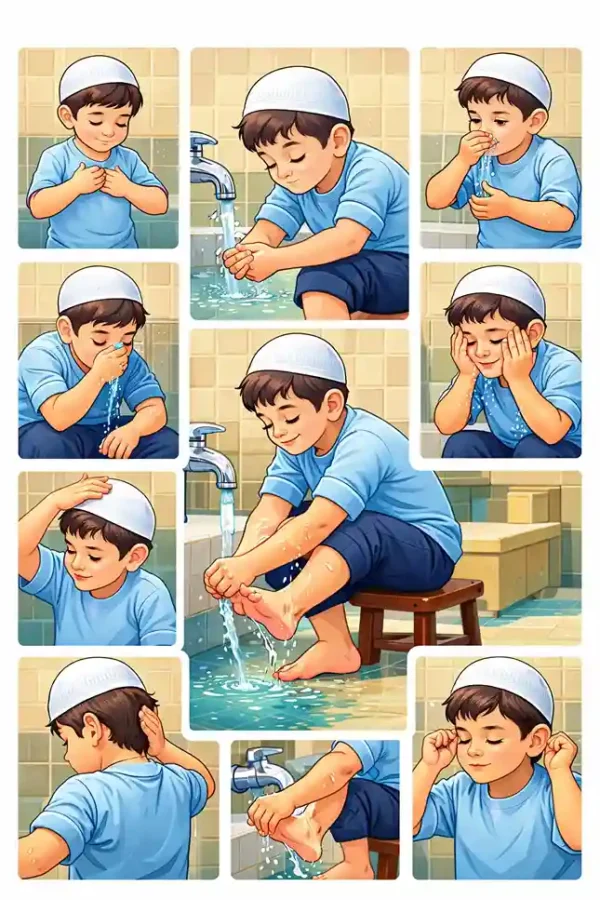
Below are all nine wudu steps for children, explained in language both parent and child can understand.
| # | Step | What to Do | Child-Friendly Explanation |
| 1 | Niyyah (Intention) | Hold the intention in your heart — no need to say it aloud | “Tell your heart you’re getting ready for Allah” |
| 2 | Bismillah | Say “Bismillah ir-Rahman ir-Raheem” | “Start with Allah’s name” |
| 3 | Wash hands | Start the wudu by cleaning each hand three times, including the area around the wrists. | “Clean hands, clean start” |
| 4 | Mouthwash (Madmadah) | Take water in the right hand, swirl it inside the mouth, spit it out — three times | “Swish the water around your mouth as if you’re giving your teeth a gentle rinse. “ |
| 5 | Nose rinse (Istinshaq & Istinthar) | Inhale water into the nose with the right hand, blow it out with the left — three times | “Sniff water in, blow it out” |
| 6 | Wash the face | From hairline to chin, from ear to ear — three times | “A clean face to meet Allah” |
| 7 | Wash arms to elbows | Right arm first, then left — three times each, fingers to elbow | “Right, then left — all the way to the bump on your arm” |
| 8 | Wipe the head and ears | Run wet hands from the front of the head to the back and return — once. Then wipe inside each ear with the index finger and outside with the thumb | “One smooth wipe front-to-back, then front again” |
| 9 | Wash feet to ankles | Right foot first, then left — three times each, with fingers between the toes | “Right foot, left foot — don’t forget between the toes!” |
One practical note parents often miss: the elbows and ankles must be included in the wash — not just washed up to them. The Prophet ﷺ warned:
“وَيْلٌ لِلأَعْقَابِ مِنَ النَّارِ”
“Woe to the heels (that are not washed properly) from the Fire.” (Sahih Muslim)
This is one of the most common mistakes in children’s wudu — washing the lower leg but leaving the heel dry.
Experience a Real Classroom
Curious about how we teach? This video offers a glimpse into a real class, showcasing our interactive approach, qualified teachers, and child-friendly learning experience.
Fun & Engaging Islamic Classes for Kids
Start your child’s journey today with interactive lessons designed to make learning Islam loved and easy.
Get Your Child a Free TrialHow Kids Can Do Wudu by Understanding the Fard and Sunnah Steps?
Understanding the difference between obligatory and recommended steps helps children learn what cannot be skipped and what earns extra reward when performed. The source materials distinguish these clearly.
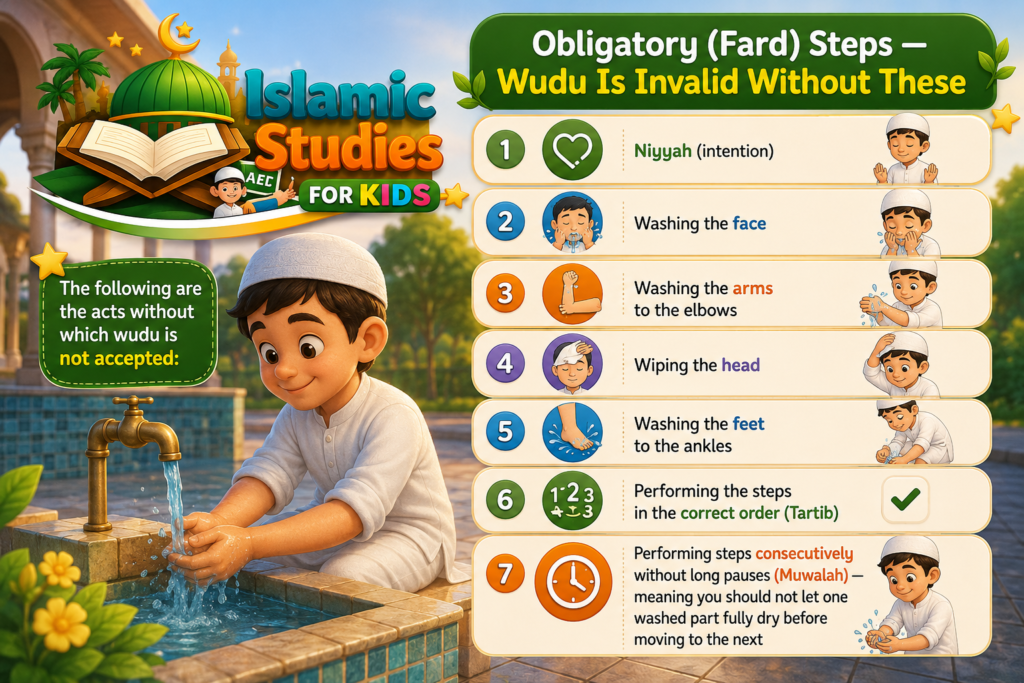
Obligatory (Fard) Steps — Wudu Is Invalid Without These
The following are the acts without which wudu is not accepted:
- Niyyah (intention)
- Washing the face
- Washing the arms to the elbows
- Wiping the head
- Washing the feet to the ankles
- Performing the steps in the correct order (Tartib)
- Performing steps consecutively without long pauses (Muwalah) — meaning you should not let one washed part fully dry before moving to the next.
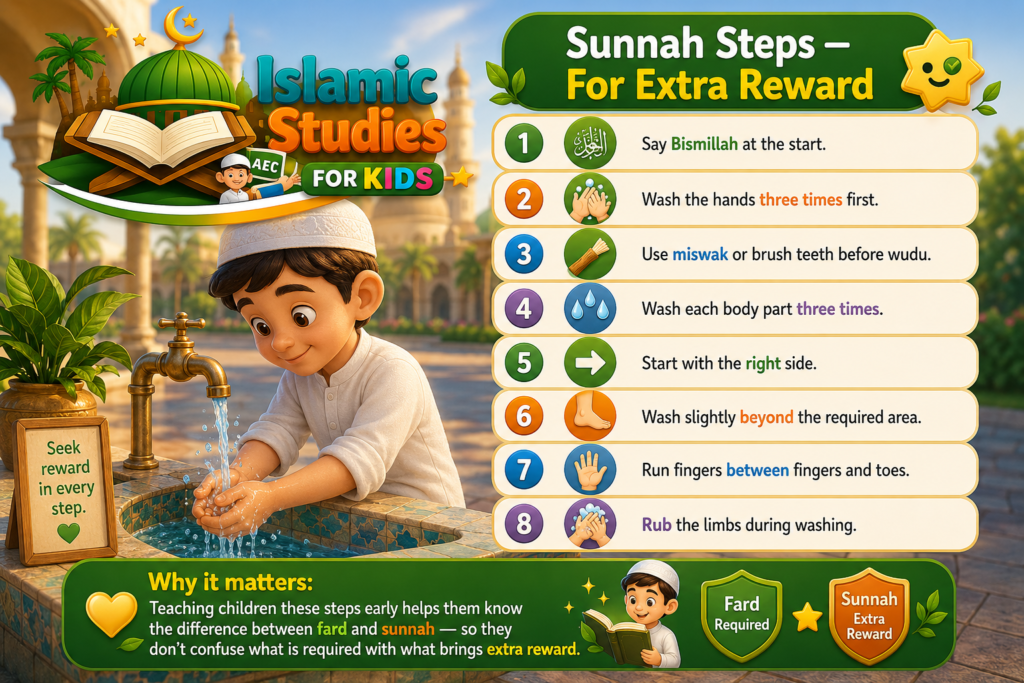
Sunnah Steps — Recommended for Extra Reward
These are acts the Prophet ﷺ performed regularly and which bring additional blessings:
- Saying Bismillah at the start
- Washing the hands three times at the beginning of wudu (before the face)
- Using a miswak (or brushing teeth before wudu)
- Washing each body part three times (the obligatory minimum is once)
- Starting with the right side (Tayamun) for hands and feet
- Extending the wash beyond the wrist on the arms and above the ankle on the feet (Itaalah al-Tahjeel)
- Running fingers between the fingers and toes (Takheel)
- Rubbing the limbs with the hand during washing (Dalk) — not just letting water run over them
Teaching children this distinction early prevents two common errors: either thinking wudu has failed when a sunnah step was missed, or assuming the fard steps are optional.
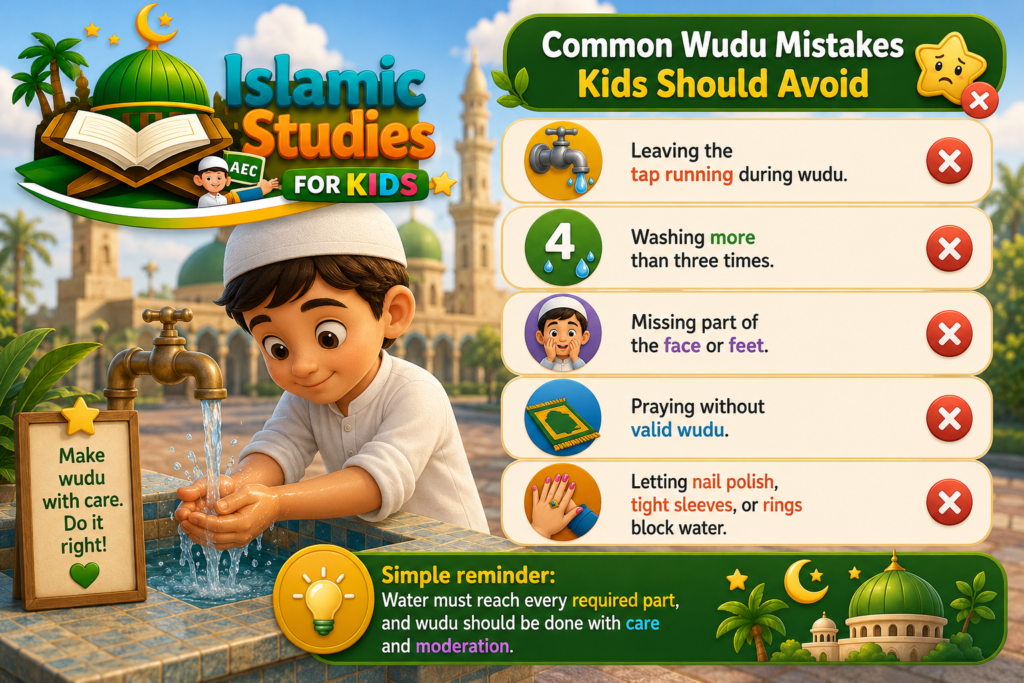
Common Wudu Mistakes Kids Should Avoid
The source materials list several errors worth addressing directly with children. These are the most frequent mistakes in practice:
- Leaving the tap running the whole time. Islam values conservation of water even during wudu. Teach children to cup water in their hands and turn off the tap between steps.
- Washing body parts more than three times. This is not rewarded and was discouraged by the Prophet ﷺ.
- Not covering the full area. The face must be washed from hairline to chin and ear to ear. Children often wash only the center of the face and miss the sides near the temples. The same applies to feet — the heel must be included.
- Praying without wudu. A prayer performed without valid wudu is not accepted, no matter how well-performed the prayer itself was.
- Nail polish or tight sleeves blocking water. Water must reach the skin. Any barrier — thick nail polish, tight bands, or rings that prevent water from reaching under them — makes that portion of wudu invalid.
The Dua Children Should Learn to Say After Wudu
When wudu is complete, the child says the Shahada followed by a special supplication. The Prophet ﷺ said:
مَا مِنْكُمْ مِنْ أَحَدٍ يَتَوَضَّأُ فَيُحْسِنُ الْوُضُوءَ، ثُمَّ يَقُولُ حِينَ يَفْرُغُ مِنْ وُضُوئِهِ: أَشْهَدُ أَنْ لَا إِلَهَ إِلَّا اللَّهُ وَحْدَهُ لَا شَرِيكَ لَهُ وَأَشْهَدُ أَنَّ مُحَمَّدًا عَبْدُهُ وَرَسُولُهُ، إِلَّا فُتِحَتْ لَهُ أَبْوَابُ الْجَنَّةِ الثَّمَانِيَةُ يَدْخُلُ مِنْ أَيِّهَا شَاءَ
“Whoever among you performs wudu properly and then says: ‘I bear witness that there is no god but Allah, alone with no partner, and I bear witness that Muhammad is His servant and His Messenger’ — the eight gates of Paradise will be opened for him to enter through whichever he wishes.” (Sahih Muslim, narrated by Umar ibn al-Khattab رضي الله عنه)
The full dua:
أَشْهَدُ أَنْ لَا إِلَهَ إِلَّا اللَّهُ وَحْدَهُ لَا شَرِيكَ لَهُ، وَأَشْهَدُ أَنَّ مُحَمَّدًا عَبْدُهُ وَرَسُولُهُ.
اللَّهُمَّ اجْعَلْنِي مِنَ التَّوَّابِينَ، وَاجْعَلْنِي مِنَ الْمُتَطَهِّرِينَ
Ash-hadu an la ilaha illa Allahu wahdahu la sharika lah, wa ash-hadu anna Muhammadan ‘abduhu wa rasuluh. Allahumma ij’alni min al-tawwabin, waj’alni min al-mutatahhirin.
“I bear witness that there is no god but Allah alone with no partner, and I bear witness that Muhammad is His servant and His Messenger. O Allah, make me among those who repent and make me among those who purify themselves.”
This dua is short enough for children aged six and above to memorize within a week of daily repetition.
What Breaks Wudu? Teaching Children the Nawaqid
Children need to know not just how to make wudu, but when they need to repeat it. The things that break wudu (nawaqid) are:
- Anything that exits from the two passages (urine, stool, wind).
- Deep sleep (where awareness is completely lost).
- Touching the private parts directly.
A practical teaching tip: when a child wakes from a nap, remind them gently that sleep breaks wudu, and they will need to renew it before prayer. This builds the habit without making it feel like a punishment.
Watch a Sample Lesson from Our Academy
Get a firsthand look at how our students learn Islamic values, Quran, and essential knowledge through engaging and interactive online classes. See why families trust Islamic Studies for Kids Academy.
Fun & Engaging Islamic Classes for Kids
Start your child’s journey today with interactive lessons designed to make learning Islam loved and easy.
Get Your Child a Free TrialHow to Make Wudu Fun for Kids Through Activities That Actually Work
Children memorize through repetition tied to positive emotion — not through being told once and expected to remember. Here are approaches that work, drawn from experience teaching young learners:
The Wudu Poster Method
- Place a laminated poster at sink height showing each step with an illustrated image and a number.
- Children follow it independently and feel proud doing so.
- After 4–6 weeks of daily wudu (five prayers a day), most children no longer need the poster.
The visual reference builds confidence during the learning period.
The Cut-and-Paste Ordering Game
Write each wudu step on a separate card with a matching illustration. Shuffle them and ask the child to put them in the correct order. This is particularly effective for ages 5–8.
Read Also: Respecting Parents in Islam for Kids
The Wudu Nasheed / Rhyme
Set the nine steps to a simple rhythm: “Hands, mouth, nose, face — arms and head in place — ears and feet, now you’re complete!” Children aged 4–7 retain sequences through rhythm far better than through instruction alone.
Read Also: How To Explain Who Is Allah To A Child
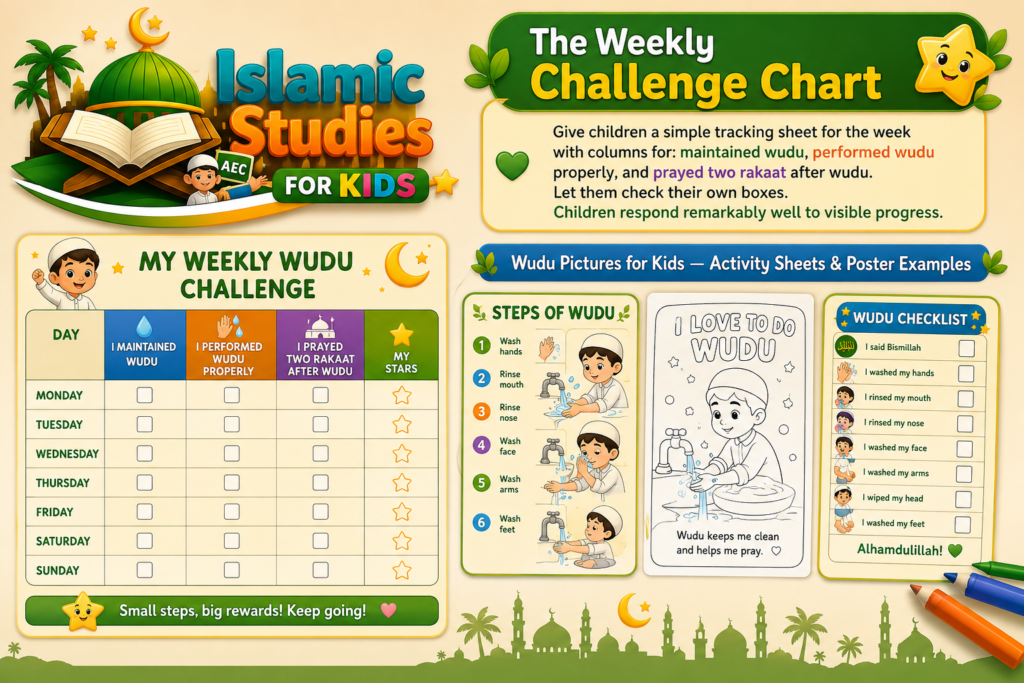
The Weekly Challenge Chart
Give children a simple tracking sheet for the week with columns for: maintained wudu, performed wudu properly, and prayed two rakaat after wudu.
Let them check their own boxes. Children respond remarkably well to visible progress.
Read Also: How to Teach Islam to Kids
Your Child Knows the Steps — But Are They Learning the Why?
Most children copy wudu from watching. The movements become habit — but the meaning, the fard versus sunnah distinction, and the spiritual connection behind every step often stay missing for years.
Structured learning with a qualified teacher closes that gap permanently.
Cleanliness in Islam for Kids Course
Built specifically for children ages 4 to 15, this course covers the complete Islamic system of Taharah:
- Wudu conditions
- Ghusl
- purification from ritual impurity
- The Sunnah practices of physical cleanliness.
Every session is delivered in English by Al-Azhar certified tutors trained in child-appropriate instruction.
Your child won’t just memorize the steps — they’ll understand why each one matters before Allah.

Book Your Child’s Free Trial Class
Islamic Studies for Kids Course Online
Once your child understands purification, the next step is building the full Islamic foundation — Aqeedah, Fiqh, Seerah, and Islamic manners — in one structured, progressive curriculum for ages 4 to 15.
Private 1-on-1 sessions. English instruction. Al-Azhar certified tutors. No prior Arabic required.

See Real Results From Real Families
Words describe what we offer — our graduates show what it actually builds.

Want to hear it directly from the families themselves?
What Families Say After Their First Semester
Words on a page describe what we offer. What families experience is what actually matters.
Children enrolled in Islamic Studies for Kids Academy consistently show measurable progress within the first semester — not just in knowledge, but in how they carry their faith daily:
“Real transformations from students who mastered the Quran and Islamic studies with our courses.”
— Hear From Our Graduates
The results families report most often:
- Children who begin making du’a independently — without being reminded.
- Improved Salah accuracy, including correct wudu sequence and prayer positions.
- Stronger Seerah literacy — children who can name prophets, retell their stories, and connect them to daily values.
- Daily Adab shifts — calmer responses, unprompted help, respectful language toward parents.
These aren’t outcomes from a single lesson. They’re what consistent, structured, expert-guided learning builds over time.
Book Your Child’s Free Trial Class

Nurture Your Child’s Islamic Knowledge with Our Islamic Studies for Kids Academy
Help your child build a strong Islamic foundation through engaging, age-appropriate, and interactive lessons designed to inspire faith, good character, and a love for Islam. Our experienced teachers guide children step by step, making Islamic learning enjoyable, practical, and easy to understand. Whether your child is just beginning or looking to deepen their knowledge, our comprehensive courses provide the perfect learning journey.
Our Islamic Studies Courses Include:
- Islamic Studies for Kids
- Islam Basics for Kids (Beginners)
- 5 Pillars of Islam for Kids
- 6 Pillars of Iman (Faith) for Kids
- Salah (Prayer) for Kids
- Wudu for Kids
- Dua for Kids
- Ramadan for Kids
- Zakat & Sadaqah for Kids
- Hajj for Kids
- Aqeedah (Islamic Belief) for Kids
- Islamic Manners & Akhlaq for Kids
- Good Deeds for Kids
- Cleanliness (Taharah) in Islam for Kids
- Angels in Islam for Kids
- Islamic History for Kids
- Seerah (Prophet’s Life) for Kids
- Prophets Stories for Kids
- Islamic Stories & Morals for Kids
- Fiqh for Kids (Islamic Jurisprudence Basics)
- Hadith for Kids
- Quran Tafseer Course for Kids
- Islamic Holidays & Events for Kids
- Islamic Identity for Kids
- Intensive Islamic Course for Kids
Enroll today and give your child the knowledge, values, and confidence to grow as a practicing Muslim with a strong connection to Allah and His teachings.
Fun & Engaging Islamic Classes for Kids
Start your child’s journey today with interactive lessons designed to make learning Islam loved and easy.
Get Your Child a Free TrialConclusion
Wudu steps for kids are more than a pre-prayer checklist — they are a child’s first act of worship each day, performed five times before every Salah.
Teaching children the correct sequence, what is obligatory versus recommended, what breaks wudu, and the powerful dua that follows gives them not just a physical routine but a meaningful connection to their faith.
The key to making it stick: consistency, positive reinforcement, and the right teaching tools. A poster at sink height, a weekly tracking chart, and a simple rhyme take children from confusion to confident practice faster than any single explanation can.
Start early, make it joyful, and remember — every correct wudu your child performs is an act of worship with rewards the Prophet ﷺ described as opening all eight gates of Paradise.
Frequently Asked Questions About Wudu for Kids
What are the wudu steps for kids in order?
The wudu steps in order are: 1) Intention (niyyah), 2) Say Bismillah, 3) Wash hands three times, 4) Rinse mouth three times, 5) Rinse nose three times, 6) Wash face three times, 7) Wash arms to elbows three times (right first), 8) Wipe head and ears once, 9) Wash feet to ankles three times (right first). End with the dua after wudu.
At what age should children start learning wudu?
Children can begin learning the wudu steps as early as age 4–5 through observation and imitation. Most children can perform all steps independently by ages 6–7 with regular practice.
Formal instruction tied to prayer should begin around age 7, as this is when the Prophet ﷺ instructed parents to encourage children toward Salah.
How many times is each body part washed in wudu?
Most body parts are washed three times. The head and ears are wiped only once. The minimum obligatory amount for each washed part is one time — the three repetitions are sunnah and earn additional reward.
What breaks a child’s wudu?
Wudu is broken by anything exiting the two passages (urine, stool, wind), by deep sleep, or by touching the private parts directly. When any of these occur before prayer, the child must renew their wudu.
Does a child need to say the niyyah for wudu out loud?
No. The intention (niyyah) is held in the heart and does not need to be spoken aloud. Saying “I intend to make wudu” verbally is not required and was not the regular practice of the Prophet ﷺ.
Simply being aware that one is performing wudu as an act of worship is sufficient.
What is the dua children should say after wudu?
After completing wudu, children say the Shahada followed by: “Allahumma ij’alni min al-tawwabin, waj’alni min al-mutatahhirin” — “O Allah, make me among those who repent and among those who purify themselves.”
The Prophet ﷺ said this dua opens all eight gates of Paradise for the one who recites it after a proper wudu (Sahih Muslim).
External Links



Leave a Reply