 Islamic Studies
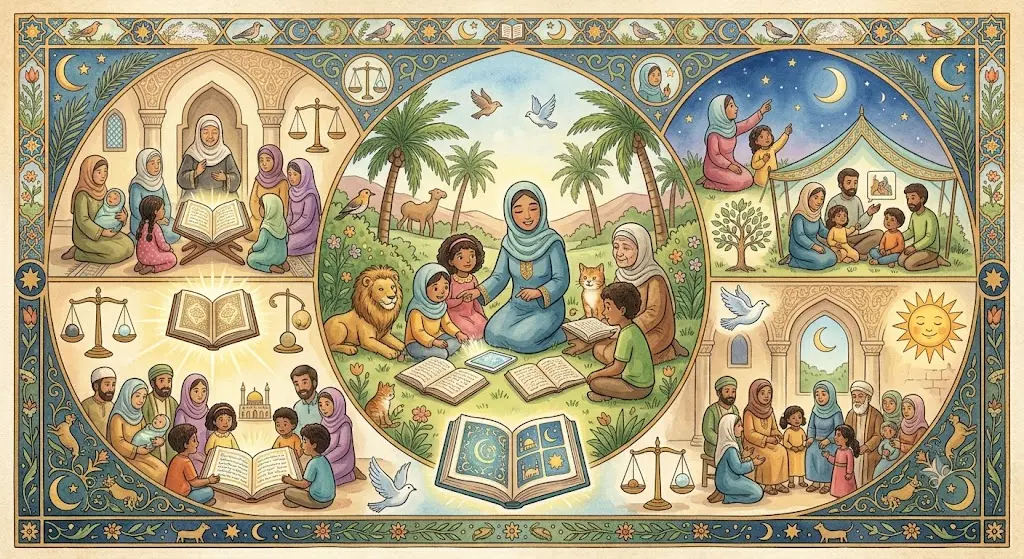
Every Muslim mother carries two responsibilities at once: raising children who love Allah, and continuing to grow in her own faith. Yet somewhere between homework, meals, and bedtime routines, her own Islamic learning quietly gets pushed to the end of the list.
The truth is, you don’t have to choose between being a present mother and a growing Muslim. The two are deeply connected. When you learn Islam as a Muslim mother, you don’t just fill your own heart — you become the living classroom your children learn from every day.
This guide gives you 10 concrete, realistic tips to learn Islam at home, deepen your understanding of the Quran and Sunnah, and pass that knowledge on naturally — even on your busiest days.
Learning Islam as a Muslim is not a one-time event — it is a lifelong practice. For mothers, this learning carries extra weight, because your understanding of the deen directly shapes what your children absorb at home.
The Prophet ﷺ made seeking knowledge an obligation on every Muslim, not just scholars. Your role as a mother gives your learning immediate, daily purpose.
1. Start with Calm — Because You Cannot Pour from an Empty Cup
The first step to learning Islam as a Muslim mother is protecting your inner state. Children are extraordinarily perceptive. Research in child development consistently shows that a mother’s emotional regulation directly affects her children’s sense of security — and Islamic tradition said this long before modern psychology.
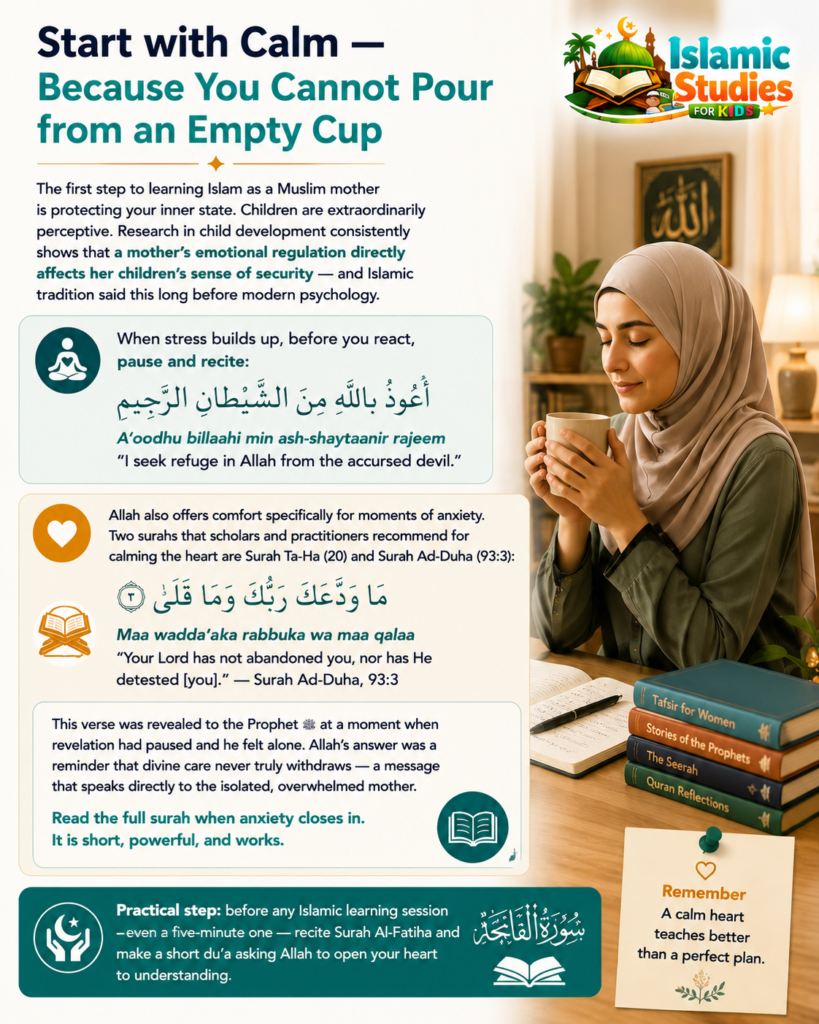
When stress builds up, before you react, pause and recite:
أَعُوذُ بِاللَّهِ مِنَ الشَّيْطَانِ الرَّجِيمِ
A’oodhu billaahi min ash-shaytaanir rajeem “I seek refuge in Allah from the accursed devil.”
Allah also offers comfort specifically for moments of anxiety. Two surahs that scholars and practitioners recommend for calming the heart are Surah Ta-Ha (20) and Surah Ad-Duha (93:3):
مَا وَدَّعَكَ رَبُّكَ وَمَا قَلَىٰ
Maa wadda’aka rabbuka wa maa qalaa “Your Lord has not abandoned you, nor has He detested [you].” — Surah Ad-Duha, 93:3
This verse was revealed to the Prophet ﷺ at a moment when revelation had paused and he felt alone. Allah’s answer was a reminder that divine care never truly withdraws — a message that speaks directly to the isolated, overwhelmed mother. Read the full surah when anxiety closes in. It is short, powerful, and works.
Practical step: before any Islamic learning session — even a five-minute one — recite Surah Al-Fatiha and make a short du’a asking Allah to open your heart to understanding.
2. Introduce Good Habits at an Early Age — for You and Your Children
Learning how to learn more about Islam as a Muslim begins with structuring your day around the deen, not squeezing the deen into your day. Good habits planted early — in you and in your children — grow into a natural Islamic household rhythm.
The Prophet ﷺ said:
كُلُّكُمْ رَاعٍ وَكُلُّكُمْ مَسْؤُولٌ عَنْ رَعِيَّتِهِ Kullukum raa’in wa kullukum mas’oolun ‘an ra’iyyatih “Each of you is a shepherd, and each of you is responsible for his flock.” — Narrated by Ibn Umar (رضي الله عنهما), recorded in Sahih al-Bukhari, 893 and Sahih Muslim, 1829
The hadith continues: “A woman is the shepherd of her husband’s household and is responsible for her flock.” This is not a burden — it is a rank. It means the Muslim mother holds genuine authority and genuine accountability over what the home produces. Your learning directly shapes your flock.
Practical steps for building early habits:
- Read aloud to children from Islamic picture books from infancy — they absorb language and atmosphere before they understand words
- Replace background TV with Quran recitation or Islamic nasheeds during playtime
- Make wudu a shared, calm ritual rather than a rushed obligation
If you want to build the Quran specifically into your children’s daily rhythm from the start, the Quran courses for mothers give you a structured starting point — so you and your children are learning together, not separately.
3. Introduce Islam to Your Children in a Friendly Way — While You’re Still Learning It Yourself
One of the most common mistakes Muslim mothers make is waiting until they “know enough” to teach their children. You don’t need to know everything to begin. You need to be one step ahead, and learning together is often more powerful than teaching from above.
The best entry point for both of you: bedtime duas. These short supplications are the gentlest form of Islamic education because they carry meaning, rhythm, and repetition — the three conditions for deep learning in young children.
Start with:
بِسْمِكَ اللَّهُمَّ أَمُوتُ وَأَحْيَا Bismika Allahumma amootu wa ahyaa “In Your name, O Allah, I die and I live.” — Narrated by Hudhayfah (رضي الله عنه), recorded in Sahih al-Bukhari, 6324
This dua teaches children that sleep is a trust given to Allah each night and returned each morning — a profound concept, packaged in seven words. As you teach it, you are also learning it more deeply yourself.
Specialist tip: don’t explain the dua to very young children in abstract theological terms. Connect it to what they already know: “We say this so Allah keeps us safe while we sleep — like He keeps the stars safe at night.”
4. Talk to Your Children as Respected Individuals — and Let That Change How You Talk to Allah
Communicating with children at their level — sitting at their height, speaking plainly, listening before responding — is not just good parenting. It is Islamic adab (courtesy).
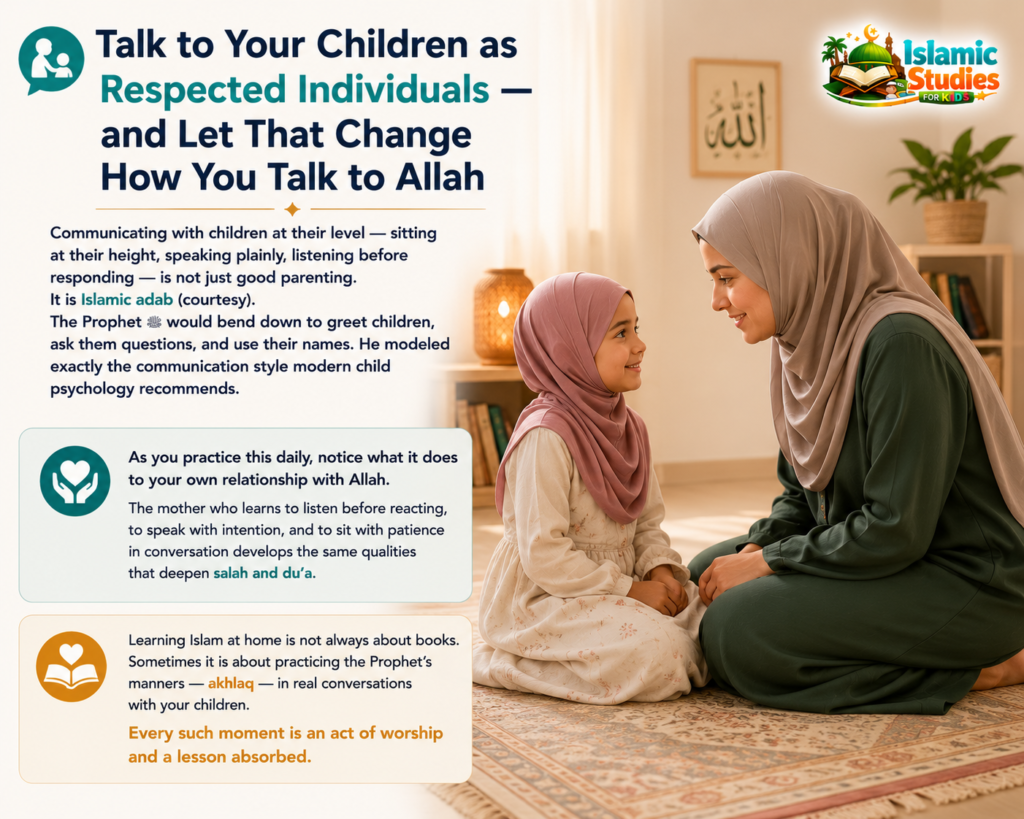
The Prophet ﷺ would bend down to greet children, ask them questions, and use their names. He modeled exactly the communication style modern child psychology recommends.
As you practice this daily, notice what it does to your own relationship with Allah. The mother who learns to listen before reacting, to speak with intention, and to sit with patience in conversation develops the same qualities that deepen salah and du’a.
Learning Islam at home is not always about books. Sometimes it is about practicing the Prophet’s manners — akhlaq — in real conversations with your children. Every such moment is an act of worship and a lesson absorbed.
Read also: The Story of Satan in the Quran for Kids
5. Use Positive Reinforcement — and Understand Why Islam Chose It First
Islam arrived with a complete framework of positive motivation more than 1,400 years before behavioral psychology named it. Allah consistently reminds believers of reward before mentioning consequence.
The Quran opens with mercy (Al-Rahman, Al-Raheem) before any mention of punishment.
The Prophet ﷺ said:
يَسِّرُوا وَلَا تُعَسِّرُوا، وَبَشِّرُوا وَلَا تُنَفِّرُوا Yassiroo wa laa tu’assiroo, wa bashshiroo wa laa tunaffiroo “Make things easy and do not make them difficult. Give glad tidings and do not drive people away.” — Narrated by Anas ibn Malik (رضي الله عنه), recorded in Sahih al-Bukhari, 69
Apply this to how you teach your children Islam — and to how you learn yourself. Don’t make your personal Islamic learning a source of guilt. Celebrate every surah memorized, every dua learned, every prayer prayed on time. Progress in the deen is built on encouragement, not self-punishment.
Experience a Real Classroom
Curious about how we teach? This video offers a glimpse into a real class, showcasing our interactive approach, qualified teachers, and child-friendly learning experience.
Fun & Engaging Islamic Classes for Kids
Start your child’s journey today with interactive lessons designed to make learning Islam loved and easy.
Get Your Child a Free Trial6. Integrate Islamic Learning into Your Lifestyle — Don’t Quarantine It
Learning Islam for mothers fails when it is treated as a separate activity that competes with daily life. The most durable Islamic education is integrated — woven into cooking, driving, shopping, and resting.
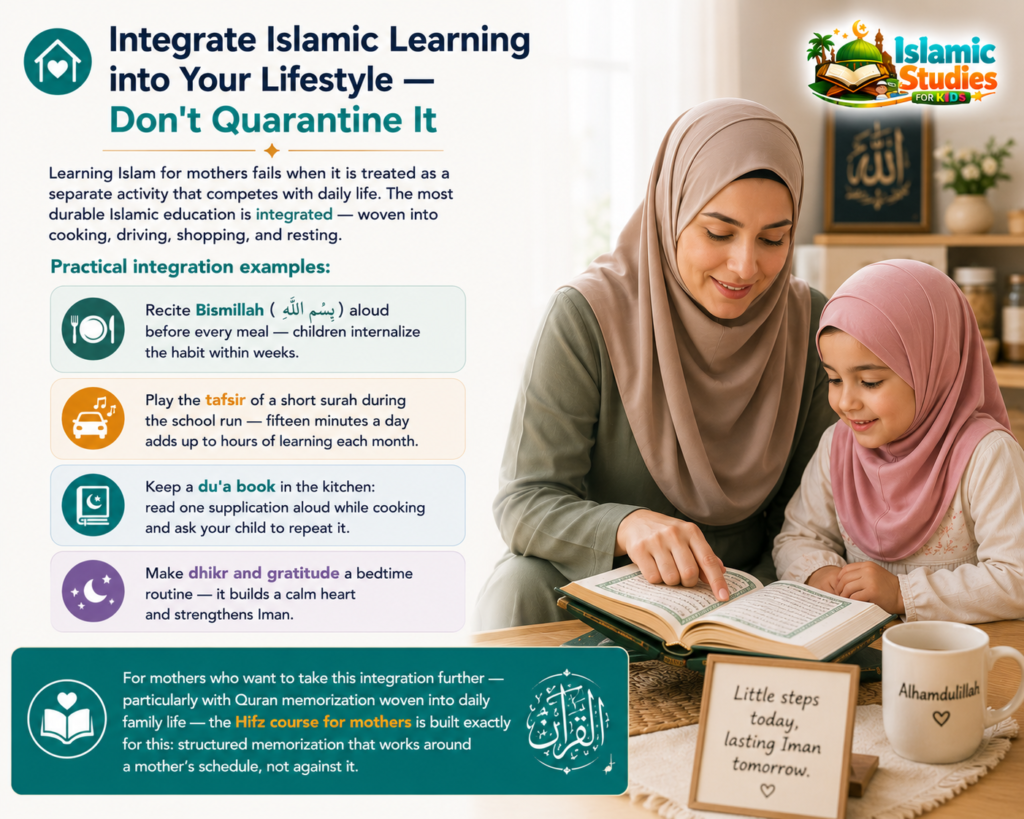
Practical integration examples:
- Recite Bismillah (بِسْمِ اللَّهِ) aloud before every meal — children internalize the habit within weeks
- Play the tafsir of a short surah during the school run — fifteen minutes a day adds up to hours of learning each month
- Keep a du’a book in the kitchen: read one supplication aloud while cooking and ask your child to repeat it
For mothers who want to take this integration further — particularly with Quran memorization woven into daily family life — the Hifz course for mothers is built exactly for this: structured memorization that works around a mother’s schedule, not against it.
7. Keep the End Goal in Front of You
Every Islamic learning effort a mother makes is an investment in a child’s eternal future. This is not motivational language — it is Islamic theology. The Prophet ﷺ said:
إِذَا مَاتَ الإِنْسَانُ انْقَطَعَ عَنْهُ عَمَلُهُ إِلاَّ مِنْ ثَلاَثَةٍ إِلاَّ مِنْ صَدَقَةٍ جَارِيَةٍ أَوْ عِلْمٍ يُنْتَفَعُ بِهِ أَوْ وَلَدٍ صَالِحٍ يَدْعُو لَهُ
Idhaa maata al-insaanu inqata’a ‘anhu ‘amaluhu illaa min thalaatha: illaa min sadaqatin jaariyatin, aw ‘ilmin yuntafa’u bih, aw waladin saalihin yad’oo lah “When a person dies, all their deeds are cut off except three: an ongoing charity, knowledge that benefits others, or a righteous child who prays for them.” — Narrated by Abu Hurairah recorded in Sahih Muslim, 1631
Two of these three — beneficial knowledge and a righteous child — are directly in the hands of the Muslim mother. This hadith is not a pressure. It is a permission slip to take your own Islamic learning seriously, because it is itself an act of sadaqah jaariyah (ongoing charity) that outlives you.
Decision framework: when you feel guilty for taking thirty minutes to study Islam while the house is imperfect, remember: that thirty minutes counts as worship, as charity, and as an investment in your children’s akhirah.
8. Be Consistent and Fair with Yourself — Not Just with Your Children
Mothers often apply perfect fairness standards to their children while subjecting themselves to crushing inconsistency: they study Islam when they “feel inspired” and abandon it when life gets busy. Sustainable learning requires the same steadiness you expect from your children’s routines.
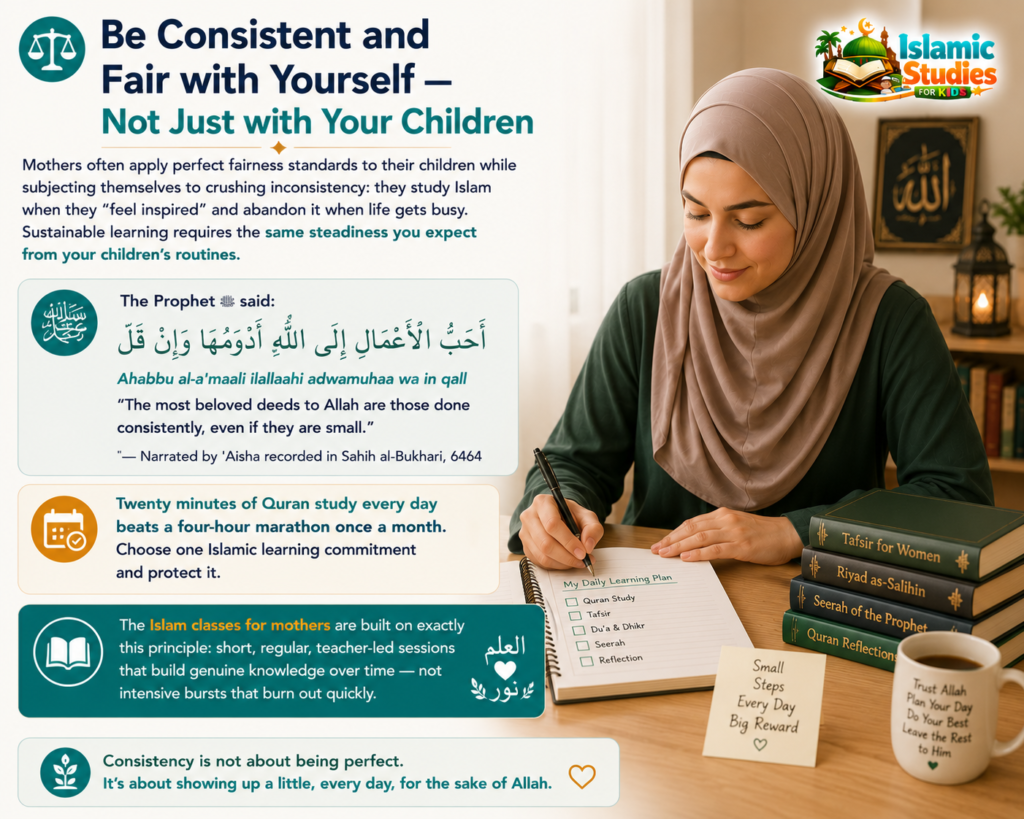
The Prophet ﷺ said:
أَحَبُّ الأَعْمَالِ إِلَى اللَّهِ أَدْوَمُهَا وَإِنْ قَلَّ
Ahabbu al-a’maali ilallaahi adwamuhaa wa in qall “The most beloved deeds to Allah are those done consistently, even if they are small.” — Narrated by ‘Aisha recorded in Sahih al-Bukhari, 6464
Twenty minutes of Quran study every day beats a four-hour marathon once a month. Choose one Islamic learning commitment and protect it. The Islam classes for mothers are built on exactly this principle: short, regular, teacher-led sessions that build genuine knowledge over time — not intensive bursts that burn out quickly.
9. Hold to the Rules of Your Learning — Even When You Don’t Feel Like It
Structured Islamic learning requires rules as much as children’s routines do. If you’ve committed to an online Islamic course for mothers, attend it even when you’re tired. If you’ve committed to reading one page of tafsir before bed, do it even on hard nights. The deen rewards persistence most in exactly the moments it feels hardest.
Structure your Islamic learning like this:
- Fix a time — same time each day, even for fifteen minutes (after Fajr is the most protected and the most blessed)
- Fix a subject — rotating between Quran, hadith, fiqh, and seerah prevents fatigue and builds a complete understanding
- Fix accountability — a learning partner, a course with a teacher, or a family reading circle keeps you consistent when motivation drops
The mother who learns how to start learning Islam systematically — not just inspirationally — is the one whose knowledge actually compounds over years.
Read also: Prophet Muhammad Story for Muslim Kids
10. Master the Art of Distraction — and Redirect It Toward the Deen
Children are easily distracted, and so are adults. Rather than fighting distraction, the skilled Muslim mother learns to redirect it. When your child is restless, offer them an Islamic puzzle or audio Quran rather than a cartoon.
The same principle applies to your own learning. When you feel pulled away from a difficult topic — Arabic grammar, fiqh of prayer, memorization — distract yourself toward something easier but still Islamic. Listen to a short tafsir podcast. Read a simplified hadith. The key is staying in the field, not leaving it.
Original framework — the “Redirect, Don’t Resist” method: instead of fighting distraction with discipline alone, design your environment so that the path of least resistance leads back to Islamic content. Put Quran.com on your home screen. Leave your hadith book open on the kitchen table. Make the default choice the Islamic one.
Watch a Sample Lesson from Our Academy
Get a firsthand look at how our students learn Islamic values, Quran, and essential knowledge through engaging and interactive online classes. See why families trust Islamic Studies for Kids Academy.
Start Learning Islam Today with islamic studies for kids
You don’t need to overhaul your schedule to learn Islam as a Muslim mother. You need the right structure, the right teacher, and a plan that fits your real life.
islamic studies for kids offers online Islamic courses for mothers and children — taught by qualified instructors, flexible around your timetable, and designed to grow your knowledge while connecting your family.
Our Courses for Mothers:
- Islamic Studies Classes for Mothers
- Arabic Course for Mothers
- Quran Reading Course for Mothers
- Quran Hifz (Memorization) for Mothers
- Tajweed Course for Mothers
Enroll today and begin your journey of learning, worship, and spiritual growth from the comfort of your home.
Fun & Engaging Islamic Classes for Kids
Start your child’s journey today with interactive lessons designed to make learning Islam loved and easy.
Get Your Child a Free TrialConclusion
Learning Islam as a Muslim mother is not a luxury — it is the foundation of the Muslim home. Every tip in this guide connects to one central truth: your own Islamic knowledge is the single greatest asset your children have. A mother who is calm (Tip 1), consistent (Tip 8), and committed to structured learning (Tip 9) does not just raise better children — she becomes a better Muslim herself, every single day.
The Prophet ﷺ called the mother the shepherd of her household. Shepherds know their terrain. Start where you are, study what you can, and trust that Allah rewards every step taken toward His knowledge — no matter how small.
Frequently Asked Questions
How do I start learning Islam as a Muslim mother with no time?
Start with fifteen minutes after Fajr — the most protected and focused part of the day. Choose one subject: either one page of Quran with translation, or one hadith from Riyad al-Salihin. Consistency over a short time beats irregular long sessions. Most online Islamic courses for mothers are now available in short modules built for busy schedules.
Can I learn Islam at home without a formal teacher?
You can begin with high-quality resources — Quran.com for tafsir, sunnah.com for authenticated hadith, and structured Islamic courses online. However, for fiqh (Islamic law), Quran memorization, and Tajweed, a qualified teacher prevents mistakes that are difficult to undo later. A teacher also provides accountability, which sustains learning.
What is the best subject to study first when learning Islam?
Begin with ‘Aqeedah (Islamic belief) — understanding who Allah is, the role of the Prophet ﷺ, and the pillars of faith. This gives every other subject its foundation. After ‘Aqeedah, move to the fiqh of the five daily prayers, which is the most immediate practical need. Quran recitation can run alongside both from day one.
How do I teach Islam to my children when I’m still learning myself?
Teach one step ahead. Learn a dua today, teach it to your children tomorrow. Read a story from the Quran tonight, narrate it at breakfast. Children don’t need a perfect teacher — they need a sincere one. Learning visibly in front of your children also models the value of seeking knowledge as a lifelong practice.
Are online Islamic courses for mothers effective?
Yes — provided they include a live teacher, structured curriculum, and regular review. Self-paced video courses offer flexibility but often lack accountability. The most effective format combines scheduled live sessions (even once a week) with structured self-study in between. islamicstudiesforkids.com offers exactly this kind of structured, teacher-led learning for mothers.
How long does it take to learn Islam properly?
Islamic knowledge has no endpoint — the Prophet ﷺ was still receiving revelation until the end of his life. A practical goal for a Muslim mother is to achieve functional competence within two years: understanding the Quran with basic tafsir, knowing the fiqh of daily worship, and having a working knowledge of core hadith collections. This is fully achievable with thirty minutes of daily study.


Leave a Reply