 For Parents
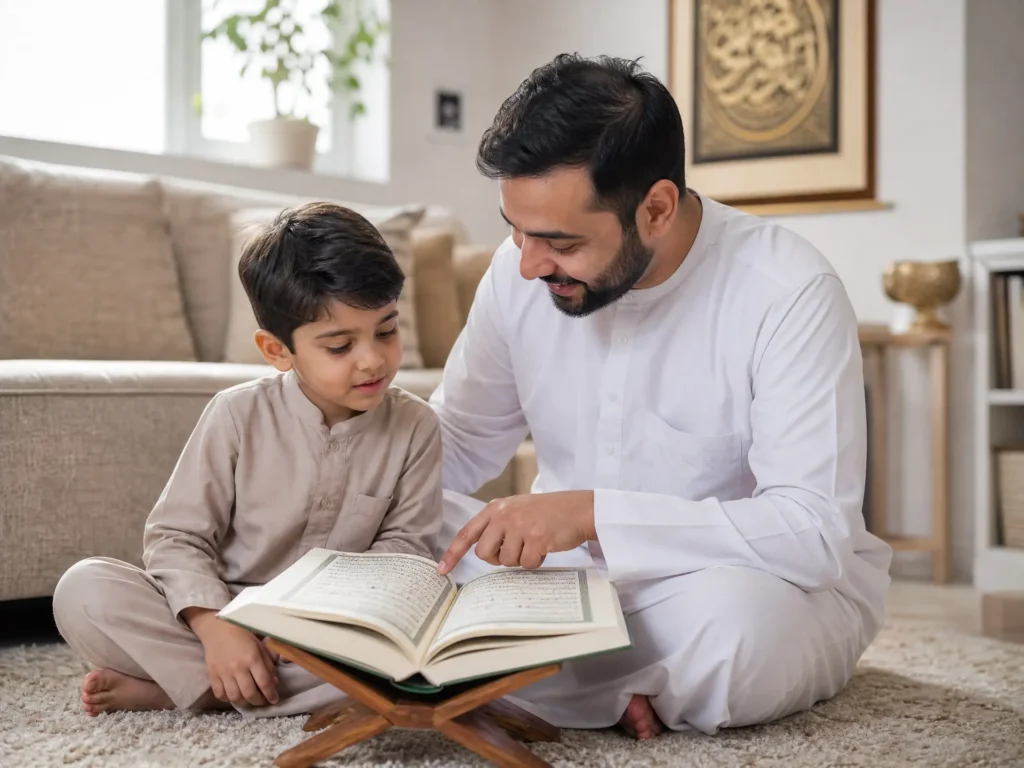
Learning how to teach Islam to kids is one of the most rewarding responsibilities a parent takes on — and often one of the most confusing. Your child is curious, full of energy, asks questions you didn’t expect, and learns far more from what they see than from what they’re told.
The good news is that teaching faith to a child is not about long lectures or early memorization drills. It’s about building a warm relationship with the religion first, then layering in worship and knowledge as the child grows.
What you’ll learn in this article?
- The one principle that should come before any rule or ritual you teach.
- A clear age-by-age map: what to teach at ages 3–6, from age 7, and at 10 and up.
- Fun, hands-on ways to teach Islam that hold a child’s attention.
- How to weave faith into ordinary daily moments at home.
- How to answer hard questions, including questions about children of other faiths.
1. Teach Islam to Kids by Starting With Love Not Rules
The starting point for teaching Islam to kids is emotional, not academic. A child who loves Allah and His Messenger ﷺ will want to learn; a child who only fears punishment will comply for a while, then resist. Building that affection early is what makes everything else possible.
This shapes a simple rule worth holding onto: love before law, model before instruct. Get the feeling right first, and the practice follows more naturally.
Why Does Loving Allah Come Before Learning the Rules?
A young child cannot grasp detailed rulings, but they can absolutely understand that Allah is the Creator who provides everything they enjoy and protects them.
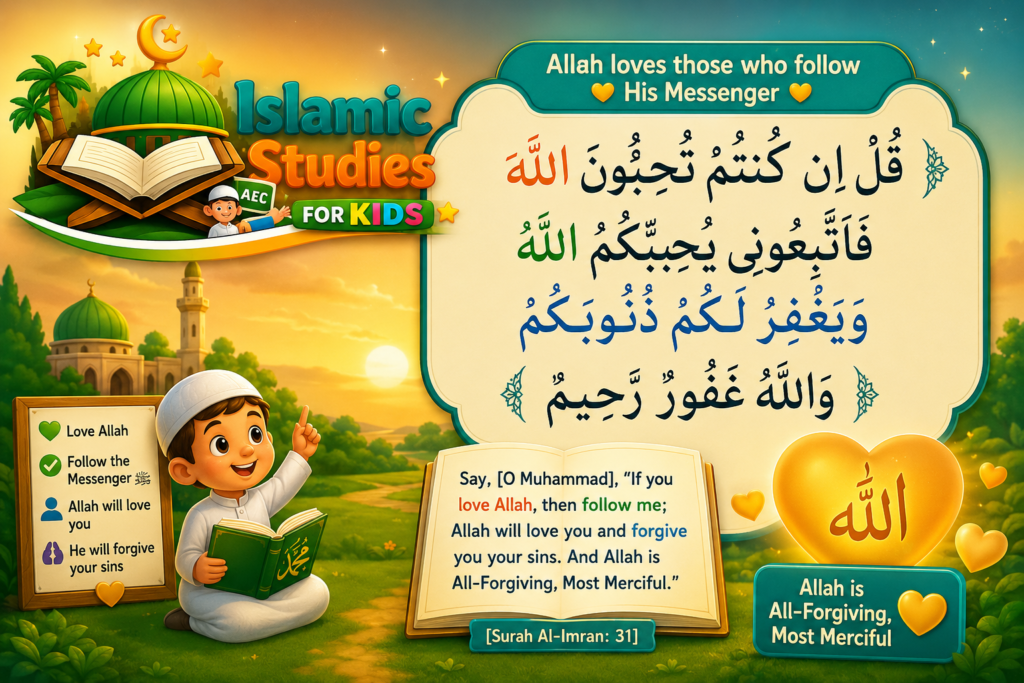
The Quran ties love of Allah directly to following the Prophet ﷺ: “Say, if you love Allah, then follow me, and Allah will love you”
﴿قُلْ إِن كُنتُمْ تُحِبُّونَ اللَّهَ فَاتَّبِعُونِي يُحْبِبْكُمُ اللَّهُ وَيَغْفِرْ لَكُمْ ذُنُوبَكُمْ ۗ وَاللَّهُ غَفُورٌ رَّحِيمٌ﴾[Surah Al-Imran: 31]
In practice, this means leading with mercy rather than fear. Instead of warning a five-year-old about the Fire, point them toward the reward, the beauty of Paradise, and Allah’s care for them. The goal at this stage is attraction, not pressure.
2. Children Learn by Copying the Role Models Around Them
Children absorb behavior far more than instruction. When a child watches a parent pray consistently, speak honestly, and mention Allah in daily life like saying:
- Alhamdulillah over good news.
- Bismillah before eating.
They treat those habits as the normal way to live.
One of the biggest parenting mistakes is asking children to pray regularly when they rarely see that habit practiced at home. Children learn most from what they observe every day.
This is where guided support can make a difference: a steady and caring teacher helps reinforce the habits parents begin, which is exactly what a well-designed kids’ program aims to do
3. Teaching Children Islam by Age in a Stage by Stage Map
Teaching children Islam works best when it matches a child’s developmental stage rather than treating every age the same. Pushing too hard too early creates resistance; waiting too long misses the years when belief takes root most easily.
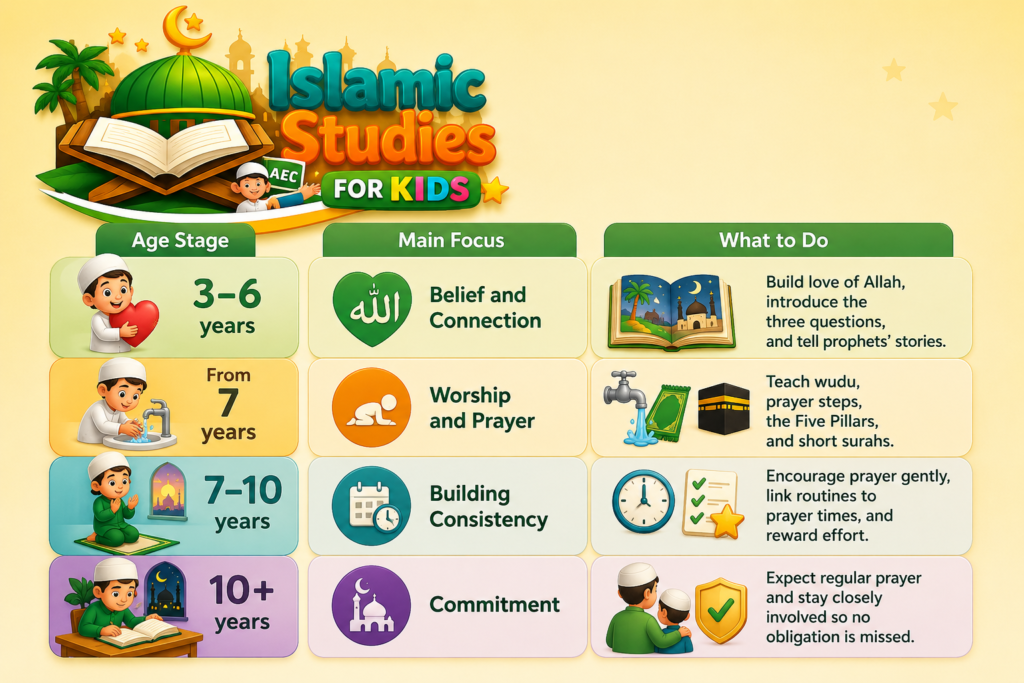
Here is a simple map of what to prioritize at each stage, before we look at each one in detail.
| Age stage | Main focus | What to do |
| 3–6 years | Belief and connection | Build love of Allah, introduce the three questions, tell prophets’ stories |
| From age 7 | Worship and prayer | Help children learn short surahs gradually and confidently. |
| 7–10 years | Building consistency | Encourage prayer gently, link daily routines to prayer times, reward effort |
| 10 years and up | Commitment | Expect regular prayer, stay closely involved, don’t let any obligation slip |
Building Belief and Connection in Children Ages 3 to 6
This is the planting stage, focused on creed (aqeedah) in its simplest form. The classic foundation is teaching a child to answer three questions:
- Who is your Lord? (My Lord is Allah).
- What is your religion? (My religion is Islam).
- Who is your prophet? (Muhammad ﷺ).
Reinforce this through gratitude and stories. Connect everyday blessings to Allah, and tell the stories of the prophets in a lively, age-appropriate way, drawing out a single value each time — honesty, trust, courage. Keep it warm, short, and frequent rather than long and formal.
Experience a Real Classroom
Curious about how we teach? This video offers a glimpse into a real class, showcasing our interactive approach, qualified teachers, and child-friendly learning experience.
Fun & Engaging Islamic Classes for Kids
Start your child’s journey today with interactive lessons designed to make learning Islam loved and easy.
Get Your Child a Free TrialIntroducing Worship and Prayer at Age 7 and Up
The Prophet ﷺ instructed parents to teach children to pray at the age of seven (reported by Abu Dawud), which marks the natural point to begin worship.
Teach wudu and the prayer steps gradually, without expecting full commitment yet — at this stage the child is learning, not obligated.
Small, concrete tools work well:
- Give the child their own little prayer mat.
- Teach them short surahs to recite.
- Offer warm encouragement when they take part.
Reading the Quran starts here too, beginning with the short surahs alongside simple explanations of their meaning.
Encouraging Consistency in Children Ages 10 and Up
By around ten, the habits built earlier either hold or fade — which is why the previous years matter so much. Here, stay involved and don’t let obligations slip, while continuing the encouragement rather than harshness that has worked all along.
A practical tip from this stage: anchor prayer to existing routines. “We’ll have lunch after Dhuhr” or “we’ll go to the park after Maghrib” ties worship to the rhythm of the day, so prayer becomes a fixed point rather than an interruption.
4. Teach A Child About Islam Through Daily Life
The most durable way to teach a child about Islam is to fold it into the ordinary moments of the day, rather than setting it apart as a separate “lesson time.” Children practice what they learn in real routines.
These small, repeated habits are easy to build in:
- At mealtimes — teach Bismillah before eating and Alhamdulillah after, and explain that Allah is the One who provides the food.
- At bedtime and waking — teach the simple daily adhkar tied to each action, like the sleeping supplication.
- During good moments — when the child gets something they love, prompt them to thank Allah for it.
- During kind acts — when they help someone, connect that behavior to what Islam loves and rewards.
Done consistently, these turn belief into a lived reflex. The child grows up sensing that Allah is present in the details of their day, which is a far stronger foundation than memorized facts alone.
5. Use Fun Ways to Teach Islam and Interactive Activities That Stick
Some of the most effective and fun ways to teach Islam are hands-on activities, because children learn and remember far more through play and doing than through passive listening. Active involvement keeps an energetic child engaged and locks the information in.
Before reaching for these, set up the activity with a quick, warm introduction so the child knows what they’re learning. Then try options like these:
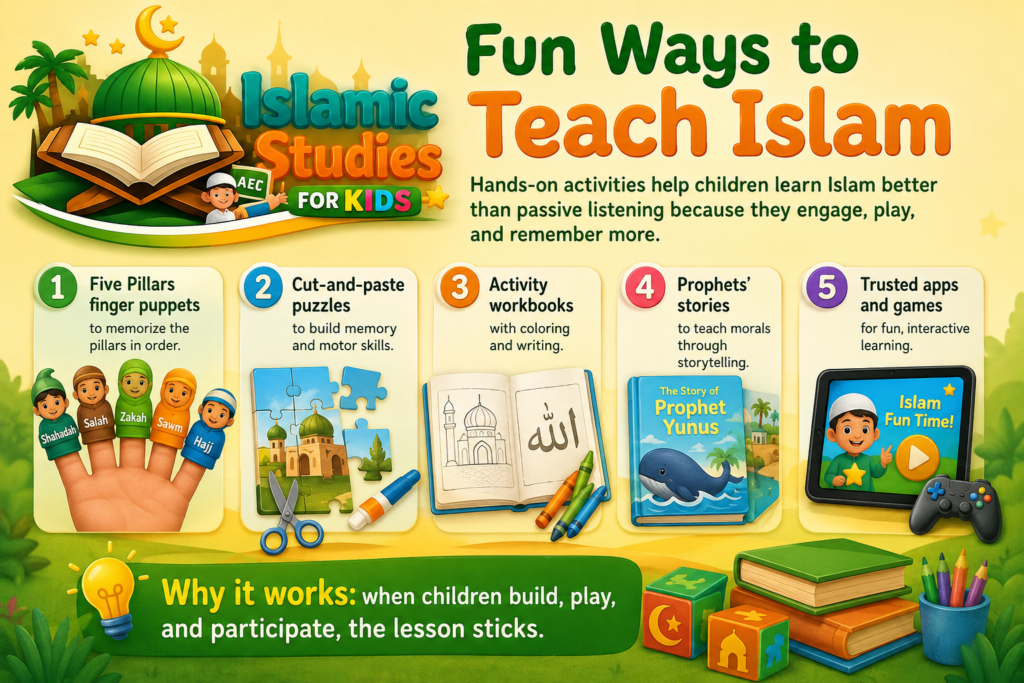
- Five Pillars finger puppets — a small puppet for each finger, one per pillar, recited together to memorize the five pillars in order.
- Cut-and-paste pillar puzzles — the child cuts pieces and assembles them in the correct order, training both motor skills and memory at once.
- Activity workbooks — coloring and writing pages that pair an explanation with a practical task, ideal for slightly older children.
- Prophets’ stories — children connect with characters and events more than with direct explanation, so stories carry morals naturally.
- Trusted apps and games — interactive apps designed for children that present Quran stories and lessons in an engaging format, used in moderation.
The principle behind all of these: when a child builds something or plays a role, the lesson becomes theirs. That’s also why structured, activity-based programs outperform lecture-style teaching for young learners — and why guided kids’ classes can take real pressure off busy parents.
6. Teaching Kids About Islam at Home Through Values and Manners
Teaching kids about Islam at home goes well beyond worship — it includes the character and manners (akhlaq) that Islam treats as central. These are learned habits, not instincts, so they need patient, repeated nurturing.
Honoring parents (birr al-walidayn) is a clear example, ranked in the hadith of Ibn Mas’ud just after prayer on time among the deeds most beloved to Allah (reported by Bukhari and Muslim). Children learn it on two levels at once:
- Through how you treat them — give instructions gently, keep the relationship warm and respectful, and praise their good behavior so they want to keep it.
- Through how they see you treat your own parents — speaking to them kindly, caring for their comfort, and visiting them with your child alongside you.
Alongside this, teach the daily adhkar, encourage only good speech, and explain why something is forbidden rather than simply banning it — that Islam never prohibits anything without wisdom behind it.
Read Also: Wudu Steps for Kids
7. Explain Islam to a Child When They Ask Hard Questions
Knowing how to explain Islam to a child includes being ready for the unexpected questions — and how you respond matters as much as the answer itself. The most important thing is to welcome the question warmly, listen well, and answer honestly at the child’s level.
A real example:
A child in school may notice classmates of other faiths leaving for separate religious lessons and ask, “What does Christian mean?” or “Why am I a Muslim?” Rather than showing alarm, answer simply and confidently.
Speak about the one Creator who provides and deserves worship, that He has no partner and no son, and that the messengers were all chosen by Allah to guide people. Frame the child’s own faith as something beautiful and secure.
Two practitioner notes to keep in mind:
- If you’re genuinely busy, it’s better to apologize and promise to answer later — even “when you’re older you’ll understand this part” — than to brush the child off. The openness you show shapes whether they keep coming to you.
- Keep the home an attractive, positive environment for faith. A child who associates Islam with warmth and answers rarely drifts toward what others offer through sweets and gifts alone.
Read Also: Respecting Parents in Islam for Kids
Watch a Sample Lesson from Our Academy
Get a firsthand look at how our students learn Islamic values, Quran, and essential knowledge through engaging and interactive online classes. See why families trust Islamic Studies for Kids Academy.
Fun & Engaging Islamic Classes for Kids
Start your child’s journey today with interactive lessons designed to make learning Islam loved and easy.
Get Your Child a Free TrialRead Also: How To Explain Who Is Allah To A Child
8. Build Your Child’s Islamic Foundation with Trusted Guidance
You know what to teach and when to teach it. The real challenge is staying consistent — and that’s exactly where most parents need support.
Islamic Studies for Kids Academy provides the structure your child needs through the Islamic Studies for Kids Course Online, built around the same principles this article covers:
- Aqeedah, Fiqh, Seerah & Islamic Manners — a complete, age-appropriate curriculum for children ages 4 to 15.
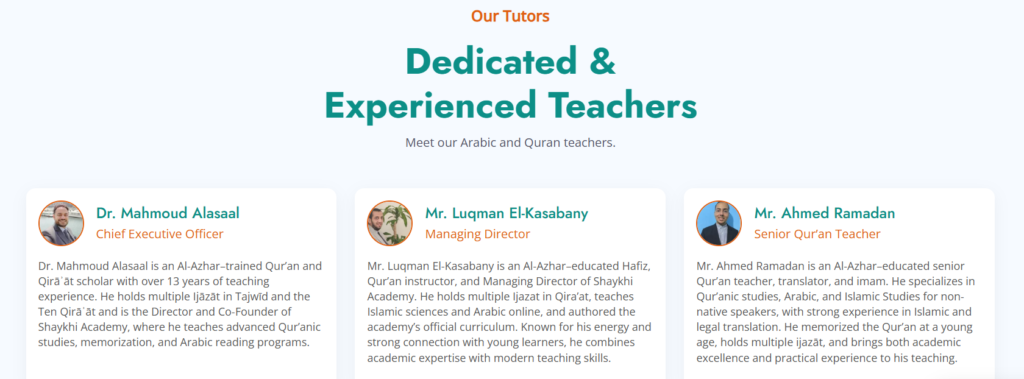
- Al-Azhar Certified Tutors — academically credentialed scholars trained in child-friendly teaching methods.
- Private 1-on-1 Sessions — paced around your child’s level, not a group average.
- Flexible Scheduling — sessions fit around school hours and your family’s timetable.
- Full English Instruction — no prior Arabic knowledge needed to start.
Your role is the role model at home. Let our tutors handle the structure, consistency, and fun that keeps children genuinely engaged.
Start Your Child’s Free Trial Class Today

See Real Results From Real Families
Words can describe what Islamic Studies for Kids Academy offers — but nothing speaks louder than the families who’ve lived it.
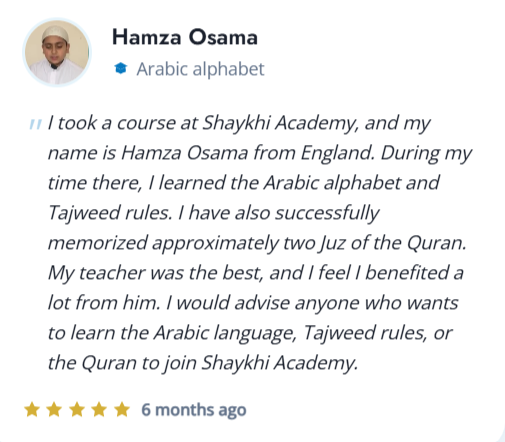
Want to hear it in their own words?
Watch Graduate Stories From Real Students
Nurture Your Child’s Islamic Knowledge with Expert-Led Online Classes
Give your child a strong foundation in Islam through engaging, interactive, and age-appropriate online lessons. Our experienced teachers make learning the Quran and Islamic values enjoyable, helping children build confidence, strengthen their faith, and develop a lifelong love for learning. Whether your child is just beginning or advancing their Quranic journey, we have the perfect course for every age and level.
Our Islamic Studies Courses for Kids:
- Quran for Kids
- Noorani Qaida for Kids
- Quran Recitation for Kids
- Tajweed for Kids
- Quran Memorization (Hifz) for Kids
- Quran for Toddlers
- Quranic Arabic for Kids
- Quran Stories for Kids
Fun & Engaging Islamic Classes for Kids
Start your child’s journey today with interactive lessons designed to make learning Islam loved and easy.
Get Your Child a Free TrialConclusion
Learning how to teach Islam to kids comes down to a simple order: build love for Allah and His Messenger ﷺ first, model the behavior you want to see, and then layer in worship, knowledge, and manners as your child grows.
Match each stage to your child’s age, lean on stories and hands-on activities instead of pressure, and weave faith into ordinary daily moments at home.
Start early, lead with mercy, and stay close as you go — that’s the foundation a confident, practicing young Muslim is built on.
Frequently Asked Questions
At what age should I start teaching my child about Islam?
You can begin from birth in simple ways, and start gentle creed lessons around ages 3–6. Formal worship like prayer is introduced from age seven, following the Prophet’s ﷺ guidance, with full commitment expected closer to age ten.
What is the best way to teach Islam to a child?
The best Islamic teaching for kids leads with love rather than fear and relies on your own example. Children copy what they see, so consistent prayer, honesty, and mentioning Allah in daily life teach more than instruction alone.
How do I make Islamic education for kids fun?
Make Islamic education for kids fun by using hands-on activities like finger puppets for the five pillars, cut-and-paste puzzles, coloring workbooks, and prophets’ stories. Children remember far more through play and doing than through passive listening.
How do I teach my child to pray?
Teach prayer gradually from age seven by showing wudu and the prayer steps without pressure, giving the child their own prayer mat, and praising their effort. Anchor prayers to daily routines, like eating after Dhuhr, to build consistency.
What if my child loses interest or refuses?
Avoid harshness and fear, which usually backfire, and return to encouragement and warmth. Keep lessons short, tie them to enjoyable activities, and make your home a positive place for faith so the child associates Islam with comfort, not stress.
How do I answer my child’s questions about other religions?
Answer calmly and simply at the child’s level, without showing alarm. Speak about the one Creator who has no partner and deserves worship, frame their own faith as something beautiful and secure, and always welcome the question rather than brushing it off.


Leave a Reply