 Islamic Studies
Have you ever watched your child tilt their head and ask, “But why do we fast?” or “Who was Prophet Muhammad, really?” — and found yourself searching for the right way to respond? Those questions are golden. They mean your child is curious about their faith, and curiosity is the best starting point for lifelong Islamic identity.
This guide covers the most important Islam facts for kids, organized by topic so you can share one at a time — at dinner, during car rides, or right before bed. Each fact includes a simple way to explain it and a question to keep the conversation going.
What You’ll Learn in This Article
- The core beliefs every Muslim child needs to know first.
- Fun and surprising Islam facts kids love sharing with friends.
- Quran facts, Ramadan facts, and Prophet Muhammad facts explained simply.
- How to turn each fact into a meaningful conversation at home.
- A recommended next step for structured Islamic learning.
Where to Start With Core Islam Facts for Kids
Before diving into individual topics, children need a foundation — a small number of core facts that everything else in Islam connects back to.
The two most important starting points are the meaning of the word “Islam” itself and the six beliefs that frame the entire faith.
a. What Is Islam?
Islam is a religion followed by nearly 2 billion people worldwide, making it the second-largest religion on Earth.
The word “Islam” comes from the Arabic root S-L-M, which connects to both “submission” — submitting to God’s will — and “salaam,” meaning peace. A Muslim is someone who submits to Allah.
That etymology is one of the most powerful Islam facts kids can hold onto: the very name of their faith contains the word for peace. If your child is asking deeper questions about the Creator, our guide on Who is Allah? Explaining to Kids is a natural next read.
b. What Do Muslims Believe?
The foundation of Islamic belief is called Tawheed — the conviction that Allah is One, unique, and without partners. Every other belief in Islam builds on this single idea. Muslims also believe in:
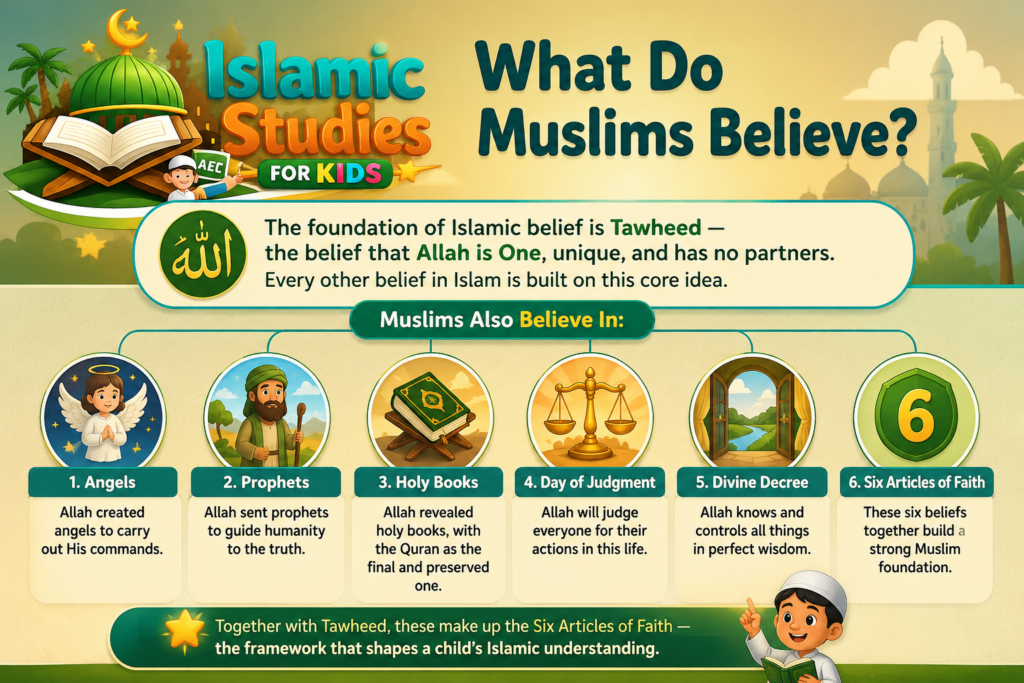
- Angels.
- The prophets Allah sent to guide humanity.
- Holy books — with the Quran as the final and preserved one
- The Day of Judgment.
- Divine decree — the belief that Allah knows and governs all things.
These five items alongside Tawheed form the Six Articles of Faith, and they are the framework a child’s Islamic knowledge should grow inside.
For practical ways to introduce these beliefs at home, see How to Teach Islam to Kids.
Conversation starter for parents: Ask your child, “If you had to explain to a friend what Muslims believe in just three sentences, what would you say?” Then build from their answer.
The Five Pillars as Islam Facts Kids Can Count on Their Fingers
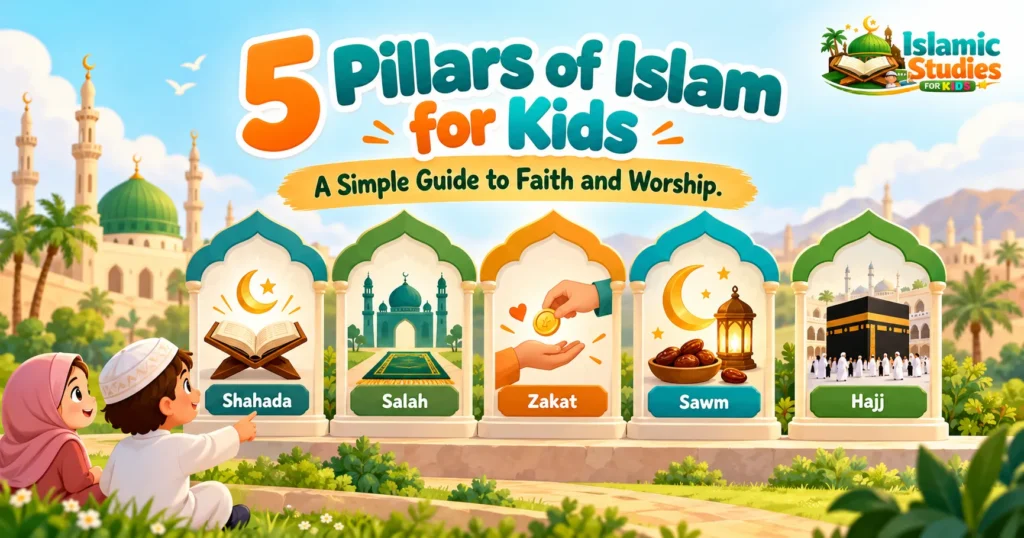
The Five Pillars are the five core practices that structure a Muslim’s daily and yearly life. Think of them as the skeleton of Islamic practice — everything else a Muslim does connects back to one of these five duties.
One of the most effective ways to teach young children is to use their fingers — Shahada on the thumb, working across to Hajj on the pinky.
The Five Pillars Explained Simply
The table below summarises each pillar with its Arabic name and a child-friendly explanation:
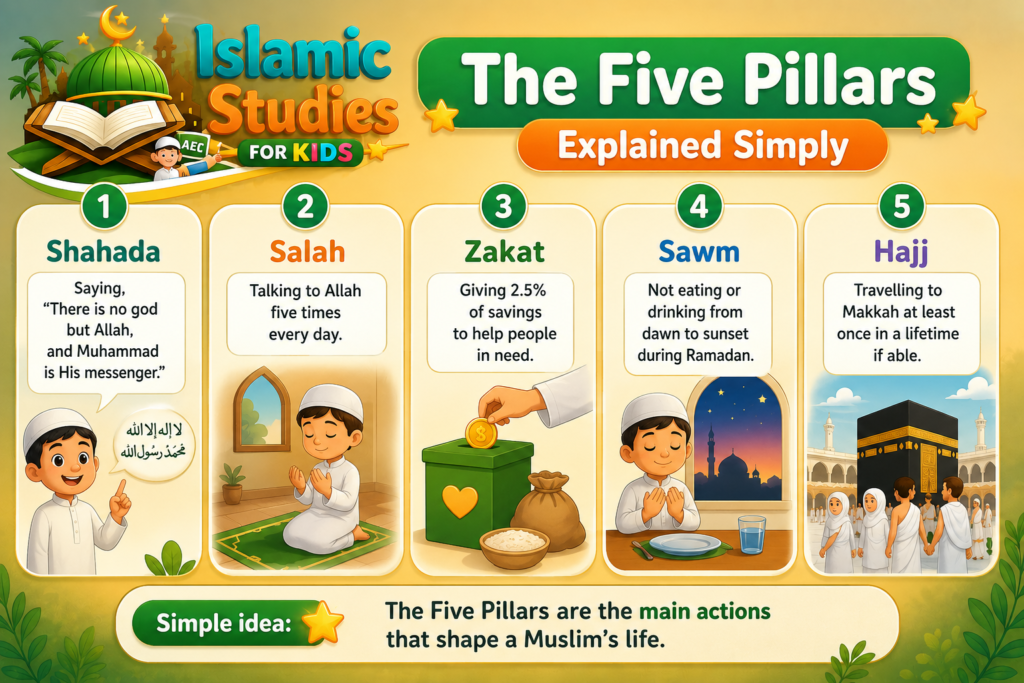
| Pillar | Arabic Name | What It Means for Kids |
| Declaration of Faith | Shahada | Saying: “There is no god but Allah, and Muhammad is His messenger” |
| Prayer | Salah | Talking to Allah five times every day |
| Charity | Zakat | Giving 2.5% of savings to help people in need |
| Fasting | Sawm | No eating or drinking from dawn to sunset during Ramadan |
| Pilgrimage | Hajj | Travelling to Mecca at least once in a lifetime if able |
A detail most kids find genuinely surprising: Zakat is not a suggestion — for Muslims who meet a minimum wealth threshold (called the nisab), it is an obligation, Muslims give 2.5% of qualifying savings once those funds have been held for a full Hijri year.
Two pillars that children can begin practicing right away are Salah and fasting. For step-by-step guidance on both, see How to Pray for Kids in Islam and Wudu Steps for Kids. Want your child to truly understand and live each pillar in a structured setting? 5 Pillars of Islam for Kids Course Online
Experience a Real Classroom
Curious about how we teach? This video offers a glimpse into a real class, showcasing our interactive approach, qualified teachers, and child-friendly learning experience.
Fun & Engaging Islamic Classes for Kids
Start your child’s journey today with interactive lessons designed to make learning Islam loved and easy.
Get Your Child a Free TrialQuran Facts for Kids
The Quran is at the heart of Islamic life — children hear it recited in prayer, see it treated with special care at home, and are often encouraged to memorize parts of it from a young age.
Understanding a few key facts about the Quran helps children develop genuine respect and curiosity for what they are learning, rather than treating memorization as a mechanical exercise.
a. What Is the Quran?
The Quran is the holy book of Islam — and Muslims believe it is the direct, unchanged speech of Allah, revealed to Prophet Muhammad ﷺ through the Angel Jibreel (Gabriel) over 23 years.
It is not a book written about God; Muslims believe it is the word of God Himself. The Quran contains:
- 114 surahs (chapters).
- 6,236 ayahs (verses).
- The shortest surah — Surah Al-Kawthar — has only 3 verses and is often the first surah children memorize.
- The longest — Surah Al-Baqarah — has 286 verses.
Looking to help your child begin their Quran journey? See How to Learn Quran for Kids for a complete starting guide, then explore the dedicated courses: Quran Recitation Course for Kids · Quran Memorization Course for Kids · Noorani Qaida Course for Kids
b. Amazing Quran Facts Kids Love
These are the facts that make children say “really?!” — and then repeat them to their friends:
- The Quran was revealed in Arabic and has remained unchanged for over 1,400 years — memorized and recited worldwide in its original language.
- A person who has memorized the entire Quran is called a Hafiz (for boys) or Hafiza (for girls). There are millions of Huffaz around the world, making the Quran the most memorized book in human history. If your child is inspired to take that journey, How to Make Your Child Memorize Quran and Juz Amma Memorization for Kids are the perfect place to start.
- The word “Allah” appears over 2,600 times in the Quran.
- Surah Al-Fatiha, the opening chapter, is recited in every single unit of every Muslim’s daily prayer. A Muslim who prays all five prayers recites it at least 17 times per day.
That last fact reframes daily prayer for children: every time they pray, they are reciting the very first surah Allah placed in His book.
For children who want to understand what they recite, consider: Quranic Arabic Course for Kids Online · Tajweed Rules for Kids · Quran Activities for Kids
Prophet Muhammad Facts for Kids
Children who know the Prophet’s ﷺ story — not just his name — develop a personal connection to their faith that lasts.
The facts below go beyond dates and places to highlight the character and decisions that made him the model for over a billion Muslims worldwide.
a. Who Was Prophet Muhammad ﷺ?
Prophet Muhammad ﷺ was born in Mecca, in modern-day Saudi Arabia, around 570 CE. Before receiving revelation, he was known across his community by the nickname Al-Amin — “The Trustworthy” — because of his exceptional honesty.
This is a fact worth emphasizing with children: the Prophet’s character was noticed and respected before prophethood.
At around the age of 40, while meditating in the Cave of Hira on the mountain of Jabal al-Nour, he received the first revelation through Angel Jibreel.
The first word revealed was “Iqra” — “Read.” This opening command shaped the entire direction of the new faith: toward knowledge, learning, and reflection.
b. Key Prophet Muhammad Facts for Kids
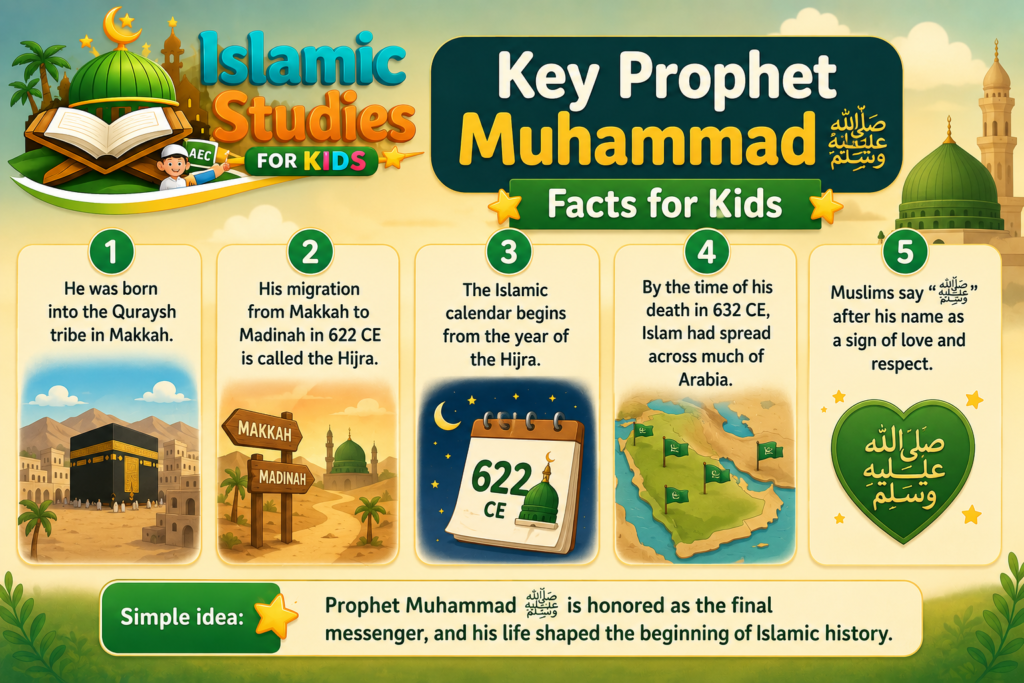
- He was born into the Quraysh tribe, the most influential tribe in Mecca.
- His migration from Mecca to Medina in 622 CE — called the Hijra — is so significant that the Islamic calendar begins from this year.
- By the time of his death in 632 CE, nearly all of the Arabian Peninsula had accepted Islam. This era of early Muslim civilization is explored in depth in Islamic Civilization & Golden Age for Kids.
- Muslims say “ﷺ” (Sallallahu alayhi wa sallam — “peace and blessings be upon him”) after his name as a sign of love and respect.
Conversation starter: Ask your child, “Why do you think people called the Prophet ‘The Trustworthy’ before he was even a prophet?” This creates a natural opportunity to discuss honesty, good character, and the Islamic teachings and connects naturally to Islamic Quotes for Kids.
Want your child to learn the Prophet’s full story in an engaging, age-appropriate way? Seerah Course for Kids Online
Ramadan Facts for Kids
Ramadan is the month children feel most visibly — the household schedule changes, adults fast, and the evenings fill with prayer and family time.
But many children experience Ramadan without truly understanding why it is the most important month in the Islamic year. These facts give them that understanding.
a. What Is Ramadan?
Ramadan is the ninth month of the Islamic lunar calendar and the holiest month of the year for Muslims. It is the month in which the Quran was first revealed to Prophet Muhammad ﷺ, which is why Muslims increase their Quran recitation during these 30 days significantly.
During Ramadan, healthy adult Muslims fast from the Fajr (dawn) prayer until the Maghrib (sunset) prayer — no eating, drinking, or smoking in between.
Children are not required to fast, but many begin practicing with half-days or a few days to build the habit gradually. For a full guide on how to involve your child, see Can Kids Fast in Ramadan?
b. Ramadan Facts Children Find Fascinating
- The word “Ramadan” comes from the Arabic root ramida (رَمِضَ), meaning intense heat — some scholars connect this to how fasting “burns away” sins.
- The pre-dawn meal before fasting begins is called Suhoor; the meal that breaks the fast at sunset is called Iftar. The Prophet ﷺ recommended breaking the fast with a date and water.
- The last 10 nights of Ramadan include Laylat al-Qadr — the Night of Power — which the Quran describes as better than a thousand months of worship.
- At the end of Ramadan, Muslims celebrate Eid al-Fitr, the Festival of Breaking the Fast, with prayer, special foods, new clothes, and gifts.
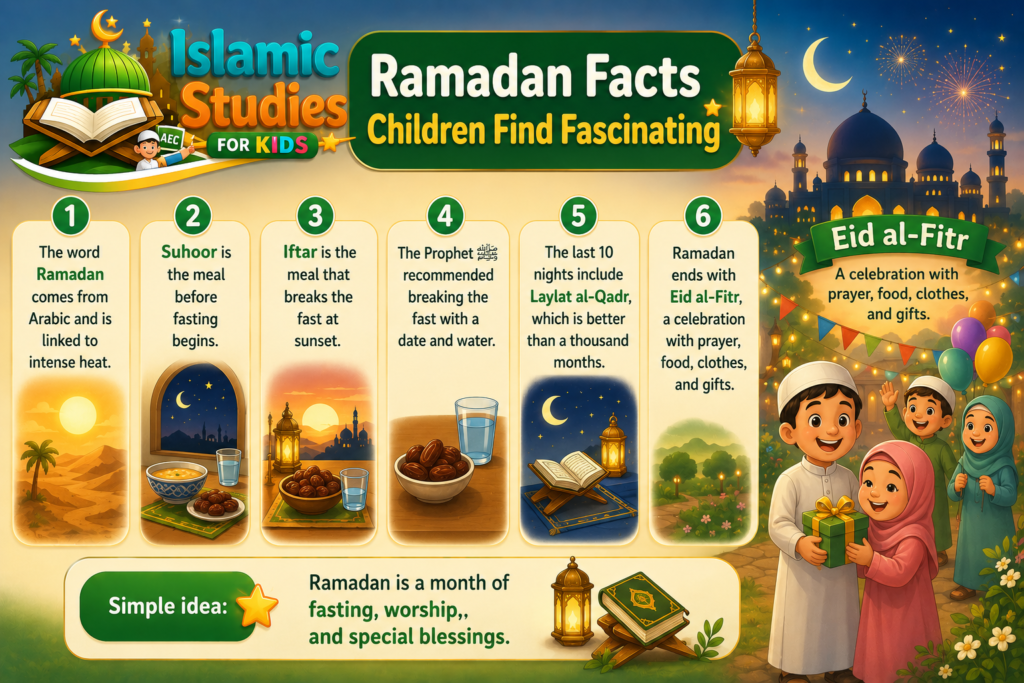
Connecting Ramadan to the Quran’s revelation is the most important Ramadan fact a child can internalize — it explains why the month feels different, not just what happens in it.
Fun and Interesting Islam Facts for Kids
Some facts stick with children not because they are complicated, but because they are surprising — the kind that make a child say “really?!” and repeat them to a friend the next day.
These facts do exactly that, while quietly building Islamic pride and identity. For hands-on ways to keep this energy going, explore Islamic Activities for Kids.
- Islam is the fastest-growing religion in the world.
- Muslims do not worship Muhammad ﷺ — they worship Allah alone. Muhammad ﷺ was a prophet and messenger, the last in a long line that includes Adam, Noah, Abraham, Moses, and Jesus (peace be upon them all).
- The Kaaba in Mecca — a cube-shaped structure draped in black cloth — is believed by Muslims to have been originally built by Prophet Ibrahim (Abraham) and his son Ismail. Every Muslim in the world faces its direction when they pray, no matter where they are on Earth.
- Arabic is the language of the Quran and Islamic prayer. It is spoken by around 400 million people as a native language and understood as a religious language by over a billion more.
- Muslims greet each other with “As-salamu alaykum” — “Peace be upon you.” This greeting is a small daily act of Islamic identity and kindness combined.
- There are three sacred cities in Islam: Mecca, Medina, and Jerusalem.
- The call to prayer (Adhan) is sounded five times daily from mosques around the world. At any given moment on Earth, the Adhan is being called somewhere.
Want to make learning these facts interactive? Islamic Apps for Kids lists the best tools to keep your child engaged beyond the classroom.
Read Also: Islamic Worksheets for Kids
The Two Eids Every Muslim Child Should Know as Islamic Holidays
The Islamic year has two major celebrations, and both are connected directly to the core pillars of Islam — one to Ramadan, one to Hajj.
Understanding the meaning behind each Eid, not just the festivities, gives children a much richer experience of these days.
1. Eid al-Fitr
Eid al-Fitr marks the end of Ramadan. It begins with a special communal prayer in the morning, followed by a day of celebration — family gatherings, festive food, new clothes, and gifts.
Before Eid prayer, Muslims give a specific charity called Zakat al-Fitr, ensuring that families without means can also celebrate.
2. Eid al-Adha
Eid al-Adha — the Festival of Sacrifice — commemorates Prophet Ibrahim’s ﷺ willingness to sacrifice his son in obedience to Allah, before Allah replaced his son with a ram. It falls during the days of Hajj.
Many Muslim families sacrifice an animal and distribute the meat between family, neighbors, and the poor in three equal portions. For a child-friendly deep dive into this celebration, see Eid ul Adha for Kids.
Watch a Sample Lesson from Our Academy
Get a firsthand look at how our students learn Islamic values, Quran, and essential knowledge through engaging and interactive online classes. See why families trust Islamic Studies for Kids Academy.
Fun & Engaging Islamic Classes for Kids
Start your child’s journey today with interactive lessons designed to make learning Islam loved and easy.
Get Your Child a Free TrialGive Your Child the Gift of Structured Islamic Learning
Sharing facts at home is a beautiful start — but children grow deepest when they learn in a structured, consistent environment with qualified teachers who know how to make Islam feel alive, not like a school subject.
Islamic Studies for Kids Academy connects children aged 4–15 with expert instructors who use stories, games, and age-appropriate curriculum to build confident Muslim identity — covering Aqeedah, Akhlaq, Islamic history, and Quran in short, engaging sessions that fit your family’s schedule.
If you’re wondering where to begin, teach my child Islam online walks you through exactly how online Islamic education works.
Explore our full range of courses:
- Islamic Studies for Kids — Full Course Catalogue
- Aqeedah for Kids Course Online
- Islamic History for Kids Course Online
- Islamic Manners and Akhlaq for Kids
- Quran Course for Kids Online
The first lesson is completely free. Your child has nothing to lose and an entire foundation of faith to gain.
Start your child’s free trial lesson today

Fun & Engaging Islamic Classes for Kids
Start your child’s journey today with interactive lessons designed to make learning Islam loved and easy.
Get Your Child a Free TrialConclusion
Islam facts for kids become genuinely powerful when they go beyond lists and connect to daily life, family conversations, and a child’s growing sense of identity.
The word “Islam” means peace. The first word revealed in the Quran was “Read.” The Prophet ﷺ was known as “The Trustworthy” before he ever received revelation.
These are not trivia points — they are windows into a complete way of life. Every fact in this article is a conversation waiting to happen between you and your child. Start with one. Ask a question. Listen to what they already know. Then build from there, Insha’Allah.
Frequently Asked Questions
Parents and educators often ask the same core questions when introducing Islam to children for the first time. The answers below are written to be shared directly with kids — clear, simple, and true to the faith.
What is Islam in simple words for kids?
Islam is a religion that teaches there is one God — Allah — who created everything. Muslims follow the guidance Allah sent through His final prophet, Muhammad ﷺ, recorded in the holy book called the Quran.
Islam gives Muslims a way to live — how to pray, be kind, give to others, and prepare for the life after this one.
What are the 5 pillars of Islam for kids?
The Five Pillars are the five core duties every Muslim follows:
Shahada — saying there is one God and Muhammad is His messenger
Salah — praying five times daily
Zakat — giving 2.5% of savings to those in need
Sawm — fasting during Ramadan from dawn to sunset
Hajj — is the journey to Makkah that every Muslim is encouraged to make once in their lifetime if they have the means to do so.
Who is Prophet Muhammad for kids?
Prophet Muhammad ﷺ was a man born in Mecca around 570 CE who was known for his honesty before he became a prophet. At age 40, Allah chose him to receive His final message — the Quran — through the Angel Jibreel.
He spent the rest of his life teaching people how to worship Allah and live with kindness, justice, and integrity.
What is the Quran for kids?
The Quran is the holy book of Islam. Muslims believe it is the direct word of Allah, revealed to Prophet Muhammad ﷺ over 23 years. It has 114 chapters and 6,236 verses.
The Quran has been memorized in its original Arabic by millions of people throughout history, making it the most memorized book in the world.
What are fun facts about Islam for kids?
Some of the most interesting Islam facts for kids:
By saying “As-salamu alaykum,” Muslims share a message of peace whenever they meet.
The Adhan is sounding somewhere on Earth at every moment of the day.
The Kaaba in Mecca was originally built by Prophet Ibrahim and his son Ismail.
A Muslim who memorizes the entire Quran earns the title of Hafiz or Hafiza.
Why do Muslims fast during Ramadan?
Muslims fast during Ramadan because it is a command from Allah in the Quran, and because Ramadan is the month the Quran was first revealed. Fasting teaches:
Self-discipline.
Gratitude for Allah’s blessings.
Compassion for people who go without food.
It is a month of increased prayer, charity, and closeness to Allah.


Leave a Reply