5 Pillars Of Islam For Kids – A Simple Guide To Faith And Worship
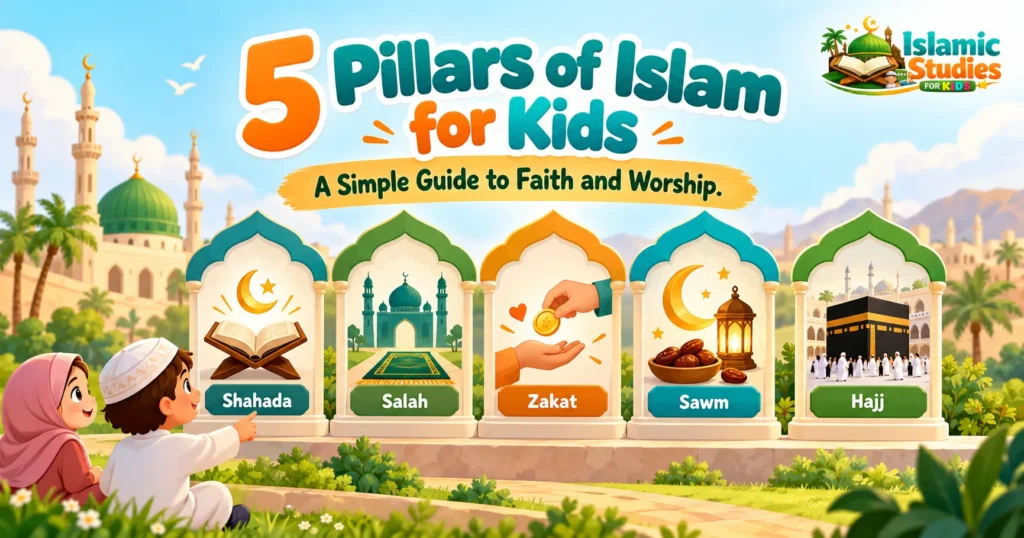
The 5 pillars of Islam for kids are Shahada (faith), Salah (prayer), Zakat (obligatory charity), Sawm (fasting during Ramadan), and Hajj (pilgrimage to Makkah). These five essential acts of worship form the foundation of Islam and guide Muslims in strengthening their faith, worshipping Allah, and fulfilling their religious responsibilities.
Just as a building needs strong foundations, these five pillars support a Muslim’s religious life. Each has a different purpose, from declaring faith in Allah and performing daily prayers to helping those in need, fasting during Ramadan, and completing the pilgrimage to Makkah.
In this guide, you’ll discover the five pillars of Islam explained for kids through simple meanings, Quranic verses, everyday examples, and practical activities that help parents teach these important foundations in an engaging, age-appropriate way.
1. Shahada: The Declaration of Faith in Allah
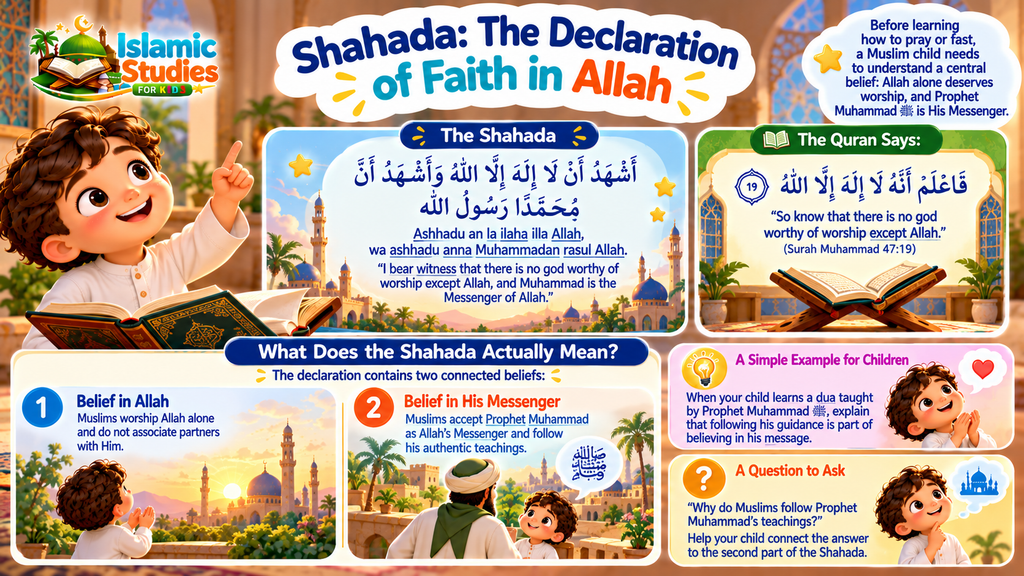
Before learning how to pray or fast, a Muslim child needs to understand a central belief: Allah alone deserves worship, and Prophet Muhammad (peace be upon him) is His Messenger.
Ashhadu an la ilaha illa Allah, wa ashhadu anna Muhammadan rasul Allah.
“I bear witness that there is no god worthy of worship except Allah, and Muhammad is the Messenger of Allah.”
The Quran says:
فَاعْلَمْ أَنَّهُ لَا إِلَٰهَ إِلَّا اللَّهُ
“So know that there is no god worthy of worship except Allah.” (Surah Muhammad 47:19)
What Does the Shahada Actually Mean?
The declaration contains two connected beliefs:
Belief in Allah: Muslims worship Allah alone and do not associate partners with Him.
Belief in His Messenger: Muslims accept Prophet Muhammad as Allah’s Messenger and follow his authentic teachings.
Children may find it easier to understand the Shahada when they connect it to something familiar.
For example, when they learn a dua taught by Prophet Muhammad, explain that following his guidance is part of believing in his message.
A useful question to ask is: “Why do Muslims follow Prophet Muhammad’s teachings?” Help your child connect the answer to the second part of the Shahada.
Our 5 Pillars of Islam for Kids Course covers Shahada, Salah, Zakat, Sawm, and Hajj in dedicated modules. The program welcomes children ages 4 to 15 and provides English-language instruction from Al-Azhar-certified tutors, helping students understand both the meaning and practical requirements of each pillar.
2. Salah: The Five Daily Prayers That Connect Muslims With Allah
Salah is the daily prayer. Muslims pray five times a day at set times, and each prayer is made up of units called rak’ahs.
Prayer
Time
Rak’ahs
Fajr
Dawn, before sunrise
2
Dhuhr
After midday
4
Asr
Afternoon
4
Maghrib
After sunset
3
Isha
Night
4
Before praying, a Muslim makes wudu: washing the hands, mouth, nose, face and arms, wiping over the head, and washing the feet. Then they stand in a clean place facing the qiblah, which is the direction of the Kaaba in Makkah.
The Prophet ﷺ asked parents to teach their children to pray at the age of seven (Abu Dawud). Many children start earlier by standing next to their parents and copying the movements, which is a gentle way to get them used to prayer without any pressure.
Why Do Muslims Pray Five Times a Day?
Salah is an obligation and a regular opportunity to remember Allah. It introduces children to the importance of worship, attentiveness, and responsibility.
“Indeed, prayer prohibits immorality and wrongdoing.” (Al-Ankabut 29:45)
Young children are not expected to master every movement immediately. They may begin by recognizing prayer names, learning Wudu, and memorizing Al-Fatiha.
3. Zakat: Giving a Portion of Wealth to Those Entitled to Receive It
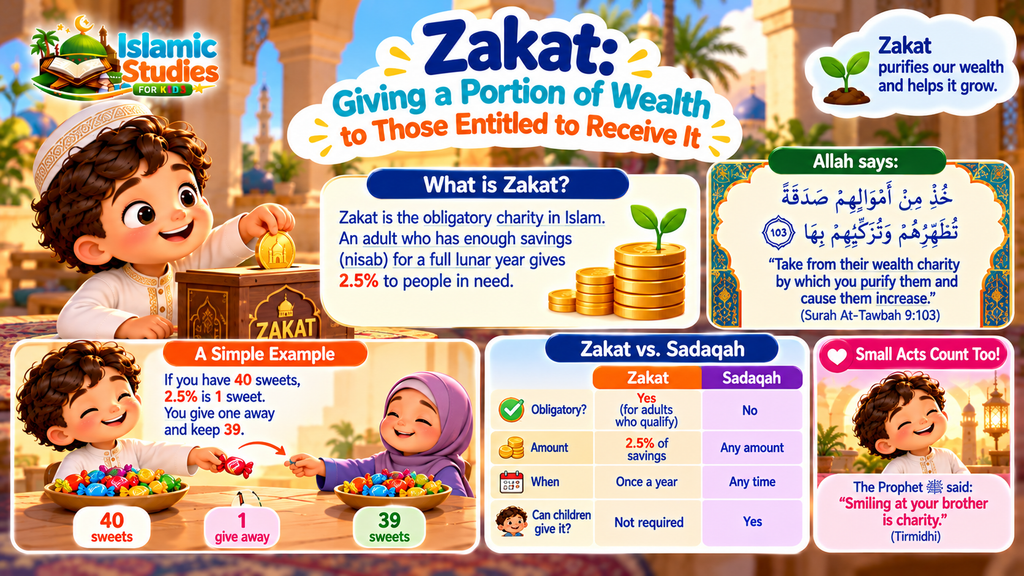
Zakat is the obligatory charity in Islam. An adult whose savings stay above a set minimum (called nisab) for a full lunar year gives 2.5% of that amount to people in need, such as the poor and those in debt. The word zakat comes from an Arabic root linked to purity and growth.
The Quran describes that same idea of purifying and growing:
“Take from their wealth charity by which you purify them and cause them increase.” (At-Tawbah 9:103)
Percentages can be hard for children, so try it with sweets. If your child has 40 sweets, 2.5% of them is one sweet. They give one away and keep the other 39.
Children don’t pay zakat themselves, but they can give sadaqah, which is voluntary charity. Here is how the two compare:
Zakat
Sadaqah
Obligatory?
Yes, for adults who qualify
No
Amount
2.5% of savings
Any amount
When
Once a year
Any time
Can children give it?
Not required
Yes
The Prophet ﷺ said that smiling at your brother is charity (Tirmidhi), so sadaqah is something a child can do every day, even without money.
Watch a Sample Lesson from Our Academy
Get a firsthand look at how our students learn Islamic values, Quran, and essential knowledge through engaging and interactive online classes. See why families trust Islamic Studies for Kids Academy.
Fun & Engaging Islamic Classes for Kids
Start your child’s journey today with interactive lessons designed to make learning Islam loved and easy.
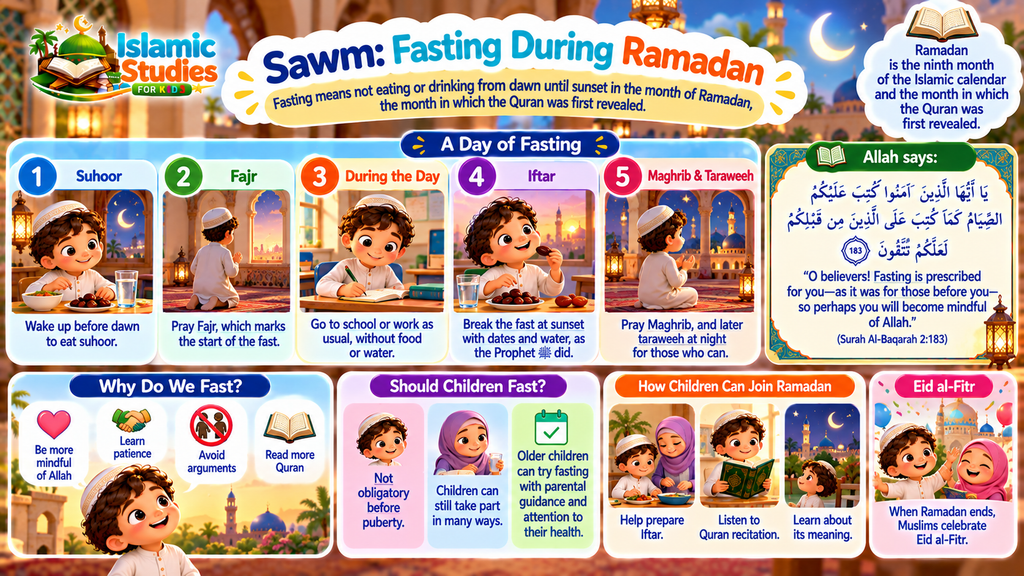
“O believers! Fasting is prescribed for you—as it was for those before you—so perhaps you will become mindful of Allah.” (Al-Baqarah 2:183)
Ramadan is also a time to be more patient, avoid arguments and read more Quran. When the month ends, Muslims celebrate Eid al-Fitr.
Fasting becomes obligatory at puberty, so younger children aren’t required to fast. Many families still let them practise, for example by fasting until Dhuhr or trying one full day on a weekend.
Should Children Fast During Ramadan?
Fasting is not obligatory before puberty. Children can still take part in Ramadan by helping prepare Iftar, listening to Quran recitation, and learning about its meaning.
Older children who want to practice fasting should do so with appropriate parental guidance and attention to their health.
Rather than measuring a child’s faith by how many hours they can go without food, focus on helping them understand why Muslims fast.
5. Hajj: The Pilgrimage to Makkah That Unites Muslims Worldwide
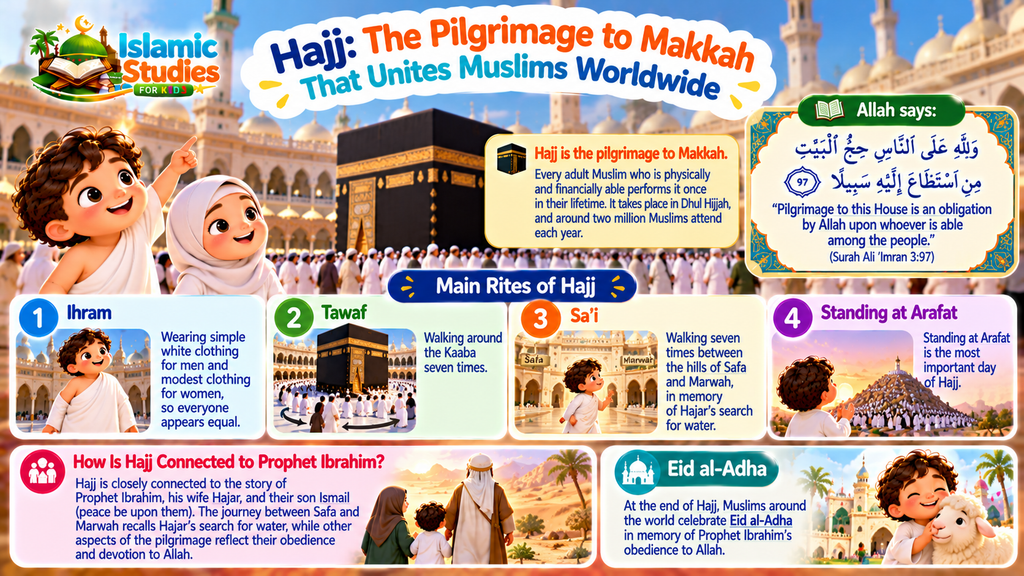
Hajj is the pilgrimage to Makkah. Every adult Muslim who is physically and financially able has to perform it once in their lifetime. It takes place in Dhul Hijjah, the twelfth month of the Islamic calendar, and around two million pilgrims attend each year.
The condition of being able comes from the Quran itself:
“Pilgrimage to this House is an obligation by Allah upon whoever is able among the people.” (Ali ‘Imran 3:97)
Some of the main rites of Hajj are:
Wearing ihram, simple white clothing for men and modest clothing for women, so that everyone appears equal.
Tawaf, walking around the Kaaba seven times.
Sa’i, walking seven times between the hills of Safa and Marwah, in memory of Hajar searching for water for her son Ismail.
Standing at Arafat, the most important day of Hajj.
At the end of Hajj, Muslims around the world celebrate Eid al-Adha in memory of Prophet Ibrahim’s obedience to Allah.
How Is Hajj Connected to Prophet Ibrahim?
Hajj is closely connected to the story of Prophet Ibrahim, his wife Hajar, and their son Ismail (peace be upon them).
The journey between Safa and Marwah recalls Hajar’s search for water, while other aspects of the pilgrimage reflect obedience and devotion to Allah.
These connections give children an opportunity to learn Islamic history alongside worship. Our Islamic History for Kids lessons explore the people and events that shaped Islamic faith and practice.
When Are the Five Pillars Practiced?
The five pillars are not all performed on the same schedule. Some are daily obligations, while others depend on wealth, the Islamic calendar, or a person’s ability.
Pillar
When It Applies
Shahada
The declaration of faith, affirmed throughout Muslim life
Salah
Five times every day
Zakat
When the relevant financial conditions are met
Sawm
During Ramadan, for those required and able to fast
Hajj
Once in a lifetime for those who meet its conditions
These differences are important when explaining the pillars of Islam for children. A young child can learn about all five pillars without being personally required to perform every one.
How Can Parents Teach the Five Pillars at Home?
Children do not need to learn every ruling in a single lesson. Begin with the names and meanings, then introduce more detail as their understanding develops.
Here are five different ways to make the lessons memorable:
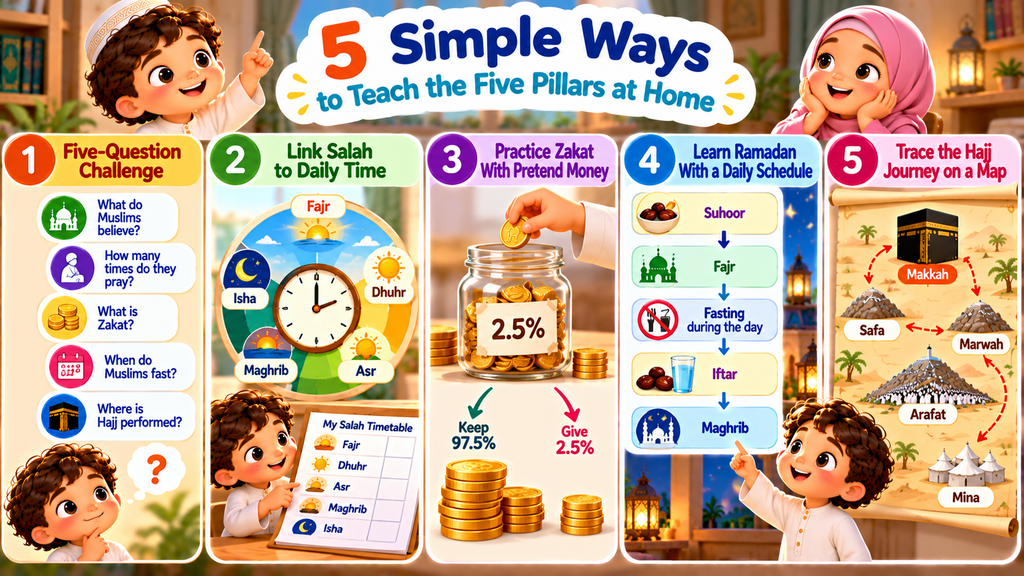
1. Use a Five-Question Challenge to Review the Pillars
Instead of asking children only to recite the names, ask five questions: What do Muslims believe? How many times do they pray? What is Zakat? When do Muslims fast? Where is Hajj performed?
This checks whether they understand the meaning behind each pillar. Parents can turn the questions into a fun quiz and encourage children to explain their answers in their own words.
2. Connect Salah Lessons With Everyday Timekeeping
Give your child a simple daily timetable and ask them to identify the five prayer names. Older children can learn how prayer times relate to the sun’s position.
Use familiar activities, such as waking up, lunchtime, and bedtime, to help children understand the daily prayer schedule. This makes remembering the five Salah times easier.
3. Practice Zakat Calculations With Pretend Money
Use simple amounts to explain percentages and obligatory giving. Keep the discussion separate from voluntary charity so children understand the difference.
For example, ask children to calculate 2.5% of £100 or £200. Explain that actual Zakat obligations depend on specific conditions, including the Nisab threshold, rather than applying to every amount of money.
4. Teach Ramadan Through the Daily Fasting Schedule
Ask your child to put Suhoor, Fajr, Iftar, and Maghrib in the correct order. Explain what each term means and how it relates to fasting.
Children can create a simple Ramadan timeline showing Suhoor before Fajr and Iftar at Maghrib. This visual activity helps them understand how Muslims organise their day during Ramadan.
5. Trace the Hajj Journey on a Map
Find Makkah and the surrounding sacred sites. Show where pilgrims perform different rituals and explain why people travel there.
Use pictures or a printable map to identify the Kaaba, Mina, Arafat, and Muzdalifah. Encourage children to describe one important Hajj ritual associated with each location.
For children who need a broader, organized foundation in Islamic subjects, the Intensive Islamic Course for Kids covers worship, belief, Prophetic history, and other essential areas through structured lessons.
Experience a Real Classroom
Curious about how we teach? This video offers a glimpse into a real class, showcasing our interactive approach, qualified teachers, and child-friendly learning experience.
Fun & Engaging Islamic Classes for Kids
Start your child’s journey today with interactive lessons designed to make learning Islam loved and easy.
Build Your Child’s Islamic Foundation With Islamic Studies for Kids Academy
Learning the Five Pillars of Islam is an important step in helping children understand their faith, but true Islamic education goes beyond memorizing names and definitions. At Islamic Studies for Kids Academy, we help children discover the meaning of Islamic beliefs, understand the importance of worship, and connect Islamic values with their everyday lives.
Our academy creates a welcoming and engaging learning environment where children feel comfortable asking questions, exploring their faith, and developing a deeper connection with Allah. Through age-appropriate explanations, interactive learning, and personalized guidance, we make Islamic education meaningful, enjoyable, and easy to understand.
Whether your child is just beginning their Islamic learning journey or looking to strengthen their knowledge, Islamic Studies for Kids Academy supports their growth with patient guidance and a focus on understanding rather than memorization alone. Our goal is to help children develop confidence in their Muslim identity and build a lasting love for Islam.
Learning the 5 pillars of Islam for kids helps children understand the main foundations of Muslim worship. Shahada establishes belief, Salah organizes daily prayer, Zakat fulfills an obligation toward eligible recipients, Sawm introduces the worship of Ramadan, and Hajj connects Muslims through a sacred pilgrimage.
Each pillar has its own meaning, conditions, and purpose. Teaching children these differences helps them move beyond simply remembering five names and begin understanding how Islam is practiced. Short explanations and familiar examples can make that knowledge easier to retain.
Parents can build on this foundation gradually, introducing new details as their children become ready. The aim is to help children develop accurate Islamic knowledge, confidence in practicing their faith, and an appreciation of the responsibilities and blessings of Muslim life.
Frequently Asked Questions About the 5 Pillars of Islam for Kids
1. What Are the Five Pillars of Islam in Simple Words?
The five pillars are Shahada (faith), Salah (prayer), Zakat (obligatory giving), Sawm (fasting during Ramadan), and Hajj (pilgrimage to Makkah). They form the foundations of Muslim worship and religious practice.
2. What Is the Difference Between the Five Pillars of Islam and the Six Pillars of Iman?
The Five Pillars of Islam describe fundamental acts of worship and religious practice. The Six Pillars of Iman describe essential beliefs, including belief in Allah, His angels, books, messengers, the Last Day, and divine decree.
3. Are All Five Pillars Obligatory for Every Muslim?
The five pillars are fundamental to Islam, but their practical obligations have different conditions. Zakat depends on qualifying wealth, Hajj on ability, and fasting and prayer have rules concerning maturity and other circumstances.
4. Why Is Shahada the First Pillar of Islam?
Shahada comes first because belief in Allah and His Messenger is the foundation upon which Muslim worship is based. It establishes whom Muslims worship and whose guidance they follow.
5. Can Children Learn the Five Pillars Before They Are Obligatory?
Yes. Children can learn their meanings and gradually practice age-appropriate forms of worship. Religious responsibilities generally apply at puberty, with additional conditions relevant to particular pillars.
6. What Is the Best Way to Help Children Remember the Five Pillars?
Help children associate each pillar with one clear meaning: faith, prayer, obligatory giving, fasting, and pilgrimage. Review them through short conversations, matching questions, and examples rather than relying on memorization alone.
 Islamic Studies





Leave a Reply