 Quran
Quran
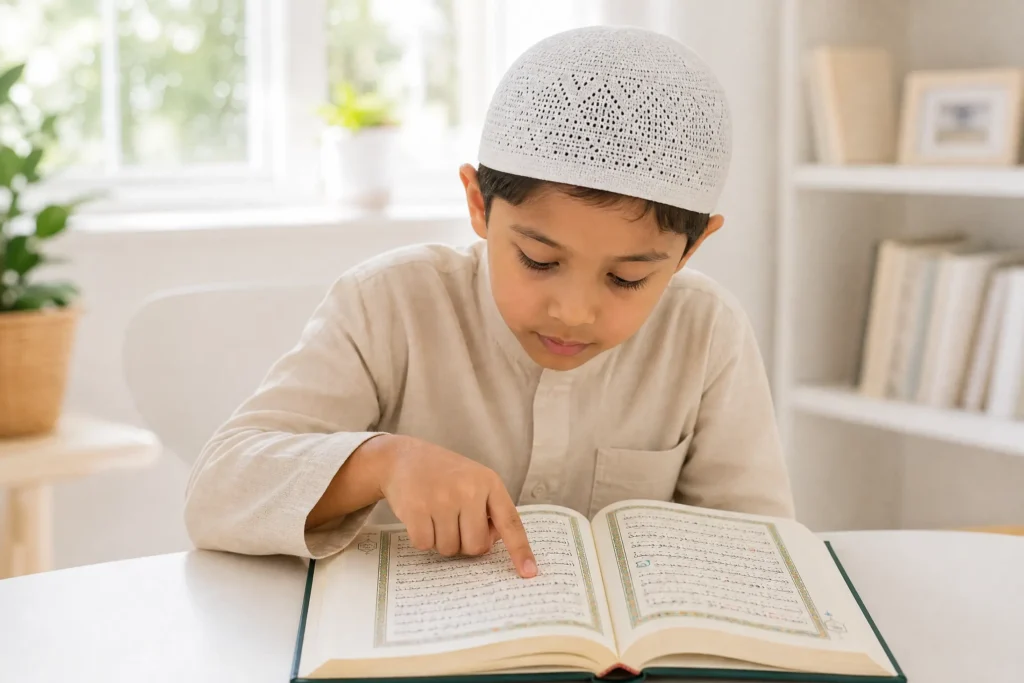
Most children can recite a Surah from memory by age five. Far fewer recite it correctly. The gap between the two isn’t talent — it’s whether tajweed rules for kids were introduced early, in a way the child’s brain was actually built to absorb.
Tajweed for kids is the set of pronunciation rules that govern how each Arabic letter in the Quran is articulated — where it’s produced in the mouth or throat, how long it’s held, and how it changes when it meets certain neighboring letters.
Children aged 5 to 12 sit in the most active window of phonetic learning they will ever have, which is exactly why tajweed classes for kids work best when they start young rather than waiting until a child is “old enough” to sit through a lesson.
What You’ll Learn in This Article?
- Why early childhood is the best window for learning tajweed.
- The core tajweed rules for kids, explained with real Quran examples.
- A practical, age-appropriate approach to teaching each rule.
- Common mistakes parents and teachers should watch for.
- How Islamic Studies for Kids Academy structures its tajweed classes for kids.
The Main Tajweed Rules for Kids, Explained Simply
Before any rule makes sense to a child, it helps to know there are really just a handful of categories worth mastering first.
Below are the ones every parent should understand, with the Quranic examples a child is most likely to already know by heart.
a. Noon Sakinah and Tanween
Noon Sakinah (a noon with no vowel, written نْ) and tanween (the double-vowel sound at the end of a word) change their pronunciation depending on which letter comes right after them.
There are four rules that govern this, and a child doesn’t need to memorize the linguistic theory to apply them correctly — they need to hear and repeat each one enough times that the sound becomes automatic.

- Izhar (clear pronunciation) applies when the noon or tanween is followed by one of six throat letters: ء ه ع ح غ خ. The noon is pronounced clearly, with no nasal sound added — as in أنْعَمْتَ عَلَيْهِمْ from Al-Fatiha, a phrase nearly every child has memorized before they ever learn the rule behind it.

- Idgham (merging) applies when the noon or tanween is followed by ي ر م ل و ن. The noon disappears into the next letter rather than being pronounced separately. It comes in two forms: with ghunnah (a nasal hum) before ي ن م و, and without ghunnah before ر ل.


- Iqlab (conversion) is the simplest rule to teach because it only has one trigger letter: ب. When noon or tanween is followed by ب, it’s pronounced as a hidden م instead — a child can learn this in a single lesson because there’s only one case to remember.

- Ikhfa (concealment) applies to the remaining fifteen letters not covered above. The noon is neither fully pronounced nor fully merged — it’s held in a soft, partly nasal position, as in مِنْ ثَمَرات.

A common teaching mistake is introducing all four rules in one sitting. Children retain ikhfa and izhar far better when they’re taught a single rule, drilled with three or four real Quranic examples, and only then moved to the next one a few days later.
b. Mim Sakinah
Mim Sakinah, a meem carrying no vowel (م), follows the same logic as noon sakinah but with only three outcomes, which makes it an easier second rule to introduce.
- Ikhfa shafawi (lip concealment) applies when the meem is followed by ب — the sound is softened with a light nasal hum, as in تَرْمِيهِم بِحِجَارَةٍ.

- Idgham shafawi (lip merging) applies when meem meets another meem, collapsing into one elongated sound, as in لَكُمْ مَا.

- Izhar shafawi (clear lip pronunciation) applies to every other letter, where the meem is simply pronounced clearly, as in أَنْعَمْتَ.

Because all three rules are tied to lip movement, this is one of the easiest categories for young children to learn through the body-sensation approach described below — touching the lips while reciting makes the rule physically obvious rather than abstract.
c. Madd, Elongation of Sound
Madd is the extension of a vowel sound for a set number of counts, marked by one of three letters: “Alif (ا), Waw (و), or Ya (ي)”.
There are two types of madd:

- Natural madd (al-madd al-asli) holds the sound for two counts — roughly the time it takes to raise and lower a finger twice. Children can hear this clearly in words like قَال, يقُول, and قِيل, where the vowel is visibly stretched compared to a short vowel.
- There are also secondary” Firi”, longer forms of madd that extend beyond two counts when a hamzah or certain letter combinations are involved, but these are typically introduced only after a child has fully internalized the two-count natural madd — rushing ahead to six-count madd before the basic two-count rhythm is solid is one of the more common pacing mistakes in early tajweed classes for kids.
Experience a Real Classroom
Curious about how we teach? This video offers a glimpse into a real class, showcasing our interactive approach, qualified teachers, and child-friendly learning experience.
Fun & Engaging Islamic Classes for Kids
Start your child’s journey today with interactive lessons designed to make learning Islam loved and easy.
Get Your Child a Free TrialHow to Teach Tajweed for Kids?
Knowing the rules is one thing. Getting a five-year-old to apply them without losing interest after ten minutes is another.
The methods below are ordered roughly by age, from the most physical and playful approaches for younger children to more structured methods for children who are already reading independently.
a. Use Body Movement for Younger Children
For children aged 5 to 8, explaining where a letter is “articulated” in technical terms doesn’t land. What works instead is physical association:
- Touching the throat while pronouncing throat letters (ء ه ع ح غ خ).
- Touching the lips for lip letters (ب م و ف).
- Placing two fingers on the nose to feel the vibration during ghunnah.

This turns an abstract concept into something the child can physically feel and remember.
b. Connect Every Rule to a Surah the Child Already Knows
A child who already has Al-Fatiha or Al-Ikhlas memorized doesn’t need to learn new text and a new rule at the same time — they can focus entirely on the sound.
This is why the four noon sakinah rules, ghunnah, and qalqalah are almost always introduced using these short, familiar Surahs rather than unfamiliar verses, which reduces the cognitive load on the child considerably.
If your child hasn’t memorized these short Surahs yet, Juz Amma Memorization for Kids and How to Make Your Child Memorize Quran are good starting points, alongside the Quran Memorization Course for Kids Online.
c. Keep Sessions Short
Twenty to thirty minutes is the practical ceiling for a focused tajweed lesson with a young child. Beyond that, attention drops sharply and retention with it.
Two shorter sessions a week tend to outperform one long session, because the rule gets reinforced through repetition rather than crammed into a single sitting.
d. Make Listening a Daily Habit
Exposing a child’s ear to correct recitation from skilled reciters, in the car or at home, trains the ear to recognize correct sound even before the child can produce it themselves.
This passive listening complements active lessons and is one of the lowest-effort, highest-impact things a parent can do consistently.
Quran Activities for Kids has more ideas for building this kind of daily exposure without it feeling like a lesson.
Why Does Tajweed for Kids Matter This Early?
Tajweed for kids is not simply about correct pronunciation for its own sake — it’s about protecting the meaning of the Quran.
Mispronouncing a single letter can change a word’s meaning entirely, which is why tajweed has been transmitted orally, teacher to student, since the time of the Prophet ﷺ.
Teaching it early means a child’s recitation is correct from the very first time they pray independently, rather than being corrected years later after habits have already formed.
The importance of tajweed for kids also extends beyond worship. Learning to:
- Distinguish heavy letters (تفخيم) from light letters (ترقيق).
- Control breath and rhythm precisely.
…..builds focus and listening skills that carry over into general language learning — children who study tajweed early often develop stronger Arabic letter recognition and pronunciation overall, simply from the repetition involved.
For a broader look at how Quran learning supports a child’s faith more generally, see How to Learn Quran for Kids.
Get Started, Free Trial Tajweed Class for Your Child
If your child has already memorized a few short Surahs, they likely have everything they need to start applying these rules correctly within just a few sessions.
Islamic Studies for Kids Academy pairs your child with a teacher experienced specifically in working with children — not an adult curriculum adapted down, but a program built around how young learners actually absorb sound.

Book a free trial class and see how your child responds to a first lesson before committing to anything.
Why Do Children Learn Tajweed Faster Than Adults?
A child’s brain between ages 5 and 12 is in an active phase of phonological acquisition, which gives early learners a real edge over adults starting later. The main reasons children pick up tajweed faster come down to this:
- A wider window for sound acquisition — the same neurological window that lets bilingual children pick up a second language’s sounds without an accent also applies to Quranic Arabic.
- Easier mastery of difficult sounds — Arabic sounds that adult learners often struggle with for years, like the throat-articulated ع or the heavy ق, are absorbed naturally by children taught correctly at this age.
- No incorrect habits to unlearn — an adult coming to tajweed after years of imprecise recitation has to consciously override patterns that feel automatic, while a child starting fresh simply learns it right the first time.
- Lifelong payoff from early correction — what’s learned correctly early tends to stay correct for life, which matters every single day, since a child who recites Al-Fatiha correctly by age ten will repeat that correct recitation in prayer thousands of times over a lifetime.
Explore the Tajweed Course for Kids Online to see how this early-start approach is built into the curriculum.
Tajweed Rules for Kids vs. Adult Tajweed Study
The core difference between teaching tajweed to a child and teaching it to an adult is not the rules themselves — they’re identical — but the method and pace used to deliver them.
| Aspect | Children | Adults |
| Learning method | Repetition, physical sensation, and connection to text already memorized | Direct explanation and correction of existing habits |
| Pace of new rules | One rule isolated, drilled against familiar Surahs, reinforced over several short sessions | Multiple rules (e.g., all four noon sakinah rules, madd categories) covered in a single structured course |
| Why this pace works | Abstract logic isn’t yet reliable, so each rule needs to become automatic before the next is added | Can hold abstract logic in mind, so faster sequencing is manageable |
| Common pitfall | Rushing the sequence leaves children able to name a rule without reliably applying it while reciting | Less prone to this since existing habits, not pacing, are the main obstacle |
Common Mistakes Parents Should Watch For
Even motivated parents tend to fall into the same handful of traps when supporting their child’s tajweed journey at home. Knowing them in advance makes them far easier to avoid.
- Introducing too many rules at once, which leaves a child able to recite the names of the rules without reliably applying any of them.
- Correcting a child mid-recitation too often, which interrupts flow and builds anxiety around reading aloud — it’s usually more effective to let a child finish a verse, then go back and correct one or two points.
- Skipping straight to longer Surahs before short ones are fully mastered, which buries new rules under unfamiliar vocabulary the child also has to process.
Watch a Sample Lesson from Our Academy
Get a firsthand look at how our students learn Islamic values, Quran, and essential knowledge through engaging and interactive online classes. See why families trust Islamic Studies for Kids Academy.
Fun & Engaging Islamic Classes for Kids
Start your child’s journey today with interactive lessons designed to make learning Islam loved and easy.
Get Your Child a Free TrialBuild a Daily Tajweed Habit with Islamic Studies for Kids Academy
Children who review one short Surah a day, applying just one rule consistently, retain far more than children drilled on multiple rules occasionally.

Islamic Studies for Kids Academy’s classes are built around this principle — short, focused sessions, one rule at a time, with progress shared directly with parents after every lesson so you can reinforce the same rule at home between classes.
Book Your Child’s Free Trial Tajweed Class

Why Families Choose Islamic Studies for Kids Academy for Tajweed
Knowing the rules is only half the equation — the other half is who’s teaching them. Here’s what sets Islamic Studies for Kids Academy apart:
- Al-Azhar Certified Tutors, Teaching in English — Every tutor holds Al-Azhar certification, with sessions run entirely in English, so Arabic fluency is never a prerequisite for starting.
- Private One-on-One Sessions — No group classes. Each session focuses entirely on one child’s pace, rule mastery, and pronunciation gaps.
- A Free Trial Before Any Commitment — A certified tutor assesses your child’s level at the trial and assigns the correct entry point before enrollment.
- Female Tutors Available for Girls and Sisters — Assigned at the trial and maintained throughout every module.
- Flexible Scheduling Across Every Time Zone — Sessions booked around your family’s schedule, with no fixed timetable.
- Verified Progress After Every Module — Written reports document exactly which rules your child has mastered.
Our Islamic Studies Courses Include:
- Islamic Studies for Kids
- Islam Basics for Kids (Beginners)
- 5 Pillars of Islam for Kids
- 6 Pillars of Iman (Faith) for Kids
- Salah (Prayer) for Kids
- Wudu for Kids
- Dua for Kids
- Ramadan for Kids
- Zakat & Sadaqah for Kids
- Hajj for Kids
- Aqeedah (Islamic Belief) for Kids
- Islamic Manners & Akhlaq for Kids
- Good Deeds for Kids
- Cleanliness (Taharah) in Islam for Kids
- Angels in Islam for Kids
- Islamic History for Kids
- Seerah (Prophet’s Life) for Kids
- Prophets Stories for Kids
- Islamic Stories & Morals for Kids
- Fiqh for Kids (Islamic Jurisprudence Basics)
- Hadith for Kids
- Quran Tafseer Course for Kids
- Islamic Holidays & Events for Kids
- Islamic Identity for Kids
- Intensive Islamic Course for Kids
Enroll today and give your child the knowledge, values, and confidence to grow as a practicing Muslim with a strong connection to Allah and His teachings.

Conclusion
Tajweed rules for kids aren’t a separate subject from learning to read the Quran — they’re what makes that reading accurate. The earlier a child starts, the more naturally the sounds settle into place, and the less correcting needs to happen later.
Starting with noon sakinah, mim sakinah, and natural madd, anchored to Surahs your child already knows by heart, gives them a foundation that holds for a lifetime of prayer and recitation.
The goal isn’t to rush a child through every rule in a single term. It’s steady, short, consistent practice — one rule mastered before the next is introduced — built around a teacher who knows how to keep a young learner engaged through the process.
Frequently Asked Questions
Parents often have a handful of practical questions before starting their child on a structured tajweed path. Here are the ones we hear most often.
1. At what age should my child start learning tajweed?
Children can begin informal exposure to correct recitation as early as age three or four, simply through listening to parents recite. Formal tajweed rules for kids are best introduced around age six or seven, once basic letter recognition is in place, with ages seven to ten considered the strongest window for absorbing correct pronunciation.
2. How long should a tajweed class for kids last?
Twenty to thirty minutes per session works best for young children’s attention spans. Two shorter sessions a week generally produce better retention than one longer weekly session.
3. Can tajweed for kids be taught effectively online?
Yes. Online tajweed classes for kids work well because the child learns in a familiar environment, sessions can be scheduled around the child’s best focus times, and the teacher’s attention is fully on one student rather than split across a classroom.
4. What Surahs should my child start with?
Start with Surahs your child has already memorized — Al-Fatiha, Al-Ikhlas, Al-Falaq, An-Nas, and Al-Kawthar are ideal.
These short Surahs contain examples of nearly every essential rule, letting the child focus purely on pronunciation rather than learning new text.
5. How do I know if a tajweed teacher is right for my child?
Look for a teacher with both formal Quranic certification and specific experience working with children, since teaching children effectively requires a different approach than teaching adults.
A free trial class is the most reliable way to see how a teacher engages your specific child before committing further.
6. Is it normal for my child to forget a rule after learning it?
Yes, this is common and not a sign of poor learning. Tajweed rules need repeated exposure across several Surahs before they become automatic.
Reviewing one rule consistently for a week or two, rather than moving on immediately, usually resolves this.



Leave a Reply