 Stories

You want your children connected to the Quran, to their faith, and to the Arabic language — but you were not raised speaking it. You sit with your child during their Quran lesson and feel helpless because you cannot correct a single word. You open a children’s Arabic book and realize you cannot read half the page.
This is where most Muslim mothers find themselves. And this guide is written specifically for you.
Learning Arabic as a mother is not about becoming a scholar. It is about building enough of a foundation to understand your salah, guide your children, and feel present in your worship rather than reciting words that pass through you without meaning. That goal is realistic — and this article shows you exactly how to reach it.
1. Choosing the Right Type of Arabic for Your Goal
Before buying a textbook or downloading an app, you need to answer one question: which Arabic do you actually need?
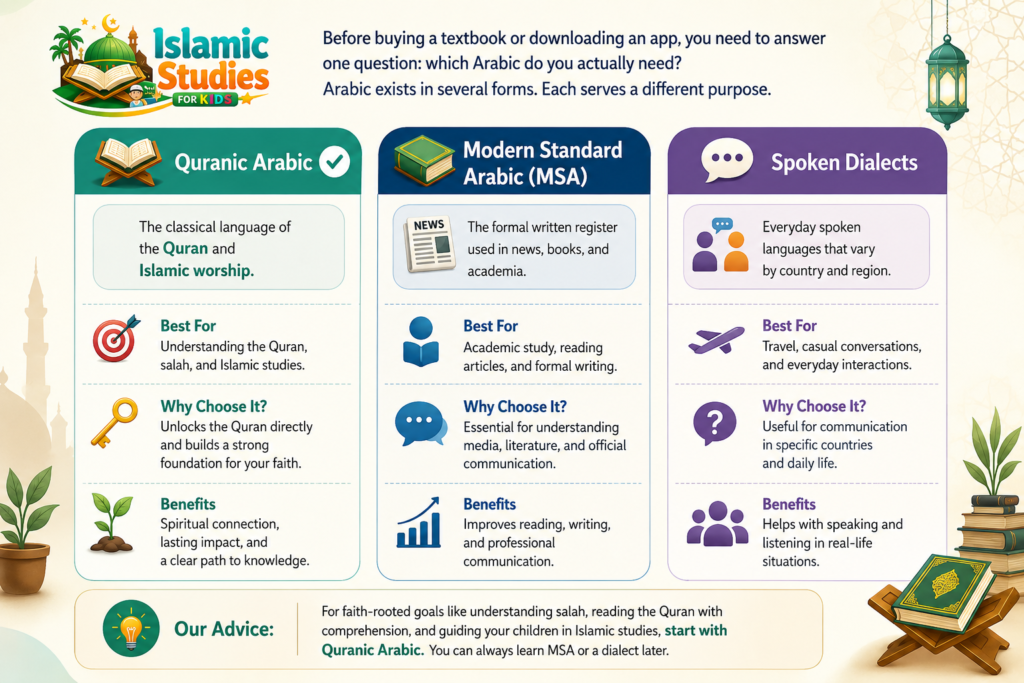
Arabic exists in several forms. Spoken regional dialects — Egyptian, Levantine, Gulf — differ significantly from one another and from the Arabic of the Quran. Modern Standard Arabic (MSA) is the formal written register used in news and academia. Quranic Arabic is the classical language of the Quran and of Islamic worship.
For a Muslim mother whose goals are faith-rooted — understanding salah, reading Quran with comprehension, guiding her children in Islamic studies — Quranic Arabic is the correct starting point. It unlocks the Quran directly and serves as the foundation for everything else. A spoken dialect can be layered on later for travel or conversation, but attempting both at once typically produces confusion and leads to dropout.
Make this decision before you spend a single hour studying. Clarity about your goal protects your time.
2. Starting from Zero: The Arabic Alphabet Comes First
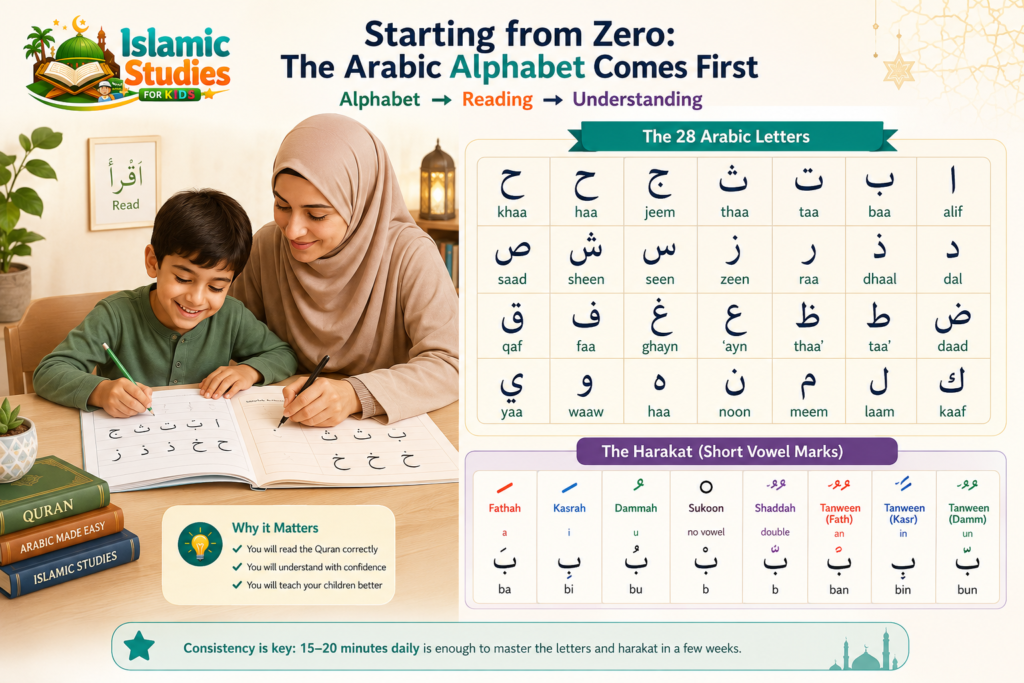
The correct starting point is the Arabic alphabet — not transliteration, not vocabulary lists, and not phrases.
Many adult learners make the mistake of memorizing words in English letters first: writing “Bismillah” instead of بِسْمِ اللَّه, or “Alhamdulillah” instead of الْحَمْدُ لِلَّه. This feels faster at the beginning, but it creates a ceiling you cannot break through. You will never read the Quran, a textbook, or your child’s homework using transliteration.
The Arabic alphabet has 28 letters, each appearing in up to four forms depending on its position in a word. After letters come the harakat — the short vowel marks written above and below letters that control pronunciation. These are essential for Quran reading, where vowelization determines meaning.
Most mothers with 15–20 minutes of daily practice can recognize all 28 letters within two to four weeks. The harakat take another two to three weeks to internalize with consistent reading practice. This is not a long investment — and it is the only foundation that actually works.
Think of it the way Arabic-speaking children learn: alphabet first, then reading, then meaning. The sequence is the same for adult learners. Skipping it only creates gaps you will spend months correcting.
3. Building a Daily Routine That Fits a Mother’s Life
Consistency beats intensity — this is the single most important principle for a busy mother learning Arabic.
A mother who studies Arabic for 15 minutes every day will consistently outpace one who studies for two hours on Saturday and nothing the rest of the week. Language retention depends on regular reinforcement because the brain consolidates new patterns through repeated daily exposure. Long weekend sessions do not replicate that.
A practical weekly routine that fits real mother life:
Daily (10–15 minutes): Review five vocabulary words using flashcards, or read five lines of voweled Arabic text aloud. Connect each word to a Quranic verse or du’aa you already know.
Three times per week (20–30 minutes): A structured lesson — with a teacher, a structured course, or a focused grammar module. This is where new material is introduced and mistakes are corrected.
Once per week (15–20 minutes): Review everything from that week. Write out new vocabulary. Read a short passage studied earlier in the week and notice what has become easier.
The critical design principle: build this routine around your worst week, not your best one. If you can only commit to 10 minutes daily during a hard week, your routine should fit within 10 minutes. Ambitious schedules that collapse under family pressure teach your brain that Arabic is something you quit — and that association is hard to reverse.
If you want a structured program designed specifically around a mother’s schedule, our Arabic classes for mothers provide live sessions with female teachers, flexible rescheduling, and a curriculum built for women starting from zero.
Experience a Real Classroom
Curious about how we teach? This video offers a glimpse into a real class, showcasing our interactive approach, qualified teachers, and child-friendly learning experience.
Fun & Engaging Islamic Classes for Kids
Start your child’s journey today with interactive lessons designed to make learning Islam loved and easy.
Get Your Child a Free Trial4. Using What You Already Know from Salah and Quran
Most Muslim mothers already carry Arabic in their memory — they simply have not mapped meaning onto it yet.
You recite Surah Al-Fatihah multiple times every single day. You say Subhanallah, Alhamdulillah, Allahu Akbar, Astaghfirullah. These are real Arabic words with real grammatical structure, and they are your most powerful starting vocabulary because you already know how they sound, how they feel in your mouth, and when they are said.
A high-leverage study method: each week, take five words from your daily prayers and learn their meaning, their Arabic root, and where else they appear in the Quran. The Arabic root system means one three-letter root produces dozens of related words — learning رحم (the root for mercy) gives you رَحِيم (Most Merciful), رَحْمَة (mercy), and الرَّحْمَن (The Most Gracious) all at once. One root, multiple words, instant expansion.
This approach works especially well for mothers because it connects new learning to something already practiced daily. Linguists who study Quranic Arabic note that the 50 most frequently used words in the Quran account for roughly 60% of total word occurrences. For a motivated mother, targeted Quranic vocabulary is the single fastest path to meaningful comprehension.
You can deepen this further through our Quran courses for mothers, which combine recitation, word-level meaning, and basic Arabic together in one structured track.
5. Learning Arabic to Teach Your Children
Many mothers approach Arabic not just for themselves but with a specific purpose: to guide their children. The honest answer that surprises most of them is that you do not need to be fluent before you start teaching.
The practical threshold is much more accessible than fluency. If you can read voweled Arabic text accurately, recognize high-frequency Quranic vocabulary, and understand Surah Al-Fatihah word by word — you have enough to begin teaching a child at the beginner level. That foundation typically takes a dedicated mother between three and six months to build.
The Parallel Learning Method
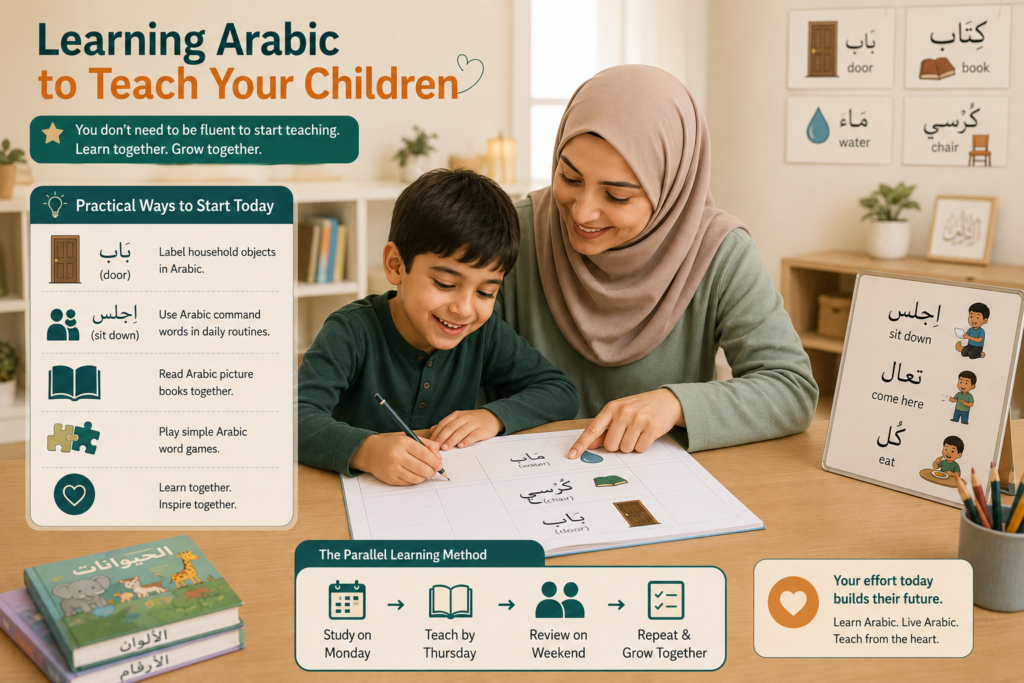
The most effective approach for mothers who want to teach is staying one step ahead of your child rather than waiting to be ten steps ahead. Study this week’s vocabulary on Monday. Teach it to your child by Thursday. Review it together on the weekend.
This structure creates mutual accountability — you cannot skip your own Arabic study without letting your child’s progress fall behind. It also removes the false benchmark of “I’m not ready yet,” because readiness is a milestone, not a feeling, and that milestone is reachable.
Bringing Arabic into Your Home Before You Feel Ready
Practical ways to start before you reach that milestone:
- Label household objects in Arabic: بَاب (door), كِتَاب (book), مَاء (water), كُرْسِي (chair)
- Use Arabic command words in daily routines: اجلس (sit down), تعال (come here), كُل (eat)
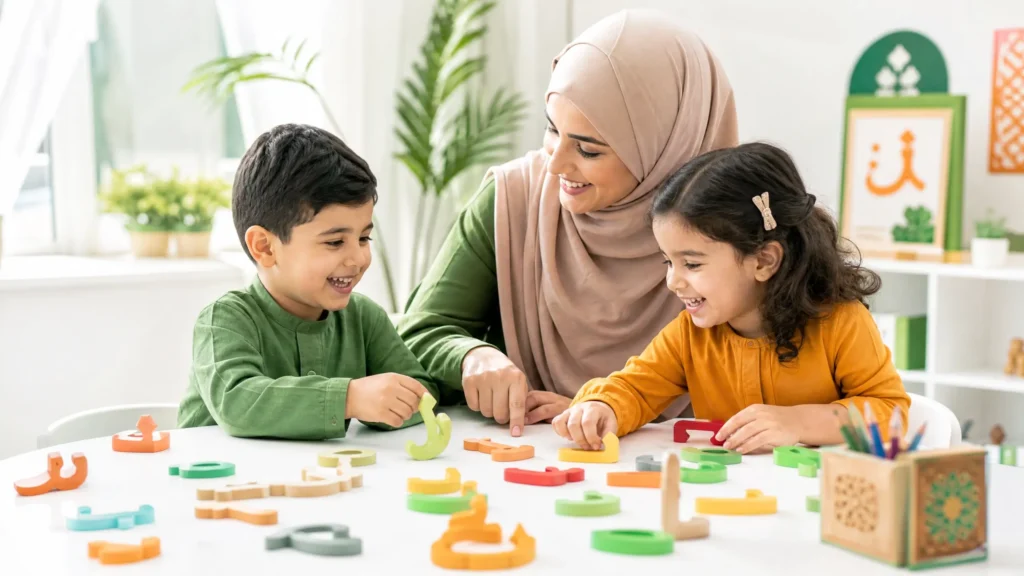
- Read Arabic picture books together — you learn the words as you go, and your child sees Arabic as normal, not foreign
- Play simple Arabic word games: who can say the Arabic word for five things on the dinner table?
One of the most powerful motivators for children is watching their mother make effort, make mistakes, and keep going. A mother who learns alongside her child teaches resilience alongside Arabic. When you are ready to add structured teaching for your children alongside your own study, our Quran and Arabic courses run both tracks together.
Common Mistakes Mothers Make When Learning Arabic
Most mothers who struggle with Arabic are not lacking effort or commitment — they are making a small number of avoidable mistakes that quietly stall progress for months. Identifying these early saves you significant time.
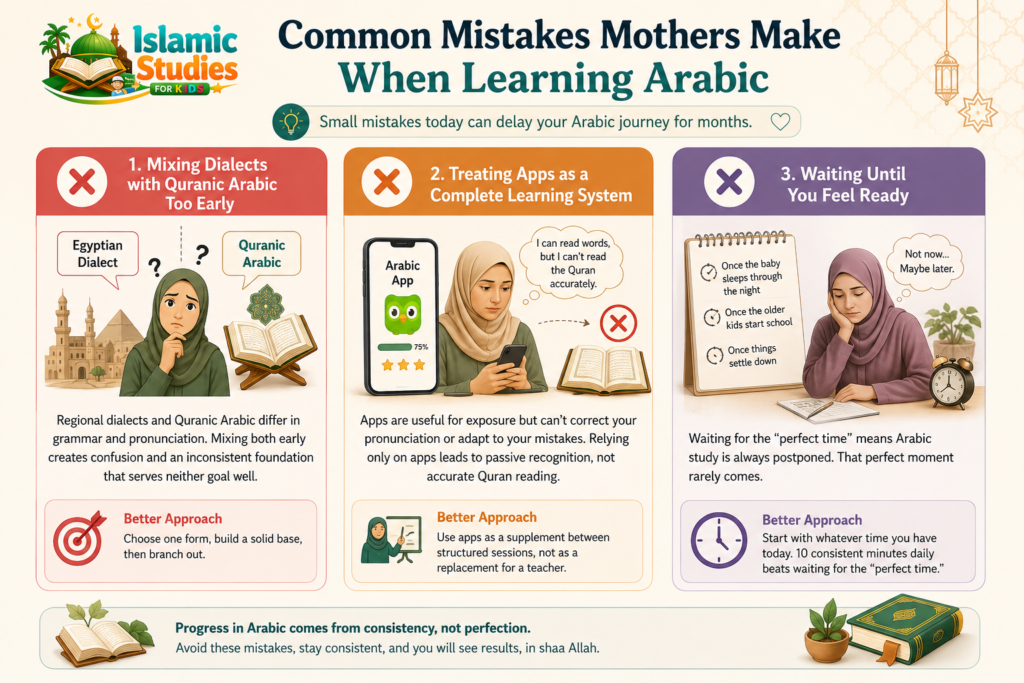
Mixing Dialects with Quranic Arabic Too Early
Regional dialects and Quranic Arabic share vocabulary but differ significantly in grammar and pronunciation. Mothers who switch between an Egyptian dialect app and a Quranic Arabic course find the two systems conflict more than they help each other. The result is a blended, inconsistent foundation that serves neither goal well. Choose one form, build a solid base, then branch out.
Read Also: How to Manage Islamic Home Learning?
Treating Apps as a Complete Learning System
Language apps provide useful exposure to letters and vocabulary — but they cannot correct your pronunciation in real time or adapt to the specific errors you are making as an English-speaking adult. A mother who relies entirely on apps for six months often finds she can recognize vocabulary passively but cannot read a line of Quran accurately, because the phonetic precision that reading requires was never trained. Use apps as a supplement between structured sessions, not as a replacement for a teacher.
Read Also: Benefits of Learning Arabic for Muslim Mothers
Waiting Until You Feel Ready to Begin
The most common form of delay among Muslim mothers is waiting for a better time: once the baby sleeps through the night, once the older kids start school, once things settle down. Arabic study that is permanently deferred to a future better moment rarely begins.
The clearest lesson from mothers who have successfully built Arabic into their lives: start with whatever time you actually have today. Ten consistent minutes daily produces more Arabic knowledge in a year than waiting another twelve months for a bigger time window that never arrives.
Read Also: How a Mother Can Learn Quran Online?
Watch a Sample Lesson from Our Academy
Get a firsthand look at how our students learn Islamic values, Quran, and essential knowledge through engaging and interactive online classes. See why families trust Islamic Studies for Kids Academy.
Fun & Engaging Islamic Classes for Kids
Start your child’s journey today with interactive lessons designed to make learning Islam loved and easy.
Get Your Child a Free TrialStart Learning Arabic Today with Courses Built for Mothers
Structured instruction with a qualified teacher solves the three problems that self-study cannot: it corrects pronunciation in real time, answers questions in context, and provides the accountability that keeps you showing up consistently.
At islamic studies for kids our Arabic and Islamic studies courses for mothers are taught by qualified female instructors, designed around flexible scheduling, and built for women starting from zero background. Whether your goal is Quranic comprehension, guiding your children, or deepening your salah — there is a course track built for exactly where you are now.
Our Courses for Mothers:
- Islamic Studies Classes for Mothers
- Arabic Course for Mothers
- Quran Reading Course for Mothers
- Quran Hifz (Memorization) for Mothers
- Tajweed Course for Mothers
Enroll today and begin your journey of learning, worship, and spiritual growth from the comfort of your home.

Conclusion
Learning Arabic as a mother is one of the most meaningful investments you can make for your family’s Islamic foundation. As Muhammad ibn Shubrumah, one of the righteous predecessors, said: “Men have never worn a garment more beautiful than Arabic.” That beauty is available to you too, whatever your starting point.
You do not need fluency to make a real difference. You need the alphabet, a consistent routine, a clear goal, and enough patience to celebrate small progress rather than wait for complete mastery. A child who grows up watching their mother study Arabic, make mistakes, and persist learns something deeper than vocabulary — they learn that their faith is worth effort.
Start with 15 minutes today. Build from there. The Arabic you learn this year will still be serving your family ten years from now — in salah, in Quran, and in every conversation you have with your children about why this language matters.
Frequently Asked Questions
How long does it take a mother to learn Arabic from scratch?
Most mothers with no prior Arabic background can read basic voweled Arabic text within three to six months of consistent daily practice — 15 to 20 minutes per day. Reaching meaningful Quranic comprehension typically takes one to two years. Progress depends far more on daily consistency than on session length.
Do I need to be fluent in Arabic before teaching it to my children?
No. The practical benchmark for starting to teach is being able to read voweled Arabic accurately and understand Surah Al-Fatihah word by word. Most mothers reach this point within three to six months of focused study. From there, the Parallel Learning approach — staying one step ahead of your child — allows you to teach effectively while continuing to learn yourself.
What is the difference between Quranic Arabic and spoken dialects?
Quranic Arabic is the classical Arabic of the Quran, preserved without regional variation and used across all Islamic scholarship. Spoken dialects are regional everyday languages that differ from each other and from Quranic Arabic in grammar, vocabulary, and pronunciation. For mothers whose primary goal is faith-connected learning, Quranic Arabic is the correct first choice.
Can I learn Arabic at home without a teacher?
Significant progress is possible at home using structured courses, audio resources, and apps — particularly for alphabet recognition and vocabulary. However, Arabic sounds that do not exist in English (ع، غ، ح، خ) are very difficult to correct without real-time feedback. Even one weekly session with a qualified teacher prevents months of ingrained mispronunciation that becomes increasingly hard to undo.
Is it too late to learn Arabic as an adult mother?
No. Adult learners bring real advantages: intentional motivation, existing Quranic vocabulary from years of salah, and the ability to understand grammar analytically. Many mothers have built a solid Quranic Arabic foundation starting in their thirties, forties, and beyond. The challenges are pronunciation and time — both manageable with the right routine.
What should I learn in Arabic first?
The Arabic alphabet and the harakat (short vowel marks). Everything else — vocabulary, grammar, Quran reading — depends on being able to decode Arabic script accurately. Most dedicated beginners can recognize all 28 letters within two to four weeks of daily practice.



Leave a Reply