 For Parents

Learning the Quran as a mother can feel impossible between school runs, meal prep, and work deadlines — but it’s more achievable than you think. With the right approach, a mother can learn Quran online from home, on her own schedule, with a qualified female instructor who understands exactly what her day looks like.
This guide covers every practical step: how to choose the right course, what to expect as a beginner, how to build a habit that actually sticks, and how to make your learning a foundation for your entire household.
1. Mothers Can Learn Quran Online Without Disrupting Daily Life
Online Quran learning has fundamentally changed what is possible for mothers. You no longer need to arrange childcare, commute to a mosque, or fit into a fixed class schedule designed for students with empty calendars.
Here is what makes the online model genuinely practical for mothers:
| Feature | Why It Matters for Mothers |
| Flexible scheduling | Book sessions around nap times, school hours, or work shifts |
| Female instructors | Learn comfortably with a qualified sister who understands your context |
| One-on-one lessons | Lessons adjust to your pace — no being left behind in a group |
| Home-based learning | No commute, no childcare arrangements, no wasted time |
| Rescheduling options | Life happens — good platforms accommodate that without penalty |
The key is choosing a platform built for mothers specifically, not a general course that simply happens to be online.
2. Quran Courses Available for Mothers Online
Not all online Quran courses are structured the same way. Before enrolling, it helps to know which type fits your current level and goal.
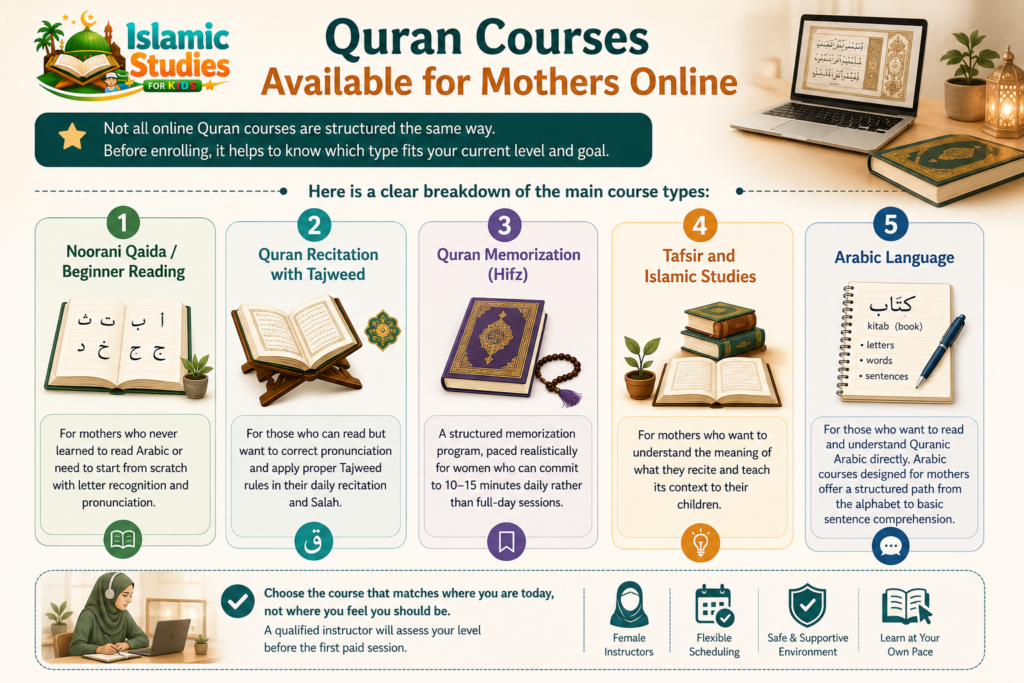
Here is a clear breakdown of the main course types:
- Noorani Qaida / Beginner Reading — For mothers who never learned to read Arabic or need to start from scratch with letter recognition and pronunciation.
- Quran Recitation with Tajweed — For those who can read but want to correct pronunciation and apply proper Tajweed rules in their daily recitation and Salah.
- Quran Memorization (Hifz) — A structured memorization program, paced realistically for women who can commit to 10–15 minutes daily rather than full-day sessions.
- Tafsir and Islamic Studies — For mothers who want to understand the meaning of what they recite and teach its context to their children.
- Arabic Language — For those who want to read and understand Quranic Arabic directly. Arabic courses designed for mothers offer a structured path from the alphabet to basic sentence comprehension.
Choose the course that matches where you are today, not where you feel you should be. A qualified instructor will assess your level before the first paid session.
3. The Right Platform for Online Quran Classes for Mothers
With dozens of platforms available, the decision can feel overwhelming. Apply these five criteria before enrolling anywhere.
1. Female instructors are available and assigned by default
Many mothers are not comfortable learning from a male teacher. Confirm that the platform guarantees a female instructor — not just offers the option as an upsell.
2. Instructors hold Ijazah certification
An Ijazah is the gold standard credential in Quranic teaching — it means the teacher’s recitation has been verified through an unbroken chain back to the Prophet ﷺ. Ask about this directly before booking.
3. Scheduling is genuinely flexible
A platform that offers “flexible scheduling” but has no availability during school hours or evenings is not flexible for mothers. Check the available time slots across your time zone before committing.
4. A free trial class is offered
Any reputable platform will offer at least one trial session. Use it. You will quickly know whether the teaching style, pace, and instructor’s communication style work for you.
5. The curriculum is structured, not improvised
Ad hoc lessons may feel relaxed, but progress requires a clear syllabus. Ask to see the course structure before enrolling. For Islamic studies classes for mothers, a structured curriculum ensures you move through foundational knowledge systematically rather than covering random topics each week.
Experience a Real Classroom
Curious about how we teach? This video offers a glimpse into a real class, showcasing our interactive approach, qualified teachers, and child-friendly learning experience.
Fun & Engaging Islamic Classes for Kids
Start your child’s journey today with interactive lessons designed to make learning Islam loved and easy.
Get Your Child a Free Trial4. Mothers Can Stay Consistent with Quran Learning at Home
Consistency is the real challenge — not the learning itself. These approaches are drawn from how experienced instructors structure lessons for mothers specifically.
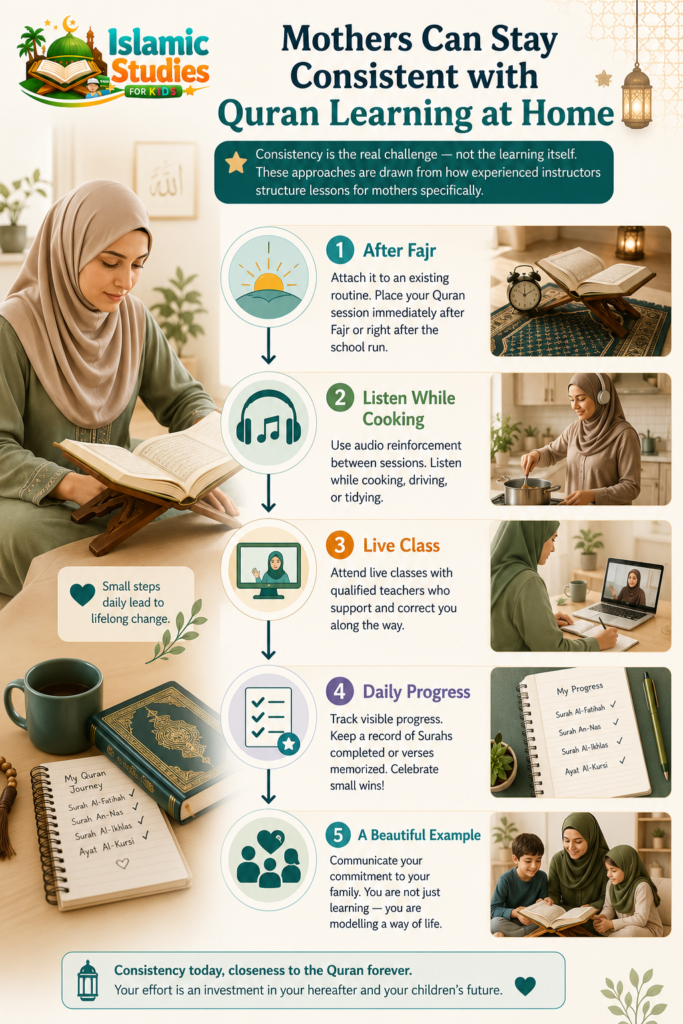
A practical framework for building a sustainable Quran habit:
- Attach it to an existing routine. Place your Quran session immediately after Fajr or right after the school run. Habits stack more easily onto existing anchors.
- Start with a micro-commitment. Five minutes daily is more sustainable than 45 minutes three times a week. Increase time gradually once the habit is established.
- Use audio reinforcement between sessions. Listen to your instructor’s model recitation or a Qari you find easy to follow while cooking, driving, or tidying. This passive repetition accelerates memory retention significantly.
- Track visible progress. Keep a simple record of Surahs completed or verses memorized. Seeing concrete progress on paper is one of the strongest motivators for adult learners.
- Communicate your commitment to your family. Children who see their mother dedicating time to the Quran absorb that as a value. You are not just learning — you are modelling a way of life.
Read also: How to Manage Islamic Home Learning? A Mother’s Complete Guide
5. A Mother Can Memorize the Quran Online — Here Is How
Yes — and thousands of mothers have done it through structured online programs. The caveat is that traditional Hifz models were designed for children with no competing responsibilities, and applying that same structure to a mother’s life is a formula for burnout.
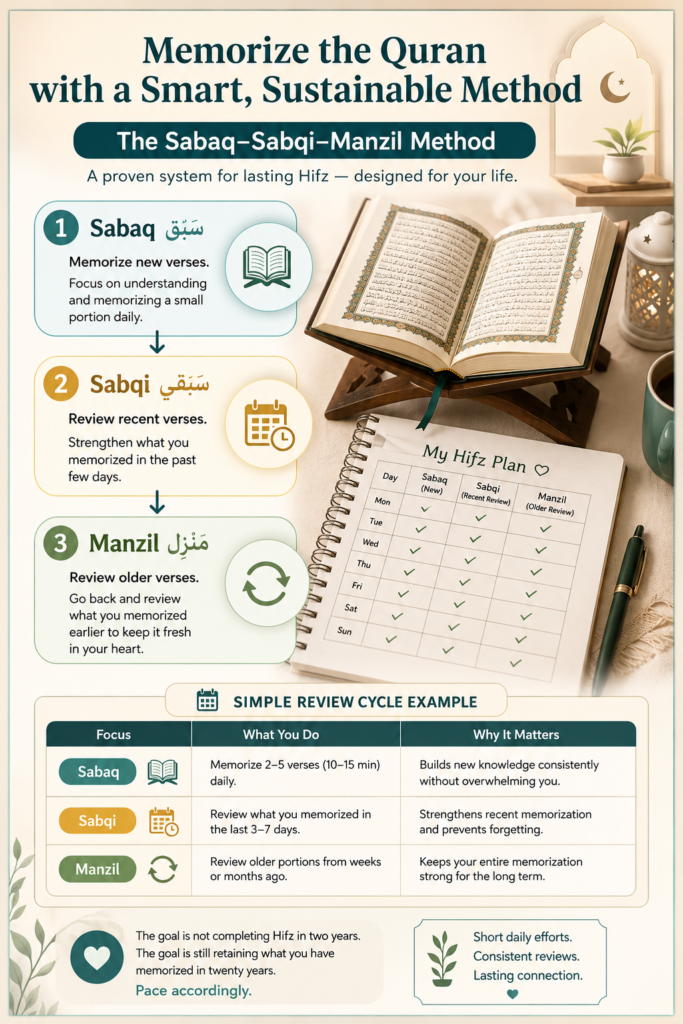
A realistic approach uses short daily sessions (10–15 minutes), a structured review cycle to prevent forgetting previously memorized verses, and an instructor who adjusts the pace to your life rather than a fixed syllabus timeline. The Sabaq-Sabqi-Manzil method — memorizing new material, reviewing recent material, and cycling older material — is particularly effective for adult women because it prevents the common experience of memorizing forward while forgetting everything behind.
The goal is not completing Hifz in two years. The goal is still retaining what you have memorized in twenty years. Pace accordingly.
6. Learning Quran as a Mother Creates a Legacy for Your Children
One of the most compelling reasons mothers cite for starting Quran learning is not personal — it is their children. A mother who can recite correctly, understand what she is reading, and explain basic Tajweed rules becomes the first Quran teacher in her household.
Children who grow up watching their mother sit down with the Quran daily, correct her own recitation, and ask questions about meaning develop a relationship with the Quran that no classroom alone can build. The Prophet ﷺ said: “The best among you are those who learn the Quran and teach it.” A mother who does both simultaneously — learning for herself and passing it to her children — fulfils that in the most direct way possible.
If your goal is to guide your children in Arabic and Islamic values, Arabic language courses built for mothers provide the foundation you need to be a confident first teacher at home.
Read Also: How to Manage Islamic Home Learning?
The 3 Biggest Mistakes Mothers Make When Learning Quran Online
Most mothers who struggle with online Quran learning make the same mistakes. Knowing them in advance saves months of frustration.
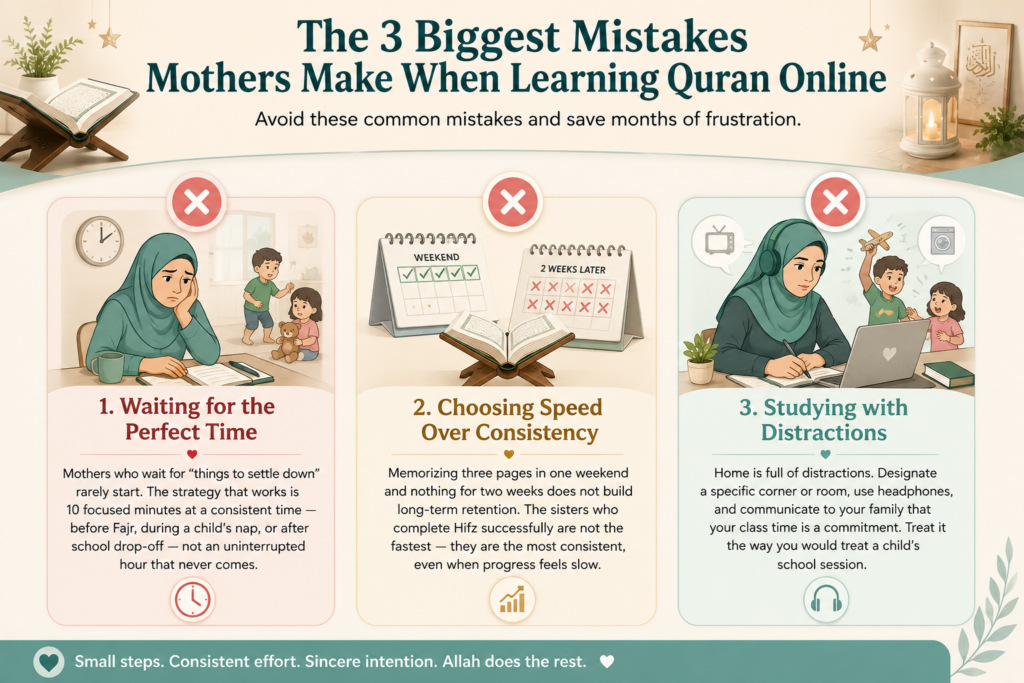
Mistake 1: Waiting for a “perfect” time block
Mothers who tell themselves they will study “when things settle down” rarely start. The strategy that works is 10 focused minutes at a consistent time — before Fajr, during a child’s nap, or after school drop-off — rather than waiting for an uninterrupted hour that never arrives.
Read Also: Benefits of Learning Arabic for Muslim Mothers
Mistake 2: Choosing speed over consistency
Memorizing three pages in one weekend and nothing for two weeks does not build long-term retention. The sisters who complete Hifz programs successfully are not the fastest — they are the most consistent, even when progress feels slow.
Read Also: How to Learn Arabic as a Mother?
Mistake 3: Studying in a distracting environment
Online learning happens at home, which is also where everything else happens. Designate a specific corner or room, use headphones, and communicate to your family that your class time is a commitment. Treat it the way you would treat a child’s school session.
Read Also: How to Learn Islam as a Muslim Mother?
Watch a Sample Lesson from Our Academy
Get a firsthand look at how our students learn Islamic values, Quran, and essential knowledge through engaging and interactive online classes. See why families trust Islamic Studies for Kids Academy.
Fun & Engaging Islamic Classes for Kids
Start your child’s journey today with interactive lessons designed to make learning Islam loved and easy.
Get Your Child a Free TrialStart Your Quran Journey Today — Courses Designed for Mothers
You have been meaning to start. The right time is not when life gets quieter — it is now, with a course structured around your life as it actually is.
islamic studies fo rkids offers online Quran and Islamic studies courses specifically designed for mothers: flexible scheduling, qualified female instructors, and curricula that build from where you are to where you want to be.
Our Courses for Mothers:
- Islamic Studies Classes for Mothers
- Arabic Course for Mothers
- Quran Reading Course for Mothers
- Quran Hifz (Memorization) for Mothers
- Tajweed Course for Mothers
Enroll today and begin your journey of learning, worship, and spiritual growth from the comfort of your home.
Conclusion
A mother learning Quran online is not a compromise on quality — it is the most practical, sustainable path available. With the right platform, a qualified female instructor, realistic scheduling, and a consistent daily habit, the learning you build now compounds into spiritual growth that shapes your household for generations.
The three things that make the difference are: choosing a course that fits your actual level, committing to daily micro-sessions rather than weekly marathons, and treating your learning time as a non-negotiable commitment the way you treat your children’s education.
Your Quran journey and your role as a mother are not in competition. They strengthen each other.
Frequently Asked Questions
What is the best way for a mother to learn Quran online?
The most effective approach combines live one-on-one sessions with a certified female instructor and short daily practice between classes. Mothers who attach their Quran time to an existing daily routine — such as immediately after Fajr — build the most consistent habit.
Can I learn Quran online as a complete beginner with no Arabic background?
Yes. Reputable platforms start with the Arabic alphabet and Noorani Qaida before any Quran recitation. Instructors trained for adult beginners move at a pace appropriate for someone learning letters for the first time, not the pace of a childhood classroom.
Do online Quran classes for mothers offer female instructors?
They should, and you should confirm this before enrolling. A genuinely women-focused platform assigns female instructors by default — not as an optional add-on. Ask directly whether all your sessions will be with a female teacher.
How much time does a mother need to dedicate to online Quran learning?
As little as 10–15 minutes of daily practice, combined with one or two live sessions per week, produces measurable progress for most mothers. Consistency over time matters more than session length.
Can mothers memorize the Quran through online classes?
Yes. Structured online Hifz programs for sisters are paced around real life — short daily sessions, structured review cycles, and instructors who adjust timelines to fit a mother’s schedule rather than a full-time student’s.
What is the difference between Tajweed and basic Quran recitation courses?
Basic recitation courses focus on reading letters and words correctly from the Mushaf. Tajweed courses add the rules of pronunciation — elongation (Madd), echo sounds (Qalqalah), nasal sounds (Ghunna) — that make recitation correct according to the way the Quran was revealed. Most mothers benefit from starting with basic recitation and progressing to Tajweed once fluency is established.


Leave a Reply