 Quran
Quran
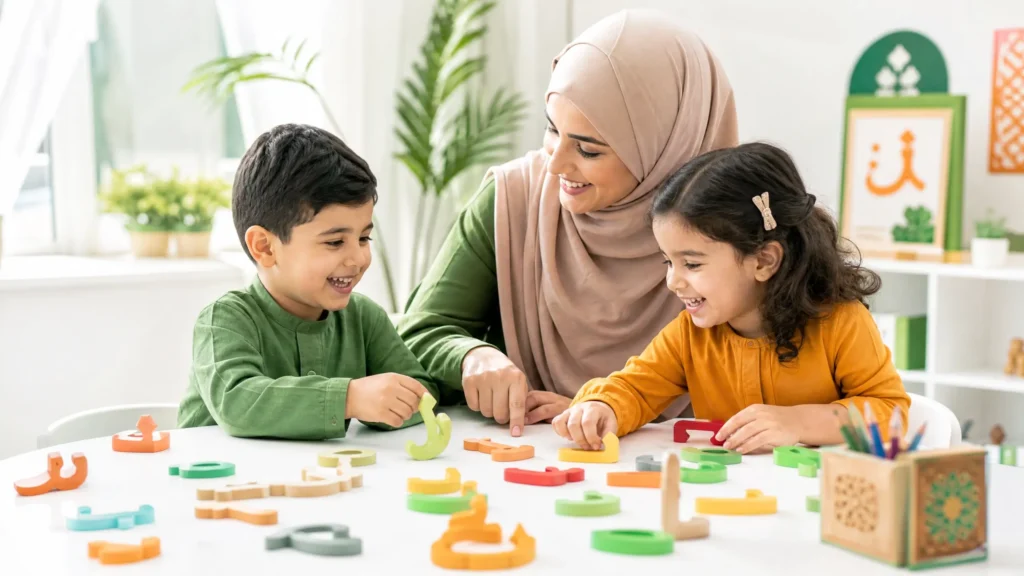
Many parents ask the samWhat Age Should Kids Learn Arabic?e question before their child ever picks up a single letter: what age should kids learn Arabic? The honest answer is that children can start almost immediately — the real variable isn’t the age you begin, it’s how consistently and naturally Arabic shows up in your child’s daily life.
At Islamic Studies For Kids Academy, this question comes up in nearly every first conversation with a parent. Some are raising bilingual households.
Others want their child to read the Quran with understanding. Both goals point to the same starting principle: earlier exposure makes the language feel natural instead of foreign, but no age closes the door on learning Arabic.
This guide walks through what children can realistically learn at each age, what “best age to learn Arabic for kids” actually means in practice, and how parents can support progress at home without needing to speak Arabic themselves.
What Age Should Kids Learn Arabic?
Children can begin learning Arabic as early as age 2 to 3, starting with listening and simple word recognition rather than formal instruction. Between ages 4 and 6, most children are ready for structured letter learning and short spoken phrases. This window matters because pronunciation habits formed early tend to stick, while habits corrected later take more effort to unlearn.
There isn’t a single fixed “correct” age, though. What matters more is matching the teaching method to the child’s developmental stage — a 3-year-old and a 9-year-old should never be taught the same way, even if they’re both technically “learning Arabic.”
1. Why Early Exposure Matters for Arabic
Young children absorb new sounds without the self-consciousness that older learners develop. Arabic includes sounds that don’t exist in English — ع, ق, ح, and غ among them — and children under about age 7 tend to pick up these sounds through repetition far more easily than teenagers or adults, who often need to be taught the mechanics of tongue and throat placement explicitly.
This is one reason many families start with listening rather than speaking: hearing Arabic regularly, even before a child can respond, builds the sound recognition that later makes speaking and reading easier.
2- The Critical Period and Why It’s Often Misunderstood?
Language development research points to a “critical period” — a window, generally before puberty, when the brain is unusually efficient at absorbing new language patterns. For Arabic specifically, this matters because the language operates on two tracks: everyday spoken dialects and Modern Standard Arabic (MSA), the form used in the Quran, formal writing, and media.
The mistake some parents make is treating the critical period as a deadline. It isn’t. It’s an efficiency window, not a cutoff. A child who starts at 9 isn’t locked out of fluency — they simply need a different teaching approach than a 3-year-old would.
Families building toward Quran literacy often start this window with a Noorani Qaida course, which introduces Arabic letter sounds and joining rules before a child moves into full recitation — a natural bridge between early listening and structured reading.
Read Also: arabic kids books
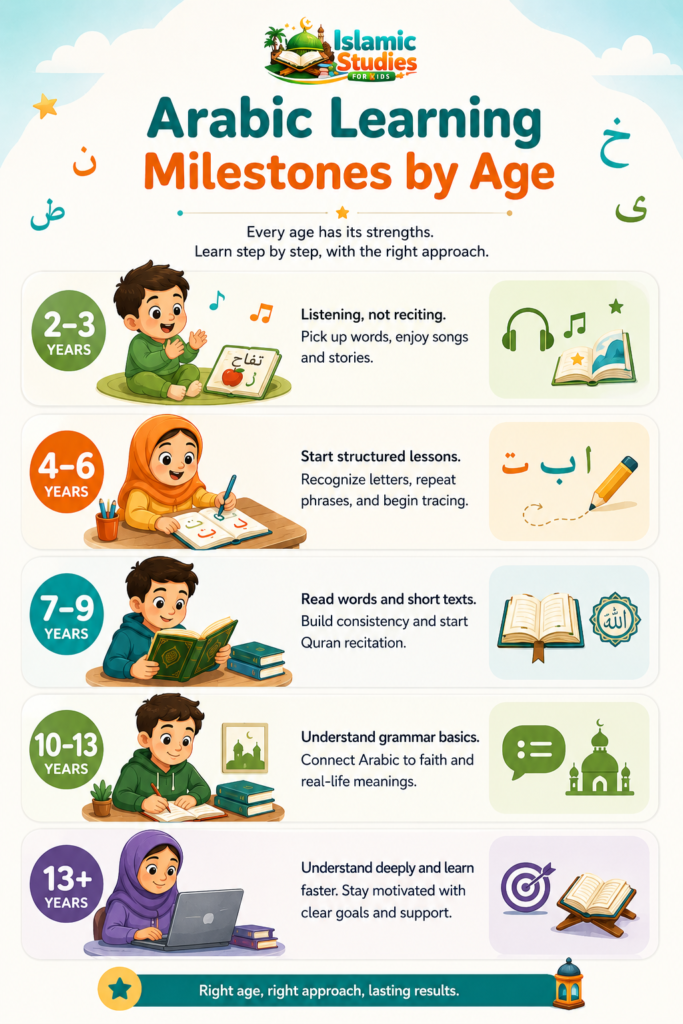
Arabic Learning Milestones by Age
Every stage of childhood brings a different set of realistic capabilities. Understanding what’s actually achievable at each age prevents two common mistakes: pushing formal grammar on a toddler, or assuming an older child has “missed the window” entirely.
Ages 2–3
Yes — but “learning” at this age means listening, not reciting. A 3-year-old can recognize familiar Arabic sounds, pick up single words for common objects, colors, or greetings, and enjoy Arabic songs and short stories. They are not yet forming sentences or reading letters, and expecting that at this stage usually backfires.
The most effective approach here is passive but consistent exposure: Arabic playing in the background, simple words repeated during daily routines, and short rhymes or nasheeds. There’s no testing, no correction — just repetition in a low-pressure environment.
Ages 4–6
This stage is where most structured programs, including ours, recommend starting formal lessons. Children can now repeat short phrases, answer simple questions, and begin recognizing individual Arabic letters by shape and sound. Motor skills are also developed enough to begin basic letter tracing.
This is typically the age families begin the Quranic Arabic course, since children at this stage can start connecting spoken words to their written form without the cognitive load of full grammar instruction.
Experience a Real Classroom
Curious about how we teach? This video offers a glimpse into a real class, showcasing our interactive approach, qualified teachers, and child-friendly learning experience.
Fun & Engaging Islamic Classes for Kids
Start your child’s journey today with interactive lessons designed to make learning Islam loved and easy.
Get Your Child a Free TrialAges 7–9
By 7 to 9, most children can handle more structured lessons: connecting letters into words, reading short voweled texts, and beginning to notice grammar patterns like plural forms or simple sentence structure. This is also the age where consistency starts to matter more than raw exposure — three focused 20-minute sessions a week outperform one long weekend session.
Children at this stage often begin a formal Quran recitation course, applying their growing letter and word recognition directly to reading Quranic text, followed by Tajweed once recitation is stable.
Ages 10–13
Older children in this range can hold short conversations, read longer texts, and start understanding grammar explanations rather than just memorizing patterns. This is also when Arabic starts connecting to a child’s sense of identity — many children this age respond well to linking Arabic directly to their faith, through Quran study or basic Fiqh lessons taught partly in Arabic terminology.
A common mistake at this stage: focusing purely on grammar drills. Children 10 to 13 often disengage from language learning that feels like a worksheet. Mixing in conversation practice, short readings, or connecting lessons to Hadith stories keeps motivation intact.
Read Also: How to Teach Quran to a 6–7 Year Old?
Ages 13 and Older
Yes, and often faster in some respects than younger children. Teenagers can understand grammar explanations directly instead of absorbing patterns slowly through repetition, and they can sustain longer, more focused study sessions. What they typically need more of is a clear reason to persist — connecting Arabic to reading the Quran independently, for example, tends to keep older kids engaged through the early difficulty.
The main challenge at this age isn’t ability, it’s self-consciousness. Teenagers are more aware of making mistakes in front of others, so a patient, judgment-free learning environment matters more here than it did for a 4-year-old.
Read Also: How to Introduce Islam to a 2–3 Year Old
When Should Children Start Arabic If They’re Learning It as a Heritage Language?
For families where Arabic isn’t spoken daily at home, Arabic often functions as a heritage language — tied to faith and family rather than everyday necessity. In these households, the “best age” question shifts slightly: starting early still helps, but consistency of exposure matters more than the exact starting age.
Common obstacles for heritage learners include limited daily exposure, competition from school-language demands, and a lack of Arabic-speaking peers. The fix isn’t a stricter schedule — it’s making Arabic feel connected to something the child already values, whether that’s Quran memorization, family conversations, or a favorite Islamic story told partly in Arabic.
Read also: Is It Haram To Force Your Child To Read Quran?
How Parents Can Support Arabic Learning at Home
Parents don’t need to be fluent to make a real difference. What moves the needle most is consistency: short daily exposure beats occasional long sessions almost every time.
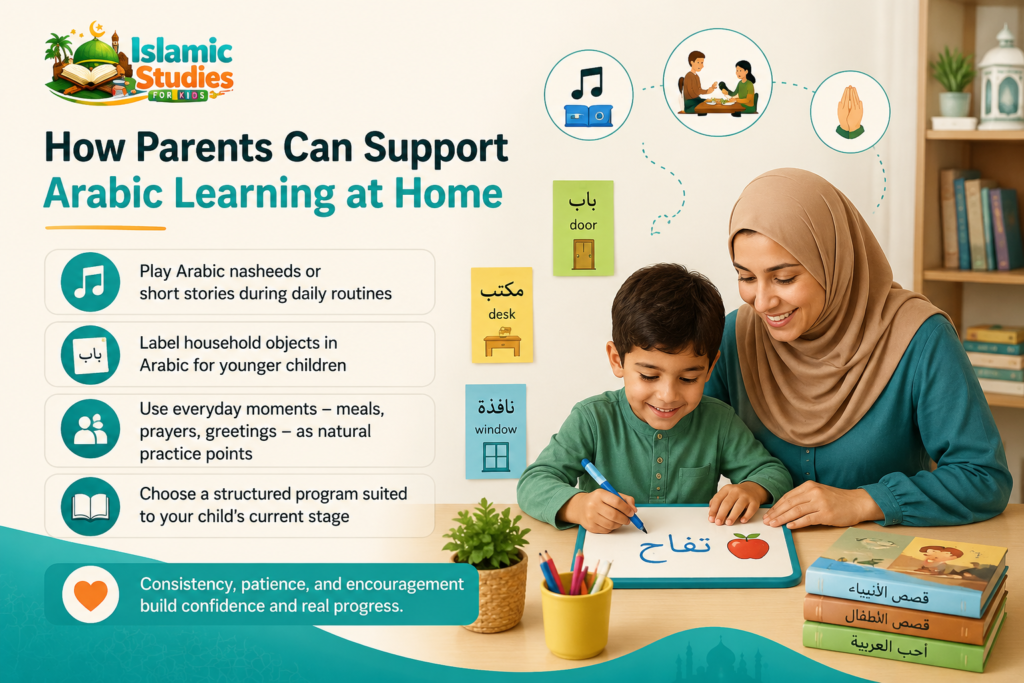
Practical steps that work across age groups:
- Play Arabic nasheeds or short stories during daily routines
- Label household objects in Arabic for young kids
- Use everyday moments — meals, prayers, greetings — as natural practice points
- Choose a structured program suited to your child’s current stage rather than a general one-size-fits-all course
Consistency also means protecting your child from comparison. Every child progresses at a different pace, and treating early mistakes as normal — not as failure — keeps kids willing to keep trying.
Read Also: At What Age Can Kids Fast In Ramadan?
Watch a Sample Lesson from Our Academy
Get a firsthand look at how our students learn Islamic values, Quran, and essential knowledge through engaging and interactive online classes. See why families trust Islamic Studies for Kids Academy.
Fun & Engaging Islamic Classes for Kids
Start your child’s journey today with interactive lessons designed to make learning Islam loved and easy.
Get Your Child a Free TrialStart Your Child’s Arabic Journey Today
Waiting for the “perfect age” often means losing months of easy, low-pressure exposure your child could have had already. Whether your child is 3 and just starting to listen, or 12 and ready for structured grammar, the right starting point is simply where they are now.

Islamic Studies For Kids Academy builds age-appropriate Arabic and Quran learning paths for every stage of your child’s journey:
- Noorani Qaida Course: for toddlers and young children just starting to listen and recognize letters
- Quranic Arabic Course: for children ready to connect spoken words to their written form
- Quran Recitation Course: for kids building toward confident, independent reading
- Tajweed Course: for children ready to master correct pronunciation rules
Every path is taught with patience, structure, and a clear connection to faith at every stage.
Our Islamic Studies Courses Include:
- Islamic Studies for Kids
- Islam Basics for Kids (Beginners)
- 5 Pillars of Islam for Kids
- 6 Pillars of Iman (Faith) for Kids
- Salah (Prayer) for Kids
- Wudu for Kids
- Dua for Kids
- Ramadan for Kids
- Zakat & Sadaqah for Kids
- Hajj for Kids
- Aqeedah (Islamic Belief) for Kids
- Islamic Manners & Akhlaq for Kids
- Good Deeds for Kids
- Cleanliness (Taharah) in Islam for Kids
- Angels in Islam for Kids
- Islamic History for Kids
- Seerah (Prophet’s Life) for Kids
- Prophets Stories for Kids
- Islamic Stories & Morals for Kids
- Fiqh for Kids (Islamic Jurisprudence Basics)
- Hadith for Kids
- Quran Tafseer Course for Kids
- Islamic Holidays & Events for Kids
- Islamic Identity for Kids
- Intensive Islamic Course for Kids
Enroll today and give your child the knowledge, values, and confidence to grow as a practicing Muslim with a strong connection to Allah and His teachings.
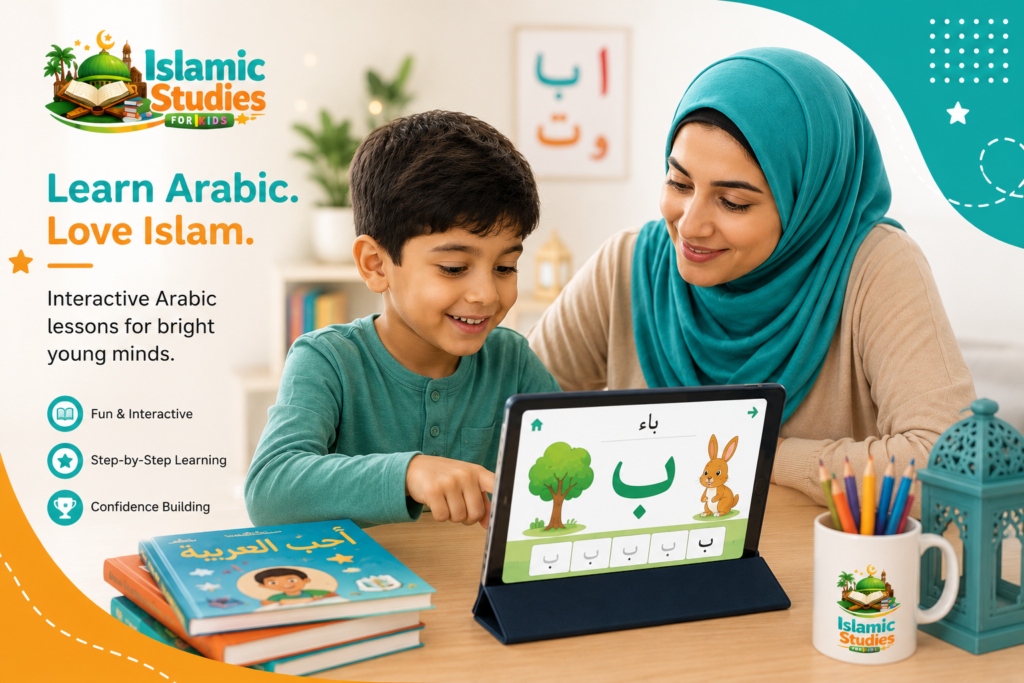
Book your child’s free trial lesson today.
Conclusion
There’s no single magic age at which Arabic learning must begin. Children as young as 2 or 3 can start absorbing sounds through listening and play, children aged 4 to 9 are typically ready for structured letters and reading, and children 10 and older can handle grammar-focused instruction with the added benefit of stronger focus and reasoning skills.
What actually determines success isn’t the starting age, it’s whether the teaching method fits the child’s current stage, and whether exposure is consistent rather than occasional. Whatever age your child is now is the right age to start, provided the approach matches where they are developmentally.
Frequently Asked Questions
Below are the most common questions parents ask about the best age to start Arabic for their children.
1. What age should kids learn Arabic?
Children can start Arabic exposure as early as age 2 to 3 through listening and songs, with structured letter learning typically beginning around age 4 to 6. Children of any age, including teenagers, can still learn effectively with the right teaching approach.
2. Can a 3 year old learn Arabic?
Yes, a 3-year-old can learn Arabic, though “learning” at this age means listening and simple word recognition rather than reading or forming sentences. Songs, repetition, and short stories work best at this stage.
3. Can a 13 year old learn Arabic?
Yes. Teenagers often grasp grammar explanations faster than younger children and can sustain longer study sessions. Their main challenge is usually confidence rather than ability, so a patient, low-pressure learning environment helps most.
4. Is it too late to start Arabic after age 10?
No. Starting after age 10 simply calls for a different teaching method — one built around grammar explanations and meaningful context, such as Quran study, rather than pure repetition and play.
5. How can parents support Arabic learning if they don’t speak Arabic themselves?
Parents can play Arabic songs or stories daily, label household items in Arabic, and use greetings or short phrases during routines. Enrolling in a structured, age-appropriate program handles the instructional side while parents reinforce consistency at home.

Leave a Reply