 For Parents
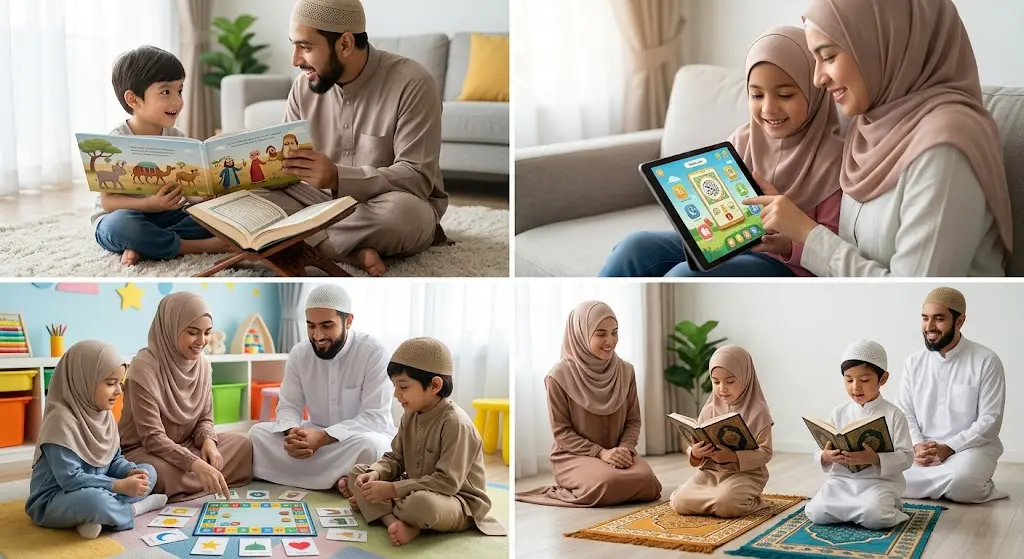
Many parents pour enormous energy into enrichment — language classes, sports, music lessons — yet the most lasting gift they can give a child is a heart that loves the Quran. Not a child who recites reluctantly, but one who reaches for it on their own. That outcome is possible at every age, and it begins much earlier than most parents think.
This guide covers exactly how to instill love of Quran in children, from before birth through the pre-teen years, with concrete steps you can start today.
Start With Instilling Love of Quran Yourselves (as Parents) First
Before a single technique, a single app, or a single memorization schedule — start here. Children are the world’s most accurate mirrors. They reflect what they see at home, not what they are told to do. If the Quran is alive in your daily life, it will become alive in theirs.
Dedicate even five minutes a day to reciting where your child can see you. Let them catch you listening to recitation while cooking, or pausing whatever you are doing to hear an ayah you love. When children observe that a parent genuinely values something — not performs it, but values it — they absorb that priority into their own sense of what matters.
The character of the Messenger of Allah ﷺ was the Quran itself (Sahih Muslim). You do not have to be a scholar to lead by example; you just have to be consistent and sincere.
One practical shift: replace background music with Quran recitation during car rides, meal prep, or household chores. No announcement needed. The ambient exposure alone begins the process of making kids love Quran.
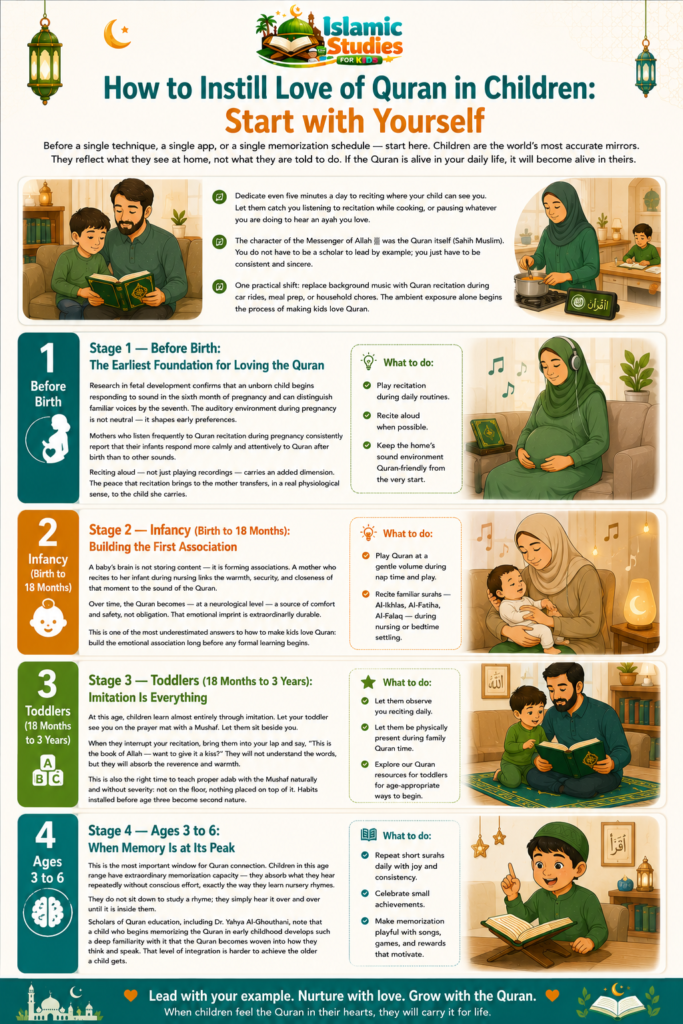
Stage 1 — Before Birth: The Earliest Foundation for Loving the Quran
Research in fetal development confirms that an unborn child begins responding to sound in the sixth month of pregnancy and can distinguish familiar voices by the seventh. The auditory environment during pregnancy is not neutral — it shapes early preferences.
Mothers who listen frequently to Quran recitation during pregnancy consistently report that their infants respond more calmly and attentively to Quran after birth than to other sounds. The link is familiarity: the child has already heard it hundreds of times in the womb.
Reciting aloud — not just playing recordings — carries an added dimension. The peace that recitation brings to the mother transfers, in a real physiological sense, to the child she carries. That calmness becomes the child’s first association with the Quran.
What to do: Play recitation during daily routines. Recite aloud when possible. Keep the home’s sound environment Quran-friendly from the very start.
Stage 2 — Infancy (Birth to 18 Months): Building the First Association
A baby’s brain is not storing content — it is forming associations. The question at this stage is not “what is my child learning?” but “what is my child learning to feel about this?”
A mother who recites to her infant during nursing links the warmth, security, and closeness of that moment to the sound of the Quran. Over time, the Quran becomes — at a neurological level — a source of comfort and safety, not obligation. That emotional imprint is extraordinarily durable. It can shape a person’s relationship with Allah’s words for decades.
This is one of the most underestimated answers to how to make kids love Quran: build the emotional association long before any formal learning begins.
Keep recitation soft and consistent. You do not need formal sessions. The Quran playing while your baby plays, or your voice reciting while you rock them to sleep, is enough.
What to do: Play Quran at a gentle volume during nap time and play. Recite familiar surahs — Al-Ikhlas, Al-Fatiha, Al-Falaq — during nursing or bedtime settling.
Stage 3 — Toddlers (18 Months to 3 Years): Imitation Is Everything
At this age, children learn almost entirely through imitation. They do not yet respond to explanations — they respond to what the people they love actually do. This is the stage where parental modeling has its maximum impact.
Let your toddler see you on the prayer mat with a Mushaf. Let them sit beside you, even if they are just turning pages or making noise. When they interrupt your recitation, bring them into your lap and say, “This is the book of Allah — want to give it a kiss?” They will not understand the words, but they will absorb the reverence and warmth surrounding the Quran.
This is also the right time to teach proper adab with the Mushaf naturally and without severity: not on the floor, nothing placed on top of it. Habits installed before age three become second nature.
What to do: Let them observe you reciting daily. Let them be physically present during family Quran time. Explore our Quran resources for toddlers for age-appropriate ways to begin.
Stage 4 — Ages 3 to 6: When Memory Is at Its Peak
This is the most important window for Quran connection. Children in this age range have extraordinary memorization capacity — they absorb what they hear repeatedly without conscious effort, exactly the way they learn nursery rhymes. They do not sit down to study a rhyme; they simply hear it over and over until it is inside them.
Scholars of Quran education, including Dr. Yahya Al-Ghouthani, note that a child who begins memorizing the Quran in early childhood develops such a deep familiarity with it that the Quran becomes woven into how they think and speak. That level of integration is harder to achieve the older a child gets.
Building a Lifelong Relationship with the Quran: Ages 6 to 12
By this stage, the foundation should be in place. The work now is about deepening understanding, expanding habits, and encouraging kids to read Quran independently.
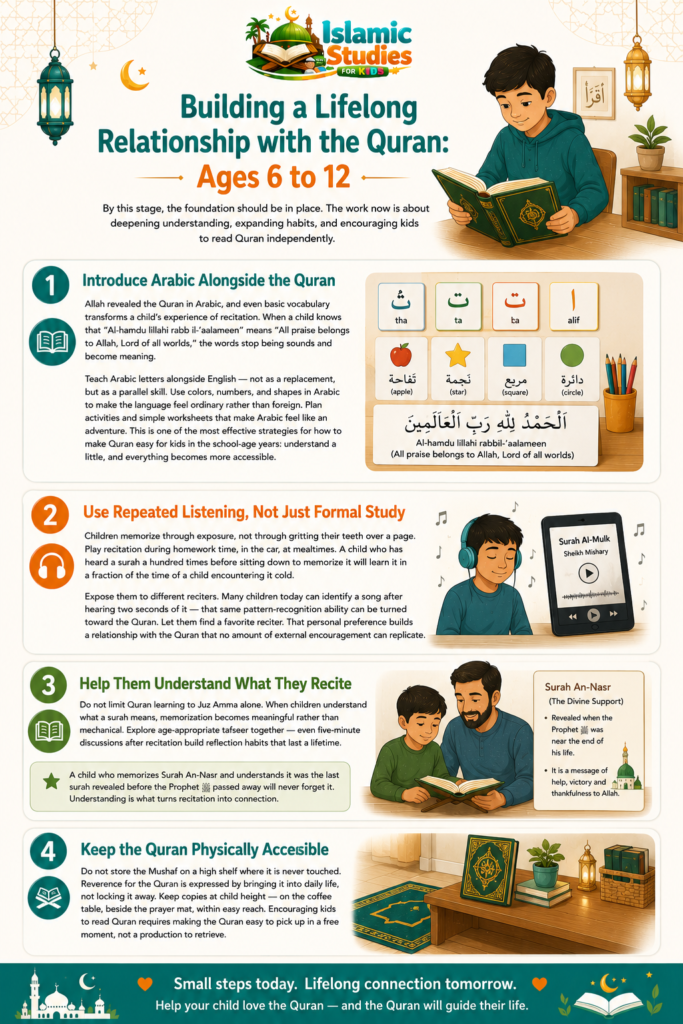
Introduce Arabic Alongside the Quran
Allah revealed the Quran in Arabic, and even basic vocabulary transforms a child’s experience of recitation. When a child knows that “Al-hamdu lillahi rabb il-‘aalameen” means “All praise belongs to Allah, Lord of all worlds,” the words stop being sounds and become meaning.
Teach Arabic letters alongside English — not as a replacement, but as a parallel skill. Use colors, numbers, and shapes in Arabic to make the language feel ordinary rather than foreign. Plan activities and simple worksheets that make Arabic feel like an adventure. This is one of the most effective strategies for how to make Quran easy for kids in the school-age years: understand a little, and everything becomes more accessible.
Read also: How To Raise A Muslim Child In A Non-Muslim Country?
Experience a Real Classroom
Curious about how we teach? This video offers a glimpse into a real class, showcasing our interactive approach, qualified teachers, and child-friendly learning experience.
Fun & Engaging Islamic Classes for Kids
Start your child’s journey today with interactive lessons designed to make learning Islam loved and easy.
Get Your Child a Free TrialUse Repeated Listening, Not Just Formal Study
Children memorize through exposure, not through gritting their teeth over a page. Play recitation during homework time, in the car, at mealtimes. A child who has heard a surah a hundred times before sitting down to memorize it will learn it in a fraction of the time of a child encountering it cold.
Expose them to different reciters. Many children today can identify a song after hearing two seconds of it — that same pattern-recognition ability can be turned toward the Quran. Let them find a favorite reciter. That personal preference builds a relationship with the Quran that no amount of external encouragement can replicate.
Help Them Understand What They Recite
Do not limit Quran learning to Juz Amma alone. When children understand what a surah means, memorization becomes meaningful rather than mechanical. Explore age-appropriate tafseer together — even five-minute discussions after recitation build reflection habits that last a lifetime.
A child who memorizes Surah An-Nasr and understands it was the last surah revealed before the Prophet ﷺ passed away will never forget it. Understanding is what turns recitation into connection.
Keep the Quran Physically Accessible
Do not store the Mushaf on a high shelf where it is never touched. Reverence for the Quran is expressed by bringing it into daily life, not locking it away. Keep copies at child height — on the coffee table, beside the prayer mat, within easy reach. Encouraging kids to read Quran requires making the Quran easy to pick up in a free moment, not a production to retrieve.
How to Make Quran Easy for Kids at This Age?
The key is repetition without drilling. Take two or three verses and scatter them across the day: at breakfast, in the car, before nap, at bedtime. Children do not need to sit still and repeat — they need to hear. Passive listening at this age produces genuine memorization. A child who has heard Surah Al-Ikhlas two hundred times across two weeks will recite it back without ever having formally studied it.
Choose short surahs that appear in daily Salah: Al-Fatiha, Al-Ikhlas, Al-Falaq, An-Nas. When a child hears a surah they know during prayer, the recognition moment is thrilling — and that thrill is precisely the emotion you want attached to Quran.
How to Make Quran Reading Fun for Kids at This Age?
The single most powerful tool at this stage is story. Introduce stories from the Quran — Sulayman and the Hoopoe, Musa and Al-Khidr, the People of the Elephant — and always frame them as Quran stories, not generic tales: “Let’s hear a story from the Quran tonight.” That framing, repeated consistently, links the joy of storytime directly to the Quran itself.
Give your child their own personal Quran. Let them choose the cover. Allow bookmarks, let them mark verses they love. Ownership creates attachment.
Reward every milestone freely: verbal praise in front of the family, stickers, small gifts when a surah is completed. Never use scolding or shame over memorization — a single negative experience at this age can create an aversion that takes years to reverse.
What to do: Repeat short surahs throughout daily routines. Tell Quran stories at bedtime when memory consolidates most strongly. Reward effort, never perfection.
The One Daily Habit That Ties Everything Together
Across every age and stage, one practice consistently outperforms everything else: end the day with Quran.
When the last thing a child hears before sleep is recitation — even played softly beside their bed — the Quran becomes embedded in their subconscious in a way that daytime exposure alone cannot match. Parents who do this consistently report that their children begin asking for Quran at bedtime, the way other children ask for a bedtime story.
That is the relationship you are building: a child who reaches for the Quran on their own terms, because they genuinely love it.
Read also: Fun Ways to Teach Islam to Kids at Home (That Actually Stick)
Watch a Sample Lesson from Our Academy
Get a firsthand look at how our students learn Islamic values, Quran, and essential knowledge through engaging and interactive online classes. See why families trust Islamic Studies for Kids Academy.
Start Your Child’s Quran Journey with Expert Guidance
Building love for the Quran at home sets the foundation — structured, expert-led learning is what helps children progress accurately and consistently.
At Islamic Studies For Kids children learn Quran, Arabic, and Islamic studies through engaging, age-appropriate lessons designed to make every session something they look forward to.

Our Islamic Studies Courses Include:
- Islamic Studies for Kids
- Islam Basics for Kids (Beginners)
- 5 Pillars of Islam for Kids
- 6 Pillars of Iman (Faith) for Kids
- Salah (Prayer) for Kids
- Wudu for Kids
- Dua for Kids
- Ramadan for Kids
- Zakat & Sadaqah for Kids
- Hajj for Kids
- Aqeedah (Islamic Belief) for Kids
- Islamic Manners & Akhlaq for Kids
- Good Deeds for Kids
- Cleanliness (Taharah) in Islam for Kids
- Angels in Islam for Kids
- Islamic History for Kids
- Seerah (Prophet’s Life) for Kids
- Prophets Stories for Kids
- Islamic Stories & Morals for Kids
- Fiqh for Kids (Islamic Jurisprudence Basics)
- Hadith for Kids
- Quran Tafseer Course for Kids
- Islamic Holidays & Events for Kids
- Islamic Identity for Kids
- Intensive Islamic Course for Kids
Enroll today and give your child the knowledge, values, and confidence to grow as a practicing Muslim with a strong connection to Allah and His teachings.
Fun & Engaging Islamic Classes for Kids
Start your child’s journey today with interactive lessons designed to make learning Islam loved and easy.
Get Your Child a Free TrialConclusion
Learning how to instill love of Quran in children is not about finding the right app or the strictest memorization schedule. It is about creating an environment where the Quran is present, where it is associated with warmth and joy, and where children see the adults they admire genuinely connected to it.
Start in the womb if you can. Start this evening if you cannot. Use stories, repetition, songs, and daily ambient exposure in the early years. Move to meaning, Arabic, and independent reading as children grow. Never use pressure — the scholarly tradition and practical experience alike confirm that love, not compulsion, produces a lasting bond.
The Prophet ﷺ said: “Read the Quran, for it will come on the Day of Resurrection as an intercessor for its companions.” (Sahih Muslim) The greatest gift you can give your child is not recitation for its own sake, but a genuine love for Allah’s words that will accompany them their entire lives.
FAQs
What is the best age to start instilling love of Quran in kids?
The process can begin before birth. Fetuses respond to sound from around the sixth month of pregnancy, and mothers who recite or play Quran during pregnancy consistently report that their babies are more calm and responsive to recitation after birth. In practical terms, there is no age too young to begin — and no age too late.
How do I make Quran reading fun for kids who actively resist it?
Replace obligation with positive association. Connect Quran to things your child already enjoys: a favorite story before bed, a reciter played during their favorite quiet activity, a special reading spot they helped set up. Never begin a session as a consequence and never end it in frustration. The goal at every session is for them to finish feeling good, not relieved it is over.
How can I encourage kids to read Quran without forcing them?
Lead by example first — genuinely, not performatively. When children see a parent choosing to recite because they want to, not because they have to, that models the internal motivation you want them to develop. Use small, consistent rewards for effort rather than perfection, and praise publicly when they complete something new. Coercion produces compliance; warmth and consistency produce love.
How do I make Quran easy for kids who find Arabic difficult?
Start with listening before reading. A child who has heard Surah Al-Ikhlas dozens of times will find it far easier to read than one encountering it for the first time on a page. Introduce Arabic letters gradually using games and everyday activities to make them familiar. And always connect words to their meanings early — understanding what Allahu Akbar actually means transforms it from a phrase into a statement.
How many surahs should a child memorize by a certain age?
There is no fixed standard, and comparing children does more harm than good. A child with consistent ambient exposure since infancy may have much of Juz Amma internalized before formal study begins. Another child starting at age five may take two years to reach the same point. What matters is consistent, joyful engagement — not a timeline or a comparison with anyone else.
What should I do if my child goes through a phase of resisting Quran?
Step back without abandoning the habit entirely. Reduce formal sessions temporarily but keep ambient recitation present in the home. Look for what changed: a negative experience with a teacher, peer pressure, or a sense that Quran time is taking something else away. Address the root cause rather than the resistance itself. Forcing a child through a resistant phase consistently deepens aversion rather than resolving it.



Leave a Reply