 For Parents
Most children who grow up feeling disconnected from their faith weren’t failed by lack of information — they were failed by lack of experience. They memorized facts but never felt Islam belong to them.
If you’ve been searching for fun ways to teach Islam to kids at home, you already understand the real goal: not compliance, but love. The good news is that children are extraordinarily receptive when Islamic learning feels like part of life rather than separate from it. Every meal, every bedtime, every car ride is an opportunity — and this guide shows you how to use them.
Whether your child is 4 or 14, these fun Islamic activities for kids at home are practical, age-specific, and built around how children actually learn.
1. The “Islam Before the Lesson” Principle
The most effective Islamic teaching happens before any formal activity begins. Children internalize values through repetition within familiar contexts — not through dedicated lesson slots that feel like school.
This is the principle many guides on teaching Islam in a fun way overlook. Before planning any activity, ask yourself: where in our daily routine does Islam already belong? Saying Bismillah before eating, making dua before sleep, greeting with Salaam when entering a room — these micro-moments, done consistently, do more to build a child’s Islamic identity than any one-time craft project.
Build the habit layer first. Then add the activities below on top of it.
2. Fun Ways to Teach Islam to Kids Through Storytelling
Storytelling is the oldest educational tool in human history, and Islamic tradition is extraordinarily rich in material. The stories of the Prophets — Ibrahim questioning the idols, Musa facing Pharaoh, Yunus calling out from the depths of the sea — carry moral weight that children absorb emotionally long before they can analyze it intellectually.
The key distinction between storytelling that works and storytelling that doesn’t is application. A story told well ends with a question, not just a conclusion.
Use Expressive, Interactive Storytelling (Ages 4–10)
Children aged 4–10 don’t experience stories passively — they want to be inside them. Use different voices for different characters, pause at tense moments and ask “what do you think will happen?”, and connect the lesson to something real in your child’s life.
After telling the story of Prophet Ibrahim questioning the statues, ask: “Have you ever noticed something that didn’t make sense and asked why?” That question is what moves the story from entertainment to formation.
You can find beautifully told prophets’ stories on IslamicStudiesForKids.com, written specifically for young readers with age-appropriate language and Quranic grounding.
Host a Weekly Family Story Night (Ages 6–14)
Dedicate one evening per week to an Islamic story. Take turns choosing the story. Ask one question after each — “What did this prophet teach us about patience?” — and let every family member answer. This ritual builds Islamic knowledge without any pressure, and children look forward to it when it becomes a family tradition rather than a parenting obligation.
3. Fun Islamic Activities for Kids at Home With Arts, Crafts, and Games
Hands-on activities anchor learning in memory. Research on interactive learning consistently shows that children retain information far more effectively when their bodies and hands are engaged — not just their ears.
Arts and Crafts for Islamic Learning (Ages 4–8)
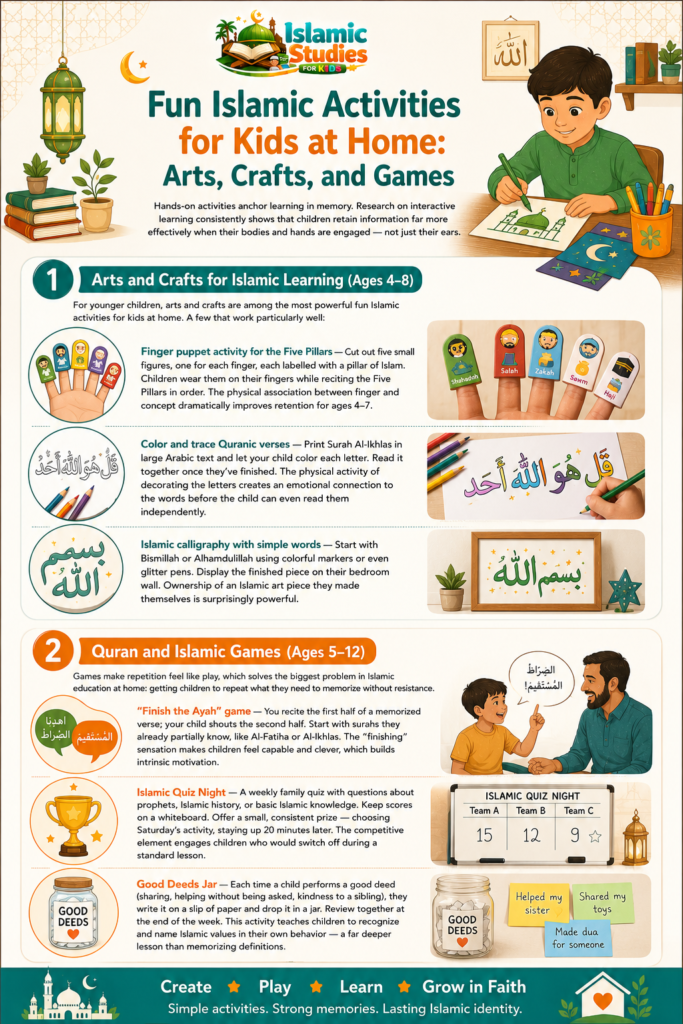
For younger children, arts and crafts are among the most powerful fun Islamic activities for kids at home. A few that work particularly well:
Finger puppet activity for the Five Pillars — Cut out five small figures, one for each finger, each labelled with a pillar of Islam. Children wear them on their fingers while reciting the Five Pillars in order. The physical association between finger and concept dramatically improves retention for ages 4–7.
Color and trace Quranic verses — Print Surah Al-Ikhlas in large Arabic text and let your child color each letter. Read it together once they’ve finished. The physical activity of decorating the letters creates an emotional connection to the words before the child can even read them independently.
Islamic calligraphy with simple words — Start with Bismillah or Alhamdulillah using colorful markers or even glitter pens. Display the finished piece on their bedroom wall. Ownership of an Islamic art piece they made themselves is surprisingly powerful.
Read also: How To Raise A Muslim Child In A Non-Muslim Country?
Experience a Real Classroom
Curious about how we teach? This video offers a glimpse into a real class, showcasing our interactive approach, qualified teachers, and child-friendly learning experience.
Fun & Engaging Islamic Classes for Kids
Start your child’s journey today with interactive lessons designed to make learning Islam loved and easy.
Get Your Child a Free TrialQuran and Islamic Games (Ages 5–12)
Games make repetition feel like play, which solves the biggest problem in Islamic education at home: getting children to repeat what they need to memorize without resistance.
“Finish the Ayah” game — You recite the first half of a memorized verse; your child shouts the second half. Start with surahs they already partially know, like Al-Fatiha or Al-Ikhlas. The “finishing” sensation makes children feel capable and clever, which builds intrinsic motivation.
Islamic Quiz Night — A weekly family quiz with questions about prophets, Islamic history, or basic Islamic knowledge. Keep scores on a whiteboard. Offer a small, consistent prize — choosing Saturday’s activity, staying up 20 minutes later. The competitive element engages children who would switch off during a standard lesson.
Good Deeds Jar — Each time a child performs a good deed (sharing, helping without being asked, kindness to a sibling), they write it on a slip of paper and drop it in a jar. Review together at the end of the week. This activity teaches children to recognize and name Islamic values in their own behavior — a far deeper lesson than memorizing definitions.
4. Teach Islam to kids Through Daily Routines
The most sustainable form of Islamic activities for kids at home isn’t a scheduled activity at all — it’s daily life restructured around Islamic awareness.
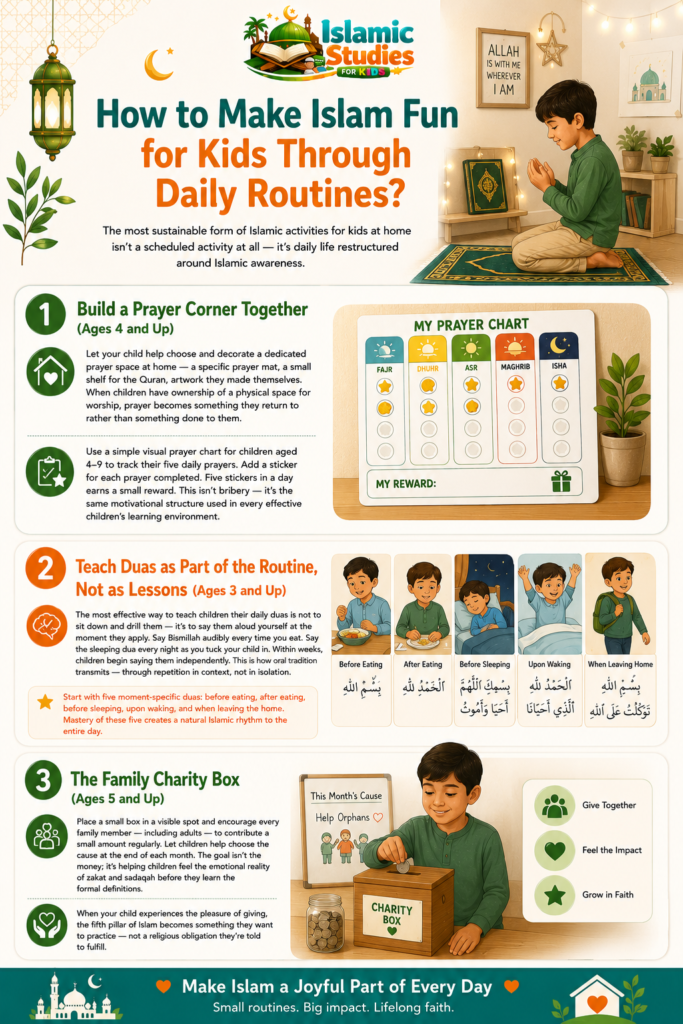
Build a Prayer Corner Together (Ages 4 and Up)
Let your child help choose and decorate a dedicated prayer space at home — a specific prayer mat, a small shelf for the Quran, artwork they made themselves. When children have ownership of a physical space for worship, prayer becomes something they return to rather than something done to them.
Use a simple visual prayer chart for children aged 4–9 to track their five daily prayers. Add a sticker for each prayer completed. Five stickers in a day earns a small reward. This isn’t bribery — it’s the same motivational structure used in every effective children’s learning environment.
Teach Duas as Part of the Routine, Not as Lessons (Ages 3 and Up)
The most effective way to teach children their daily duas is not to sit down and drill them — it’s to say them aloud yourself at the moment they apply. Say Bismillah audibly every time you eat. Say the sleeping dua every night as you tuck your child in. Within weeks, children begin saying them independently. This is how oral tradition transmits — through repetition in context, not in isolation.
Start with five moment-specific duas: before eating, after eating, before sleeping, upon waking, and when leaving the home. Mastery of these five creates a natural Islamic rhythm to the entire day.
The Family Charity Box (Ages 5 and Up)
Place a small box in a visible spot and encourage every family member — including adults — to contribute a small amount regularly. Let children help choose the cause at the end of each month. The goal isn’t the money; it’s helping children feel the emotional reality of zakat and sadaqah before they learn the formal definitions.
When your child experiences the pleasure of giving, the fifth pillar of Islam becomes something they want to practice — not a religious obligation they’re told to fulfill.
5. Teaching Islam Through Quran Activities at Home
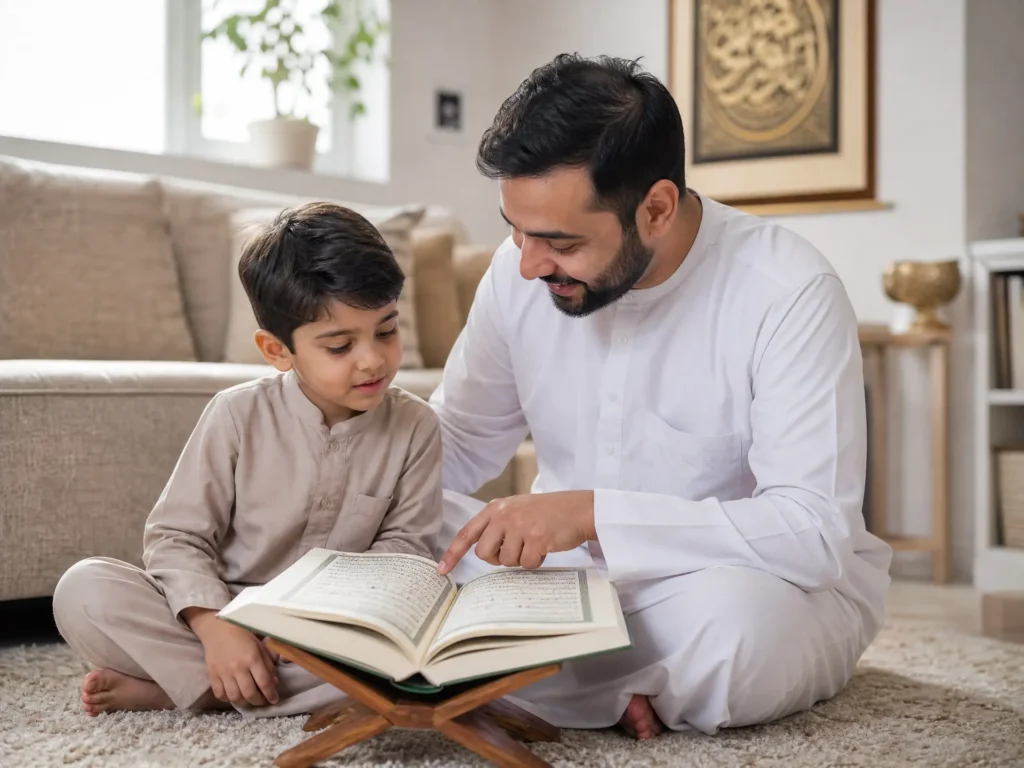
The Quran sits at the center of Islamic identity, and introducing it with joy rather than pressure is one of the most important things a parent can do. Children who associate the Quran with warmth, family togetherness, and achievable success develop a relationship with it that lasts into adulthood.
Normalize Quranic Sound Before Formal Study (All Ages)
Play a trusted reciter during breakfast, during drawing time, or in the car. Sheikh Mishary Rashid Al-Afasy’s slow, clear recitation is particularly well-suited for children because the rhythm is easy to follow. Children who hear a surah repeatedly before formally studying it memorize it significantly faster — the text is already familiar before the lesson begins.
Start with Juz Amma — the short surahs children will use in their daily prayers are the most practical first focus.
Quran Storytelling as a Gateway (Ages 5–12)
Stories from the Quran are among the most powerful Quran stories you can share with young children. When a child knows the story of Prophet Yunus calling out from inside the whale, the dua he made — La ilaha illa anta subhanaka inni kuntu mina-dhalimeen — carries weight. They understand what those words meant in that moment, and that emotional context makes the verse impossible to forget.
Pair each Quran story with its dua or key verse. The verse becomes the child’s souvenir from the story — something they carry with them and recognize when they hear it recited in Salah
Watch a Sample Lesson from Our Academy
Get a firsthand look at how our students learn Islamic values, Quran, and essential knowledge through engaging and interactive online classes. See why families trust Islamic Studies for Kids Academy.
Read also: How to Choose a Quran Teacher for Your Child? – 7 Criteria
Start Your Child’s Islamic Education with Expert Support
Home learning plants the seeds — structured, expert guidance helps them grow deep roots.
Islamic Studies For Kids connects families with qualified, experienced Islamic educators who know how to make learning genuinely engaging for children aged 4 to 15. Whether your child is just beginning to explore their faith or ready to go deeper into Quran, Arabic, or Islamic values, there is a learning path built for them.

Our Islamic Studies Courses for Kids:
- Quran for Kids
- Noorani Qaida for Kids
- Quran Recitation for Kids
- Tajweed for Kids
- Quran Memorization (Hifz) for Kids
- Quran for Toddlers
- Quranic Arabic for Kids
- Quran Stories for Kids
Fun & Engaging Islamic Classes for Kids
Start your child’s journey today with interactive lessons designed to make learning Islam loved and easy.
Get Your Child a Free TrialConclusion
Teaching Islam at home doesn’t require a separate curriculum, special resources, or dedicated lesson blocks every day. It requires weaving Islamic awareness into the moments that already fill your child’s life — meals, bedtime, conversations, play — and then adding fun activities that make those moments memorable.
The fun ways to teach Islam to kids at home that last longest are never purely informational. They’re relational: a story told together, a dua said aloud at dinner, a craft displayed on a bedroom wall, a family quiz night that ends in laughter. Children who grow up with those experiences don’t just know Islam — they feel it belongs to them.
Start with one activity this week. Add one daily dua to your routine. And remember that every small, consistent effort is doing exactly what it needs to do.
Frequently Asked Questions
What is the best age to start teaching Islam to kids at home?
Islamic teaching at home can begin as early as age two or three through sound, routine, and imitation — not formal lessons. Children this young absorb the sounds of Quranic recitation, the rhythm of Bismillah before meals, and the feeling of family prayer long before they can articulate what they mean. Formal activities and games become more effective from around age four onward.
How do I make Islamic learning fun for a child who resists it?
The most common reason children resist Islamic learning is that it has been experienced as a separate, formal obligation rather than a natural part of life. Start by removing the lesson format entirely. Play Quranic recitation in the background, tell a prophet story at bedtime, involve your child in a family charity activity. Once Islam feels like part of the household culture rather than homework, resistance usually drops significantly.
Which Islamic activities work best for toddlers and young children (ages 3–6)?
The most effective fun Islamic activities for kids in this age group are sensory and physical: finger puppets for the Five Pillars, coloring Quranic verses, clapping rhythms while reciting short surahs, and simple role-play games. Formal teaching — reading, writing, memorization drills — is not developmentally appropriate for most children under five. Focus on exposure, warmth, and repetition instead.
How long should daily Islamic learning sessions be at home?
Keep sessions short: 10–15 minutes for ages 4–6, 15–20 minutes for ages 7–10, and up to 30 minutes for older children — with variety built in. Children retain more from three 10-minute Islamic moments spread through the day than from one 30-minute sitting. Daily dua practice, a short Quran listening session during drawing time, and a bedtime story together accomplish more than a single formal lesson.
Can I teach Islam at home without formal religious training?
Yes. The most important Islamic teaching happens through a parent’s own practice, not their credentials. Children learn Bismillah by hearing you say it. They learn kindness by watching you give sadaqah. They learn dua by hearing you make it. Formal knowledge of Islamic jurisprudence is not a prerequisite for raising a child who loves their faith. When deeper questions arise, resources like IslamicStudiesForKids.com and qualified online Islamic educators can fill those gaps.


Leave a Reply