 For Parents
Every mother who has chosen Islamic home learning remembers the moment the decision quietly settled. A lesson her child brought home that didn’t reflect the values she was raising them with. A school schedule with no room for Salah. The steady feeling that six hours a day spent somewhere else was pulling against everything she was building at home.
Managing Islamic home learning yourself is not the easy path — but it is a deeply rewarding one. This guide gives you what most guides skip: not just the inspiration, but the actual structure, the curriculum decisions, the daily rhythm, and the honest mistakes to avoid in year one.
1. Set Your Intention Before Anything Else
Before any curriculum, any schedule, or any purchase, Islamic home learning starts with niyyah — intention.
The Prophet Muhammad ﷺ said:
إِنَّمَا الأَعْمَالُ بِالنِّيَّاتِ، وَإِنَّمَا لِكُلِّ امْرِئٍ مَّا نَوَى
“Innamā al-aʿmālu bin-niyyāt, wa innamā likulli imri’in mā nawā”
“Actions are judged by intentions, and every person will have what they intended.” — Ṣaḥīḥ al-Bukhārī, Hadith 1; Ṣaḥīḥ Muslim, Hadith 1907 (sunnah.com)
This hadith is placed first deliberately. It is the most frequently cited statement in Islamic scholarship — and mothers who return to it on hard homeschooling days consistently describe it as what keeps them going. The niyyah is not a formality. It is the anchor you return to every time the lesson plan doesn’t go as expected, the child resists, or the day falls apart before noon.
Before you choose a single resource, write down in plain language: What do I actually want my child to become? Let that answer guide every decision that follows.
Make it a daily practice to open each school morning with the Quranic supplication for knowledge:
رَّبِّ زِدۡنِي عِلۡمٗا
“Rabbi zidnī ʿilmā”
“My Lord, increase me in knowledge.” — Sūrat Ṭāhā, 20:114 (quran.com/20/114)
Reciting this together with your child before any lesson begins frames the entire school day as an act of worship — not merely an academic exercise.
2. Write Your Vision Before You Buy a Single Curriculum
A vision is the reason you pick up a curriculum — not the curriculum itself. Most mothers who struggle in year one chose resources before they had a vision, and found themselves delivering content that didn’t fit their child or their home.
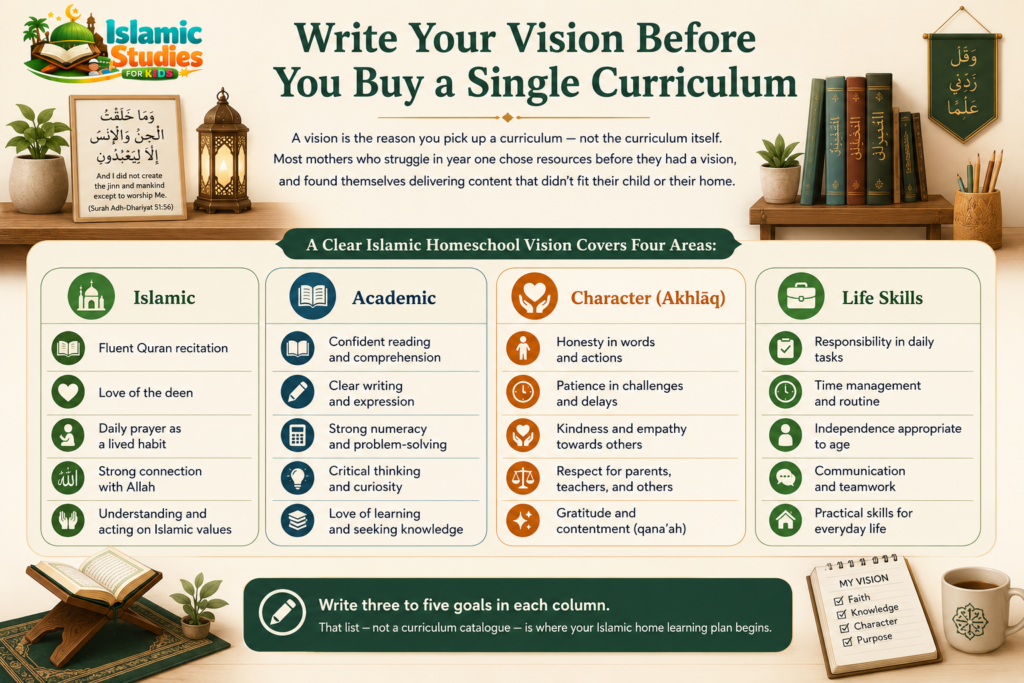
A clear Islamic homeschool vision covers four areas:
| Goal Area | Example Targets |
| Islamic | Fluent Quran recitation, love of the deen, daily prayer as lived habit |
| Academic | Confident reading and writing, strong numeracy, critical thinking |
| Character (Akhlāq) | Honesty, patience, kindness — modelled through the day, not just taught |
| Life Skills | Responsibility, time management, independence appropriate to age |
Write three to five goals in each column. That list — not a curriculum catalogue — is where your Islamic home learning plan begins.
3. Give Quran the Best Part of Your Day — Not the Leftover Hours
Quran is not the subject that gets squeezed in when everything else is done. It occupies the prime slot of the day, when your child is fresh and focused — typically the first thirty to forty-five minutes after Fajr, before fatigue sets in and before academic subjects begin.
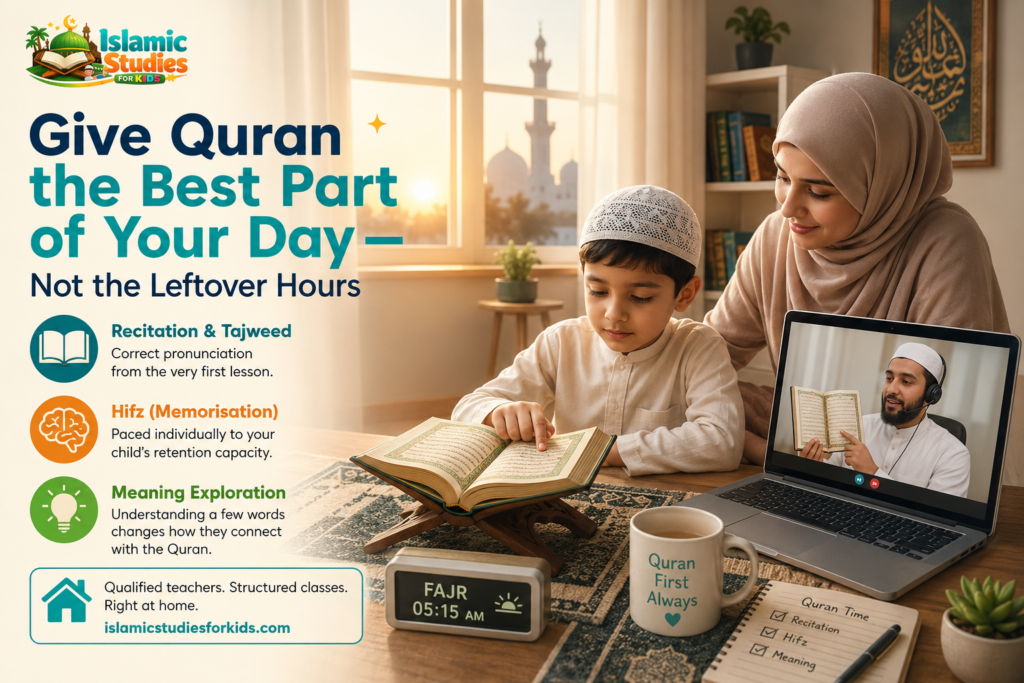
Quran instruction at home covers three distinct disciplines, each requiring separate attention:
- Recitation and Tajweed — correct pronunciation from the very first lesson. Errors embedded early are genuinely difficult to undo later. This is the one area where unqualified teaching does more damage than good.
- Hifz (memorisation) — paced individually to your child’s retention capacity. A child who retains one new ayah with real confidence outperforms one who memorises five with weak consolidation every time.
- Meaning exploration — brief, woven into recitation rather than treated as a separate subject. Understanding a handful of words in each surah transforms how a child relates to what they are reciting.
If your own Tajweed is not strong enough to teach correctly, bringing in a qualified teacher is not a compromise on the homeschooling philosophy — it is what makes the philosophy work. The Quran classes at islamicstudiesforkids.com offer structured recitation and Tajweed instruction designed to fit directly into your home routine.
Experience a Real Classroom
Curious about how we teach? This video offers a glimpse into a real class, showcasing our interactive approach, qualified teachers, and child-friendly learning experience.
Fun & Engaging Islamic Classes for Kids
Start your child’s journey today with interactive lessons designed to make learning Islam loved and easy.
Get Your Child a Free Trial4. Teach Arabic to Unlock the Quran — Not Just to Learn a Language
Arabic is not a separate subject in a strong Islamic home learning plan — it is the vehicle through which everything else becomes deeper. A child who knows that Salah is rooted linguistically in connection and supplication relates to every rakʿa differently. A child who can read Al-Fatiha and understand each word is not reciting sounds — they are speaking to Allah with awareness.
Arabic instruction at home works best in short, daily sessions. Ten to fifteen focused minutes daily, connecting letters to words your child already knows from the Quran, builds more fluency than one-hour sessions that exhaust young attention spans. Structured Arabic classes complement what you teach at home without requiring you to be an Arabic specialist yourself.
5. Weave Islamic Studies Through Every Subject — Not Into One Lesson Block
Here is the distinction that separates effective Islamic home learning from standard homeschooling with Islamic content added on top.
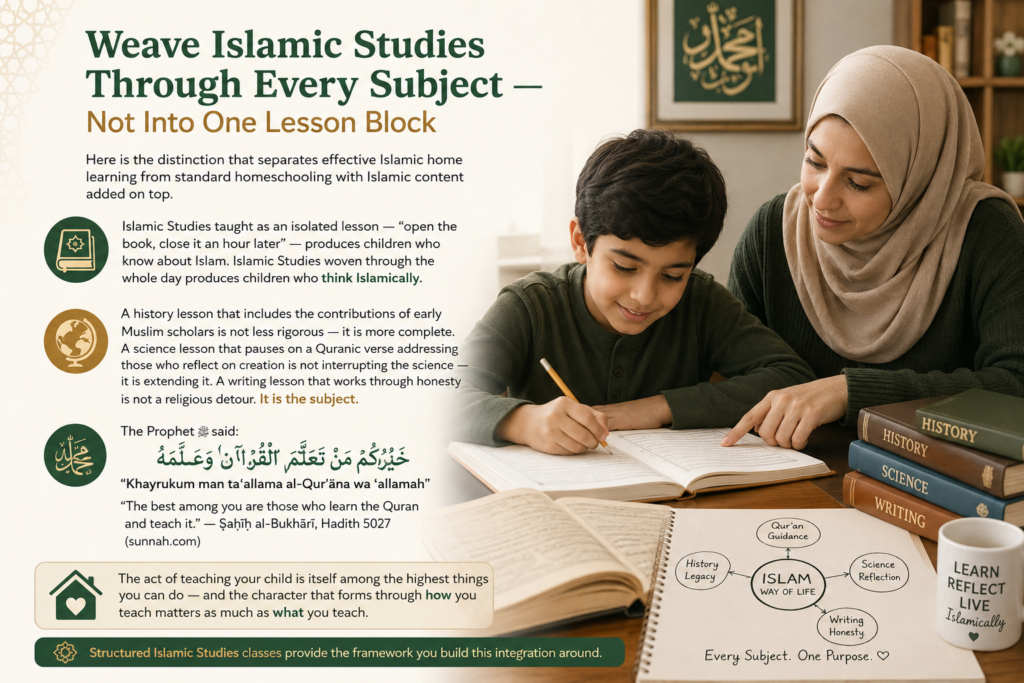
Islamic Studies taught as an isolated lesson — “open the book, close it an hour later” — produces children who know about Islam. Islamic Studies woven through the whole day produces children who think Islamically.
A history lesson that includes the contributions of early Muslim scholars is not less rigorous — it is more complete. A science lesson that pauses on a Quranic verse addressing those who reflect on creation is not interrupting the science — it is extending it. A writing lesson that works through honesty is not a religious detour. It is the subject.
The Prophet ﷺ said:
خَيْرُكُمْ مَنْ تَعَلَّمَ الْقُرْآنَ وَعَلَّمَهُ
“Khayrukum man taʿallama al-Qur’āna wa ʿallamah”
“The best among you are those who learn the Quran and teach it.” — Ṣaḥīḥ al-Bukhārī, Hadith 5027 (sunnah.com)
The act of teaching your child is itself among the highest things you can do — and the character that forms through how you teach matters as much as what you teach. Structured Islamic Studies classes provide the framework you build this integration around.
6. Cover Core Academics Properly — at Your Child’s Actual Level
Reading, writing, mathematics, science, and history still need to be covered — and covered well. The freedom of Islamic home learning is not freedom to skip these. It is freedom to teach them in sequence, at your child’s real level, with connections between subjects made explicit.
A nine-year-old who is ready for algebra but reading two years below their age should be doing both simultaneously — advancing in maths and receiving intensive reading support — without waiting for a class of thirty to catch up. That individual calibration is what homeschooling makes possible and conventional schooling almost never delivers.
7. Use Prophets’ Stories and Sahabah Accounts to Build Real Character
Character development in Islamic home learning is not a weekly lesson on Islamic manners. It is modelled through the texture of every day — how disagreements are handled during lessons, how mistakes are corrected, how you yourself respond to difficulty.
The stories of the Prophets and the Companions of the Prophet ﷺ are the most powerful character-building tools available to a homeschooling mother. Connecting those stories to real situations your child faces — not just reading them as historical accounts — is what helps children internalise Islamic values in a practical, lasting way.
8. Structure Your Day Around Salah — Not Around a School Bell
The most practical advantage of Islamic home learning is one most parents only discover after they start: the day can be built around prayer times, not squeezed in between them.
A child who grows up experiencing prayer as the frame the day is organised around — not an interruption to productivity — carries that relationship with Salah into adulthood differently than one who learned to fit prayer into spare moments.
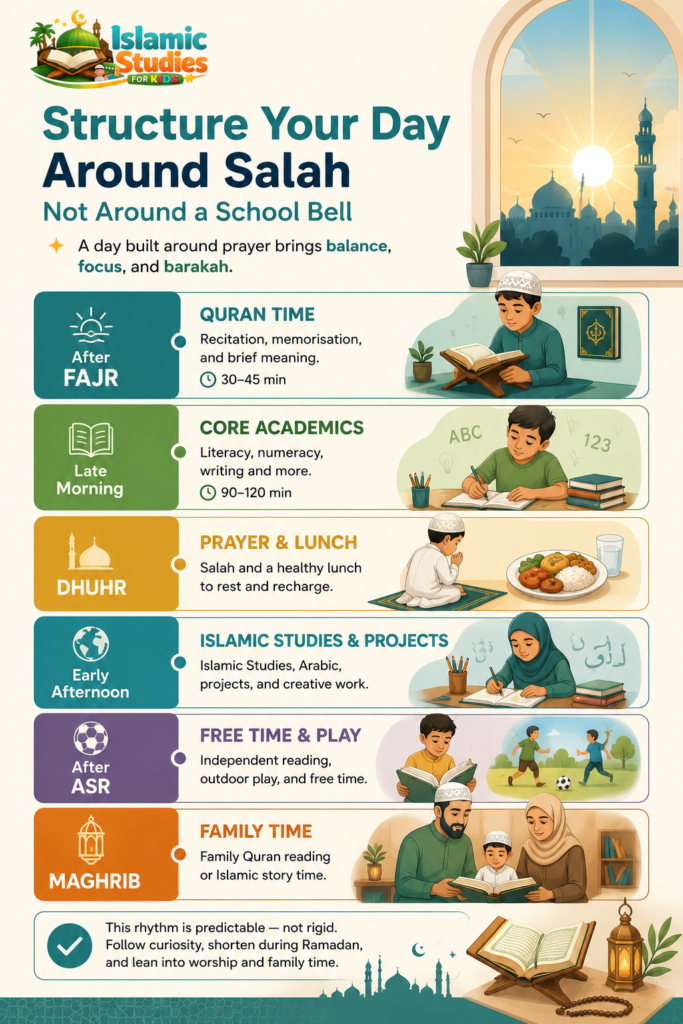
Here is a workable daily rhythm for elementary-age children (ages 6–11):
| Time Block | Subject |
| After Fajr | Quran — recitation, memorisation, brief meaning (30–45 min) |
| Late morning | Core academics — literacy, numeracy, writing (90–120 min) |
| Dhuhr | Prayer + lunch break (natural midday pause) |
| Early afternoon | Islamic Studies, Arabic, projects, creative work |
| After Asr | Independent reading, outdoor play, free time |
| Maghrib | Family Quran reading or Islamic story |
This rhythm is predictable — not rigid. If a discussion runs long and produces genuine curiosity, follow it. The schedule is a servant, not a master. During Ramadan and around the Islamic calendar, shorten the academic load and lean into worship and family time — that flexibility is the whole point.
9. Keep Instruction Time Realistic — Shorter Than You Think
This surprises most first-year mothers: formal instruction done well is short. Children’s brains are not built for six hours of directed learning.
| Age Group | Focused Instruction | Rest of the Day |
| Ages 5–7 | 1–2 hours | Read-alouds, play, exploration |
| Ages 8–11 | 2–3 hours | Independent reading and projects |
| Ages 12+ | 3–4 hours | Increasingly self-directed work |
Three focused hours of real instruction produces more than six hours of a child sitting at a desk past the point their attention can hold. Independent reading, outdoor time, and creative play are not wasted time — they are the other half of what makes learning stick.
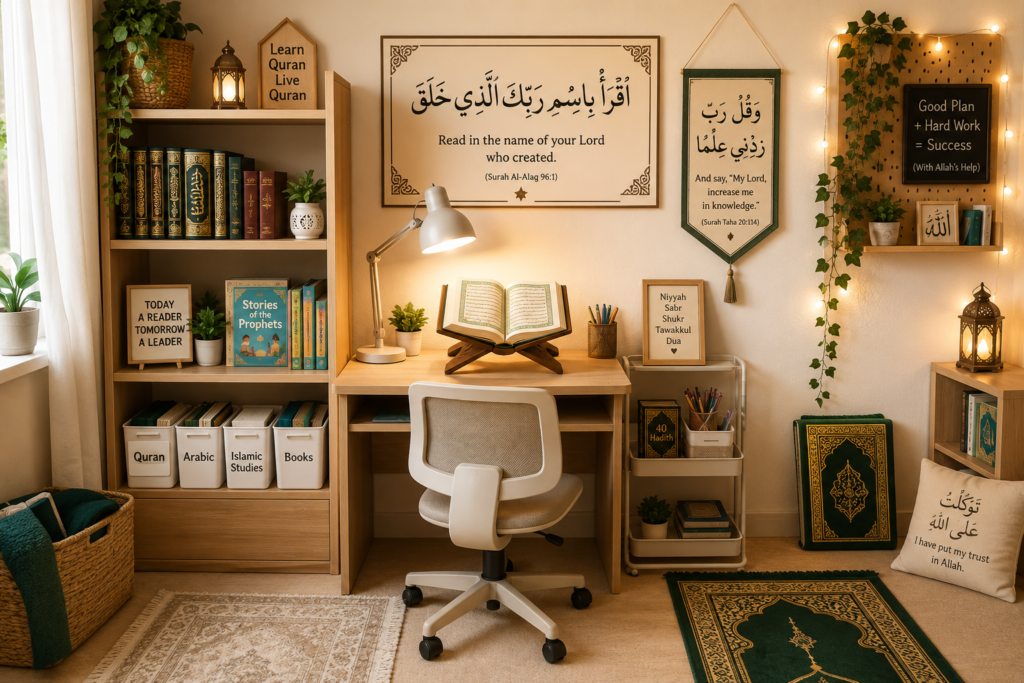
10. Create a Dedicated Learning Corner — Not Necessarily a Separate Room
A well-organised, designated learning area helps children distinguish between study time and leisure time. It does not require a separate room — a clean corner, a small shelf, good light, and appropriate furniture is enough.
Consider adding Islamic calligraphy or Quranic verses to the space. A designated area for Quranic materials and Islamic books — separate from general schoolwork — signals to the child that these hold a different weight. A prayer corner with a prayer mat nearby makes Salah a natural part of the rhythm, not a transition that requires preparation.
Avoid These 3 Mistakes That Collapse Most Islamic Homeschools in Year One
Many Muslim families begin homeschooling with sincere intentions: they want stronger Islamic values, better learning, and a home centered around faith. Yet many Islamic homeschooling journeys become overwhelming within the first year—not because the parents lack dedication, but because they unknowingly make a few foundational mistakes.
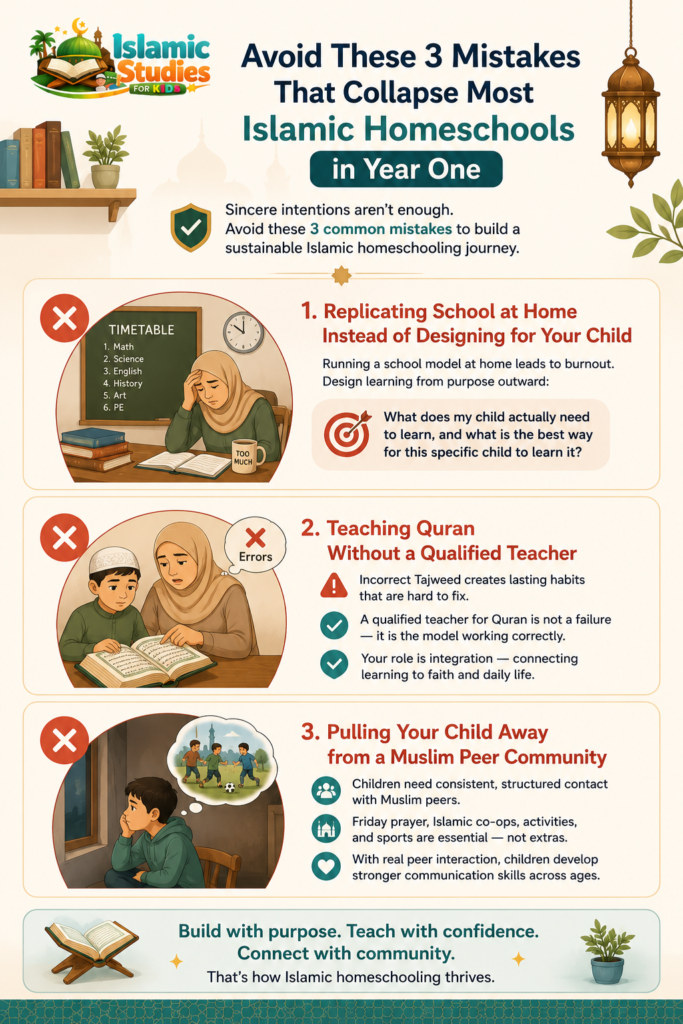
Replicating School at Home Instead of Designing for Your Child
The most common and costly error. Mothers who set up a school timetable — same subjects, same structure, same pacing as a conventional school — find themselves exhausted within months, because they are running an institution designed for thirty children inside a household designed for three.
Islamic home learning works when it is designed from purpose outward: What does my child actually need to learn, and what is the best way for this specific child to learn it? The answer is never a six-period school day at the kitchen table.
Read Also: Benefits of Learning Arabic for Muslim Mothers
Teaching Quran Without a Qualified Teacher
This is the mistake that costs the most in the long run and is the least discussed. A parent who teaches Quran with imperfect Tajweed embeds those errors in the child’s recitation — and mispronunciation habits formed in early childhood are genuinely difficult to correct later.
Seeking a qualified teacher for Quran is not a failure of the homeschooling model. It is the model working correctly. Your irreplaceable role is integration — connecting what your child learns to faith and daily life — not being a certified Tajweed specialist on top of everything else.
Read Also: How to Learn Arabic as a Mother?
Pulling Your Child Away from a Muslim Peer Community
Children who learn at home still need consistent, structured contact with peers — Muslim peers in particular, who share the framework of their education. Friday prayer communities, Islamic co-ops, regular activities with other homeschooling families, and sports clubs are not extras. They are part of what makes the model sustainable for the child and for you.
The socialisation concern about homeschooling is legitimate when families withdraw entirely. It is not a structural feature of Islamic home learning itself. Children educated at home with regular structured peer contact consistently develop stronger communication skills — because they interact across ages, not only with same-age classmates.
Read Also: How a Mother Can Learn Quran Online?
Experience a Real Classroom
Curious about how we teach? This video offers a glimpse into a real class, showcasing our interactive approach, qualified teachers, and child-friendly learning experience.
Fun & Engaging Islamic Classes for Kids
Start your child’s journey today with interactive lessons designed to make learning Islam loved and easy.
Get Your Child a Free TrialYou Don’t Have to Teach Everything Alone — Build Your Support Team
Successful Islamic home learning is rarely a solo act. Think of yourself as the coordinator of your child’s education — the one who holds it together and ensures the integration — not the sole expert in every subject.
What mothers typically lead: reading, writing, mathematics, daily Islamic practice, character, and life skills. What qualified specialists handle: Quran recitation and Tajweed, Arabic grammar and vocabulary, and any subject that falls outside your confidence.
The Quran, Arabic, and Islamic Studies courses at islamic studies for kids are built for exactly this partnership — structured classes with qualified teachers that slot into your home routine while you lead the rest of the day. Asking for expert help is not outsourcing your responsibility. It is the most responsible thing you can do for your child’s foundation.
Our Islamic Studies Courses Include:
- Islamic Studies for Kids
- Islam Basics for Kids (Beginners)
- 5 Pillars of Islam for Kids
- 6 Pillars of Iman (Faith) for Kids
- Salah (Prayer) for Kids
- Wudu for Kids
- Dua for Kids
- Ramadan for Kids
- Zakat & Sadaqah for Kids
- Hajj for Kids
- Aqeedah (Islamic Belief) for Kids
- Islamic Manners & Akhlaq for Kids
- Good Deeds for Kids
- Cleanliness (Taharah) in Islam for Kids
- Angels in Islam for Kids
- Islamic History for Kids
- Seerah (Prophet’s Life) for Kids
- Prophets Stories for Kids
- Islamic Stories & Morals for Kids
- Fiqh for Kids (Islamic Jurisprudence Basics)
- Hadith for Kids
- Quran Tafseer Course for Kids
- Islamic Holidays & Events for Kids
- Islamic Identity for Kids
- Intensive Islamic Course for Kids
Enroll today and give your child the knowledge, values, and confidence to grow as a practicing Muslim with a strong connection to Allah and His teachings.
Conclusion
Islamic home learning works when it is designed from purpose outward — Quran first, Arabic as the key that deepens understanding, Islamic Studies woven through the day rather than scheduled as a single lesson, and academics taught at the child’s real pace.
The daily rhythm built around prayer times is not just a scheduling preference. It is one of the most significant gifts Islamic home learning gives a child: the experience of Salah as the frame the whole day moves between, not a task fitted into spare moments.
Year one will not be perfect. It is not meant to be. It is the year you learn what your child is actually like as a learner, where you need outside help, and what works in your specific home. Treat it as data, not performance — and go into year two more calibrated, more realistic, and more effective.
The work is real. So is the reward.
Frequently Asked Questions
1. Can I homeschool my child in Islam without being a qualified teacher?
Yes. Your role is to guide your child’s overall education, not to be an expert in every subject. Many mothers teach core subjects themselves while relying on qualified teachers for Quran, Tajweed, or Arabic. This combination provides both flexibility and accuracy.
2. What is the ideal daily schedule for Islamic home learning?
A practical schedule begins with Quran while your child is most focused, followed by core academic subjects. Prayer times naturally divide the day, with Islamic Studies, Arabic, projects, and outdoor activities arranged around Salah rather than around a traditional school timetable.
3. How many hours should I homeschool each day?
Quality matters more than quantity. Younger children often need only one to two hours of focused instruction, while older children may benefit from two to four hours. The rest of the day can include reading, creative projects, life skills, and independent learning.
4. Is socialization a problem for homeschooled Muslim children?
Not when families intentionally build opportunities for interaction. Regular mosque activities, homeschooling groups, sports, volunteer work, and community programs allow children to develop strong social skills while maintaining an Islamic environment.
5. What subjects should every Islamic homeschool include?
A balanced Islamic homeschool includes Quran, Arabic, Islamic Studies, reading, writing, mathematics, science, history, character development, and practical life skills. Together, these subjects help children grow academically, spiritually, and personally.
6. What is the biggest mistake new homeschooling mothers make?
The most common mistake is trying to copy a traditional school at home. Islamic home learning works best when it is tailored to your child’s pace, built around your family’s routine, and centered on Quran and Salah rather than a rigid classroom schedule.


Leave a Reply