 For Parents
Every Muslim parent has felt it — that quiet, overwhelming weight the moment you first hold your child. You love them beyond words, and you want to get this right. But what does “right” actually look like?
The Prophet Muhammad ﷺ didn’t leave parents guessing. Across dozens of authentic narrations, he laid out a complete, compassionate, and practical vision for how to raise children — one that addresses their souls, their character, their confidence, and their relationship with Allah. These ahadith are not abstract rulings. They are real guidance from a man who kissed children in public, played with them, remembered their names, and wept with tenderness at their care.
This guide brings together the most important hadith about raising children, explains what each one means in practice, and gives you the tools to apply them in your home today.
What You’ll Learn in This Article
- The key hadith about raising children covering prayer, fairness, character, and the fitrah
- What each hadith actually requires of you as a parent — not just what it says
- How the Prophet ﷺ treated children in his own life, and what we can copy from that
- Quranic verses that reinforce these prophetic teachings
- Practical parenting principles drawn directly from the sunnah
- Answers to the most common questions parents ask about Islamic child-rearing
The Hadith About Raising Children Every Parent Needs to Know
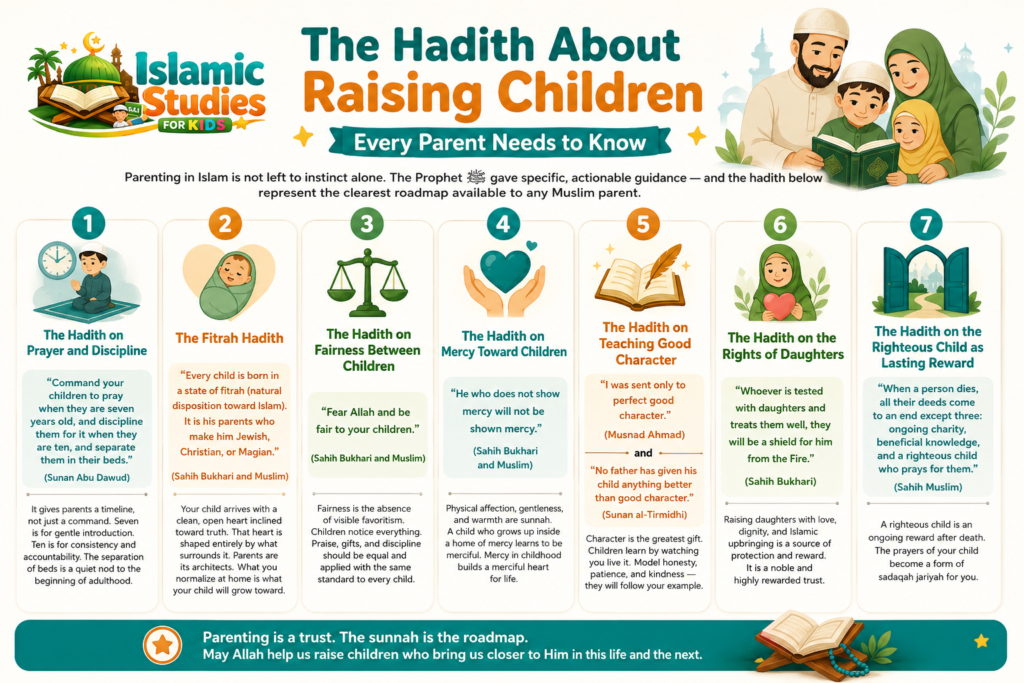
Parenting in Islam is not left to instinct alone. The Prophet ﷺ gave specific, actionable guidance — and the hadith below represent the clearest roadmap available to any Muslim parent.
1. The Hadith on Prayer and Discipline
Teaching children to pray is not something Islam leaves to chance. The Prophet ﷺ outlined a gradual approach that gives children time to develop love for salah before they become fully accountable. Rather than expecting immediate perfection, parents are encouraged to build the habit first and reinforce it consistently as the child matures.
مُرُوا أَوْلَادَكُمْ بِالصَّلَاةِ وَهُمْ أَبْنَاءُ سَبْعِ سِنِينَ، وَاضْرِبُوهُمْ عَلَيْهَا وَهُمْ أَبْنَاءُ عَشْرٍ، وَفَرِّقُوا بَيْنَهُمْ فِي الْمَضَاجِعِ
“Command your children to pray when they are seven years old, discipline them for it when they are ten years old, and separate them in their beds.(Sunan Abu Dawud)
This hadith presents a clear parenting methodology rather than a single instruction. Between the ages of seven and ten, children are introduced to prayer through regular practice, encouragement, and parental guidance. By the age of ten, parents are expected to reinforce consistency and responsibility. The gradual progression recognizes a child’s developmental stages and shows that Islamic education is built on patience, preparation, and steady habit formation rather than sudden demands.
2. The Fitrah Hadith
One of the most reassuring teachings in Islam is that every child enters the world with a pure and natural disposition toward truth and faith. This means that parents are not expected to create faith from nothing—they are entrusted with protecting and nurturing the fitrah that Allah has already placed within their child.
مَا مِنْ مَوْلُودٍ إِلَّا يُولَدُ عَلَى الْفِطْرَةِ، فَأَبَوَاهُ يُهَوِّدَانِهِ، أَوْ يُنَصِّرَانِهِ، أَوْ يُمَجِّسَانِهِ.
“Every child is born in a state of fitrah (natural disposition toward Islam). It is his parents who make him Jewish, Christian, or Magian.” (Sahih Bukhari and Muslim)
This hadith about raising children is both a comfort and a warning. The comfort: your child arrives with a clean, open heart inclined toward truth. The warning: that heart is shaped entirely by what surrounds it.
Parents are not decorators of their children’s faith. They are its architects. What you normalize at home — prayer, gratitude, honesty, the mention of Allah — is what your child’s fitrah will grow toward. What you neglect, or what fills that space instead, shapes them just as powerfully.
3. The Hadith on Fairness Between Children
Islam places great importance on justice within the family, beginning with the relationship between parents and their children. Fair treatment strengthens love, trust, and unity among siblings, while favoritism can create jealousy and lasting emotional wounds. The Prophet ﷺ emphasized that parents should strive to be just in their dealings with every child.
اتَّقُوا اللَّهَ وَاعْدِلُوا بَيْنَ أَوْلَادِكُمْ
“Fear Allah and be fair to your children.” (Sahih Bukhari and Muslim)
This narration came when a companion wanted to give one child a special gift without giving the same to his other children. The Prophet ﷺ refused to witness it.
Fairness here is not mathematical equality — it is the absence of visible favoritism. Children notice everything. A child who perceives themselves as less loved will carry that wound into adulthood. The Prophet ﷺ understood the psychological reality of sibling dynamics long before developmental psychology named it.
Practically: when you praise, praise all. When you gift, equalize. When you discipline, apply the same standard regardless of which child it is.
4. The Hadith on Mercy Toward Children
Allah commands believers to build their families upon mercy, compassion, and kindness. The Prophet ﷺ demonstrated this through both his words and his actions, reminding parents that mercy is not optional—it is a defining quality of a true believer.
مَنْ لَا يَرْحَمْ لَا يُرْحَمْ
“He who does not show mercy will not be shown mercy.” (Sahih Bukhari and Muslim)
This hadith was said when a companion named Al-Aqra ibn Habis saw the Prophet ﷺ kissing his grandson Al-Hasan and remarked that he had ten children and had never kissed a single one of them. The Prophet ﷺ looked at him and said those words.
Physical affection, gentleness, and warmth are not indulgences. They are sunnah. A child who grows up inside a home of mercy learns to be merciful. A child who grows up without it often has to unlearn that absence for the rest of their life.
5. The Hadith on Teaching Good Character
In Islam, raising a child is about far more than providing food, clothing, or education. A parent’s greatest responsibility is to nurture noble character, for good manners are among the most valuable gifts a child can carry throughout life. The Prophet ﷺ repeatedly emphasized that character should be at the heart of every Muslim’s upbringing.
إِنَّمَا بُعِثْتُ لِأُتَمِّمَ صَالِحَ الْأَخْلَاقِ
“I was sent only to perfect good character.” (Musnad Ahmad)
And in a separate narration directed toward parenting specifically:
مَا نَحَلَ وَالِدٌ وَلَدَهُ مِنْ نَحْلٍ أَفْضَلَ مِنْ أَدَبٍ حَسَنٍ
“No father has given his child anything better than good character.” (Sunan al-Tirmidhi)
This is the clearest hierarchy Islam offers on parenting. Wealth, education, social connections — none of these are the gift. Character is the gift. And character is taught by modeling it, not announcing it.
Children learn honesty because they watch their parents tell the truth when it is inconvenient. They learn patience because they see it in how you respond to traffic, to difficult news, to disagreements in the house. You cannot teach what you do not live. Encouraging good deeds for kids from an early age is one of the most direct ways to build that character habit before it needs to be corrected later.
6. The Hadith on the Rights of Daughters
Islam transformed how daughters were viewed, replacing the prejudices of pre-Islamic society with honor, mercy, and immense reward. The Prophet ﷺ taught that raising daughters with love, dignity, and care is not merely a family responsibility—it is a path to Allah’s pleasure and protection in the Hereafter.
مَنْ كَانَ لَهُ بَنَاتٌ فَأَحْسَنَ إِلَيْهِنَّ، كُنَّ لَهُ سِتْرًا مِنَ النَّارِ
“Whoever is tested with daughters and treats them well, they will be a shield for him from the Fire.” (Sahih Bukhari)
In the cultural context of 7th-century Arabia, where daughters were sometimes buried alive, this hadith was revolutionary. It elevated the raising of daughters to an act of protection and salvation.
This is not a consolation prize for parents who “only” have girls. It is a statement about the spiritual weight of raising them with love, dignity, and proper Islamic upbringing. The Prophet ﷺ consistently elevated the status of daughters in his community — and this principle extends today to every girl growing up in a Muslim home.
7. The Hadith on the Righteous Child as Lasting Reward
Every parent hopes to leave behind something meaningful after death. Islam teaches that one of the greatest legacies is not wealth or status, but a righteous child whose faith and supplications continue to benefit their parents long after they are gone. Raising children upon righteousness is therefore an investment in both this life and the Hereafter.
إِذَا مَاتَ الإِنْسَانُ انْقَطَعَ عَنْهُ عَمَلُهُ إِلَّا مِنْ ثَلَاثٍ: صَدَقَةٍ جَارِيَةٍ، أَوْ عِلْمٍ يُنْتَفَعُ بِهِ، أَوْ وَلَدٍ صَالِحٍ يَدْعُو لَهُ
“When a person dies, all their deeds come to an end except three: ongoing charity, beneficial knowledge, and a righteous child who prays for them.” (Sahih Muslim)
This narration reframes the entire project of parenting. Raising a righteous child is not just a duty in this life — it is an investment that continues generating reward after death. The child who prays for you after you are gone is, in Islamic understanding, a form of sadaqah jariyah.
This should give every parent a long perspective. The hard nights, the patient corrections, the years of consistent effort — they are not lost. If they produce a child who remembers Allah and remembers you in their prayers, that return continues indefinitely.
Read also: The Prophet Ibrahim Story for Kids: The Complete Guide for Parents
The Hadith on Child Upbringing in Arabic
For parents who want to share these narrations with their children in the original Arabic, here are three of the most foundational:
On prayer:
مُرُوا أَوْلَادَكُمْ بِالصَّلَاةِ وَهُمْ أَبْنَاءُ سَبْعِ سِنِينَ، وَاضْرِبُوهُمْ عَلَيْهَا وَهُمْ أَبْنَاءُ عَشْرٍ
“Command your children to pray when they are seven years old, discipline them regarding it when they are ten years old, and separate them in their beds.” (Sunan Abu Dawud)
On the fitrah:
كُلُّ مَوْلُودٍ يُولَدُ عَلَى الْفِطْرَةِ، فَأَبَوَاهُ يُهَوِّدَانِهِ أَوْ يُنَصِّرَانِهِ أَوْ يُمَجِّسَانِهِ
“Every child is born upon the fitrah (natural disposition toward Islam). Then his parents make him a Jew, a Christian, or a Magian.” (Sahih Bukhari and Sahih Muslim)
On good character:
مَا نَحَلَ وَالِدٌ وَلَدَهُ مِنْ نَحْلٍ أَفْضَلَ مِنْ أَدَبٍ حَسَنٍ
“No father has given his child a gift better than good character.” (Sunan al-Tirmidhi)
Reciting these with children — even before they fully understand — plants the Arabic words in their memory and connects the teachings to their original source. If you want to build this habit alongside other basics of Islam for kids, starting with short Arabic narrations is one of the most effective entry points.
How the Prophet ﷺ Treated Children: Sunnah in Action
Reading the hadith about raising children is one thing. Watching how the Prophet ﷺ actually behaved with children is another — and it is just as instructive.
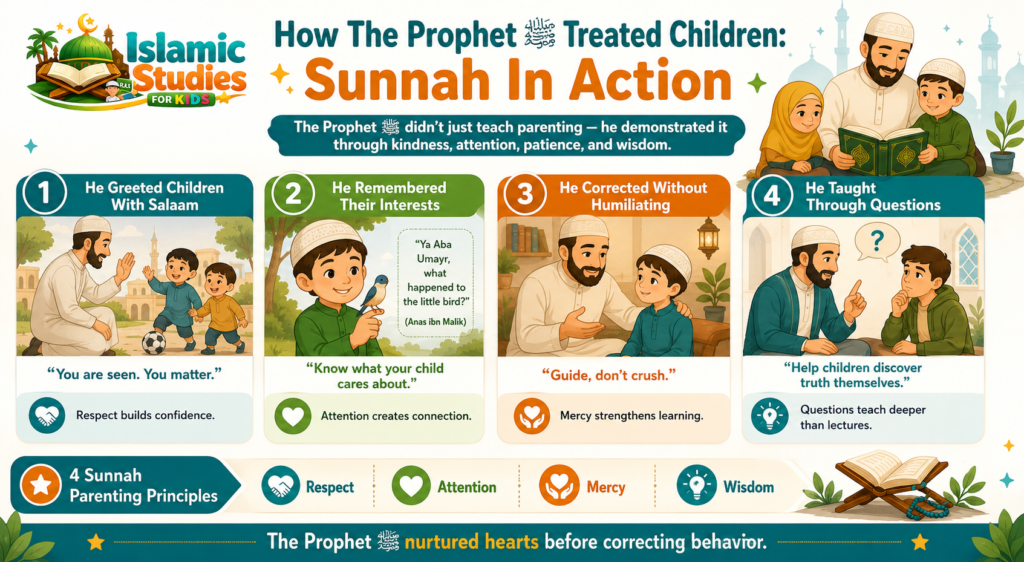
He greeted children with salaam
The Prophet ﷺ would pass children playing in the street and give them salaam. This was not a small thing. Salaam is respect. Giving it to a child tells that child: you matter, you are seen, your presence is acknowledged.
He remembered their names and asked about their pets
In a famous narration, Anas ibn Malik — who served the Prophet ﷺ for ten years — recounts how the Prophet ﷺ used to address Anas’s younger brother with the playful question: “Ya Aba Umayr, what happened to the little bird?” The child had a pet bird that had died. The Prophet ﷺ noticed, remembered, and asked.
That level of attention to a child’s world is a parenting principle in itself: know what your child cares about.
Experience a Real Classroom
Curious about how we teach? This video offers a glimpse into a real class, showcasing our interactive approach, qualified teachers, and child-friendly learning experience.
Fun & Engaging Islamic Classes for Kids
Start your child’s journey today with interactive lessons designed to make learning Islam loved and easy.
Get Your Child a Free TrialHe let children make mistakes without humiliating them
Anas ibn Malik said: “The Prophet ﷺ served for ten years and never once said ‘uff’ to me, never asked me why I did something I did, and never scolded me for something I left undone.” (Sahih Muslim)
This does not mean consequences were absent. It means the Prophet ﷺ corrected without crushing. He guided without humiliating. He held children to standards without making them feel worthless when they fell short.
He taught by asking questions, not lecturing
When a young man came asking permission for something forbidden, the Prophet ﷺ did not rebuke him. He asked: “Would you accept it for your mother?” The young man said no. “Neither do people accept it for their mothers.” (Musnad Ahmad)
That exchange — a question, a moment of reflection, an insight the young man reached himself — is worth a thousand lectures.
Blessings of Children in Islam
The Quran describes children as “an adornment of the life of this world” (Surah Al-Kahf, 18:46). But Islamic teaching adds depth to that: children are not only a gift for the present. They are a trust (amanah) that will be asked about on the Day of Judgment.
The Prophet ﷺ said: “Each of you is a shepherd and each of you is responsible for his flock. A man is the shepherd of his household and is responsible for them.” (Sahih Bukhari and Muslim)
This dual reality — children as blessing and children as responsibility — is what gives Islamic parenting its urgency. You are not raising a person. You are raising a soul. And you will be asked how you did it.
Quranic Verses That Reinforce the Hadith on Child Upbringing
Luqman’s advice to his son (Surah Luqman, 31:13–19) is the Quran’s most extended parenting passage. It covers monotheism first, then gratitude to parents, then prayer, then commanding good and forbidding evil, then humility in conduct and moderation in voice — in that exact sequence. That sequence is itself a curriculum.
يَا بُنَيَّ لَا تُشْرِكْ بِاللَّهِ ۖ إِنَّ الشِّرْكَ لَظُلْمٌ عَظِيمٌ “O my son, do not associate anything with Allah. Indeed, associating others with Him is a great wrong.” (31:13)
The dua of believing parents appears in Surah Al-Furqan (25:74):
رَبَّنَا هَبْ لَنَا مِنْ أَزْوَاجِنَا وَذُرِّيَّاتِنَا قُرَّةَ أَعْيُنٍ وَاجْعَلْنَا لِلْمُتَّقِينَ إِمَامًا
“Our Lord, grant us from among our wives and offspring comfort to our eyes and make us an example for the righteous.”
Teaching children this dua — and explaining that their parents make it for them — connects the child to the family’s spiritual intention in a way that lands differently than rules alone. You can explore more duas for kids that are short enough for young children to memorize and meaningful enough to carry into adulthood.
The accountability verse (Surah Luqman, 31:16) teaches children that nothing escapes Allah — not even the weight of a mustard seed. This is one of the earliest foundations of taqwa a parent can build.
10 Practical Principles from the Hadith on Raising Children
These principles emerge directly from the narrations above. Each one maps back to a specific hadith or prophetic action.
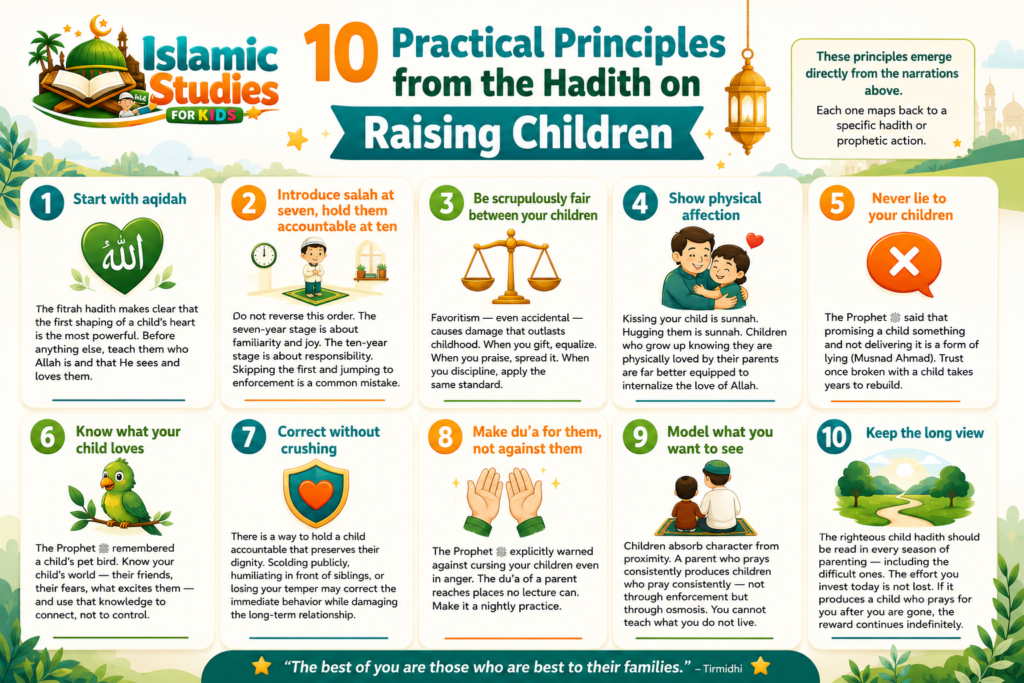
1. Start with aqidah
The fitrah hadith makes clear that the first shaping of a child’s heart is the most powerful. Before anything else, teach them who Allah is and that He sees and loves them.
2. Introduce salah at seven, hold them accountable at ten
Do not reverse this order. The seven-year stage is about familiarity and joy. The ten-year stage is about responsibility. Skipping the first and jumping to enforcement is a common mistake.
3. Be scrupulously fair between your children
Favoritism — even accidental — causes damage that outlasts childhood. When you gift, equalize. When you praise, spread it. When you discipline, apply the same standard.
4. Show physical affection
Kissing your child is sunnah. Hugging them is sunnah. Children who grow up knowing they are physically loved by their parents are far better equipped to internalize the love of Allah.
5. Never lie to your children
The Prophet ﷺ said that promising a child something and not delivering it is a form of lying (Musnad Ahmad). Trust once broken with a child takes years to rebuild.
6. Know what your child loves
The Prophet ﷺ remembered a child’s pet bird. Know your child’s world — their friends, their fears, what excites them — and use that knowledge to connect, not to control.
7. Correct without crushing
There is a way to hold a child accountable that preserves their dignity. Scolding publicly, humiliating in front of siblings, or losing your temper may correct the immediate behavior while damaging the long-term relationship.
8. Make du’a for them, not against them
The Prophet ﷺ explicitly warned against cursing your children even in anger. The du’a of a parent reaches places no lecture can. Make it a nightly practice.
9. Model what you want to see
Children absorb character from proximity. A parent who prays consistently produces children who pray consistently — not through enforcement but through osmosis. You cannot teach what you do not live.
10. Keep the long view
The righteous child hadith should be read in every season of parenting — including the difficult ones. The effort you invest today is not lost. If it produces a child who prays for you after you are gone, the reward continues indefinitely.
Read also: What Does the Quran Say About Children?
Watch a Sample Lesson from Our Academy
Get a firsthand look at how our students learn Islamic values, Quran, and essential knowledge through engaging and interactive online classes. See why families trust Islamic Studies for Kids Academy.
Help Your Child Build a Real Foundation in Islamic Studies
The hadith about raising children give parents direction. But applying that direction well requires knowledge, consistency, and often the support of skilled educators who know how to reach children at every age.
Islamic Studies for Kids Academy offers structured Islamic education designed specifically for children — covering Quran, aqidah, seerah, and character development through engaging, age-appropriate methods.
Our Islamic Studies Courses Include:
- Islamic Studies for Kids
- Islam Basics for Kids (Beginners)
- 5 Pillars of Islam for Kids
- 6 Pillars of Iman (Faith) for Kids
- Salah (Prayer) for Kids
- Wudu for Kids
- Dua for Kids
- Ramadan for Kids
- Zakat & Sadaqah for Kids
- Hajj for Kids
- Aqeedah (Islamic Belief) for Kids
- Islamic Manners & Akhlaq for Kids
- Good Deeds for Kids
- Cleanliness (Taharah) in Islam for Kids
- Angels in Islam for Kids
- Islamic History for Kids
- Seerah (Prophet’s Life) for Kids
- Prophets Stories for Kids
- Islamic Stories & Morals for Kids
- Fiqh for Kids (Islamic Jurisprudence Basics)
- Hadith for Kids
- Quran Tafseer Course for Kids
- Islamic Holidays & Events for Kids
- Islamic Identity for Kids
- Intensive Islamic Course for Kids
Enroll today and give your child the knowledge, values, and confidence to grow as a practicing Muslim with a strong connection to Allah and His teachings.
Fun & Engaging Islamic Classes for Kids
Start your child’s journey today with interactive lessons designed to make learning Islam loved and easy.
Get Your Child a Free TrialConclusion
The hadith about raising children form one of the most coherent and compassionate parenting frameworks in any religious tradition. They are specific without being rigid, demanding without being harsh, and always anchored in mercy.
The Prophet ﷺ knew that parents who raise righteous children are doing something that outlasts their own lives. He knew that a child’s fitrah is a trust. He knew that fairness, gentleness, character modeling, and du’a are not optional additions to good parenting — they are the core of it.
Start with one hadith. Apply it this week. Let that practice become a habit, and then build from there. Your child’s character is not formed in a single lesson. It is shaped by ten thousand small moments — and the Prophet ﷺ gave you a map for all of them.
Frequently Asked Questions
What is the most important hadith about raising children?
Many scholars point to the fitrah hadith — “Every child is born in a state of fitrah, and it is his parents who make him Jewish, Christian, or Magian” (Sahih Bukhari and Muslim) — as the most foundational. It establishes parental responsibility as the single most powerful shaping force in a child’s life.
What does the hadith say about the blessings of children in Islam?
The Prophet ﷺ described a righteous child as one of only three deeds that continue after death: “When a person dies, all their deeds end except three — ongoing charity, beneficial knowledge, and a righteous child who prays for them.” (Sahih Muslim). Children are framed as a source of lasting reward, not just a worldly blessing.
At what age should I start teaching my child to pray according to hadith?
The Prophet ﷺ instructed parents to command their children to pray at age seven and to discipline them for it at age ten (Sunan Abu Dawud). Age seven is for gentle introduction; age ten is for consistent accountability.
What does Islam say about how to treat children emotionally?
The Prophet ﷺ demonstrated and explicitly taught mercy, physical affection, and respect for a child’s dignity. He said “He who does not show mercy will not be shown mercy” (Sahih Bukhari and Muslim) in the context of a parent who had never kissed his children. Emotional warmth is a prophetic value, not a Western addition to Islamic parenting.
Is there a hadith about being fair between children?
Yes. The Prophet ﷺ said: “Fear Allah and be fair to your children” (Sahih Bukhari and Muslim). He refused to witness a gift given to one child when the same gift was not given to the others — making fairness between siblings a matter of taqwa, not just parenting preference.
What is the hadith about every child being born on fitrah?
“Every child is born in a state of fitrah (natural disposition toward Islam). It is his parents who make him Jewish, Christian, or Magian.” (Sahih Bukhari and Muslim). Fitrah means the child arrives with an innate inclination toward tawhid and goodness. The home environment — beginning from birth — shapes which direction that inclination develops.


Leave a Reply