 Quran
Quran
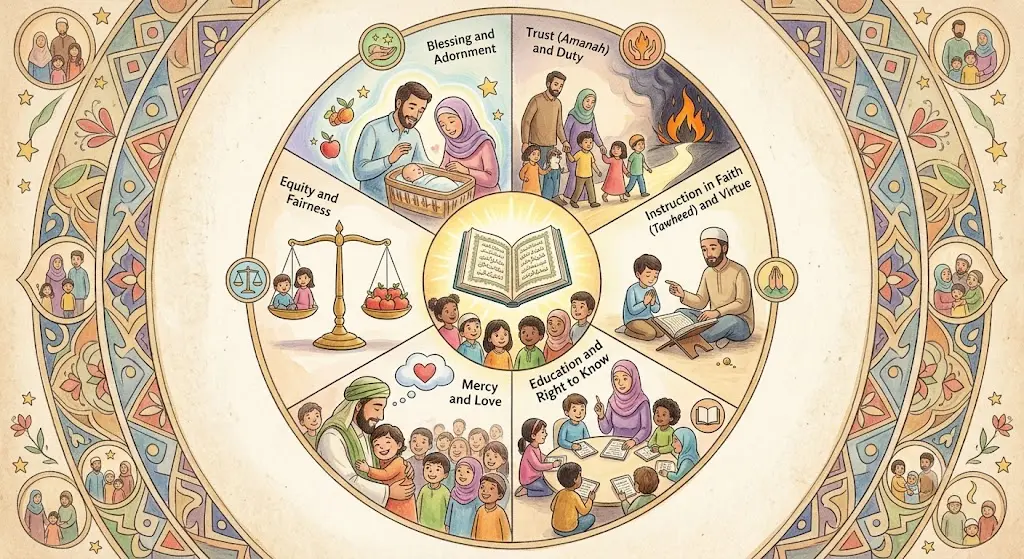
Every parent raising a child in this day and age faces a question that has never gone away: Am I doing this right? The Quran answered that question fourteen centuries ago — and its guidance is detailed, practical, and surprisingly modern in its understanding of what children actually need.
What does the Quran say about children? It says they are both a gift and a trust. It outlines their rights before they are even born, protects them by name in multiple surahs, and shows parents exactly how to raise them through the example of prophets and wise men like Luqman.
This article walks through the Quran’s core teachings on children — the verses every Muslim parent should know, the rights Islam guarantees children, and the parenting principles woven throughout the Quran and Sunnah.
What Does the Quran Say Children Are?
The Quran opens the conversation on children with two powerful framings placed side by side — and understanding both is the foundation of Islamic parenting.
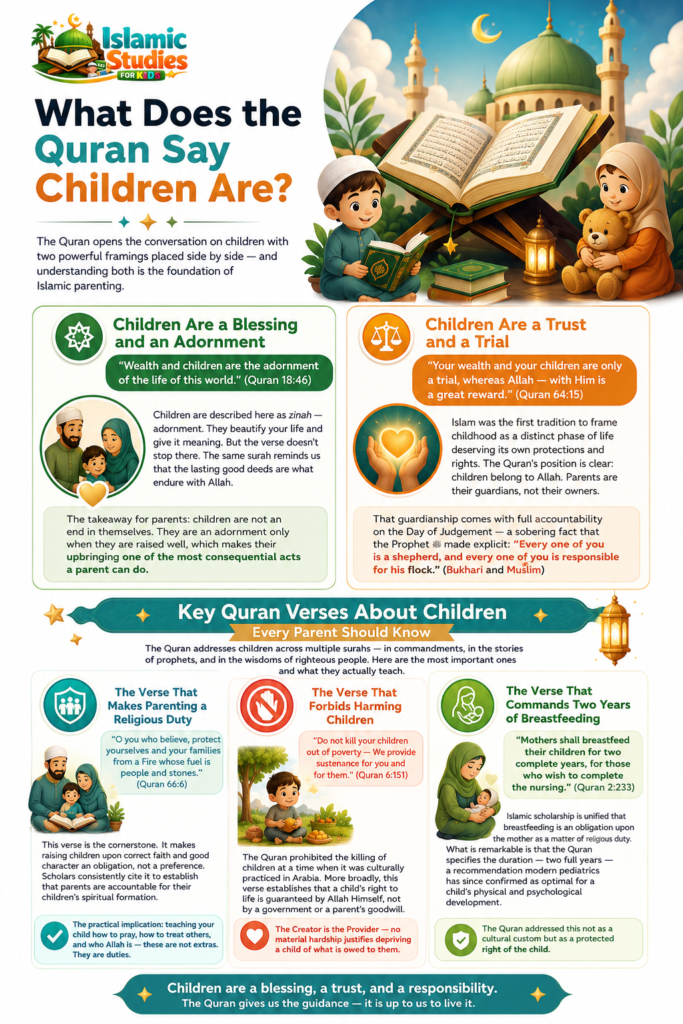
Children Are a Blessing and an Adornment
Before speaking about the responsibility of raising children, the Quran first reminds us that children are one of Allah’s greatest blessings. They bring joy, hope, and beauty to family life. Yet Islam also teaches that this blessing should never distract believers from what truly lasts: righteous deeds that earn Allah’s pleasure.
الْمَالُ وَالْبَنُونَ زِينَةُ الْحَيَاةِ الدُّنْيَا ۖ وَالْبَاقِيَاتُ الصَّالِحَاتُ خَيْرٌ عِندَ رَبِّكَ ثَوَابًا وَخَيْرٌ أَمَلًا
(Surah Al-Kahf 18:46)
“Wealth and children are the adornment of this worldly life, but the everlasting good deeds are far better with your Lord in reward and in hope.”
The Quran describes children as zinah—an adornment that beautifies worldly life. Their presence fills a home with happiness and purpose. However, the verse immediately redirects believers toward a greater priority: the righteous deeds that remain with Allah forever. For parents, this means that children become a lasting blessing when they are nurtured upon faith, good character, and obedience to Allah. Raising righteous children is therefore among the most rewarding acts a parent can perform.
Children Are a Trust and a Trial
Alongside describing children as a blessing, the Quran also teaches that they are a test. Parenthood is not simply a privilege but a sacred trust for which every parent will be accountable before Allah.
إِنَّمَا أَمْوَالُكُمْ وَأَوْلَادُكُمْ فِتْنَةٌ ۚ وَاللَّهُ عِندَهُ أَجْرٌ عَظِيمٌ
(Surah At-Taghābun 64:15)
“Your wealth and your children are only a trial, whereas Allah—with Him is a great reward.”
This verse reminds parents that children ultimately belong to Allah, not to us. They are a trust (amanah) placed in our care for a limited time. The real test is whether parents fulfill their responsibilities by providing love, guidance, Islamic education, and righteous example. Success is measured not by worldly achievements alone but by raising children who know, worship, and obey Allah.
Key s About Children Every Parent Should Know
The Quran addresses children across multiple surahs — in commandments, in the stories of prophets, and in the wisdoms of righteous people. Here are the most important ones and what they actually teach.
The Verse That Makes Parenting a Religious Duty
Before discussing practical parenting, the Quran establishes that raising children upon faith is not merely a family preference—it is a religious obligation. Parents are entrusted with protecting their children not only from worldly harm but also from spiritual loss.
يَا أَيُّهَا الَّذِينَ آمَنُوا قُوا أَنْفُسَكُمْ وَأَهْلِيكُمْ نَارًا وَقُودُهَا النَّاسُ وَالْحِجَارَةُ
(Surah At-Tahrim 66:6)
“O believers! Protect yourselves and your families from a Fire whose fuel is people and stones.”
This verse is one of the strongest Quranic foundations for Islamic parenting. Allah commands believers to safeguard both themselves and their families from Hellfire by teaching faith, righteous conduct, and obedience to Him. Classical scholars, including Ibn Kathir and Al-Tabari, explain that parents fulfill this command by educating their children about Islam, encouraging prayer, teaching good manners, and guiding them away from sin. In other words, nurturing a child’s relationship with Allah is a duty—not an optional extra.
The Verse That Forbids Harming Children
The Quran came at a time when some societies buried their children alive or killed them out of fear of poverty. Islam completely abolished these practices and declared every child’s life sacred.
وَلَا تَقْتُلُوا أَوْلَادَكُم مِّنْ إِمْلَاقٍ ۖ نَّحْنُ نَرْزُقُكُمْ وَإِيَّاهُمْ
(Surah Al-An’am 6:151)
“Do not kill your children out of fear of poverty. We provide for you and for them.”
This verse affirms that every child has an inherent right to life because provision comes from Allah alone. Parents are reminded that financial hardship can never justify harming or neglecting a child. Beyond its historical context, the verse teaches Muslims to place their trust in Allah’s provision while fulfilling their responsibility to care for and protect their children with compassion and dignity.
The Verse That Commands Two Years of Breastfeeding
Islam recognizes that caring for a child’s physical and emotional well-being begins from birth. The Quran provides detailed guidance on breastfeeding, emphasizing the child’s right to proper nourishment during the earliest stage of life.
وَالْوَالِدَاتُ يُرْضِعْنَ أَوْلَادَهُنَّ حَوْلَيْنِ كَامِلَيْنِ لِمَنْ أَرَادَ أَن يُتِمَّ الرَّضَاعَةَ
(Surah Al-Baqarah 2:233)
“Mothers may breastfeed their children for two complete years for whoever wishes to complete the nursing period.”
This verse establishes breastfeeding as one of the child’s important rights while also outlining the ideal nursing period of two complete years. Islamic jurists explain that this guidance protects the health and development of the child while encouraging cooperation between both parents in fulfilling their responsibilities. Modern medical research has likewise recognized the significant nutritional, developmental, and emotional benefits associated with breastfeeding during the first two years of life.
What Surah Talks About Children Most?
The most concentrated parenting curriculum in the entire Quran appears in Surah Luqman (Chapter 31). Luqman was a wise man — not a prophet — which makes his example uniquely accessible. His advice to his son, recorded across five verses, covers every dimension of a child’s development.
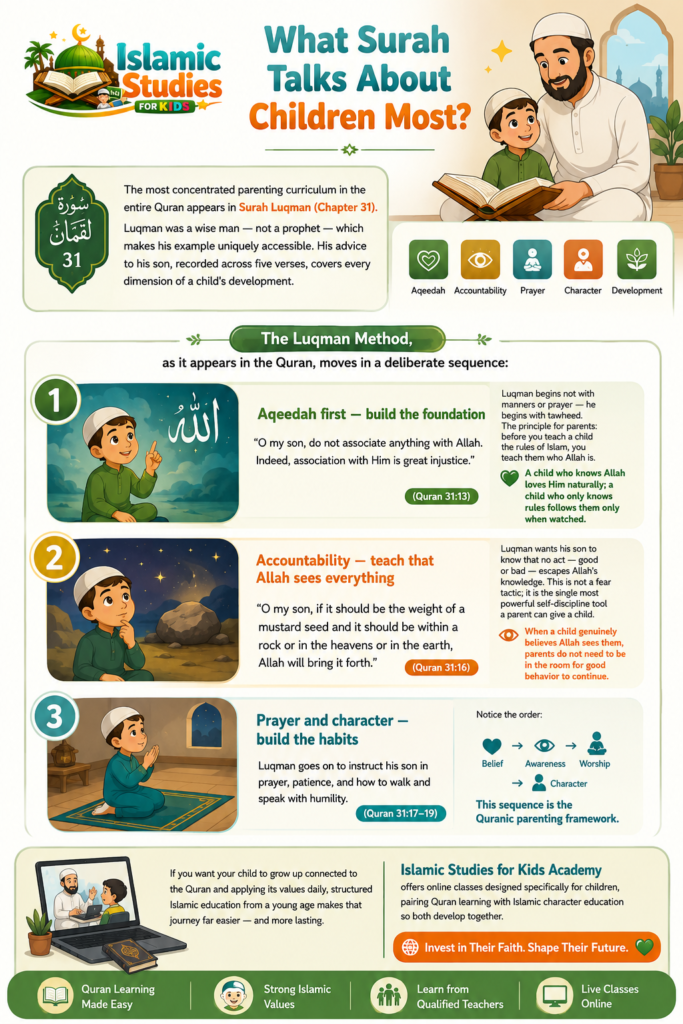
The Luqman Method, as it appears in the Quran, moves in a deliberate sequence:
1. Aqeedah First — Build the Foundation
Before teaching rules and rituals, the Quran teaches parents to establish the correct belief in Allah. A strong relationship with Allah becomes the foundation upon which every other aspect of a child’s character is built.
وَإِذْ قَالَ لُقْمَانُ لِابْنِهِ وَهُوَ يَعِظُهُ يَا بُنَيَّ لَا تُشْرِكْ بِاللَّهِ ۖ إِنَّ الشِّرْكَ لَظُلْمٌ عَظِيمٌ
(Surah Luqman 31:13)
“And ˹remember˺ when Luqman said to his son, while advising him, ‘O my dear son! Do not associate anything with Allah. Indeed, associating others with Him is a great injustice.'”
Luqman begins his advice with Tawheed, the most important lesson a child can ever learn. Before children memorize rules or acts of worship, they should understand who Allah is, why He alone deserves worship, and how much He loves His servants. When faith is firmly rooted in the heart, obedience becomes an act of love rather than mere habit.
Read also: The Prophet Ibrahim Story for Kids: The Complete Guide for Parents
Experience a Real Classroom
Curious about how we teach? This video offers a glimpse into a real class, showcasing our interactive approach, qualified teachers, and child-friendly learning experience.
Fun & Engaging Islamic Classes for Kids
Start your child’s journey today with interactive lessons designed to make learning Islam loved and easy.
Get Your Child a Free Trial2. Accountability — Teach That Allah Sees Everything
After establishing faith, Luqman teaches his son that Allah has complete knowledge of every action, no matter how small or hidden. This awareness develops sincerity and self-discipline.
يَا بُنَيَّ إِنَّهَا إِن تَكُ مِثْقَالَ حَبَّةٍ مِّنْ خَرْدَلٍ فَتَكُن فِي صَخْرَةٍ أَوْ فِي السَّمَاوَاتِ أَوْ فِي الْأَرْضِ يَأْتِ بِهَا اللَّهُ ۚ إِنَّ اللَّهَ لَطِيفٌ خَبِيرٌ
(Surah Luqman 31:16)
“O my dear son! Even if a deed were the weight of a mustard seed, hidden inside a rock or anywhere in the heavens or the earth, Allah will bring it forth. Surely Allah is Most Subtle, All-Aware.”
This verse teaches children that no good deed goes unnoticed and no wrongdoing remains hidden from Allah. Such awareness nurtures taqwa (God-consciousness), encouraging children to make the right choices even when no one else is watching. It builds inner character rather than dependence on external supervision.
3. Prayer and Good Character — Build Lifelong Habits
Once belief and awareness of Allah are established, Luqman turns to worship and character. He teaches his son to pray consistently, encourage good, avoid evil, remain patient, and treat others with humility.
يَا بُنَيَّ أَقِمِ الصَّلَاةَ وَأْمُرْ بِالْمَعْرُوفِ وَانْهَ عَنِ الْمُنكَرِ وَاصْبِرْ عَلَىٰ مَا أَصَابَكَ ۖ إِنَّ ذَٰلِكَ مِنْ عَزْمِ الْأُمُورِ وَلَا تُصَعِّرْ خَدَّكَ لِلنَّاسِ وَلَا تَمْشِ فِي الْأَرْضِ مَرَحًا ۖ إِنَّ اللَّهَ لَا يُحِبُّ كُلَّ مُخْتَالٍ فَخُورٍ وَاقْصِدْ فِي مَشْيِكَ وَاغْضُضْ مِن صَوْتِكَ ۚ إِنَّ أَنكَرَ الْأَصْوَاتِ لَصَوْتُ الْحَمِيرِ
“O my dear son! Establish prayer, encourage what is right, forbid what is wrong, and patiently endure whatever befalls you… Do not turn your cheek away from people in arrogance, nor walk proudly upon the earth… Be moderate in your pace and lower your voice. Indeed, the harshest of all voices is the braying of a donkey.”
These verses complete the Quranic parenting framework. Luqman’s guidance follows a deliberate sequence: belief, awareness of Allah, worship, then character. A child who understands this order is more likely to develop sincere faith, consistent worship, patience during hardships, and kindness toward others. This holistic approach remains one of the greatest models of parenting found in the Quran.
Rights of Children in the Quran
The Quran does not treat children as possessions of their parents, but as independent human beings entrusted to their care. Across its stories, laws, and moral guidance, the Quran establishes clear rights for children long before modern discussions of child welfare emerged. From the moment a child is born, Islam safeguards their dignity, protection, emotional well-being, and fair treatment, creating a framework that nurtures both character and faith. The following rights are among the most important principles highlighted throughout the Quran and reinforced by the Islamic tradition.
1. The Right to a Good Name
One of the first gifts parents give their child is a name. The Quran highlights the importance of choosing honorable names by mentioning children whose names were chosen with wisdom and purpose.
يَا زَكَرِيَّا إِنَّا نُبَشِّرُكَ بِغُلَامٍ اسْمُهُ يَحْيَىٰ لَمْ نَجْعَل لَّهُ مِن قَبْلُ سَمِيًّا
(Surah Maryam 19:7)
“O Zakariyya! Indeed, We give you good news of a son whose name will be Yahya. We have not given this name to anyone before him.”
Allah Himself named Prophet Yahya (John), demonstrating the significance of giving children meaningful and honorable names. Likewise, the mother of Maryam dedicated her daughter to Allah and chose a name associated with worship and devotion (Quran 3:36). A good name becomes part of a child’s identity throughout life and reflects the values parents hope to instill.
2. The Right to Life
The Quran repeatedly affirms that every child has the right to life and protection. No social custom, financial hardship, or personal preference can justify taking an innocent life.
وَلَا تَقْتُلُوا أَوْلَادَكُمْ خَشْيَةَ إِمْلَاقٍ ۖ نَّحْنُ نَرْزُقُهُمْ وَإِيَّاكُمْ ۚ إِنَّ قَتْلَهُمْ كَانَ خِطْئًا كَبِيرًا
(Surah Al-Isra 17:31)
“Do not kill your children for fear of poverty. We provide for them and for you. Surely killing them is a great sin.”
This verse abolished the pre-Islamic practice of killing children out of fear of poverty and established that every child’s provision comes from Allah. The Quran consistently teaches that life is sacred, and parents are entrusted with protecting—not threatening—the lives of their children.
3. The Right to Justice Among Siblings
The story of Prophet Yusuf demonstrates how favoritism among children can create jealousy, division, and long-lasting family conflict. Islam therefore commands parents to deal fairly with all their children.
إِذْ قَالُوا لَيُوسُفُ وَأَخُوهُ أَحَبُّ إِلَىٰ أَبِينَا مِنَّا وَنَحْنُ عُصْبَةٌ
(Surah Yusuf 12:8)
“They said, ‘Surely Yusuf and his brother are more beloved to our father than we are, although we are a strong group.'”
The brothers’ feelings of favoritism eventually led them to plot against Yusuf. The Quran records this story as a powerful lesson about the dangers of unequal treatment within the family.
4. The Right to Gentle Treatment
The Quran teaches that kindness and gentleness are among the greatest qualities of a leader—and the same principle applies to parents raising children.
فَبِمَا رَحْمَةٍ مِّنَ اللَّهِ لِنتَ لَهُمْ ۖ وَلَوْ كُنتَ فَظًّا غَلِيظَ الْقَلْبِ لَانفَضُّوا مِنْ حَوْلِكَ
(Surah Aal ‘Imran 3:159)
“It is out of Allah’s mercy that you have been gentle with them. Had you been harsh and hard-hearted, they would have dispersed from around you.”
Although this verse addresses the Prophet ﷺ in his leadership, its lesson extends naturally to parenting. Children respond far better to compassion, patience, and respectful correction than to harshness and anger. Classical scholars such as Al-Ghazali encouraged parents to advise gently, praise good behavior, and avoid excessive criticism that weakens a child’s confidence.
5. The Right to Play
The Quran recognizes that recreation is a natural and beneficial part of childhood. Healthy play contributes to a child’s emotional, physical, and intellectual development.
أَرْسِلْهُ مَعَنَا غَدًا يَرْتَعْ وَيَلْعَبْ وَإِنَّا لَهُ لَحَافِظُونَ
(Surah Yusuf 12:12)
“Send him with us tomorrow so that he may enjoy himself and play, and we will surely protect him.”
Although Yusuf’s brothers spoke these words with dishonest intentions, the Quran records their acknowledgment that playing was a normal and accepted activity for children. Muslim scholars, including Al-Ghazali and Ibn Sina, emphasized that balanced play supports learning, creativity, and emotional health. Islam encourages moderation, allowing children time for both education and healthy recreation.
Read also: Hadith About Raising Children – A Complete Guide for Muslim Parents
The Prophet’s ﷺ Parenting Principles: What the Sunnah Adds
While the Quran establishes the principles of Islamic parenting, the life of the Prophet ﷺ demonstrates how those principles are lived in everyday family life. His approach to children was built on mercy, patience, wisdom, and understanding. Rather than relying on harsh discipline or constant commands, he nurtured faith gradually, recognizing that strong character begins with a strong relationship with Allah. This complements the Quranic model found in the advice of Luqman to his son, where belief comes before worship, and worship comes before character.
Watch a Sample Lesson from Our Academy
Get a firsthand look at how our students learn Islamic values, Quran, and essential knowledge through engaging and interactive online classes. See why families trust Islamic Studies for Kids Academy.
Start Building Your Child’s Quran Foundation Today
The Quran does not just describe what children deserve — it shows you how to give it to them. Every verse, every prophet’s example, every wise word from Luqman points toward the same outcome: a child who knows Allah, trusts their parents, and carries Islamic values as their own — not as rules imposed on them.
The earlier that foundation is built, the deeper it holds.
Islamic Studies for Kids Academy brings certified, child-specialist instructors directly to your home through live online sessions. Your child learns Quran, tajweed, and Islamic studies in a structured, age-appropriate environment — building exactly the foundation the Quran calls every parent to provide.

Our Islamic Studies Courses for Kids:
- Quran for Kids
- Noorani Qaida for Kids
- Quran Recitation for Kids
- Tajweed for Kids
- Quran Memorization (Hifz) for Kids
- Quran for Toddlers
- Quranic Arabic for Kids
- Quran Stories for Kids
Fun & Engaging Islamic Classes for Kids
Start your child’s journey today with interactive lessons designed to make learning Islam loved and easy.
Get Your Child a Free TrialConclusion
The Quran’s answer to the question “what does it say about children?” is comprehensive: they are a gift, a trust, a trial, and a responsibility. Their rights begin before birth and cover every stage of childhood — the right to life, to a good name, to fair treatment, to gentle parenting, to play, and to religious education. The parenting method the Quran presents through Luqman, Ibrahim, Ya’qub, and the Prophet ﷺ is not a rigid rulebook — it is a relationship-first framework built on knowing Allah, showing love, explaining reasons, and holding children to standards with patience and consistency. Every parent who applies these principles is doing exactly what the Quran calls them to do: protecting their family from the Fire by raising children who know and love their Creator.
Frequently Asked Questions
What does the Quran say about children?
The Quran describes children as an adornment of this life and a trust from Allah. It guarantees children rights to life, fair treatment, gentle parenting, and religious education — and places full parental accountability before Allah for how those rights are upheld. Multiple surahs address children directly, including Surah Luqman, Surah Al-Kahf, and Surah Al-Tahrim.
Which surah talks about children and parenting most directly?
Surah Luqman (Chapter 31) contains the most detailed parenting guidance in the Quran. Luqman’s advice to his son covers tawheed, awareness of Allah’s knowledge, prayer, patience, and good character — in a sequence that functions as a complete parenting curriculum.
What are the rights of children in the Quran?
The Quran establishes a child’s right to life, a good name, breastfeeding for two complete years, financial provision, just treatment among siblings, gentle and non-harsh parenting, play, and religious guidance. These rights are described as divine guarantees, not cultural customs, and are binding on parents as a religious duty.
How does the Quran say children should be treated?
The Quran instructs parents to treat children with mercy, justice, and consistent guidance. The verse in Surah Al-Imran warning against harshness was applied by scholars directly to parenting — hardness causes children to pull away, while gentleness builds trust and genuine obedience.
What does Islam say about a parent’s responsibility for their children?
Islam frames parenting as a form of shepherding for which every parent will be questioned on the Day of Judgement. The Quranic command in Surah Al-Tahrim (66:6) — to protect your family from the Fire — means teaching children correct faith and good character is a religious obligation, not optional.
How can I teach my child the Quran’s values from a young age?
Start with who Allah is before rules and prohibitions — this is Luqman’s method. Use stories from the Quran, model the values yourself, explain the why behind every instruction, and make prayer and dhikr a natural part of daily life rather than a scheduled requirement. Structured Islamic education with qualified teachers accelerates this significantly.


Leave a Reply