 Quran
Quran
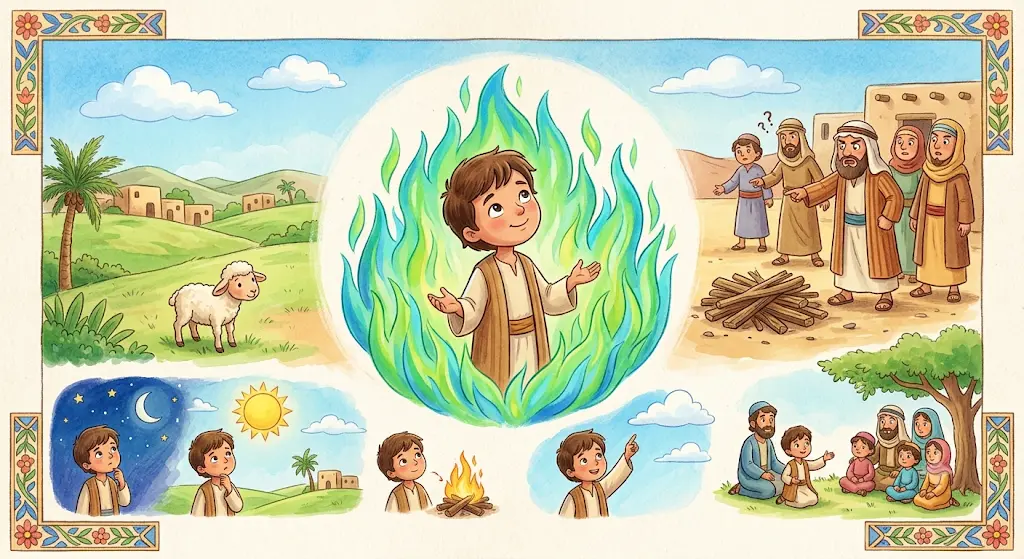
Every child who hears the prophet Ibrahim story for the first time asks the same question: “And then what happened?” That’s how you know this story works. Prophet Ibrahim (peace be upon him) was thrown into fire, argued with kings, left his family in a desert valley, and was commanded to sacrifice his son — and through every trial, he held on to Allah with complete trust.
This guide walks parents through the full prophet Ibrahim story for kids, phase by phase, with Quranic verses in Arabic and English, age-appropriate language, and practical tips for making the lessons stick in young hearts.
What You’ll Learn in This Article
- Who Prophet Ibrahim was and why he is called the Father of the Prophets
- How Ibrahim grew up questioning idols — and what that teaches children about thinking for themselves
- The night of the stars, moon, and sun — and the brilliant argument Ibrahim made for Tawheed
- How he destroyed the idols and what happened when his people threw him into the fire
- His patient, loving da’wah to his own father
- The sacrifice of Ismail and the building of the Kaaba
- Key Quranic verses with full Arabic tashkeel, transliteration, and references
- Lessons tailored for different ages (4–7, 8–12, 13+)
Who Was Prophet Ibrahim?
Prophet Ibrahim (peace be upon him) is one of the five greatest messengers in Islam — the Ulul ‘Azm — meaning those prophets who showed extraordinary patience and resolve. He is known as the Father of the Prophets because nearly all the prophets who came after him descended from his lineage — including Ismail, Ishaaq, Ya’qub, Yusuf, Musa, ‘Isa, and our beloved Prophet Muhammad (peace be upon them all).
Allah honoured Ibrahim with the highest title given to any human being: Khalilullah — the intimate friend of Allah.
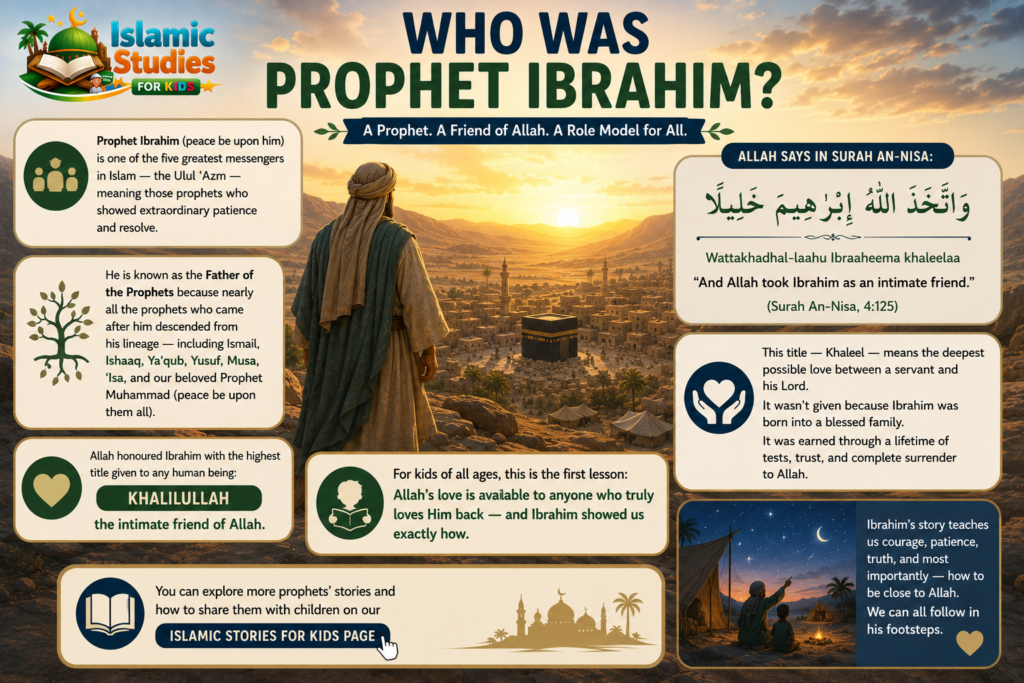
Allah says in Surah An-Nisa:
وَاتَّخَذَ اللَّهُ إِبْرَاهِيمَ خَلِيلًا
Wattakhadhal-laahu Ibraaheema khaleelaa
“And Allah took Ibrahim as an intimate friend.” (Surah An-Nisa, 4:125)
This title — Khaleel — means the deepest possible love between a servant and his Lord. It wasn’t given because Ibrahim was born into a blessed family. It was earned through a lifetime of tests, trust, and complete surrender to Allah.
For kids of all ages, this is the first lesson: Allah’s love is available to anyone who truly loves Him back — and Ibrahim showed us exactly how.
Prophet Ibrahim’s Birth and Childhood in Babylon
Ibrahim (peace be upon him) was born in the city of Babylon, in what is today Iraq. At the time, his people were divided into three groups: those who worshipped stars and planets, those who worshipped idols, and those who worshipped their kings as gods. It was a world covered in the darkness of shirk (associating partners with Allah).
And into this world, one boy was born who would change history.
What makes Ibrahim’s story even more remarkable for children?
The fact is that his father, Azar, was not merely an idol worshipper; he was the very person who carved and sold them. Thus, the child destined to grow up and shatter idols was raised in the home of the man who crafted them.
Yet Ibrahim looked at those statues from a young age and felt something was deeply wrong. They could not hear. They could not speak. They could not help anyone. How could his father — a man Ibrahim loved — bow down to something he made with his own hands?
This is a powerful conversation starter for parents. Ask your child: “If you saw something that everyone around you was doing, but you thought it was wrong — would you say something?”
Ibrahim did. And that courage to question is where his entire story begins.
“His journey shows children that using your mind, asking honest questions, and refusing to follow the crowd blindly — these are not signs of disrespect. They are signs of a sound heart.”
Prophet Ibrahim and the Stars, Moon, and Sun
One of the most memorable phases of the prophet Ibrahim story for kids is the night Ibrahim stood under the open sky and used the heavens themselves to argue for Tawheed — the oneness of Allah.
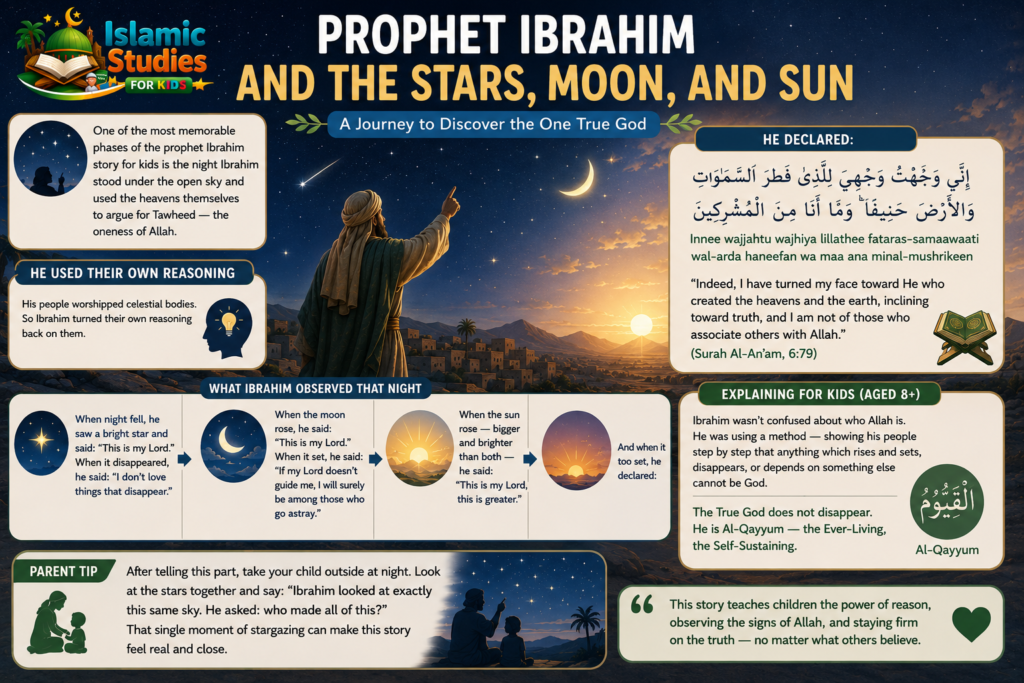
His people worshipped celestial bodies. So Ibrahim turned their own reasoning back on them.
When night fell, he saw a bright star and said: “This is my Lord.” When it disappeared, he said: “I don’t love things that disappear.” When the moon rose, he said: “This is my Lord.” When it set, he said: “If my Lord doesn’t guide me, I will surely be among those who go astray.” When the sun rose — bigger and brighter than both — he said: “This is my Lord, this is greater.” And when it too set, he declared:
إِنِّى وَجَّهْتُ وَجْهِيَ لِلَّذِى فَطَرَ ٱلسَّمَٰوَٰتِ وَٱلْأَرْضَ حَنِيفًا ۖ وَمَآ أَنَا۠ مِنَ ٱلْمُشْرِكِينَ
Innee wajjahtu wajhiya lillathee fataras-samaawaati wal-arda haneefan wa maa ana minal-mushrikeen
“Indeed, I have turned my face toward He who created the heavens and the earth, inclining toward truth, and I am not of those who associate others with Allah.” (Surah Al-An’am, 6:79)
For children aged 8 and older, parents can explain: Ibrahim wasn’t confused about who Allah is. He was using a method — showing his people step by step that anything which rises and sets, disappears, or depends on something else cannot be God. The True God does not disappear. He is Al-Qayyum — the Ever-Living, the Self-Sustaining.
Parent tip: After telling this part, take your child outside at night. Look at the stars together and say: “Ibrahim looked at exactly this same sky. He asked: who made all of this?” That single moment of stargazing can make this story feel real and close.
Prophet Ibrahim Destroys the Idols
When reasoning and argument didn’t move his people, Ibrahim decided to give them an undeniable proof. When the townspeople left for a festival, he entered their temple and smashed every idol — except the largest one. He then placed the axe around the neck of the biggest idol.
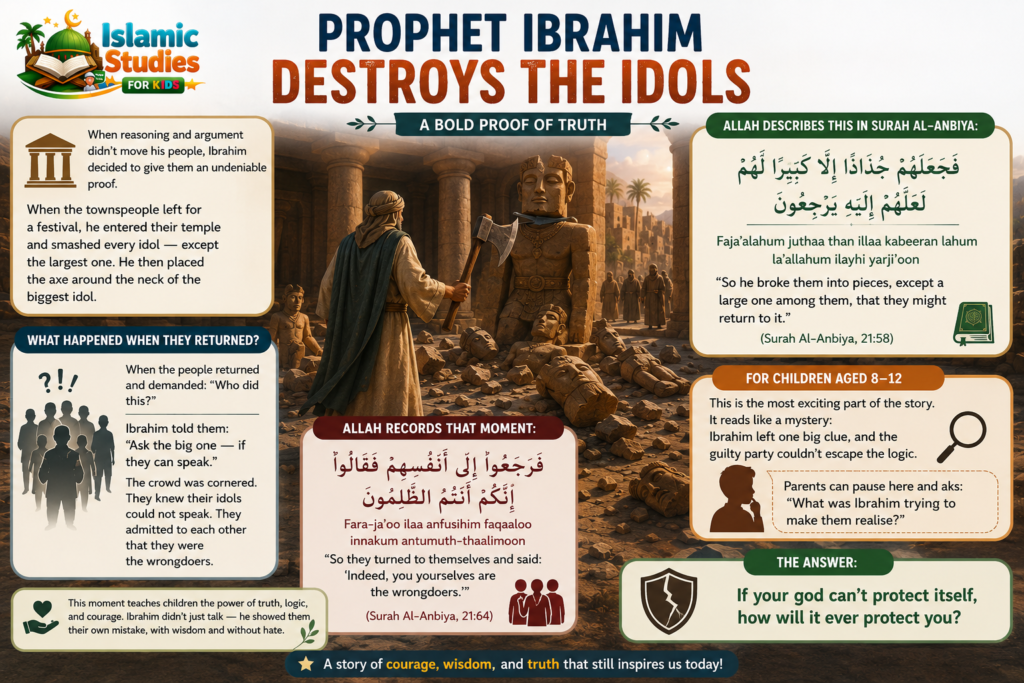
Allah describes this in Surah Al-Anbiya:
فَجَعَلَهُمْ جُذَاذًا إِلَّا كَبِيرًا لَّهُمْ لَعَلَّهُمْ إِلَيْهِ يَرْجِعُونَ
Faja’alahum juthааthan illaa kabeeran lahum la’allahum ilayhi yarji’oon
“So he broke them into pieces, except a large one among them, that they might return to it.” (Surah Al-Anbiya, 21:58)
When the people returned and demanded: “Who did this?” Ibrahim told them: “Ask the big one — if they can speak.” The crowd was cornered. They knew their idols could not speak. They admitted to each other that they were the wrongdoers.
Allah records that moment:
فَرَجَعُوٓا۟ إِلَىٰٓ أَنفُسِهِمْ فَقَالُوٓا۟ إِنَّكُمْ أَنتُمُ ٱلظَّٰلِمُونَ
Fara-ja’oo ilaa anfusihim faqaaloo innakum antumuth-thaalimoon
“So they turned to themselves and said: ‘Indeed, you yourselves are the wrongdoers.'” (Surah Al-Anbiya, 21:64)
For children aged 8–12, this is the most exciting part of the story. It reads like a mystery: Ibrahim left one big clue, and the guilty party couldn’t escape the logic. Parents can pause here and ask: “What was Ibrahim trying to make them realise?”
The answer: If your god can’t protect itself, how will it ever protect you?
Read also: The Prophet Yusuf Story for Kids: The Complete Guide for Parents
Allah Saved Ibrahim from the Fire
The people’s defeat in the argument turned into rage. They collected enormous amounts of wood. They lit a fire so massive that no one dared get close to it — and they used a catapult (منجنيق) to hurl Ibrahim into its centre.
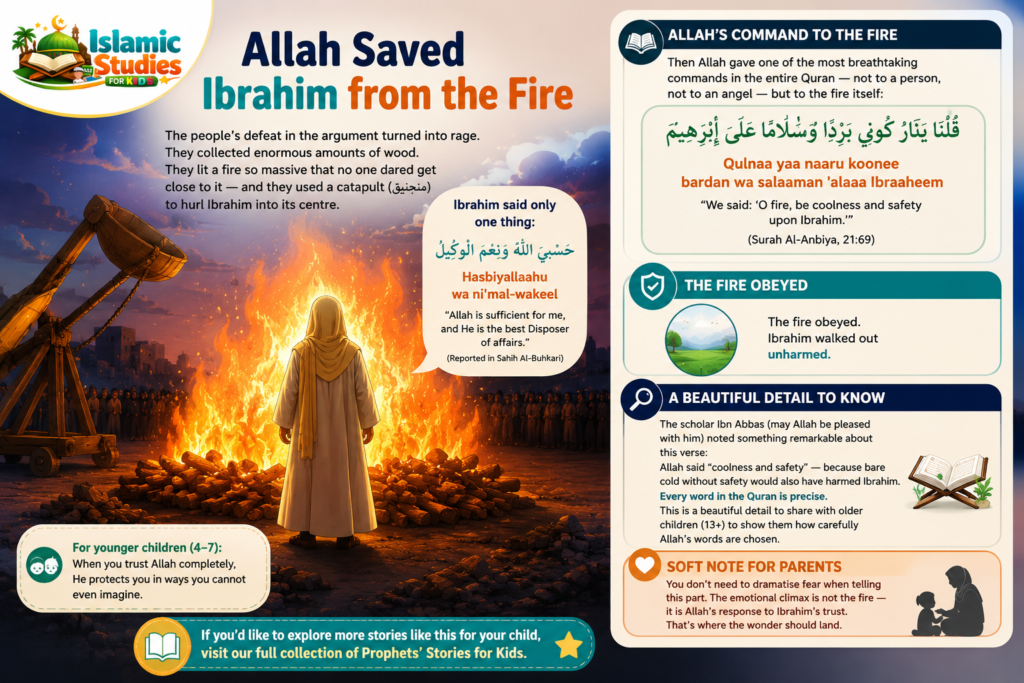
Ibrahim said only one thing:
حَسْبِيَ اللَّهُ وَنِعْمَ الْوَكِيلُ
Hasbiyallaahu wa ni’mal-wakeel
“Allah is sufficient for me, and He is the best Disposer of affairs.” (Reported in Sahih Al-Bukhari)
Then Allah gave one of the most breathtaking commands in the entire Quran — not to a person, not to an angel — but to the fire itself:
قُلْنَا يَٰنَارُ كُونِى بَرْدًا وَسَلَٰمًا عَلَىٰٓ إِبْرَٰهِيمَ
Qulnaa yaa naaru koonee bardan wa salaaman ‘alaaa Ibraaheem
“We said: ‘O fire, be coolness and safety upon Ibrahim.'” (Surah Al-Anbiya, 21:69)
The fire obeyed. Ibrahim walked out unharmed.
Experience a Real Classroom
Curious about how we teach? This video offers a glimpse into a real class, showcasing our interactive approach, qualified teachers, and child-friendly learning experience.
Fun & Engaging Islamic Classes for Kids
Start your child’s journey today with interactive lessons designed to make learning Islam loved and easy.
Get Your Child a Free TrialThe scholar Ibn Abbas (may Allah be pleased with him) noted something remarkable about this verse: Allah said “coolness and safety” — because bare cold without safety would also have harmed Ibrahim. Every word in the Quran is precise. This is a beautiful detail to share with older children (13+) to show them how carefully Allah’s words are chosen.
For younger children (4–7), the lesson is simple and powerful: When you trust Allah completely, He protects you in ways you cannot even imagine.
Soft note for parents: You don’t need to dramatise fear when telling this part. The emotional climax is not the fire — it is Allah’s response to Ibrahim’s trust. That’s where the wonder should land.
If you’d like to explore more stories like this for your child, visit our full collection of Prophets’ Stories for Kids.
Prophet Ibrahim’s Da’wah to His Father
One of the most emotionally rich parts of the prophet Ibrahim story for kids is his relationship with his father, Azar. Even though Azar made and sold idols, Ibrahim never stopped loving him. And because he loved him, he could not stay silent.
Ibrahim called his father to Allah again and again — always with gentleness, always with the word “Yaa abati” (يَا أَبَتِ) — “O my dear father” — repeating it before every argument. Never harsh. Never superior. Always soft.
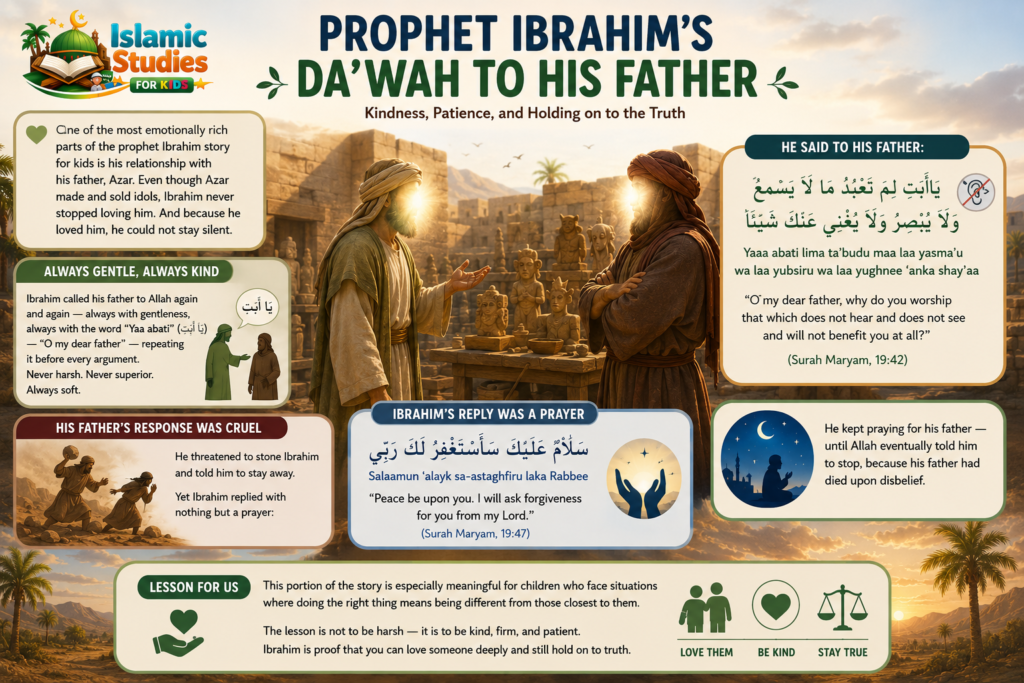
He said to his father:
يَٰٓأَبَتِ لِمَ تَعْبُدُ مَا لَا يَسْمَعُ وَلَا يُبْصِرُ وَلَا يُغْنِى عَنكَ شَيْئًا
Yaaa abati lima ta’budu maa laa yasma’u wa laa yubsiru wa laa yughnee ‘anka shay’aa
“O my dear father, why do you worship that which does not hear and does not see and will not benefit you at all?” (Surah Maryam, 19:42)
His father’s response was cruel: he threatened to stone Ibrahim and told him to stay away. Yet Ibrahim replied with nothing but a prayer:
سَلَٰمٌ عَلَيْكَ ۖ سَأَسْتَغْفِرُ لَكَ رَبِّىٓ
Salaamun ‘alayk sa-astaghfiru laka Rabbee
“Peace be upon you. I will ask forgiveness for you from my Lord.” (Surah Maryam, 19:47)
He kept praying for his father — until Allah eventually told him to stop, because his father had died upon disbelief.
This portion of the story is especially meaningful for children who face situations where doing the right thing means being different from those closest to them. The lesson is not to be harsh — it is to be kind, firm, and patient. Ibrahim is proof that you can love someone deeply and still hold on to truth.
The Greatest Test: Ibrahim and the Sacrifice of Ismail
Years after his trials, Allah gave Ibrahim a son — Ismail — through his wife Hajar. Then came the hardest test of all. Allah showed Ibrahim in a dream that he was sacrificing his own son.
Ibrahim told Ismail honestly. And Ismail’s response — from a young man — stands as one of the most moving moments in the entire Quran:
قَالَ يَٰٓأَبَتِ ٱفْعَلْ مَا تُؤْمَرُ ۖ سَتَجِدُنِىٓ إِن شَآءَ اللَّهُ مِنَ ٱلصَّٰبِرِينَ
Qaala yaaa abatif’al maa tu’mar satajidunee in shaaa’al-laahu minas-saabireen
“He said: ‘O my father, do what you are commanded. You will find me, if Allah wills, among the patient.'” (Surah As-Saffat, 37:102)
As Ibrahim placed the knife, Allah called out:
يَٰٓإِبْرَٰهِيمُ قَدْ صَدَّقْتَ ٱلرُّءْيَآ
Yaaa Ibraaheem, qad saddaqtar-ru’yaa
“O Ibrahim! You have fulfilled the vision.” (Surah As-Saffat, 37:104–105)
Allah replaced Ismail with a ram from Paradise. This event is the origin of Eid Al-Adha — celebrated every year by Muslims around the world. Every time a family makes Udhiyyah (قُرْبَان), they are connecting to Ibrahim’s story directly.
For children, this is the moment to ask: “Do you think it was easy for Ibrahim?” And then: “Why did he do it anyway?” The answer — trust in Allah — is the heart of this entire story.
Ibrahim and Ismail Build the Kaaba
The final great chapter of the prophet Ibrahim story for kids is the building of the Kaaba in Makkah. Allah commanded Ibrahim and his son Ismail to raise the foundations of the first house of worship on earth.
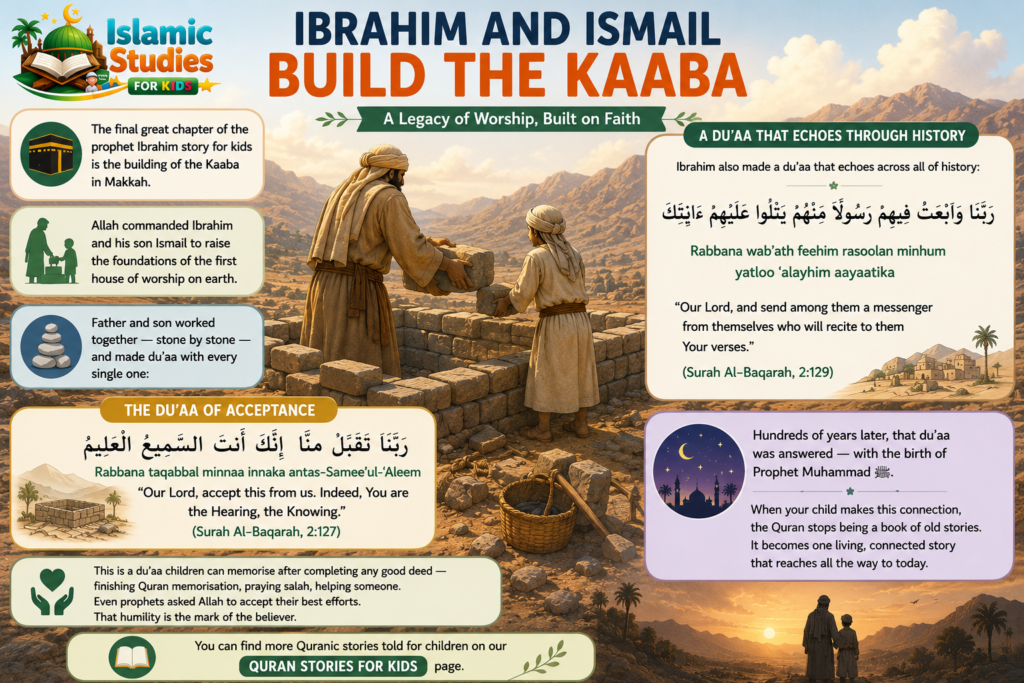
Father and son worked together — stone by stone — and made du’aa with every single one:
رَبَّنَا تَقَبَّلْ مِنَّآ ۖ إِنَّكَ أَنتَ ٱلسَّمِيعُ ٱلْعَلِيمُ
Rabbana taqabbal minnaa innaka antas-Samee’ul-‘Aleem
“Our Lord, accept this from us. Indeed, You are the Hearing, the Knowing.” (Surah Al-Baqarah, 2:127)
This is a du’aa children can memorise after completing any good deed — finishing Quran memorisation, praying salah, helping someone. Even prophets asked Allah to accept their best efforts. That humility is the mark of the believer.
Ibrahim also made a du’aa that echoes across all of history:
رَبَّنَا وَٱبْعَثْ فِيهِمْ رَسُولًا مِّنْهُمْ يَتْلُوا۟ عَلَيْهِمْ ءَايَٰتِكَ
Rabbana wab’ath feehim rasoolan minhum yatloo ‘alayhim aayaatika
“Our Lord, and send among them a messenger from themselves who will recite to them Your verses.” (Surah Al-Baqarah, 2:129)
Hundreds of years later, that du’aa was answered — with the birth of Prophet Muhammad ﷺ. When your child makes this connection, the Quran stops being a book of old stories. It becomes one living, connected story that reaches all the way to today.
Read also: Prophet Musa Story for Kids: Miracles, Lessons & Complete Quranic Guide
Watch a Sample Lesson from Our Academy
Get a firsthand look at how our students learn Islamic values, Quran, and essential knowledge through engaging and interactive online classes. See why families trust Islamic Studies for Kids Academy.
Give Your Child the Gift of Learning These Stories Properly
Prophet stories come alive when told by someone who knows how to speak to children — not just at them.
At islamic studies for kids your child can learn the full stories of the prophets through age-appropriate, structured Islamic Studies lessons designed for children aged 4–15. Every lesson uses storytelling, Quranic verses, and discussion questions that make the lessons stay long after the session ends.
Our Islamic Studies Courses for Kids:
- Quran for Kids
- Noorani Qaida for Kids
- Quran Recitation for Kids
- Tajweed for Kids
- Quran Memorization (Hifz) for Kids
- Quran for Toddlers
- Quranic Arabic for Kids
- Quran Stories for Kids
Fun & Engaging Islamic Classes for Kids
Start your child’s journey today with interactive lessons designed to make learning Islam loved and easy.
Get Your Child a Free TrialConclusion
The prophet Ibrahim story for kids is not just one story — it is a collection of life lessons wrapped in the most compelling narrative in the Quran. From the young boy who questioned idols in his father’s house, to the man who walked out of a fire unhurt, to the father who raised his knife in obedience and received a ram from Paradise — every phase of Ibrahim’s life teaches something children need.
He taught us that truth matters more than what the crowd does. That gentle words work better than anger, even with those who hurt us. That Allah’s command — however hard — always ends in mercy. And that the Kaaba your child faces in every prayer was built by a father and son who begged Allah to accept their work.
These lessons are worth returning to — not just once, but regularly, as your child grows and understands more with each retelling.
Frequently Asked Questions
Who was Prophet Ibrahim in simple words for kids?
Prophet Ibrahim (peace be upon him) was one of the greatest prophets in Islam. He grew up in Babylon, Iraq, in a family that worshipped idols — but from a young age, he used his mind and rejected idol worship. Allah chose him as His close friend (Khalilullah) and sent him to guide his people to worship Allah alone.
Why is Prophet Ibrahim called the Father of the Prophets?
Ibrahim is called the Father of the Prophets (أبو الأنبياء) because almost all the prophets who came after him — including Ishaaq, Ya’qub, Yusuf, Musa, ‘Isa, and Muhammad (peace be upon them all) — were from his descendants.
What is the main lesson of the Prophet Ibrahim story for kids?
The central lesson is Tawakkul — complete trust in Allah. Every test Ibrahim faced, from the fire to the command to sacrifice his son, was met with full surrender to Allah. And in every case, Allah responded with mercy, protection, and reward.
What Quranic du’aa can children learn from Ibrahim’s story?
Two of the most important du’aas are: رَبَّنَا تَقَبَّلْ مِنَّآ (Rabbana taqabbal minnaa — “Our Lord, accept from us”) from Surah Al-Baqarah (2:127), and حَسْبِيَ اللَّهُ وَنِعْمَ الْوَكِيلُ (Hasbiyallaahu wa ni’mal-wakeel — “Allah is sufficient for me, and He is the best Disposer of affairs”), reported in Sahih Al-Bukhari. Both are short, meaningful, and easy for young children to memorise.
What age is the Prophet Ibrahim story suitable for?
The story is suitable for all ages with different levels of detail. Children aged 4–7 benefit most from the fire miracle and the “who made the stars?” question. Children aged 8–12 can understand the idol-breaking argument and the sacrifice. Teenagers can engage with the deeper themes of da’wah, patience with family, and the concept of Khalilullah.
How did Prophet Ibrahim show kindness to his father even when his father rejected him?
Ibrahim always called his father with the gentle word Yaa abati (يَا أَبَتِ — “O my dear father”) and offered to pray for him even after his father threatened to stone him. This shows children that loving someone and disagreeing with them are not opposites — and that kindness in da’wah matters as much as the message itself.


Leave a Reply