 Islamic Studies
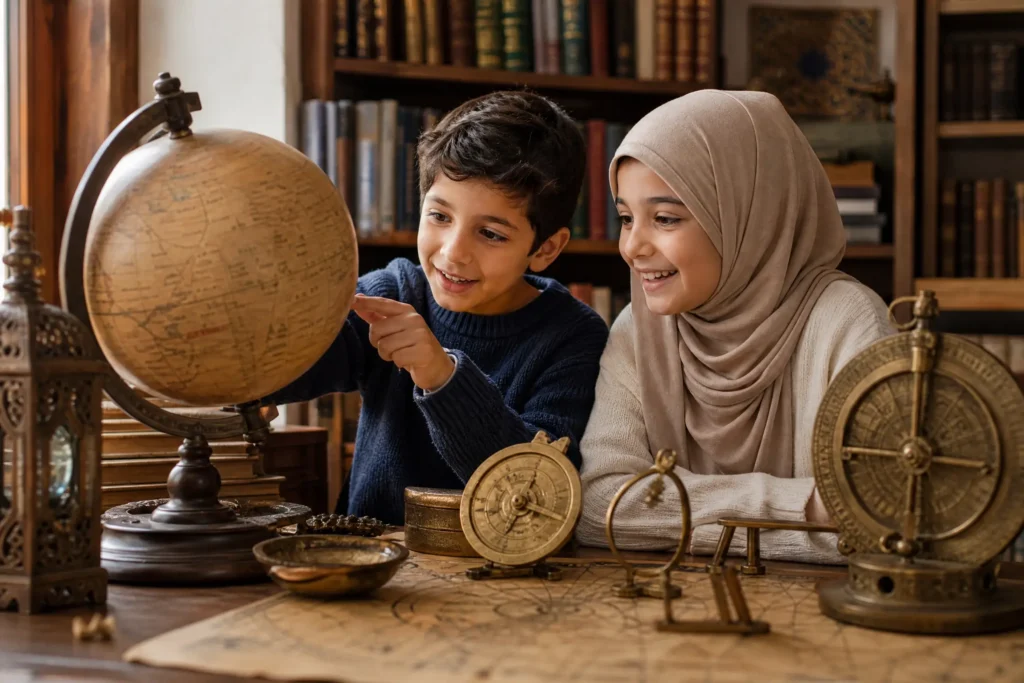
Islamic civilization and the Golden Age for kids is one of history’s most exciting stories — and one of the least told. While Europe was struggling through the Dark Ages, Muslim scholars in Baghdad, Cordoba, and Cairo were inventing algebra, building the world’s first hospitals, mapping the globe, and studying the stars.
The knowledge they created changed the world permanently, and children can still find it in their classrooms, hospitals, and phones today.
What You’ll Learn in This Article?
- What Islamic civilization is and when the Golden Age of Islam happened.
- Why Baghdad became the center of world knowledge.
- The most important Muslim scientists and what they discovered.
- Islamic inventions kids still use every day.
- How Islamic science reached Europe and changed history.
- Fun facts about the Islamic empire for kids.
What Is Islamic Civilization & Golden Age for Kids?
Islamic civilization is the culture, knowledge, and achievements built by Muslim peoples across more than a thousand years of history.
It began with the founding of Islam in 610 CE by the Prophet Muhammad ﷺ in Mecca and grew into one of the largest and most advanced civilizations the world has ever seen.
The Golden Age of Islam is the name historians give to the period when Islamic civilization reached its greatest heights in science, medicine, mathematics, art, and learning.
It generally lasted from around 750 CE to 1258 CE — roughly 500 years of extraordinary achievement that directly shaped the modern world.
As historian Howard R. Turner wrote, Muslim artists and scientists, princes and laborers together created a unique culture that influenced societies on every continent.
When Did the Islamic Golden Age Begin and End?
The Islamic Golden Age is tied to the rise of the Abbasid Caliphate. Here is the key timeline:
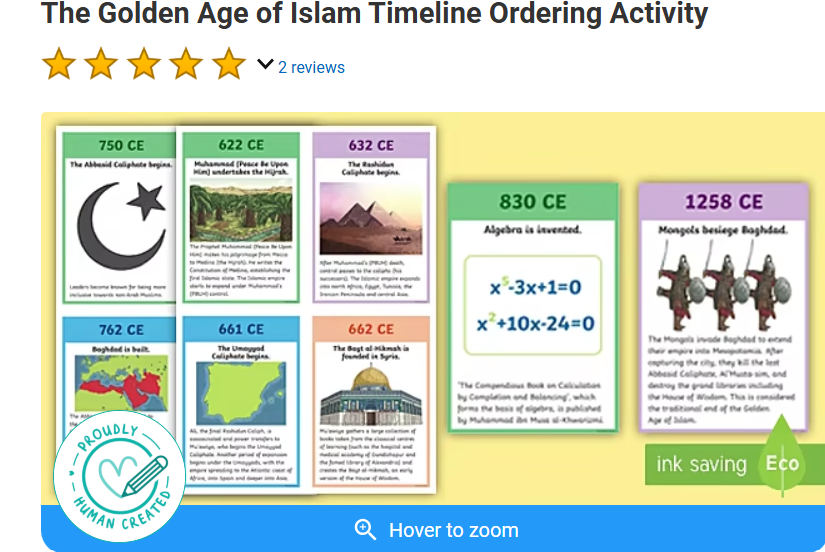
| Year | Event |
| 610 CE | Prophet Muhammad ﷺ receives the first revelation of the Quran in Mecca |
| 622 CE | The first Islamic state is established in Medina |
| 632 CE | The Rashidun Caliphate begins; the empire expands into Central Asia, North Africa, and Egypt |
| 661–750 CE | The Umayyad Caliphate rules; the empire spreads to Spain, the Atlantic coast of Africa, and deep into Asia |
| 750 CE | The Abbasid Caliphate takes control — the Golden Age begins |
| 762 CE | Baghdad is built and becomes the world’s center of learning |
| 830 CE | The House of Wisdom opens in Baghdad |
| 1258 CE | The Mongols destroy Baghdad — most historians mark this as the Golden Age’s end |
Some historians believe the Golden Age continued until 1500 CE, overlapping with the great Ottoman, Safavid, and Mughal empires.
Either way, the knowledge produced during this period never disappeared — it became the foundation of modern science.
Experience a Real Classroom
Curious about how we teach? This video offers a glimpse into a real class, showcasing our interactive approach, qualified teachers, and child-friendly learning experience.
Fun & Engaging Islamic Classes for Kids
Start your child’s journey today with interactive lessons designed to make learning Islam loved and easy.
Get Your Child a Free TrialWhy the Islamic Golden Age Happened and What It Means for Kids ?
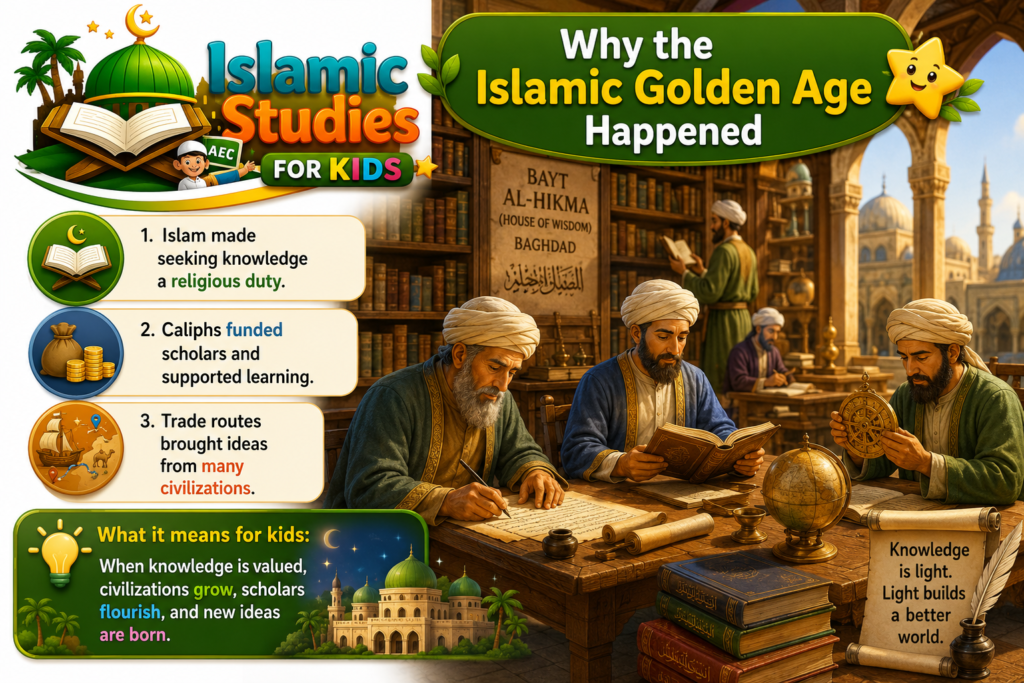
The Islamic Golden Age did not happen by accident. Three specific factors caused it, and children who understand these factors understand why Islam produced so many scholars and inventions in such a short time.
1. Islam Made Seeking Knowledge a Religious Duty
The Prophet Muhammad ﷺ said: “Seeking knowledge is an obligation upon every Muslim.” This was not a suggestion — it was part of the faith.
The Quran itself repeatedly calls on believers to observe the natural world, to think, and to reflect. In a civilization where learning was an act of worship, scholars were honored as the inheritors of the prophets.
This is the single most important explanation for the Golden Age — and the one most competing articles miss entirely.
2. The Caliphs Actively Funded and Protected Scholars
The Abbasid Caliphs, particularly Harun Al-Rashid and his son Al-Ma’mun, invested heavily in learning. Al-Ma’mun founded the House of Wisdom in Baghdad around 830 CE — the world’s greatest research academy of its time.
He gathered scholars from across the Islamic world, provided them with salaries, a massive library, and an observatory, and tasked them with translating and advancing all human knowledge.
3. Trade Routes Brought Ideas from Every Civilization
Because Islamic merchants traveled from Spain to China, the Islamic world became the crossroads of all human knowledge. Greek philosophy, Indian mathematics, Persian science, and Chinese technology all flowed into Baghdad and were translated into Arabic. Muslim scholars then studied these works, corrected their errors, and added entirely new discoveries on top.
Islamic Science for Kids Through the Story of the House of Wisdom
The House of Wisdom — Bayt al-Hikmah in Arabic — was a huge academy established in Baghdad where scholars studied every field of human knowledge. It was created by Caliph Harun Al-Rashid and greatly expanded by his son Al-Ma’mun.
What Was Inside The House of Wisdom?
Inside the House of Wisdom:
- A massive library containing manuscripts gathered from across the known world.
- An astronomical observatory for studying the night sky.
- Translation workshops where scholars converted Greek, Persian, Sanskrit, and Syriac texts into Arabic.
- Research rooms where scholars from Muslim, Christian, and Jewish backgrounds worked side by side.
One remarkable book produced at the House of Wisdom was The Book of Ingenious Devices, published in 850 CE and believed to have been written by three brothers known as the Banu Musa.
It described mechanical inventions with extraordinary precision — centuries before Europe developed comparable engineering knowledge.
The House of Wisdom was the world’s first organized research institution, and it produced discoveries that changed every field of human knowledge.
Prarents can give this sheets for there kids:

The Greatest Muslim Scientists of the Islamic Golden Age for Kids
The Islamic Golden Age produced some of history’s most important scientists.
These were not specialists in one subject — most were experts in multiple fields simultaneously, combining medicine, mathematics, philosophy, and astronomy the way Leonardo da Vinci combined art and engineering centuries later.
Famous Muslim Scientists and Their Discoveries
During the Islamic Golden Age, many Muslim scholars excelled in several fields at the same time.
The table below highlights some of the most influential scientists and the lasting impact of their discoveries.
| Scientist | Field(s) | What They Discovered or Created |
| Al-Khwarizmi | Mathematics | Invented algebra; introduced the Hindu-Arabic number system (0–9) to the world; the word “algorithm” comes from his name |
| Ibn al-Haytham | Physics, Optics | Proved that light enters the eye (not the other way round); invented the first camera-like device; called the “first scientist” for developing the scientific method |
| Ibn Sina (Avicenna) | Medicine | Wrote The Canon of Medicine, used in European universities for 600 years; described infectious diseases and invented quarantine |
| Al-Zahrawi | Surgery | Invented the scalpel, forceps, and catgut sutures; wrote a 1,500-page surgical manual using around 200 instruments |
| Al-Razi | Medicine | Discovered measles and smallpox as separate diseases; studied children’s diseases and how the brain works |
| Ibn Nafis | Medicine | First correctly described how blood circulates through the lungs — 300 years before European scientists |
| Al-Idrisi | Geography | Created the most accurate world map of the 12th century |
| Al-Biruni | Science, Geography | Calculated the Earth’s circumference with remarkable precision using mathematics alone |
| Jabir ibn Hayyan | Chemistry | Invented the alembic (distillation device); is considered the father of chemistry |
Each of these scholars changed their field permanently. Their books were translated into Latin and used in European universities for centuries after the Golden Age ended.
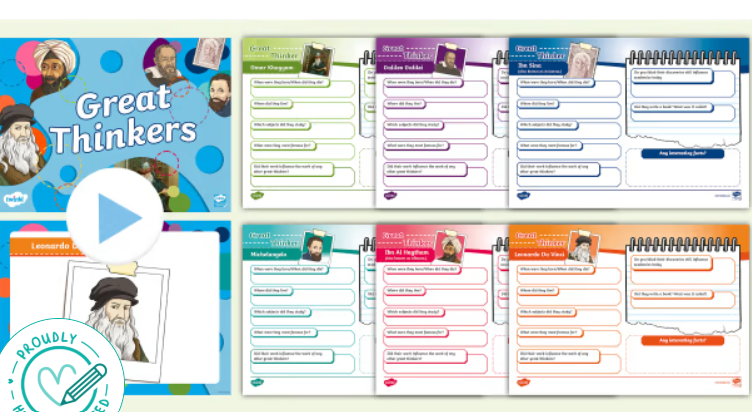
Islamic Studies for Kids Academy helps children discover Islamic history through expert-led, age-appropriate online classes.
Amazing Muslim Inventions Kids Still Use Today
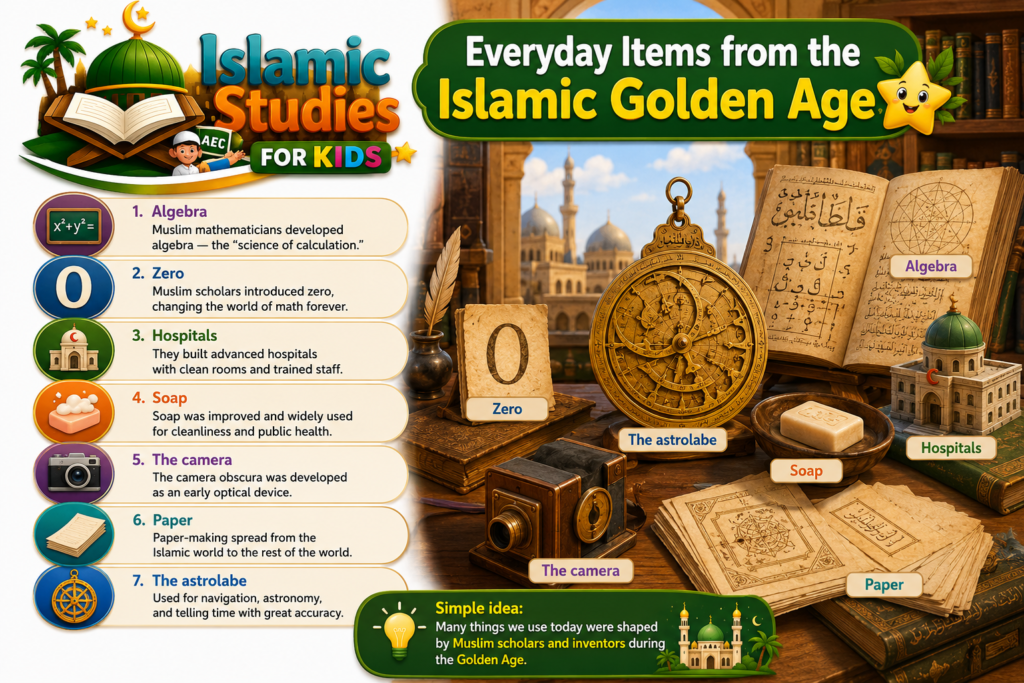
One of the most powerful ways to make Islamic history real for children is to show them how Golden Age inventions are still present in their daily lives.
The Islamic Golden Age did not just produce old history — it produced the tools modern civilization runs on.
Everyday Items That Came From the Golden Age
- Algebra — Al-Khwarizmi’s Kitab al-Mukhtasar fi Hisab al-Jabr gave us the word “algebra” (from al-jabr). Every time a child solves for x in maths class, they are using a method invented in 9th-century Baghdad.
- The number zero — The Hindu-Arabic numeral system including zero was introduced to Europe by Al-Khwarizmi. Before this, Europeans used Roman numerals, which had no zero and made complex calculation extremely difficult.
- Hospitals — The Islamic world built the first hospitals that treated all patients regardless of wealth or religion. The Mansuri Hospital in Cairo (built 1284 CE) had separate wards for different diseases, music therapy, and medical libraries. Europe’s first comparable hospitals came centuries later.
- Soap and personal hygiene products — Arab chemists developed soap as we know it. The Prophet Muhammad ﷺ is recorded to have used a twig called a miswak to clean his teeth — a practice that prefigured the toothbrush.
- The camera — Ibn al-Haytham built the first camera obscura (he called it al-qamara) to study how light travels. The word “camera” traces directly to his Arabic term.
- Paper — Muslims learned papermaking from Chinese prisoners captured after the Battle of Talas in 751 CE. They then built paper mills across the empire — in Samarkand, Baghdad, and eventually Spain — spreading the technology to Europe by the 13th century. Before paper, knowledge spread slowly and expensively on parchment.
- The astrolabe — Islamic astronomers refined the astrolabe, a device for identifying the position of the sun and stars. It served as both a compass and a clock, and Muslims used it to determine the direction of Mecca for prayer — the same device that later guided European explorers across the Atlantic.
How Large Was the Islamic Empire? Facts for Kids
The Islamic Empire was one of the largest in world history. Understanding its size helps children grasp how knowledge could travel so quickly from one end of the civilization to the other.
- At its greatest extent under the Umayyad Caliphate, the empire governed approximately 28% of the world’s population — a larger share than any empire before it at that time.
- The empire stretched from Spain and the Atlantic coast of Africa in the west all the way to the borders of China and India in the east.
- A book published in Damascus or Baghdad could travel by trade caravan to Cordoba in Spain within a month — creating remarkable cultural unity across thousands of miles.
- By the 10th century CE, the city of Cordoba alone had 700 mosques, 70 libraries, and paved, lamp-lit streets — when London’s main road had not a single public lamp.
- The University of Al-Qarawiyyin in Fez, Morocco — founded in 859 CE — is recognized by the Guinness Book of Records as the oldest continuously operating university in the world.
Read Also: Can Kids Fast in Ramadan?
What Was the Caliphate and How Did It Work?
After the Prophet Muhammad ﷺ died, the Muslim community was led by a Caliph — a political and religious leader. The first four Caliphs were companions of the Prophet and are called the Rightly Guided Caliphs. They were:
- Abu Bakr Al-Siddiq
- Umar ibn Al-Khattab
- Uthman ibn Affan
- Ali ibn Abi Talib
These were followed by two great dynastic caliphates:
- The Umayyad Caliphate (661–750 CE): Expanded the empire to its greatest geographic size; established the first Islamic navy; issued the first Islamic currency.
- The Abbasid Caliphate (750–1258 CE): Built Baghdad; founded the House of Wisdom; presided over the Golden Age of science and learning.
Read Also: What to Do in Ramadan for Kids?
Watch a Sample Lesson from Our Academy
Get a firsthand look at how our students learn Islamic values, Quran, and essential knowledge through engaging and interactive online classes. See why families trust Islamic Studies for Kids Academy.
Fun & Engaging Islamic Classes for Kids
Start your child’s journey today with interactive lessons designed to make learning Islam loved and easy.
Get Your Child a Free TrialHow Did Islamic Knowledge Reach Europe?
One of the most important — and least taught — facts about Islamic civilization is that it directly caused the European Renaissance. When Golden Age manuscripts were translated from Arabic into Latin, they triggered a revolution in European thinking.
The 4 Ways Islamic Knowledge Reached Europe
The main channels through which Islamic knowledge entered Europe were:
- Al-Andalus (Islamic Spain): European students traveled to Islamic universities in Cordoba and Toledo to study medicine, astronomy, and mathematics. Muslim professors taught in universities that Europeans later built on the Islamic model.
- The Crusades: European knights who came to fight returned home with exposure to Islamic medical practices, architecture, and science.
- Translation centers: Gerard of Cremona, an Italian scholar who lived in Toledo for 50 years, translated 71 Arabic scientific works into Latin by himself.
- Trade routes: Islamic merchants carried not only goods but ideas across three continents.
The impact was permanent. Ibn Sina’s Canon of Medicine was printed 16 times in the 15th century and 20 times in the 16th — and remained a standard medical textbook in European universities until the late 1800s.
Ibn Rushd’s (Averroes’) philosophy became the foundation of medieval European philosophical thought.
Read Also: How to Teach Kids to Pray in Islam?
Your Child Just Read About Al-Khwarizmi, Now Imagine Them Learning From His Tradition
Every name in this article — Al-Khwarizmi, Ibn Sina, Ibn al-Haytham — came from a civilization that treated seeking knowledge as an act of worship. That wasn’t coincidence. It was a culture deliberately built around learning.

Islamic Studies for Kids Academy exists to give your child a direct connection to that same tradition — not as history they read about, but as an identity they carry.
Islamic History for Kids Course Online
This is the course built exactly for what your child just read. Children ages 4 to 15 explore Islam from the first Revelation through the Abbasid Caliphate, the House of Wisdom, the rightly guided Caliphs, and the development of Islamic civilization — in English, with Al-Azhar certified tutors who bring each era to life through story, not lecture.
Your child won’t just memorize dates. They’ll understand why the Golden Age happened — and feel proud that it belongs to them.
Book Your Child’s Free Trial Class
Prophets Stories Course for Kids
Behind every civilization that the Golden Age built stood a chain of prophets whose example shaped how Muslims think, learn, and live.
This course teaches children ages 4 to 15 authentic Quranic accounts — Adam, Musa, Ibrahim, Muhammad ﷺ — delivered by Al-Azhar certified tutors trained in engaging young learners.
History makes sense when children know the story that started it.
See Real Results From Real Graduates
The shift families notice most isn’t just knowledge — it’s pride. Children who understand Islamic history stop seeing their faith as something separate from the world’s story. They start seeing it as the reason so much of that story exists.

Watch Graduate Stories From Real graduates
Nurture Your Child’s Islamic Knowledge with Our Islamic Studies for Kids Academy
Help your child build a strong Islamic foundation through engaging, age-appropriate, and interactive lessons designed to inspire faith, good character, and a love for Islam. Our experienced teachers guide children step by step, making Islamic learning enjoyable, practical, and easy to understand. Whether your child is just beginning or looking to deepen their knowledge, our comprehensive courses provide the perfect learning journey.
Our Islamic Studies Courses Include:
- Islamic Studies for Kids
- Islam Basics for Kids (Beginners)
- 5 Pillars of Islam for Kids
- 6 Pillars of Iman (Faith) for Kids
- Salah (Prayer) for Kids
- Wudu for Kids
- Dua for Kids
- Ramadan for Kids
- Zakat & Sadaqah for Kids
- Hajj for Kids
- Aqeedah (Islamic Belief) for Kids
- Islamic Manners & Akhlaq for Kids
- Good Deeds for Kids
- Cleanliness (Taharah) in Islam for Kids
- Angels in Islam for Kids
- Islamic History for Kids
- Seerah (Prophet’s Life) for Kids
- Prophets Stories for Kids
- Islamic Stories & Morals for Kids
- Fiqh for Kids (Islamic Jurisprudence Basics)
- Hadith for Kids
- Quran Tafseer Course for Kids
- Islamic Holidays & Events for Kids
- Islamic Identity for Kids
- Intensive Islamic Course for Kids
Enroll today and give your child the knowledge, values, and confidence to grow as a practicing Muslim with a strong connection to Allah and His teachings.
Fun & Engaging Islamic Classes for Kids
Start your child’s journey today with interactive lessons designed to make learning Islam loved and easy.
Get Your Child a Free TrialConclusion
Islamic civilization and the Golden Age produced some of history’s greatest contributions to science, medicine, mathematics, and art.
Children who understand this history understand where algebra came from, why hospitals exist, how the number zero changed the world, and how a 9th-century Muslim scientist invented the principles behind the modern camera.
This is not ancient history with no connection to today. It is the direct origin story of the modern world — and it belongs to Muslim children as part of their heritage.
Every time a child solves an algebra problem or uses a zero, they are touching something that began in Baghdad over a thousand years ago, in a library built by people who believed that seeking knowledge was an act of worship.
Frequently Asked Questions
What was the Islamic Golden Age for kids in simple words?
The Islamic Golden Age was a period from roughly 750 CE to 1258 CE when Muslim scholars made groundbreaking discoveries in science, medicine, mathematics, astronomy, and art.
While Europe was in the Dark Ages, Islamic civilization was the world’s leading center of learning, producing inventions and ideas that still shape daily life today.
Who were the most famous Muslim scientists for kids to know?
The most important Muslim scientists include Al-Khwarizmi (inventor of algebra), Ibn al-Haytham (pioneer of optics and the scientific method), Ibn Sina (whose medical encyclopedia was used in European universities for 600 years), Al-Zahrawi (father of modern surgery), and Ibn Nafis (who first described blood circulation through the lungs).
What did the Islamic civilization invent that we still use today?
Islamic civilization gave the world algebra, the number zero, the hospital system, soap, the astrolabe, early camera technology, paper manufacturing in the Western world, and the foundations of modern chemistry.
The word “algorithm” — used in every computer program today — comes directly from the name of the Muslim mathematician Al-Khwarizmi.
What Was the House of Wisdom and Why Did It Matter?
The House of Wisdom was a research academy and library built in Baghdad around 830 CE by Caliph Al-Ma’mun.
It was the world’s greatest center of learning of its time, where scholars translated Greek, Persian, Indian, and Chinese knowledge into Arabic and then built entirely new discoveries on top of those foundations. It had a library, an observatory, and hosted Muslim, Christian, and Jewish scholars working side by side.
Why did the Islamic Golden Age end?
Most historians mark the end of the Islamic Golden Age with the Mongol destruction of Baghdad in 1258 CE, which also destroyed the House of Wisdom and its vast library.
However, Islamic learning continued in other centers — Egypt, Persia, the Ottoman Empire, and Al-Andalus — and the knowledge produced during the Golden Age had already spread to Europe and the wider world, making its impact permanent.
How did Islamic civilization influence Europe?
Islamic civilization reached Europe mainly through Al-Andalus (Islamic Spain), where European students studied in Islamic universities and took that knowledge home. Italian scholar Gerard of Cremona alone translated 71 Arabic scientific works into Latin.
Islamic medical, philosophical, and mathematical texts became the standard curriculum in European universities for centuries, directly triggering the Renaissance and modern science.



Leave a Reply