 Islamic Studies
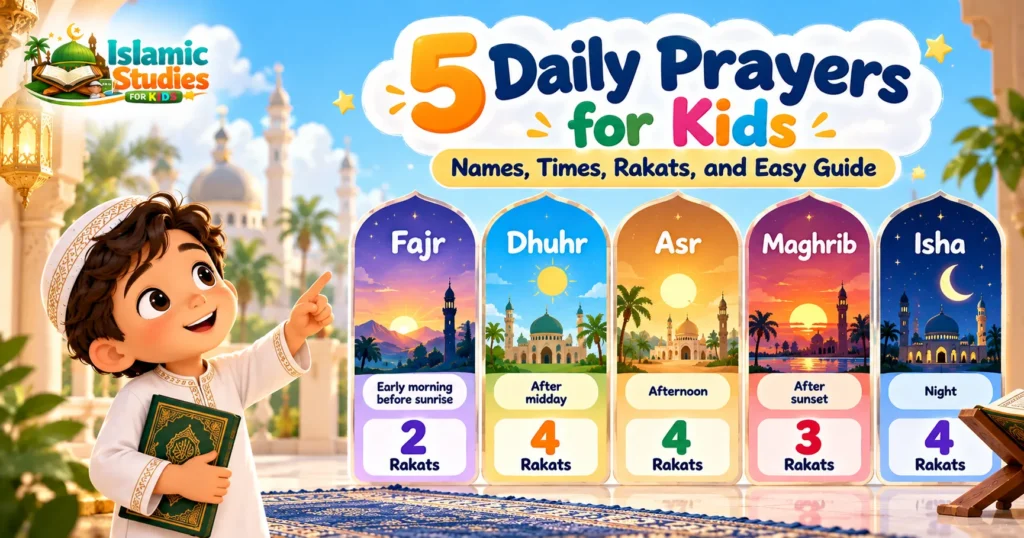
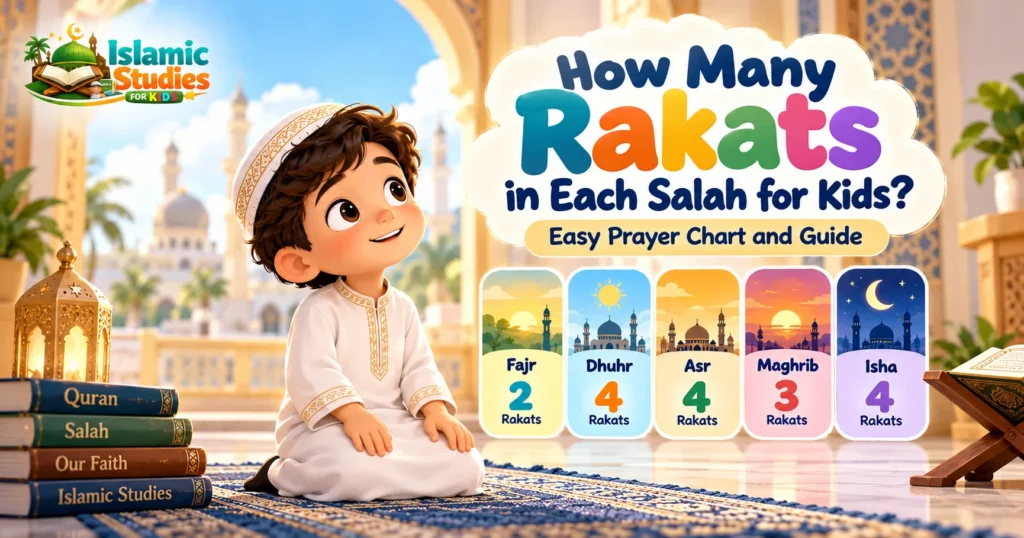
The 5 daily prayers for kids are Fajr, Dhuhr, Asr, Maghrib, and Isha. Muslims perform these prayers at different times throughout the day, from dawn until night. Fajr has 2 obligatory Rakats, Dhuhr has 4, Asr has 4, Maghrib has 3, and Isha has 4, making a total of 17 obligatory Rakats daily.
Teaching your child these prayers is one of the most meaningful steps in their Islamic learning journey. However, remembering five Arabic names, different prayer times, and the correct number of Rakats can feel overwhelming for young learners.
In this guide, you’ll discover the names, meanings, times, and Rakats of the five daily prayers. You’ll also learn what makes each prayer special, the difference between Fard and Sunnah prayers, and practical ways to help children remember Salah.
1. Fajr – The Early Morning Prayer (2 Rakats)
Fajr (الفجر) is the first daily prayer. The Arabic word Fajr means dawn, the time when the first light of morning appears before sunrise.
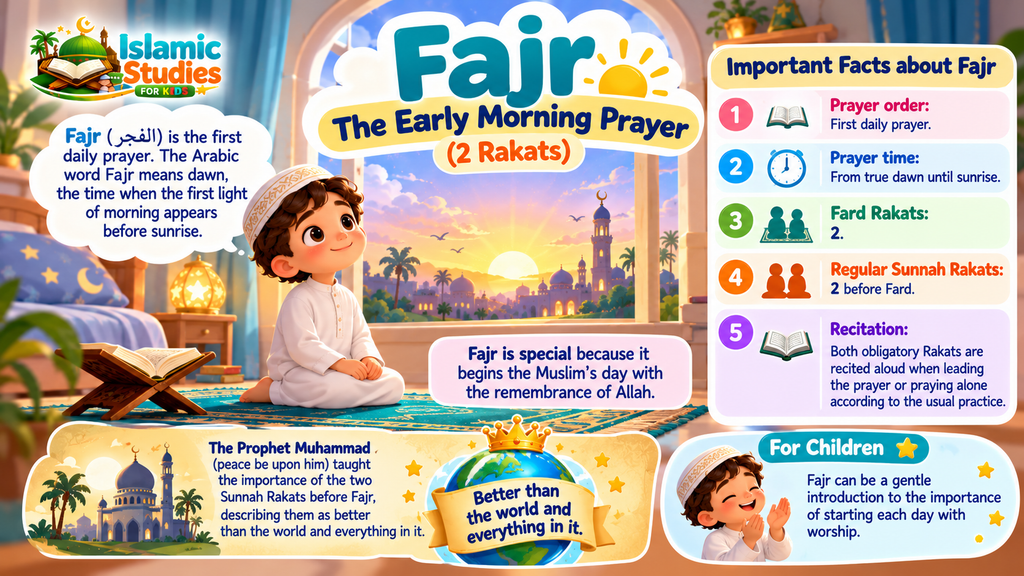
Muslims perform Fajr between true dawn and sunrise. It includes 2 obligatory Rakats, along with 2 Sunnah Rakats prayed before the Fard prayer.
Fajr is special because it begins the Muslim’s day with the remembrance of Allah. For children, it can be a gentle introduction to the importance of starting each day with worship.
Important facts about Fajr:
- Prayer order: First daily prayer.
- Prayer time: From true dawn until sunrise.
- Fard Rakats: 2.
- Regular Sunnah Rakats: 2 before Fard.
- Recitation: Both obligatory Rakats are recited aloud when leading the prayer or praying alone according to the usual practice.
The Prophet Muhammad (peace be upon him) taught the importance of the two Sunnah Rakats before Fajr, describing them as better than the world and everything in it.
2. Dhuhr – The Midday Prayer (4 Rakats)
Dhuhr (الظهر) is the second daily prayer. Its time begins after the sun passes its highest point in the sky and continues until Asr begins.
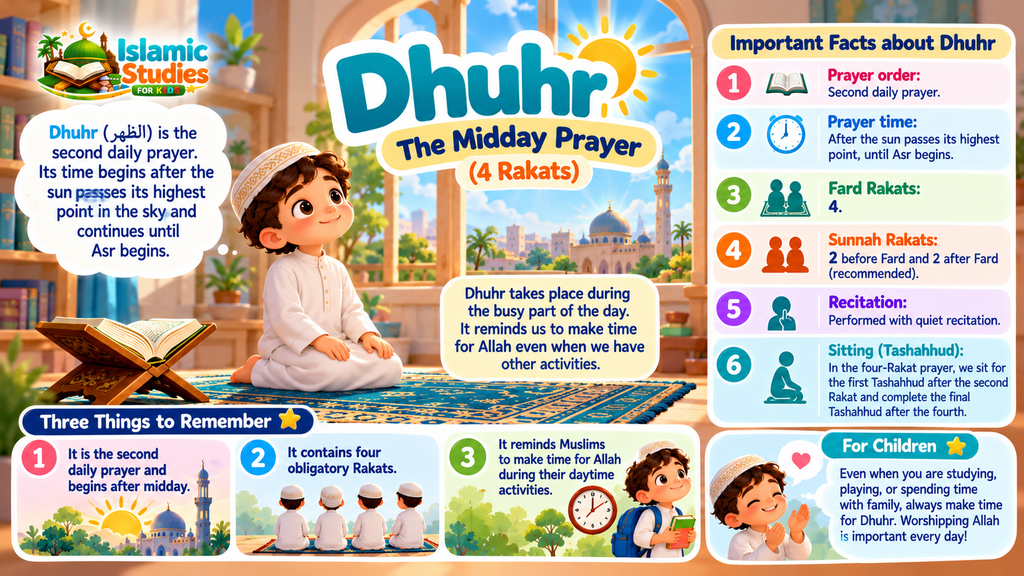
Dhuhr consists of 4 obligatory Rakats, performed with quiet recitation. Muslims also perform recommended Sunnah prayers before and after Dhuhr.
Unlike Fajr, which is performed before sunrise, Dhuhr takes place during the busy part of the day. Children may be studying, playing, or spending time with family when Dhuhr arrives.
This makes Dhuhr an opportunity to teach children that worship remains important even when they have other activities.
There are three important things children should understand about Dhuhr:
- It is the second daily prayer and begins after midday.
- It contains four obligatory Rakats.
- It reminds Muslims to make time for Allah during their daytime activities.
In the four-Rakat prayer, Muslims sit for the first Tashahhud after the second Rakat and complete the final Tashahhud after the fourth.
Salah is the second of the 5 Pillars of Islam. It teaches Muslims to remember and worship Allah throughout their day. Here are the five daily prayers explained simply for children.

3. Asr – The Afternoon Prayer (4 Rakats)
Asr (العصر) is the third of the five daily prayers. It is performed in the afternoon, after Dhuhr and before Maghrib.
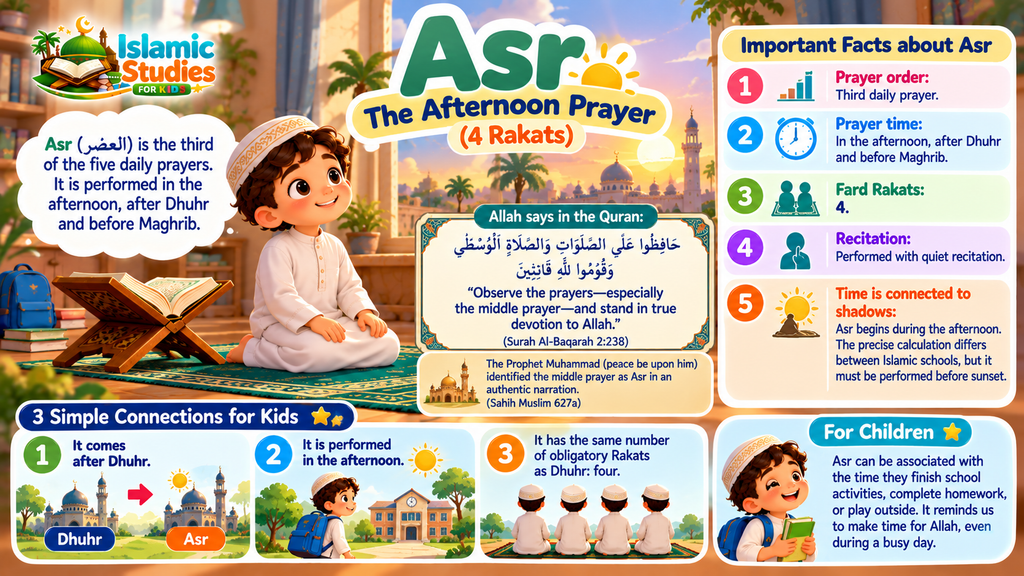
Asr contains 4 obligatory Rakats, just like Dhuhr, and is performed with quiet recitation.
Its starting time is connected to the length of shadows. The precise calculation differs between Islamic schools of thought, but Asr takes place during the afternoon and must be performed before sunset.
Asr has a special place in Islamic teachings. Allah says:
حَافِظُوا عَلَى الصَّلَوَاتِ وَالصَّلَاةِ الْوُسْطَىٰ وَقُومُوا لِلَّهِ قَانِتِينَ
“Observe the prayers—especially the middle prayer—and stand in true devotion to Allah.”
For children, Asr can be associated with the time they finish school activities, complete homework, or play outside.
They can remember Asr through these simple connections:
- It comes after Dhuhr.
- It is performed in the afternoon.
- It has the same number of obligatory Rakats as Dhuhr: four.
4. Maghrib – The Sunset Prayer (3 Rakats)
Maghrib (المغرب) is the fourth daily prayer. The Arabic name is associated with sunset and the western direction, where the sun disappears from view.
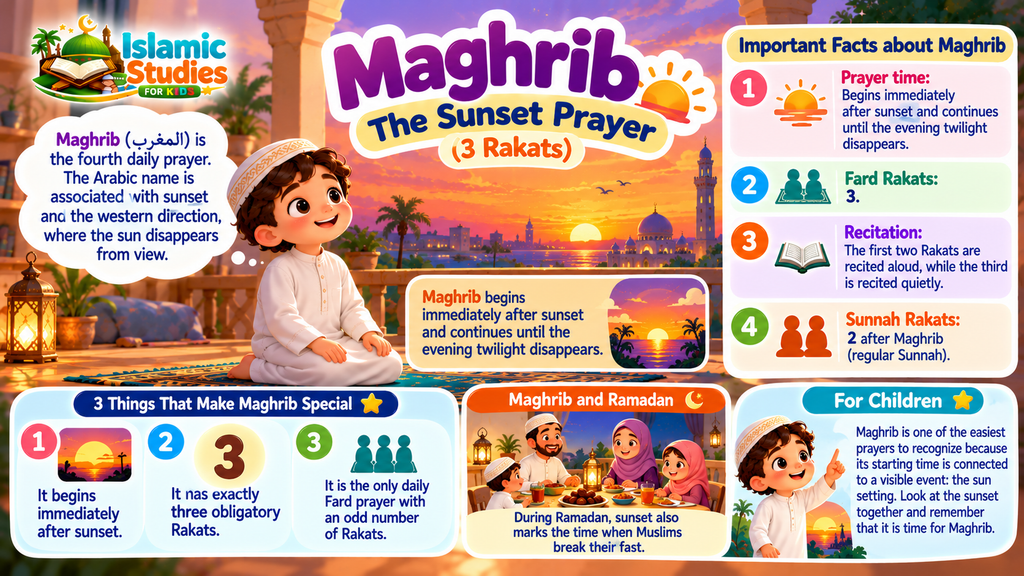
Maghrib begins immediately after sunset and continues until the evening twilight disappears. It consists of 3 obligatory Rakats, making it the only one of the five daily obligatory prayers with three Rakats. The first two Rakats are recited aloud, while the third is recited quietly. Muslims also perform two regular Sunnah Rakats after Maghrib.
Maghrib is one of the easiest prayers for children to recognize because its starting time is connected to a visible event: the sun setting.During Ramadan, sunset also marks the time when Muslims break their fast. This gives children another familiar way to remember Maghrib.
Maghrib is different from the other prayers in three ways:
- It begins immediately after sunset.
- It has exactly three obligatory Rakats.
- It is the only daily Fard prayer with an odd number of Rakats.
Parents can help children identify Maghrib by observing sunset together and explaining how it signals the beginning of prayer time.
5. Isha – The Night Prayer (4 Rakats)
Isha (العشاء) is the fifth and final obligatory prayer of the day. Its time begins after the evening twilight disappears.
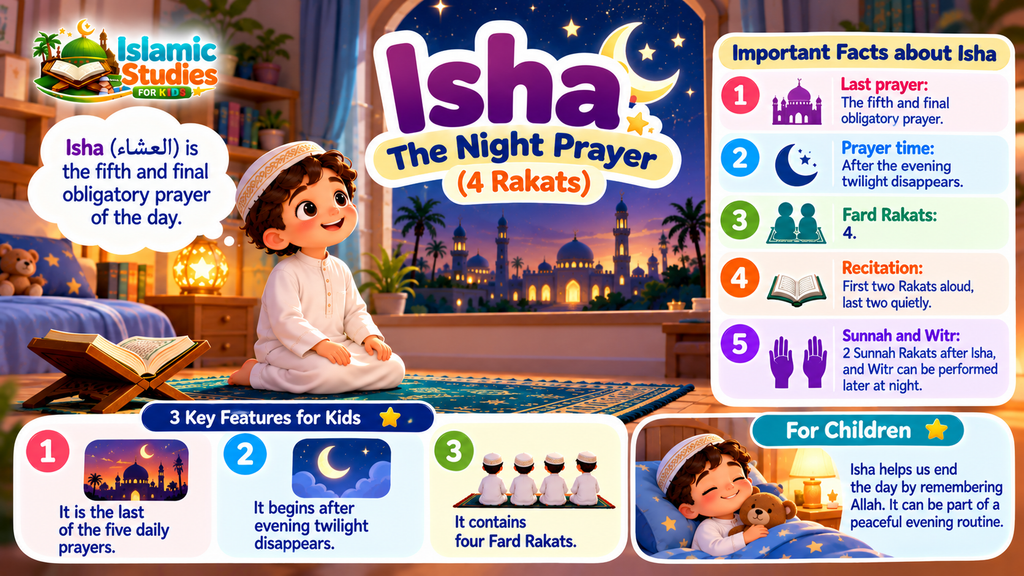
Isha contains 4 obligatory Rakats. The first two are recited aloud, while the final two are recited quietly. Muslims also perform two regular Sunnah Rakats after Isha, and Witr can be performed later during the night.
Isha teaches children that remembering Allah is important not only in the morning or afternoon but also at the end of the day. It can become part of a peaceful evening routine, helping children develop consistency in worship.
For children learning the daily Salah schedule, Isha has three key features:
- It is the last of the five obligatory daily prayers.
- It begins after evening twilight disappears.
- It contains four Fard Rakats.
The exact ending time of Isha is interpreted differently among Islamic scholars, so parents should follow a reliable local prayer timetable.
Experience a Real Classroom
Curious about how we teach? This video offers a glimpse into a real class, showcasing our interactive approach, qualified teachers, and child-friendly learning experience.
Fun & Engaging Islamic Classes for Kids
Start your child’s journey today with interactive lessons designed to make learning Islam loved and easy.
Get Your Child a Free Trial5 Daily Prayers Chart for Kids: Names, Times, and Rakats
This simple chart brings together the essential information children need to remember.
| Prayer | Arabic Name | Prayer Time | Fard Rakats |
| Fajr | الفجر | Dawn, before sunrise | 2 |
| Dhuhr | الظهر | After midday | 4 |
| Asr | العصر | Afternoon | 4 |
| Maghrib | المغرب | After sunset | 3 |
| Isha | العشاء | Night | 4 |
| Total | 5 prayers | Throughout the day | 17 |
Children can memorize the prayer names in this order:
Fajr → Dhuhr → Asr → Maghrib → Isha
And remember the obligatory Rakats with this number pattern:
2 → 4 → 4 → 3 → 4
This chart shows only the obligatory Rakats. Sunnah and voluntary prayers are explained below.
What Is the Difference Between Fard and Sunnah in the Five Daily Prayers?
When children start learning Salah, they may notice that their parents pray more Rakats than the 17 obligatory Rakats. This is because Muslims perform different types of prayers, including Fard, Sunnah, and Nafl.
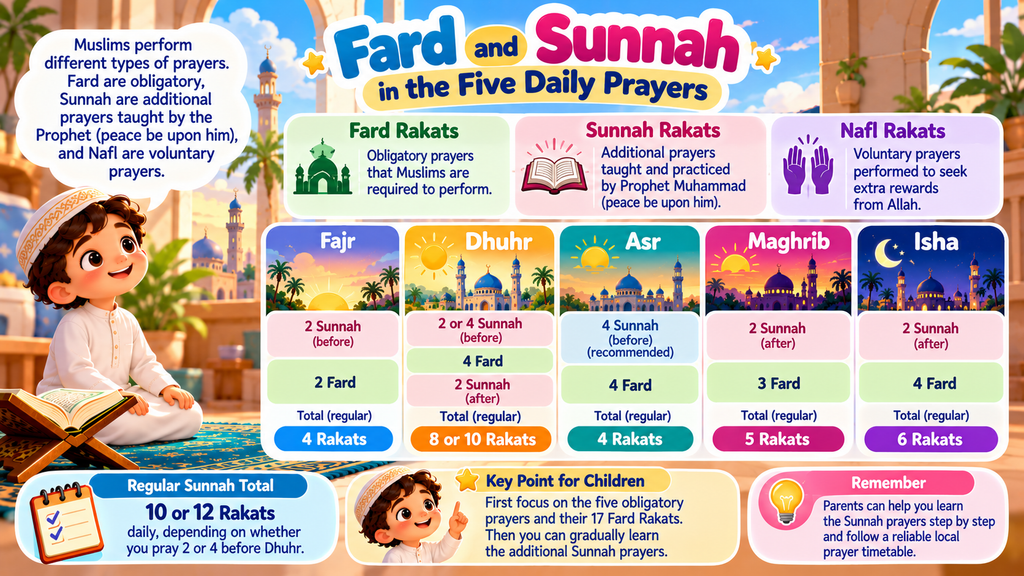
- Fard Rakats: Obligatory prayers that Muslims are required to perform.
- Sunnah Rakats: Additional prayers taught and practiced by Prophet Muhammad (peace be upon him).
- Nafl Rakats: Voluntary prayers performed to seek extra rewards from Allah.
How Many Sunnah Rakats Are There in the Five Daily Prayers?
The regular Sunnah prayers are performed before or after certain obligatory prayers:
- Fajr: 2 Sunnah Rakats before the 2 Fard Rakats.
- Dhuhr: 2 or 4 Sunnah Rakats before the 4 Fard Rakats, followed by 2 Sunnah Rakats afterward.
- Asr: 4 Rakats before Asr are recommended, but they are not part of the regular confirmed Sunnah prayers.
- Maghrib: 2 Sunnah Rakats after the 3 Fard Rakats.
- Isha: 2 Sunnah Rakats after the 4 Fard Rakats.
The regular Sunnah prayers commonly total 10 or 12 Rakats daily, depending on whether two or four are performed before Dhuhr. Other voluntary prayers can also be performed.
Children should first focus on remembering the five obligatory prayers and their 17 Fard Rakats. Once they become familiar with these, they can gradually learn the additional Sunnah prayers.
How Are the Five Daily Prayer Times Determined?
The five daily Salah times follow the position of the sun rather than fixed clock hours. Allah says:
إِنَّ الصَّلَاةَ كَانَتْ عَلَى الْمُؤْمِنِينَ كِتَابًا مَّوْقُوتًا
“Indeed, performing prayers is a duty on the believers at the appointed times.” (Surah An-Nisa 4:103)
The main natural signs are dawn, the sun passing its highest point, afternoon shadow lengths, sunset, and the disappearance of evening twilight.
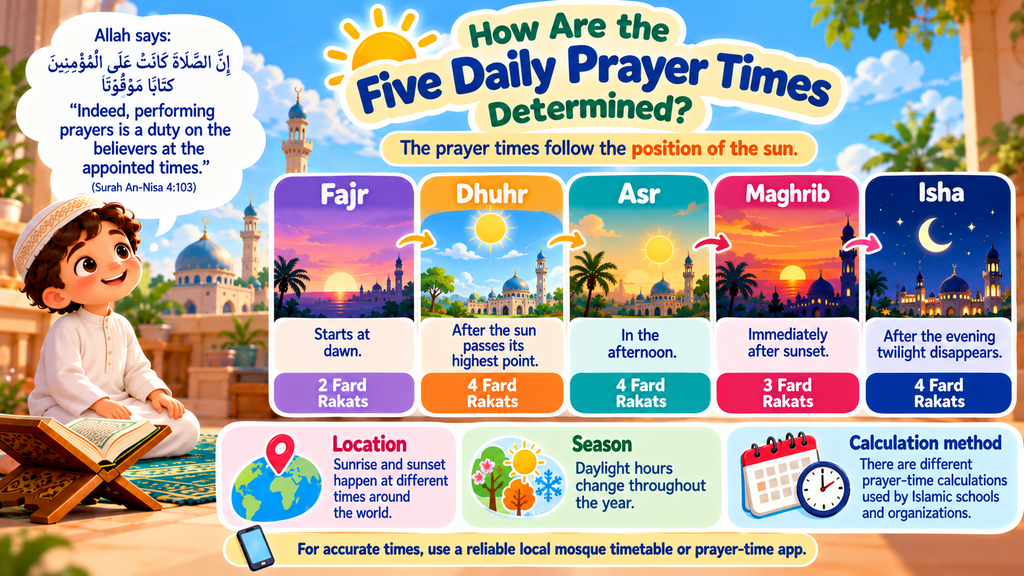
The exact clock times change because of:
- Location: Sunrise and sunset happen at different times around the world.
- Season: Daylight hours change throughout the year.
- Calculation method: Some prayer-time calculations differ between Islamic schools and organizations.
For accurate times, parents should use a reliable local mosque timetable or prayer-time app. Children should first understand the general link between Salah and the sun before trying to memorize specific clock times.
How to Perform the Five Daily Prayers: Basic Steps for Kids?
Although the five prayers have different numbers of Rakats, they share the same basic movements. Prophet Muhammad (peace be upon him) said:
صَلُّوا كَمَا رَأَيْتُمُونِي أُصَلِّي
“Pray as you have seen me praying.” (Sahih Al-Bukhari 631)
Here is a simple overview of the prayer sequence. These steps help children become familiar with Salah and understand what happens during each Rakat.
Step 1: Prepare with Wudu and Face the Qiblah
Before praying, children should perform Wudu, wear appropriate clothing, and face the Qiblah, the direction of the Kaaba in Makkah. The intention to pray is made in the heart.
Parents can teach children how to perform Wudu step by step and explain why cleanliness is important before Salah. Creating a quiet, clean prayer space at home can also help children prepare for worship. Younger children may need reminders and guidance until they become comfortable with these preparations.
Step 2: Begin with Takbir and Quran Recitation
Stand and say “Allahu Akbar” to begin the prayer. Recite Surah Al-Fatihah and, in the first two Rakats, another passage from the Quran.
Children can begin by memorizing Surah Al-Fatihah and a few short Surahs, such as Surah Al-Ikhlas or Surah Al-Kawthar. Parents can practice the verses with them outside prayer time to help improve pronunciation and memorization. Learning the meanings of simple Quranic phrases can also help children understand what they are reciting.
Step 3: Perform Ruku and Stand Again
Bow with your hands on your knees and say “Subhana Rabbiyal-Azeem.” Then rise to standing, saying “Sami’ Allahu liman hamidah,” followed by “Rabbana wa lakal-hamd.”
Ruku teaches children to show humility and respect before Allah. Parents can demonstrate the correct bowing position and encourage children to perform each movement calmly. Practicing the Arabic phrases separately can make it easier for beginners to remember what to say during Salah.
Step 4: Perform Two Sujoods
Prostrate and say “Subhana Rabbiyal-A’la.” Sit briefly between the two prostrations, then perform the second Sujood. These movements complete one Rakat.
Sujood is a special part of Salah in which Muslims show humility and submission to Allah. Children should learn to place their forehead, nose, hands, knees, and toes on the ground during prostration. Parents can explain that Sujood is a beautiful moment of worship and teach children to move gently between each position.
Step 5: Complete the Rakats and End with Tasleem
Repeat the movements until all the required Rakats are completed. In three- and four-Rakat prayers, sit for the first Tashahhud after the second Rakat. After the final Rakat, recite the final Tashahhud and end the prayer with Tasleem.
Children can learn the full sequence, recitations, and correct movements through guided Salah lessons for kids.

Why Are the Five Daily Prayers Important for Muslim Kids?
Salah is one of the most important acts of worship in Islam. It helps Muslims remember Allah and strengthens their connection with Him throughout the day. For children, it brings several meaningful benefits.
Salah Helps Children Remember Allah
The five prayers create regular moments to remember Allah from morning until night. Whether children are starting their day with Fajr or ending it with Isha, Salah reminds them that Allah is always aware of them and hears their prayers. Over time, these moments can help children develop a stronger awareness of Allah in their everyday lives.
Salah Teaches Gratitude
Children learn to praise Allah and appreciate His blessings, such as family, health, food, and safety. Through Salah, they begin to understand that everything good in their lives comes from Allah. Parents can encourage this understanding by asking children to name a blessing they are thankful for after prayer.
Salah Encourages Responsibility
Recognizing prayer times and preparing for worship helps children build consistency and responsibility. Simple habits, such as making Wudu, keeping a prayer mat ready, and learning when each Salah begins, teach children the importance of preparation and commitment. With gentle guidance from parents, these routines can gradually become a natural part of their day.
Salah Connects Belief with Worship
Salah shows children how Islamic beliefs shape daily actions. When children pray, they practice expressing their love for Allah, trusting Him, and following His guidance. This helps them understand that Islam is not only about what Muslims believe but also about how they live and worship.
Parents can build on this understanding by introducing the 6 Pillars of Iman, which explain the essential beliefs of Islam. Learning about these pillars alongside Salah helps children see the connection between faith, worship, and everyday behavior.

5 Easy Ways to Help Kids Memorize Their Daily Prayers
Memorizing the five prayers becomes easier when parents connect learning to familiar activities. Simple games, visual reminders, and daily practice can help children remember prayer names, times, and Rakats without feeling overwhelmed. Here are five practical ways to make learning Salah enjoyable and meaningful.
1. Display a Colorful Prayer Chart
Print or draw a chart showing Fajr, Dhuhr, Asr, Maghrib, and Isha, with the number of Rakats next to each. Encourage your child to review it daily.
Use different colors or simple pictures to represent each prayer. For example, a sunrise illustration can help children remember Fajr, while a moon and stars can represent Isha. Place the chart somewhere visible, such as a bedroom wall or study area. Parents can also let children add a sticker whenever they correctly identify a prayer or complete their daily learning activity.
2. Connect Each Prayer to the Time of Day
Fajr is before sunrise, Dhuhr is after midday, Asr is in the afternoon, Maghrib begins at sunset, and Isha is at night. This helps children understand the order instead of just memorizing unfamiliar names.
Parents can connect each Salah to familiar daily activities, such as waking up, returning from school, or preparing for bedtime. For example, children might associate Fajr with the early morning sky and Maghrib with the sun setting. These simple connections make the five daily prayer times easier to recognize and remember.
3. Practice with Simple Questions
Ask questions such as:
- Which prayer comes first?
- Which prayer begins at sunset?
- Which prayer has three Rakats?
- What is the last prayer of the day?
- Which prayers have four Rakats?
Children can answer out loud or point to the right prayer on the chart.
Turn these questions into a short family quiz or matching game. Parents can prepare cards with prayer names on one side and the number of obligatory Rakats on the other. Younger children can match pictures to prayer names, while older children can answer without looking at the chart. Keep the activity short and encouraging so children enjoy reviewing what they have learned.
4. Invite Children to Watch Family Prayers
Young children learn by watching adults. Let your child observe Salah and gradually practice standing, bowing, and prostrating with you.
Praying together gives children an opportunity to become familiar with the movements and sequence of Salah. Parents can demonstrate each position and explain its meaning in simple words. After prayer, encourage children to ask questions about unfamiliar movements or recitations. This supportive environment helps them develop confidence as they learn to perform Salah.
5. Build a Gentle Daily Routine
Encourage your child to recognize prayer times and join in according to their age and ability. Avoid overwhelming them with too many recitations or rules at once; a gradual approach makes Salah easier to understand and practice.
Start with small, achievable learning goals, such as remembering the names of all five prayers or identifying their correct order. As children become more comfortable, introduce the number of obligatory Rakats and basic Salah recitations. Parents can use a simple prayer tracker to celebrate progress and encourage consistency. Positive reinforcement, patience, and regular practice can help children develop a lasting connection with Salah.
At What Age Should Children Start Learning the Five Daily Prayers?
Children can begin learning prayer names and watching Salah before they are old enough to perform it independently. Prophet Muhammad (peace be upon him) instructed parents to teach their children to pray from the age of seven.
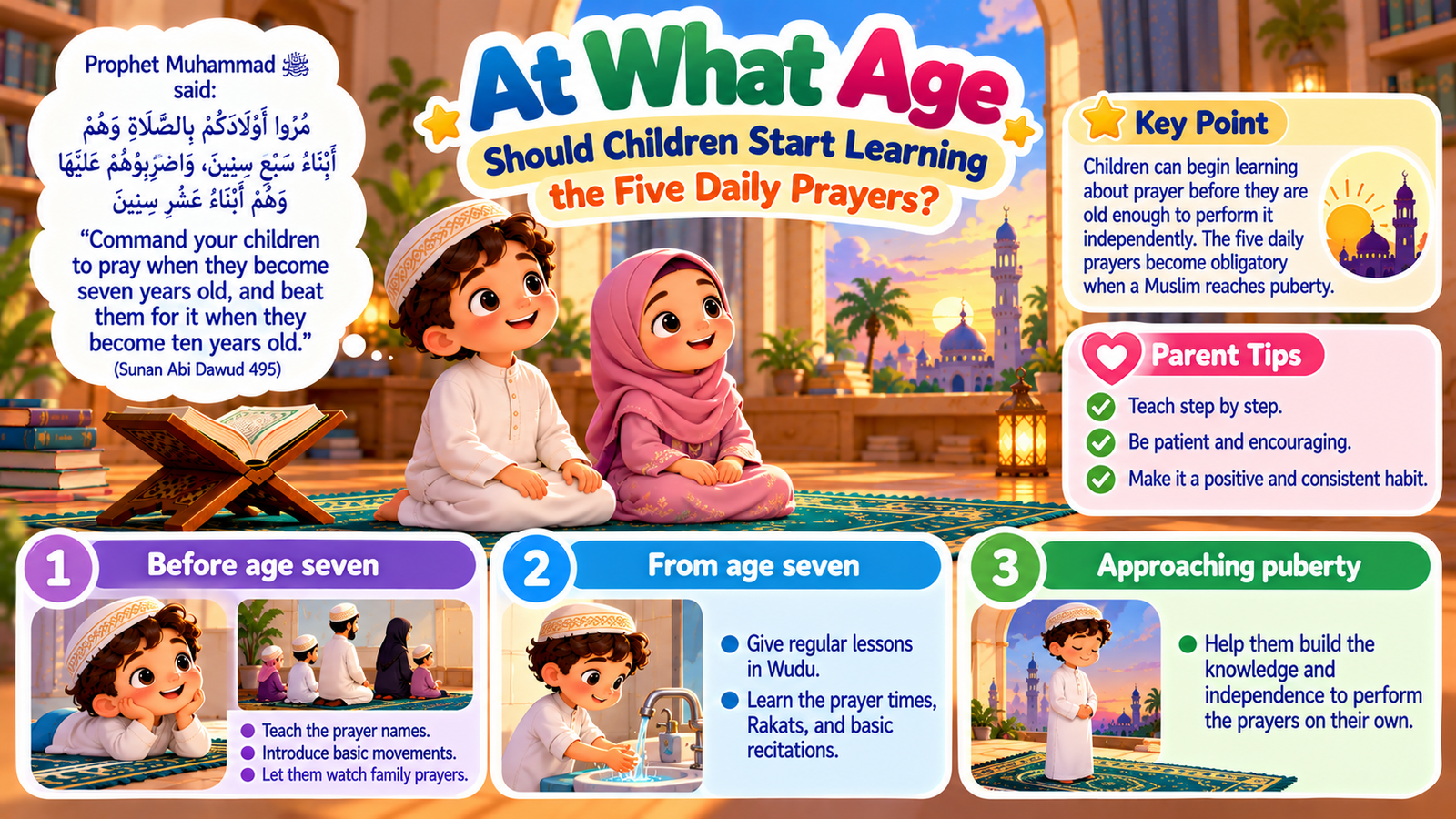
The Prophet Muhammad ﷺ said:
مُرُوا أَوْلَادَكُمْ بِالصَّلَاةِ وَهُمْ أَبْنَاءُ سَبْعِ سِنِينَ، وَاضْرِبُوهُمْ عَلَيْهَا وَهُمْ أَبْنَاءُ عَشْرِ سِنِينَ، وَفَرِّقُوا بَيْنَهُمْ فِي الْمَضَاجِعِ
“Command your children to pray when they become seven years old, and beat them for it when they become ten years old; and arrange their beds separately.”
Parents can introduce Salah step by step:
- Before age seven: Teach the prayer names, introduce basic movements, and let children watch family prayers.
- From age seven: Give regular lessons in Wudu, prayer times, Rakats, and essential recitations.
- Approaching puberty: Help them develop the knowledge and independence to perform the obligatory prayers on their own.
The five daily prayers become obligatory when a Muslim reaches puberty and becomes religiously accountable. Until then, parents should focus on patient instruction, consistent practice, and gentle encouragement, without harshness or harm.
Watch a Sample Lesson from Our Academy
Get a firsthand look at how our students learn Islamic values, Quran, and essential knowledge through engaging and interactive online classes. See why families trust Islamic Studies for Kids Academy.
Fun & Engaging Islamic Classes for Kids
Start your child’s journey today with interactive lessons designed to make learning Islam loved and easy.
Get Your Child a Free TrialHelp Your Child Build a Stronger Connection with Allah at Islamic Studies for Kids Academy
Learning the five daily prayers is an important first step, but helping your child understand Salah, remember its movements, and develop a genuine love for worship requires patience and proper guidance. As a parent, you want your child to grow up knowing not only how to pray, but also why Salah matters and how it strengthens their connection with Allah.
At Islamic Studies for Kids Academy, we make Islamic learning engaging, simple, and meaningful for children. Through age-appropriate lessons and supportive teachers, we help young Muslims build a strong foundation in Salah, understand essential Islamic teachings, and develop confidence in practicing their faith.
Give your child the opportunity to learn Islam with confidence and love. Book a free trial lesson today and take the first step toward a meaningful Islamic learning journey!
Our Islamic Studies Courses for Kids:
- Quran Course for Kids
- Noorani Qaida Course for Kids
- Quran Recitation Course for Kids
- Tajweed Course for Kids
- Quran Memorization (Hifz) Course for Kids
- Quran Course for Toddlers
- Quranic Arabic Course for Kids
- Quran Stories Course for Kids

Conclusion
Learning the 5 daily prayers for kids begins with understanding Fajr, Dhuhr, Asr, Maghrib, and Isha. Each prayer has its own time and number of Rakats, helping children recognize how Salah fits into everyday Muslim life. Once they remember these basics, they can gradually learn the movements, recitations, and differences between Fard and Sunnah prayers.
Parents play an important role in making this journey easier. Simple prayer charts, daily reminders, and practicing Salah together can help children remember what they learn without feeling overwhelmed. The goal is to build understanding and confidence through patience and consistency.
Most importantly, Salah is more than a daily routine. It is a way to remember Allah, express gratitude, and strengthen faith. By learning the five daily prayers from an early age, children can develop meaningful worship habits that stay with them as they grow.
Frequently Asked Questions About the 5 Daily Prayers for Kids
What are the names of the five daily prayers in order?
Fajr, Dhuhr, Asr, Maghrib, and Isha. Muslims perform them in this order from dawn until night.
How many Rakats are in each of the five daily prayers?
Fajr has 2 obligatory Rakats, Dhuhr has 4, Asr has 4, Maghrib has 3, and Isha has 4, for a total of 17 daily.
What is the difference between Maghrib and Isha?
Maghrib begins right after sunset and has three obligatory Rakats. Isha begins after evening twilight disappears and has four.
Do the five daily prayers have the same times everywhere?
No. Prayer times vary by date, location, and calculation method. Muslims should follow a reliable local timetable.
Is Jumu’ah one of the five daily prayers?
Jumu’ah is the congregational Friday prayer. It replaces Dhuhr for Muslims who are required to attend it and consists of two obligatory Rakats after the Friday sermon.
Do children have to pray five times every day?
The five prayers become obligatory at puberty. Before that, children are taught and encouraged to pray so they can build the knowledge and habits they’ll need.
What should children learn after memorizing the five daily prayers?
Next, they can learn Wudu, the Qiblah, Surah Al-Fatihah, the prayer movements, Tashahhud, and other essential recitations.



Leave a Reply