 Islamic Studies
Allah is above everything He created, and nothing is like Him. He is not inside anything He made, yet He is always close to us: He hears us, sees us, and knows everything we do. If your child just asked “Where is Allah?”, you can say these words today. The rest of this guide shows you where they come from in the Quran and how to grow the answer as your child grows.
This question is a good sign. It means your child is thinking about their Creator. Islam welcomes questions, so never tell a child “Don’t ask that.” A warm, simple answer builds love for Allah. A scolding teaches them to stop asking. If your child is still learning who Allah is, start with our Islamic basics lessons for kids, then come back to this question.
Why children ask “Where is Allah?”
Young children understand the world through things they can see and touch. Everything they know has a place: Mama is in the kitchen, the toy is under the bed. So when they hear about Allah, the natural next question is “Where is He?”
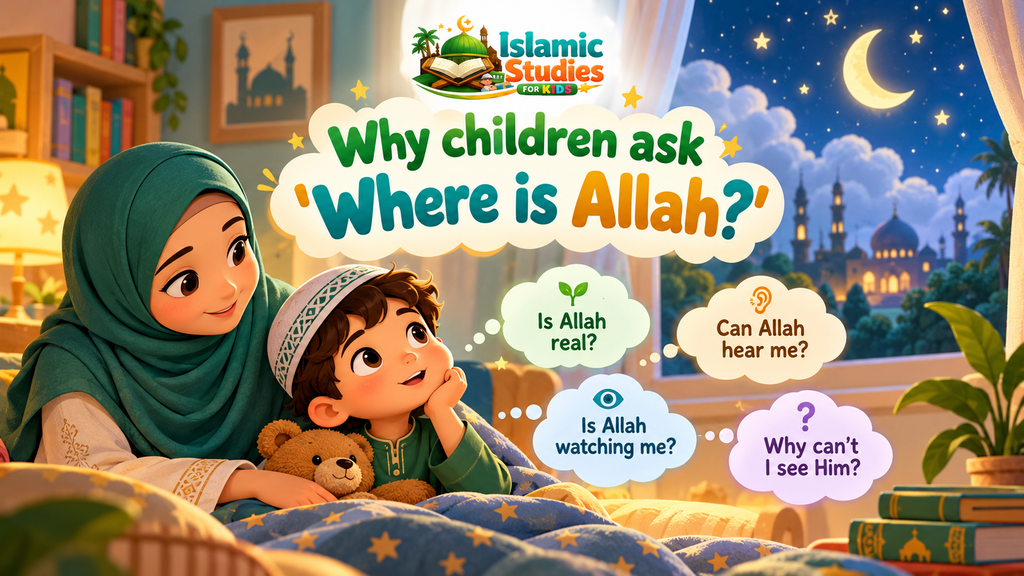
Behind the question there is usually a deeper one:
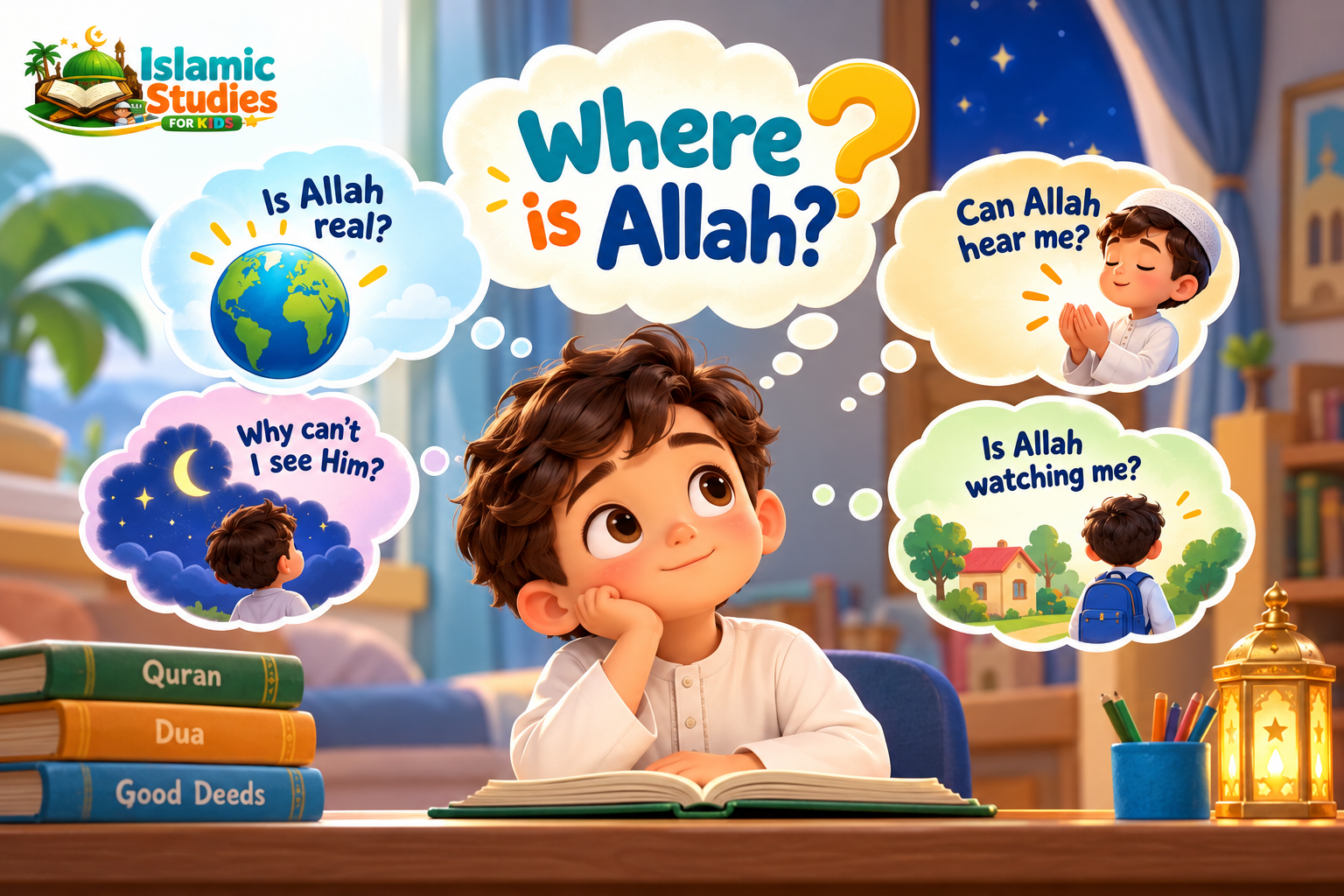
- “Is Allah real?” They want to know that the One they pray to truly exists.
- “Can Allah hear me?” They want to know their dua reaches Him.
- “Is Allah watching me?” Sometimes this comes from comfort, sometimes from worry about doing something wrong.
- “Why can’t I see Him?” They are trying to fit an unseen Creator into a world of seen things.
Listen for which one your child means. A child who asks at bedtime in the dark often needs reassurance more than theology. A child who asks after a science lesson may want a bigger answer about creation. The Quran-based answers below cover each of these.
Where is Allah according to the Quran?
The Quran gives children seven clear ideas. Teach them one at a time, each with its verse.
1. Allah is above everything
The Quran describes Allah as the Most High and the Most Great, emphasizing His absolute greatness above all creation.
وَهُوَ ٱلْعَلِيُّ ٱلْعَظِيمُ
“And He is the Most High, the Most Great.” (Al-Baqarah 2:255)
ٱلرَّحْمَٰنُ عَلَى ٱلْعَرْشِ ٱسْتَوَىٰ
“The Most Merciful rose over the Throne.” (Taha 20:5)
Say to your child: “Allah is higher and greater than the sky, the stars, and everything He made.”
2. Nothing is like Allah
The Quran teaches that Allah is unique and cannot be compared to anything in His creation.
لَيْسَ كَمِثْلِهِۦ شَىْءٌ ۖ وَهُوَ ٱلسَّمِيعُ ٱلْبَصِيرُ
“There is nothing like Him, and He is the All-Hearing, the All-Seeing.” (Ash-Shura 42:11)
Say to your child: “Allah is not like people, animals, or anything we can picture. He is much greater.”
3. Allah is close to us
Allah reassures believers that He is near and responds when they sincerely call upon Him.
وَإِذَا سَأَلَكَ عِبَادِى عَنِّى فَإِنِّى قَرِيبٌ ۖ أُجِيبُ دَعْوَةَ ٱلدَّاعِ إِذَا دَعَانِ
“When My servants ask you about Me, I am near. I answer the call of the one who calls upon Me.” (Al-Baqarah 2:186)
Say to your child: “When you make dua, Allah hears you right away, even if you whisper.”
4. Allah knows everything
The Quran reminds us that Allah’s knowledge encompasses everything we do, wherever we may be.
وَهُوَ مَعَكُمْ أَيْنَ مَا كُنتُمْ ۚ وَٱللَّهُ بِمَا تَعْمَلُونَ بَصِيرٌ
“He is with you wherever you are, and Allah sees what you do.” (Al-Hadid 57:4)
Say to your child: “Allah sees you at school, at home, and in the dark. You are never alone.”
5. Allah is with His believers to protect them
When the Prophet (peace be upon him) and Abu Bakr hid in the cave of Thawr during the Hijrah, the enemies stood right at the entrance. Abu Bakr was afraid for the Prophet, and the Prophet calmed him:
إِذْ يَقُولُ لِصَٰحِبِهِۦ لَا تَحْزَنْ إِنَّ ٱللَّهَ مَعَنَا
“When he said to his companion, ‘Do not be sad. Indeed, Allah is with us.'” (At-Tawbah 9:40)
When Allah sent Musa and Harun (peace be upon them) to the cruel Pharaoh, they were scared. Allah told them:
قَالَ لَا تَخَافَآ ۖ إِنَّنِى مَعَكُمَآ أَسْمَعُ وَأَرَىٰ
“He said, ‘Do not fear. I am with you both; I hear and I see.'” (Taha 20:46)
Notice how Allah explains His being “with” them: He hears and He sees. This is the perfect answer for a frightened child. Say: “Allah is with you like He was with Musa. He hears you and sees you, and He takes care of you.”
6. Allah knows even our thoughts
Allah explains in Surah Qaf that His knowledge reaches even the thoughts and whispers hidden within a person’s heart.
وَلَقَدْ خَلَقْنَا ٱلْإِنسَٰنَ وَنَعْلَمُ مَا تُوَسْوِسُ بِهِۦ نَفْسُهُۥ ۖ وَنَحْنُ أَقْرَبُ إِلَيْهِ مِنْ حَبْلِ ٱلْوَرِيدِ
“We created the human being, and We know what his own soul whispers to him, and We are closer to him than his jugular vein.” (Qaf 50:16)
The jugular vein is the big vein in the neck. Let your child gently feel their pulse there. Then explain: “Allah knows what you’re thinking even before you say it. Nothing about you is hidden from Him.”
7. Our good words go up to Allah
The Quran teaches that sincere and good words ascend to Allah, highlighting the value of remembering Him and performing righteous deeds.
إِلَيْهِ يَصْعَدُ ٱلْكَلِمُ ٱلطَّيِّبُ وَٱلْعَمَلُ ٱلصَّٰلِحُ يَرْفَعُهُۥ
“To Him rise good words, and righteous deeds raise them up.” (Fatir 35:10)
Children love this picture. Say: “Every time you say SubhanAllah, Alhamdulillah, or a kind word, it goes up to Allah. And your good deeds help lift it higher.” It turns the question “Where is Allah?” into a reason to say good things.
Notice how these fit together. Allah is above His creation and not mixed into it. At the same time, nothing is hidden from Him, and He answers us when we call. Children don’t need to hold the whole picture at once. They need to feel two things: Allah is great, and Allah is near.
Surah Al-Ikhlas is the best summary to memorise together:
قُلْ هُوَ ٱللَّهُ أَحَدٌ ٱللَّهُ ٱلصَّمَدُ لَمْ يَلِدْ وَلَمْ يُولَدْ وَلَمْ يَكُن لَّهُۥ كُفُوًا أَحَدٌۢ
“Say: He is Allah, the One. Allah, the Self-Sufficient whom all need. He has no child, nor was He born. And there is none like Him.” (Al-Ikhlas 112:1-4)
Reading the stories of the prophets helps these ideas stick, so pair this lesson with our Quran stories for kids.

Names of Allah that answer “Where is Allah?”
Allah teaches us about Himself through His beautiful names. Six of them answer this question directly, and children can learn them one a week.
| Name | Meaning | Where it comes from | What it teaches your child |
| ٱلْأَعْلَىٰ Al-A’la | The Most High | Al-A’la 87:1 | Allah is higher than everything. |
| ٱلْعَلِيُّ Al-‘Aliyy | The Exalted | Al-Baqarah 2:255 | Allah is above all, in greatness and power. |
| ٱلْقَرِيبُ Al-Qarib | The Near | Hud 11:61 | Allah is close when you call Him. |
| ٱلسَّمِيعُ As-Sami’ | The All-Hearing | Ash-Shura 42:11 | Allah hears every word, even a whisper. |
| ٱلْبَصِيرُ Al-Basir | The All-Seeing | Ash-Shura 42:11 | Allah sees everything, even in the dark. |
| ٱلْمُحِيطُ Al-Muhit | The All-Encompassing | Fussilat 41:54 | Nothing is outside Allah’s knowledge and power. |
Your child already says one of these names many times a day. In every sujud of salah, Muslims say:
سُبْحَانَ رَبِّيَ الْأَعْلَى
“Glory be to my Lord, the Most High.” The Prophet (peace be upon him) said this in his sujud (Sahih Muslim 772),
and it comes from the verse:
سَبِّحِ ٱسْمَ رَبِّكَ ٱلْأَعْلَى
“Glorify the name of your Lord, the Most High.” (Al-A’la 87:1)
This is a beautiful lesson for children. When we put our heads on the floor, at our lowest point, we praise Allah as the Most High. Being humble before Allah is what raises us. For more on building faith step by step, see our Islamic basics for kids.
Can We See Allah?
We cannot see Allah in this life, but believers will see Him in the Hereafter. The Quran and Sunnah explain this in ways children can easily understand.
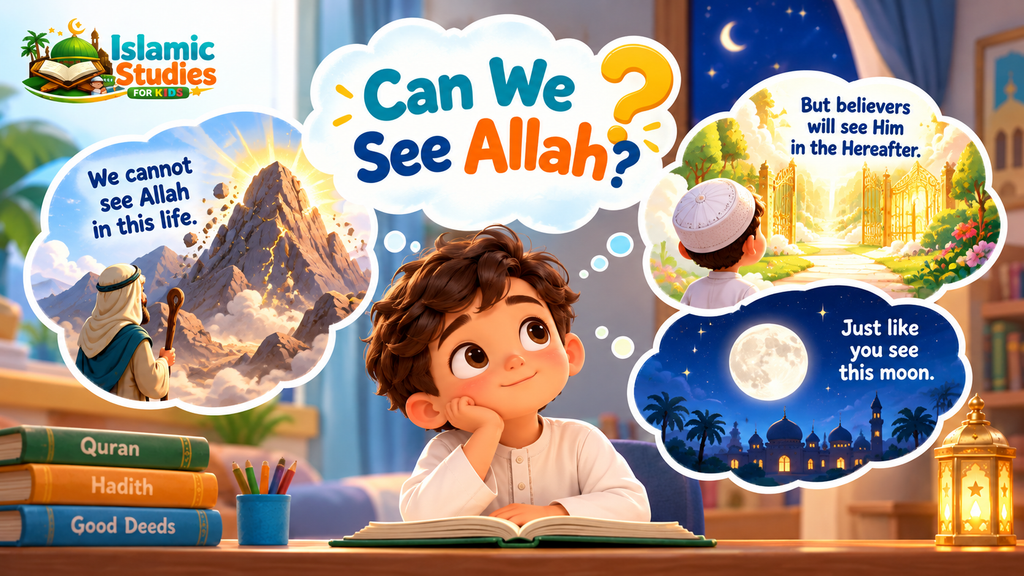
Prophet Musa (peace be upon him) asked Allah to let him see Him. Allah replied:
قَالَ لَن تَرَىٰنِى وَلَٰكِنِ ٱنظُرْ إِلَى ٱلْجَبَلِ
“You will not see Me, but look at the mountain.” (Al-A’raf 7:143)
When Allah revealed His glory to the mountain, it crumbled, and Musa fell unconscious. This teaches children that we cannot see Allah with our eyes in this life.
But believers have a wonderful promise. Allah says:
وُجُوهٌ يَوْمَئِذٍ نَّاضِرَةٌ إِلَىٰ رَبِّهَا نَاظِرَةٌ
“Some faces that Day will be shining, looking at their Lord.” (Al-Qiyamah 75:22–23)
The Prophet (peace be upon him) also said:
«إِنَّكُمْ سَتَرَوْنَ رَبَّكُمْ كَمَا تَرَوْنَ هَذَا الْقَمَرَ»
“You will see your Lord just as you see this moon.” (Sahih al-Bukhari 554)
The comparison describes how clearly believers will see Allah, not what Allah looks like.
Although we cannot see Allah now, He always sees us:
لَّا تُدْرِكُهُ ٱلْأَبْصَٰرُ وَهُوَ يُدْرِكُ ٱلْأَبْصَٰرَ
“No vision can grasp Him, but He grasps all vision.” (Al-An’am 6:103)
The Prophet (peace be upon him) taught us to worship Allah with Ihsan:
«أَنْ تَعْبُدَ اللَّهَ كَأَنَّكَ تَرَاهُ، فَإِنْ لَمْ تَكُنْ تَرَاهُ فَإِنَّهُ يَرَاكَ»
“Worship Allah as though you see Him, and if you do not see Him, He sees you.” (Sahih al-Bukhari 50)
Tell your child: “We cannot see Allah now, but He sees us, hears our prayers, and knows everything about us. We can see His beautiful creations, and believers will have the wonderful blessing of seeing Him in Jannah.”
Watch a Sample Lesson from Our Academy
Get a firsthand look at how our students learn Islamic values, Quran, and essential knowledge through engaging and interactive online classes. See why families trust Islamic Studies for Kids Academy.
Fun & Engaging Islamic Classes for Kids
Start your child’s journey today with interactive lessons designed to make learning Islam loved and easy.
Get Your Child a Free TrialHow to Answer “Where Is Allah for Kids?” Step by Step
When your child asks where Allah is, keep your answer simple, gentle, and reassuring.
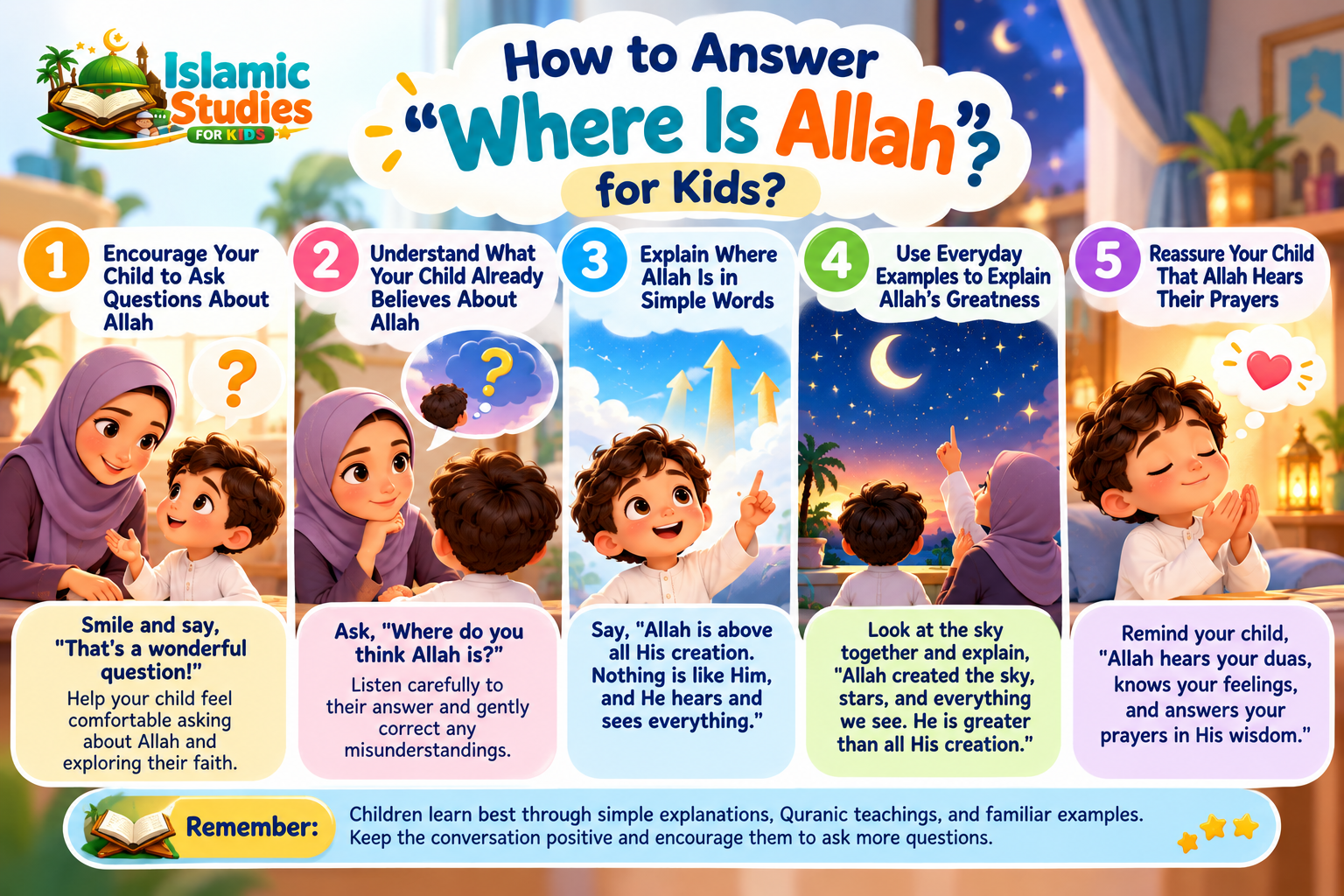
Follow these five steps:
1. Encourage Your Child to Ask Questions About Allah
Smile and say, “That’s a wonderful question!” Help your child feel comfortable asking about Allah and exploring their faith.
Create a welcoming environment where children can express their thoughts freely. Responding with patience and kindness helps them develop confidence in asking questions about Islam.
2. Understand What Your Child Already Believes About Allah
Ask, “Where do you think Allah is?” Listen carefully to their answer and gently correct any misunderstandings.Children may form ideas based on what they see or hear. Asking follow-up questions helps parents understand their child’s thinking and provide explanations that match their age.
3. Explain Where Allah Is in Simple Words
Say, “Allah is above all His creation. Nothing is like Him, and He hears and sees everything.”
Help children understand that Allah is not like people or anything in the created world. Use Surah Ash-Shura 42:11 to explain that nothing resembles Allah, while acknowledging that Islamic scholars have different approaches to explaining divine attributes.
4. Use Everyday Examples to Explain Allah’s Greatness
Look at the sky together and explain, “Allah created the sky, stars, and everything we see. He is greater than all His creation.”
Encourage children to observe nature, such as mountains, trees, and animals. These familiar examples can help them appreciate Allah’s power and reflect on the beauty of His creation.
5. Reassure Your Child That Allah Hears Their Prayers
Remind your child, “Allah hears your duas, knows your feelings, and answers your prayers in His wisdom.”
Explain that children can make dua whenever they need help, feel thankful, or want to ask Allah for something good. Refer to Surah Al-Baqarah 2:186 to show that Allah hears and responds to those who call upon Him.
Remember: Children learn best through simple explanations, Quranic teachings, and familiar examples. Keep the conversation positive and encourage them to ask more questions.
How to Explain Where Allah Is to Kids of Different Ages?
Children understand Allah’s greatness differently as they grow. Use age-appropriate explanations to make the answer simple and meaningful.
| Age Group | How to Explain Where Allah Is |
| Ages 3–5 | “Allah is above everything He created. He made the sky, stars, and the whole world. He always hears you when you make dua.” |
| Ages 6–8 | Teach Surah Al-Ikhlas and Ash-Shura 42:11. Explain that Allah is One, nothing is like Him, and He is not like people or anything He created. |
| Ages 9–12 | Read Al-Baqarah 2:255 and 2:186. Explain that Allah is above His creation, knows everything, and answers duas. Introduce His beautiful names, such as Al-‘Aliyy (the Most High) and Al-Qarib (the Near). |
Understanding Allah’s greatness and care helps children develop a stronger connection to their faith. Explore our Muslim identity for kids lessons to help your child grow in faith and confidence.

Common Questions Kids Ask About Allah
Children are naturally curious about Allah. Here are six common questions with simple answers supported by the Quran and Sunnah.
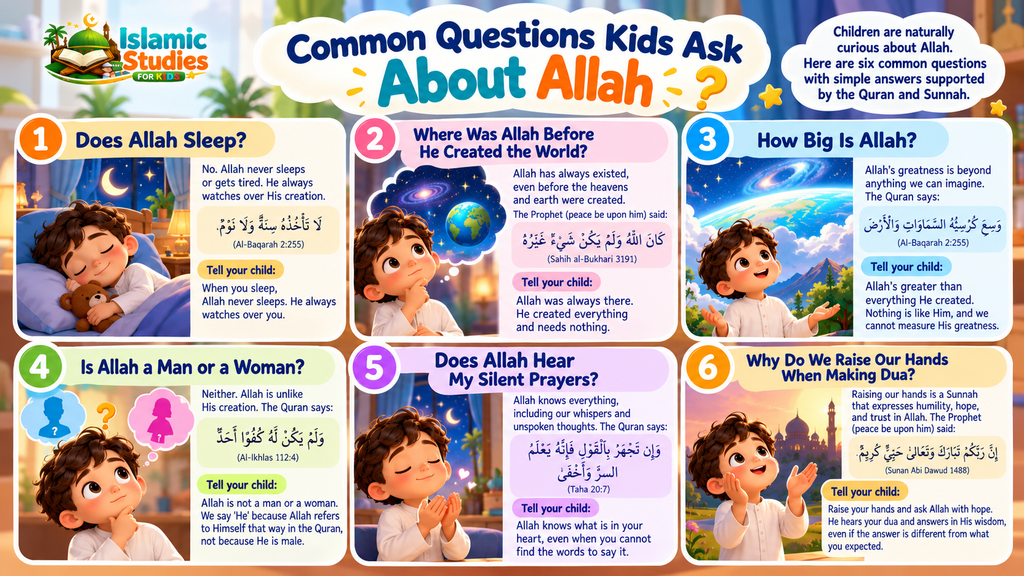
Does Allah Sleep?
No. Allah never sleeps or gets tired. He always watches over His creation. The Quran says:
لَا تَأْخُذُهُۥ سِنَةٌ وَلَا نَوْمٌ
“Neither drowsiness nor sleep overtakes Him.” (Al-Baqarah 2:255)
Tell your child: “When you sleep, Allah never sleeps. He always watches over you.”
Where Was Allah Before He Created the World?
Allah has always existed, even before the heavens and earth were created. The Prophet (peace be upon him) said:
«كَانَ اللَّهُ وَلَمْ يَكُنْ شَيْءٌ غَيْرُهُ»
“Allah existed, and there was nothing other than Him.” (Sahih al-Bukhari 3191)
Tell your child: “Allah was always there. He created everything and needs nothing.”
How Big Is Allah?
Allah’s greatness is beyond anything we can imagine. The Quran says:
وَسِعَ كُرْسِيُّهُ ٱلسَّمَٰوَٰتِ وَٱلْأَرْضَ
“His Kursi extends over the heavens and the earth.” (Al-Baqarah 2:255)
Tell your child: “Allah is greater than everything He created. Nothing is like Him, and we cannot measure His greatness.”
Is Allah a Man or a Woman?
Neither. Allah is unlike His creation. The Quran says:
وَلَمْ يَكُن لَّهُۥ كُفُوًا أَحَدٌۢ
“And there is none comparable to Him.” (Al-Ikhlas 112:4)
Tell your child: “Allah is not a man or a woman. We say ‘He’ because Allah refers to Himself that way in the Quran, not because He is male.”
Does Allah Hear My Silent Prayers?
Allah knows everything, including our whispers and unspoken thoughts. The Quran says:
وَإِن تَجْهَرْ بِٱلْقَوْلِ فَإِنَّهُۥ يَعْلَمُ ٱلسِّرَّ وَأَخْفَى
“Whether you speak aloud, He knows the secret and what is even more hidden.” (Taha 20:7)
Tell your child: “Allah knows what is in your heart, even when you cannot find the words to say it.”
Why Do We Raise Our Hands When Making Dua?
Raising our hands is a Sunnah that expresses humility, hope, and trust in Allah. The Prophet (peace be upon him) said:
«إِنَّ رَبَّكُمْ تَبَارَكَ وَتَعَالَى حَيِيٌّ كَرِيمٌ»
“Your Lord, Blessed and Exalted, is Shy and Generous.” (Sunan Abi Dawud 1488)
The hadith explains that Allah is too generous to turn away His servant’s raised hands empty.
Tell your child: “Raise your hands and ask Allah with hope. He hears your dua and answers in His wisdom, even if the answer is different from what you expected.”
Common Mistakes to Avoid When Explaining Allah to Kids
When answering questions about Allah, avoid explanations that may confuse or frighten children.
- Saying “Allah is everywhere.” Children may imagine Allah inside physical objects. Instead, explain: “Allah is above His creation, and His knowledge reaches everywhere.” This reflects a particular traditional interpretation of the Quranic verses.
- Drawing or imagining Allah’s appearance. Allah is unlike anything He created (Ash-Shura 42:11). Avoid pictures or comparisons that suggest what He looks like.
- Using Allah to frighten children. Instead of saying, “Allah will be angry with you,” teach children about His mercy, love, and forgiveness.
- Discouraging questions about Allah. Never dismiss a child’s curiosity. Give a simple answer or say, “Let’s learn about it together.”
The Prophet (peace be upon him) taught us about Allah’s mercy through the story of a mother who desperately searched for her baby. When she found him, she held him close. The Prophet said:
«لَلَّهُ أَرْحَمُ بِعِبَادِهِ مِنْ هَذِهِ بِوَلَدِهَا»
“Allah is more merciful to His servants than this mother is to her child.” (Sahih al-Bukhari 5999)
Remember: Help children understand Allah through His greatness, mercy, and care. Their questions should strengthen their love for Allah, not create fear or confusion.
Fun Activities to Teach Kids About Allah
Simple, hands-on activities help children understand Allah’s greatness, knowledge, and care while making learning enjoyable.
1. Explore the Sky to Understand Allah’s Greatness
Take your child outside at sunset or nighttime and look at the sky together. Ask:
- Who created the sky and stars?
- Who is greater than everything we see?
- Is anything like Allah?
Then make a short dua together: “O Allah, You are the Most High. Thank You for creating me.”
Learning goal: Help children recognize Allah’s greatness through His creation.
2. Teach Allah’s Greatness Through Sujud
Pray two rak’ahs together and explain that Subhana Rabbiyal A’la means “Glory be to my Lord, the Most High.”
After praying, ask: “What did we say about Allah during sujud?”
Learning goal: Connect Allah’s greatness with daily worship.
3. Create a Dua Jar to Build Trust in Allah
Ask your child to write or draw one dua each night and place it in a jar. Review the duas together regularly and discuss how Allah answers prayers in His wisdom, sometimes in unexpected ways.
Learning goal: Teach children that Allah hears every dua and knows what is best for them.
4. Play the “Allah Sees Everything” Game
During a walk, point to an ant, a bird, or a falling leaf. Take turns saying, “Allah created it, and Allah sees it.”
Learning goal: Help children understand that nothing is hidden from Allah.
5. Memorize a Hadith About Allah’s Protection
The Prophet (peace be upon him) taught young Abdullah ibn Abbas:
«يَا غُلَامُ، إِنِّي أُعَلِّمُكَ كَلِمَاتٍ: احْفَظِ اللَّهَ يَحْفَظْكَ، احْفَظِ اللَّهَ تَجِدْهُ تُجَاهَكَ»
“O young boy, I will teach you some words: Be mindful of Allah, and He will protect you. Be mindful of Allah, and you will find Him in front of you.” (Jami’ at-Tirmidhi 2516)
Explain that being mindful of Allah means obeying Him, remembering Him, and trusting His guidance.
Learning goal: Strengthen children’s faith and trust in Allah’s care.
Experience a Real Classroom
Curious about how we teach? This video offers a glimpse into a real class, showcasing our interactive approach, qualified teachers, and child-friendly learning experience.
Fun & Engaging Islamic Classes for Kids
Start your child’s journey today with interactive lessons designed to make learning Islam loved and easy.
Get Your Child a Free TrialHelp Your Child Build a Strong Islamic Foundation With Islamic Studies for Kids Academy
Every child’s journey toward understanding Allah begins with simple questions. At Islamic Studies for Kids Academy, we help children explore these questions through engaging Islamic education that makes learning about Allah, the Quran, and Islamic values meaningful and enjoyable.
Our approach focuses on helping children understand essential Islamic beliefs, develop a love for Allah, and connect what they learn to everyday life. From understanding where Allah is to discovering His beautiful names and attributes, children can gradually build their knowledge and confidence in their faith.
Whether your child is beginning to learn about Islam or looking to strengthen their existing knowledge, Islamic Studies for Kids Academy offers a supportive learning environment designed to encourage curiosity, understanding, and spiritual growth.
Give your child a meaningful start in Islamic education — Book a Free Trial Lesson Today!
Our Islamic Studies Courses Include:
- Islamic Studies Course for Kids
- Islam Basics Course for Kids
- 5 Pillars of Islam Course for Kids
- 6 Pillars of Iman (Faith) Course for Kids
- Salah (Prayer) Course for Kids
- Wudu Course for Kids
- Dua Course for Kids
- Ramadan Course for Kids
- Zakat & Sadaqah Course for Kids
- Hajj Course for Kids
- Aqeedah (Islamic Belief ) Course for Kids
Conclusion
Answering “Where is Allah for kids?” is an important step in helping children understand their Creator. The Quran teaches us about Allah’s greatness, His highness above creation, and His perfect knowledge of everything. Although we cannot see Allah in this life, He hears our prayers, knows our thoughts, and cares for us wherever we are.
Parents can make these teachings easier to understand through simple Quranic verses, stories of the prophets, and everyday activities. Encouraging children to ask questions about Allah helps develop curiosity, trust, and a deeper connection with their Islamic faith.
Most importantly, teaching children about Allah should inspire love, reassurance, and confidence rather than fear or confusion. With patience and age-appropriate explanations, parents can build a strong foundation of faith that continues to grow throughout their children’s lives.
Frequently Asked Questions About Where Allah Is for Kids
1. Where Is Allah in Islam for Kids?
Allah is above His creation, and nothing is like Him. The Quran describes Allah as the Most High (Al-Baqarah 2:255). Although we cannot see Him, He hears our prayers, knows our thoughts, and cares for us wherever we are.
2. Is Allah in the Sky or Above the Sky?
The Quran says that Allah rose over the Throne (Taha 20:5). In traditional Islamic explanations that affirm Allah’s highness, this means Allah is above His creation, not contained within the sky or anything He created. Children should understand that Allah is unlike anything in the universe.
3. Is Allah With Me Wherever I Go?
Yes. Allah says, “He is with you wherever you are” (Al-Hadid 57:4). Explain to children that Allah knows where they are, sees what they do, and hears their prayers. They can always turn to Him for guidance and comfort.
4. Can Allah Hear Me From Anywhere in the World?
Yes. Allah is As-Sami’, the All-Hearing. Whether a child makes dua at home, at school, or while travelling, Allah hears them. The Quran reminds us that Allah is near and responds to those who call upon Him (Al-Baqarah 2:186).
5. How Can I Know Allah Is Real If I Cannot See Him?
We learn about Allah through the Quran and the signs of His creation. The sky, stars, animals, and natural world encourage us to reflect on our Creator. The Quran invites us to consider the creation of the heavens and earth (Ali ‘Imran 3:190).
6. What Is the Easiest Way to Teach Kids Where Allah Is?
Start with a simple explanation: “Allah is above everything He created, nothing is like Him, and He hears and sees us.” Use Quranic verses, short stories, and everyday activities. Encourage questions and explain Allah’s greatness with kindness and patience.
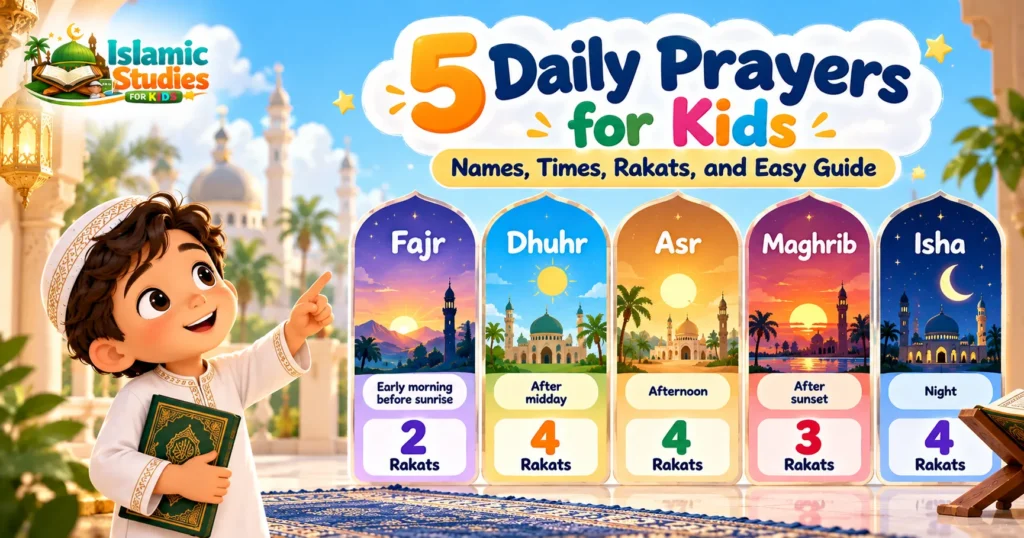


[…] and sight, while He is above His Throne. Children often ask about this topic, and this guide on where Allah is, explained for kids helps parents answer gently and […]
[…] His knowledge is with us wherever we are. Parents can explain this idea gently with our guide on where is Allah for kids, written in simple […]