 Islamic Studies
Belief in Allah for kids is the very first lesson in a child’s Islamic journey. It is the foundation that every other part of faith is built on, and it shapes how children understand the world, their blessings, and their purpose in life.
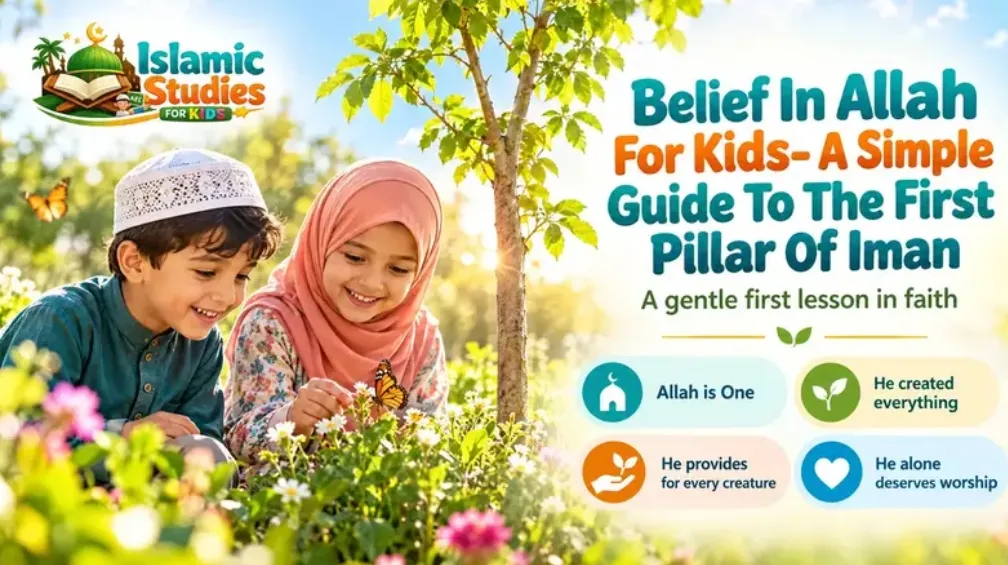
Iman billah for kids means helping children know that Allah is One, that He created everything, that He provides for every creature, and that He alone deserves to be worshipped. When this belief is taught with love and patience, it grows into a strong and lasting faith.
In this guide, parents and teachers will learn what the first pillar of Iman means, what the Quran and authentic Sunnah teach about it, and practical ways to teach believing in Allah to children at home.
Key Takeaways: What You Will Learn
- What belief in Allah (Iman billah) means, explained in simple words children can understand.
- Why belief in Allah is the first of the six pillars of Iman, based on the Hadith of Jibril.
- The core concepts every child should learn: Allah is One, the Creator, the Provider, and the only One worthy of worship.
- Practical, age-appropriate ways to plant love of Allah in a child’s heart.
- Common mistakes to avoid when teaching children about Allah.
What Is Belief in Allah for Kids?
Belief in Allah (in Arabic: al-Iman billah, الإيمان بالله) is the firm conviction that Allah exists, that He is One with no partner, that He is the Creator and Sustainer of everything, and that He alone deserves to be worshipped. It is the first and most important pillar of Iman (faith) in Islam.
For kids, belief in Allah can be explained in a few simple sentences: Allah made everything around us, Allah gives us everything we have, Allah loves us, Allah sees and hears us all the time, and we worship only Allah. These short ideas form the foundation of a child’s faith.
Teaching belief in Allah to children is more than sharing information. It means gently planting certainty, love, and trust in Allah in a child’s heart, using a style that matches the child’s age, curiosity, and understanding.
What Does Iman Mean in Islam?
Iman (إيمان) refers to having firm belief and certainty in the heart. In Islam, it means believing in six essential matters: Allah, His angels, His revealed books, His messengers, the Last Day, and Divine Decree (Al-Qadar), including both its good and its bad.
These six pillars are the foundation of a Muslim’s faith and form an important part of Islamic Aqeedah. Children can learn about these beliefs and understand their importance through Aqeedah lessons for kids.

Why Is Belief in Allah the First Pillar of Iman?
Belief in Allah is the first and most important pillar of Iman because it forms the foundation of all other Islamic beliefs. Muslims believe in the angels because Allah created them, in the revealed books because Allah sent them, and in the prophets because Allah chose them to deliver His messages.
In other words, belief in all the other pillars begins with believing in Allah and accepting His guidance. This is why Tawheed (belief in the oneness of Allah) is at the heart of Islamic faith and the starting point for understanding the remaining pillars of Iman.

The Hadith of Jibril: Evidence for the Pillars of Iman
The clearest evidence for the six pillars of Iman is the famous Hadith of Jibril. In this hadith, the angel Jibril (Gabriel) came in the form of a man and asked Prophet Muhammad ﷺ about Islam, Iman, and Ihsan, while the Companions sat and listened. Here is the part about Iman:
قَالَ: فَأَخْبِرْنِي عَنِ الإِيمَانِ.
قَالَ: «أَنْ تُؤْمِنَ بِاللَّهِ وَمَلاَئِكَتِهِ وَكُتُبِهِ وَرُسُلِهِ وَالْيَوْمِ الآخِرِ وَتُؤْمِنَ بِالْقَدَرِ خَيْرِهِ وَشَرِّهِ»
“He (the inquirer) said: Inform me about Iman (faith). He (the Holy Prophet) replied: That you affirm your faith in Allah, in His angels, in His Books, in His Apostles, in the Day of Judgment, and you affirm your faith in the Divine Decree about good and evil.”
Children can learn this hadith in simple words, and exploring authentic hadith lessons for children helps them connect these teachings directly to the Prophet ﷺ.

The Six Pillars of Iman Explained for Kids
Understanding the six pillars of Iman is essential for every Muslim child because they form the foundation of Islamic faith. Each pillar teaches children an important truth about Allah, His creation, and the unseen world.
The following table explains each pillar in simple words, making it easier for young learners to understand and remember.
| Pillar of Iman | Arabic | Simple Meaning for Kids |
|---|---|---|
| 1. Belief in Allah | الإيمان بالله | Allah is One, He created everything, and we worship only Him. |
| 2. Belief in the Angels | الإيمان بالملائكة | Allah created angels from light, and they always obey Him. |
| 3. Belief in the Books | الإيمان بالكتب | Allah sent books to guide people; the Quran is the final book. |
| 4. Belief in the Messengers | الإيمان بالرسل | Allah sent prophets to teach people; Muhammad ﷺ is the last. |
| 5. Belief in the Last Day | الإيمان باليوم الآخر | One day, everyone will be rewarded for what they did. |
| 6. Belief in Qadar | الإيمان بالقدر | Everything happens by Allah’s knowledge and will. |
Watch a Sample Lesson from Our Academy
Get a firsthand look at how our students learn Islamic values, Quran, and essential knowledge through engaging and interactive online classes. See why families trust Islamic Studies for Kids Academy.
Fun & Engaging Islamic Classes for Kids
Start your child’s journey today with interactive lessons designed to make learning Islam loved and easy.
Get Your Child a Free TrialWhat Is the Difference Between the Pillars of Islam and the Pillars of Iman?
The pillars of Islam are five outward acts of worship: the Shahadah, prayer (Salah), charity (Zakah), fasting in Ramadan, and Hajj. The pillars of Iman are six inner beliefs held in the heart. Kids can remember it simply: Islam is what we do, and Iman is what we believe.
A helpful picture for children is a building. The pillars of Islam are the visible columns, while the pillars of Iman are the strong foundation underneath. Children who first learn the basics of Islam for kids find it easier to see how belief and action fit together.

Why Should Children Learn Belief in Allah Early?
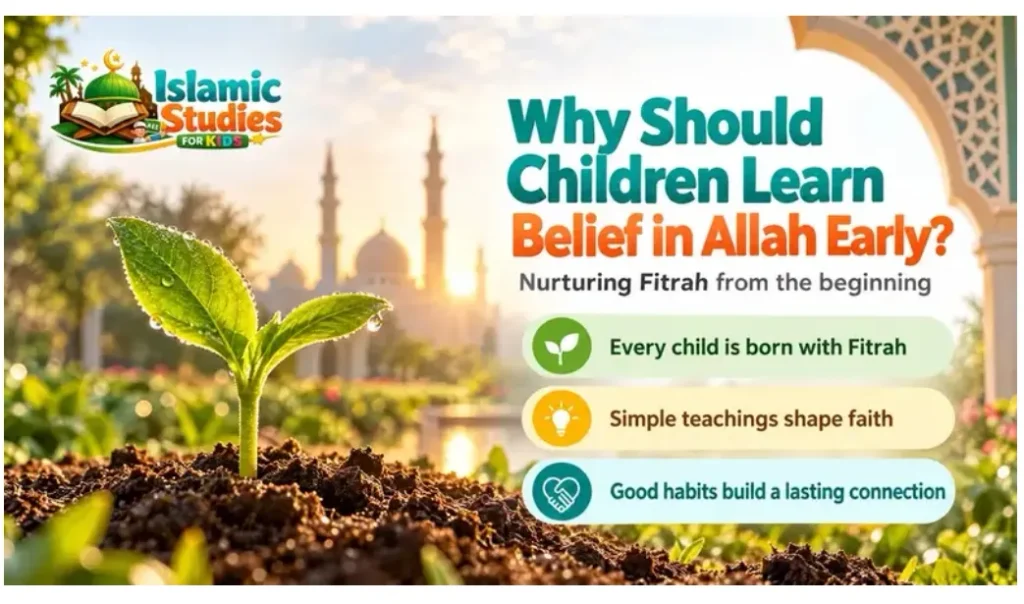
Islam teaches that every child is born with a natural inclination to believe in and recognize Allah, known as Fitrah (فطرة). This natural disposition gives children an initial foundation for developing their faith and understanding their Creator.
During the early years of childhood, parents and teachers play an important role in nurturing this Fitrah through simple Islamic teachings, good examples, and positive daily habits. By introducing children to Allah’s names, sharing stories from the Quran, and encouraging acts of worship and kindness, they can help children develop a strong and healthy connection with their faith as they grow.
«كُلُّ مَوْلُودٍ يُولَدُ عَلَى الْفِطْرَةِ، فَأَبَوَاهُ يُهَوِّدَانِهِ أَوْ يُنَصِّرَانِهِ أَوْ يُمَجِّسَانِهِ»
“Every child is born upon the Fitrah (the natural disposition), and then his parents make him a Jew, a Christian, or a Magian.”
Sahih al-Bukhari 1385 (excerpt)
Read Also: What Is Shirk For Kids? Meaning, Types, And How To Avoid It
What Should Kids Know About Allah?
Teaching children about belief in Allah begins with introducing a few simple and essential concepts that help them understand who Allah is and how to recognize His greatness. Parents and teachers can explain each concept using familiar examples from everyday life, age-appropriate stories, and verses from the Quran.
This gradual approach makes learning easier and helps children develop a deeper understanding of Tawheed (the oneness of Allah) while strengthening their faith from an early age.
Linking faith to action through good deeds lessons for kids helps children see that Iman lives in both the heart and in actions.

1. Allah Is One (Tawheed)
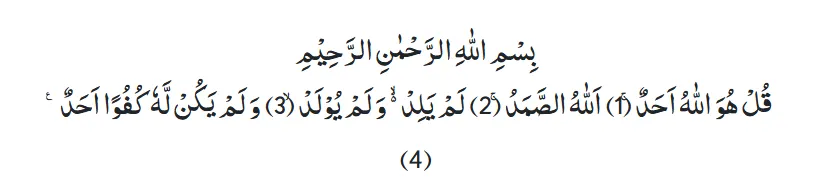
Tawheed (توحيد) means believing that Allah is One, with no partner, no equal, and nothing like Him. Tawheed is the heart of belief in Allah and the core message of every prophet. Surah Al-Ikhlas, which many children memorize early, summarizes Tawheed beautifully.
قُلْ هُوَ اللَّهُ أَحَدٌ ﴿١﴾ اللَّهُ الصَّمَدُ ﴿٢﴾ لَمْ يَلِدْ وَلَمْ يُولَدْ ﴿٣﴾ وَلَمْ يَكُن لَّهُ كُفُوًا أَحَدٌ ﴿٤﴾
“Say, “He is Allah, [who is] One, Allah, the Eternal Refuge. He neither begets nor is born, nor is there to Him any equivalent.””
Parents can read this simple explanation of Tawheed for kids for more ideas on teaching it.
2. Allah Is the Creator of Everything
Allah is Al-Khaliq (الخالق), meaning the Creator of everything. Everything children see around them, from the sun, moon, stars, trees, and flowers to animals, oceans, and even their own bodies, is created by Allah. He created the world with wisdom and perfect order, giving every living thing what it needs to grow and survive.
Nothing created itself, and nothing exists without Allah’s will. By observing the beauty and wonders of nature, children can recognize Allah’s greatness, appreciate His creation, and learn to thank Him for the countless blessings He has given them.
اللَّهُ خَالِقُ كُلِّ شَيْءٍ ۖ وَهُوَ عَلَىٰ كُلِّ شَيْءٍ وَكِيلٌ
“Allah is the Creator of all things, and He is, over all things, Disposer of affairs.”
3. Allah Is the Provider of Everything
Allah is Ar-Razzaq (الرزاق), meaning the Provider who gives sustenance to all His creation. He provides every living creature with food, water, and everything it needs to survive and grow. From the food we eat and the water we drink to the air we breathe, all these blessings come from Allah.
Parents can use simple daily moments, such as having breakfast or drinking a glass of water, to remind children that Allah provides for them and deserves their thanks. This helps children develop gratitude and recognize Allah’s kindness in the little things they experience every day.
وَمَا مِن دَابَّةٍ فِي الْأَرْضِ إِلَّا عَلَى اللَّهِ رِزْقُهَا
“And there is no creature on earth but that upon Allah is its provision.”
Surah Hud (11:6) — opening part of the verse
4. Allah Alone Deserves Worship
Because Allah is the only Creator and Provider, He is the only One worthy of worship. In Islam, worship means showing our love, gratitude, and obedience to Allah through our words and actions.
Children can worship Allah in many simple ways, such as performing Salah, making dua, remembering Him through dhikr, reading the Quran, and showing kindness to others.
The Quran teaches us that Allah created humans and jinn to worship Him, reminding us that worship is the main purpose of our existence.
وَمَا خَلَقْتُ الْجِنَّ وَالْإِنسَ إِلَّا لِيَعْبُدُونِ
“And I did not create the jinn and mankind except to worship Me.”
Teaching Kids the Beautiful Names of Allah
Al-Asma’ al-Husna (الأسماء الحسنى), meaning the Most Beautiful Names of Allah, are a wonderful way to help children learn about their Creator and understand His greatness. Each name teaches them about one of Allah’s perfect attributes, such as His mercy, knowledge, power, and kindness.
Parents can make these names easier to understand by connecting each one to familiar situations in children’s daily lives. For example, learning that Allah is Ar-Rahman (The Most Merciful) helps children recognize His mercy, while knowing that He is Ar-Razzaq (The Provider) teaches them to appreciate the blessings they receive every day.
| Name | Arabic | Meaning | Everyday Example |
|---|---|---|---|
| Al-Khaliq | الخالق | The Creator | Allah created the flowers in our garden. |
| Ar-Razzaq | الرزاق | The Provider | Allah gave us the food on our table. |
| Ar-Rahman | الرحمن | The Most Merciful | Allah’s mercy surrounds us every day. |
| As-Sami‘ | السميع | The All-Hearing | Allah hears every dua, even a whisper. |
| Al-Basir | البصير | The All-Seeing | Allah sees our good deeds, even when no one else does. |
How to Teach Kids That Allah Sees and Hears Them
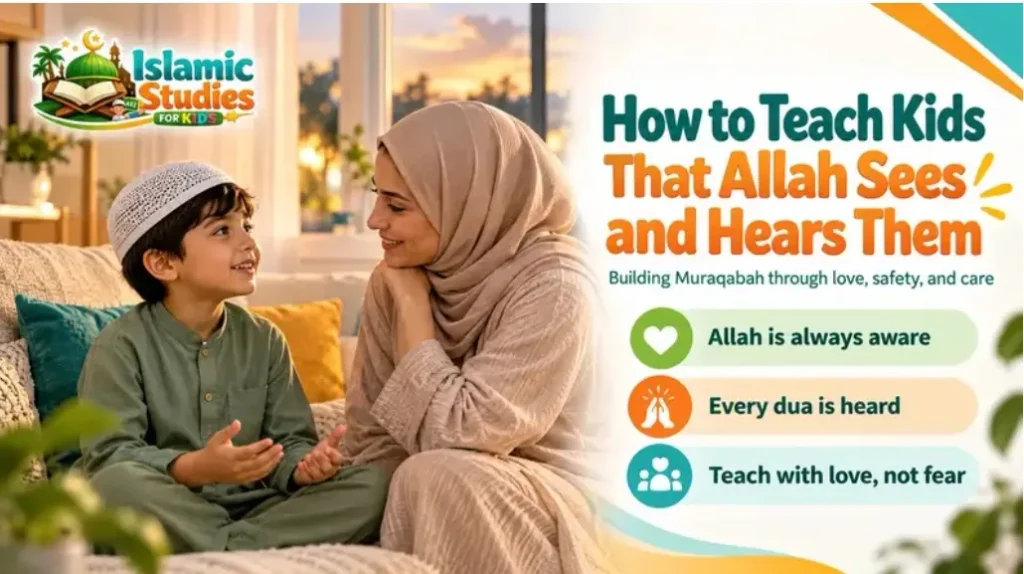
Teaching children that Allah sees and hears them builds Muraqabah (مراقبة), a constant awareness of Allah. The goal is for children to feel safe, loved, and cared for, knowing that Allah is always aware of them, rather than feeling watched or afraid.
وَهُوَ مَعَكُمْ أَيْنَ مَا كُنتُمْ ۚ وَاللَّهُ بِمَا تَعْمَلُونَ بَصِيرٌ
“And He is with you wherever you are. And Allah, of what you do, is Seeing.”
Surah Al-Hadid (57:4) — part of the verse
Scholars of Ahl al-Sunnah explain that Allah being “with us” means He is with us by His knowledge, hearing, and sight, while He is above His Throne. Children often ask about this topic, and this guide on where Allah is, explained for kids helps parents answer gently and correctly.
What Is Ihsan for Children?
Ihsan (إحسان) is the highest level of faith and worship in Islam. Prophet Muhammad ﷺ explained Ihsan as worshipping Allah as though you see Him, and even though you cannot see Him, knowing that He always sees you.
For children, this means trying to do good things, speak honestly, and make the right choices because they know Allah is aware of everything they do. Ihsan also teaches children to give their best effort in worship, studies, and daily activities, even when nobody is watching.
قَالَ: مَا الإِحْسَانُ؟ قَالَ: «أَنْ تَعْبُدَ اللَّهَ كَأَنَّكَ تَرَاهُ، فَإِنْ لَمْ تَكُنْ تَرَاهُ فَإِنَّهُ يَرَاكَ»
“Then he further asked, “What is Ihsan (perfection)?” Allah’s Messenger replied, “To worship Allah as if you see Him, and if you cannot achieve this state of devotion then you must consider that He is looking at you.””
Experience a Real Classroom
Curious about how we teach? This video offers a glimpse into a real class, showcasing our interactive approach, qualified teachers, and child-friendly learning experience.
Fun & Engaging Islamic Classes for Kids
Start your child’s journey today with interactive lessons designed to make learning Islam loved and easy.
Get Your Child a Free TrialPractical Ways to Teach Believing in Allah to Children
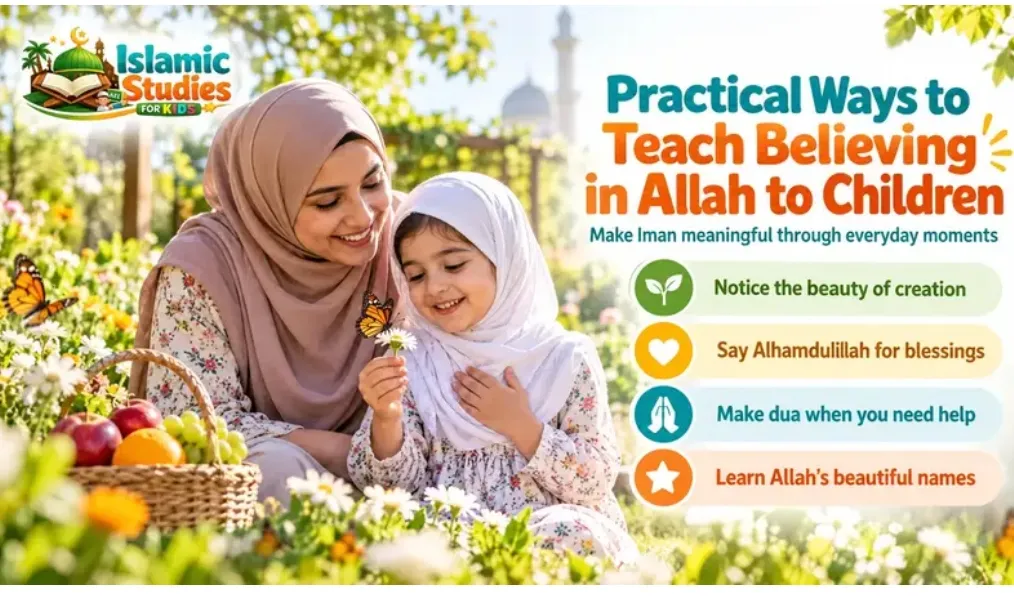
Children develop a strong belief in Allah through their everyday experiences, not just by attending lessons or memorizing Islamic information. Simple daily moments, such as noticing the beauty of nature, thanking Allah for His blessings, making dua when they need help, and learning about His beautiful names, can make Iman more meaningful to them.
Parents and teachers can use these opportunities to connect Islamic teachings with children’s daily lives and help them build a loving relationship with Allah.
The following methods offer practical educational ideas that Muslim families and teachers can use to nurture Iman billah and make learning about Allah enjoyable and memorable for children.
Read Also: What Is Iman For Kids? Iman Meaning, The Six Pillars Of Faith, And Easy Examples
1. Reflect on Allah’s Creation Together
Reflecting on nature is one of the easiest and most enjoyable ways to teach children about belief in Allah. Parents can use everyday moments, such as walking in a garden, watching birds, or looking at the sky, to encourage children to think about the beauty and wonders of creation.
Ask simple questions like, “Who made this beautiful flower?” or “Who made the sun rise every morning?” These conversations help children understand that everything around them has a Creator and that Allah created the world with wisdom and purpose.
أَفَلَا يَنظُرُونَ إِلَى الْإِبِلِ كَيْفَ خُلِقَتْ ﴿١٧﴾ وَإِلَى السَّمَاءِ كَيْفَ رُفِعَتْ ﴿١٨﴾ وَإِلَى الْجِبَالِ كَيْفَ نُصِبَتْ ﴿١٩﴾ وَإِلَى الْأَرْضِ كَيْفَ سُطِحَتْ ﴿٢٠﴾
“Then do they not look at the camels – how they are created? And at the sky – how it is raised? And at the mountains – how they are erected? And at the earth – how it is spread out?”
2. Teach Love of Allah Before Fear
Children should first learn about Allah through His beautiful qualities, understanding Him as Ar-Rahman (The Most Merciful), Al-Wadud (The Most Loving), and Al-Hafiz (The Protector).
When children recognize how much Allah cares for His creation and appreciate His countless blessings, they become more motivated to obey Him out of love, gratitude, and trust rather than fear alone.
Parents should use gentle explanations and positive encouragement to help children develop a healthy relationship with Allah.
3. Build the Habit of Dhikr and Dua
Dhikr (ذِكر) means remembering Allah with words, and dua (دعاء) means asking Allah directly. Repeat short adhkar with your child every day: Bismillah before eating, Alhamdulillah after eating, and the duas for sleeping and waking up. For children, consistency matters more than quantity.
Teach children to turn to Allah first, whether they lost a toy, feel scared of the dark, or feel sad about a friend. Allah tells us in the Quran that He is near and responds to those who call upon Him.
وَإِذَا سَأَلَكَ عِبَادِي عَنِّي فَإِنِّي قَرِيبٌ ۖ أُجِيبُ دَعْوَةَ الدَّاعِ إِذَا دَعَانِ
“And when My servants ask you, [O Muhammad], concerning Me – indeed I am near. I respond to the invocation of the supplicant when he calls upon Me.”

4. Help Children Through Fear and Difficult Moments
Young children naturally go through stages of fear, such as fear of the dark or of certain animals. Parents can use these moments to hug the child, acknowledge their feelings, and remind them that Allah is with them and protects them.
Reciting Ayat al-Kursi and the Mu‘awwidhat before sleep can become a calming bedtime routine.
5. Use Stories, Songs, and Hands-On Activities
Children learn best when education is enjoyable and interactive, so stories and play can make learning about Allah more meaningful.
Parents can use stories of the Prophets, simple nasheeds about Allah’s creation, Islamic coloring pages, and fun activities to introduce children to the concept of belief in Allah.
One lovely idea is creating a gratitude jar, where children write or draw one blessing they are thankful to Allah for each day and place the note inside.
6. Be a Living Example for Your Child
Children copy what they see and hear. When parents say “Alhamdulillah” for good news, “La hawla wa la quwwata illa billah” when a cup breaks, and “In sha Allah” for future plans, children absorb these words and learn that everything happens by Allah’s will.
Want extra support at home? A dedicated teacher can reinforce these daily habits with structured lessons on the pillars of Iman, the names of Allah, and short surahs, so your child keeps growing in faith week after week.
How to Teach Iman Billah at Different Ages
Children’s understanding of belief in Allah develops gradually as they grow, with each age group having different learning needs and abilities. Younger children benefit from simple explanations, familiar examples, and playful activities, while older children can explore deeper Islamic concepts and ask more detailed questions.
Parents and teachers should introduce these teachings in an age-appropriate way without rushing the learning process. The table below provides general educational guidance on what to focus on at each stage, while allowing room for every child’s individual pace and understanding.
| Age Group | Focus | Activities |
|---|---|---|
| Ages 3–5 | Allah made everything; Allah loves us | Nature walks, Surah Al-Ikhlas, saying Bismillah |
| Ages 6–8 | The six pillars of Iman; names of Allah | Name-of-the-week, short hadiths, daily duas |
| Ages 9–12 | Tawheed, Ihsan, and the basics of Qadar | Discussing verse meanings, reflection journals |
Common Mistakes to Avoid When Teaching Children About Allah
Even parents who are eager to teach their children about Allah may sometimes use approaches that make learning about faith difficult or less enjoyable. Certain words and behaviors can unintentionally create fear, confusion, or distance instead of helping children develop love and trust in Allah.
By avoiding these mistakes, parents can help their children build a healthy relationship with Allah and develop a strong belief in Him through love, understanding, and everyday practice.
- Using Allah only to scare children: Constant threats can make a child associate Allah with fear instead of love and mercy.
- Imagining Allah in human form: Teach children that Allah is not like anything He created, as Surah Al-Ikhlas explains.
- Silencing questions: When you do not know an answer, say “Let’s find out together” or “Allah knows best” instead of “Don’t ask.”
- Teaching once and stopping: Belief in Allah is nurtured through daily reminders, not a single lesson.
- Overloading young minds: Share small, simple ideas that match your child’s age rather than long lectures.
Fun & Engaging Islamic Classes for Kids
Start your child’s journey today with interactive lessons designed to make learning Islam loved and easy.
Get Your Child a Free TrialEnroll Your Child in Online Islamic Studies Classes
Islamic Studies for Kids offers interactive online classes that help children learn Aqeedah, the pillars of Iman, the beautiful names of Allah, and authentic Hadith in an enjoyable and engaging way.
The lessons are age-appropriate, flexible, and designed to meet the learning needs of children from different backgrounds. Through qualified teachers and interactive activities, children can understand Islamic beliefs and develop a stronger connection with their faith.
Give your child a strong foundation of belief in Allah from an early age. Book a free trial class today and help your child grow in faith and love for Allah with every lesson!

Our Islamic Studies Courses Include:
- Islamic Studies Course for Kids
- Islam Basics Course for Kids
- 5 Pillars of Islam Course for Kids
- 6 Pillars of Iman (Faith) Course for Kids
- Salah (Prayer) Course for Kids
- Wudu Course for Kids
- Dua Course for Kids
- Ramadan Course for Kids
- Zakat & Sadaqah Course for Kids
- Hajj Course for Kids
Enroll today and give your child the knowledge, values, and confidence to grow as a practicing Muslim with a strong connection to Allah and His teachings.

Conclusion
Belief in Allah for kids is the first pillar of Iman and the foundation of their entire faith. It teaches children that Allah is One, the Creator of everything, the Provider of all living creatures, the All-Hearing and All-Seeing, and the only One worthy of worship.
Understanding these essential qualities helps children know their Creator, recognize His countless blessings, and develop a strong connection with Him.
When belief in Allah is introduced through love, reflection on His creation, learning His beautiful names, practicing daily dhikr, and following good examples, it gradually becomes part of a child’s everyday life.
With patience, consistency, and gentle guidance, parents can turn simple daily moments into meaningful opportunities to strengthen their children’s Iman and nurture a lifelong love for Allah.
Frequently Asked Questions About Belief in Allah for Kids
What is the first pillar of Iman for kids?
The first pillar of Iman is belief in Allah. It means believing that Allah exists, that He is One with no partner, that He created and provides for everything, and that only He deserves worship.
How do I explain Allah to a young child?
Explain Allah through simple facts and daily examples: Allah made the sun, the trees, and us; Allah gives us food; Allah loves us and hears our duas. Short sentences and nature examples work best for young children.
At what age should I start teaching my child about Allah?
Many parents begin teaching about Allah from early childhood, often around ages 2–3, as children start to speak and ask questions. Simple words like Bismillah and Alhamdulillah are a natural first step.
What is the difference between Islam and Iman for kids?
Islam is what a Muslim does, such as praying, fasting, and giving charity. Iman is what a Muslim believes in the heart, such as belief in Allah, His angels, His books, His messengers, the Last Day, and Qadar.
What should I say if my child asks what Allah looks like?
Tell your child that Allah is not like anything He created, and that we cannot see Allah in this world. Surah Al-Ikhlas teaches that there is nothing equal or similar to Allah.


Leave a Reply