 Islamic Studies
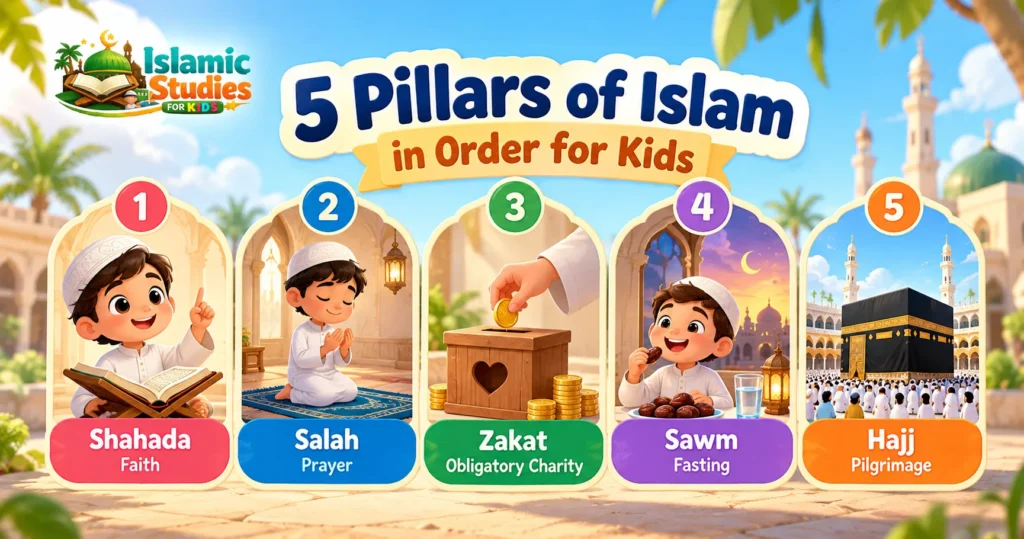
The 5 pillars of Islam in order for kids are Shahada (Faith), Salah (Prayer), Zakat (Obligatory Charity), Sawm (Fasting), and Hajj (Pilgrimage). These five pillars form the foundation of Islamic practice and help Muslims worship Allah, fulfil their religious duties, and strengthen their faith.
Learning the correct sequence is a good starting point for children. Each pillar has a different meaning: some involve daily worship, while others are connected to giving, Ramadan, or the pilgrimage to Makkah.
Below, you’ll find the five pillars of Islam in order, with simple explanations, Quranic references, an easy-to-read chart, and helpful ways for children to remember all five.
1. Shahada – Faith
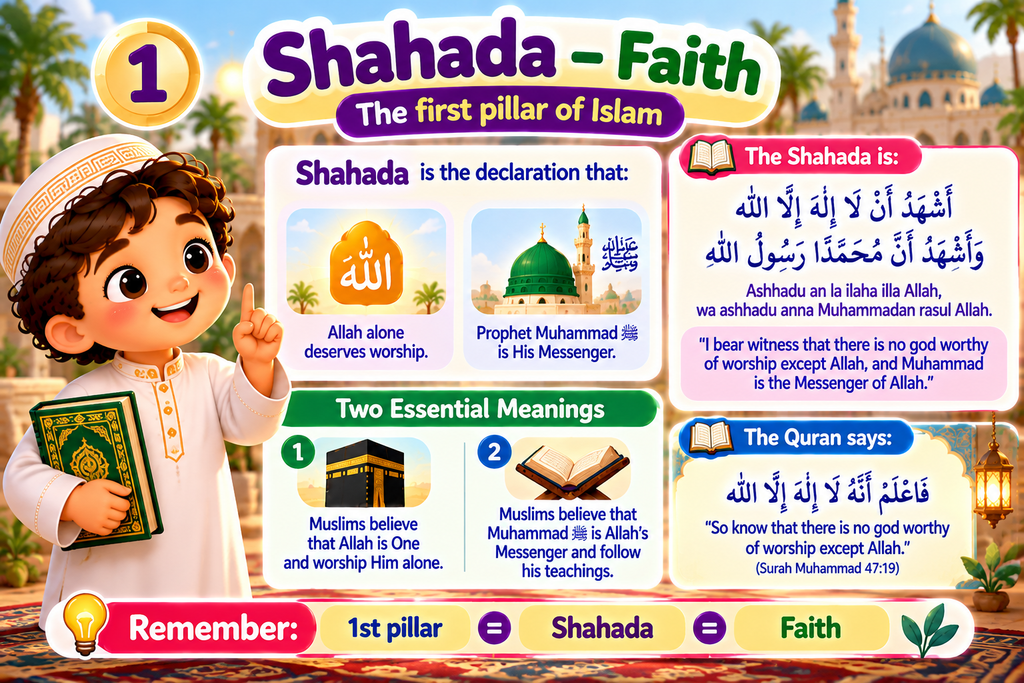
Shahada is the first pillar of Islam. It is the declaration that Allah alone deserves worship and that Prophet Muhammad ﷺ is His Messenger.
The Shahada is:
أَشْهَدُ أَنْ لَا إِلَٰهَ إِلَّا اللَّهُ وَأَشْهَدُ أَنَّ مُحَمَّدًا رَسُولُ اللَّهِ
Ashhadu an la ilaha illa Allah, wa ashhadu anna Muhammadan rasul Allah.
“I bear witness that there is no god worthy of worship except Allah, and Muhammad is the Messenger of Allah.”
This declaration has two essential meanings. First, Muslims believe that Allah is One and worship Him alone. Second, they believe that Muhammad ﷺ is Allah’s Messenger and follow his teachings.
The Quran says:
فَاعْلَمْ أَنَّهُ لَا إِلَٰهَ إِلَّا اللَّهُ
“So know that there is no god worthy of worship except Allah.” (Surah Muhammad 47:19)
Remember: 1st pillar = Shahada = Faith.
2. Salah – Prayer
Salah is the second pillar of Islam. It refers to the five obligatory daily prayers that Muslims perform at prescribed times.
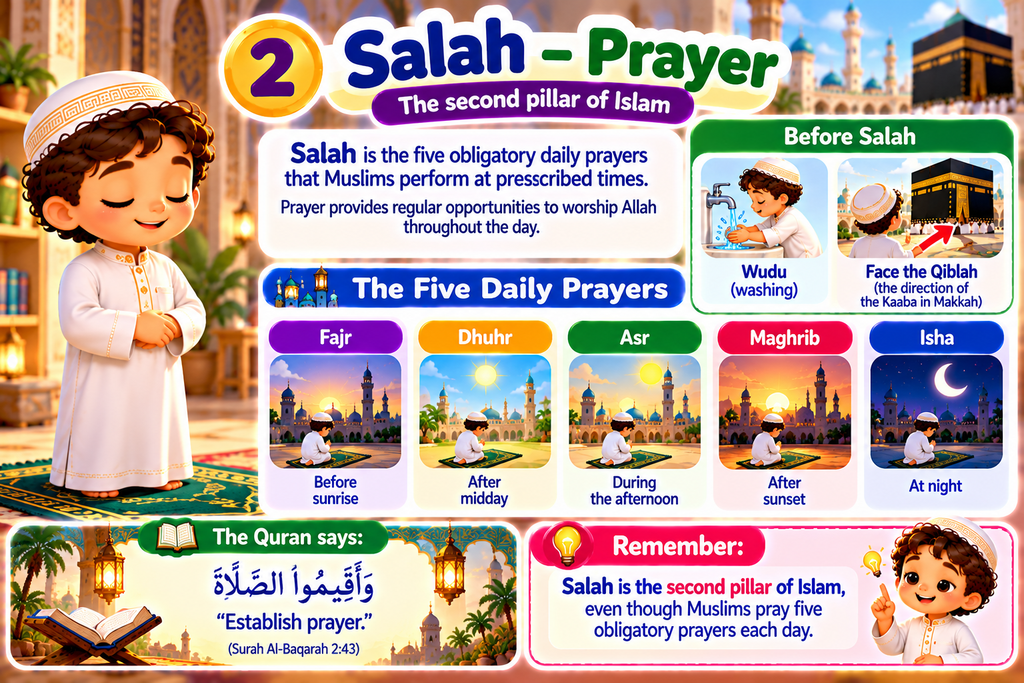
Prayer provides regular opportunities to worship Allah throughout the day. Before Salah, Muslims prepare through ritual purification, including Wudu, and face the Qiblah, the direction of the Kaaba in Makkah.
The five prayers are:
- Fajr: Before sunrise.
- Dhuhr: After midday.
- Asr: During the afternoon.
- Maghrib: After sunset.
- Isha: At night.
Allah says:
وَأَقِيمُوا الصَّلَاةَ
“Establish prayer.” (Surah Al-Baqarah 2:43)
One common mistake is confusing Salah’s position with the number of prayers. Salah is the second pillar, even though Muslims pray five obligatory prayers each day.
As children learn about Salah and the other pillars, they may begin asking how these acts of worship are practised in everyday life. Our 5 Pillars of Islam for Kids guide explores each pillar in more detail, helping young learners build a clearer understanding of their faith.

3. Zakat – Obligatory Charity
Zakat is the third pillar of Islam. It is a form of worship involving the obligatory giving of wealth to eligible recipients.
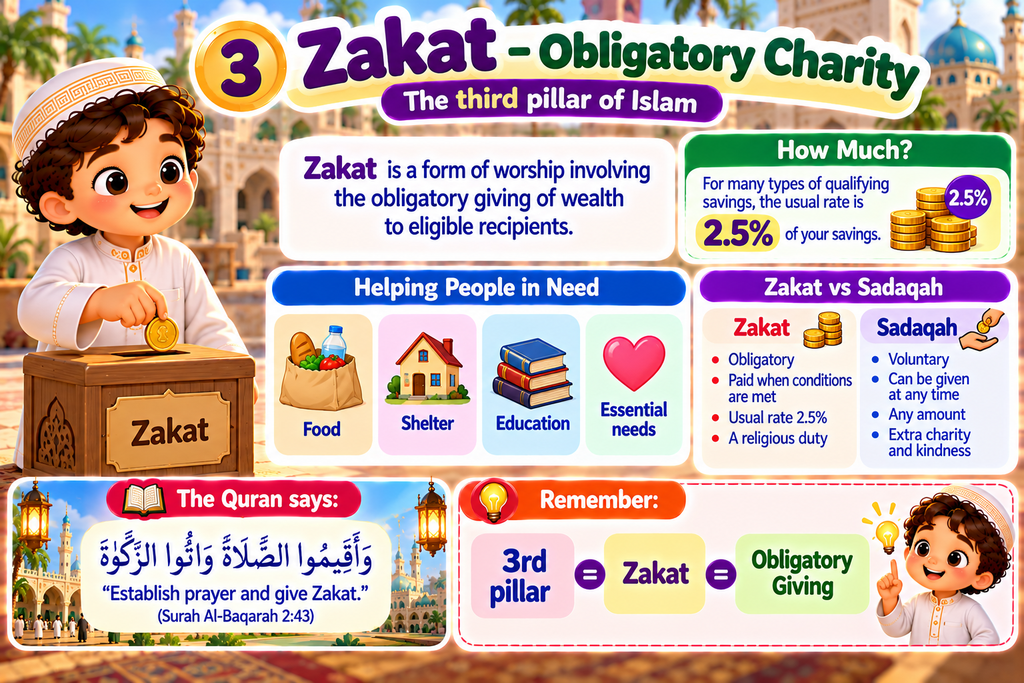
Muslims who meet the relevant financial conditions must pay Zakat. For many types of qualifying savings, the usual rate is 2.5%, although different rules apply to different types of wealth.
Zakat is not the same as Sadaqah. While Sadaqah is voluntary charity, Zakat is a religious obligation when its conditions are met.
The Quran says:
وَأَقِيمُوا الصَّلَاةَ وَآتُوا الزَّكَاةَ
“Establish prayer and give Zakat.” (Surah Al-Baqarah 2:43)
Zakat introduces children to the idea that wealth comes with responsibilities. It shows that helping eligible people in need is not only a kind gesture but can also be an act of worship required by Islam.
For example, when children see their parents giving Zakat, they can learn why Muslims consider the needs of others alongside their own.
Remember: 3rd pillar = Zakat = Obligatory Giving.
Watch a Sample Lesson from Our Academy
Get a firsthand look at how our students learn Islamic values, Quran, and essential knowledge through engaging and interactive online classes. See why families trust Islamic Studies for Kids Academy.
Fun & Engaging Islamic Classes for Kids
Start your child’s journey today with interactive lessons designed to make learning Islam loved and easy.
Get Your Child a Free Trial4. Sawm – Fasting
Sawm is the fourth pillar of Islam. It refers to fasting during Ramadan, the ninth month of the Islamic calendar.
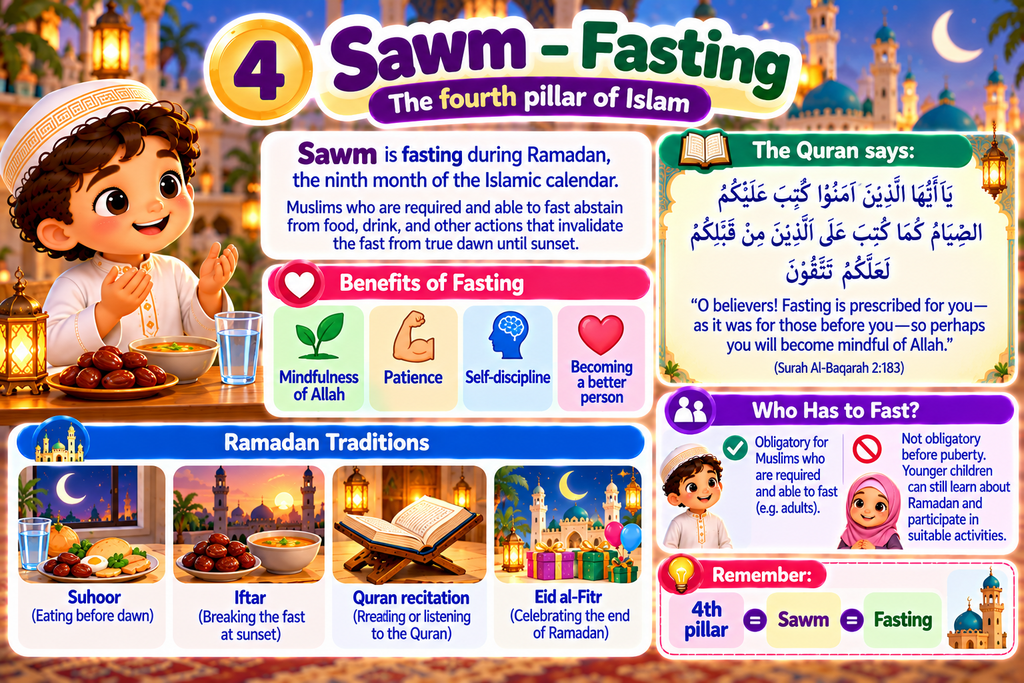
During Ramadan, Muslims who are required and able to fast abstain from food, drink, and other actions that invalidate the fast from true dawn until sunset.
Allah says:
يَا أَيُّهَا الَّذِينَ آمَنُوا كُتِبَ عَلَيْكُمُ الصِّيَامُ كَمَا كُتِبَ عَلَى الَّذِينَ مِن قَبْلِكُمْ لَعَلَّكُمْ تَتَّقُونَ
“O believers! Fasting is prescribed for you—as it was for those before you—so perhaps you will become mindful of Allah.” (Surah Al-Baqarah 2:183)
Fasting is an act of worship that encourages mindfulness of Allah, patience, and self-discipline.
Children can recognise Ramadan through several familiar traditions:
- Suhoor: Eating before dawn.
- Iftar: Breaking the fast at sunset.
- Quran recitation: Spending time reading or listening to the Quran.
- Eid al-Fitr: Celebrating the end of Ramadan.
Fasting is not obligatory before puberty. Younger children can still learn about Ramadan and participate in suitable family activities.
Remember: 4th pillar = Sawm = Fasting.
5. Hajj – Pilgrimage
Hajj is the fifth pillar of Islam in the commonly taught sequence. It is the pilgrimage to Makkah in Saudi Arabia, performed during Dhul-Hijjah, the twelfth month of the Islamic calendar.
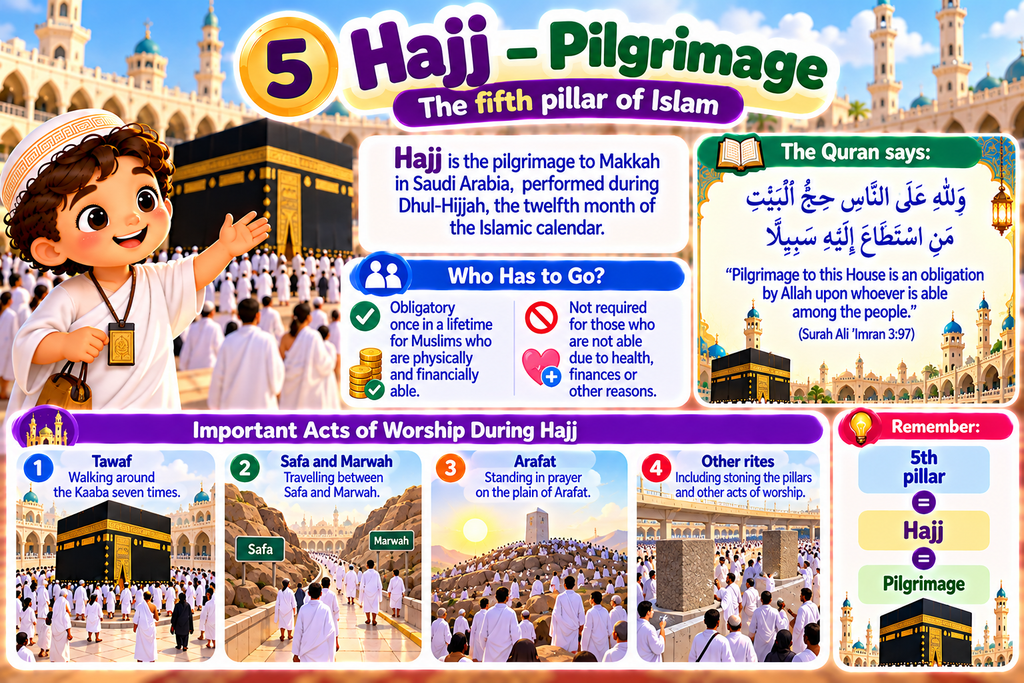
Hajj is obligatory once in a lifetime for Muslims who meet its conditions, including physical and financial ability.
Allah says:
وَلِلَّهِ عَلَى النَّاسِ حِجُّ الْبَيْتِ مَنِ اسْتَطَاعَ إِلَيْهِ سَبِيلًا
“Pilgrimage to this House is an obligation by Allah upon whoever is able among the people.” (Surah Ali ‘Imran 3:97)
During Hajj, Muslims perform important acts of worship, including Tawaf around the Kaaba, travelling between Safa and Marwah, and standing at Arafat.
The pilgrimage also connects Muslims with the history of Prophet Ibrahim, his wife Hajar, and their son Ismail (peace be upon them). Children can discover more about these important figures through Islamic History for Kids.

Unlike Salah, which is performed daily, Hajj is required only once in a lifetime for those who are able.
Remember: 5th pillar = Hajj = Pilgrimage.
5 Pillars Chart for Kids – Correct Order and Meanings
This 5 pillars chart for kids brings all five names together in one place. Parents can use it as a quick revision guide or display it where children regularly study.
| Order | Arabic Name | English Meaning | Main Practice |
| 1st | Shahada | Faith | Declaring belief in Allah and His Messenger |
| 2nd | Salah | Prayer | Praying five times a day |
| 3rd | Zakat | Obligatory Charity | Giving qualifying wealth to eligible recipients |
| 4th | Sawm | Fasting | Fasting during Ramadan |
| 5th | Hajj | Pilgrimage | Performing Hajj in Makkah when able |
Begin by reading the chart from top to bottom. Once your child knows the names, cover the English meanings and ask them to explain each pillar independently.
The goal is to remember both the correct position and the meaning of every pillar.
How Can Kids Remember the Five Pillars in Order?
Memorising unfamiliar Arabic words can be challenging at first. A few simple techniques can help children remember the pillars of Islam in order without confusing one name with another.
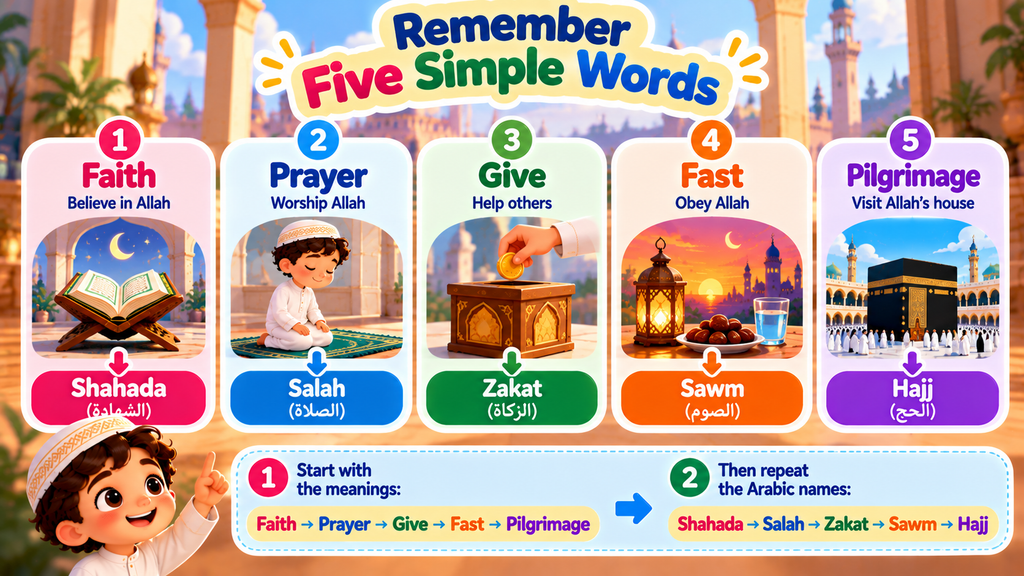
1. Remember Five Simple Words
Start with the meanings:
Faith → Prayer → Give → Fast → Pilgrimage
Then connect each word to its Arabic name:
Shahada → Salah → Zakat → Sawm → Hajj
Once children remember the English meanings, ask them to repeat the Arabic names without looking.
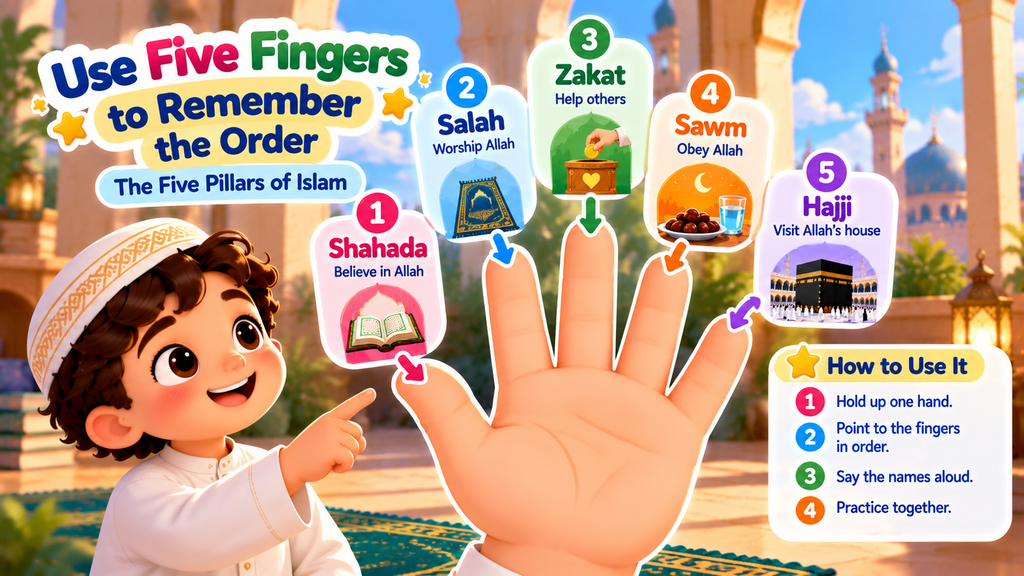
2. Use Five Fingers to Remember the Order
Ask your child to hold up one hand and assign a pillar to each finger:
- Thumb — Shahada
- Index finger — Salah
- Middle finger — Zakat
- Ring finger — Sawm
- Little finger — Hajj
Point to the fingers in order while saying the names aloud. This gives children a simple visual memory aid.
3. Practice With Missing Pillars
Write the sequence but leave some names blank:
Shahada → ______ → Zakat → ______ → Hajj
Ask your child to complete it.
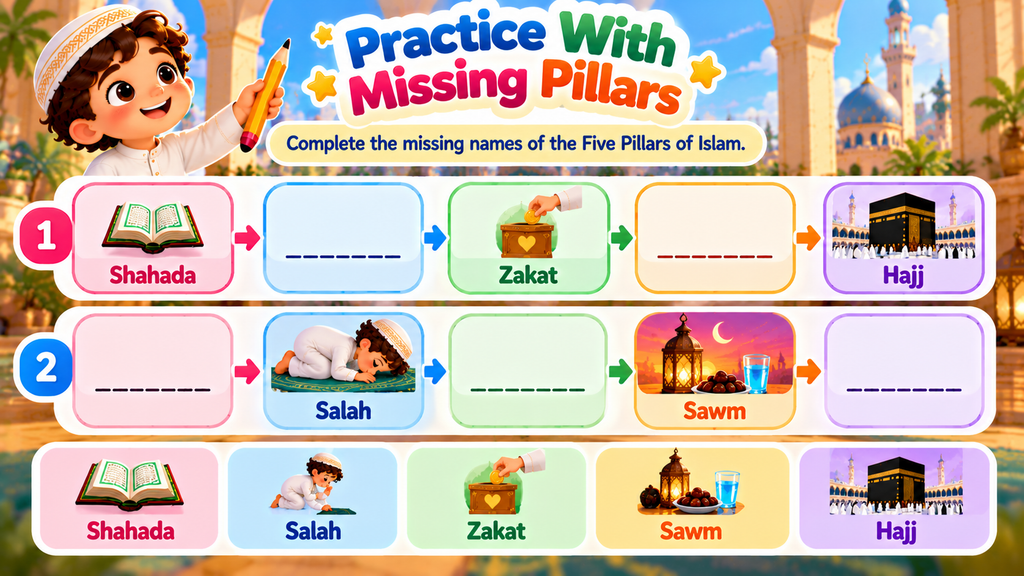
Then try another version:
______ → Salah → ______ → Sawm → ______
Changing the missing words helps children remember the position of each pillar rather than memorising a sentence without understanding it.
What Do Children Need to Understand Beyond the Order?
Remembering all five names is an important first step, but children should also recognise that the pillars are not five activities every Muslim performs on the same day.
| Pillar | When It Applies |
| Shahada | The declaration of faith, affirmed throughout Muslim life |
| Salah | Five times daily |
| Zakat | When the relevant financial conditions are met |
| Sawm | During Ramadan, for those required and able to fast |
| Hajj | Once in a lifetime for those who meet its conditions |
The order is a way of identifying the five foundations of Islam, not a timetable for completing them. Younger children can learn all five pillars even though they are not yet responsible for fulfilling every religious obligation.
For parents who want to develop their child’s understanding of Islamic worship beyond memorisation, the academy’s Islamic Studies learning programme provides opportunities for more structured learning.

Experience a Real Classroom
Curious about how we teach? This video offers a glimpse into a real class, showcasing our interactive approach, qualified teachers, and child-friendly learning experience.
Fun & Engaging Islamic Classes for Kids
Start your child’s journey today with interactive lessons designed to make learning Islam loved and easy.
Get Your Child a Free TrialHelp Your Child Grow in Faith With Islamic Studies for Kids Academy
Knowing the Five Pillars in the correct order is a wonderful beginning, but understanding Islam involves much more than remembering names. At Islamic Studies for Kids Academy, we help children explore their faith, understand Islamic teachings, and develop a meaningful connection with Allah through age-appropriate learning.
Our academy offers a supportive online environment where children can ask questions, build their understanding, and learn at a pace suited to their needs. With personalised guidance and clear explanations, we help young learners feel more confident as they explore Islamic beliefs, worship, and everyday values.
Whether your child is discovering the basics of Islam or strengthening their existing knowledge, Islamic Studies for Kids Academy aims to make learning engaging, accessible, and meaningful. Our focus is on helping children grow in knowledge while developing a lasting appreciation for their Muslim identity.
Start your child’s Islamic learning journey with confidence — Book a Free Trial Lesson Today!
Our Islamic Studies Courses Include:
- Islamic Manners & Akhlaq Course for Kids
- Good Deeds Course for Kids
- Cleanliness (Taharah) in Islam Course for Kids
- Angels in Islam Course for Kids
- Islamic History Course for Kids
- Seerah (Prophet’s Life) Course for Kids
- Prophets Stories Course for Kids
- Islamic Identity Course for Kids
- Intensive Islamic Course for Kids
Conclusion
The 5 pillars of Islam in order for kids are Shahada, Salah, Zakat, Sawm, and Hajj. Knowing this sequence gives children a clear starting point for understanding the foundations of Islamic practice and recognising the different forms of worship that Muslims perform.
A simple chart, familiar English meanings, and short memory exercises can make the names easier to remember. Rather than repeating the list without understanding, children should gradually learn what each pillar represents and how it relates to Muslim life.
Parents can support this learning through brief conversations, Quranic references, and regular revision. As children grow, they can develop a deeper understanding of the religious responsibilities, conditions, and values associated with each pillar.
Frequently Asked Questions About the 5 Pillars of Islam in Order for Kids
1. What Are the 5 Pillars of Islam in the Correct Order?
The commonly taught order is Shahada (faith), Salah (prayer), Zakat (obligatory charity), Sawm (fasting), and Hajj (pilgrimage). These five practices form the foundations of Islam.
2. Is Shahada Always the First Pillar of Islam?
Yes. Shahada is recognised as the first pillar because declaring belief in Allah and His Messenger is the foundation of Islamic faith and worship.
3. Why Do Some Hadith Narrations List Hajj Before Fasting?
Authentic hadith narrations mention fasting and Hajj in different orders. Sahih al-Bukhari 8 lists Hajj before fasting, while Sahih Muslim 16a gives fasting before Hajj. Both are pillars regardless of their order in a particular narration.
4. Which Pillar Comes After Salah?
Zakat comes after Salah in the commonly taught sequence. It is the third pillar of Islam and concerns obligatory giving under specific financial conditions.
5. Is Fasting the Fourth or Fifth Pillar of Islam?
Fasting during Ramadan is usually taught as the fourth pillar, followed by Hajj as the fifth. Some authentic hadith narrations mention the two in the opposite order.
6. What Is an Easy Way for Children to Memorise the Five Pillars?
Children can use five simple words—Faith, Prayer, Give, Fast, and Pilgrimage—and match them with Shahada, Salah, Zakat, Sawm, and Hajj. A numbered chart and short recall questions can also help.



[…] the first pillar, they are ready to learn the rest. You can continue with this guide to the 5 pillars of Islam in order for kids, which explains each pillar in a simple […]
[…] Some narrations of this hadith, including the one in Sahih Muslim, mention fasting Ramadan before Hajj. That is why most books teach the pillars as Shahadah, Salah, Zakah, Sawm, and Hajj. Parents can see this sequence explained in the 5 pillars of Islam in order for kids. […]