 Stories
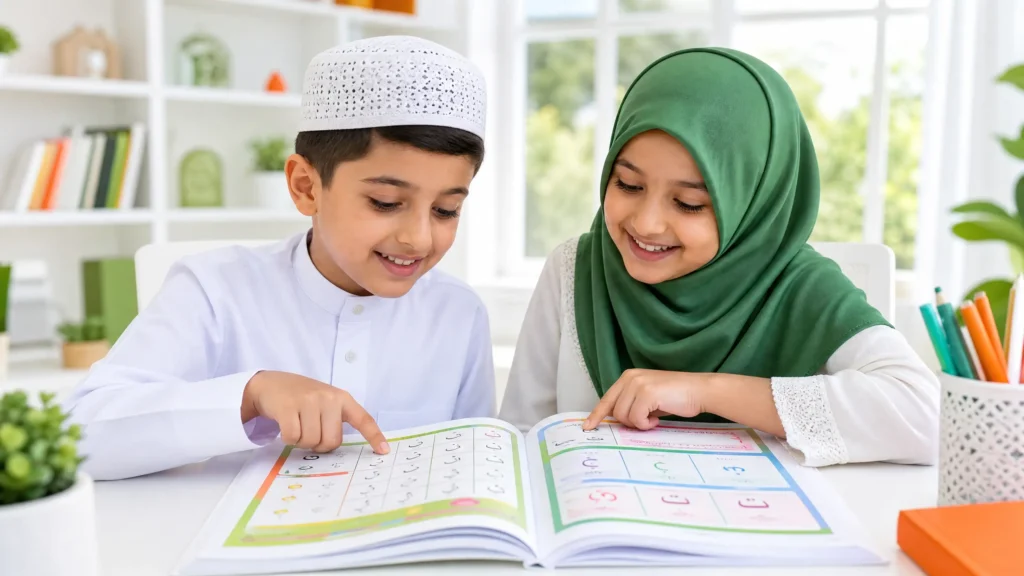
Choosing tajweed books for kids is harder than it should be. Walk into any Islamic bookstore and you’ll find a dozen options — story-based guides, color-coded workbooks, illustrated rule books, and traditional Qaidahs — with no clear way to tell which one actually fits your child.
The books below fall into a few categories: foundational reading Qaidahs for children still learning their letters, rule-based workbooks for kids ready to study tajweed categories, and story-driven or illustrated guides built to hold a young reader’s attention.
Below are eight of the most widely used tajweed books for kids, numbered in no particular ranking, with enough detail on each to help you match one to your child’s actual level.
1. Tajweed Untangled Book for Kids
Tajweed Untangled is a full-color, A4-sized guide built for children roughly 10 years and older who already have a basic grip on Arabic reading. Each chapter opens with a real Quranic example of a rule in action, then asks the child to identify the rule before it’s formally explained.

This discovery-based sequence — see the example first, then learn the rule — is one of the clearer differences between this book and older-style tajweed guides that simply list definitions.
The rules are laid out in a clean format designed for a child to revise independently, without needing an adult to walk them through every page. Alongside rule explanations, the book gives real attention to Makharij (articulation points) and to the melodic side of recitation, not just the mechanical side.
Written reflection tasks and practice lines follow each rule, giving children a chance to apply what they just read rather than only reading about it.
Suitable for: children aged 8 and above, Islamic weekend schools, and home learning alongside a teacher.
2. The Ultimate Tajweed Workbook by Iqrah Razzaq
The Ultimate Tajweed Workbook, published by Al Qasas Learning, takes a hands-on approach rather than a read-and-remember one.
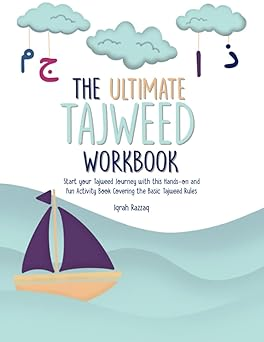
Every rule is explained visually in simple language, then followed immediately by an activity and a short quiz.
The workbook’s coverage is genuinely thorough for a children’s title. It includes Madd letters, Leen letters, the five main makharij, Ghunnah, Qalqalah, heavy letters, Ra rules.
Additionally, it covers Noon Sakinah and Tanween rules, Idgham and Ikhfa for Meem, sun and moon letters, Waqf, and the full range of Madd types Madd Muttasil, Madd Munfasil, and Madd al-Lazim — all in Uthmani script following the Hafs ‘an Asim tradition.
To move rules from theory into practice, the workbook includes tajweed-marked packs for five short surahs from Juz Amma: An-Nas, Al-Falaq, Al-Ikhlas, Al-Kafirun, and An-Naba.
Teachers who use this workbook consistently report that children who complete the coloring and matching activities retain rule names better than those who only read the explanations — physical engagement with the Quranic words seems to anchor the learning in a way passive reading doesn’t.
Suitable for: children who can already read basic Arabic, ages 7 and above, home use by parents.
Read Also:quran books for kids
Experience a Real Classroom
Curious about how we teach? This video offers a glimpse into a real class, showcasing our interactive approach, qualified teachers, and child-friendly learning experience.
Fun & Engaging Islamic Classes for Kids
Start your child’s journey today with interactive lessons designed to make learning Islam loved and easy.
Get Your Child a Free Trial3. Noorani Qaida (Color-Coded Edition)
The Noorani Qaida is the standard starting point for children who are still learning to recognize Arabic letters.
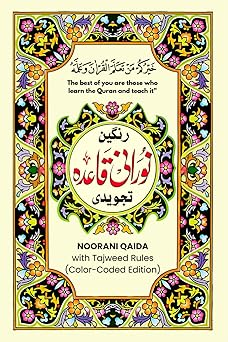
It isn’t a tajweed rule book in the traditional sense — it’s the foundation that has to be in place before a rule book makes sense.
The Qaida begins with the alphabet and introduces tajweed concepts gradually: three short vowels (harakat), prolongation rules, and basic recitation techniques, moving step by step from single letters to words and short sentences. Color-coded editions mark each letter and rule so a child can spot pronunciation patterns visually before they can articulate why the pattern exists.
One point worth flagging directly: a Qaida builds reading fluency, not pronunciation accuracy. The makharij of letters like Ain (ع), Ghain (غ), and Qaf (ق) can’t be self-corrected from a page — a child can read every line perfectly and still mispronounce these letters for years without live correction.
This is exactly the gap our instructors at Islamic Studies For Kids Academy step in to close, pairing Qaida-based reading with live pronunciation checks from the first session.
Suitable for: children as young as 4–5, as the first step before any tajweed workbook.
4. Essential Tajweed Rules for Children (Jannat Al Quran Series)
This title, part of the Jannat Al Quran children’s series, is designed as a follow-on from the Arabic & Tajweed Beginners Textbook and pairs naturally with the matching Exercise Book.
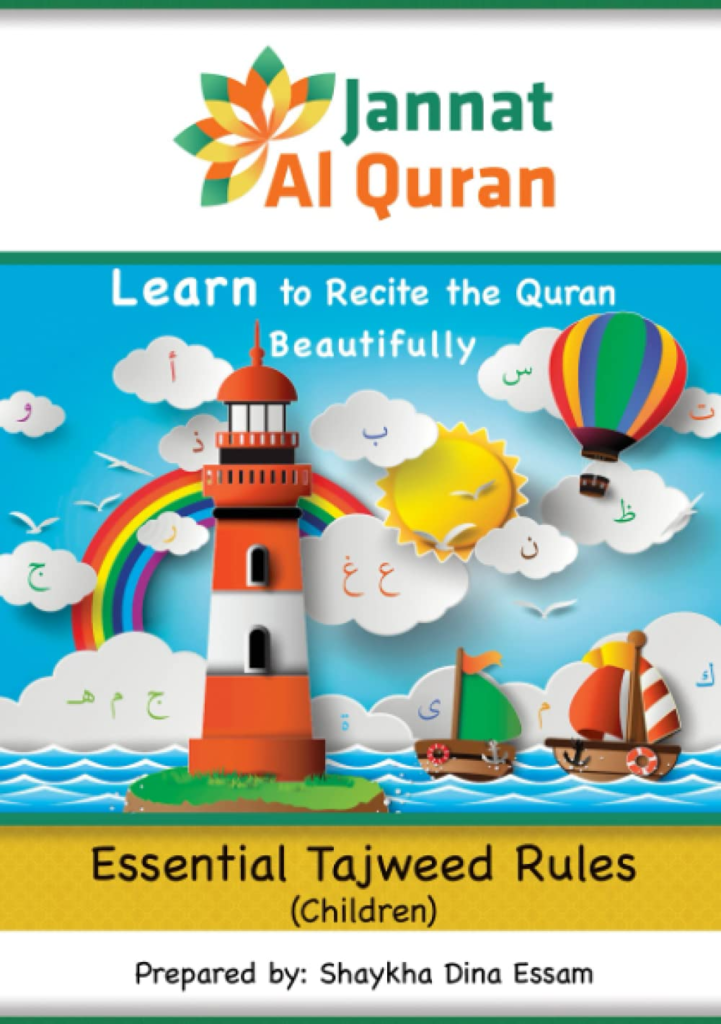
The book covers Noon Sakinah and Tanween, Meem Sakinah, Noon and Meem Mushaddad, Laam Shamsiyyah and Qamariyyah, Qalqalah, Al-Madd, heavy and light letters, and the signs of stopping — with a summary and revision exercises closing out each chapter.
The paired exercise book adds writing, drawing, and coloring tasks tied to each rule, which turns a read-only chapter into something a child actually practices.
This series is intended for children who already know basic Arabic rules and are ready to apply tajweed while reading Quranic text, rather than absolute beginners.
Suitable for: children with foundational Arabic reading skills, ready to move into applied tajweed practice.
5. Tajweed City Series
Tajweed City is a four-book set built around a story: a character named Zaid travels through fantasy worlds that represent the mouth and throat, learning pronunciation (Makharij) and rules along the way.
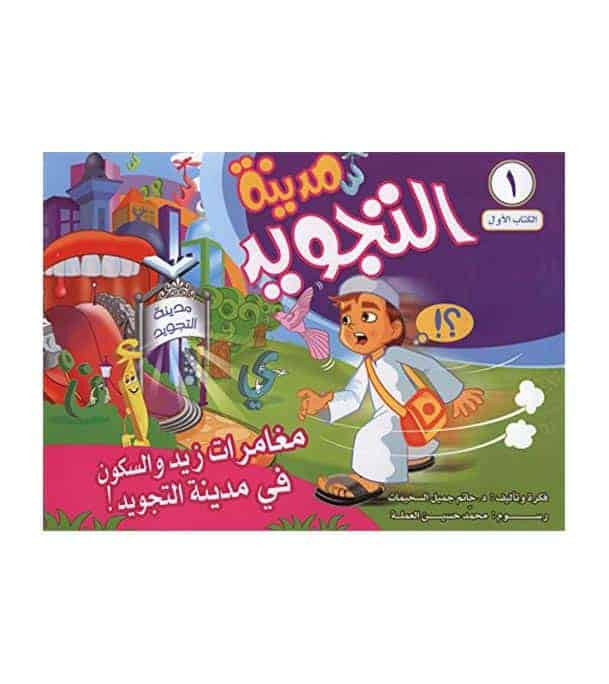
Story-driven tajweed books solve a specific problem — younger children often disengage from rule-list formats before the material sticks. By anchoring each articulation point to a location in Zaid’s journey, the series gives children a mental image to attach the rule to, which tends to help recall during actual recitation later.
Suitable for: children aged 7 and up who respond better to narrative learning than direct rule instruction.
6. The Learners’ Handbook of Tajweed
The Learners’ Handbook is built specifically for children whose first language is not Arabic, using an interactive question-and-answer style that mimics having a teacher walk through the material step by step.
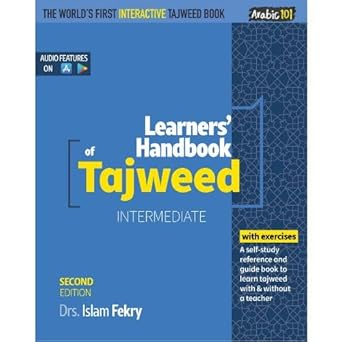
Rather than presenting tajweed as a flat list of rules to memorize, the book delivers instructions, reminders, and even warnings at the point where a child needs them closer to guided instruction than a static reference text.
Each chapter closes with a two-page infographic summarizing the rules, which doubles as a quick-reference sheet during actual Quran recitation.
The book also comes with a companion app that lets children record their own recitation and receive feedback, and listen to expert reciters to repeat after.
This is one of the few tajweed books for kids that pairs printed material with a practice tool built specifically for pronunciation feedback — though it still works best alongside a live teacher for the corrections an app can’t catch.
Suitable for: non-Arabic-speaking children, self-study settings, and families wanting a structured home-learning companion.
7. Tajweed Made Easy by Imam Abu Saad Omar Farouq
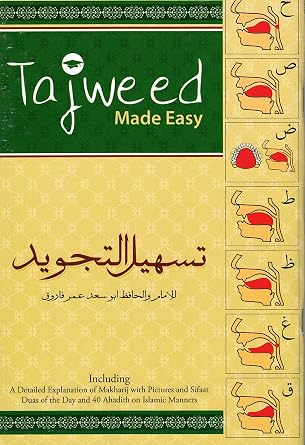
Tajweed Made Easy is organized around 29 structured lessons covering the essential and foundational rules of tajweed, with a heavy focus on visually explaining Makharij Al Huruf and Al Harakat.
The lesson ordering is one of this book’s strengths — topics build on each other rather than being grouped by category, which suits both a teacher working through the book with a class and a child working through it independently at home.
The visual practice guide for each articulation point gives children something concrete to compare their own pronunciation against, even without direct correction from an instructor.
Suitable for: both teachers introducing structured lessons and children working through material progressively at home.
Read Also: Islamic Books for Kids
8. Safar Tajweed Practice Book
The Safar Tajweed Practice Book follows on from the widely used Safar Qaidah, making it a natural next step for children who’ve completed that foundational series.
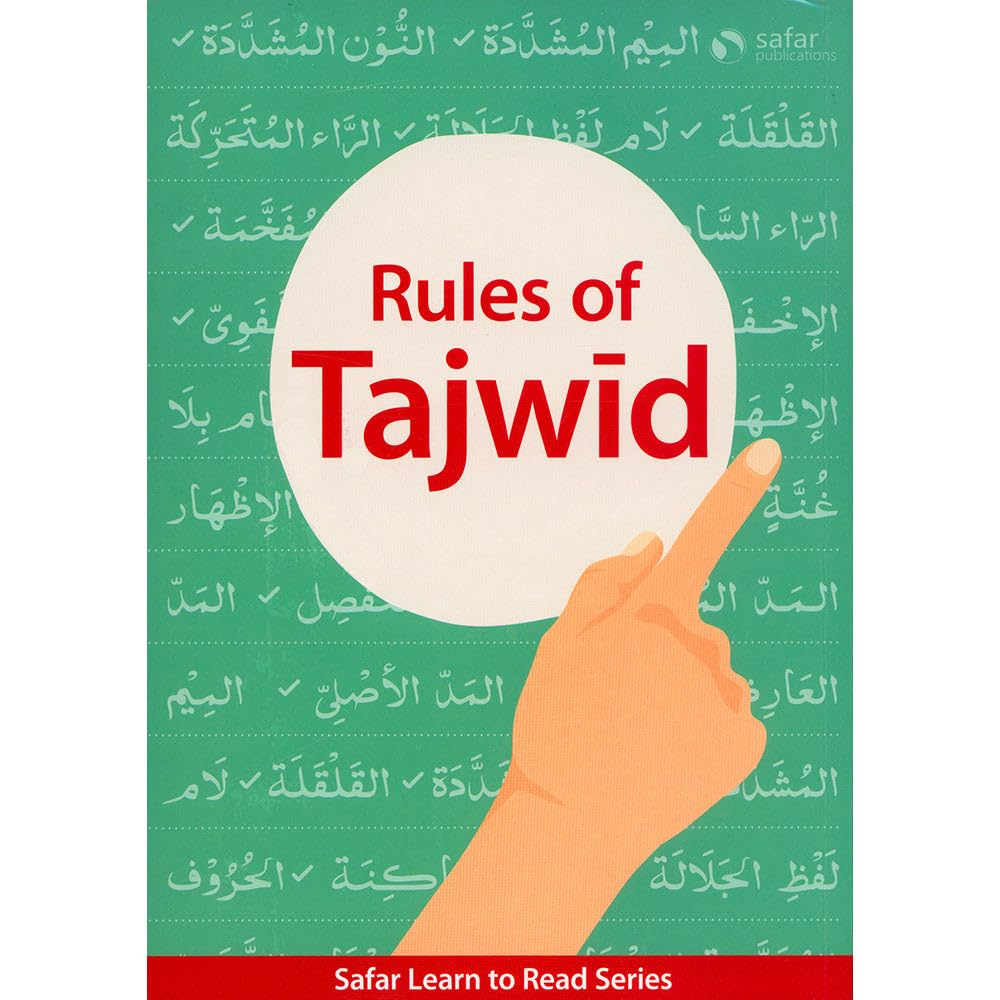
It’s built around seven graded levels, each introducing a rule, requiring the student to memorize it, and then giving several pages of spotting and practicing that rule in text.
Children don’t move to the next level until the current rule is consolidated. This prevents a specific and common problem: a child who can recite a rule’s definition perfectly but can’t identify it when it actually appears in Quranic text.
That gap between knowing a rule and recognizing it in context is one of the more persistent challenges in early tajweed education — a graded, no-skip structure is one of the more reliable ways to close it.
The book also opens with guidance on how to use it, along with the adab of reading the Quran, which situates the technical content inside its proper spiritual context. Many families pair this book with a live Tajweed Course for Kids Online, so the rules a child studies at home get checked against a real instructor’s ear.
Suitable for: children who’ve completed a Qaidah and are ready for structured, rule-by-rule practice.
What Makes A Good Tajweed Book For Kids?
Not every colorful tajweed book is actually useful. Before buying one, check it against these criteria:
| Criterion | What to Look For |
| Recitation tradition | Explicitly follows Hafs ‘an Asim |
| Script | Uthmani rasm for all Quranic examples |
| Language | Clear English explanations, not translated Arabic instruction |
| Age alignment | Matches your child’s actual reading level, not just their age in years |
| Rule coverage | Includes Noon Sakinah, Madd rules, Qalqalah, and Ghunnah at minimum |
| Practice activities | Written or interactive tasks, not explanation-only pages |
| Makharij coverage | Visual articulation-point guidance included |
A book that scores well on this table teaches rules clearly. It still can’t correct a mispronounced letter — that requires a trained ear listening in real time, which is the gap that live instruction is built to close.
Read Also: 15 Best Islamic Story Books For Kids
Watch a Sample Lesson from Our Academy
Get a firsthand look at how our students learn Islamic values, Quran, and essential knowledge through engaging and interactive online classes. See why families trust Islamic Studies for Kids Academy.
Fun & Engaging Islamic Classes for Kids
Start your child’s journey today with interactive lessons designed to make learning Islam loved and easy.
Get Your Child a Free TrialGive Your Child Live Tajweed Correction Today
A book teaches the rules. A live instructor corrects the sound. At Islamic Studies For Kids Academy, our certified teachers pair with any book on this list to give your child the real-time correction that pronunciation actually requires — no matter which title you’ve already got at home.

Courses that pair well with the books above:
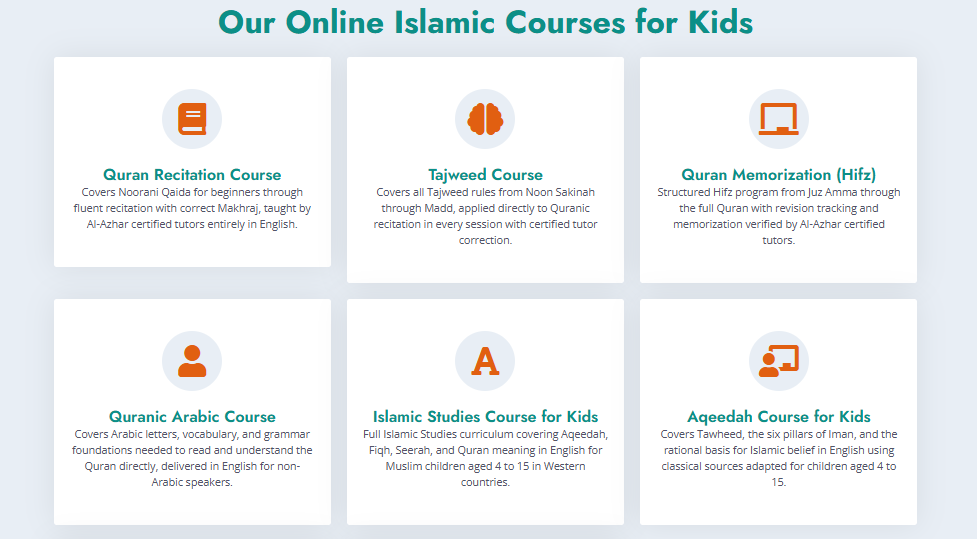
- Noorani Qaida Course for Kids Online: builds letter recognition before tajweed rules begin.
- Tajweed Course for Kids Online: turns written rules into corrected, spoken habits.
- Quran Recitation Course for Kids Online: builds fluent, sustained recitation once tajweed basics are in place.
Book a free trial Tajweed Course for Kids Online session and see exactly where your child stands.
Our Islamic Studies Courses Include:
- Islamic Studies for Kids
- Islam Basics for Kids (Beginners)
- 5 Pillars of Islam for Kids
- 6 Pillars of Iman (Faith) for Kids
- Salah (Prayer) for Kids
- Wudu for Kids
- Dua for Kids
- Ramadan for Kids
- Zakat & Sadaqah for Kids
- Hajj for Kids
- Aqeedah (Islamic Belief) for Kids
- Islamic Manners & Akhlaq for Kids
- Good Deeds for Kids
- Cleanliness (Taharah) in Islam for Kids
- Angels in Islam for Kids
- Islamic History for Kids
- Seerah (Prophet’s Life) for Kids
- Prophets Stories for Kids
- Islamic Stories & Morals for Kids
- Fiqh for Kids (Islamic Jurisprudence Basics)
- Hadith for Kids
- Quran Tafseer Course for Kids
- Islamic Holidays & Events for Kids
- Islamic Identity for Kids
- Intensive Islamic Course for Kids
Enroll today and give your child the knowledge, values, and confidence to grow as a practicing Muslim with a strong connection to Allah and His teachings.
Conclusion
The right tajweed book for kids isn’t the most colorful one or the most expensive one — it’s the one that matches where your child is right now.
A child still learning letters needs a Qaida. A child who knows the alphabet needs a structured rule workbook. A child who knows the rules by name but can’t spot them in the Mushaf needs graded practice text.
Every book covered here — from Tajweed Untangled to the Safar Tajweed Practice Book — does its job well when matched to the right stage.
What none of them can do alone is correct a mispronounced letter in real time. That’s the part live instruction covers, whether through a Quran Recitation Course for Kids Online or a dedicated tajweed class. Pair the right book with the right teacher, and progress tends to follow.
Frequently Asked Questions About Tajweed Books for Kids
Here are quick answers to the questions parents ask most often when choosing tajweed books for kids.
1. At What Age Can a Child Start Using a Tajweed Book?
Children can begin with a foundational Qaida, such as the Noorani Qaida, from around age 4 to 5. Structured rule books like Tajweed Untangled or The Ultimate Tajweed Workbook are appropriate from age 7 or 8 onward, once basic Arabic reading is established.
2. Can a Child Learn Tajweed from a Book Without a Teacher?
A tajweed book helps a child understand what a rule is, but correct pronunciation — particularly for letters like Ain, Ha, and Qaf — can’t be self-corrected through reading alone. A trained instructor needs to hear the child recite and give specific, real-time corrections.
3. Which Tajweed Book Is Best for Non-Arabic Speaking Children?
The Learners’ Handbook of Tajweed and Tajweed Untangled are both built specifically for non-Arabic speakers, with clear English explanations and Uthmani script examples. The Ultimate Tajweed Workbook also works well here since its activity-based format doesn’t require existing Arabic language intuition.
4. Do Tajweed Books for Kids Cover Rules Like Idgham and Ikhfa?
Yes, the better-designed ones do. The Ultimate Tajweed Workbook explicitly covers Idgham and Ikhfa alongside Meem rules and the full range of Madd types. Essential Tajweed Rules for Children also covers Noon Sakinah and Tanween within its structured chapter format.
5. Should a Child Memorize Tajweed Rules Before Applying Them?
Memorizing a rule’s definition is a starting point, not the goal. Books like the Safar Tajweed Practice Book and Tajweed Untangled both require children to spot and apply rules directly in Quranic text, not just recite definitions. Application inside short, familiar surahs from Juz Amma typically starts solidifying after four to six weeks of consistent weekly practice.
6. Is a Tajweed Book Enough, or Does My Child Also Need a Course?
A book builds rule awareness; a course builds correct pronunciation through live feedback. The two work best together. Enrolling in a Tajweed Course for Kids Online at Islamic Studies For Kids Academy alongside any book on this list gives your child both the reference material and the correction that pronunciation genuinely requires.


Leave a Reply