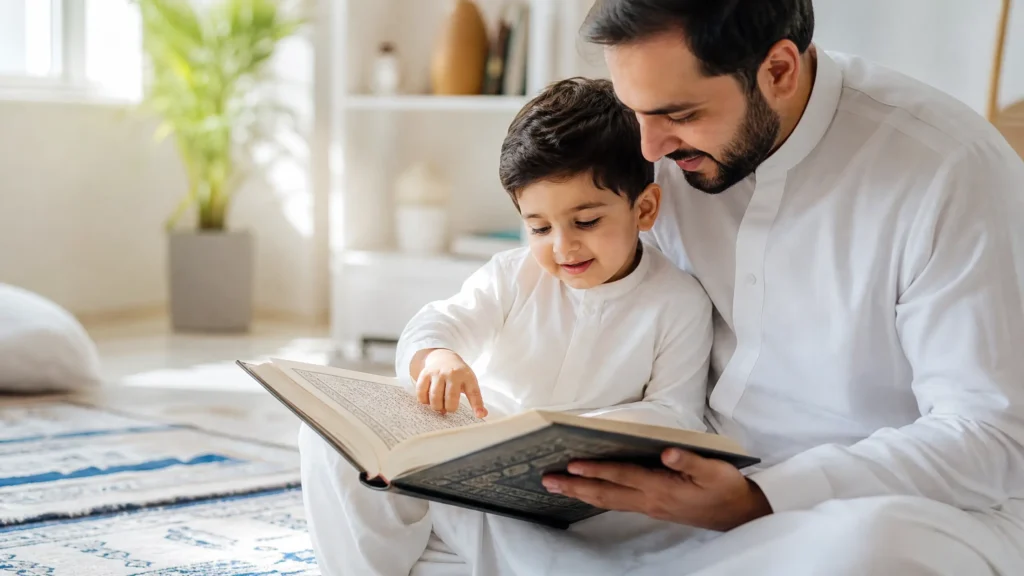
 For Parents
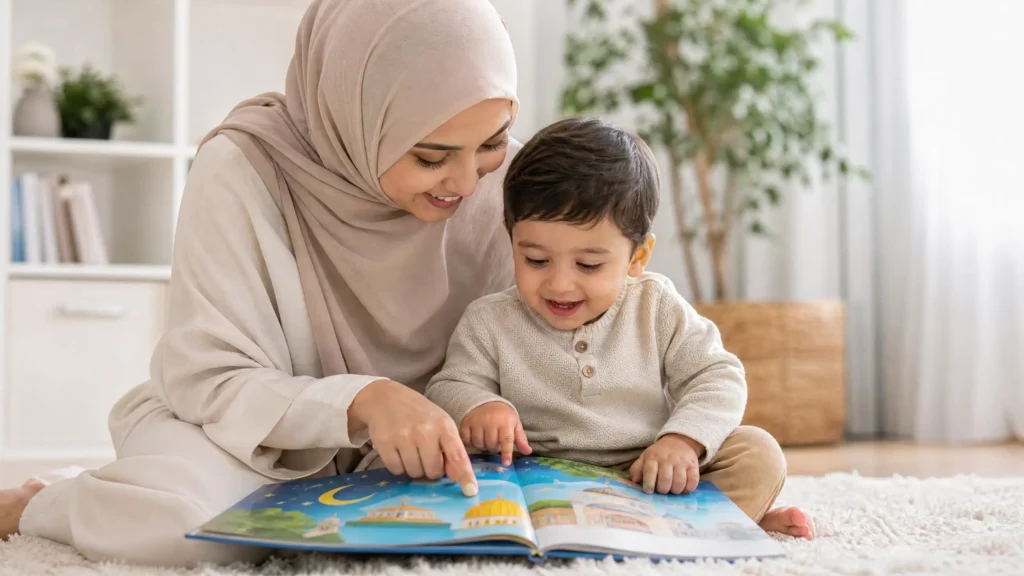
If you’re wondering how to introduce Islam to a 2–3 year old, the short answer is: through repetition, routine, and imitation — not lectures.
At this age, your toddler is watching your face, copying your tone, and absorbing everything around them long before they can understand a single explanation of faith. Introducing Islam to a 2–3 year old works best when it happens through daily habits rather than formal lessons.
This guide walks you through exactly what to do, in what order, and why it works — from teaching your first Islamic phrases to knowing when to start the Quran.
What You’ll Learn in This Article?
- Why toddlers learn faith through senses and imitation, not explanation.
- The daily habits that build Islamic familiarity fastest.
- How to use play, stories, and songs without overwhelming a short attention span.
- When children should begin learning the Quran, and what that actually looks like at age 2–3.
- The benefits of learning Quran at a young age, and common mistakes to avoid.
How to Introduce Islam to a 2–3 Year Old – Where to Start?
Introducing Islam to a 2–3 year old starts with sensory immersion — sound, touch, and repetition — rather than abstract ideas about God, the afterlife, or religious rules.
A toddler’s brain isn’t built for theology yet; it’s built for pattern recognition. So the goal in these early years isn’t to explain Islam, it’s to make it familiar:
- A sound they’ve heard a hundred times.
- A word they say without thinking.
- A mat they sit on because Mommy sits there too.
Two- and three-year-olds are still developing object permanence and basic cause-and-effect reasoning. Ask a toddler “where is Allah?” and you’ll get a blank stare or a random answer — not because they’re not learning, but because that question belongs to a later developmental stage.
What they can do at this age is link a feeling to a word or a moment:
- Comfort, joy, or calm → linked to a word like Bismillah or Alhamdulillah.
- A daily moment → linked to a habit, like bedtime or mealtime.
That link, repeated daily, becomes the foundation everything else is built on.
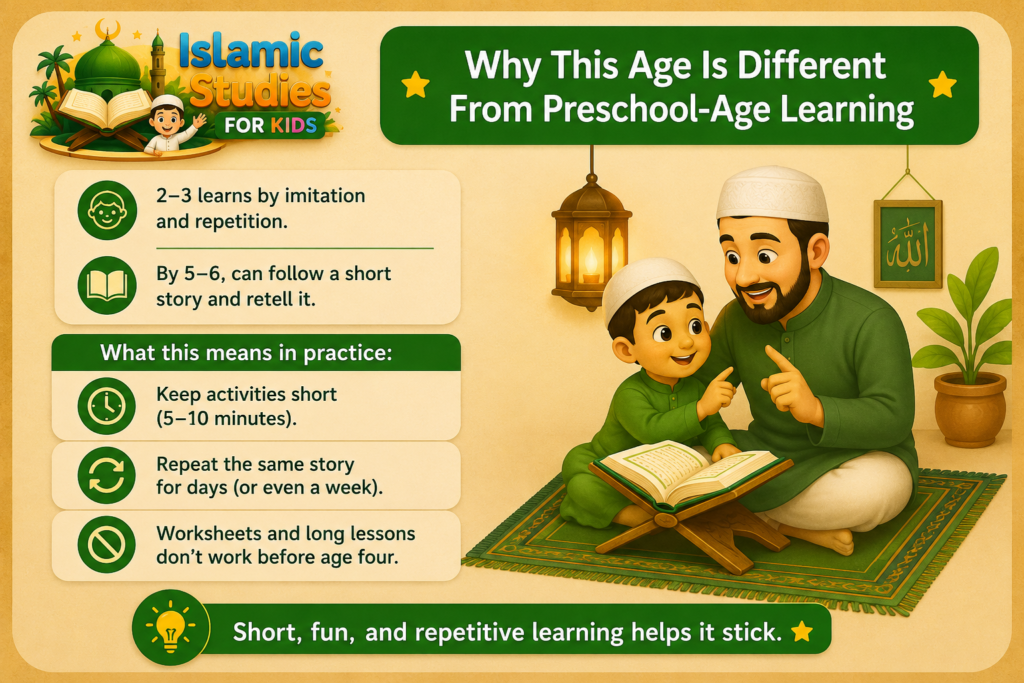
Why This Age Is Different From Preschool-Age Learning?
A 2–3 year old learns almost entirely through imitation and repetition, not instruction. A 5–6 year old can follow a short story with a moral and retell it.
That gap matters enormously in practice:
- Methods designed for slightly older kids — worksheets, structured Q&A, explanations of the Five Pillars — tend to fall flat before age four.
- Every activity should stay under 5–10 minutes
- Expect to repeat the same phrase or story for a week or more before it sticks.
Daily Habits That Build Islamic Familiarity
The strongest results come from a small, unchanging set of daily habits — not variety. Toddlers thrive on sameness; the same phrase said at the same moment every day builds memory faster than five different activities tried once each.
1. Bismillah and Alhamdulillah as daily phrases
Say “Bismillah” together before eating, starting a game, or getting dressed, and “Alhamdulillah” when finishing food or after a sneeze.
These two words, repeated dozens of times a day, are usually a toddler’s first independent Islamic vocabulary — often before they can form full sentences.
2. Modeling Salah with a child-sized mat
Toddlers imitate before they understand. Give your child their own small prayer mat next to yours and let them stand, bow, or sit beside you during your prayer.
They don’t need to get the movements right — the goal is a positive, familiar ritual, not correct form. A small cap or hijab for prayer time adds to the sense of belonging.
3. A short, consistent routine block
Pick one time of day — after Fajr, after a nap, or before bed — and repeat the same 10-minute sequence:
- Bismillah, one short dua, a few minutes of Quran audio.
- A closing phrase like “Alhamdulillah.” Same order, same place, every day.
Predictability is what turns an activity into a habit.
For printable routine charts you can stick on the wall, see Islamic Worksheets for Kids — Free Printables for Parents.
At Islamic Studies For Kids Academy, this is exactly the rhythm our toddler-focused sessions are built around — short, repeatable, and designed so a busy parent can keep the routine going even on a hard day.
Explore the Quran Course for Toddlers Online.
Experience a Real Classroom
Curious about how we teach? This video offers a glimpse into a real class, showcasing our interactive approach, qualified teachers, and child-friendly learning experience.
Fun & Engaging Islamic Classes for Kids
Start your child’s journey today with interactive lessons designed to make learning Islam loved and easy.
Get Your Child a Free TrialUsing Play, Stories, and Songs to Build Familiarity
For young children, play is one of the most powerful ways to build understanding, making it an essential part of the learning process rather than a distraction from it.
A 2–3 year old absorbs more from a five-minute story or song repeated all week than from a single detailed explanation.
a. Simple Stories and Board Books
Choose Islamic board books with large pictures and short text — ones about Allah’s creations (animals, weather, the moon) or gentle Prophet stories with one clear lesson each. Key principles:
- “The Prophet ﷺ was kind” is enough for a three-year-old.
- Don’t stack multiple lessons into one sitting.
- One story, one takeaway, repeated a few times that week, lands far better than a new story every day.
For structured story-based Quran learning as your child gets older, see the Quran Stories Course for Kids Online.
b. Nasheeds, Crafts, and Sensory Play
- Nasheeds — Toddler-friendly Islamic nasheeds that highlight gratitude or Allah’s creation work well precisely because children this age memorize rhythm and rhyme before meaning.
- Simple crafts — Playdough crescent moons, a shoebox “Ka’bah” covered in black paper, or building a toy mosque from blocks turn abstract words like “moon sighting” or “mosque” into something a toddler has touched with their own hands.
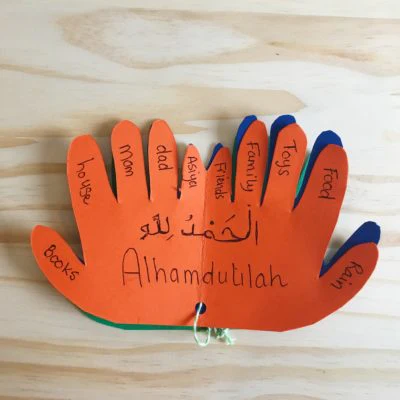
For more age-appropriate activity ideas, see Islamic Activities for Kids and Quran Activities for Kids.
When Should Children Begin Learning the Quran?
Children can begin learning the Quran at 2–3 years old, but “learning” at this age means listening and imitating sound, not reading or formal memorization.
The best time to learn Quran for children in the toddler years is built around the ear, not the eye: a short surah played daily by a qualified Qari, heard three to five times in one calm sitting, builds a sound-memory long before the child can recite independently.
A practical approach that works well:
- Pick one short surah — Al-Ikhlas is a common starting point.
- Keep the same recitation playing for 7–10 days before switching.
- Once a toddler starts humming along or reacting to the sound, move to 2–3 word phrases — such as “Qul Huwa Allahu” — repeated slowly and often before joining them into a full ayah.
Repetition of the exact same voice and rhythm, not variety, is what trains recognition at this age. For a complete picture of how this develops stage by stage, see When Should Children Begin Learning the Quran?
Do Children Memorize the Quran Before Learning to Read?
Yes — children typically memorize Quran through listening and repetition well before they can read Arabic script. This is normal and expected, not a shortcut:
- A toddler’s ear develops faster than their eye for text.
- Sound-based memorization naturally comes before letter recognition.
- Reading fluency usually develops from around age five or six onward.
For the next stage after listening-based familiarity, How to Teach Quran to a 4–5 Year Old picks up exactly where this guide leaves off.
Read alos: How to Teach Quran to a 4–5 Year Old – A Step-by-Step Guide for Parents
Benefits of Learning Quran at a Young Age
Starting Quran exposure at 2–3, even informally, has concrete advantages over waiting until school age:
- A built-in sound library — familiar rhythms and pronunciations make formal memorization noticeably smoother once the child is old enough for structured Hifz work
- Normalized Arabic recitation — exposure before a child develops self-consciousness about pronunciation makes later Quranic Arabic learning less intimidating
- Positive emotional association — because early sessions are short and sensory rather than academic, the child links the Quran with calm, closeness to a parent, and routine — not pressure or testing
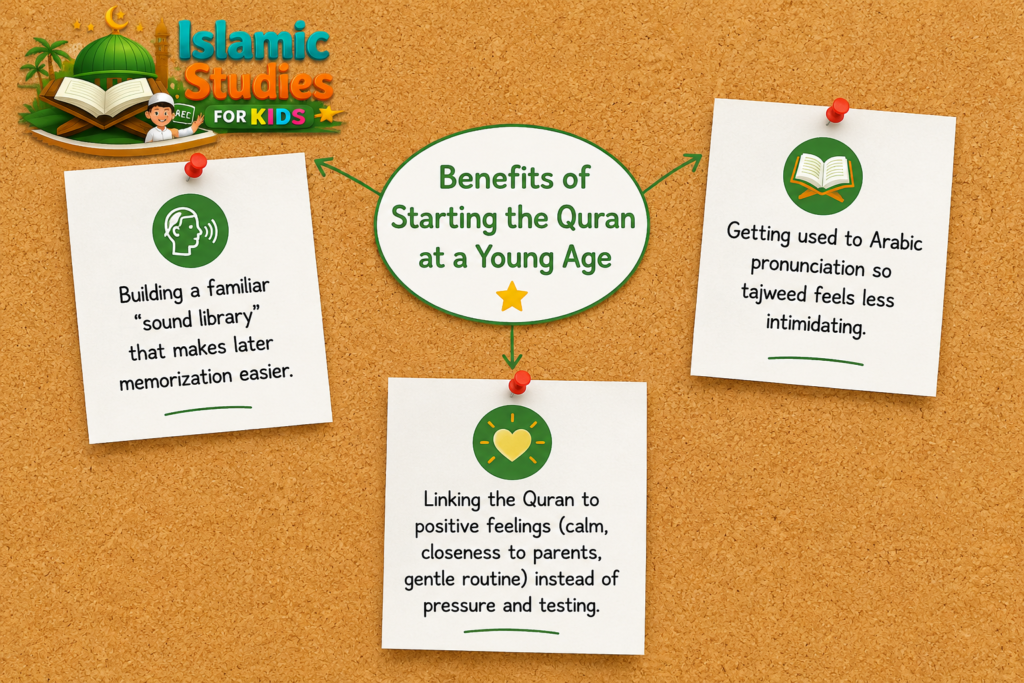
None of this replaces formal Hifz or Quranic Arabic study later on — it simply builds the foundation those programs are designed to build on. For what comes next, see Juz Amma Memorization for Kids and How to Make Your Child Memorize Quran.
Many parents reach this stage and start wondering what structured support looks like once their child is a little older.
Islamic Studies For Kids Academy’s early-years track is built specifically for that transition — moving from listening-based familiarity toward guided, age-appropriate memorization without rushing a toddler past what they’re developmentally ready for.
Common Mistakes Parents Make at This Stage
Even well-intentioned parents fall into a handful of patterns that slow this process down. Recognizing them early saves weeks of frustration.
1. Introducing too many concepts at once
A 2–3 year old needs the same small set of inputs repeated for days before adding anything new; variety at this age dilutes memory instead of building it.
2. Correcting pronunciation harshly
If a toddler mispronounces “Bismillah” or a short ayah, correcting them sharply tends to create hesitation, not accuracy. Simply repeat the correct sound warmly and move on — accuracy improves through repeated hearing, not through correction.
3. Treating Islamic and general screen time as separate
If a toddler spends hours daily on general cartoons, adding ten minutes of Quran audio won’t compete for attention the way a parent hopes.
Islamic content needs to be woven into the same daily rhythm as everything else the child watches and hears — not squeezed in as an afterthought.
Islamic Apps for Kids and Islamic Games for Kids offer child-appropriate alternatives that make this easier.
Read also: When Should Children Begin Learning the Quran?
Watch a Sample Lesson from Our Academy
Get a firsthand look at how our students learn Islamic values, Quran, and essential knowledge through engaging and interactive online classes. See why families trust Islamic Studies for Kids Academy.
Fun & Engaging Islamic Classes for Kids
Start your child’s journey today with interactive lessons designed to make learning Islam loved and easy.
Get Your Child a Free TrialShe’s Only 2. And Every Day You Wait, Someone Else Is Shaping What Feels Normal to Her.
Not you. Not Islam. Just whatever she hears most. A toddler doesn’t choose what becomes familiar — you do. And right now, that window is wide open.
- Before: Quran playing in the background between cartoons. A different reciter every night. Nothing sticking. Three months in, still nothing.
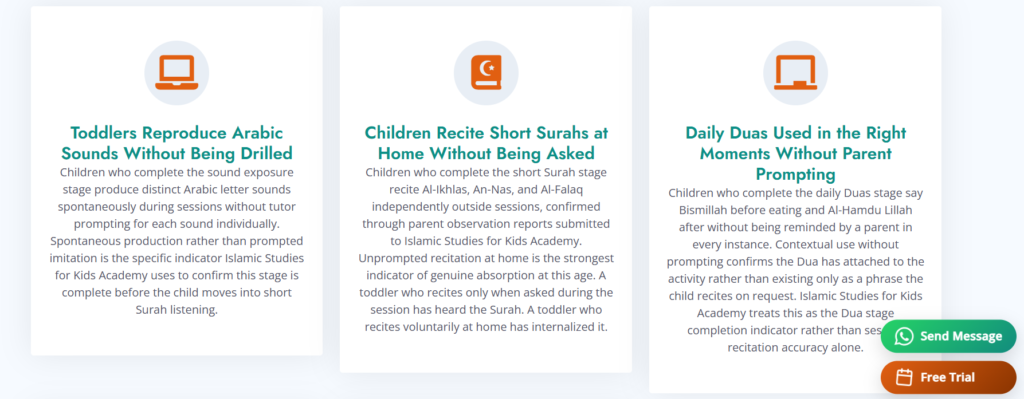
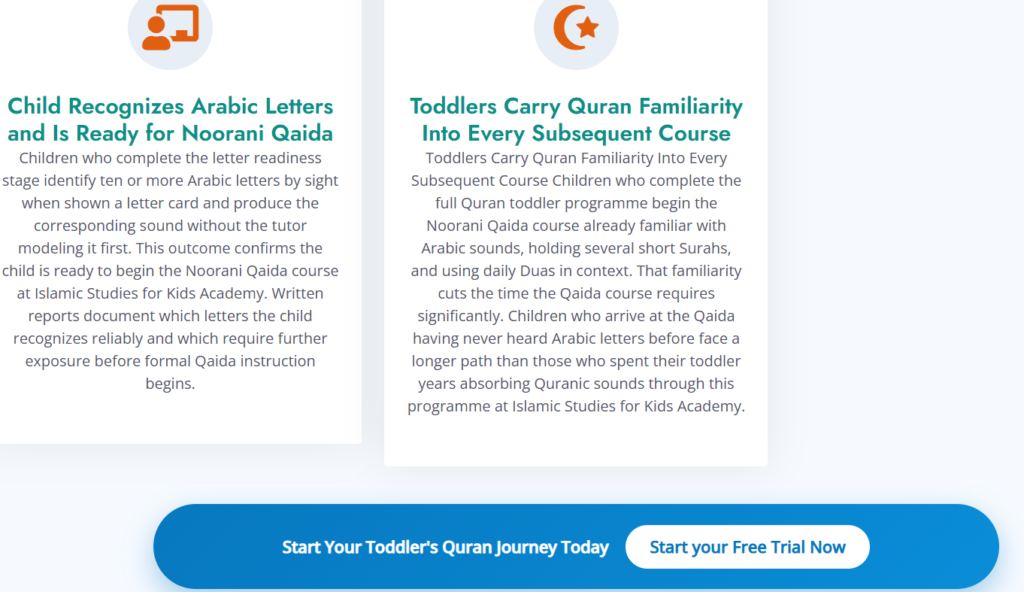
- After one semester with Islamic Studies for Kids Academy: She says Bismillah before touching her food. She hums Al-Ikhlas in the car. She pulls her prayer mat next to yours — without being asked.
Same child. Same home. One difference: a consistent, qualified teacher who knows exactly how a two-year-old’s brain builds familiarity — and built every session around that.
Short sessions. Same voice. Same calm structure. Every time.
Because at this age, consistency isn’t just helpful. It’s the whole method.
Book Your Child’s Free Trial Class
Why Muslim Families Choose Islamic Studies for Kids Academy
Not every online Islamic course is the same. Here is what families consistently point to after their first semester:
- Al-Azhar certified tutors with traditional Ijazah — not self-taught, not informally trained.
- Private 1-on-1 sessions — always, no exceptions.
- Full English instruction — no prior Arabic needed.
- Female tutors available for girls upon request.
- Flexible scheduling — after school, weekends, any time zone.
- Written progress reports after every completed level.
Book Your Child’s Free Trial Class Today

Nurture Your Child’s Islamic Knowledge with Our Islamic Studies for Kids Academy
Help your child build a strong Islamic foundation through engaging, age-appropriate, and interactive lessons designed to inspire faith, good character, and a love for Islam. Our experienced teachers guide children step by step, making Islamic learning enjoyable, practical, and easy to understand. Whether your child is just beginning or looking to deepen their knowledge, our comprehensive courses provide the perfect learning journey.
Our Islamic Studies Courses Include:
- Islamic Studies for Kids
- Islam Basics for Kids (Beginners)
- 5 Pillars of Islam for Kids
- 6 Pillars of Iman (Faith) for Kids
- Salah (Prayer) for Kids
- Wudu for Kids
- Dua for Kids
- Ramadan for Kids
- Zakat & Sadaqah for Kids
- Hajj for Kids
- Aqeedah (Islamic Belief) for Kids
- Islamic Manners & Akhlaq for Kids
- Good Deeds for Kids
- Cleanliness (Taharah) in Islam for Kids
- Angels in Islam for Kids
- Islamic History for Kids
- Seerah (Prophet’s Life) for Kids
- Prophets Stories for Kids
- Islamic Stories & Morals for Kids
- Fiqh for Kids (Islamic Jurisprudence Basics)
- Hadith for Kids
- Quran Tafseer Course for Kids
- Islamic Holidays & Events for Kids
- Islamic Identity for Kids
- Intensive Islamic Course for Kids
Enroll today and give your child the knowledge, values, and confidence to grow as a practicing Muslim with a strong connection to Allah and His teachings.
Fun & Engaging Islamic Classes for Kids
Start your child’s journey today with interactive lessons designed to make learning Islam loved and easy.
Get Your Child a Free TrialConclusion
Introducing Islam to a 2–3 year old isn’t about lessons or explanations — it’s about repetition, routine, and imitation, built into the ordinary moments of the day.
Saying Bismillah before meals, modeling Salah on a small mat, listening to the same short surah for a week, and reading one simple story again and again are what actually shape a toddler’s earliest connection to faith. Start small, stay consistent, and let familiarity do the work that explanation can’t do yet.
Frequently Asked Questions
Parents building this routine for the first time tend to arrive with the same practical questions.
When Is the Ideal Time to Introduce the Quran to Children?
The best age to start Quran for kids is around 2–3 years old, using listening and repetition rather than reading. Formal reading-based memorization typically begins later, around age five or six, once letter recognition develops.
What age should kids start Quran memorization specifically?
Kids can begin informal Quran memorization — short 2–3 word phrases repeated daily — from around age three.
Full ayah memorization tends to build naturally once a child has heard the same short surah consistently for several weeks.
How long should a daily Islamic lesson be for a toddler?
A daily Islamic lesson for a toddler should last no more than 5–10 minutes. Short, repeated sessions build memory more effectively than longer, less frequent ones at this age.
Can a 2-year-old really understand Islamic concepts?
A 2-year-old cannot understand abstract Islamic concepts, but they can absolutely form emotional and sensory associations with words, sounds, and routines. That association is the actual goal at this age — understanding follows later.
Is it normal if my toddler doesn’t want to sit still for Quran listening?
Yes, this is completely normal. A short attention span at this age is developmental, not a sign of disinterest.
Keep sessions brief, use the same calm time each day, and let the child move or play nearby while the recitation plays in the background.
Do Islamic classes for toddlers actually help, or is home routine enough?
A consistent home routine is the foundation and is enough on its own for ages 2–3. Structured Islamic classes become more useful as a support once the child is slightly older and ready for guided memorization beyond simple listening and imitation.


Leave a Reply