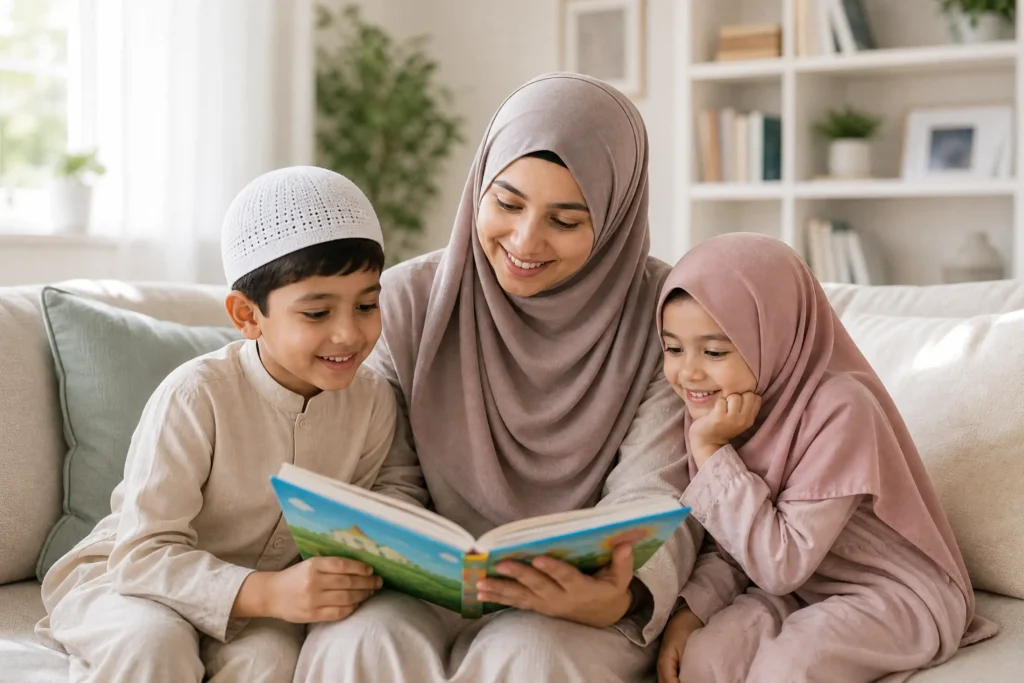
 For Parents
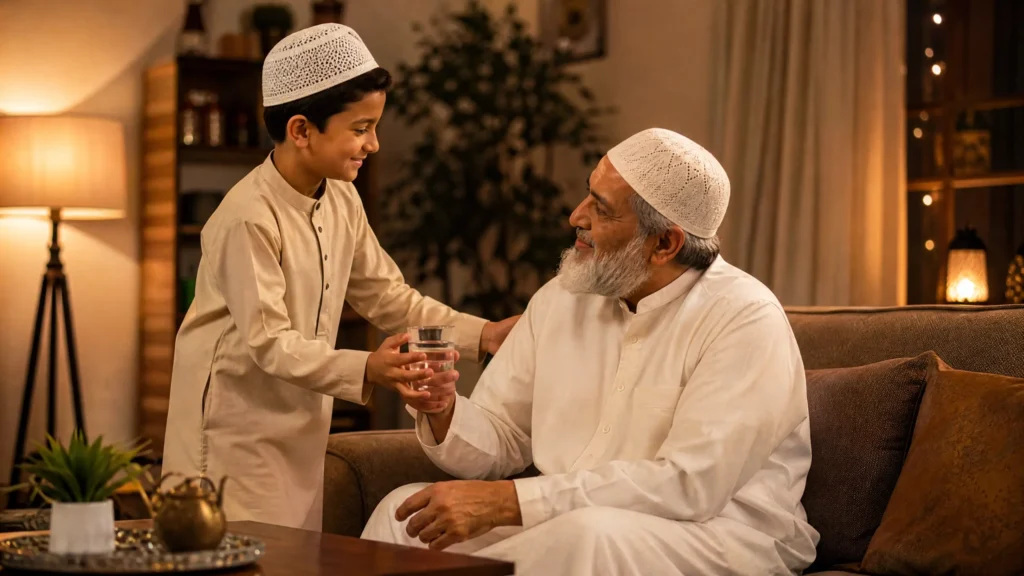
Most children love their parents deeply — but loving someone and knowing how to show that love respectfully are two very different things. Teaching children to express that love through consistent, Islamic-grounded behavior is one of the most important things a Muslim parent can do.
Respecting parents in Islam for kids goes far beyond saying “yes” quietly and not talking back. It is a complete value — birr al-walidayn — rooted in Quranic command, prophetic example, and daily practice that shapes a child’s entire character when taught with patience and warmth.
What You’ll Learn in This Article
- Why Islam places honouring parents directly after worshipping Allah.
- What birr al-walidayn means in simple, child-friendly terms.
- Quranic verses and hadiths on respect for parents in Islam — in Arabic with full tashkeel and English.
- How to teach respect at each age stage: toddlers, school-age children, and teens.
- Practical daily habits and activities children can start immediately.
- Common mistakes parents make when teaching this value — and how to avoid them.
- A powerful dua children can memorize and say after every prayer.
What Respecting Parents in Islam Really Means for Kids?
Respecting parents in Islam — known as birr al-walidayn — is one of the highest values in the Islamic faith. It means honouring, obeying, and showing kindness to your mother and father through your words, actions, and attitude in all situations.
The word birr in Arabic goes beyond simple politeness. Scholars define it as “expanding in goodness toward” someone — active, ongoing kindness rather than a passive absence of bad behaviour.
For children, this distinction matters: birr al-walidayn is not just avoiding rudeness; it is proactively looking for ways to make parents happy.
Allah’s command makes the connection unmistakable:
وَقَضَىٰ رَبُّكَ أَلَّا تَعْبُدُوٓا۟ إِلَّآ إِيَّاهُ وَبِٱلْوَالِدَيْنِ إِحْسَانًا
Wa qadaa rabbuka allaa ta’budoo illaa iyyaahu wa bil-waalidayni ihsaanaa
“And your Lord has decreed that you not worship except Him, and to parents, good treatment.” (Surah Al-Isra, 17:23)
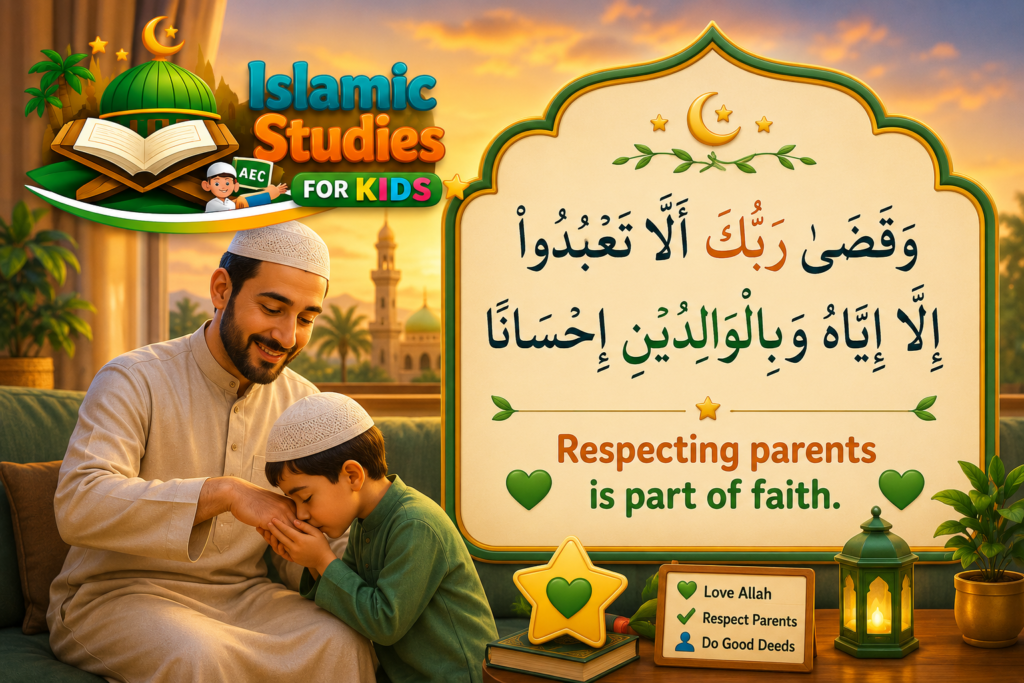
When you show children that Allah mentions parents immediately after Himself in this verse, it creates a powerful impression. That ranking — worship of Allah first, then honouring parents — tells children this is not an optional value. It is a pillar of their faith.
Islamic Teachings on Respecting Parents Kids Need to Know Early
Islam does not simply tell children to obey parents — it gives them the why behind the command, which is what turns a rule into a conviction.
The Quran and the Sunnah together build a complete picture:
- what parents deserve
- How to give it to them
- What is at stake when children fall short.
The verses and hadiths below are the foundation every Muslim child should know.
What the Quran Says About Honouring Parents in Islam?
The Quran addresses parents’ rights in multiple places, and the language is always direct and serious. Beyond the verse above, Allah continues in the same passage with detailed instructions children can understand and act on:
”إِمَّا يَبْلُغَنَّ عِندَكَ الْكِبَرَ أَحَدُهُمَا أَوْ كِلَاهُمَا فَلَا تَقُل لَّهُمَآ أُفٍّ وَلَا تَنْهَرْهُمَا وَقُل لَّهُمَا قَوْلًا كَرِيمًا”
“Immaa yablughanna ‘indakal-kibara ahaduhuma aw kilaahumaa falaa taqul lahumaa uffin wa laa tanharhumaa wa qul lahumaa qawlan kareemaa”
“Whether one or both of them reach old age with you, say not to them ‘uff,’ and do not repel them, but speak to them a noble word.” (Surah Al-Isra, 17:23)
The word uff — a sound of annoyance or impatience — is the absolute minimum of disrespect, and Allah prohibits even that.
If something as small as an impatient sigh is forbidden, children quickly understand that eye-rolling, ignoring requests, and talking back fall well beyond acceptable.
This verse provides children with a practical model of respect that they can remember and apply in their everyday interactions with their parents.
What the Prophet ﷺ Taught About Honour Parents Islam for Kids?
The Prophet Muhammad ﷺ reinforced these Quranic commands throughout his life. Three hadiths are especially powerful for children to learn.
- On the best deeds:
“I asked the Prophet ﷺ: which deed is most beloved to Allah? He said: Prayer at its proper time. I asked: then what? He said: honouring your parents. I asked: then what? He said: striving in the path of Allah.” (Narrated by Abdullah ibn Mas’ud — agreed upon, Bukhari and Muslim)
- On whose company deserves most care:
“A man came to the Prophet ﷺ and asked: who deserves my best companionship most? He said: your mother. The man asked: then who? He said: your mother. He asked: then who? He said: your mother. He asked: then who? He said: then your father.” (Narrated by Abu Hurairah — Bukhari and Muslim)
- On Allah’s pleasure being tied to parents’ pleasure:
“Allah’s pleasure lies in the parents’ pleasure, and His anger lies in their anger.” (Narrated by Abdullah ibn ‘Amr — Al-Tirmidhi)
When children understand that pleasing their parents is directly connected to pleasing Allah, obedience shifts from “because Mum said so” to “because this is how I worship Allah.” That shift — from external compliance to internal conviction — is precisely what parents are working toward.
Experience a Real Classroom
Curious about how we teach? This video offers a glimpse into a real class, showcasing our interactive approach, qualified teachers, and child-friendly learning experience.
Fun & Engaging Islamic Classes for Kids
Start your child’s journey today with interactive lessons designed to make learning Islam loved and easy.
Get Your Child a Free TrialHow to Teach Respect for Parents in Islam at Every Age Stage?
Children’s ability to understand and apply birr al-walidayn changes significantly with age. A three-year-old and a thirteen-year-old are both capable of honouring their parents, but through completely different means.
Matching teaching methods to developmental stage makes the difference between a value that sticks and one that fades — and knowing what to expect at each stage saves parents enormous frustration.
1. Teaching Toddlers and Young Children Ages 3 to 6 by Building the Habit First
Children at this stage cannot understand abstract religious concepts yet, but they are incredibly receptive to habits, routines, and imitation. Focus entirely on simple, repeatable actions rather than explanations.
Three habits worth building from this age:
- Greet parents when entering and leaving the home. A simple “Assalamu alaikum, Mama” at the door, every single time, builds a lifelong habit of acknowledgment and respect.
- Kiss the hands. Teach toddlers to kiss parents’ hands as a greeting. This physical gesture carries deep cultural and Islamic significance and connects children to their faith in a tangible, bodily way.
- Learn the dua for parents. Even a three-year-old can begin learning “Rabbi irhamhumaa kamaa rabbayaanee sagheera.” Keep it short, sing it together, and say it every night before bed.
At this stage, the goal is not understanding — it is repetition. Habits formed before age seven become the default behaviour a child returns to throughout life.
Building Understanding in School Age Children Ages 7 to 12
Children aged seven to twelve can begin understanding why Islam places such emphasis on parents. This is the age to introduce Quranic verses with simple explanation and to link respectful behaviour explicitly to worship.
A powerful opening question: “Did you know that one of the best deeds a Muslim can do — even greater in rank than striving for Islam — is being kind to their parents? The Prophet ﷺ said so himself.”
Practical daily habits for this age group to practise:
| Habit | When to Do It | How to Frame It for Children |
| Greet parents on arrival and departure | Every time, without exception | “It’s sunnah — the Prophet ﷺ loved this” |
| Respond immediately when called | As soon as they hear their name | “Delaying is a form of disrespect in Islam” |
| Help without being asked twice | Around the house daily | “When you help freely, Allah notices” |
| Speak calmly and quietly | All conversations with parents | “The Quran reminds us that even our tone of voice should reflect kindness and honour toward our parents. s” |
| Make dua for parents after each prayer | Five times daily | “Your dua reaches them even when you’re apart” |
Give children this age real responsibilities — making a cup of tea, helping a younger sibling, tidying up without being reminded. Frame each task as an act of worship, not a chore.
When children say “I don’t want to,” respond with: “When you help without complaining, Allah is pleased with you.” That reframing produces far more cooperation than repeated commands alone.
3. Guiding Teenagers to Honour Parents in Islam with Sincerity
Teenagers need dialogue, not just instruction. They are forming their own identity and resist top-down commands — but they respond genuinely when Islam is explained on an intellectual and emotional level, and when they feel their perspective is heard.
Opening a real conversation beats any lecture:
- A powerful discussion can begin with asking: Why are parents mentioned so early among Islam’s greatest responsibilities? Let them think and respond before offering your guidance.
- Then share the hadith of Abdullah ibn Mas’ud and discuss it together.
Teens who feel heard internalise Islamic values far more deeply than those who simply comply under pressure.
Fun & Engaging Islamic Classes for Kids
Start your child’s journey today with interactive lessons designed to make learning Islam loved and easy.
Get Your Child a Free TrialThe Story of Uwais al-Qarni and What It Teaches Kids About Birr al-Walidayn
Stories reach children where lectures cannot — and Islamic tradition contains accounts of birr al-walidayn that are genuinely moving, even for young children. Two are especially worth sharing regularly at home.
The Story of Uwais al-Qarni
The story of Uwais Al-Qarni is perhaps the most remarkable illustration of this value:
“Among the remarkable examples of filial devotion in Islamic history is Uwais Al-Qarani, who chose to remain beside his elderly mother instead of travelling to Madinah to meet the Prophet ﷺ.
Despite never meeting the Prophet ﷺ, the Prophet praised him by name and told his companions: “If you find him, ask him to make dua for you.””
Children absorb this story and understand the point immediately: in Islam, caring for your parents can be more beloved to Allah than things that seem far greater.
The man who stayed home with his mother was honoured by the Prophet ﷺ above many companions who had accomplished extraordinary things.
The Lesson for Young Children
For younger children, the example of Prophet Isa (AS) in the Quran is equally powerful. Allah describes him as “dutiful to his mother” — a prophet chosen by Allah, who still prioritised honouring his parent.
When children see that even prophets practiced birr al-walidayn, they understand this is not a value for ordinary people who have not been given anything special.
Stories and Learning at Islamic Studies for Kids
At Islamic Studies for Kids, children explore stories like these in age-appropriate lessons that help them genuinely connect with Islamic values rather than simply memorise rules.
Key Takeaways
| Story | Main Lesson | Why It Matters for Kids |
| Uwais al-Qarni | Caring for parents can be deeply beloved to Allah | Shows that birr al-walidayn has عظيمة value in Islam |
| Prophet Isa (AS) | Even prophets honored their parents | Teaches that respect for parents is a universal Islamic duty |
| Age-appropriate Islamic stories | Children learn values through narrative | Helps kids connect with Islam, not just memorize rules |
Read Also: Wudu Steps for Kids
Common Mistakes Parents Make When Teaching Islamic Teachings on Respecting Parents
Teaching birr al-walidayn effectively requires more than reminding children to be polite — it requires a deliberate, consistent approach that most parenting guides do not address.
Many parents make the same handful of mistakes repeatedly, and the result is children who know the rules but do not live the value. Here is what to watch for:
| Common Mistake | Why It Backfires | Better Approach |
| Correcting only in anger | Children associate respect with conflict, not values | Address behaviour calmly, not reactively |
| Expecting adult responses from young children | Creates frustration for both parent and child | Match expectations to developmental stage |
| Forgetting to model respect toward your own parents | Children imitate what they see far more than what they hear | Speak about your parents with love; phone them regularly |
| Lecturing without stories | Children tune out moral speeches quickly | Use the Uwais Al-Qarni story, the Prophet’s hadiths, real examples |
| Praising rarely | Children repeat behaviours that earn recognition | Celebrate respectful moments genuinely and specifically |
Modelling is the single most powerful and most overlooked factor. When children regularly see you speaking gently to your own parents, visiting them, or making dua for them after prayer, they absorb that behaviour at a depth no lesson can reach. Birr al-walidayn is caught more than it is taught.
Read Also: How To Explain Who Is Allah To A Child
Quranic Dua Kids Can Memorise for Respecting Parents in Islam
Memorising this dua gives children a daily spiritual practice that reinforces birr al-walidayn every time they say it. It comes from Surah Al-Isra, immediately following the main command about parents, and it is short enough for children as young as five to learn:
وَاخْفِضْ لَهُمَا جَنَاحَ الذُّلِّ مِنَ الرَّحْمَةِ وَقُل رَّبِّ ارْحَمْهُمَا كَمَا رَبَّيَانِي صَغِيرًا”
Wakhfid lahumaa janaaha adh-dhulli minar-rahmati wa qur Rabbi irhamhumaa kamaa rabbayaanee sagheera
“And lower to them the wing of humility out of mercy and say: My Lord, have mercy upon them as they brought me up when I was small.” (Surah Al-Isra, 17:24)
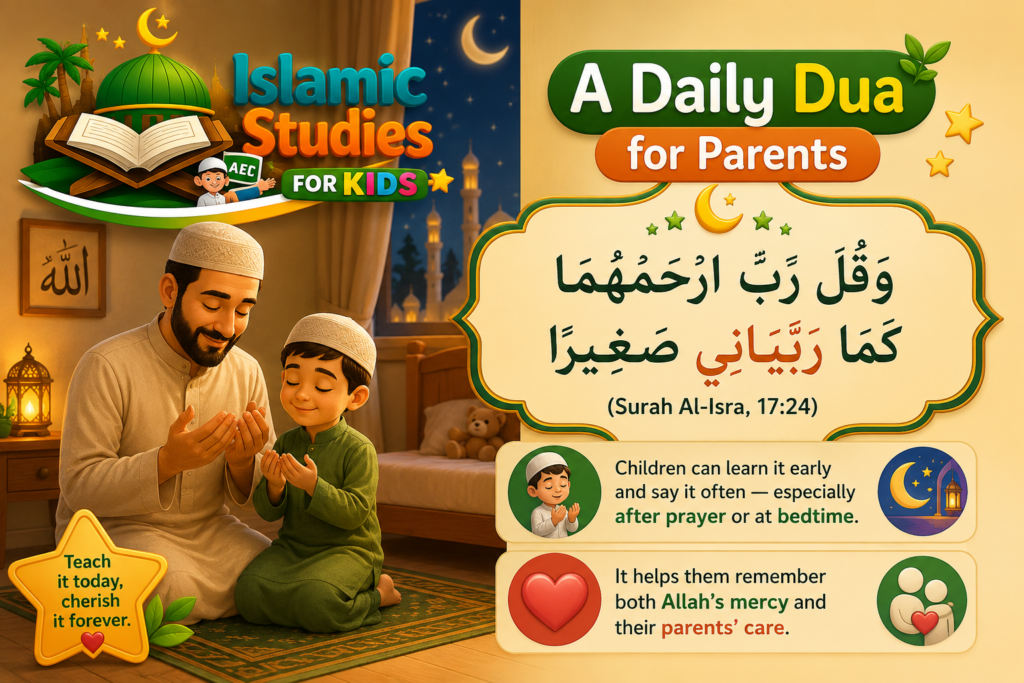
Teach it during bedtime, after Maghrib prayer, or write it on a card placed beside the prayer mat. When children see it daily, memorisation happens naturally without drilling. By age eight, most children recite it confidently and understand what they are saying.
The dua works on two levels simultaneously:
- It teaches children to ask Allah’s mercy for their parents.
- It reminds them — every single day — that their parents raised them when they were completely helpless.
That daily remembrance builds genuine gratitude more reliably than any lecture can.
Read Also: How to Teach Islam to Kids
Watch a Sample Lesson from Our Academy
Get a firsthand look at how our students learn Islamic values, Quran, and essential knowledge through engaging and interactive online classes. See why families trust Islamic Studies for Kids Academy.
Fun & Engaging Islamic Classes for Kids
Start your child’s journey today with interactive lessons designed to make learning Islam loved and easy.
Get Your Child a Free TrialWhat Changes After Your Child Joins Islamic Studies for Kids Academy?
A child who only hears “respect your parents” at home knows the rule.
A child who understands why — through Quran, Seerah, and guided discussion — lives it.
Here is what families notice after the first semester:
- Before the course, a child might respond slowly when called, argue when asked to help, or say “uff” without realising what Islam says about that single word.
- After structured learning with a certified tutor, that same child starts connecting daily behaviour to faith — not because they were told to, but because they now understand that Allah’s pleasure is tied directly to their parents’ pleasure.
Specifically, families report:
- Children reciting “Rabbi irhamhumaa” after prayer — without being reminded.
- Calmer responses when asked to do something they don’t want to do.
- Unprompted help around the house, framed by the child as “this is what Islam wants”.
- Children bringing up stories of Uwais Al-Qarni or the Prophet’s ﷺ hadiths on their own.
That shift — from compliance to conviction — is what the Islamic Studies for Kids Course Online is built to create. For children ages 4 to 15, in private 1-on-1 sessions, in English, with Al-Azhar certified tutors.
And When They’re Ready for Quran — EQuran School Is There
The values your child builds in Islamic Studies come alive even more when they can read and understand the words of Allah directly.
EQuran School, part of Islamic Studies for Kids Academy, offers a complete path — from first Arabic letters all the way to Ijazah — for children and adults at every level.
Get your child’s free trial lesson

Nurture Your Child’s Islamic Knowledge with Our Islamic Studies for Kids Academy
Help your child build a strong Islamic foundation through engaging, age-appropriate, and interactive lessons designed to inspire faith, good character, and a love for Islam. Our experienced teachers guide children step by step, making Islamic learning enjoyable, practical, and easy to understand. Whether your child is just beginning or looking to deepen their knowledge, our comprehensive courses provide the perfect learning journey.
Our Islamic Studies Courses Include:
- Islamic Studies for Kids
- Islam Basics for Kids (Beginners)
- 5 Pillars of Islam for Kids
- 6 Pillars of Iman (Faith) for Kids
- Salah (Prayer) for Kids
- Wudu for Kids
- Dua for Kids
- Ramadan for Kids
- Zakat & Sadaqah for Kids
- Hajj for Kids
- Aqeedah (Islamic Belief) for Kids
- Islamic Manners & Akhlaq for Kids
- Good Deeds for Kids
- Cleanliness (Taharah) in Islam for Kids
- Angels in Islam for Kids
- Islamic History for Kids
- Seerah (Prophet’s Life) for Kids
- Prophets Stories for Kids
- Islamic Stories & Morals for Kids
- Fiqh for Kids (Islamic Jurisprudence Basics)
- Hadith for Kids
- Quran Tafseer Course for Kids
- Islamic Holidays & Events for Kids
- Islamic Identity for Kids
- Intensive Islamic Course for Kids
Enroll today and give your child the knowledge, values, and confidence to grow as a practicing Muslim with a strong connection to Allah and His teachings.
Fun & Engaging Islamic Classes for Kids
Start your child’s journey today with interactive lessons designed to make learning Islam loved and easy.
Get Your Child a Free TrialConclusion
Respecting parents in Islam is not simply a rule children follow — it is a value rooted in Quranic command, prophetic example, and daily practice that shapes a child’s entire character when taught with consistency and warmth.
The insight most articles miss: birr al-walidayn is not one action. It is a constellation of small daily habits — the dua after each prayer, the immediate response when called, the help offered before it is requested, the calm tone even during disagreement — that together form a living expression of faith. No single lesson instils this. Consistent daily repetition does.
Age-appropriate expectations make all the difference. A four-year-old learning to greet her mother respectfully and kiss her hand, and a fourteen-year-old offering proactive help without reminders, are both practising the same Islamic value at exactly the right level for their stage.
Stories, duas, kindness habits, and genuine modelling work together. When parents build these practices daily — especially by letting children see them honour their own parents — children grow into adults who honour their parents naturally, because it became who they are. That is the true goal of teaching respecting parents in Islam for kids.
Frequently Asked Questions
What is birr al-walidayn in simple words for kids?
Birr al-walidayn means being kind, helpful, and respectful to your parents in everything you do. It means listening to them, speaking gently, helping without being asked, and making dua for them every day. In Islam, this is one of the best deeds a person can perform.
At what age should children start learning to respect parents in Islam?
Children can begin building respectful habits from age three through simple actions like greeting parents, kissing their hands, and learning short duas.
Understanding the Islamic reasons behind these habits develops between ages seven and twelve, and deeper reflection through discussion is appropriate for teenagers.
What does the Quran say about honouring parents?
The Quran commands good treatment of parents directly after the command to worship Allah alone (Surah Al-Isra, 17:23).
Allah specifically instructs believers not to say even a word of impatience to their parents, to speak to them with dignity, and to ask Allah’s mercy for them.
How can a child honour parents in Islam at home every day?
Simple daily actions include greeting parents when arriving and leaving, responding immediately when called, helping without being asked twice, never raising the voice above theirs, and reciting “Rabbi irhamhumaa kamaa rabbayaanee sagheera” after every prayer.
Is honouring parents more important than Jihad in Islam?
The Prophet ﷺ told a companion who wanted to join Jihad to return to his parents and serve them, saying that caring for living parents is itself a form of striving for Allah.
The hadith of Abdullah ibn Mas’ud also ranks honouring parents as the second most beloved deed to Allah, after prayer at its proper time.
How do you teach a child to respect parents without making it feel forced?
Use stories rather than lectures — the story of Uwais Al-Qarni is especially powerful for children. Frame respectful actions as worship, not rules: “When you help Baba without being asked, Allah is pleased with you.”
Praise respectful moments specifically and genuinely. Most importantly, model the behaviour yourself — let your children see you honouring your own parents every day.
External Links
- Teaching Children About Honoring Parents in Islam
- Explaining the Hadith on Honoring Parents to Children
- Teaching Kids the Importance of Respecting Parents
- How to Raise Children to Obey and Respect Their Parents
- Good Manners with Parents for Children
- Parents’ Rights in Islam and Children’s Responsibilities


Leave a Reply