Shahada For Kids – Meaning, Words And How To Teach The First Pillar Of Islam
The Shahada for kids is the very first lesson every Muslim child learns about their faith. It is a short sentence, but it holds the whole foundation of Islam: belief in one God, Allah, and belief that Prophet Muhammad ﷺ is His Messenger.
Many parents and teachers want to explain the Shahada in a way that young children can truly understand, not just memorize. Children ask big questions like “Who made me?” and “Why do we pray?”, and the Shahada is the starting point for answering them.
What You Will Learn
The exact words of the Shahada in Arabic, with transliteration and an easy English meaning.
A simple Shahada meaning for children, explained in two clear parts.
Why the Shahada is the first pillar of Islam for kids, based on an authentic Hadith.
How the Shahada relates to the Kalima for kids taught in many Muslim families.
Fun, age-appropriate methods parents and teachers can use to teach the Shahada at home.
What Is the Islamic Shahada for Kids?
The Shahada (Arabic: الشهادة, meaning “testimony” or “bearing witness”) is the Islamic declaration of faith. In it, a Muslim states that there is no god worthy of worship except Allah, and that Muhammad ﷺ is the Messenger of Allah. The Islamic Shahada for kids is this same declaration, explained in simple words.
Scholars also call it the Shahadatayn (the two testimonies), because the Shahada has two parts that always go together. The first part is about Allah, and the second part is about Prophet Muhammad ﷺ.
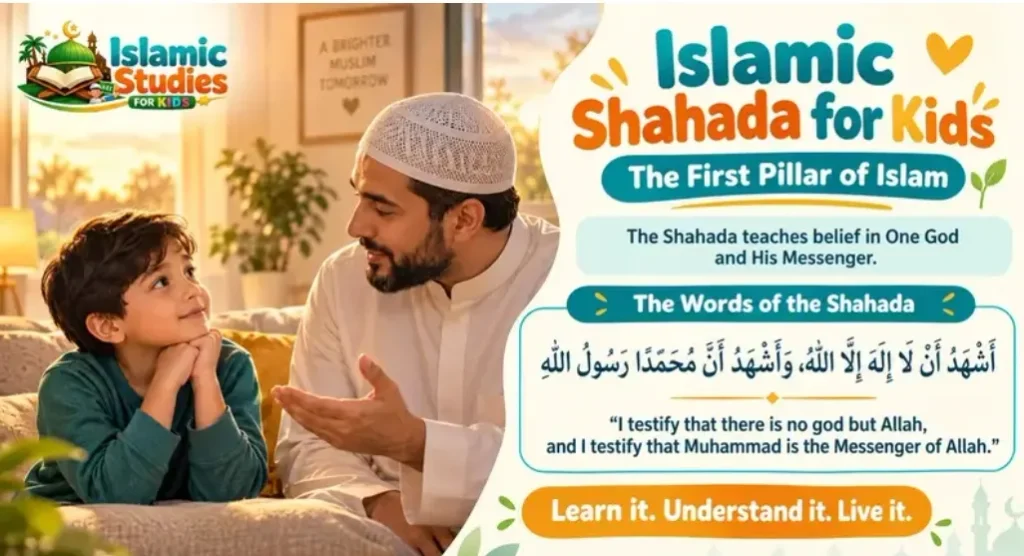
These are the words of the Shahada as Muslims say them. They are a declaration of faith, not a verse of the Quran:
Ash-hadu an lā ilāha illallāh, wa ash-hadu anna Muḥammadan rasūlullāh.
“I bear witness that there is no god worthy of worship except Allah, and I bear witness that Muhammad is the Messenger of Allah.”
The Words of the Shahada Explained Word by Word
Breaking the Shahada into small pieces helps children understand each word instead of repeating sounds they do not know. The table below shows each phrase of the Shahada with its pronunciation and a child-friendly meaning.
Arabic
Transliteration
Simple Meaning for Kids
أَشْهَدُ
Ash-hadu
I bear witness / I truly believe and say
أَنْ لَا إِلَٰهَ
An lā ilāha
That there is no god (no one to worship)
إِلَّا اللَّهُ
Illallāh
Except Allah
وَأَشْهَدُ أَنَّ مُحَمَّدًا
Wa ash-hadu anna Muḥammadan
And I bear witness that Muhammad ﷺ
رَسُولُ اللَّهِ
Rasūlullāh
Is the Messenger of Allah
Shahada Meaning for Children: A Simple Explanation
The meaning of the Shahadah for children can be explained in one simple sentence: Allah alone is the Creator of everything and the only One worthy of worship, and Prophet Muhammad ﷺ is His Messenger, whom Allah sent to teach us how to worship Him.
This simple explanation helps children understand the two main parts of the declaration of faith. Each part also answers important questions children may naturally ask, such as who created the world, why we worship Allah alone, and who taught us how to follow Islam.
Experience a Real Classroom
Curious about how we teach? This video offers a glimpse into a real class, showcasing our interactive approach, qualified teachers, and child-friendly learning experience.
Fun & Engaging Islamic Classes for Kids
Start your child’s journey today with interactive lessons designed to make learning Islam loved and easy.
The word “Ash-hadu” means “I bear witness” or “I testify.” In the Shahadah, bearing witness means accepting the truth in your heart, declaring it with your tongue, and showing your belief through your actions.
You can explain this meaning to children in simple words: “I know it is true, I say it out loud, and I try to live by it.” This helps young learners understand that the Shahadah is more than words we repeat; it is a belief that guides the way we worship Allah and behave every day.
Why the Two Parts of the Shahada Go Together
The two parts of the Shahada are connected. The first part, “La ilaha illallah,” teaches that worship belongs to Allah alone.
The second part, “Muhammadun Rasulullah,” teaches that we worship Allah the way Prophet Muhammad ﷺ showed us. Children can remember it as: “Who do we worship? Allah. How do we worship? Like the Prophet ﷺ.”
Why the Shahada Is the First Pillar of Islam for Kids
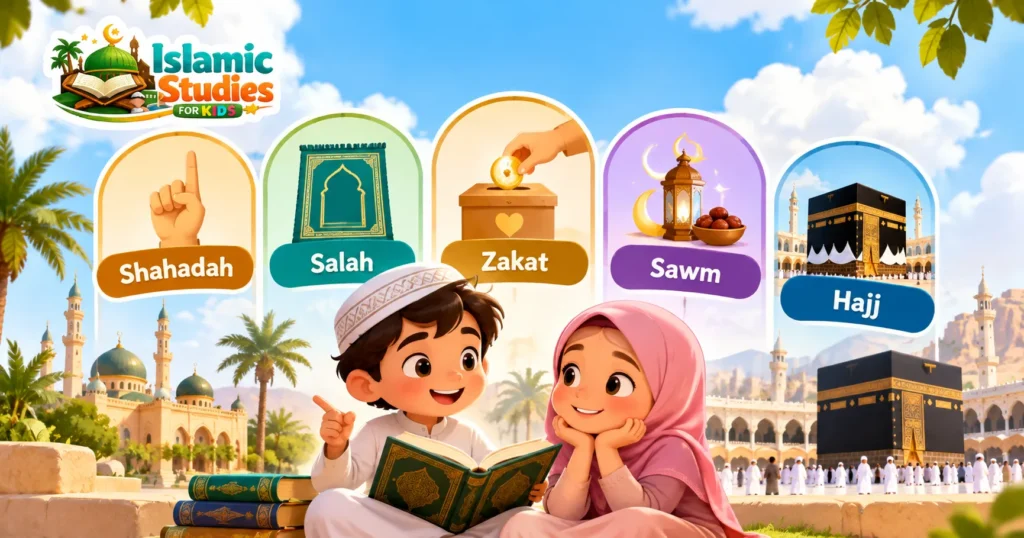
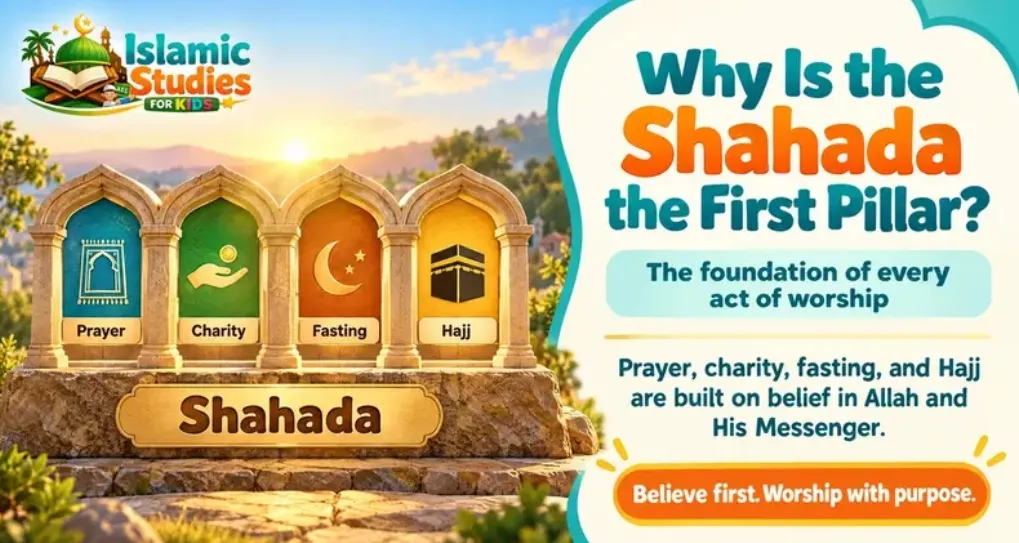
The Shahada is the first pillar of Islam for kids and adults alike, because every other act of worship is built on it. Prayer, charity, fasting, and Hajj are only meaningful when a person first believes in Allah and His Messenger ﷺ.
Prophet Muhammad ﷺ described Islam as a building standing on five pillars, with the Shahada listed first:
بُنِيَ الإِسْلاَمُ عَلَى خَمْسٍ شَهَادَةِ أَنْ لاَ إِلَهَ إِلاَّ اللَّهُ وَأَنَّ مُحَمَّدًا رَسُولُ اللَّهِ، وَإِقَامِ الصَّلاَةِ، وَإِيتَاءِ الزَّكَاةِ، وَالْحَجِّ، وَصَوْمِ رَمَضَانَ “Allah’s Messenger (ﷺ) said: Islam is based on (the following) five (principles): 1. To testify that none has the right to be worshipped but Allah and Muhammad is Allah’s Messenger. 2. To offer the (compulsory congregational) prayers dutifully and perfectly. 3. To pay Zakat (i.e. obligatory charity). 4. To perform Hajj (i.e. Pilgrimage to Mecca). 5. To observe fast during the month of Ramadan.” Sahih al-Bukhari 8
Once children understand the first pillar, they are ready to learn the rest. You can continue with this guide to the 5 pillars of Islam in order for kids, which explains each pillar in a simple sequence.
What “La Ilaha Illallah” Means for Kids
“La ilaha illallah” means “There is no god worthy of worship except Allah.” This statement expresses the core of Tawhid (التوحيد), the Islamic belief that Allah is One and has no partners. It teaches children that Allah alone deserves their prayers, du’a, and worship.
They should also learn to place their trust in Him, ask Him for help, and remember that He is the Creator and Sustainer of everything. Understanding this part of the Shahadah helps children build a strong foundation in their belief in Allah.
Children may ask questions about where Allah is and how He sees us after learning “La ilaha illallah.” Parents can use this simple guide to explain where Allah is to kids gently and accurately.
As children grow, an Aqeedah course for kids can help them understand Tawhid and the other pillars of faith step by step.
Saying “No” and Saying “Yes” in La Ilaha Illallah
Scholars explain that “La ilaha illallah” has two parts. “La ilaha” (no god) is a denial: it rejects worship of anything other than Allah, such as idols, the sun, the moon, or people. “Illallah” (except Allah) is an affirmation: it declares that all worship belongs to Allah alone.
For children, this becomes an easy game of “No” and “Yes.” No to worshipping stones, stars, or anything Allah created. Yes to worshipping Allah, the One who created them all.
Allah Is the Creator, the Provider, and the Only One We Worship
Children understand “La ilaha illallah” best when it is linked to the world around them. Allah created the sun, the rain, the trees, animals, and every person. He gives us food, water, family, and health. Because He alone created and provides, He alone deserves worship.
The Quran explains that Allah is the only true God, and that anything people worship besides Him is false:
ذَٰلِكَ بِأَنَّ اللَّهَ هُوَ الْحَقُّ وَأَنَّ مَا يَدْعُونَ مِن دُونِهِ هُوَ الْبَاطِلُ وَأَنَّ اللَّهَ هُوَ الْعَلِيُّ الْكَبِيرُ “That is because Allah is the Truth, and that what they call upon other than Him is falsehood, and because Allah is the Most High, the Grand.” Surah Al-Hajj (22:62)
What “Muhammadun Rasulullah” Means for Kids
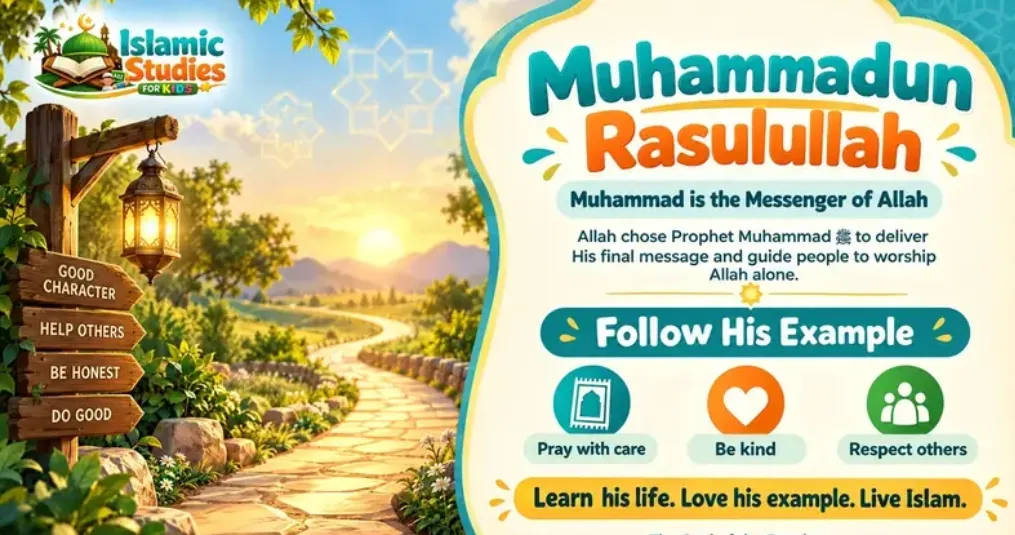
“Muhammadun Rasulullah” means “Muhammad is the Messenger of Allah.” This part of the Shahadah teaches children that Allah chose Prophet Muhammad ﷺ to deliver His final message and guide people to worship Allah alone.
He taught Muslims how to pray, behave kindly, treat others with respect, and follow Allah’s commands through his words and actions. It also teaches children that Prophet Muhammad ﷺ is the Seal of the Prophets, meaning he is the last prophet sent by Allah and no new prophet will come after him.
By learning about his life and following his example, children can develop a deeper love for the Prophet ﷺ and understand how to practice Islam in their everyday lives.
مَّا كَانَ مُحَمَّدٌ أَبَا أَحَدٍ مِّن رِّجَالِكُمْ وَلَٰكِن رَّسُولَ اللَّهِ وَخَاتَمَ النَّبِيِّينَ ۗ وَكَانَ اللَّهُ بِكُلِّ شَيْءٍ عَلِيمًا “Muhammad is not the father of [any] one of your men, but [he is] the Messenger of Allah and last of the prophets. And ever is Allah, of all things, Knowing.” Surah Al-Ahzab (33:40)
Believing and Obeying the Prophet ﷺ
Bearing witness that Muhammad ﷺ is the Messenger of Allah means believing what he told us and following what he taught. The Quran connects obeying the Prophet ﷺ directly with obeying Allah:
مَّن يُطِعِ الرَّسُولَ فَقَدْ أَطَاعَ اللَّهَ ۖ وَمَن تَوَلَّىٰ فَمَا أَرْسَلْنَاكَ عَلَيْهِمْ حَفِيظًا “He who obeys the Messenger has obeyed Allah; but those who turn away – We have not sent you over them as a guardian.” Surah An-Nisa (4:80)
For children, this can be shown through everyday Sunnah habits: saying Bismillah before eating, eating with the right hand, smiling, being honest, and being kind to parents. Each habit is a small way of living the second part of the Shahada.
Loving Prophet Muhammad ﷺ
Loving the Prophet ﷺ is part of the Shahada and part of faith itself. Prophet Muhammad ﷺ taught that a believer’s love for him should be greater than love for anyone else:
لاَ يُؤْمِنُ أَحَدُكُمْ حَتَّى أَكُونَ أَحَبَّ إِلَيْهِ مِنْ وَالِدِهِ وَوَلَدِهِ وَالنَّاسِ أَجْمَعِينَ “None of you will have faith till he loves me more than his father, his children and all mankind.” Sahih al-Bukhari 15
Children grow to love the Prophet ﷺ when they know his story: his honesty as a child, his kindness to animals, and his mercy to everyone. Lessons in Islamic history and Seerah for kids bring these stories to life in a way children remember.
Fun & Engaging Islamic Classes for Kids
Start your child’s journey today with interactive lessons designed to make learning Islam loved and easy.
Kalima for Kids: Is the Shahada the Same as the First Kalima?
In many Muslim homes, especially in South Asia, children learn the Shahada through a set known as the “Six Kalimas.” Learning the Kalima for kids in this way is a common teaching tradition.
The grouping of six Kalimas is not found as a list in the Quran or Hadith, but the core words are part of authentic Islamic belief.
The First Kalima, called Kalima Tayyibah (the good word), is: “La ilaha illallahu Muhammadur Rasulullah” (There is no god but Allah, Muhammad is the Messenger of Allah).
The Second Kalima, called Kalima Shahadah, adds the words “Ash-hadu” (I bear witness), which matches the form of the Shahada used in the adhan and prayer.
When Do Muslims Say the Shahada?
Muslims say the Shahada many times every day, which gives children plenty of chances to hear and practice it. Pointing out these moments helps children see the Shahada as part of daily life, not just a memorized lesson.
In the adhan and iqamah: the call to prayer includes the Shahada, so children hear it five times a day.
In every prayer: Muslims recite the Shahada in the Tashahhud while sitting in salah.
When entering Islam: a person becomes Muslim by sincerely declaring the Shahada.
In daily remembrance: many Muslims repeat “La ilaha illallah” as dhikr throughout the day.
Since the Shahada appears in the adhan and the Tashahhud, it is a natural bridge to learning how to pray. Lessons in Fiqh for kids teach children wudu, salah, and the practical rules of worship that follow the Shahada.
How to Teach the Shahada to Kids: Fun and Simple Methods
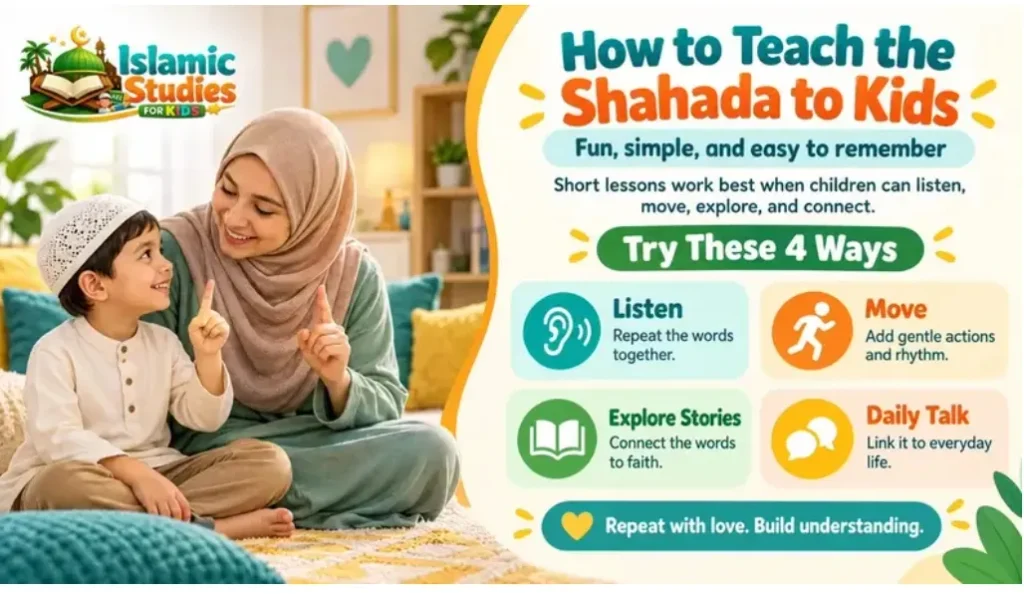
Teaching the Shahadah to kids works best through short, repeated, and enjoyable lessons. Young children learn more easily when they can listen, move, explore stories, and connect new information to their daily routines.
Parents can use simple activities, songs without inappropriate content, and everyday conversations to introduce the words and meaning of the Shahadah.
Combining these methods helps children remember the declaration of faith, understand its importance, and gradually develop a stronger connection with Allah and their Islamic identity.
1. Repeat the Shahadah Daily
Daily repetition is one of the easiest ways to help children memorize the Shahadah and become familiar with its words. Say it together after waking up, before going to sleep, or after Salah. Keep these moments short, cheerful, and relaxed, and praise your child whenever they make an effort.
With regular practice and gentle encouragement, children gradually become more confident in saying the Shahadah correctly and remembering its importance.
2. Teach the Meaning One Part at a Time
Children understand the Shahadah better when its meaning is introduced in small, simple steps. Spend a few days explaining “La ilaha illallah” before moving on to “Muhammadun Rasulullah.” Use familiar examples and ask easy questions, such as “Who created the sun, moon, and stars?”
Give your child time to think and answer, then explain how the answer connects to believing in Allah alone. This gradual approach makes learning easier and helps children understand what they are memorizing.
3. Use Stories from the Quran
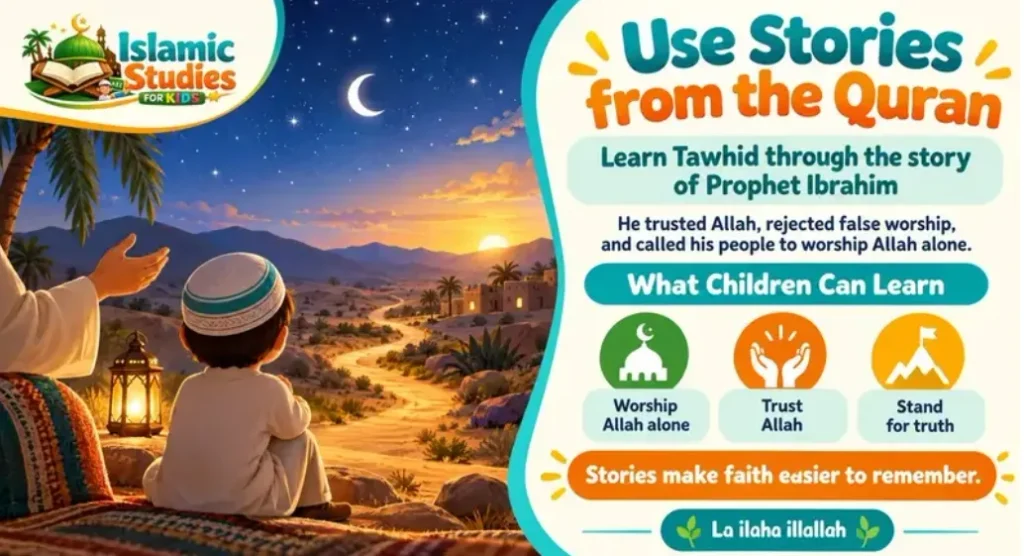
Stories of the Prophets make the meaning of Tawhid easier for children to understand and remember. The story of Prophet Ibrahim (peace be upon him), who rejected the idols worshipped by his people and called them to worship Allah alone, is a powerful example of “La ilaha illallah” in action.
Parents can share this story using simple language and explain why Prophet Ibrahim trusted Allah and refused to worship anything besides Him. Such stories help children connect the words of the Shahadah with real examples of faith and courage.
4. Connect the Shahadah to Allah’s Blessings
Children develop gratitude and love for Allah when they learn to recognize His blessings in their everyday lives. During meals, family walks, or rainy days, take a moment to point out the beautiful things around them and explain that Allah is the One who provides these blessings.
You can say, “Allah gave us this delicious food” or “Allah created the beautiful trees.” These small conversations help children understand the meaning of the Shahadah beyond memorization and encourage them to remember and thank Allah throughout the day.
Watch a Sample Lesson from Our Academy Get a firsthand look at how our students learn Islamic values, Quran, and essential knowledge through engaging and interactive online classes. See why families trust Islamic Studies for Kids Academy.
5. Use Coloring Pages, Crafts, and Nasheeds
Visual and hands-on activities can make learning the Shahadah more enjoyable, especially for younger children. Let them color the Arabic words, create a simple poster about Tawhid, or build a house representing the Five Pillars of Islam using paper and craft materials.
You can also introduce gentle nasheeds about believing in Allah and His Oneness. Choose age-appropriate materials with accurate Islamic information so children can enjoy learning while remembering the meaning of the Shahadah.
6. Be the Example Your Child Sees
Children often learn more from their parents’ actions than from lengthy explanations. When they see you performing Salah on time, saying “Alhamdulillah,” speaking honestly, and treating others with kindness, they begin to understand how Islamic beliefs influence everyday behavior.
Try to make your actions consistent with the values you teach, and involve your child in simple acts of worship and kindness. Your positive example helps children see that the Shahadah is not just something Muslims say but a declaration of faith that guides their lives.
Common Mistakes Parents Make When Teaching the Shahada
Some common teaching mistakes can make it harder for children to understand the Shahadah and appreciate its meaning. By avoiding these mistakes, parents can make learning easier, more enjoyable, and more meaningful.
A gentle approach based on patience, simple explanations, and positive encouragement helps children develop a strong and loving connection with Allah and their Islamic faith.
Memorization without meaning: children may recite the words without knowing what they are saying.
Teaching through fear only: focusing only on punishment can make faith feel heavy instead of loving.
Rushing the lesson: long sessions tire young children; a few minutes a day works better.
Mixing culture with belief: teach what comes from the Quran and authentic Sunnah, and keep cultural habits separate.
Fun & Engaging Islamic Classes for Kids
Start your child’s journey today with interactive lessons designed to make learning Islam loved and easy.
Help Your Child Learn the Shahada and Islamic Studies with Expert Teachers
Teaching the first pillar of Islam to kids becomes easier with the right support. Qualified teachers use interactive lessons, stories, and activities to help children understand the Shahadah, develop love for Allah and His Messenger ﷺ, and build strong Islamic knowledge step by step.
Explore the live online classes at Islamic Studies for Kids, where children learn Aqeedah, Fiqh, Seerah, and Islamic manners in a friendly, age-appropriate environment. Book a free trial class today and give your child an enjoyable learning experience!
Enroll today and give your child the knowledge, values, and confidence to grow as a practicing Muslim with a strong connection to Allah and His teachings.
Conclusion
The Shahadah is the first and most important lesson in a child’s Islamic education. Its two parts teach children that Allah alone deserves worship and that Prophet Muhammad ﷺ is His final Messenger, whose teachings and example guide Muslims in worshipping Allah and following the right path.
As the first pillar of Islam, the Shahadah forms the foundation for all other acts of worship. Whether children hear it called the Shahadah or the Kalimah, understanding its meaning is more important than simply memorizing its words.
Teaching it through patience, simple explanations, meaningful stories, and love helps children develop a strong connection with their faith that stays with them as they grow.
Frequently Asked Questions About the Shahada for Kids
What is the Shahada in simple words for kids?
The Shahada is the Muslim statement of faith. In simple words, it means: “Only Allah deserves to be worshipped, and Prophet Muhammad ﷺ is Allah’s Messenger.” It is the first thing a Muslim believes.
Why is the Shahada the first pillar of Islam?
The Shahada is the first pillar of Islam because all other pillars depend on it. Prophet Muhammad ﷺ listed it first when he described Islam as built on five pillars, as reported in Sahih al-Bukhari 8.
At what age should children learn the Shahada?
Children can begin hearing and repeating the Shahada from a very young age. Many parents start teaching the words around ages 2 to 4 and gradually explain the meaning as the child’s understanding grows.
Is the Kalima the same as the Shahada?
Yes, in meaning. The First Kalima (Kalima Tayyibah) and the Second Kalima (Kalima Shahadah) carry the same belief as the Shahada. The second Kalima uses the words “Ash-hadu,” matching the Shahada recited in the adhan and prayer.
What does “Rasulullah” mean?
“Rasulullah” means “the Messenger of Allah.” It refers to Prophet Muhammad ﷺ, whom Allah sent with the final message of Islam. The Quran describes him as the last of the prophets in Surah Al-Ahzab (33:40).
 Islamic Studies





Leave a Reply