 Islamic Studies
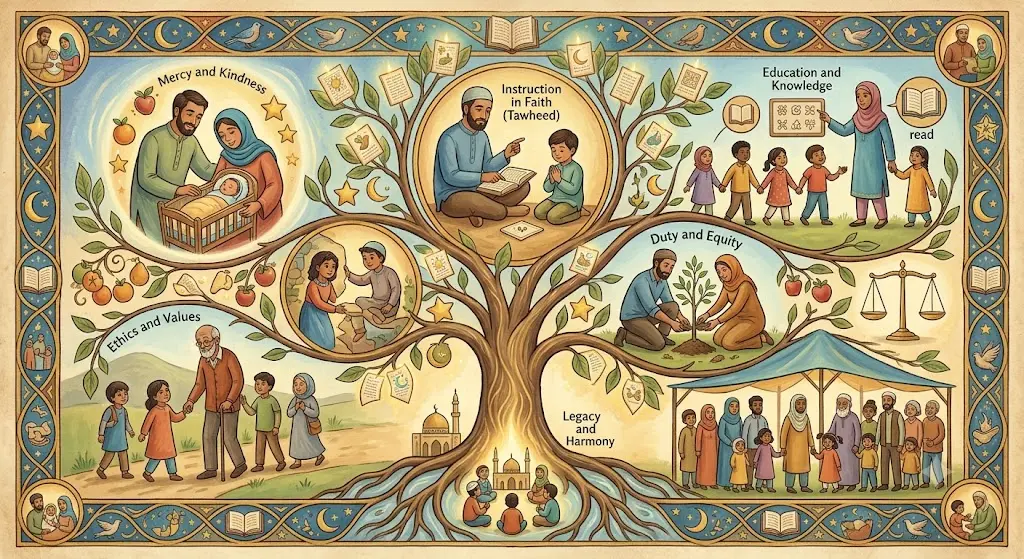
Every Muslim parent wants their child to grow up with strong faith, good character, and a clear sense of who they are. But in a world full of competing influences, that outcome doesn’t happen by accident — it requires intentional, consistent Islamic education from an early age.
Understanding how Islamic studies cultivates children goes beyond reciting a list of benefits. It means knowing why certain approaches work, what changes in a child at each stage of development, and how to avoid the most common mistake parents make: prioritizing memorization over genuine understanding.
This article gives you a complete, practical picture of what Islamic studies actually does for your child — and how to make it work at home and through structured learning.
1. Age Shapes How Islamic Studies Reaches Each Child
Islamic education is not a single subject. It is a layered process that shapes a child differently depending on their age, cognitive stage, and emotional readiness.
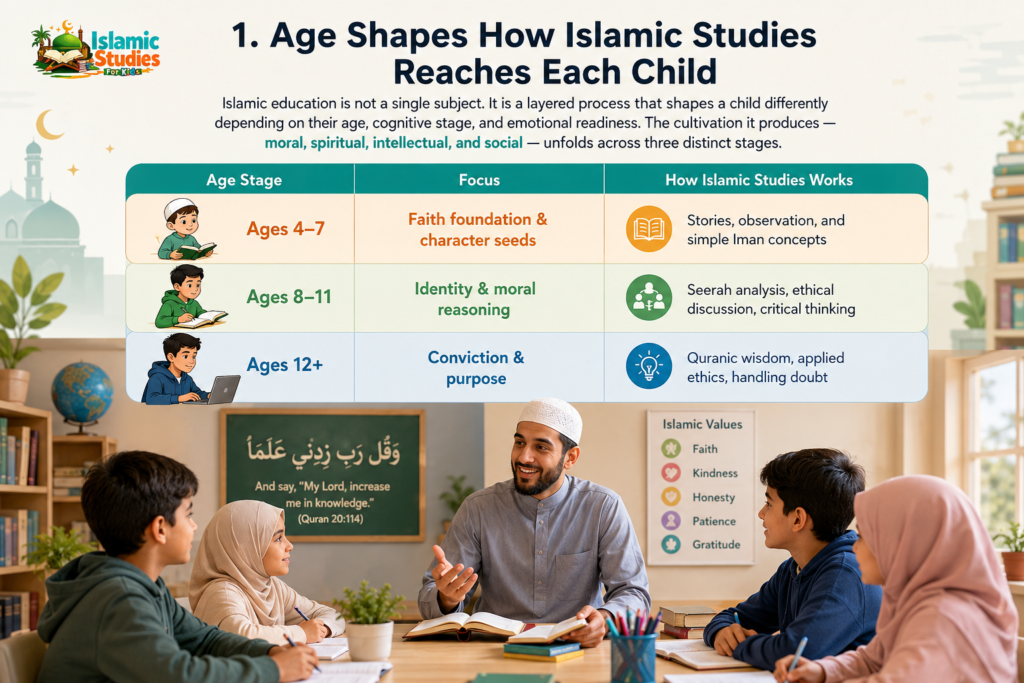
The cultivation it produces — moral, spiritual, intellectual, and social — unfolds across three distinct stages.
| Age Stage | Focus | How Islamic Studies Works |
| Ages 4–7 | Faith foundation & character seeds | Stories, observation, and simple Iman concepts |
| Ages 8–11 | Identity & moral reasoning | Seerah analysis, ethical discussion, critical thinking |
| Ages 12+ | Conviction & purpose | Quranic wisdom, applied ethics, handling doubt |
At ages 4–7, children learn almost entirely through observation and story. The Six Pillars of Iman, introduced through simple age-appropriate language, give young children their first framework for understanding who Allah is, why they pray, and what being Muslim means. Research in child development consistently shows that children under seven absorb values from what they see far more reliably than from what they are told.
Between eight and eleven, children move from absorbing values passively to actively reasoning about them. This is the stage where Seerah stories become especially powerful — the Migration to Madinah teaches planning and trust in Allah; the Conquest of Makkah teaches forgiveness and the strength of mercy; the Battle of Badr teaches reliance on Allah alongside sincere effort.
At twelve and above, Islamic education either deepens into genuine conviction or fades into habit without meaning. Teenagers need to understand the wisdom behind Islamic practices, not just the obligation — and a well-designed intensive Islamic studies program at this stage gives them the tools to handle doubt, articulate their faith confidently, and apply Islamic ethics in schools, friendships, and online environments.
2. A Strong Foundation of Iman Starts Here
Learning about Allah — His oneness, His attributes, and His relationship with creation — gives children an anchor. A child who knows why they exist and who they are accountable to has something no external achievement can replace: a settled sense of purpose.
The Six Pillars of Iman, when taught with explanation rather than rote recitation, each deliver a specific developmental benefit:
| Pillar of Iman | What It Builds in a Child |
| Belief in Allah’s Oneness | A clear sense of purpose and accountability |
| Belief in Angels | Awareness that actions are witnessed and recorded |
| Belief in Allah’s Books | Connection to divine, timeless guidance |
| Belief in All Prophets | Role models across history to learn from |
| Belief in the Day of Judgement | Motivation to act with integrity now |
| Belief in Qadar | Emotional resilience when things don’t go as planned |
3. Character Grows Through Stories, Not Abstract Rules
Islam is a complete ethical system, and Islamic studies makes that system accessible to children through stories, Sunnah examples, and Quranic guidance.
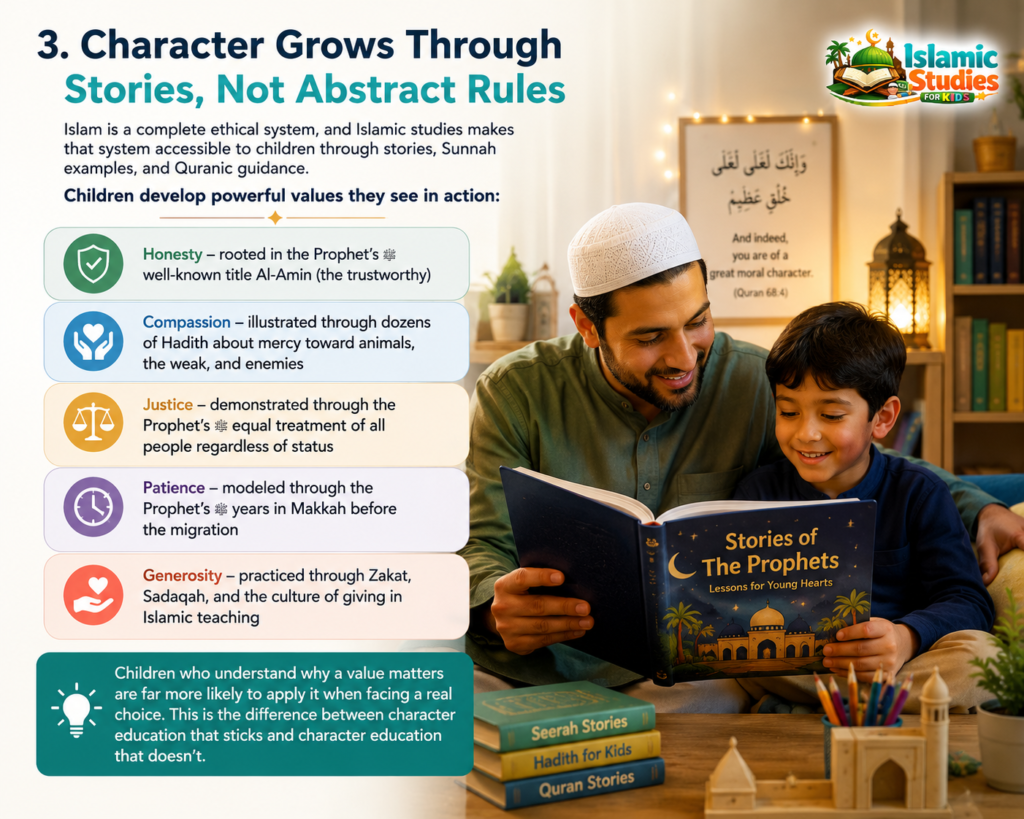
Children who learn through Islamic studies develop the following values — not as abstract concepts, but as behaviors they have seen demonstrated in real situations:
- Honesty — rooted in the Prophet’s ﷺ well-known title Al-Amin (the trustworthy)
- Compassion — illustrated through dozens of Hadith about mercy toward animals, the weak, and enemies
- Justice — demonstrated through the Prophet’s ﷺ equal treatment of all people regardless of status
- Patience — modeled through the Prophet’s ﷺ years in Makkah before the migration
- Generosity — practiced through Zakat, Sadaqah, and the culture of giving in Islamic teaching
The practical effect is significant: children who understand why a value matters are far more likely to apply it when facing a real choice. This is the difference between character education that sticks and character education that doesn’t.
4. Children Develop a Clear Muslim Identity Early
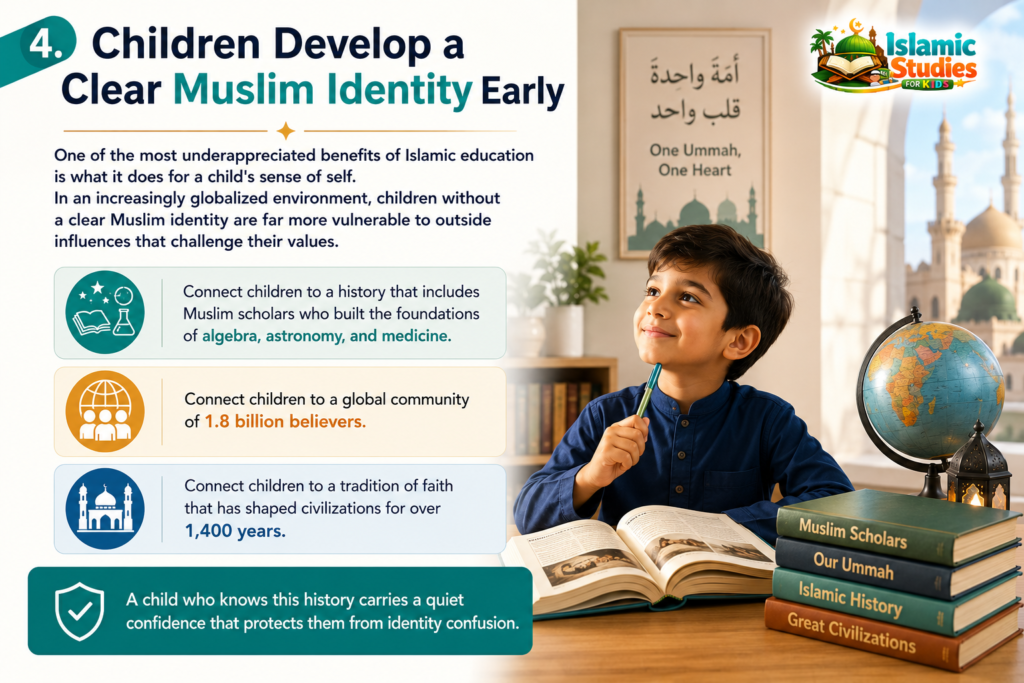
One of the most underappreciated benefits of Islamic education is what it does for a child’s sense of self. In an increasingly globalized environment, children without a clear Muslim identity are far more vulnerable to outside influences that challenge their values.
The basics of Islamic studies — taught well and early — connect children to a history that includes Muslim scholars who built the foundations of algebra, astronomy, and medicine; to a global community of 1.8 billion believers; and to a tradition of faith that has shaped civilizations for over 1,400 years. A child who knows this history carries a quiet confidence that protects them from identity confusion.
5. Critical Thinking and Faith Grow Together
Islam actively encourages asking questions, reflecting on creation, and seeking knowledge. Islamic education that is done well — where children are encouraged to discuss, question, and connect Quranic guidance to real situations — develops critical thinking skills alongside faith.
When a child asks why the Prophet ﷺ forgave the people of Makkah after their years of persecution, they are not just learning history. They are reasoning through justice, power, mercy, and leadership in ways that develop their analytical capacity alongside their character.
Read also: The Blessings of Daughters in Islam — What the Quran and Hadith Really Say
Experience a Real Classroom
Curious about how we teach? This video offers a glimpse into a real class, showcasing our interactive approach, qualified teachers, and child-friendly learning experience.
Fun & Engaging Islamic Classes for Kids
Start your child’s journey today with interactive lessons designed to make learning Islam loved and easy.
Get Your Child a Free Trial6. Children Find Belonging in Something Larger Than Themselves
A child who understands Islamic teachings knows they belong to something larger than their family, school, or neighborhood. The social dimension of Islamic education produces outcomes that are rarely discussed but deeply important:
- A ready-made community of shared values wherever they travel or move
- A framework for building friendships with other Muslims based on shared purpose
- Emotional security that comes from knowing they are part of something enduring and meaningful
7. Memorization Without Meaning Is Where Most Parents Go Wrong
The single most frequent failure in teaching Islam to children is prioritizing memorization over understanding.
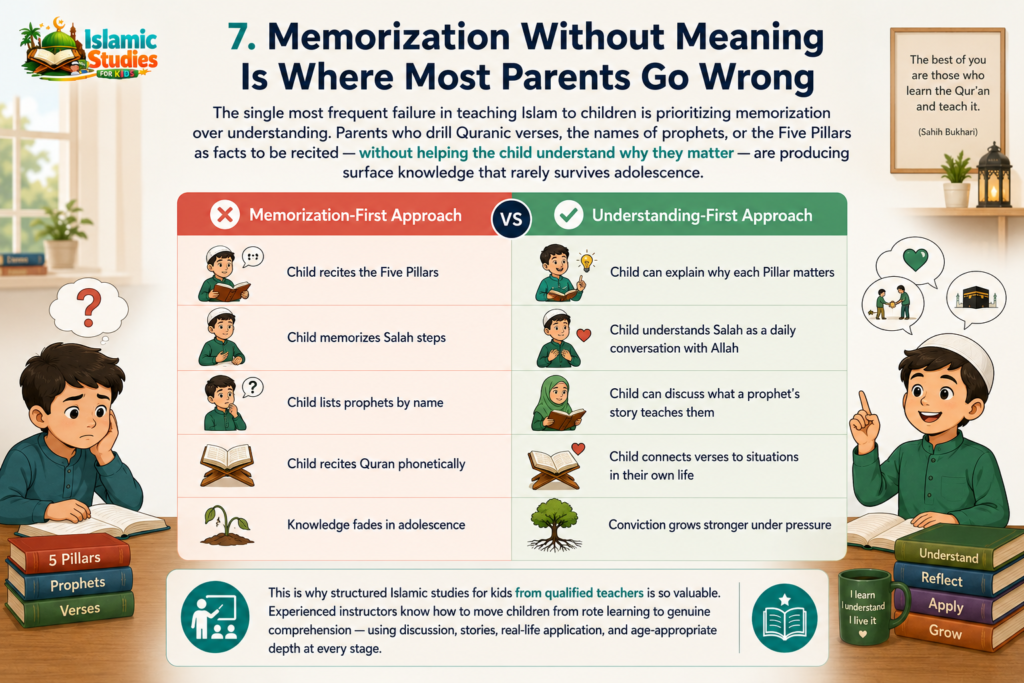
Parents who drill Quranic verses, the names of prophets, or the Five Pillars as facts to be recited — without helping the child understand why they matter — are producing surface knowledge that rarely survives adolescence.
| Memorization-First Approach | Understanding-First Approach |
| Child recites the Five Pillars | Child can explain why each Pillar matters |
| Child memorizes Salah steps | Child understands Salah as a daily conversation with Allah |
| Child lists prophets by name | Child can discuss what a prophet’s story teaches them |
| Child recites Quran phonetically | Child connects verses to situations in their own life |
| Knowledge fades in adolescence | Conviction grows stronger under pressure |
This is why structured Islamic studies for kids from qualified teachers is so valuable. Experienced instructors know how to move children from rote learning to genuine comprehension — using discussion, stories, real-life application, and age-appropriate depth at every stage.
8. Parents Who Model Islamic Values Double the Impact
The highest-leverage action any parent can take is modeling — practicing Islamic values visibly so children absorb them naturally. Formal Islamic studies delivers its full benefit only when it is reinforced at home.
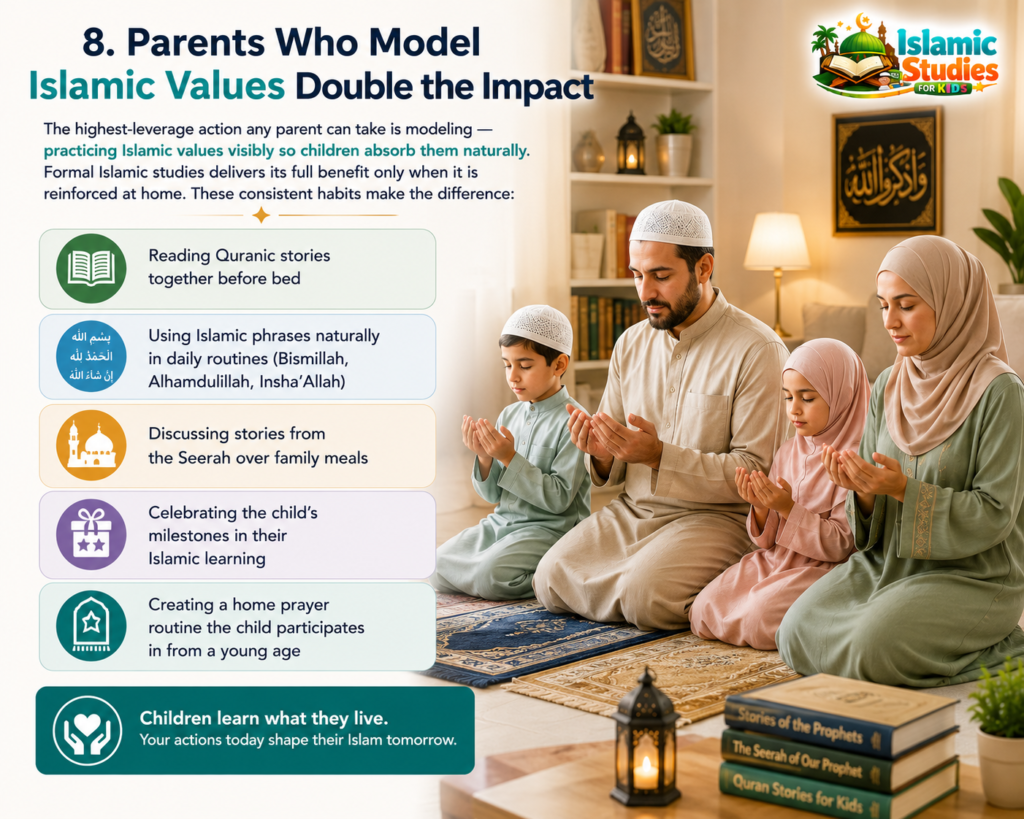
- Reading Quranic stories together before bed
- Using Islamic phrases naturally in daily routines (Bismillah, Alhamdulillah, Insha’Allah)
- Discussing stories from the Seerah over family meals
- Celebrating the child’s milestones in their Islamic learning
- Creating a home prayer routine the child participates in from a young age
9. The Right Program Depends on the Child’s Stage
The two program types are not interchangeable — they serve different stages of a child’s readiness. The Islamic studies basics program covers core concepts: the pillars of Iman and Islam, the names of Allah, stories of the prophets, and foundational daily practices. The intensive program goes deeper, covering Quranic meaning, Seerah in full context, Islamic ethics, and applied understanding for older or more advanced children.
Choosing the wrong level in either direction — too advanced too early, or too basic for a child who is ready for depth — is one of the most common reasons children disengage from Islamic education. Matching the program to the child’s actual stage is the foundation of effective Islamic learning.
10. Understanding First — That Is What Makes Islamic Education Stick
Finding the right Islamic education for your child is not just about picking a program — it is about choosing a learning environment that matches how children actually grow in faith. Islamic Studies for Kids is built around one core belief: that genuine understanding always produces stronger results than memorization alone.
Every course is designed to meet your child at their exact stage — whether they are just beginning with the basics program or ready for a deeper intensive program — with qualified teachers who know how to make Islamic values real, relatable, and lasting for young learners.
Read also: Islamic Gifts for Kids — Best Ideas for Parents
Watch a Sample Lesson from Our Academy
Get a firsthand look at how our students learn Islamic values, Quran, and essential knowledge through engaging and interactive online classes. See why families trust Islamic Studies for Kids Academy.
Why Choose Islamic Studies for Kids for Your Child?
Finding the right Islamic education for your child is not just about picking a program — it is about choosing a learning environment that matches how children actually grow in faith. Islamic Studies for Kids is built around one core belief: that genuine understanding always produces stronger results than memorization alone.
Every course is designed to meet your child at their exact stage — whether they are just beginning or ready for a deeper, more structured program — with qualified teachers who know how to make Islamic values real, relatable, and lasting for young learners.

Our Islamic Studies Courses for Kids:
- Quran for Kids
- Noorani Qaida for Kids
- Quran Recitation for Kids
- Tajweed for Kids
- Quran Memorization (Hifz) for Kids
- Quran for Toddlers
- Quranic Arabic for Kids
- Quran Stories for Kids
Fun & Engaging Islamic Classes for Kids
Start your child’s journey today with interactive lessons designed to make learning Islam loved and easy.
Get Your Child a Free TrialConclusion
Islamic studies cultivates children in ways that no other subject can replicate — building faith, character, identity, critical thinking, and a sense of purpose that guides them across every area of life. But the quality of that cultivation depends entirely on how Islamic education is delivered.
The goal is not a child who can recite the right answers. It is a child who carries Islamic values naturally, loves their faith, and has the tools to live it with confidence — at every age and in every environment they encounter.
Frequently Asked Questions
What does Islamic studies do for a child’s development?
Islamic studies develops a child on four levels simultaneously: moral (teaching values through Quranic guidance and the Sunnah), spiritual (building a direct relationship with Allah), intellectual (encouraging questioning and reflection), and social (connecting them to the Muslim community and a sense of belonging).
At what age should a child start Islamic studies?
Children can begin Islamic education as early as age four, starting with simple stories, basic concepts about Allah, and daily practices like prayer by observation. The earlier the foundation is built, the more naturally Islamic values become part of who the child is.
Why is Islamic studies important for children who grow up in non-Muslim majority countries?
Children in non-Muslim majority environments face strong outside influences that can challenge their values and identity. Solid Islamic education gives them a clear, confident Muslim identity, the tools to articulate their faith, and a moral framework that holds steady regardless of what they encounter at school or in social settings.
What is the difference between Islamic studies basics and an intensive program?
The basics program covers the pillars of Iman and Islam, the names of Allah, stories of the prophets, and foundational practices. The intensive program goes deeper — Quranic meaning, Seerah in context, Islamic ethics, and applied understanding for older or more advanced children.
How can parents reinforce Islamic studies at home?
The highest-leverage action is modeling — practicing Islamic values visibly so children absorb them naturally. Beyond that: read Quranic stories together before bed, use Islamic phrases in daily routines, discuss Seerah stories over family meals, and celebrate milestones in your child’s Islamic learning.


Leave a Reply