 For Parents
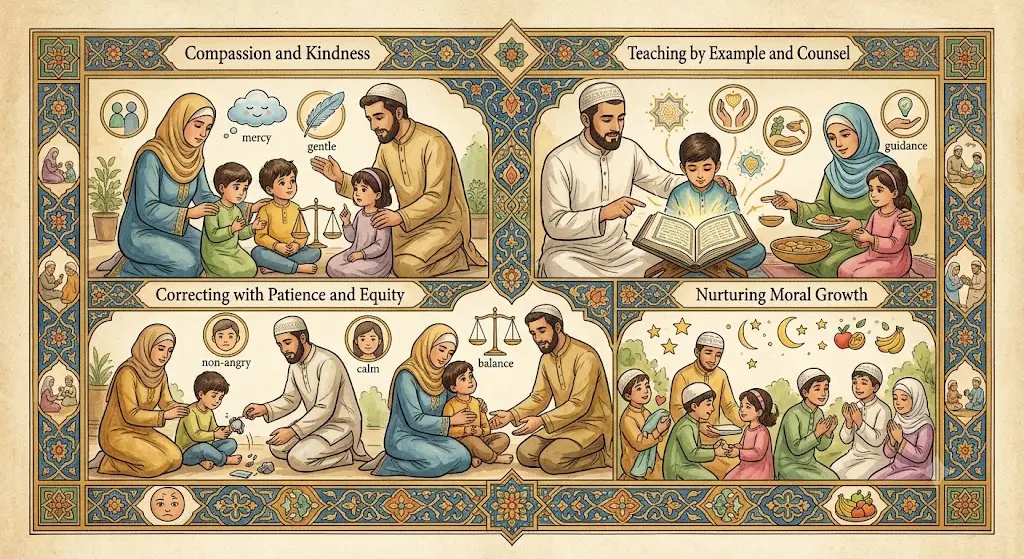
Many Muslim parents face the same quiet tension: their child misbehaves, and they want to correct them firmly — but they also want to make sure they are raising their child the right Islamic way. What does Islam actually say about disciplining children? Is there a line between guidance and harm? And what does the Quran have to say about it?
Islamic discipline is built on a concept called ta’deeb — from the Arabic root adab, meaning the refinement of character, the training of the soul, and guiding someone toward moral excellence. Disciplining a child in Islam, therefore, is not about punishment or control. It is an act of love, responsibility, and long-term care.
Classical scholars define ta’deeb as “training the soul through education and refinement toward what is right.” This means a parent who disciplines their child is not exercising power — they are fulfilling a duty before Allah.
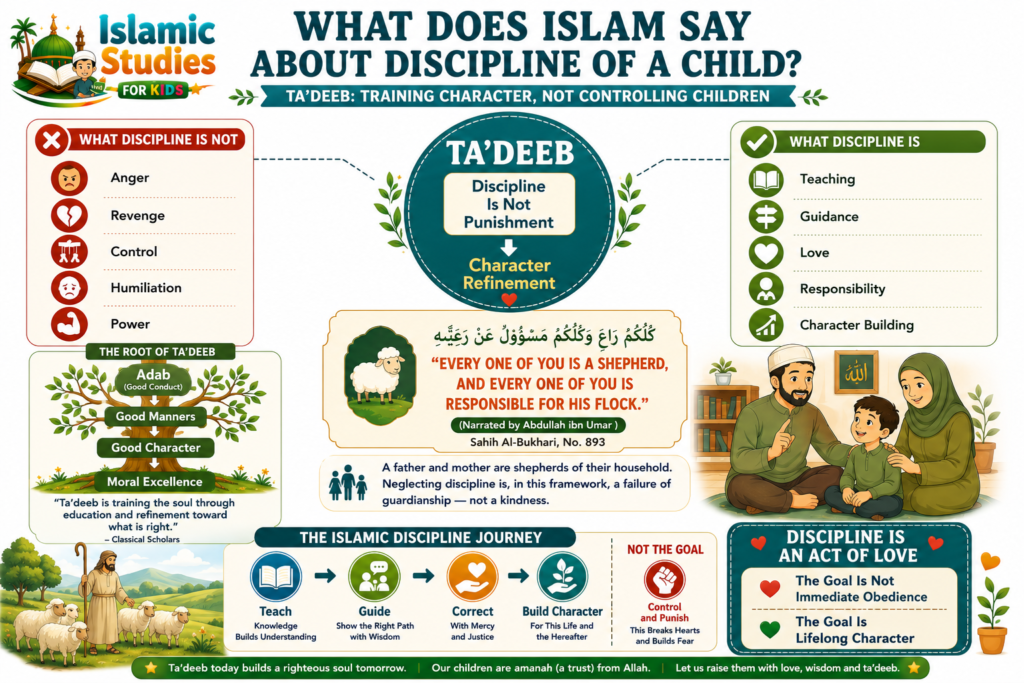
The Prophet ﷺ made this responsibility explicit. In a hadith recorded by both Al-Bukhari and Muslim:
“كُلُّكُمْ رَاعٍ وَكُلُّكُمْ مَسْؤُولٌ عَنْ رَعِيَّتِهِ” “Every one of you is a shepherd, and every one of you is responsible for his flock.” (Narrated by Abdullah ibn Umar — Sahih Al-Bukhari, No. 893)
A father and mother are shepherds of their household. Neglecting discipline is, in this framework, a failure of guardianship — not a kindness.
1. Discipline Is a Fundamental Part of Islamic Upbringing
The Islamic scholars identified several reasons why disciplining children is not just permitted but required. The following points summarise the core wisdom behind ta’deeb:
- It produces righteous character. A child who grows up without guidance loses the opportunity to develop good values, self-control, and moral awareness.
- It is a right the child has over the parent. Islamic jurisprudence frames ta’deeb as something owed to the child — not imposed on them. When a child grows up, they will recognize and appreciate the care their parents took.
- It creates justice among siblings. When a child who misbehaves faces consequences in front of peers or siblings, others are deterred from the same mistake — and fairness is maintained.
- Its outcomes are long-term. The goal of Islamic discipline is that the child grows into an adult who fulfills their rights toward Allah, toward their parents, and toward society.
2. The Quran Establishes the Foundation for Child Discipline
The Quran does not give parents a direct command to discipline their children in the way it does for other relationships, but it establishes the foundational obligation that makes discipline necessary. Allah says in Surah At-Tahrim:
“يَا أَيُّهَا الَّذِينَ آمَنُوا قُوا أَنفُسَكُمْ وَأَهْلِيكُمْ نَارًا” “O you who have believed, protect yourselves and your families from a Fire.” (Surah At-Tahrim, 66:6)
Protecting your family from the Fire means raising them with the knowledge, values, and habits of faith — which requires active guidance and, when necessary, correction.
The Quran also establishes a principle of gradual correction through the example it sets for handling conflict in Surah An-Nisa:
“وَاللَّاتِي تَخَافُونَ نُشُوزَهُنَّ فَعِظُوهُنَّ وَاهْجُرُوهُنَّ فِي الْمَضَاجِعِ وَاضْرِبُوهُنَّ” “And those [wives] from whom you fear arrogance — [first] advise them; [then if they persist], forsake them in bed; and [finally] strike them.” (Surah An-Nisa, 4:34)
Islamic scholars consistently apply this same three-stage principle — advise, then withdraw, then physical correction as a last resort — as the template for disciplining children too. The stages must be followed in order. Jumping to physical correction before exhausting earlier stages is not permitted.
3. The Hadith Makes Physical Discipline a Last Resort
The most cited hadith on this topic is about the obligation of prayer:
“مُرُوا أَوْلَادَكُمْ بِالصَّلَاةِ وَهُمْ أَبْنَاءُ سَبْعِ سِنِينَ، وَاضْرِبُوهُمْ عَلَيْهَا وَهُمْ أَبْنَاءُ عَشْرٍ، وَفَرِّقُوا بَيْنَهُمْ فِي الْمَضَاجِعِ” “Command your children to pray when they are seven years old, and strike them for neglecting it when they are ten, and separate them in their beds.” (Narrated by Abdullah ibn Amr — Sunan Abu Dawud, No. 495)
This hadith is often misread. A careful reading — and the scholarly commentary around it — reveals several important conditions:
- Age 7: instruction, encouragement, and habit-building begin — no physical correction at this stage.
- Age 10: physical correction becomes permissible only for the specific act of neglecting obligatory prayer — not for everything.
- By age 10, a child has developed enough understanding (‘aql) to comprehend the meaning of correction. Scholars note that striking a child who does not yet understand the purpose of the action serves no educational benefit.
The Prophet ﷺ himself modeled restraint. Aisha (may Allah be pleased with her) narrated:
“مَا ضَرَبَ رَسُولُ اللَّهِ ﷺ شَيْئًا قَطُّ بِيَدِهِ، وَلَا امْرَأَةً، وَلَا خَادِمًا، إِلَّا أَنْ يُجَاهِدَ فِي سَبِيلِ اللَّهِ” “The Messenger of Allah ﷺ never struck anything with his hand — not a woman, not a servant — unless he was fighting in the cause of Allah.” (Narrated by Aisha — Sahih Muslim, No. 2328)
The Prophet’s example is the clearest evidence that physical correction is a last-resort exception, not a first-response tool.
4. Islam Prescribes a Gradual Three-Stage Method of Discipline
Islamic scholars across all four major schools of jurisprudence agree on a graduated approach to child discipline. The method moves from the gentlest to the firmest — and the parent must not move to the next stage until the current one has genuinely failed.
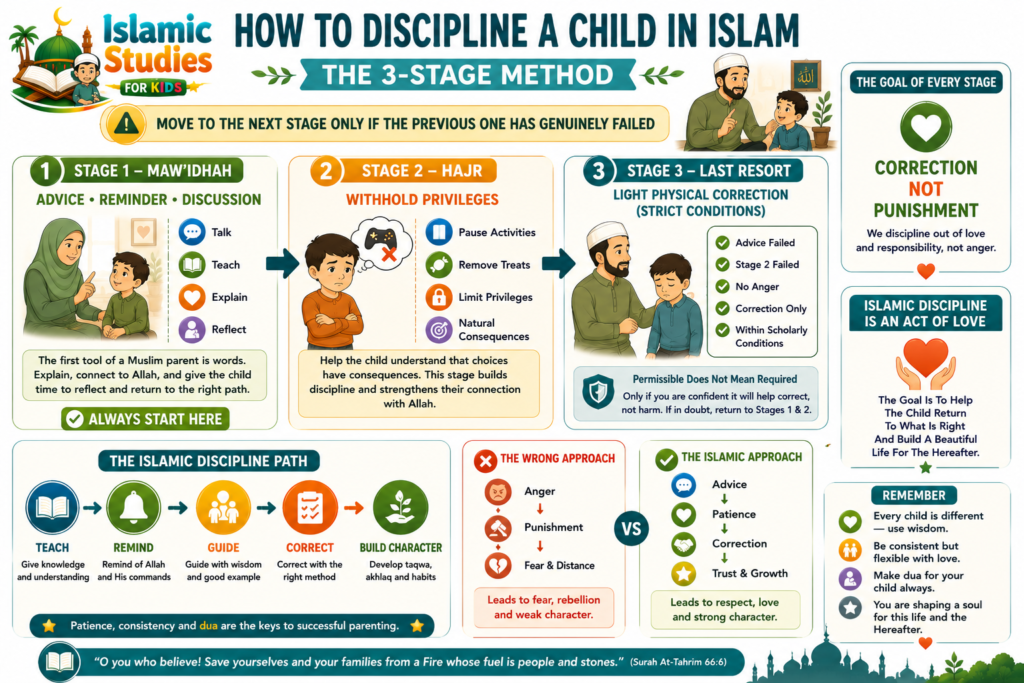
The table below summarises the three stages before the detail:
| Stage | Method | When to Use It |
| 1 | Advice and reminder (Maw’idhah) | Always — this is the starting point |
| 2 | Withholding privileges (Hajr) | When Stage 1 fails after genuine effort |
| 3 | Light physical correction (Darb) | Only when Stage 2 also fails — with strict conditions |
Advice and Gentle Guidance Come First
The first tool a Muslim parent has is their words. This means explaining why a behaviour is wrong, reminding the child of what Allah expects, connecting the mistake to its consequences, and giving the child time to reflect and return to the right path.
This stage should never be rushed. Many parents skip it because they assume words won’t work — but scholars note that for a large proportion of children, a genuine, calm conversation is all that is needed.
Connect this naturally with learning about Islamic character (akhlaq) — when children understand why certain behaviours matter to Allah, they are far more motivated to change.
Withholding Privileges Is the Second Step
If advice has been given repeatedly and the child continues the same behaviour, the parent may move to hajr — a form of emotional and material withdrawal. This means not responding positively to requests, showing visible disapproval, and withholding treats, outings, or privileges the child values.
The purpose is for the child to weigh the cost of their behaviour against what they stand to lose. Children who already have the habit of making dua and turning to Allah respond to this stage more deeply — because they understand that doing right is connected to their relationship with Allah, not just parental approval.
Read also: Quranic Verses on Child Upbringing Every Muslim Parent Needs to Know
Experience a Real Classroom
Curious about how we teach? This video offers a glimpse into a real class, showcasing our interactive approach, qualified teachers, and child-friendly learning experience.
Fun & Engaging Islamic Classes for Kids
Start your child’s journey today with interactive lessons designed to make learning Islam loved and easy.
Get Your Child a Free TrialPhysical Correction Is Permissible Only Under Strict Conditions
If both earlier stages have been used consistently and failed, light physical correction becomes permissible — but only within a framework of strict scholarly conditions. This is not the same as hitting a child out of anger or frustration. The conditions are detailed in the next section.
Important note: Physical correction is permissible — but it is never required. If the parent believes it will cause more harm than good, they must stop and return to Stages 1 and 2. Scholars explicitly state that physical correction is only valid when the parent is confident it will serve the goal of correction, not simply express frustration.
5. Most Forms of Hitting a Child Are Forbidden in Islam
Hitting a child is not automatically haram in Islam — but it is strictly conditional, and most forms of hitting that parents practice would not meet the scholarly conditions. Islamic jurisprudence permits only a very narrow form of physical correction, and anything outside those boundaries becomes forbidden.
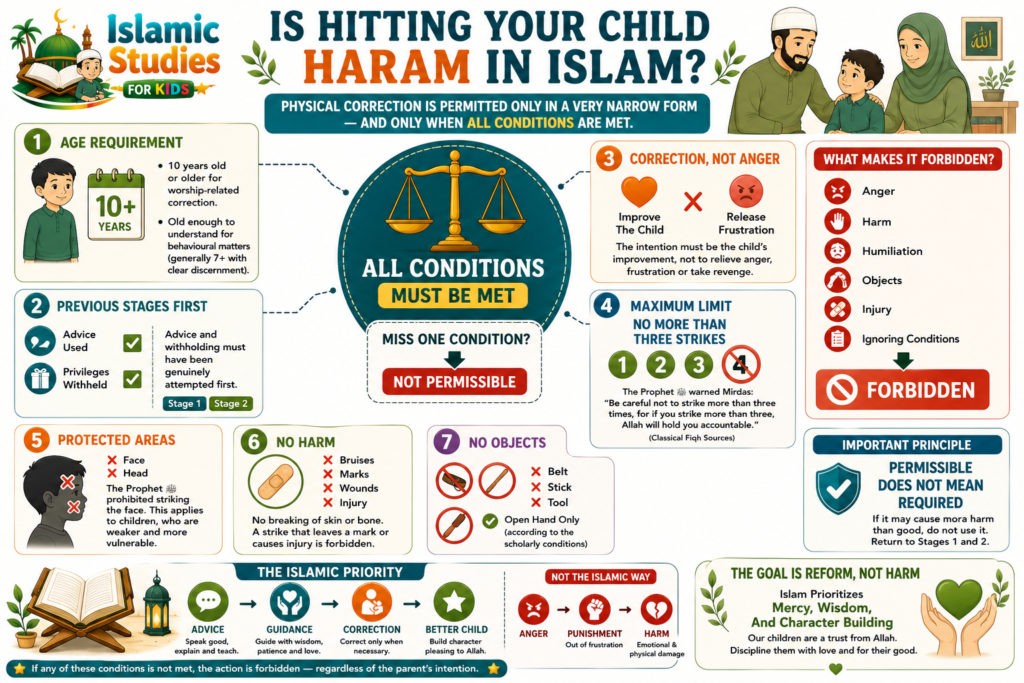
Islamic scholars established the following conditions — all of which must be met simultaneously:
- Age: The child must be at least 10 years old for correction related to worship. For behavioural matters, the child must be old enough to understand the purpose of the correction (generally age 7 and above when the child shows clear discernment).
- Earlier stages have been used: Advice and withholding must have been genuinely attempted first.
- The intention is correction, not anger: The parent must act with the goal of the child’s improvement, not to release frustration or exact revenge.
- No more than three strikes: The Prophet ﷺ warned his companion Mirdas, a teacher: “Be careful not to strike more than three times, for if you strike more than three, Allah will hold you accountable.” (Referenced in classical fiqh sources)
- Avoid the face and head: The Prophet ﷺ prohibited striking the face. If this prohibition applies to wives, scholars conclude it applies to children — who are weaker and more vulnerable.
- No breaking of skin or bone: A strike that leaves a mark, bruise, wound, or injury crosses from permitted ta’deeb into harm (idha’), which is forbidden.
- Not with an object: Scholars specify that a light strike with the open hand is the only permissible form — not sticks, belts, or any other object.
If any of these conditions is not met, the action is forbidden — regardless of the parent’s intention.
6. Only Specific Guardians May Administer Physical Discipline
Islamic jurisprudence is precise about who may physically discipline a child. The following points clarify the boundaries:
- The father is the primary party responsible for physical ta’deeb — not extended family members, not older siblings.
- The grandfather, guardian, or court-appointed custodian may assume this role in the father’s absence.
- Teachers have a limited right to correct students with a light strike by hand only — not with any object — with the guardian’s prior permission, and only to encourage learning or adherence to Islamic conduct. Scholars add: the teacher must never strike a child who does not yet understand the purpose of the correction.
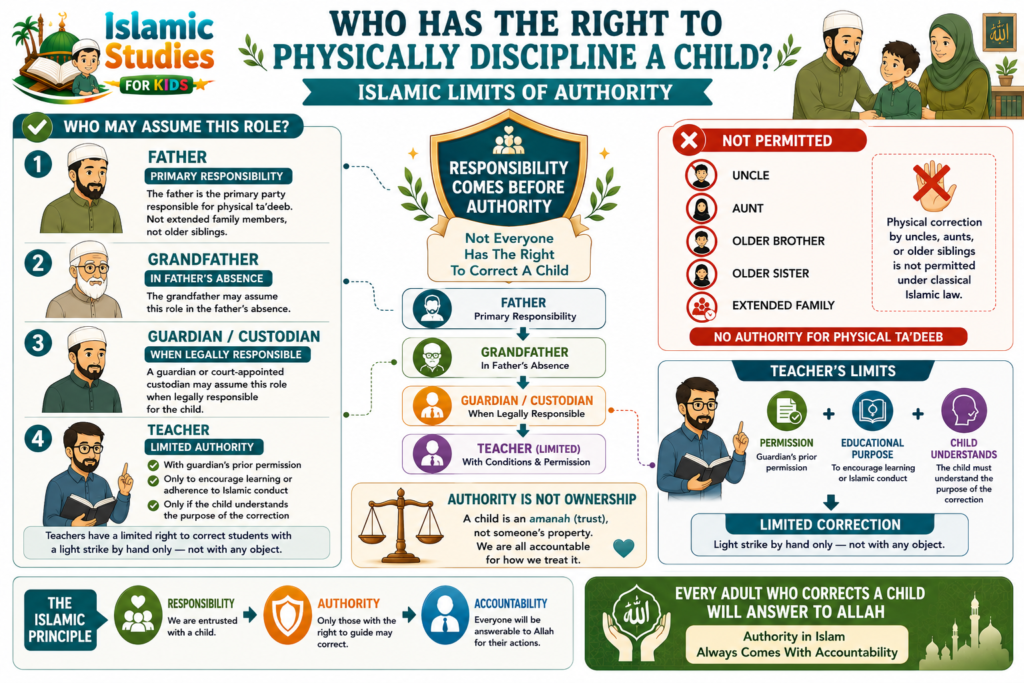
Physical correction by uncles, aunts, or older siblings is not permitted under classical Islamic law.
Read also: What Does the Quran Say About Parents?
Watch a Sample Lesson from Our Academy
Get a firsthand look at how our students learn Islamic values, Quran, and essential knowledge through engaging and interactive online classes. See why families trust Islamic Studies for Kids Academy.
Teach Your Child Islamic Values — The Right Way
The best form of discipline is prevention: raising children in an environment where they understand Allah, love good deeds, and want to do the right thing.
At Islamic Studies for Kids Academy, we help children build the foundation of Islamic character, worship, and values through structured, child-friendly learning — because a child who loves Allah needs less disciplining, and more nurturing.
[Start Your Child’s Islamic Journey Today — Explore Our Resources]

Our Islamic Studies Courses Include:
- Islamic Studies for Kids
- Islam Basics for Kids (Beginners)
- 5 Pillars of Islam for Kids
- 6 Pillars of Iman (Faith) for Kids
- Salah (Prayer) for Kids
- Wudu for Kids
- Dua for Kids
- Ramadan for Kids
- Zakat & Sadaqah for Kids
- Hajj for Kids
- Aqeedah (Islamic Belief) for Kids
- Islamic Manners & Akhlaq for Kids
- Good Deeds for Kids
- Cleanliness (Taharah) in Islam for Kids
- Angels in Islam for Kids
- Islamic History for Kids
- Seerah (Prophet’s Life) for Kids
- Prophets Stories for Kids
- Islamic Stories & Morals for Kids
- Fiqh for Kids (Islamic Jurisprudence Basics)
- Hadith for Kids
- Quran Tafseer Course for Kids
- Islamic Holidays & Events for Kids
- Islamic Identity for Kids
- Intensive Islamic Course for Kids
Enroll today and give your child the knowledge, values, and confidence to grow as a practicing Muslim with a strong connection to Allah and His teachings.
Fun & Engaging Islamic Classes for Kids
Start your child’s journey today with interactive lessons designed to make learning Islam loved and easy.
Get Your Child a Free TrialConclusion
Islam provides one of the most thoughtful, child-centered approaches to discipline found in any tradition. Discipline in Islam is not about punishment — it is about building character (ta’deeb), protecting the child’s future, and fulfilling a sacred parental responsibility before Allah.
The approach is always gradual: advice first, withdrawal second, and physical correction only as a last resort with strict conditions. The Prophet ﷺ himself never struck a child, a woman, or a servant outside of battle — a model every Muslim parent can reflect on.
What Islam forbids is harm: striking the face, striking in anger, leaving marks, exceeding three strikes, or acting before the child is old enough to understand. What Islam requires is wisdom, patience, and genuine care for the child’s wellbeing — in this world and the next.
Frequently Asked Questions
What does Islam say about discipline of a child?
Islamic discipline (ta’deeb) is a sacred parental duty aimed at building character and moral conduct — not punishment. The approach must always begin with gentle advice, then move to withholding privileges, and only in specific circumstances may include very light physical correction with strict conditions.
What does the Quran say about discipline?
The Quran establishes the obligation to protect your family from harm (At-Tahrim 66:6) and models a gradual correction principle in Surah An-Nisa (4:34). Scholars apply this graduated framework — advise, then withdraw, then correct — as the Islamic template for disciplining children.
Is hitting your child haram in Islam?
Hitting a child is not automatically haram, but the conditions that make it permissible are very strict: the child must be old enough (generally 10+ for worship-related matters), earlier stages of correction must have genuinely failed, only light strikes with the open hand are allowed (no more than three), and the face and head must never be struck. Anything outside these conditions is forbidden.
What does the Quran say about hitting your child?
The Quran does not directly address hitting children, but the Prophet ﷺ addressed it in the hadith of prayer (Abu Dawud, 495), which permits a light strike for neglecting obligatory prayer — but only at age 10 and only after advice has failed. The Prophet ﷺ himself, as Aisha narrated, never struck a child, woman, or servant in his life.
What is the hadith about hitting children?
The most important hadith is: “Command your children to pray at seven and strike them for neglecting it at ten, and separate them in their beds.” (Abu Dawud, 495). Scholars clarify that this applies to prayer specifically, requires the age of 10, and represents the absolute last resort — not a first response.
How to discipline a child in Islam without physical correction?
Islam’s primary tools for child discipline are heartfelt conversation, reminders about Allah’s expectations, and structured privilege withdrawal. Many children never need physical correction at all — scholars note that for most children, sincere repeated advice and the withdrawal of things they value is fully sufficient to correct behaviour.



Leave a Reply