 For Parents
You’re in the middle of your day — school runs, dinner, homework — and somewhere in there you’re also trying to raise a child who loves Allah, prays without being nagged, and grows up with good character. If that feels like a lot, you’re not imagining it.
The Quran was speaking to you long before this moment. Across multiple surahs, Allah gives parents not just commands but complete frameworks: why child upbringing is an act of worship, what to prioritize first, and how to sustain it through the years ahead. These aren’t vague encouragements — they are precise, actionable, and arranged in a sequence that matters.
This guide walks through the most important Quranic verses on child upbringing, unpacks what they actually mean for daily parenting, and shows you how to apply them tonight — while your children are still young enough for these seeds to take root.
What You’ll Learn in This Article
- Why Surah At-Tahrim frames child upbringing as urgent protection, not optional guidance
- The Luqman Sequence: Luqman’s 5-step parenting curriculum and why the order matters as much as the content
- The Arabic word in Surah Taha that changes how exhausted parents should think about consistency
- Prophet Ibrahim’s du’a and what it teaches about the ambition level of our prayers for our children
- A rarely-cited Quranic warning about peer influence — and what to do about it at home
- How the Prophets led by example before they ever gave instruction
1. The Quranic Foundation: Why Child Upbringing Is an Act of Worship
The Quran presents parenting as a sacred trust rather than merely a social responsibility. Raising children upon faith, worship, and righteous character is an act of devotion that earns reward from Allah. Every parent is accountable for guiding their family toward what pleases Him and protecting them from what leads to harm in this life and the Hereafter.
The Verse That Sets the Responsibility for Every Muslim Parent
يَا أَيُّهَا الَّذِينَ آمَنُوا قُوا أَنْفُسَكُمْ وَأَهْلِيكُمْ نَارًا وَقُودُهَا النَّاسُ وَالْحِجَارَةُ
“O you who have believed, protect yourselves and your families from a Fire whose fuel is people and stones.” (Surah At-Tahrim, 66:6)
The Arabic command here is (qu) — a sharp, decisive verb meaning to shield, guard, and protect. Allah does not say “advise your families gently” or “try your best when you have time.” He says protect them — the language of urgency and active responsibility.
This verse answers the “why bother?” question permanently. Raising your child with Islamic values is not extra effort on top of everything else. It is the primary parental task. And it works in both directions: the same verse applies to children learning to protect their own families one day. Quranic guidance on raising children begins here — with the weight of what is at stake.
How to use this at home: Read this verse to your child in simple terms: “Allah told parents that one of the most important things they can do is help their children stay close to Him.” For children aged 5–10, this single idea becomes a foundation they return to — understanding that parental limits exist for a reason rooted in love, not control.
2. The Luqman Sequence: A 5-Step Parenting Curriculum from the Quran
Surah Luqman contains the most detailed parenting framework in the entire Quran — but what most articles miss is this: Luqman’s advice follows a deliberate sequence. He does not teach randomly. He moves from inner belief to outer conduct, in a specific order, and understanding that order is what makes this a curriculum rather than a list.
This is the Luqman Sequence — five layers of upbringing, each building on the one before it.
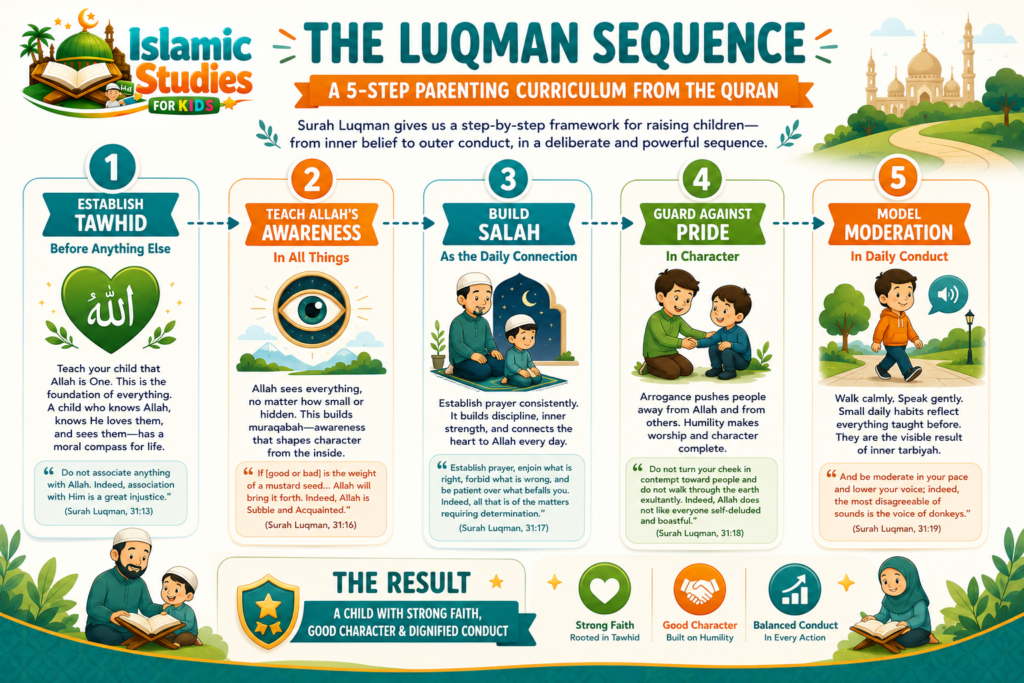
Step 1 — Establish tawhid before anything else
Every lasting Islamic upbringing begins with one essential lesson: Tawhid. Before teaching children about prayer, good manners, or Islamic rulings, parents should help them know their Creator, love Him, and worship Him alone. The Quran highlights this priority through the advice of Luqman to his son, making faith in Allah the very first foundation of successful parenting.
﴿يَا بُنَيَّ لَا تُشْرِكْ بِاللَّهِ ۖ إِنَّ الشِّرْكَ لَظُلْمٌ عَظِيمٌ﴾
“O my dear son, do not associate anything with Allah. Indeed, association with Him is a great injustice.” (Surah Luqman, 31:13)
Notice the address: (ya bunayya) — “O my dear little son.” In Arabic, this diminutive form carries warmth and tenderness that a direct translation can’t fully capture. Luqman opens his most important lesson — the oneness of Allah — with love, not authority.
This is intentional. The hardest lessons land best when they come from obvious love. Tawhid is the first lesson because everything else in a child’s life rests on it. A child who knows Allah is One, that He sees everything, and that He loves them — that child has a moral compass that functions even when parents aren’t in the room. Shirk is called zulm (great injustice) not to frighten the child, but to show how seriously this relationship with Allah matters.
How to use this at home: For children aged 4–8, a simple daily sentence works well: “Allah made you, He loves you, and He always knows where you are.” As they grow, deepen it — help them understand why associating partners with Allah is an injustice, rather than just that it is forbidden.
Step 2 — Teach Allah’s awareness in all things
After establishing tawhid, children should learn that Allah is always aware of everything they do. This understanding nurtures sincerity, honesty, and self-discipline, teaching them to choose what is right even when no one else is watching. Luqman reminded his son that nothing—no matter how small or hidden—escapes Allah’s perfect knowledge.
يَا بُنَيَّ إِنَّهَا إِن تَكُ مِثْقَالَ حَبَّةٍ مِّنْ خَرْدَلٍ فَتَكُن فِي صَخْرَةٍ أَوْ فِي السَّمَاوَاتِ أَوْ فِي الْأَرْضِ يَأْتِ بِهَا اللَّهُ ۚ إِنَّ اللَّهَ لَطِيفٌ خَبِيرٌ
“O my son, indeed if wrong should be the weight of a mustard seed and should be within a rock or anywhere in the heavens or in the earth, Allah will bring it forth. Indeed, Allah is Subtle and Acquainted.” (Surah Luqman, 31:16)
Luqman reinforces tawhid with a practical consequence: Allah sees everything, no matter how small or hidden. This verse builds the child’s sense of muraqabah — awareness of Allah’s constant knowledge — which is one of the most powerful internal regulators of behavior.
A child who genuinely believes Allah is aware of the mustard-seed deeds does not need constant external supervision. This is the Islamic version of internalized conscience — and it is built through repetition of this concept from an early age.
How to use this at home: When a child acts well when no one is watching, acknowledge it: “That was just between you and Allah — and He saw it.” This makes muraqabah feel like a relationship, not surveillance.
Step 3 — Build consistent prayer as the daily connection
Once a child’s faith is firmly rooted, the next priority is establishing salah as a lifelong habit. Luqman teaches that prayer is more than a daily obligation—it is the foundation of a believer’s relationship with Allah and the source of strength needed to uphold righteousness, resist wrongdoing, and remain patient through life’s challenges.
يَا بُنَيَّ أَقِمِ الصَّلَاةَ وَأْمُرْ بِالْمَعْرُوفِ وَانْهَ عَنِ الْمُنْكَرِ وَاصْبِرْ عَلَىٰ مَا أَصَابَكَ ۖ إِنَّ ذَٰلِكَ مِنْ عَزْمِ الْأُمُورِ
“O my son, establish prayer, enjoin what is right, forbid what is wrong, and be patient over what befalls you. Indeed, all that is of the matters requiring determination.” (Surah Luqman, 31:17)
Luqman says establish prayer — not just “pray.” The Arabic (aqim al-salah) means to maintain it consistently, correctly, and with its proper conditions. The goal is not that your child prays once when reminded. The goal is that prayer becomes the rhythm of their day.
Something subtle is embedded here too: Luqman pairs prayer with commanding good, forbidding wrong, and patient endurance. The sequence tells us something — a child who prays consistently develops the inner strength to handle difficulty without collapsing, and to speak up for what is right without fear. Prayer builds the character that everything else depends on.
How to use this at home: Start the prayer habit at age seven, as the Prophet ﷺ instructed. Make the first prayer of the day a shared one — parents and children praying Fajr together, even briefly, communicates priority in a way that no lecture can. Children who pray with their parents grow into adults who pray.
For structured support in building this habit, Quran recitation classes for kids can reinforce the connection between Quran and prayer at an age-appropriate level.
Step 4 — Guard against pride in character
Strong faith should always be accompanied by humility. After teaching his son about belief and worship, Luqman turned to character, warning against arrogance, pride, and looking down on others. The Quran reminds parents that true greatness is measured by humility, respect, and good conduct—not by status or self-importance.
وَلَا تُصَعِّرْ خَدَّكَ لِلنَّاسِ وَلَا تَمْشِ فِي الْأَرْضِ مَرَحًا ۖ إِنَّ اللَّهَ لَا يُحِبُّ كُلَّ مُخْتَالٍ فَخُورٍ
“And do not turn your cheek in contempt toward people and do not walk through the earth exultantly. Indeed, Allah does not like everyone self-deluded and boastful.” (Surah Luqman, 31:18)
Luqman now turns to character — specifically, the danger of arrogance. “Turning the cheek away” from someone in contempt is a very specific image: a person who dismisses others as beneath them. This can look like ignoring the cleaner at school, speaking over siblings, or treating someone with less wealth or status as less worthy of attention.
Arrogance (kibr) is one of the most socially destructive traits, and it forms early. Luqman addresses it here because outward worship without inner humility is incomplete. A child can pray five times and still be cruel in how they treat people — and the Quran on parenting does not let that contradiction stand.
How to use this at home: Watch the small moments. How does your child greet someone who works a service job? How do they treat a younger or less capable sibling? Those are the real tests of this lesson — and they are the moments for gentle redirection, not punishment.
Step 5 — Model moderation in daily conduct
Children learn not only from what they are taught but also from the habits they practice every day. Luqman’s final advice focuses on self-control, reminding his son that modesty, calmness, and respectful speech are signs of wisdom and strong character. Even simple actions like walking with humility and speaking gently reflect the values that Islam seeks to cultivate.
وَاقْصِدْ فِي مَشْيِكَ وَاغْضُضْ مِنْ صَوْتِكَ ۚ إِنَّ أَنْكَرَ الْأَصْوَاتِ لَصَوْتُ الْحَمِيرِ
“And be moderate in your pace and lower your voice; indeed, the most disagreeable of sounds is the voice of donkeys.” (Surah Luqman, 31:19)
Luqman closes with the most practical, everyday instruction: walk calmly, speak at a reasonable volume. These sound minor — until you realize that children’s daily social behavior is almost entirely built from these small physical habits. Tone of voice, composure in a group, how they carry themselves — these are the visible expression of everything that came before.
Moderation in conduct is the external evidence of internal tarbiyah. A child with tawhid in their heart, prayer in their schedule, muraqabah as their compass, and humility in their character — that child naturally moves through the world with composure and dignity.
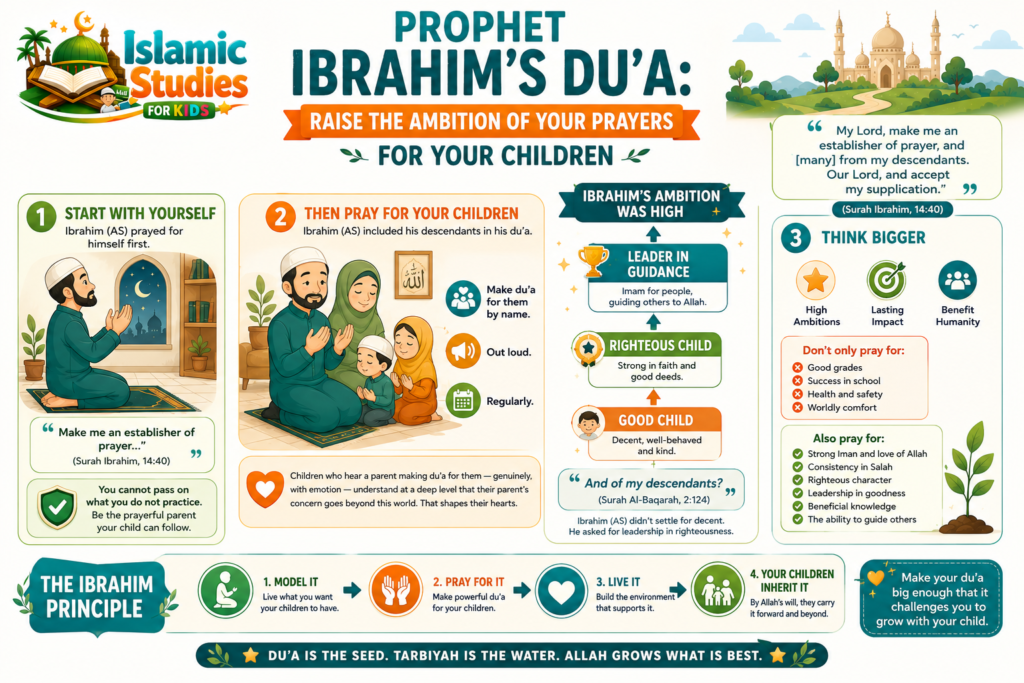
3. Prophet Ibrahim’s Du’a: Raise the Ambition of Your Prayers
One of the greatest lessons for Muslim parents is that successful parenting begins with sincere du’a. Even Prophet Ibrahim one of the greatest prophets, did not rely solely on his efforts to guide his family. He turned to Allah, asking that both he and his descendants remain steadfast in prayer. His supplication teaches parents to raise their ambitions—not only to nurture righteous children, but to ask Allah to preserve their faith for generations to come.
رَبِّ اجْعَلْنِي مُقِيمَ الصَّلَاةِ وَمِنْ ذُرِّيَّتِي ۚ رَبَّنَا وَتَقَبَّلْ دُعَاءِ
“My Lord, make me an establisher of prayer, and [many] from my descendants. Our Lord, and accept my supplication.” (Surah Ibrahim, 14:40)
Ibrahim (AS) prays for himself first — “make me an establisher of prayer” — before asking for his descendants. This ordering is a parenting principle the Quran repeats across multiple contexts: you cannot transmit what you do not possess. A parent who does not consistently establish prayer cannot genuinely ask Allah to grant their child that same consistency.
He then makes another du’a that reveals how high his ambitions for his children were. When Allah told him he would be an Imam for all humanity, Ibrahim’s immediate response was: “And of my descendants?” (Surah Al-Baqarah, 2:124). He wasn’t asking for his children to simply be decent people. He was asking for them to be leaders in guidance.
This should recalibrate how we make du’a for our children. Most of us ask for health, success in school, and good character. Ibrahim asked for leadership in righteousness. Our du’a can be more ambitious.
How to use this at home: Add your children to your du’a by name, out loud, in language they can understand. Children who hear a parent making du’a for them — genuinely, with emotion — understand at a deep level that their parent’s concern for them goes beyond this world. That knowledge quietly shapes behavior in ways that reward systems and consequences rarely do.
To help your child connect to the meaning behind these duas directly in Arabic, Quranic Arabic classes for kids build the vocabulary to understand supplications in the language they were revealed.
4. The Surah Taha Principle: A Message for Every Exhausted Parent
Parenting can feel overwhelming, especially when the results of your efforts are not immediately visible. This verse offers reassurance to every tired parent: your responsibility is to consistently encourage your family toward prayer and remain patient in that mission. Guidance and provision ultimately come from Allah, and lasting success belongs to those who persevere in righteousness.
وَأْمُرْ أَهْلَكَ بِالصَّلَاةِ وَاصْطَبِرْ عَلَيْهَا ۖ لَا نَسْأَلُكَ رِزْقًا ۖ نَحْنُ نَرْزُقُكَ ۗ وَالْعَاقِبَةُ لِلتَّقْوَى
“And enjoin prayer upon your family and be steadfast therein. We do not ask you for provision; We provide for you, and the best outcome is for righteousness.” (Surah Taha, 20:132)
Most parents know sabr — patience. But this verse uses a different word: (wastabir). This is an intensified form. Istibār implies sustained, deliberate, exerted steadfastness over a long period — the kind of patience that requires effort to maintain, not merely to initiate. It is the patience of still showing up on the hundredth reminder, not just the first.
Allah is explicitly acknowledging that commanding your family to pray — day after day, year after year — is genuinely hard. And then He follows it with something remarkable: “We do not ask you for provision; We provide for you.” The implicit message is a direct comfort to every parent: your job is the spiritual provision of your household. Material provision is already handled by Allah. Pour your effort into what actually belongs to you to do.
The verse concludes: “The best outcome is for righteousness.” Not for effort, not for perfection — for taqwa. The outcome belongs to Allah. The consistency belongs to the parent.
How to use this at home: On the days when reminding your child to pray feels exhausting and futile, return to wastabir. The difficulty of consistency is not a sign of failure — it is precisely what this verse anticipated. Your persistence is already a form of worship.
Read also: Hadith About Raising Children – A Complete Guide for Muslim Parents
Experience a Real Classroom
Curious about how we teach? This video offers a glimpse into a real class, showcasing our interactive approach, qualified teachers, and child-friendly learning experience.
Fun & Engaging Islamic Classes for Kids
Start your child’s journey today with interactive lessons designed to make learning Islam loved and easy.
Get Your Child a Free Trial5. The Prophets as Parents: Leading by Example Before Giving Instruction
The Quran does not only tell parents what to teach — it shows them how the prophets taught, through their own consistent character.
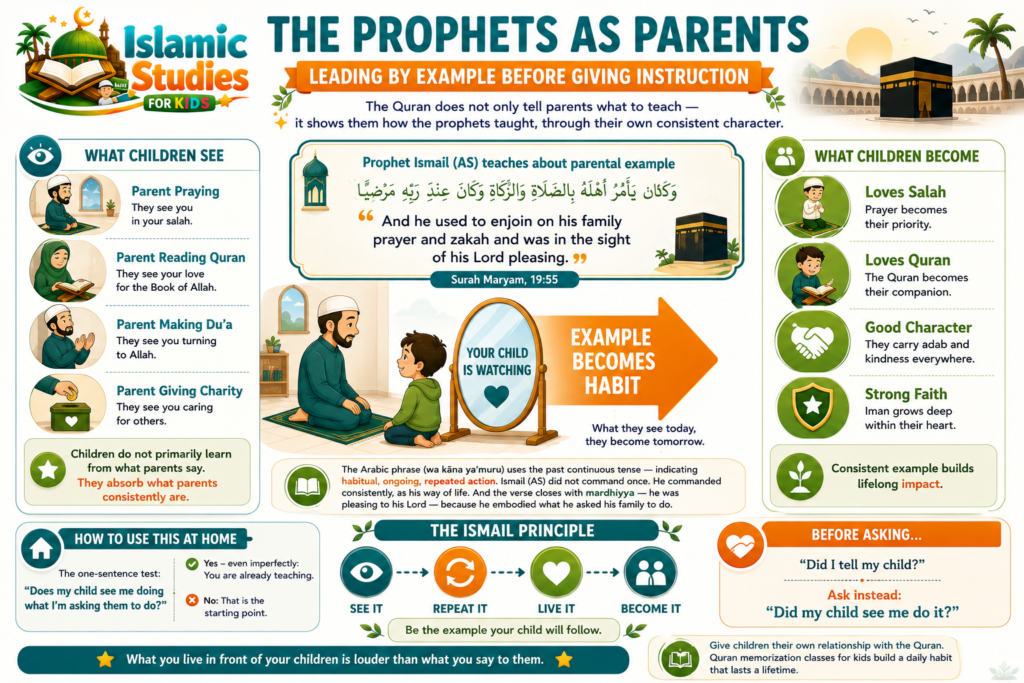
What Prophet Ismail (AS) teaches about parental example?
Children are more likely to follow what they consistently see than what they are simply told. Prophet Ismail (AS) exemplified this principle by leading his family through worship, encouraging them to establish prayer and fulfill their religious duties. His example reminds parents that the most effective way to teach faith is to live it every day with sincerity and consistency.
وَكَانَ يَأْمُرُ أَهْلَهُ بِالصَّلَاةِ وَالزَّكَاةِ وَكَانَ عِندَ رَبِّهِ مَرْضِيًّا
“And he used to enjoin on his family prayer and zakah and was in the sight of his Lord pleasing.” (Surah Maryam, 19:55)
The Arabic phrase (wa kāna ya’muru) uses the past continuous tense — indicating habitual, ongoing, repeated action. Ismail (AS) did not command his family to pray once. He commanded them consistently, as his way of life. And the verse closes with mardhiyya — he was pleasing to his Lord — because he embodied what he asked his family to do.
This is the most important parenting principle in the Quran: children do not primarily learn from what parents say. They absorb what parents consistently are. A father who prays where his child can see him is teaching without opening his mouth. A mother who reads Quran daily is demonstrating a relationship with the Book before she has taught a single ayah.
How to use this at home: The one-sentence test: “Does my child see me doing what I’m asking them to do?” If the answer is yes — even imperfectly — you are already teaching. If the answer is no, that is the starting point.
6. The Peer Influence Warning Every Parent Needs to Hear
As children grow, parents are no longer their only source of influence. Friends, classmates, and online communities can shape a child’s beliefs, habits, and decisions. The Quran warns that choosing the wrong companions can lead to lifelong regret, reminding parents to help their children build friendships that strengthen their faith and character rather than weaken them.
وَيَوْمَ يَعَضُّ الظَّالِمُ عَلَىٰ يَدَيْهِ يَقُولُ يَا لَيْتَنِي اتَّخَذْتُ مَعَ الرَّسُولِ سَبِيلًا يَا وَيْلَتَىٰ لَيْتَنِي لَمْ أَتَّخِذْ فُلَانًا خَلِيلًا
“And the Day the wrongdoer will bite on his hands, he will say, ‘Oh, I wish I had taken with the Messenger a way! Oh, woe to me! I wish I had not taken that one as a friend!'” (Surah Al-Furqan, 25:27-28)
This verse belongs in every conversation about Quran and parenting — yet it rarely appears in these articles. It shows a person on the Day of Judgment in deep regret, not over their own choices alone, but over a specific friendship that pulled them away from the right path.
Children’s peer groups have always shaped their character and choices — and the adolescent years amplify this dramatically. The Quran does not ask parents to pretend otherwise. It asks them to be proactive about it, while their children are still young and their influence still strong.
The practical corollary in Islamic tradition is suhbah salihah — righteous companionship — which parents are responsible for cultivating, not just hoping for. This means knowing your child’s friends, creating environments where good friendships form naturally (Islamic classes, community gatherings, family relationships), and talking honestly about what makes a friendship a good one.
How to use this at home: Invite your child’s friends over. Ask your child what they enjoy about each friend. When you spot concerning patterns, address them through conversation before they become habits. The goal is not to police friendships — it is to be close enough to your child that they bring friend decisions to you voluntarily.
Pair this with exposure to Quranic stories about prophets and companions — Quran stories for kids show children what righteous companions look like through the lives of people they are already learning to admire.
7. The Du’a of the Ibad Ar-Rahman: Asking for Qurrat Ayn
Every Muslim parent hopes to see their children grow into righteous believers who bring joy in this life and reward in the Hereafter. The Quran teaches that this goal begins with sincere du’a. Among the beautiful supplications of the servants of the Most Merciful is a prayer asking Allah to bless one’s family with righteousness and make them a source of comfort, happiness, and lasting goodness.
وَالَّذِينَ يَقُولُونَ رَبَّنَا هَبْ لَنَا مِنْ أَزْوَاجِنَا وَذُرِّيَّاتِنَا قُرَّةَ أَعْيُنٍ وَاجْعَلْنَا لِلْمُتَّقِينَ إِمَامًا
“And those who say, ‘Our Lord, grant us from among our wives and offspring comfort to our eyes, and make us an example for the righteous.'” (Surah Al-Furqan, 74)
This is the du’a of the servants of the Most Merciful — qurrat ayn, literally “coolness of the eye,” the Arabic expression for the deepest joy and contentment. They ask for children who are a source of this contentment — not children who are merely successful or well-behaved, but children whose righteousness brings genuine comfort to the heart.
The verse ends with something remarkable: “and make us an example for the righteous.” They do not just ask for their children to be good — they ask to be good enough themselves to be a model worth following. This is the full circle of Quranic guidance on raising children: the parent’s own tarbiyah is the prerequisite for the child’s.
When Good Parenting Doesn’t Guarantee Results: The Lesson of Prophet Nuh?
One thing the Quran on parenting does not do is promise that faithful parenting always produces righteous children — and this honesty is itself a mercy.
Prophet Nuh (AS) called his son to board the ark: “O my son, come aboard with us and do not be among the disbelievers.” (Surah Hud, 11:42). His son refused. Nuh continued to call him. The son still refused. Nuh turned to Allah in grief, and Allah responded with the most clarifying words a parent could hear about the limits of parental responsibility.
The lesson is this: a parent’s role is to take every means of guidance — teaching, example, du’a, good environment, righteous companions — and then trust the outcome to Allah. Guidance is from Allah alone. A child who strays despite sincere tarbiyah is a test and a mercy for the parent — a test that elevates their rank when they respond with patience, du’a, and continued effort.
This is not an excuse for disengagement. It is a release from the crushing guilt many parents carry. Your job is to keep going. The result belongs to Allah.
Read also: What Does the Quran Say About Children?
Watch a Sample Lesson from Our Academy
Get a firsthand look at how our students learn Islamic values, Quran, and essential knowledge through engaging and interactive online classes. See why families trust Islamic Studies for Kids Academy.
Give Your Child a Head Start with Islamic Studies for Kids Academy
The Quranic verses in this guide are not meant to be read once and set aside. They are a living framework — a shield, a curriculum, a du’a, a standard, and a warning — that parents return to across every stage of raising children.
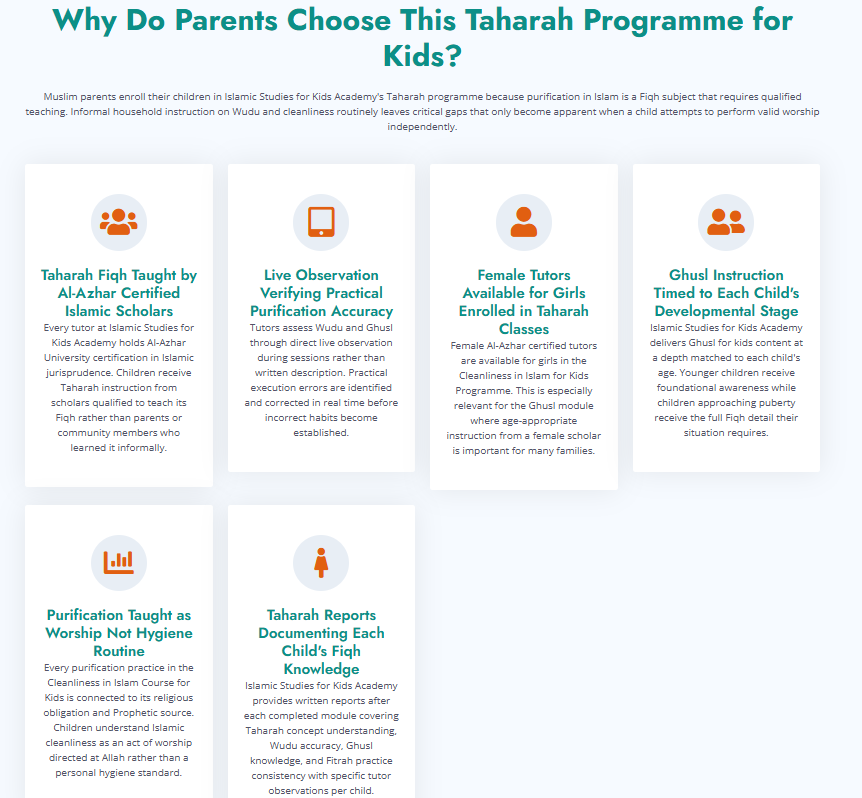
But knowing the verses is only the beginning. Children who learn Islamic values in structured, age-appropriate settings, alongside other Muslim children, retain and apply them far more deeply than children who only encounter them at home.

Our Islamic Studies Courses Include:
- Islamic Studies for Kids
- Islam Basics for Kids (Beginners)
- 5 Pillars of Islam for Kids
- 6 Pillars of Iman (Faith) for Kids
- Salah (Prayer) for Kids
- Wudu for Kids
- Dua for Kids
- Ramadan for Kids
- Zakat & Sadaqah for Kids
- Hajj for Kids
- Aqeedah (Islamic Belief) for Kids
- Islamic Manners & Akhlaq for Kids
- Good Deeds for Kids
- Cleanliness (Taharah) in Islam for Kids
- Angels in Islam for Kids
- Islamic History for Kids
- Seerah (Prophet’s Life) for Kids
- Prophets Stories for Kids
- Islamic Stories & Morals for Kids
- Fiqh for Kids (Islamic Jurisprudence Basics)
- Hadith for Kids
- Quran Tafseer Course for Kids
- Islamic Holidays & Events for Kids
- Islamic Identity for Kids
- Intensive Islamic Course for Kids
Enroll today and give your child the knowledge, values, and confidence to grow as a practicing Muslim with a strong connection to Allah and His teachings.
Fun & Engaging Islamic Classes for Kids
Start your child’s journey today with interactive lessons designed to make learning Islam loved and easy.
Get Your Child a Free TrialConclusion
The Quranic verses on child upbringing are not scattered across the Quran randomly. Together, they form a coherent approach built on a clear sequence: establish the right inner foundation (tawhid and muraqabah), build consistent worship (salah), develop grateful and humble character, guard against pride, maintain composure in daily conduct — and sustain all of it through the parent’s own example and du’a.
What makes this guidance remarkable is not its depth alone, but its honesty. The Quran acknowledges that parenting is hard (wastabir, not just sabr). It acknowledges that not every child responds — and comforts parents through the story of Nuh. It shows what success looks like — qurrat ayn — and what failure looks like in the regret of Surah Al-Furqan. It gives parents every tool they need, then reminds them that guidance belongs to Allah.
The best outcome, as Surah Taha promises, belongs to taqwa — to the families who kept showing up, even when it was hard. Start with one verse. Apply one principle this week. And trust that these seeds, planted with sincerity and patience, grow in ways you cannot yet see.
Frequently Asked Questions
What does the Quran say about raising children?
The Quran instructs parents to protect their families from misguidance (Surah At-Tahrim 66:6), establish tawhid as the first priority (Surah Luqman 31:13), build consistent prayer habits (Surah Taha 20:132), and raise children with humility, gratitude, and righteous character. Surah Luqman provides the most complete parenting curriculum in the Quran, covering belief, worship, conscience, conduct, and social behavior in a single continuous passage.
What is Surah Luqman’s advice about children?
Surah Luqman (verses 13–19) records a father’s direct advice to his son across five areas, in a deliberate sequence: establishing tawhid and avoiding shirk, building awareness that Allah sees all things, maintaining prayer consistently, avoiding arrogance in character, and practicing moderation in daily conduct. Scholars note that the sequence is intentional — inner belief must precede outer behavior for the teaching to hold.
Which Quranic verse talks about protecting your family?
Surah At-Tahrim, verse 6, uses the command (qu) — protect and shield — addressing believers directly: “O you who have believed, protect yourselves and your families from a Fire.” This is considered the foundational verse establishing parental responsibility for children’s spiritual upbringing in Islam, and the command verb signals urgency, not suggestion.
What du’a did Prophet Ibrahim make for his children?
In Surah Ibrahim (14:40), Ibrahim (AS) prays: “My Lord, make me an establisher of prayer, and [many] from my descendants. Our Lord, and accept my supplication.” Significantly, he prays for himself first — asking to be consistent in prayer before asking the same for his children. This establishes the principle that parental example must precede parental instruction.
At what age should I start teaching my child Islamic values?
Islamic guidance specifies that children should be instructed to pray at age seven and held more firmly accountable by age ten (from the hadith of Abu Dawud). However, the foundations — tawhid, love for Allah, and the sense of muraqabah — are absorbed from infancy through the home environment. Formal teaching of aqeedah, Quran, and Islamic character can begin meaningfully at ages 4–5 with age-appropriate language and patient repetition.
How do I use Quranic verses to teach my child Islamic values at home?
The most effective method is narrating the verse simply, then connecting it to something real in your child’s life soon after. For example: read Surah Luqman 31:18 about not being arrogant, then later that week ask: “Remember what Luqman told his son? How can we try that today?” Repeated gentle connection — not lectures — is how Quranic values become character. Structured Quran for toddlers and young children programs reinforce this with qualified teachers who know how to make these lessons stick.



Leave a Reply