 Quran
Quran

The best bedtime Quran stories are short Quranic narratives — about prophets, communities, and events — retold in simple, age-appropriate language to help children absorb Islamic values before sleep. Unlike fictional tales with invented morals, these stories come directly from Allah’s words, which gives them a depth and weight that children sense even when young.
Child development research consistently shows that the period just before sleep is when emotional learning consolidates most strongly. A story heard at bedtime is more likely to be remembered, discussed, and internalized than the same story told mid-afternoon. Muslim parents who build a nightly Quran story habit are not just entertaining their children — they are laying the religious and moral foundation that will carry those children through life.
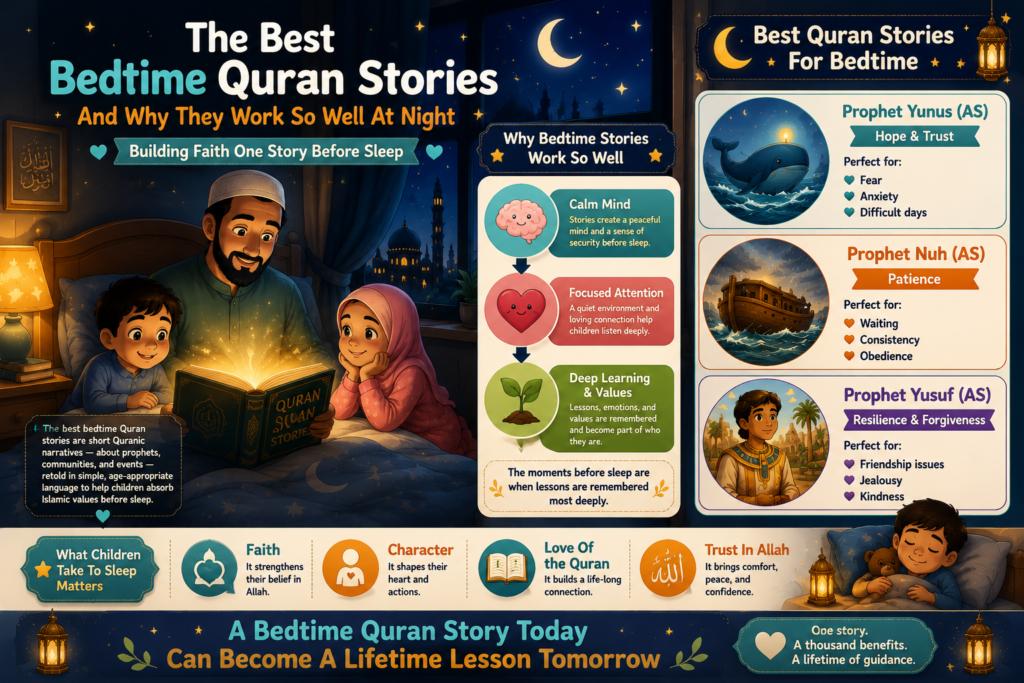
These eight stories cover the full range of Quranic themes children need: faith, obedience, repentance, patience, gratitude, and trust in Allah. Each one fits naturally into a 5–10 minute bedtime session.
Browse the full collection of Quran stories for kids to find even more narratives your child will love.
1. The Story of Prop٢het Adam and Hawwa — The First Humans on Earth
Adam (peace be upon him) was the first human and the first prophet. Allah created him from soil of different colors, breathed life into him, and gave him something remarkable: knowledge — the names, features, and uses of all existing things. This knowledge distinguished Adam and made him ready for his role as Allah’s successor on Earth.
When Allah commanded the angels to prostrate to Adam, every angel obeyed — except Iblis (Satan), who refused out of arrogance and a feeling of superiority. This disobedience was the first act of pride in creation, and it became Satan’s defining trait.
Allah placed Adam and his wife Hawwa in a beautiful garden, free to enjoy everything except one tree. When Satan tempted them into eating from it, they immediately felt regret and turned sincerely to Allah — and Allah forgave them. They were sent to Earth, but crucially, the Quran presents this not as punishment. Allah had always planned for humans to inhabit the Earth; the test in the garden was a lesson in obedience, repentance, and reliance on Allah’s mercy.
Moral for kids: Everyone makes mistakes. What matters is saying sorry sincerely. And pride — thinking you’re better than others — always leads to loss.
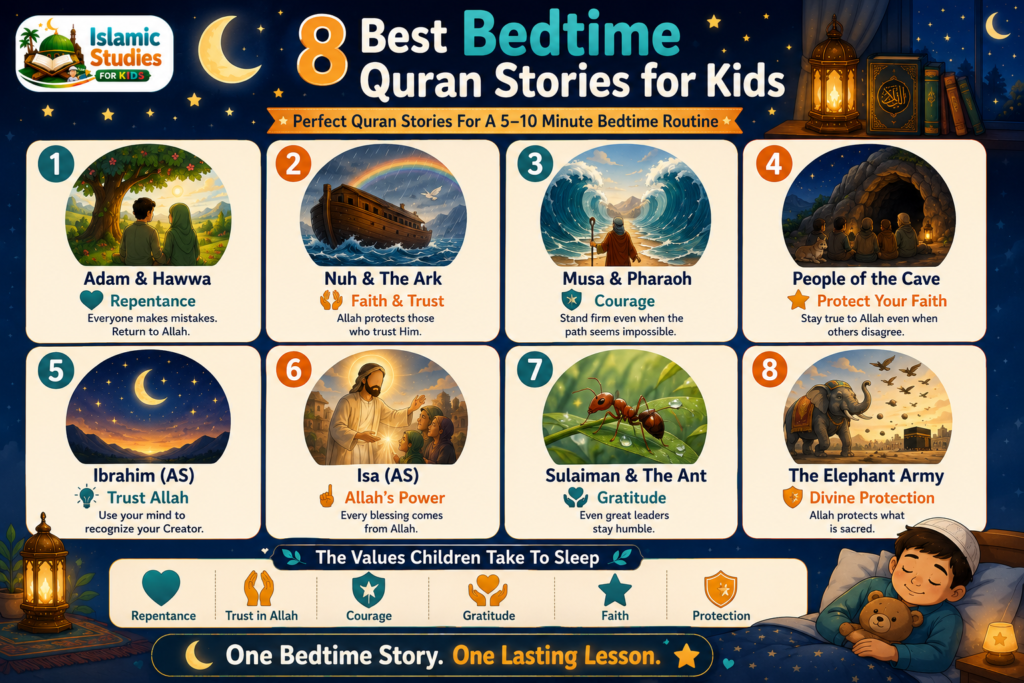
2. The Story of Prophet Nuh and the Ark — Faith Against the Flood
Prophet Nuh (peace be upon him) called his people to worship Allah alone for an extraordinarily long time — the Quran tells us he preached by day and by night, in public and in private, for centuries. His people mocked him, covered their ears, and doubled down on their rejection.
When Allah’s punishment was decreed, Nuh was commanded to build an ark. The rulers and disbelievers laughed at him as he worked. But when the floods came — with deafening thunder, blinding lightning, and water rising higher than mountains — there was nowhere to run.
One of the most powerful details in this story for children: Nuh’s own son refused to board the ark, believing he could save himself by climbing a mountain. The waves came between them. Even a prophet’s love could not substitute for a person’s own choice to believe.
Moral for kids: Faith is a personal choice that no one else can make for you. Allah protects those who trust Him.
3. The Story of Prophet Musa and Pharaoh — Courage Against Tyranny
Prophet Musa (peace be upon him) is mentioned more times in the Quran than any other prophet — a sign of how central his story is to Islamic teaching.
His story begins with a miracle of survival: as a baby, he was placed in a basket on the Nile to escape Pharaoh’s soldiers — and was delivered straight into Pharaoh’s palace, where he grew up under divine protection. Later, Allah spoke to him directly at Mount Tur, gave him two miracles (a staff that became a serpent and a hand that shone with white light), and sent him to confront the most powerful tyrant of his time.
When Pharaoh’s magicians threw down their ropes in the great contest, Musa’s staff swallowed them all. The magicians immediately recognized the difference between a magic trick and a true miracle — they prostrated to Allah on the spot. Pharaoh, by contrast, chose anger over truth.
The story ends with one of the Quran’s most dramatic moments: the Red Sea parting for Musa and the believers, then closing over Pharaoh and his army. In his final moments, drowning, Pharaoh declared faith — but the Quran records it as too late.
Moral for kids: Accept truth before it’s too late. And always know that Allah’s help comes to those who hold firm, even when the sea looks impossible to cross.
4. The Story of the People of the Cave (Ashab Al-Kahf) — Protecting Your Faith
A group of young men lived in a city where idol worship was the norm and the king demanded everyone participate in annual idol festivals. These young men believed in the Oneness of Allah, following the teachings of Prophet Isa (peace be upon him). They refused to join.
When the king ordered their arrest, they fled to a cave in the mountains. There, they prayed for Allah’s protection — and Allah caused them to sleep for 309 years. When they woke, they thought only hours had passed. One of them went into the city to buy food and was stunned when a shopkeeper refused his ancient coins. They slowly realized the world had moved on without them.
A key detail children love: their dog stayed at the cave entrance throughout, like a loyal guard. The Quran even mentions the dog, a sign of the story’s precise, true nature.
Moral for kids: Standing up for what you believe, even when everyone around you disagrees, is one of the bravest things you can do. And Allah never forgets those who hold on to their faith.
Read also: Quran Stories for Kids: The Best Islamic Stories Every Child Should Know
5. The Story of Prophet Ibrahim — Finding Allah Through Thinking
This story works especially well for children aged 5–9 who are naturally asking “Who made everything?” Prophet Ibrahim (peace be upon him) grew up surrounded by idol worshippers, including his own family. Rather than simply accepting what he saw, he thought deeply.
One night, he looked at a star and said: “Could this be my Lord?” When it set, he rejected it. He looked at the moon — and rejected it too when it set. He looked at the sun, the greatest thing visible — and when it set, he concluded: “My Lord is not something that disappears. He is the One who created all of these.”
That independent, thinking path to Allah made Ibrahim one of the greatest prophets. Allah later tested him with profound trials — including being asked to leave his wife and infant son in the desert and, later, to sacrifice his son. He passed every test, earning the title Khalilullah: the Friend of Allah.
Moral for kids: Think for yourself about who Allah is. And when things are difficult, trust that Allah has a plan.
Experience a Real Classroom
Curious about how we teach? This video offers a glimpse into a real class, showcasing our interactive approach, qualified teachers, and child-friendly learning experience.
Fun & Engaging Islamic Classes for Kids
Start your child’s journey today with interactive lessons designed to make learning Islam loved and easy.
Get Your Child a Free Trial6. The Story of Prophet Isa (Jesus) — Miracles Come from Allah Alone
Prophet Isa (peace be upon him) was born through a miracle: his mother Maryam, one of the most honoured women in the Quran, conceived him without a father, by Allah’s command. When people questioned her, baby Isa spoke from his cradle to defend her — his very first miracle.
As he grew, Isa healed the sick, restored sight to the blind, and — by Allah’s will — gave life to the dead. Every miracle he performed, he attributed directly to Allah, never to himself. The Quran is clear that Isa was a prophet and servant of Allah, sent to the children of Israel with the message of Tawheed (the Oneness of God).
When enemies plotted against him, Allah protected him, raising him up before harm could reach him.
Moral for kids: Every miracle, every good thing, every blessing comes from Allah alone. The greatest people are those who give all credit to Him.
7. Prophet Sulaiman and the Ant — Leadership and Gratitude
Prophet Sulaiman (peace be upon him) was gifted by Allah with extraordinary power: he could command humans, jinn, and animals, and he was granted the ability to understand animal speech. One day, marching with his vast army, he heard a tiny ant warning her colony to take shelter so they would not be crushed underfoot.
Rather than ignoring the ant, Sulaiman stopped, smiled, and thanked Allah for allowing him to hear and understand it. He then asked Allah to help him be grateful and do good deeds worthy of that blessing.
Moral for kids: Even the greatest leaders stay humble and grateful. And every creature — even the smallest ant — matters to Allah.
8. The Elephant Army (Surah Al-Fil) — Allah Protects What Is Sacred
In the year the Prophet Muhammad ﷺ was born, a ruler named Abraha marched on Makkah with a massive army and war elephants, intending to destroy the Kaaba. His army seemed unstoppable.
But the lead elephant stopped at the edge of Makkah and refused to move forward. Then Allah sent flocks of small birds carrying pebbles — and the entire army was destroyed. No human army defended the Kaaba that day. Allah defended it Himself.
Moral for kids: No matter how powerful an enemy looks, Allah’s protection is always greater. Trust Allah to defend what is right.
Explore the full Prophet stories collection
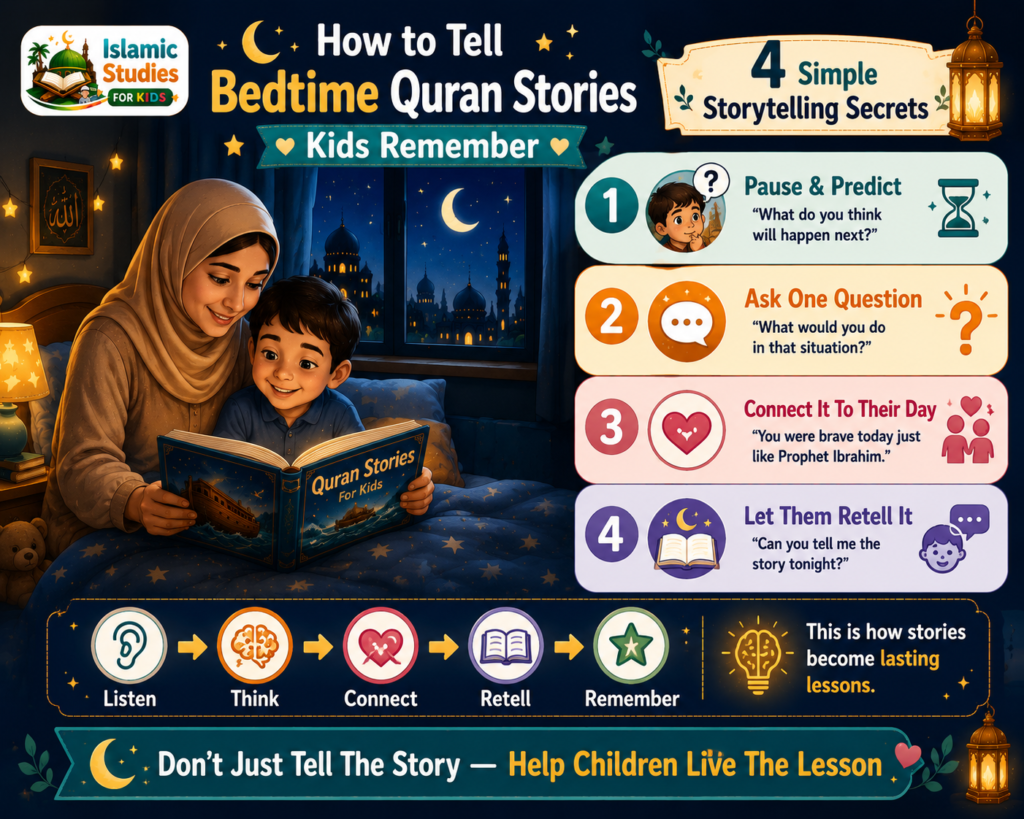
How to Tell Bedtime Quran Stories in a Way Kids Remember?
The story itself is only half the work. How you tell it determines whether your child remembers it tomorrow or forgets it by morning. These practitioner-tested techniques make a real difference:
Pause at the turning point. Before Musa throws his staff, before the flood rises, before the birds appear — pause and ask: “What do you think will happen next?” Children who predict the story remember it far better than children who only listen.
One question after the story, not five. Ask only: “What would you have done in that situation?” That single question moves the moral from the story into your child’s personal world.
Connect it to their day. If your child faced something difficult that day, match the story to it. “Remember how Prophet Ibrahim didn’t give up even when things were really hard? You did something like that today.”
Let them retell it. A few nights after first telling a story, say: “Can you tell me the story of Prophet Nuh tonight?” Children who retell stories develop their own relationship with the narrative — it becomes theirs, not just something they heard.
For structured Islamic story time and more resources, explore Islamic stories for kids — a library of Quranic and prophetic narratives designed specifically for children.
Age-by-Age Guide: Which Bedtime Quran Stories to Tell When
Not every story lands equally with every age. Match the story to where your child is developmentally:
| Age | Best Stories | Why They Work |
| Ages 3–5 | The Elephant Army, Prophet Sulaiman and the Ant | Short, visual, a clear “wow” moment |
| Ages 5–8 | Adam and Hawwa, Prophet Nuh, Prophet Ibrahim | Introduces testing, forgiveness, and trust in Allah |
| Ages 8–12 | Prophet Musa, People of the Cave, Prophet Isa | Longer narratives, more moral complexity |
A practical note for parents of toddlers: you do not need the full story. The Elephant Army can be told in three sentences to a three-year-old: “Abraha came to break the Kaaba. His big elephants stopped. Allah sent birds and saved it.” The child absorbs the concept of divine protection — the length of the narrative doesn’t matter yet.
Read also: Prophet Stories for Kids – 14 Prophets
Watch a Sample Lesson from Our Academy
Get a firsthand look at how our students learn Islamic values, Quran, and essential knowledge through engaging and interactive online classes. See why families trust Islamic Studies for Kids Academy.
Give Your Child Quran Stories That Stay With Them for Life
Bedtime is just ten minutes — but ten minutes of Quran story time, given consistently, builds something that lasts decades. The children who grew up hearing these stories become the adults who tell them to their own children.
If you want your child to go deeper — to understand why these stories matter, to learn the Quran directly, and to connect with Islamic studies in a structured, engaging way — islamic studies for kids offers a full library of Quran stories, prophet stories, and Islamic studies resources designed exactly for Muslim children and their parents.
[Explore Quran Stories for Kids]

Our Islamic Studies Courses Include:
- Islamic Studies for Kids
- Islam Basics for Kids (Beginners)
- 5 Pillars of Islam for Kids
- 6 Pillars of Iman (Faith) for Kids
- Salah (Prayer) for Kids
- Wudu for Kids
- Dua for Kids
- Ramadan for Kids
- Zakat & Sadaqah for Kids
- Hajj for Kids
- Aqeedah (Islamic Belief) for Kids
- Islamic Manners & Akhlaq for Kids
- Good Deeds for Kids
- Cleanliness (Taharah) in Islam for Kids
- Angels in Islam for Kids
- Islamic History for Kids
- Seerah (Prophet’s Life) for Kids
- Prophets Stories for Kids
- Islamic Stories & Morals for Kids
- Fiqh for Kids (Islamic Jurisprudence Basics)
- Hadith for Kids
- Quran Tafseer Course for Kids
- Islamic Holidays & Events for Kids
- Islamic Identity for Kids
- Intensive Islamic Course for Kids
Enroll today and give your child the knowledge, values, and confidence to grow as a practicing Muslim with a strong connection to Allah and His teachings.
Fun & Engaging Islamic Classes for Kids
Start your child’s journey today with interactive lessons designed to make learning Islam loved and easy.
Get Your Child a Free TrialConclusion
The best bedtime Quran stories are more than entertainment. Each one — Adam and Hawwa, Nuh and the ark, Musa facing Pharaoh, the young men in the cave — carries a moral that speaks directly to the challenges children face: how to handle mistakes, how to stay brave when things are hard, how to trust Allah when outcomes are out of your hands.
Ten minutes at bedtime, told consistently, is enough to plant these lessons deep. Start with the story that feels right for your child’s age tonight, and let the Quran speak to them in the quietest, most receptive moment of their day.
Frequently Asked Questions
What age should children start hearing bedtime Quran stories?
Children can begin hearing Quran stories from as early as age 2–3. At this age, they absorb language, tone, and simple moral patterns, even before they can discuss them. Short, visual stories like the Elephant Army work perfectly for toddlers. Longer narratives with moral complexity, like Prophet Musa’s story, suit children aged 6 and above.
How long should a bedtime Quran story session be?
A session of 5 to 10 minutes is enough for most children aged 3–10. One story per night, followed by a single question, is more effective than reading multiple stories back to back. Consistency over weeks builds far more than a single long session.
Which Quran story is best to start with for young children?
The story of the Elephant Army (Surah Al-Fil) is an excellent first story for young children. It is short, has a clear and dramatic event, and delivers the core lesson — that Allah protects what is sacred — without requiring complex explanation. Prophet Sulaiman and the Ant is another strong starting point for ages 4–6.
Do I need to read Arabic to tell my child Quran stories?
No. The stories can be told entirely in English or your native language. What matters is accuracy to the Quranic content and age-appropriate language. Parents who tell the story in their own words — rather than reading from a text — often connect with their children more naturally.
How do I make sure my child remembers the moral of the story?
Ask one specific question after the story, not several. “What would you have done?” or “What did you learn from what Musa did?” works far better than listing the morals yourself. Children remember lessons they reached on their own far longer than lessons they were told.
Can bedtime Quran stories replace formal Islamic education?
Bedtime stories build love, familiarity, and early moral foundation — but they work best alongside structured Islamic learning, not instead of it. Stories inspire a child to want to know more; formal learning gives them the tools to go deeper into the Quran, its meaning, and Islamic values.


Leave a Reply