 Stories
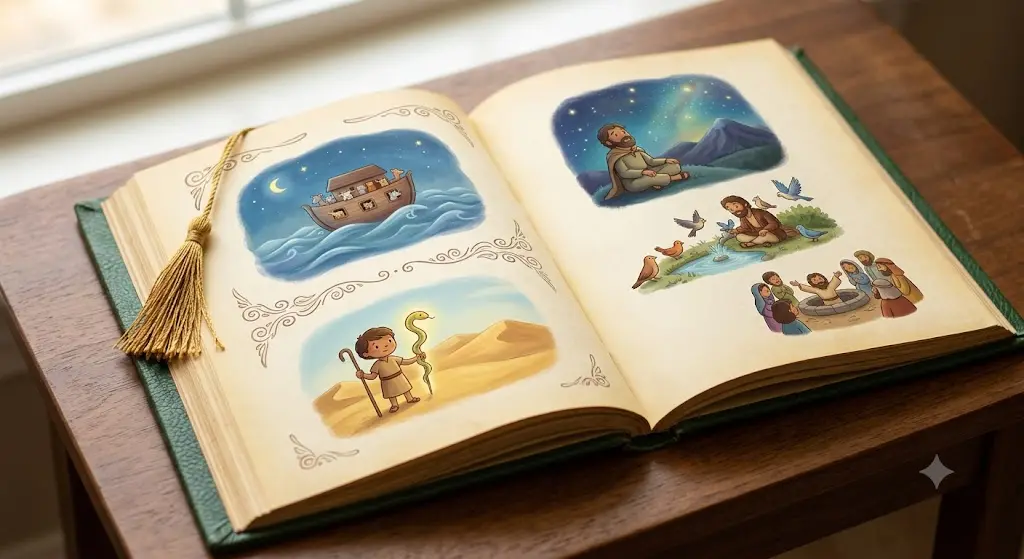
Every child who hears the story of Prophet Nuh (AS) patiently building a ship while his neighbors mocked him — or Prophet Yusuf (AS) forgiving the brothers who betrayed him — carries something with them for life. Prophet stories for kids are not bedtime tales. They are the most effective character-education curriculum ever written, grounded in revelation and tested across fourteen centuries.
This guide covers 14 prophet stories from Adam (AS) to Muhammad (ﷺ), each told in child-friendly language, with clear lessons your child can actually apply. You will also find a practical framework for how to teach these stories by age so that the values stick — not just the events.
For structured, guided learning of these stories alongside expert Islamic Studies teachers, explore our Islamic Stories for Kids program at Islamic Studies for Kids.
The Quran mentions 25 prophets by name. Below are 14 of the most frequently taught, each condensed into a story your child can follow and a lesson they can hold.
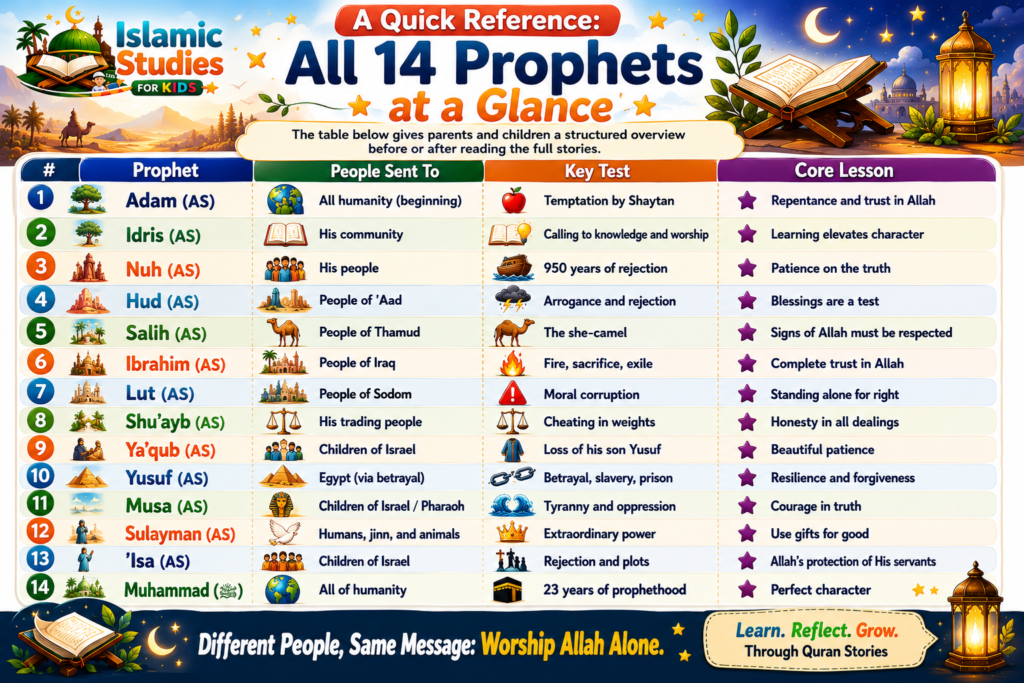
1. Prophet Adam (AS) — The First Human
Adam (AS) is the first human being Allah ﷻ ever created — shaped from clay, given a soul, and honored above all of Allah’s creation. When Allah commanded the angels to bow to Adam as a sign of honor, all obeyed except Iblis (Shaytan), who refused out of arrogance and was cast away.
Adam and his wife Hawwa were placed in Jannah, warned to avoid one tree. Shaytan whispered to them until they ate from it. They immediately felt remorse and turned to Allah:
رَبَّنَا ظَلَمْنَا أَنفُسَنَا وَإِن لَّمْ تَغْفِرْ لَنَا وَتَرْحَمْنَا لَنَكُونَنَّ مِنَ الْخَاسِرِينَ
Rabbanaa zalamnaa anfusanaa wa-in lam taghfir lanaa wa-tarhamnaaa lanakoonanna minal-khaasireen
“Our Lord, we have wronged ourselves, and if You do not forgive us and have mercy upon us, we will surely be among the losers.” (Surah Al-A’raf, 7:23)
Allah accepted their repentance and sent them to Earth to begin human history.
Lessons for children:
- Arrogance (like Iblis) leads to loss; humility leads to mercy
- Everyone makes mistakes — what matters is turning back to Allah quickly
- Shaytan is our open enemy and whispers to lead us astray
2. Prophet Idris (AS) — The Scholar Prophet
Idris (AS) came after Adam and Shith (AS) as one of the earliest prophets. He was known across his community for constant remembrance of Allah and extraordinary knowledge.
He is credited as the first human to write with a pen — at a time when no one recorded knowledge in writing. He was also the first to sew clothing. These are not minor details: they establish that Islamic tradition links knowledge and innovation to prophethood, not away from it.
Allah raised him to an elevated station, and the Prophet Muhammad (ﷺ) met Idris in the fourth heaven during Al-Isra wal-Mi’raj.
Lessons for children:
- Learning and knowledge raise a person’s rank — with people and with Allah
- Constant dhikr (remembrance of Allah) keeps the heart connected
- Being useful and innovative is part of a good Muslim’s character
3. Prophet Nuh (AS) — The Patient Caller
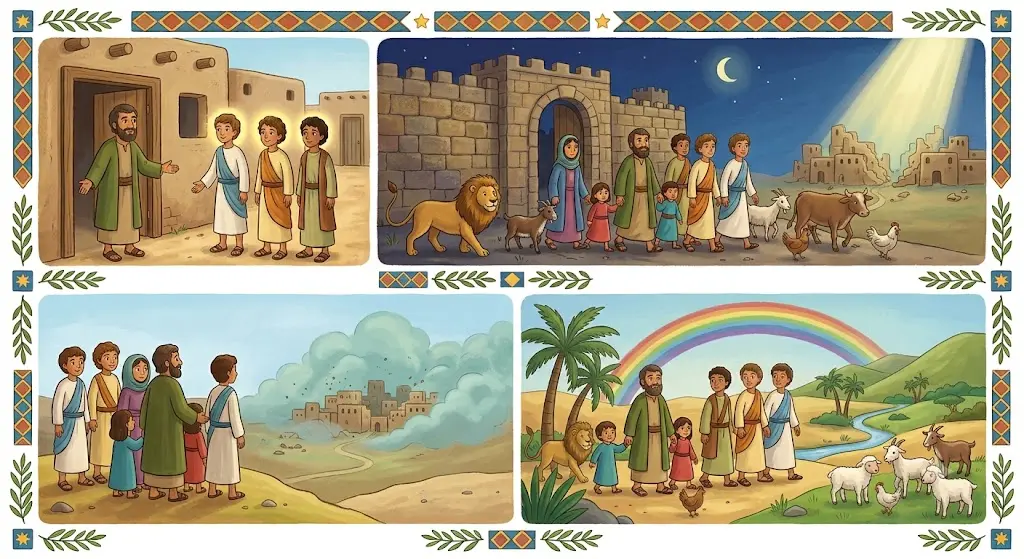
Nuh (AS) was sent to a people who had turned entirely to idol worship. He called them for 950 years — an almost incomprehensible commitment — yet only a small number believed.
Allah instructed him to build a large ship, and his neighbors mocked him openly. He answered them with certainty: if you mock us today, we will witness your regret when the punishment comes.
The great flood came. The waters rose above the mountains. Only the believers on the ship survived. Even Nuh’s own son refused to board, certain he could climb to safety — and drowned.
Lessons for children:
- Patience on the truth, even when you stand almost alone, is a form of worship
- Obeying Allah — even when His command seems strange — is always the right choice
- Ties of family do not override ties of faith
4. Prophet Hud (AS) — Sent to the People of ‘Aad
The people of ‘Aad were exceptionally strong physically and lived in the region of Al-Ahqaf (in the Arabian Peninsula). Allah gave them tremendous blessings — height, strength, fertile land — yet they fell into arrogance and idol worship.
Hud (AS) called them to Allah’s oneness and warned them of punishment. They mocked him and rejected every sign. Allah sent a violent, roaring wind against them for seven nights and eight days until nothing of them remained. Hud (AS) and the believers were saved.
Lessons for children:
- Physical strength and blessings are a test, not a guarantee of protection
- Gratitude for Allah’s gifts — not arrogance — is the correct response to blessing
5. Prophet Salih (AS) — The She-Camel and the Warning
The people of Thamud carved their homes into the mountains of Al-Hijr (in present-day Saudi Arabia). They were given great strength and prosperity. When they demanded a miracle to prove Salih’s (AS) prophethood, Allah caused a she-camel to emerge from solid rock — a clear, extraordinary sign.
Salih (AS) warned them: This is Allah’s camel. Let her graze freely and drink from the well on her day. If you harm her, a painful punishment will come within three days.
They killed the camel in defiance. Salih (AS) left with the believers, and on the third day the punishment destroyed the entire city.
Lessons for children:
- Arrogance blinds people to clear signs right in front of them
- Allah always keeps His word — both in promise and in warning
- Nothing is impossible for Allah
6. Prophet Ibrahim (AS) — The Friend of Allah
Ibrahim (AS) is called Khalilullah — the close friend of Allah. His story is the backbone of monotheism in Islam, Judaism, and Christianity. He was raised in a household where his own father carved idols for people to worship.
Ibrahim (AS) studied the sun, the moon, and the stars — and reasoned through observation that none of them could be God, because they all set. He concluded: My face is turned toward the One who created the heavens and the earth.
He smashed all the idols in the temple except the largest, then told his people to ask the large idol what happened. When they admitted it cannot speak, he had already made his point. In retaliation, they threw him into a massive fire. Allah’s command:
قُلْنَا يَـٰنَارُ كُونِى بَرْدًا وَسَلَامًا عَلَىٰٓ إِبْرَٰهِيمَ
Qulnaa yaa naaru koonee bardan wa-salaaman ‘alaa Ibraaheem
“We said: O fire, be coolness and safety for Ibrahim.” (Surah Al-Anbiya, 21:69)
He walked out unharmed. Ibrahim (AS) also faced the trials of leaving his wife Hajar and infant son Ismail in the valley of Makkah, and the command to sacrifice his son — each time placing his full trust in Allah.
Lessons for children:
- Thinking deeply about creation leads the honest heart to Allah
- Courage means standing for truth even when everyone else disagrees
- Allah’s protection is real — and it comes through complete trust
7. Prophet Lut (AS) — Standing Alone Against Wrongdoing
Lut (AS) was the nephew of Ibrahim (AS) and was sent to the people of Sodom, who had fallen into severe moral corruption — specifically the sin of men pursuing men, which was unprecedented among all prior communities.
He pleaded with them repeatedly. They not only refused but threatened him. When angels came to warn him to leave with his family, the people of Sodom tried to assault the angels (who appeared as men). Allah rained stones of destruction upon the city and turned it upside down. Lut (AS) and his daughters escaped; his wife, who had sided with the wrongdoers, did not.
Lessons for children:
- One person standing for right is enough — Allah supports whoever holds to the truth
- Companionship shapes character: the people we choose to stay with matter
8. Prophet Shu’ayb (AS) — Justice in the Marketplace
Shu’ayb (AS) was sent to a prosperous trading community known for cheating in weights and measures — taking full value for themselves while giving buyers less than they paid for.
He told them:
وَلَا تَبْخَسُوا النَّاسَ أَشْيَاءَهُمْ وَلَا تَعْثَوْا فِي الْأَرْضِ مُفْسِدِينَ
Wa laa tabkhasun-naasa ashyaa-ahum wa laa ta’thaw fil-ardi mufsideen
“Do not deprive people of their due and do not commit abuse on the earth, spreading corruption.” (Surah Hud, 11:85)
They mocked him and increased in their fraud. A dark cloud they mistook for shade became a punishment that destroyed them entirely.
Lessons for children:
- Honesty in buying and selling is a direct Islamic obligation
- Cheating harms real people — and has real consequences from Allah
- Economic injustice is a form of corruption in the earth
Read also: Quran Stories for Kids: The Best Islamic Stories Every Child Should Know
9. Prophet Ya’qub (AS) — Patience Through Grief
Ya’qub (AS) — also known as Israel — was the son of Ishaq (AS) and grandson of Ibrahim (AS). He was a prophet from a line of prophets. His son Yusuf was his closest, and this closeness made Yusuf’s brothers envious.
When his sons returned with a bloodied shirt claiming Yusuf had been eaten by a wolf, Ya’qub (AS) knew they were lying. His response is one of the most powerful in the Quran:
فَصَبْرٌ جَمِيلٌ وَاللَّهُ الْمُسْتَعَانُ
Fa-sabrun jameel wallahul-musta’aan
“Beautiful patience — and Allah is the one whose help is sought.” (Surah Yusuf, 12:18)
He waited, grieved, and trusted — for decades — until Yusuf (AS) was returned to him.
Lessons for children:
- Sabrun jameel (beautiful patience) means not complaining to anyone except Allah
- Jealousy pushes people into terrible choices
- The end of the story is always in Allah’s hands, not ours
10. Prophet Yusuf (AS) — The Complete Story of Resilience
The story of Yusuf (AS) is the only prophet story given an entire chapter in the Quran — and Allah calls it ahsanal qasas (the best of stories). It contains abandonment, betrayal, false accusation, imprisonment, and eventual triumph — and is therefore one of the most emotionally complete prophet stories for kids, covering nearly every difficult feeling children encounter.
Thrown into a well by his brothers, sold into slavery in Egypt, imprisoned on a false charge — Yusuf (AS) maintained his character through each stage. He used his Allah-given gift of dream interpretation to rise to become the Minister of Finance of Egypt, where he managed a crisis that saved millions from famine.
When his brothers came begging for food — not recognizing him — he eventually revealed himself and said:
لَا تَثْرِيبَ عَلَيْكُمُ الْيَوْمَ
Laa tathreeba ‘alaykumul-yawm
“No blame will there be upon you today.” (Surah Yusuf, 12:92)
No revenge. No bitterness. Only forgiveness.
Lessons for children:
- Every hardship in your story is a chapter, not the ending
- Your gifts (like dream interpretation) are from Allah — use them honestly
- Forgiving people who hurt you is one of the highest prophetic qualities
You can find a fuller version of this story in our dedicated guide on Prophets’ Stories for Kids.
Experience a Real Classroom
Curious about how we teach? This video offers a glimpse into a real class, showcasing our interactive approach, qualified teachers, and child-friendly learning experience.
Fun & Engaging Islamic Classes for Kids
Start your child’s journey today with interactive lessons designed to make learning Islam loved and easy.
Get Your Child a Free Trial11. Prophet Musa (AS) — Courage Against Tyranny
Pharaoh ruled Egypt with total power and enslaved the Children of Israel. When he heard a prophecy that a child from among them would end his reign, he ordered every newborn Israelite boy killed.
Musa’s (AS) mother placed him in a basket in the Nile. He floated directly to Pharaoh’s palace, where Pharaoh’s own wife Asiya asked to adopt him — and Musa (AS) was raised inside the house of his enemy, protected by Allah.
As an adult, Musa (AS) was given the divine mission to free his people and invite Pharaoh to worship Allah alone. His signs included a staff that became a snake and a hand that shone with light. Pharaoh refused across many confrontations and plagues. The final moment came at the sea — which Allah split so Musa’s people could cross, then closed over Pharaoh’s army.
The Torah (Tawrah) was also revealed to Musa (AS) as guidance for the Children of Israel.
Lessons for children:
- Courage means speaking the truth to someone who has power over you
- Allah’s protection is with those He sends — no Pharaoh is stronger than Allah
- Even impossible-looking walls (like a sea) open when Allah commands
12. Prophet Sulayman (AS) — A Kingdom Used for Good
Sulayman (AS) received from Allah what no other human before or after him received: a kingdom over humans, jinn, wind, and animals — with the ability to understand the language of every creature.
The Quran records him hearing an ant warn her colony:
يَـٰٓأَيُّهَا ٱلنَّمْلُ ٱدْخُلُوا۟ مَسَـٰكِنَكُمْ لَا يَحْطِمَنَّكُمْ سُلَيْمَـٰنُ وَجُنُودُهُۥ
Yaa ayyuhan-namlu-dkhuluu masaakinakum laa yahtimannakum Sulaymaanu wa junooduh
“O ants, enter your homes lest Sulayman and his soldiers crush you.” (Surah An-Naml, 27:18)
He smiled and made du’a, grateful for the blessing of understanding. Sulayman (AS) used his extraordinary power entirely in the service of Allah — governing justly, building great structures, and bringing entire kingdoms to monotheism.
Lessons for children:
- How you use your gifts matters more than what the gifts are
- Gratitude to Allah for blessings — not pride in them — is the prophetic way
- Every creature, even an ant, has its own life worthy of care
13. Prophet ‘Isa (AS) — Miracles and Pure Worship
‘Isa (AS) — known in Christianity as Jesus — is one of the five greatest prophets in Islam (Ulul ‘Azm). He was sent to the Children of Israel at a time when they excelled in medicine. Allah gave him signs no physician could produce: healing the blind and the leper, raising the dead — all bi’idhnillah (by Allah’s permission), not by ‘Isa’s own power.
He fashioned a bird from clay, breathed into it by Allah’s permission, and it flew. He was also given the Injeel (Gospel) as revelation.
When his enemies plotted to crucify him, Allah protected him. He was not killed or crucified — Allah raised him to Himself:
وَمَا قَتَلُوهُ وَمَا صَلَبُوهُ وَلَٰكِن شُبِّهَ لَهُمْ
Wa maa qataloohu wa maa salaboohu wa laakin shubbiha lahum
“They did not kill him, nor did they crucify him — but it was made to appear so to them.” (Surah An-Nisa, 4:157)
‘Isa (AS) will return before the Day of Judgment and lead a community of believers.
Lessons for children:
- All miracles come from Allah — ‘Isa (AS) never claimed to act from his own power
- Allah protects His chosen servants from those who wish them harm
- ‘Isa (AS) is a great prophet of Islam — Muslims love and honor him
14. Prophet Muhammad (ﷺ) — The Final Messenger
Muhammad (ﷺ) was born in Makkah and known even before prophethood as Al-Sadiq Al-Amin — the Truthful, the Trustworthy. At the age of forty, revelation began through angel Jibreel (AS): “Recite in the name of your Lord who created.” The Quran was revealed to him over 23 years.
He called his people away from idol worship and toward the worship of Allah alone. The Quraysh responded with persecution, torture of the vulnerable, and economic boycotts. The Prophet (ﷺ) and the Muslims endured for 13 years in Makkah before migrating to Madinah — the Hijrah — which marks Year 1 of the Islamic calendar.
In Madinah, the Prophet (ﷺ) built a mosque, established a community, and set the model for Islamic governance, character, and scholarship. Eight years after the Hijrah, Makkah was opened to Islam — and the Prophet (ﷺ) entered with full forgiveness for those who had persecuted him and his companions.
The Prophet (ﷺ) said:
“إِنَّمَا بُعِثْتُ لِأُتَمِّمَ مَكَارِمَ الْأَخْلَاقِ”
Innamaa bu’ithtu li-utammima makaarim al-akhlaaqi
“I was only sent to perfect noble character.” (Al-Bayhaqi, Shu’ab Al-Iman, reported by Abu Hurairah)
Lessons for children:
- Good character is the mission — every prophet modeled it, and Muhammad (ﷺ) completed it
- Patience through persecution without responding with hatred is the prophetic standard
- The Quran is his living miracle — still unchanged, still memorized, still guiding
How to Teach Prophet Stories for Kids by Age?
Teaching prophet stories is a skill, and the method matters as much as the content. Children at different ages need different entry points into the same stories.
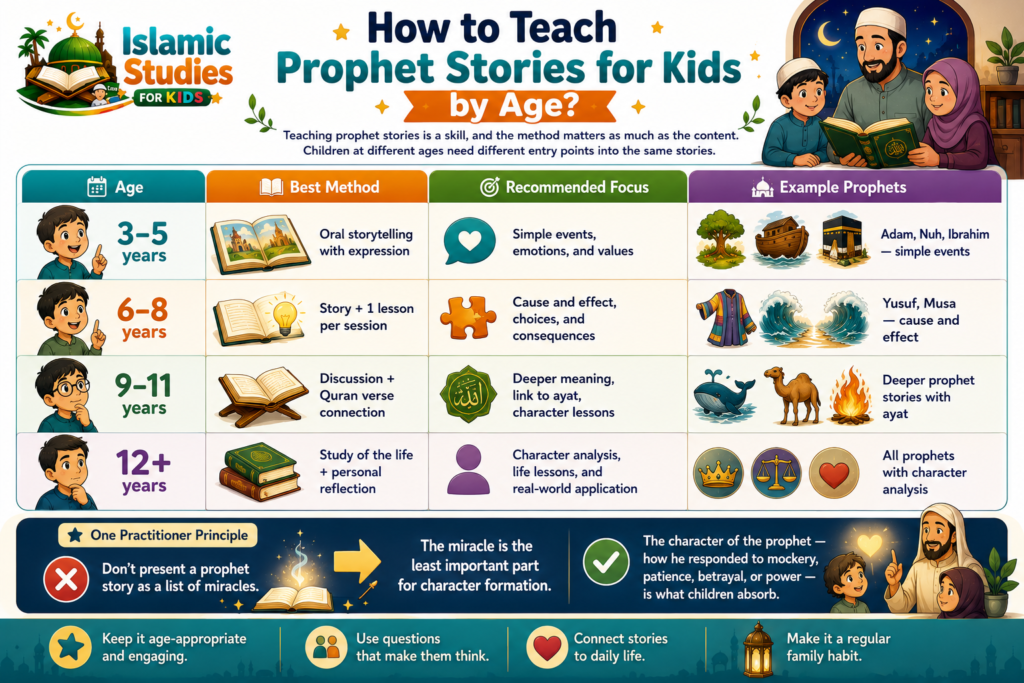
Here is a practical, field-tested framework:
| Age | Best Method | Recommended Focus |
| 3–5 years | Oral storytelling with expression | Adam, Nuh, Ibrahim — simple events |
| 6–8 years | Story + 1 lesson per session | Yusuf, Musa — cause and effect |
| 9–11 years | Discussion + Quran verse connection | Deeper prophet stories with ayat |
| 12+ years | Study of the life + personal reflection | All prophets with character analysis |
One practitioner principle to keep in mind: never present a prophet story as a list of miracles. The miracle is the least important part for character formation. The character of the prophet — how he responded to mockery, patience, betrayal, power — is what children absorb. Lead with that.
Read also: The Best Bedtime Quran Stories for Kids: Timeless Lessons for Little Hearts
Common Mistakes Parents Make When Sharing Prophet Stories for Kids
Most parents who tell prophet stories mean well but fall into a small number of patterns that reduce the stories’ impact.
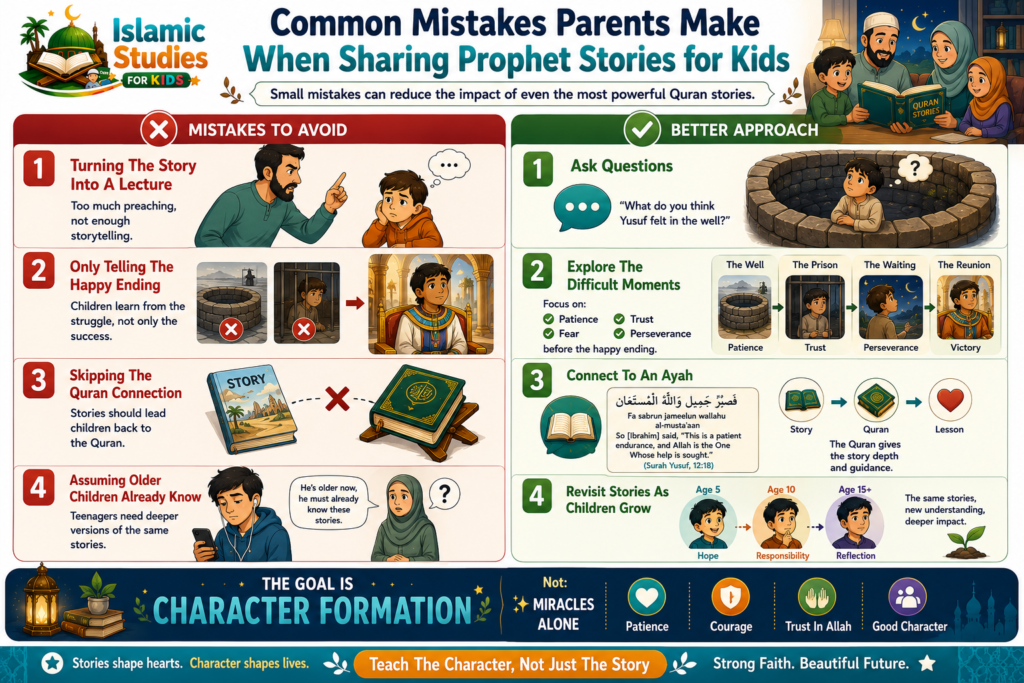
Here is what to avoid:
- Turning the story into a lecture: children disengage the moment they sense a lesson is being delivered. Let the story breathe, then ask “What do you think Yusuf felt when he was in the well?”
- Only telling the happy ending: children learn resilience from the difficulty, not just the resolution. Spend time with the hard parts before rushing to the outcome.
- Skipping the Quran connection: each prophet story has at least one ayah that encapsulates its meaning. Pairing the Arabic with the English text — even briefly — gives children contact with the Quran as a living text, not a separate subject.
- Assuming older children already know: many teenagers have only childhood-level prophet knowledge. Revisit the stories with adolescents at a more complex level — the same events carry entirely different weight.
Watch a Sample Lesson from Our Academy
Get a firsthand look at how our students learn Islamic values, Quran, and essential knowledge through engaging and interactive online classes. See why families trust Islamic Studies for Kids Academy.
Start Your Child’s Prophet Story Learning the Right Way
Understanding prophet stories is most powerful when it happens in a structured environment alongside qualified teachers who know how to make these lessons come alive for children at different ages.
At Islamic Studies for Kids, we offer dedicated Prophet Stories courses for children taught by experienced Islamic Studies educators — combining accurate narration, Quranic connection, and age-appropriate character education.
Whether your child is 5 or 15, there is a structured path designed for them.
[Start with a free trial session today]
Our Islamic Studies Courses for Kids:
- Quran for Kids
- Noorani Qaida for Kids
- Quran Recitation for Kids
- Tajweed for Kids
- Quran Memorization (Hifz) for Kids
- Quran for Toddlers
- Quranic Arabic for Kids
- Quran Stories for Kids
Fun & Engaging Islamic Classes for Kids
Start your child’s journey today with interactive lessons designed to make learning Islam loved and easy.
Get Your Child a Free TrialConclusion
Prophet stories for kids are the single most powerful tool in Islamic character education — more effective than rules, reminders, or lectures. The 14 prophets covered in this guide — from Adam (AS) to Muhammad (ﷺ) — each carried a unique test, a clear call to Allah’s oneness, and a character lesson that is just as relevant for a child today as it was for the communities they were sent to.
The framework is simple: tell the story with emotion, linger on the difficulty before the resolution, connect it to a Quranic verse, and ask your child what they notice. Do that consistently, and you are not just teaching Islamic history — you are building the character that Islam calls for.
Frequently Asked Questions About Prophet Stories for Kids
Why Prophet Stories for Kids Are Different from Other Stories?
Prophet stories are the only stories that combine historical truth, moral teaching, and divine wisdom in a single narrative. Unlike invented fables, every event in a prophet’s life is grounded in revelation.
Allah ﷻ confirms this in the Quran:
لَقَدْ كَانَ فِي قَصَصِهِمْ عِبْرَةٌ لِّأُوْلِي الْأَلْبَابِ
Laqad kaana fee qasasihim ‘ibratun li-ulil-albaab
“There was certainly in their stories a lesson for those of understanding.” (Surah Yusuf, 12:111)
The Arabic root of the word qasas (stories) also carries the meaning of tracing footsteps — meaning children who learn these stories are literally following the path the prophets walked.
A key practitioner observation: children aged 5–10 do not learn values through instruction. They learn through identification. When a child hears that Prophet Ibrahim (AS) stood alone against an entire city and came out of the fire unharmed, they file that away as a template — people who hold to what is right are protected. That template shapes decisions quietly, for years.
How many prophets are there in Islam?
Islam teaches that Allah sent 124,000 prophets throughout human history, though only 25 are mentioned by name in the Quran. Muslims are required to believe in all prophets sent by Allah, without distinction between them.
At what age should children start learning prophet stories?
Children can begin hearing simplified prophet stories from age 3. The stories of Adam (AS) and Nuh (AS) work well as early introductions because they have clear, concrete events. Deeper character analysis suits children aged 8 and above.
Which prophet story is best for teaching patience to children?
The story of Yusuf (AS) is the most complete for teaching patience — it spans childhood betrayal, slavery, false imprisonment, and eventual elevation. The story of Ya’qub (AS) is equally powerful for teaching sabrun jameel (beautiful patience) while waiting for something precious to return.
Is it true that Prophet Isa (AS) is mentioned in the Quran?
Yes. ‘Isa (AS) is mentioned by name 25 times in the Quran, more than any prophet other than Musa (AS). He is described as a word from Allah, a spirit from Him, a messenger to the Children of Israel, and a prophet who will return before the Day of Judgment.
How many times is Prophet Muhammad (ﷺ) mentioned in the Quran?
The name Muhammad (ﷺ) appears four times in the Quran. He is also referred to by other titles such as Ahmad, Al-Nabi, and Al-Rasul across many more verses. His complete character is described throughout the Quran rather than concentrated in a single passage.
Can prophet stories replace Islamic Studies for children?
Prophet stories are a foundational part of Islamic Studies, but not a replacement for it. A structured Islamic Studies program covers aqidah (belief), fiqh (practice), Quran, and character development — of which prophet stories form one essential pillar. The stories provide the why; structured Islamic education provides the how.


Leave a Reply