 For Parents
Most parents work hard to give their children a good life — food, clothing, education, healthcare. But according to Islamic teaching, the duties of parents towards their children in Islam go much deeper than physical provision. They include the child’s soul, character, faith, and preparation for this life and the next.
The Prophet Muhammad ﷺ made this responsibility clear: “Each of you is a shepherd, and each of you is responsible for his flock.” (Bukhari & Muslim). For parents, that flock is their children.
This guide covers what Islam actually requires of parents — from the Quran, Sunnah, and classical scholars — and what most parents overlook without realizing it.
Duties of Parents Towards Their Children in Islam
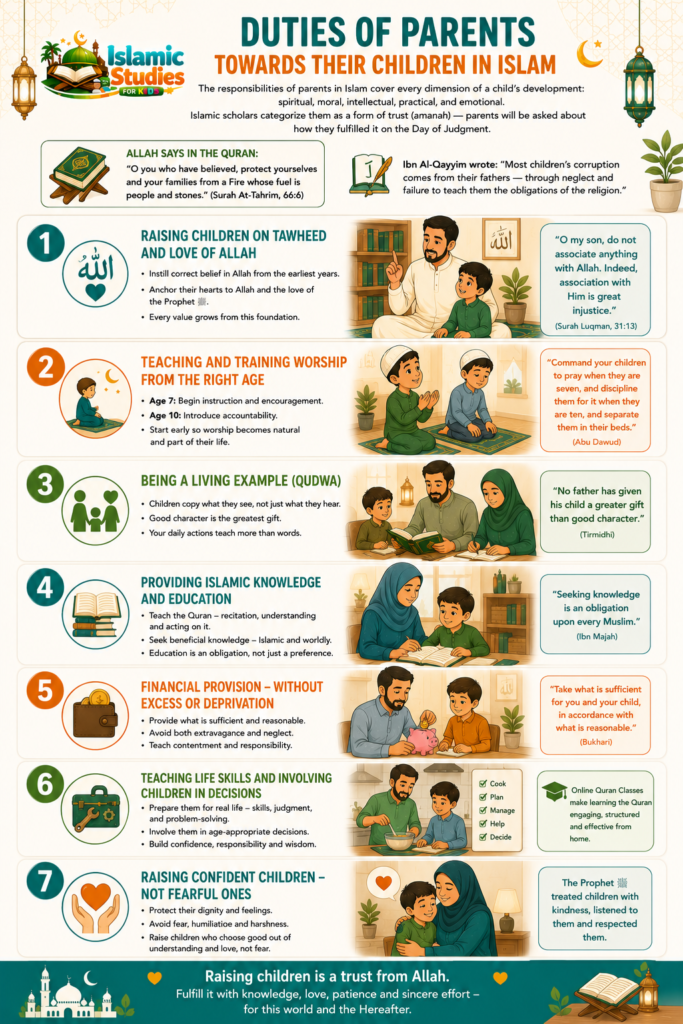
The responsibilities of parents in Islam cover every dimension of a child’s development: spiritual, moral, intellectual, practical, and emotional. Islamic scholars categorize them as a form of trust (amanah) — parents will be asked about how they fulfilled it on the Day of Judgment.
Allah says in the Quran:
“O you who have believed, protect yourselves and your families from a Fire whose fuel is people and stones.” (Surah At-Tahrim, 66:6)
This verse is the foundational parenting command in Islam. Ibn Al-Qayyim wrote directly about what neglecting it looks like: “Most children’s corruption comes from their fathers — through neglect and failure to teach them the obligations of the religion.”
1. Raising Children on Tawheed and Love of Allah
The first and weightiest duty is instilling correct Islamic belief in children from their earliest years. Luqman’s advice to his son — preserved in the Quran — begins not with manners or education, but with the prohibition of shirk: “O my son, do not associate anything with Allah. Indeed, association with Him is great injustice.” (Surah Luqman, 31:13)
This is not accidental. When a child’s heart is anchored to Allah and the love of the Prophet ﷺ, every other value — honesty, patience, kindness — grows from that foundation.
The Prophet ﷺ said: “Every child is born in a state of fitrah (natural disposition toward Islam). His parents then make him a Jew, a Christian, or a Zoroastrian.” (Bukhari). This hadith puts the full weight of the child’s spiritual direction on the parents — not on teachers, not on schools alone.
2. Teaching and Training Worship from the Right Age
One duty most parents understand in principle but struggle to implement in practice is training children in worship — specifically prayer. Islam provides a clear, actionable timeline here.
The Prophet ﷺ said: “Command your children to pray when they are seven, and discipline them for it when they are ten, and separate them in their beds.” (Abu Dawud)
This establishes a two-stage system:
- Age 7: Begin instruction and encouragement — make salah familiar and positive
- Age 10: Introduce accountability — the child is expected to pray consistently
Most parents begin at 10 when the instruction should have begun at 7. That three-year gap matters. The scholars note that the goal of starting early is tamreen — habituation — so prayer becomes natural by the time it is obligatory.
This same gradual principle applies to fasting, Quran recitation, and other acts of worship: introduce gently when young, hold accountable as the child matures.
3. Being a Living Example (Qudwa)
Islamic upbringing is not primarily what you tell your children — it is what they see you do. The Arabic term qudwa (exemplary conduct) names this principle explicitly.
The Prophet ﷺ said: “No father has given his child a greater gift than good character.” (Tirmidhi). And elsewhere: “Training your child well is better than giving a sa’ in charity.” (Tirmidhi)
A practical note from Islamic pedagogy: children inherit qualities they observe at home far more readily than qualities they are lectured about. A father who prays regularly, speaks truthfully, and treats his wife with respect is doing more active parenting in those moments than in any explicit lesson. The same applies to the mother. Parenting by example is not optional — it is the mechanism by which values actually transfer.
4. Providing Islamic Knowledge and Education
Teaching beneficial knowledge is one of Islam’s five essential purposes (maqasid al-shariah), specifically the preservation of the mind (hifz al-‘aql). The first command revealed in the Quran was “Read” (Surah Al-Alaq, 96:1–5), and the Prophet ﷺ said: “Seeking knowledge is an obligation upon every Muslim.” (Ibn Majah)
For parents, this means two things in practice:
First, teaching Quran — both recitation and comprehension. The Prophet ﷺ said: “The best of you are those who learn the Quran and teach it.” (Bukhari). A parent who helps their child recite, understand, and act on the Quran fulfills a deeply layered duty.
Second, general education and intellectual development. Islam encourages every form of knowledge that benefits the person and the community. Parents who invest in their child’s education — Islamic and worldly — are fulfilling a religious obligation, not simply a cultural preference.
Finding structured Islamic education for your child can feel overwhelming. Islamic Stories course offer a focused, age-appropriate curriculum that covers aqeedah, Quran, and Islamic character — making this duty easier to fulfill consistently.
5. Financial Provision — Without Excess or Deprivation
Providing for a child’s material needs is a clear parental duty in Islam, primarily assigned to the father. Allah says: “Spend of your wealth on what is good for parents and relatives.” (Surah Al-Baqarah, 2:215). Children are among the closest family members, and their provision takes priority.
The Prophet ﷺ told Hind, wife of Abu Sufyan: “Take what is sufficient for you and your child, in accordance with what is reasonable.” (Bukhari). This narration establishes a principle of moderation: provision should be adequate but not extravagant.
This is a nuance many parenting discussions miss. Over-provision — giving children everything they want, shielding them from difficulty — can produce moral weakness and entitlement. Under-provision creates its own harms. The Islamic standard is ma’ruf: what is reasonable and appropriate.
Read also: How To Instill Love Of Quran In Children? ـ A Parent’s Practical Guide
6. Teaching Life Skills and Involving Children in Decisions
The responsibilities of parents in Islam extend beyond the mosque and the study table. Parents are expected to prepare children for real life — practical skills, good judgment, and the ability to handle challenges.
Classical scholars of Islamic education recommended involving children in household decisions and problem-solving from a young age. This is not merely a parenting style — it builds the ‘aql (sound reasoning) and hikmah (wisdom) that Islamic character depends on.
Teaching a child to swim, cook, manage money, negotiate, or handle adversity are all considered legitimate parenting responsibilities in Islamic tradition. A child raised only with religious knowledge but no practical capability is not fully prepared.
Quran learning is one of the most important practical investments parents can make. Online Quran Classes connect children with qualified teachers who make Quran learning engaging, structured, and effective from home.
Experience a Real Classroom
Curious about how we teach? This video offers a glimpse into a real class, showcasing our interactive approach, qualified teachers, and child-friendly learning experience.
Fun & Engaging Islamic Classes for Kids
Start your child’s journey today with interactive lessons designed to make learning Islam loved and easy.
Get Your Child a Free Trial7. Raising Confident Children — Not Fearful Ones
This is perhaps the most overlooked duty of parents towards their child in Islam, and it deserves direct attention.
Islam instructs parents to protect their children’s dignity, safeguard their feelings, and avoid methods that produce fear, humiliation, or broken self-esteem. The Prophet ﷺ never belittled or shamed children. He listened to them, played with them, and addressed them with respect.
Islamic educators note that children raised through intimidation — constant threats, harsh punishment, emotional humiliation — often develop cowardice, deception, or deep resentment as they grow. They obey out of fear, not principle. When the fear is removed, the behavior collapses.
The goal of Islamic parenting is to raise a child who chooses good because they understand and believe in it — not one who complies only when watched.
How Are Parents Supposed to Treat Their Children in Islam?
The way parents treat their children is not left to culture or personal style in Islam — it follows clear principles drawn from Quranic guidance and prophetic example.
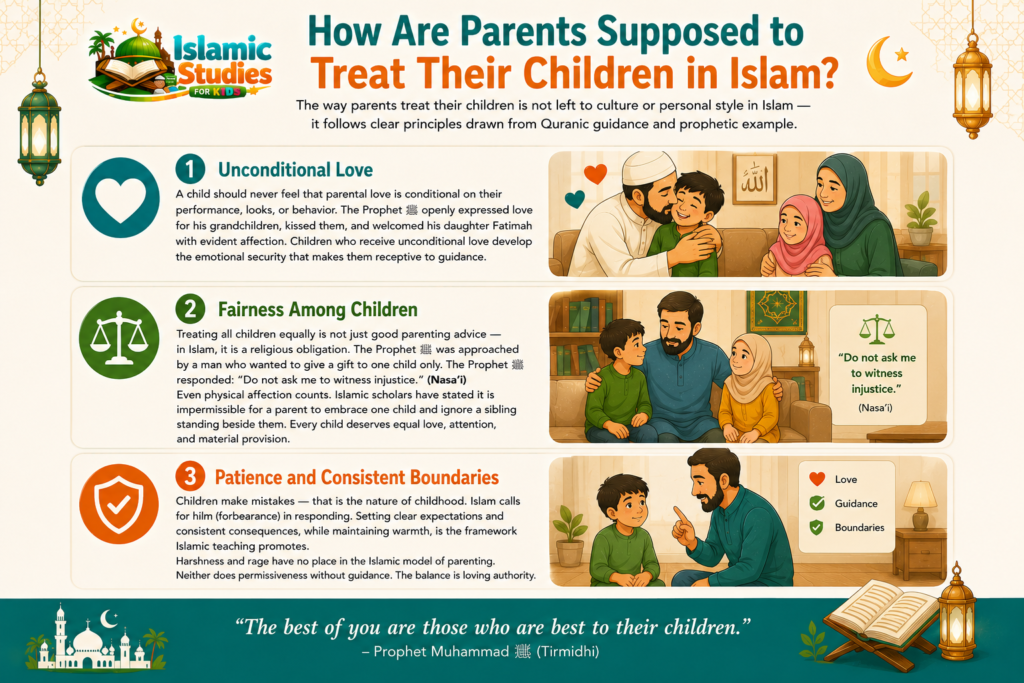
Unconditional Love
A child should never feel that parental love is conditional on their performance, looks, or behavior. The Prophet ﷺ openly expressed love for his grandchildren, kissed them, and welcomed his daughter Fatimah with evident affection. Children who receive unconditional love develop the emotional security that makes them receptive to guidance.
Fairness Among Children
Treating all children equally is not just good parenting advice — in Islam, it is a religious obligation. The Prophet ﷺ was approached by a man who wanted to give a gift to one child only. The Prophet ﷺ responded: “Do not ask me to witness injustice.” (Nasa’i)
Even physical affection counts. Islamic scholars have stated it is impermissible for a parent to embrace one child and ignore a sibling standing beside them. Every child deserves equal love, attention, and material provision.
Patience and Consistent Boundaries
Children make mistakes — that is the nature of childhood. Islam calls for hilm (forbearance) in responding. Setting clear expectations and consistent consequences, while maintaining warmth, is the framework Islamic teaching promotes.
Harshness and rage have no place in the Islamic model of parenting. Neither does permissiveness without guidance. The balance is loving authority.
The Spiritual vs. Material Imbalance — The Most Common Parenting Mistake in Islam
There is one mistake that Islamic scholars flag repeatedly, and it describes many sincere Muslim families today.
Parents protect their children from cold and heat. They rush to doctors when children fall ill. They spend generously on food, clothing, and schooling. And yet they give far less attention to the child’s spiritual formation — the Quran, the prayer, the character.
This is not a failure of love. It is a failure of priority.
As the source texts make clear: the body needs food, but the heart needs something more. The Prophet ﷺ said: “There is a piece of flesh in the body; if it is sound, the whole body is sound, and if it is corrupt, the whole body is corrupt. That piece is the heart.” (Bukhari & Muslim)
The parents who raise righteous children have understood this. Their child’s spiritual health is treated with the same urgency as their physical health. The Quran, the prayer, the company of good people — these are not optional extras. They are the core of what parents owe their children in Islam.
Read also: Rights of Children in Islam – A Complete Guide for Muslim Parents
Watch a Sample Lesson from Our Academy
Get a firsthand look at how our students learn Islamic values, Quran, and essential knowledge through engaging and interactive online classes. See why families trust Islamic Studies for Kids Academy.
Start Your Child’s Islamic Education Today
At Islamic Studies for Kids, every lesson is built around one goal: giving your child a genuine foundation in faith — not just facts to memorize, but values that shape who they become.
From Quran recitation and Islamic studies to understanding the character of the Prophet ﷺ, the courses are designed for young learners at every level, taught by qualified teachers in a structured, engaging environment your child will actually look forward to.
Because the best time to build that foundation is now — while their hearts are open and their habits are still forming.

Our Islamic Studies Courses Include:
- Islamic Studies for Kids
- Islam Basics for Kids (Beginners)
- 5 Pillars of Islam for Kids
- 6 Pillars of Iman (Faith) for Kids
- Salah (Prayer) for Kids
- Wudu for Kids
- Dua for Kids
- Ramadan for Kids
- Zakat & Sadaqah for Kids
- Hajj for Kids
- Aqeedah (Islamic Belief) for Kids
- Islamic Manners & Akhlaq for Kids
- Good Deeds for Kids
- Cleanliness (Taharah) in Islam for Kids
- Angels in Islam for Kids
- Islamic History for Kids
- Seerah (Prophet’s Life) for Kids
- Prophets Stories for Kids
- Islamic Stories & Morals for Kids
- Fiqh for Kids (Islamic Jurisprudence Basics)
- Hadith for Kids
- Quran Tafseer Course for Kids
- Islamic Holidays & Events for Kids
- Islamic Identity for Kids
- Intensive Islamic Course for Kids
Enroll today and give your child the knowledge, values, and confidence to grow as a practicing Muslim with a strong connection to Allah and His teachings.
Fun & Engaging Islamic Classes for Kids
Start your child’s journey today with interactive lessons designed to make learning Islam loved and easy.
Get Your Child a Free TrialConclusion
The duties of parents towards their children in Islam are comprehensive: from planting belief in Allah to teaching prayer at the right age, modeling good character, providing materially without excess, building practical skills, and raising children in dignity — not fear. These responsibilities are not cultural tradition — they are a religious trust that parents will answer for before Allah.
The deepest parenting insight in Islamic teaching is this: what you invest in your child’s heart returns — to them, to you, and to the community they will shape. Raising a righteous child is one of the most enduring acts of worship a parent can perform.
Frequently Asked Questions
What are the main duties of parents towards their children in Islam?
The main duties include raising children on correct Islamic belief, training them in worship from age seven, providing material needs without excess, teaching the Quran and Islamic knowledge, modeling good character, and treating children with love, fairness, and dignity. These responsibilities are considered a religious trust (amanah) in Islam.
What do parents owe their children spiritually in Islam?
Parents are responsible for their child’s spiritual formation — teaching tawheed, instilling love of Allah and the Prophet ﷺ, training them to pray, and connecting them to the Quran. Islamic scholars state that a child who reaches adulthood without this foundation represents a failure of parental duty, regardless of how well they were provided for materially.
At what age should parents begin teaching children to pray?
According to a hadith in Abu Dawud, parents should begin instructing children in prayer at age seven and hold them accountable for it at age ten. The early years (7–10) are for habituation — making salah familiar and positive — so that prayer becomes natural well before the age of obligation.
How are parents supposed to treat their children in Islam?
Islam instructs parents to treat children with unconditional love, fairness between siblings, patience, and consistent boundaries. The Prophet ﷺ demonstrated this through his warmth with his grandchildren and his instruction that no parent should favor one child over another in gifts or affection.
What is the Islamic ruling on treating children unequally?
Giving preference to one child over another — in gifts, love, or attention — is considered impermissible. The Prophet ﷺ refused to witness a transaction in which one child received something his siblings did not. Scholars extend this to all forms of favoritism, including physical affection.
What happens when parents neglect their duties in Islam?
Ibn Al-Qayyim stated directly: most of children’s corruption traces back to parental neglect — failing to teach religious obligations and leaving children without proper guidance. On the Day of Judgment, every parent will be asked about their children, as the Prophet ﷺ said: “Each of you is a shepherd and each is responsible for his flock.”


Leave a Reply