 For Parents
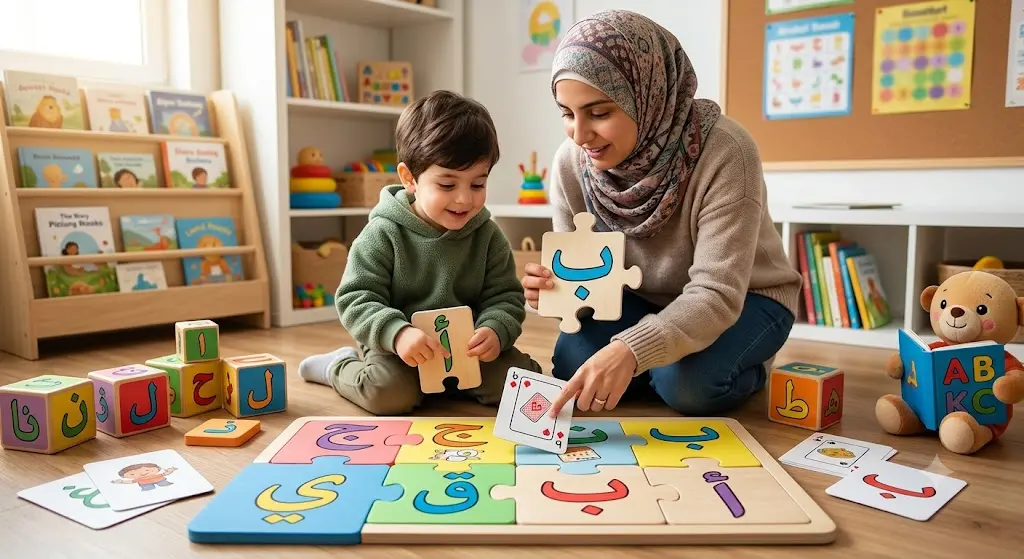
You sit down with your child, point to the first Arabic letter, and watch their eyes go blank. Twenty-eight unfamiliar shapes, no uppercase or lowercase to anchor them, and sounds that don’t exist in English — the Arabic alphabet can feel like a mountain from the bottom. But here’s what experienced teachers know: children don’t struggle because Arabic is hard. They struggle because it’s taught in the wrong order, with the wrong tools.
This guide gives you a structured, practical approach to teaching Arabic to kids at home — organized by how children’s brains actually learn, not just by how the letters are traditionally listed.
The biggest mistake parents make when teaching Arabic to children is starting with Alif and marching straight through to Ya. It feels logical — that’s how the alphabet is ordered — but it ignores how children’s visual memory works.
The Arabic alphabet contains 28 letters, and many share the same base shape. The letters ب، ت، ث, for example, are identical in form — what distinguishes them is only the number and position of their dots. Teaching these three together means your child learns one shape and three letters simultaneously. Teaching them weeks apart in alphabetical order throws that advantage away entirely.
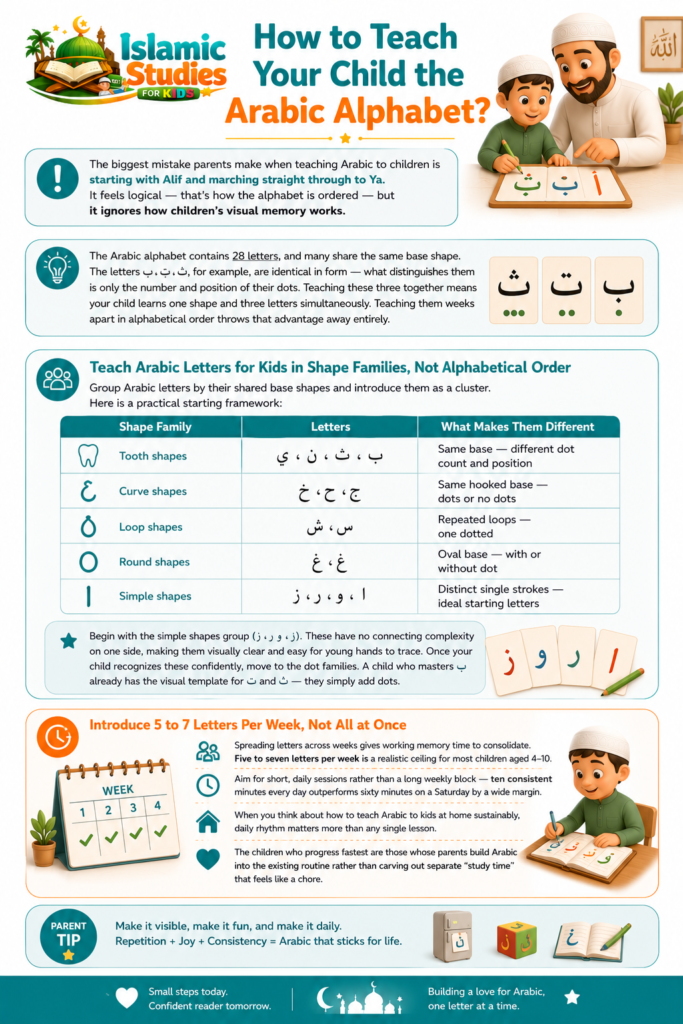
1. Teach Arabic Letters for Kids in Shape Families, Not Alphabetical Order
Group Arabic letters by their shared base shapes and introduce them as a cluster. Here is a practical starting framework:
| Shape Family | Letters | What Makes Them Different |
| Tooth shapes | ب، ت، ث، ن، ي | Same base — different dot count and position |
| Curve shapes | ج، ح، خ | Same hooked base — dots or no dots |
| Loop shapes | س، ش | Repeated loops — one dotted |
| Round shapes | ع، غ | Oval base — with or without dot |
| Simple shapes | ا، و، ر، ز | Distinct single strokes — ideal starting letters |
Begin with the simple shapes group (ا، و، ر، ز). These have no connecting complexity on one side, making them visually clear and easy for young hands to trace. Once your child recognizes these confidently, move to the dot families. A child who masters ب already has the visual template for ت and ث — they simply add dots.
Introduce 5 to 7 Letters Per Week, Not All at Once
Spreading letters across weeks gives working memory time to consolidate. Five to seven letters per week is a realistic ceiling for most children aged 4–10. Aim for short, daily sessions rather than a long weekly block — ten consistent minutes every day outperforms sixty minutes on a Saturday by a wide margin.
When you think about how to teach Arabic to kids at home sustainably, daily rhythm matters more than any single lesson. The children who progress fastest are those whose parents build Arabic into the existing routine rather than carving out separate “study time” that feels like a chore.
2. Teach Listening Before Writing ـ The Most Overlooked Step in Teaching Arabic to Children
Most parents move directly to letter tracing when they begin teaching Arabic to children at home. This skips an essential stage: children need to hear and recognize a letter before they have any meaningful reason to write it.
The listening-first sequence looks like this: hear the letter’s name → hear the letter’s sound in a word → recognize it visually → then write it. Skipping directly to writing produces letters your child can copy but cannot recall independently. The difference matters enormously when they begin reading the Quran — and especially when they advance to understanding Quranic Arabic, where letter precision directly affects meaning.
3. Build Sound Awareness Before Pen Touches Paper
Read aloud with your child daily, pointing to each letter and producing its sound clearly. Use audio tools — YouTube channels, Arabic alphabet apps, or recordings — so your child hears correct pronunciation, not an approximated English version. Unlike English, Arabic has no silent letters, which actually makes the sound-to-letter relationship more consistent once the sounds are established correctly.
When you introduce a letter, pair it immediately with a word your child can picture: ب for باب (door), س for سمك (fish), م for موز (banana). The image anchors the letter in memory far more durably than the letter name alone. This multisensory connection — sound, image, and letter shape together — is how retention becomes long-term.
If your child has been mispronouncing a letter from the beginning, that error tends to persist and creates problems when they move to Quran recitation. Catching pronunciation mistakes early is one of the strongest arguments for involving a qualified teacher alongside home practice. At islamic studies for kids children can access expert-led Arabic classes designed specifically for young non-Arabic-speaking learners, with real-time pronunciation correction built into every session.

4. Practical Activities for To Teach Arabic to Kids at Home
Hands-on activities convert passive exposure into active memory. The tools below serve different ages and learning styles — rotate regularly to prevent boredom.
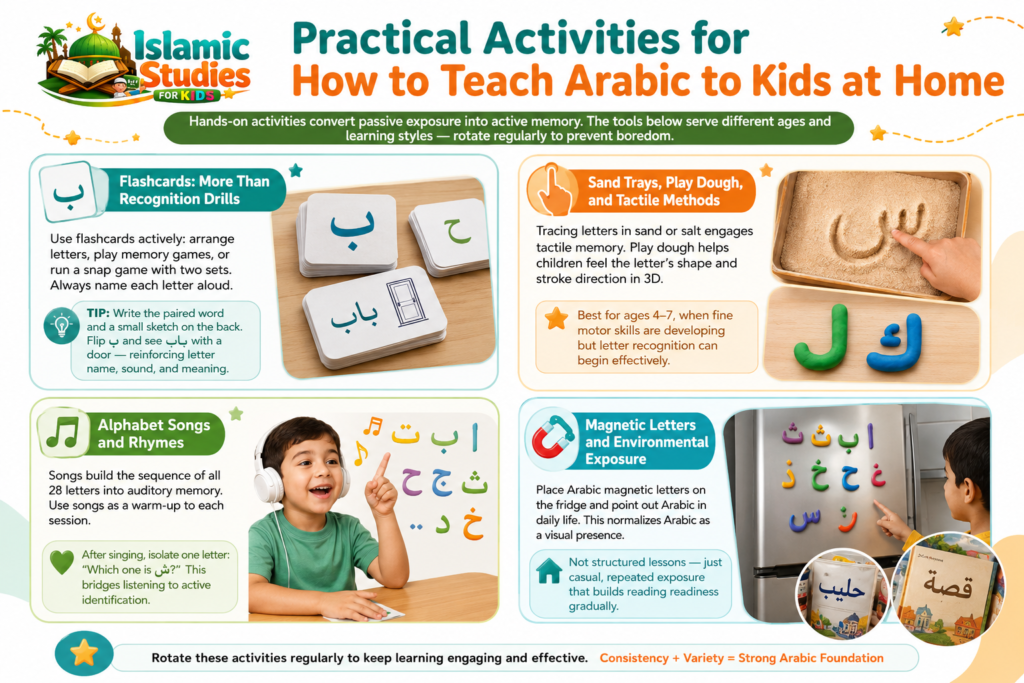
Flashcards: More Than Recognition Drills
Flashcards are versatile when used actively rather than passively. Use them to arrange letters in shape-family order, play memory-matching games, or run a snap game with two sets. The key is naming each letter aloud every time a card is handled — passive visual exposure without sound engagement builds recognition but not recall.
A practical tip: write the paired word and a small sketch on the back of each card. When your child flips ب and sees باب with a drawing of a door, they reinforce three memory pathways at once — letter name, letter sound, and real-world meaning.
Read also: How to Choose a Quran Teacher for Your Child? – 7 Criteria
Experience a Real Classroom
Curious about how we teach? This video offers a glimpse into a real class, showcasing our interactive approach, qualified teachers, and child-friendly learning experience.
Fun & Engaging Islamic Classes for Kids
Start your child’s journey today with interactive lessons designed to make learning Islam loved and easy.
Get Your Child a Free TrialSand Trays, Play Dough, and Tactile Methods
Pouring a thin layer of sand or salt into a tray and asking your child to trace letters with one finger engages tactile memory. Children who struggle with pencil tracing often retain letter shapes far better through physical movement first. Play dough works similarly — shaping the letter ل or ك out of clay gives a three-dimensional sense of the stroke direction.
These activities are especially effective for ages 4–7, where fine motor skills for controlled writing are still developing but letter recognition can absolutely begin.
Alphabet Songs and Rhymes
Arabic alphabet songs build the sequence of all 28 letters into auditory memory. Once the sequence is internalized through song, your child has a mental scaffold to locate individual letters. Use songs as a warm-up to each session — one or two repetitions before the day’s letters keeps the full alphabet fresh even while you focus on specific clusters.
After singing, ask your child to isolate one letter: “Which one is ش?” This bridges passive listening to active identification, which is where real learning happens.
Magnetic Letters and Environmental Exposure
Placing Arabic magnetic letters on the fridge and leaving them available throughout the day creates casual, repeated exposure. The goal isn’t structured sessions — it’s normalizing Arabic as a visual presence in your home. Children who see Arabic letters regularly approach them as familiar objects rather than foreign symbols.
Point out Arabic letters on food packaging, books, and signs during daily life. The habit of noticing Arabic in context builds reading readiness gradually, without requiring dedicated lesson time. This is one of the most underused strategies in how to teach Arabic to kids at home — passive environmental exposure works quietly in the background while formal lessons do the heavier lifting.
5. Handle the Letters That Confuse Almost Every Child Properly
Three clusters cause consistent difficulty in teaching Arabic to children at home. Knowing they are coming — and having a strategy — makes the difference between a child who pushes through and one who stalls.
The ج، ح، خ Group
These three letters share an identical base shape. The only distinguishing features are: ج has a dot below the curve, ح has no dot, خ has a dot above. The mistake most parents make is teaching these letters weeks apart. When they appear separately, a child has no reference point for the differences.
The correct approach is to introduce all three together, side by side, the moment any one of them comes up. Put them on three cards, hold them up simultaneously, and name them in order: “This one with the dot below is Jeem. This one with no dot is Haa. This one with the dot above is Khaa.” The comparison creates a mental framework that isolated teaching never builds.
The ب، ت، ث، ن، ي Group
These letters share the same tooth-shaped base. The dot-counting logic — one dot below for ب, two dots above for ت, three dots above for ث — is your primary teaching tool. Make it a game: draw the base shape, then ask your child to add the dots to turn it into a specific letter. This builds both recognition and fine motor skills simultaneously.
Similar-Sounding Letters
Arabic has pairs of letters whose sounds are challenging for English-speaking children: ق and ك, ص and س, ط and ت. Introduce these pairs with exaggerated contrast in your pronunciation. The emphatic letters (ص، ط، ض) are produced further back in the mouth with a heavier quality — demonstrate the difference clearly and have your child feel the physical sensation of the sound, not just hear it.
Parents who are not Arabic speakers themselves should use audio reference tools here rather than guessing. When teaching Arabic letters for kids who need to eventually read Quran correctly, sound accuracy at the letter stage is not optional. If you are learning alongside your child, our Arabic course for mothers is designed exactly for this — building your own foundation so you can support your child’s learning with confidence at home.
Read also: How To Teach Your Child To Pray (Salah)?
Watch a Sample Lesson from Our Academy
Get a firsthand look at how our students learn Islamic values, Quran, and essential knowledge through engaging and interactive online classes. See why families trust Islamic Studies for Kids Academy.
Start Your Child’s Arabic Journey with Expert Guidance
Home practice builds the foundation — but professional instruction accelerates progress and prevents the mispronunciation habits that are far harder to undo later.
islamic studies for kids connects families with qualified Arabic teachers who specialize in teaching the Arabic alphabet to children from the very first letter.
- Expert instructors with deep experience teaching non-Arabic-speaking children
- Age-appropriate, interactive lessons that match your child’s attention span
- Real-time pronunciation correction before errors become habits
- Flexible scheduling that fits your family’s routine
- A structured path from letter recognition all the way to Quran reading
Book your child’s free trial lesson today and give them the right start with the Arabic alphabet.

Our Islamic Studies Courses Include:
- Islamic Studies for Kids
- Islam Basics for Kids (Beginners)
- 5 Pillars of Islam for Kids
- 6 Pillars of Iman (Faith) for Kids
- Salah (Prayer) for Kids
- Wudu for Kids
- Dua for Kids
- Ramadan for Kids
- Zakat & Sadaqah for Kids
- Hajj for Kids
- Aqeedah (Islamic Belief) for Kids
- Islamic Manners & Akhlaq for Kids
- Good Deeds for Kids
- Cleanliness (Taharah) in Islam for Kids
- Angels in Islam for Kids
- Islamic History for Kids
- Seerah (Prophet’s Life) for Kids
- Prophets Stories for Kids
- Islamic Stories & Morals for Kids
- Fiqh for Kids (Islamic Jurisprudence Basics)
- Hadith for Kids
- Quran Tafseer Course for Kids
- Islamic Holidays & Events for Kids
- Islamic Identity for Kids
- Intensive Islamic Course for Kids
Enroll today and give your child the knowledge, values, and confidence to grow as a practicing Muslim with a strong connection to Allah and His teachings.
Fun & Engaging Islamic Classes for Kids
Start your child’s journey today with interactive lessons designed to make learning Islam loved and easy.
Get Your Child a Free TrialConclusion
Teaching Arabic to children becomes far more manageable when you move away from alphabetical drilling and toward shape-family grouping. Starting with visually simple letters, teaching similar letters together rather than apart, and building listening recognition before writing practice are the three decisions that make the biggest difference in how quickly and confidently your child progresses.
Hands-on tools — flashcards, sand trays, magnetic letters, and alphabet songs — serve different learning styles and should be rotated regularly. Short daily sessions of ten to fifteen minutes consistently outperform longer, occasional lessons every time. And when children reach the letters that confuse almost everyone — the ج، ح، خ cluster, the dot families, the emphatic consonants — a prepared strategy gets them through without stalling.
Teaching Arabic to kids at home is entirely achievable with the right sequence and the right support. The Arabic alphabet is your child’s gateway to the Quran and to one of the world’s most widely spoken languages — and every letter learned is a step closer to that connection.
Frequently Asked Questions
What age should a child start learning the Arabic alphabet?
Children can begin recognizing Arabic letters from age 4, with sessions kept to 10–15 minutes. At this stage, the focus is letter shapes and sounds through songs and visual tools, not formal writing. Writing practice typically begins between ages 5 and 7 when fine motor skills are ready.
How long does it take a child to learn the Arabic alphabet?
Most children can recognize all 28 Arabic letters within 4–8 weeks of consistent daily practice, typically 10–15 minutes per day. Reading simple words with short vowels generally follows 2–4 months after that, depending on practice consistency and the child’s age.
How do I teach Arabic to kids at home if I don’t speak Arabic myself?
Use audio resources — apps, YouTube channels, or online classes — to ensure your child hears correct native pronunciation. Your role as a non-Arabic-speaking parent is to create daily practice habits, provide hands-on tools, and reinforce what your child learns with a qualified teacher. Consistency at home matters more than your own fluency level.
Should I teach Arabic letters for kids in alphabetical order?
No. Teaching letters in shape-family clusters — such as ب، ت، ث together — is far more effective than strict alphabetical order. When children see that these three letters share one base shape and differ only in their dots, they learn three letters for the visual effort of one.
Why does my child keep confusing ج، ح، and خ?
These three letters share the same base shape, so teaching them separately weeks apart leaves children without a comparison framework. The solution is to introduce all three side by side as soon as any one of them comes up, naming the distinguishing feature each time: dot below (ج), no dot (ح), dot above (خ).
Is it better to teach Arabic letters through writing or listening first?
Listening and recognition should always come before writing. Children who hear a letter’s sound and can identify it visually before picking up a pencil retain it more durably. Writing reinforces a letter already known — it cannot replace the recognition stage that must come first.



Leave a Reply