 For Parents
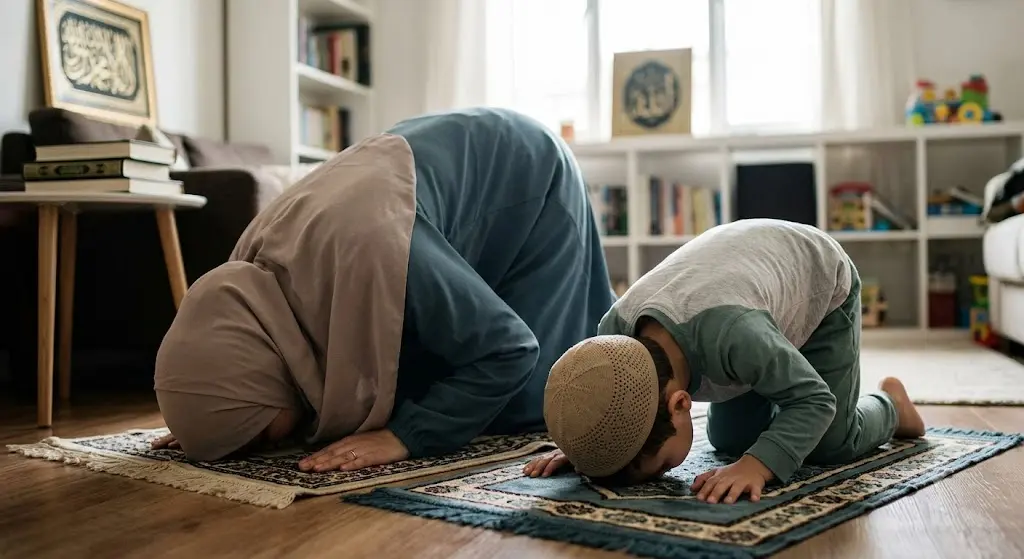
Your child watches you roll out your prayer rug, follows you into the room, and tries to copy every movement. That moment — before you’ve said a single word about Salah — is already teaching. The truth most parents miss is this: teaching kids Salah begins long before formal instruction, and love works faster than obligation.
This guide gives you a practical, age-sensitive roadmap for teaching Salah for kids — from first exposure at age three through consistent daily prayer by age ten — drawing on the Prophetic model and real teaching methods that work.
The Two-Phase Framework for Teaching Salah to Kids
Most parents wait until age seven to begin teaching prayer, following the well-known hadith: “Command your children to pray at the age of seven” (Abu Dawud). That is correct — but it misses the preparation that makes age seven actually work.
Teaching Salah for kids follows two distinct phases, and confusing them is one of the most common mistakes parents make.
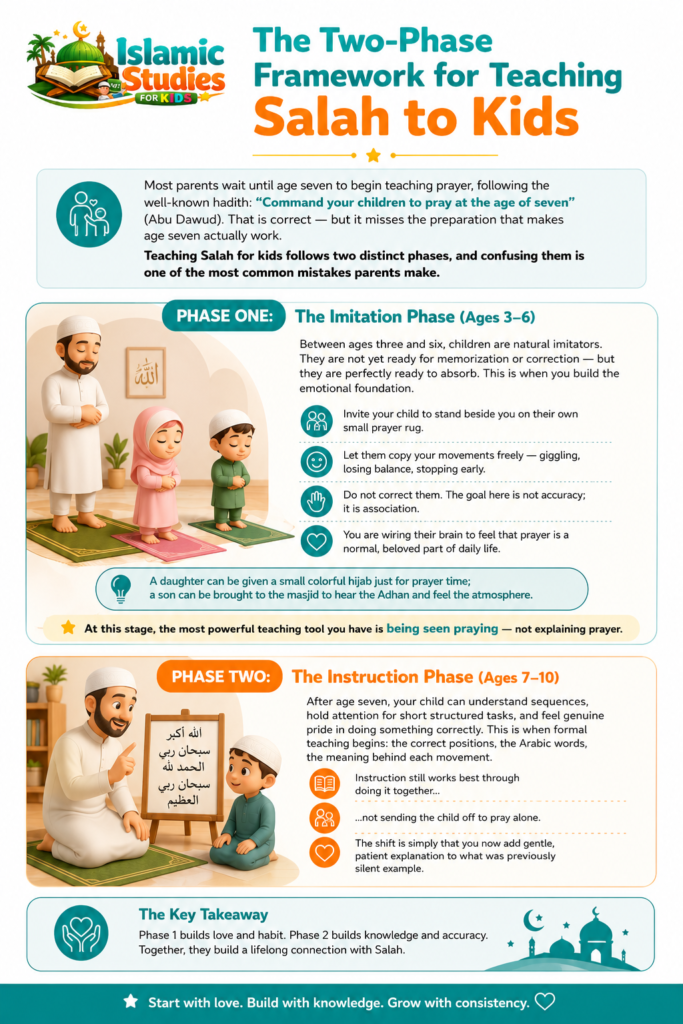
Phase One: The Imitation Phase (Ages 3–6)
Between ages three and six, children are natural imitators. They are not yet ready for memorization or correction — but they are perfectly ready to absorb. This is when you build the emotional foundation.
Invite your child to stand beside you on their own small prayer rug. Let them copy your movements freely — giggling, losing balance, stopping early. Do not correct them. The goal here is not accuracy; it is association. You are wiring their brain to feel that prayer is a normal, beloved part of daily life. A daughter can be given a small colorful hijab just for prayer time; a son can be brought to the masjid to hear the Adhan and feel the atmosphere.
At this stage, the most powerful teaching tool you have is being seen praying — not explaining prayer.
Phase Two: The Instruction Phase (Ages 7–10)
After age seven, your child can understand sequences, hold attention for short structured tasks, and feel genuine pride in doing something correctly. This is when formal teaching begins: the correct positions, the Arabic words, the meaning behind each movement.
Instruction still works best through doing it together, not sending the child off to pray alone. The shift is simply that you now add gentle, patient explanation to what was previously silent example.
How to Teach Wudu Before Teaching Salah?
Salah cannot begin without Wudu. Before your child learns a single prayer position, teach them purification — and make it enjoyable rather than another checklist.
Most children ages four to seven actually enjoy water, which makes this step easier than parents expect. Use rhythm to teach the sequence. A simple rhyme like “Hands, mouth, nose, face, arms, head, ears, feet — now you’re clean and ready to meet” is remembered by young children far more reliably than a numbered list.
A laminated Wudu chart placed at sink height, with a picture for each step, gives children independence and ownership. Children who can follow their own chart without asking a parent feel proud — and that pride is what drives repetition.
Avoid correcting every small mistake during Wudu at first. Let the habit form, then refine the detail.
Teaching Salah for Kids Step by Step
Once Wudu is familiar, introduce the prayer positions one small group at a time — never all at once.
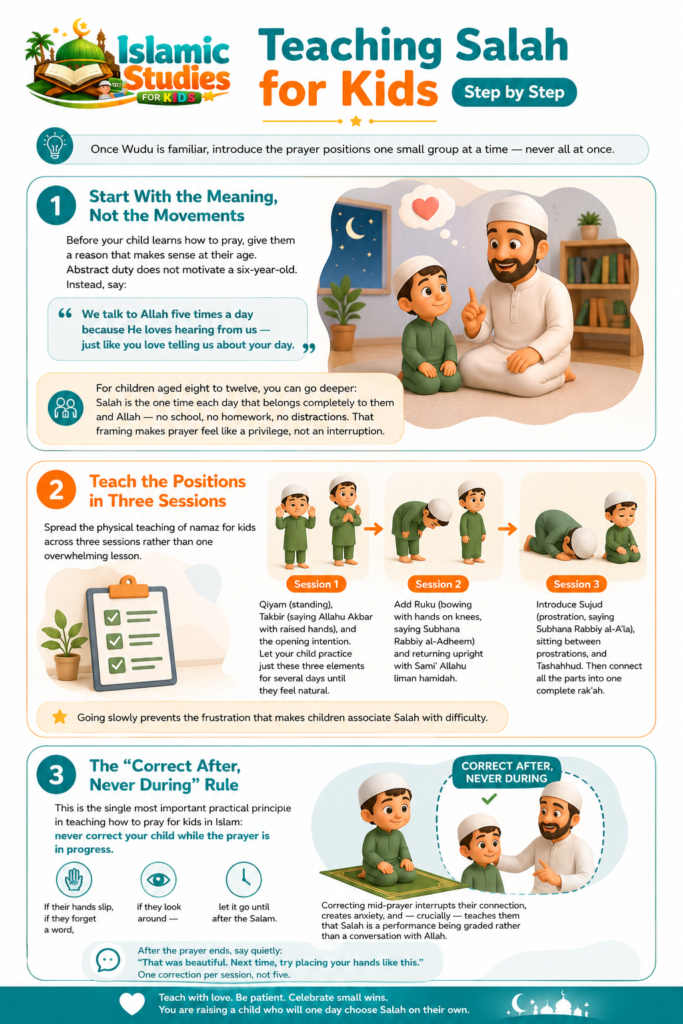
1. Start With the Meaning, Not the Movements
Before your child learns how to pray, give them a reason that makes sense at their age. Abstract duty does not motivate a six-year-old. Instead, say: “We talk to Allah five times a day because He loves hearing from us — just like you love telling us about your day.”
For children aged eight to twelve, you can go deeper: Salah is the one time each day that belongs completely to them and Allah — no school, no homework, no distractions. That framing makes prayer feel like a privilege, not an interruption.
2. Teach the Positions in Three Sessions
Spread the physical teaching of namaz for kids across three sessions rather than one overwhelming lesson.
Session 1: Qiyam (standing), Takbir (saying Allahu Akbar with raised hands), and the opening intention. Let your child practice just these three elements for several days until they feel natural.
Session 2: Add Ruku (bowing with hands on knees, saying Subhana Rabbiy al-Adheem) and returning upright with Sami’ Allahu liman hamidah.
Session 3: Introduce Sujud (prostration, saying Subhana Rabbiy al-A’la), sitting between prostrations, and Tashahhud. Then connect all the parts into one complete rak’ah.
Going slowly prevents the frustration that makes children associate Salah with difficulty.
Read also: How To Teach Your Child The Arabic Alphabet?
Experience a Real Classroom
Curious about how we teach? This video offers a glimpse into a real class, showcasing our interactive approach, qualified teachers, and child-friendly learning experience.
Fun & Engaging Islamic Classes for Kids
Start your child’s journey today with interactive lessons designed to make learning Islam loved and easy.
Get Your Child a Free Trial3. The “Correct After, Never During” Rule
This is the single most important practical principle in teaching how to pray for kids in Islam: never correct your child while the prayer is in progress. If their hands slip, if they forget a word, if they look around — let it go until after the Salam.
Correcting mid-prayer interrupts their connection, creates anxiety, and — crucially — teaches them that Salah is a performance being graded rather than a conversation with Allah. After the prayer ends, say quietly: “That was beautiful. Next time, try placing your hands like this.” One correction per session, not five.
How to Teach Al-Fatihah for Salah?
Al-Fatihah is recited in every rak’ah of every prayer. It is the most essential portion of Salah for kids to learn correctly — prioritize it above all other surahs.
Teach It in Three Segments Over One Week
Divide Al-Fatihah into three portions and introduce one portion every two days:
- Days 1–2: Bismillah ir-Rahman ir-Raheem through Malik yawm id-deen
- Days 3–4: Iyyaka na’budu through as-Sirat al-mustaqeem
- Days 5–7: Sirat alladhina an’amta alayhim through Ameen
Use call-and-response: you recite one line slowly, your child repeats it. Five minutes after any meal is enough. Children aged five to ten typically have Al-Fatihah memorized within four to six weeks using this method consistently — without any drills or pressure.
Building a Daily Prayer Habit That Sticks
Learning the how is only half the challenge. Keeping kids praying consistently is where most families struggle — not because their children lack willingness, but because there is no structure to hold the habit in place.
Use a Visual Prayer Chart
A simple chart with five boxes per day — one for each Salah — works remarkably well for children aged six to twelve. Checking a box feels satisfying in itself. Seeing a full row completed creates genuine pride. Missing a box is not a failure; it shows which prayer time needs a better routine around it.
Give your child ownership of their chart. Let them put the checkmark themselves. Never remove a check as a punishment — that turns the chart into a threat rather than a motivator.
Tie Prayer to Daily Anchors
Children do not track time by the clock the way adults do. They track it by events. Instead of “pray at 1 pm,” use: “We pray Dhuhr after lunch.” “We pray Maghrib when the sun goes down, before we watch anything.” “Isha is after your bath.” Anchoring each prayer to an existing daily routine removes the negotiation.
Invite, Don’t Command
The language you use matters more than parents realize. “Come pray with me” produces a completely different emotional response than “Go pray.” The first frames Salah as something shared; the second frames it as a chore being delegated. Throughout the teaching process — especially with children under ten — the invitation model works far better than the command model.

What to Do When Your Child Refuses to Pray?
Refusal is normal and does not signal a deeper problem. It usually means prayer feels like a burden interrupting something the child values. The response that works is not stricter enforcement — it is reducing resistance.
When a child says “I don’t want to pray,” respond with: “Let’s just do two minutes together — just Fajr, just the short version — then you can go right back to what you were doing.” Starting small prevents the full confrontation. Most children who initially resist will finish the prayer and feel fine about it.
What damages the relationship with prayer long-term is turning every refusal into a conflict. If you lose that battle publicly and repeatedly, Salah becomes associated with tension rather than connection. Pick the moment and the approach carefully, especially with children aged eight to twelve who are developing their sense of autonomy.
Never make Salah the condition for something the child wants. “You can’t watch TV until you pray” puts prayer in the frame of punishment and reward rather than relationship. Connect prayer to beautiful things — “After Fajr, let’s have breakfast together” — rather than using it as leverage.
Read also: How to Choose a Quran Teacher for Your Child? – 7 Criteria
Watch a Sample Lesson from Our Academy
Get a firsthand look at how our students learn Islamic values, Quran, and essential knowledge through engaging and interactive online classes. See why families trust Islamic Studies for Kids Academy.
Start Teaching Your Child Salah with Expert Support
Home practice builds the foundation — expert guidance makes it last.
At islamic studies for kids your child learns how to pray in Islam through structured, age-appropriate Islamic studies delivered by qualified instructors who understand how children actually learn. Whether your child is taking their very first steps with Wudu or refining their full Salah for kids, lessons are built around their pace, not a one-size-fits-all curriculum.

Our Islamic Studies Courses for Kids:
- Quran for Kids
- Noorani Qaida for Kids
- Quran Recitation for Kids
- Tajweed for Kids
- Quran Memorization (Hifz) for Kids
- Quran for Toddlers
- Quranic Arabic for Kids
- Quran Stories for Kids
Fun & Engaging Islamic Classes for Kids
Start your child’s journey today with interactive lessons designed to make learning Islam loved and easy.
Get Your Child a Free TrialConclusion
Teaching your child to pray Salah is less about transmitting a technique and more about building a relationship — between your child and their Creator, and between prayer and the best parts of daily life. The parents who see the most lasting results are not the strictest; they are the ones who made Salah feel safe, familiar, and worth returning to.
Start in the imitation phase with presence and example. Move into instruction at seven with patience and structure. Correct gently after the prayer, never during it. Teach Al-Fatihah in small pieces over weeks. Anchor each prayer to a daily moment. And when resistance comes — go smaller, not harder.
A child who prays imperfectly but willingly at age eight will almost always become a teenager who prays with understanding and genuine love for Salah.
Frequently Asked Questions
What age should I start teaching my child to pray?
Begin introducing Salah through gentle observation and imitation from age three. Formal instruction — teaching the steps, words, and positions of prayer correctly — is recommended from age seven, following the Prophetic guidance to command children to pray at seven and reinforce the habit by age ten.
How do I teach a child to pray in Islam if they keep forgetting the steps?
Forgetting is normal at every stage. The most effective fix is to reduce what you teach in each session. If your child forgets Ruku, practice only Qiyam and Ruku for a week before adding anything new. Mastery of a few steps beats incomplete knowledge of all of them. Visual prompt cards placed near the prayer rug also help children self-correct without needing a parent present.
What should I do if my child refuses to pray?
Respond with a shorter version rather than a full confrontation. Offer to pray together for just two minutes. Avoid linking prayer to rewards or punishments, as this shifts the child’s motivation away from genuine connection. If refusal continues, focus on maintaining the warm atmosphere around prayer time rather than enforcing compliance — the habit will follow when the relationship is right.
How long does it take for a child to learn Salah completely?
Most children aged seven to nine can learn the complete movements and words of one Salah within two to three months of consistent daily practice. Al-Fatihah typically takes four to six weeks to memorize correctly using daily call-and-response. The goal is not speed — a child who learns Salah over six months and loves it will maintain it far longer than one who was rushed through it in two weeks.
Is it okay to let my child pray imperfectly while they are still learning?
Yes — and it is actually important to allow it. Correcting every error mid-prayer creates anxiety and negative associations. Accept imperfect prayer warmly, offer one quiet correction after the Salam, and let consistency and time do the rest. The Prophet ﷺ modeled gentleness with those learning their religion, and children respond to the same.
Should boys and girls learn to pray Salah differently?
The core structure of Salah is the same for boys and girls. The main practical differences involve dress: girls cover their hair and body during prayer from the age they begin formal learning. Boys who attend the masjid for congregational prayer gain an additional layer of reinforcement that is harder to replicate at home, so taking sons to Jumu’ah from age seven onward is a particularly effective supplement to home teaching.




Leave a Reply