What Is Shirk For Kids? – Meaning, Types And How To Avoid It
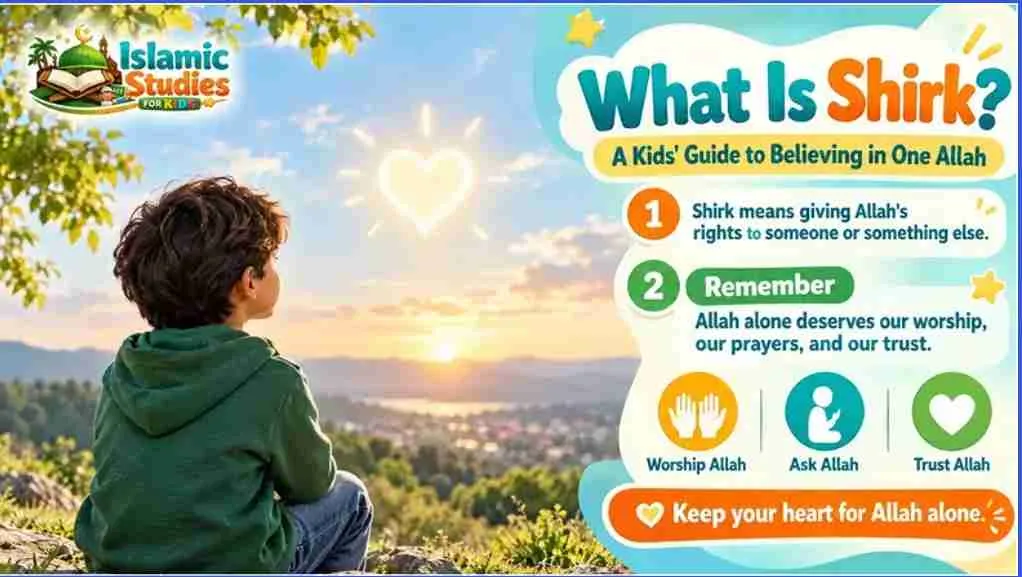
What is shirk for kids? Shirk is the biggest mistake a person can make in Islam, because it means giving something that belongs only to Allah to someone or something else. Understanding shirk helps every Muslim child protect the most precious gift they have: their belief in One God.
Many children hear the word shirk at the masjid, in class, or at home without fully understanding it. This guide explains shirk meaning for kids in simple, friendly language, using verified Quranic verses and authentic Hadith so parents and young learners can trust every lesson.
At Islamic Studies for Kids, we believe children learn Islam best when lessons are clear, loving, and easy to remember. In this article, you will learn what shirk is, its main types, real-life examples, and simple ways for kids to stay away from it.
What You Will Learn About Shirk
What shirk means in Islam and why it is the opposite of Tawheed.
The two main types of shirk for kids: major shirk and minor shirk, with clear examples.
Why the Quran calls shirk a great injustice and the greatest sin.
Practical, kid-friendly steps for avoiding shirk in daily life.
How parents can teach children about shirk in a gentle, age-appropriate way.
Shirk Meaning for Kids
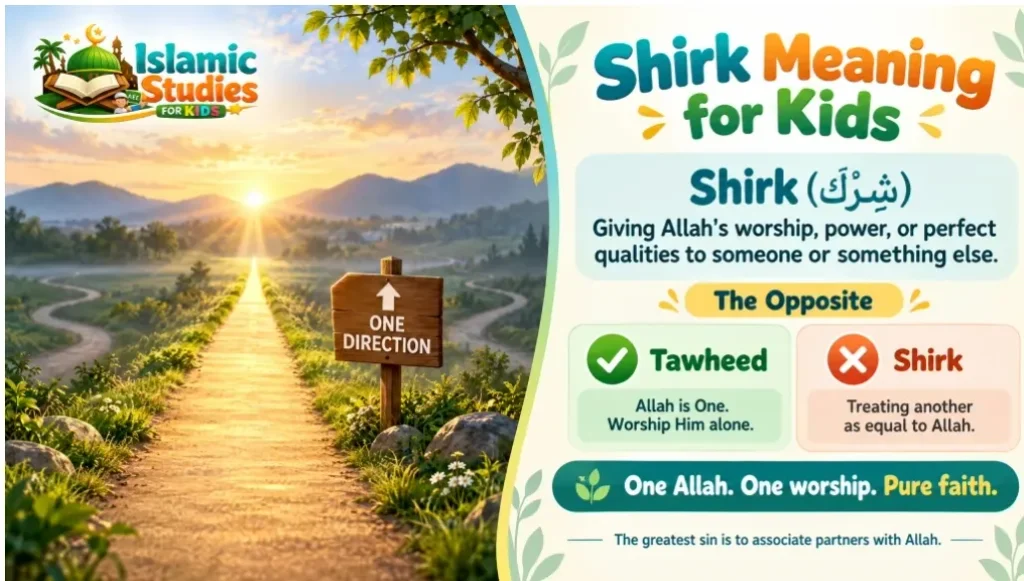
Shirk (شِرْك) is associating partners with Allah. It means giving any act of worship, power, or perfect quality that belongs only to Allah to someone or something else. In simple words for kids, shirk is treating anyone or anything as if it were equal to Allah, or worshipping it alongside Him.
Shirk is the opposite of Tawheed. Tawheed means believing that Allah is One, with no partner, and worshipping Him alone. Children who understand Tawheed can easily recognize shirk, so you may enjoy reading our simple guide on what Tawheed means for kids.
Prophet Muhammad ﷺ described shirk as the greatest sin of all. When his Companion Abdullah ibn Mas’ud asked him which sin is the greatest in the sight of Allah, the Prophet ﷺ answered clearly:
سَأَلْتُ النَّبِيَّ ﷺ أَىُّ الذَّنْبِ أَعْظَمُ عِنْدَ اللَّهِ قَالَ: «أَنْ تَجْعَلَ لِلَّهِ نِدًّا وَهْوَ خَلَقَكَ» “I asked the Prophet ﷺ, ‘What is the greatest sin in the Sight of Allah?’ He said, ‘That you set up a rival unto Allah though He Alone created you.’” Sahih al-Bukhari 4477 (excerpt)
In this Hadith, the Arabic word nidd (نِدّ) means a rival, an equal, or a match. Shirk happens when a person treats anything as a rival to Allah, even though Allah alone created them, provides for them, and takes care of them every moment.
What Does the Word Shirk Mean in Arabic?
The Arabic word shirk comes from the root sharaka (شَرَكَ), which means to share or to become a partner. A sharik (شَرِيك) is a partner. In Islamic belief, shirk means making someone a partner with Allah in something that belongs only to Him.
The table below explains the most important Arabic words connected to shirk, so kids can understand them easily:
Arabic Word
Transliteration
Simple Meaning for Kids
شِرْك
Shirk
Associating partners with Allah
شَرِيك
Sharik
A partner
تَوْحِيد
Tawheed
Believing in Allah as One and worshipping Him alone
مُشْرِك
Mushrik
A person who commits shirk
نِدّ
Nidd
A rival or an equal
عِبَادَة
Ibadah
Worship: everything Allah loves that we say or do
Shirk Explained to Children in Simple Words
Shirk can be explained to children by reminding them who gives them everything. Allah created us and gave us our eyes, our families, our food, and the air we breathe. Because every blessing comes from Allah alone, He alone deserves our worship, our dua, and our deepest love and thanks.
Here is a simple example for kids: imagine someone gave you a wonderful gift, but you thanked a person who did nothing at all. That would feel unfair. Allah is far greater than any example, yet this helps children see why worshipping anyone besides Allah is wrong.
Children often ask how we know Allah is real and why He alone deserves worship. Our article on the proof that Allah exists for kids answers this question with simple signs from nature and the Quran.
Experience a Real Classroom
Curious about how we teach? This video offers a glimpse into a real class, showcasing our interactive approach, qualified teachers, and child-friendly learning experience.
Fun & Engaging Islamic Classes for Kids
Start your child’s journey today with interactive lessons designed to make learning Islam loved and easy.
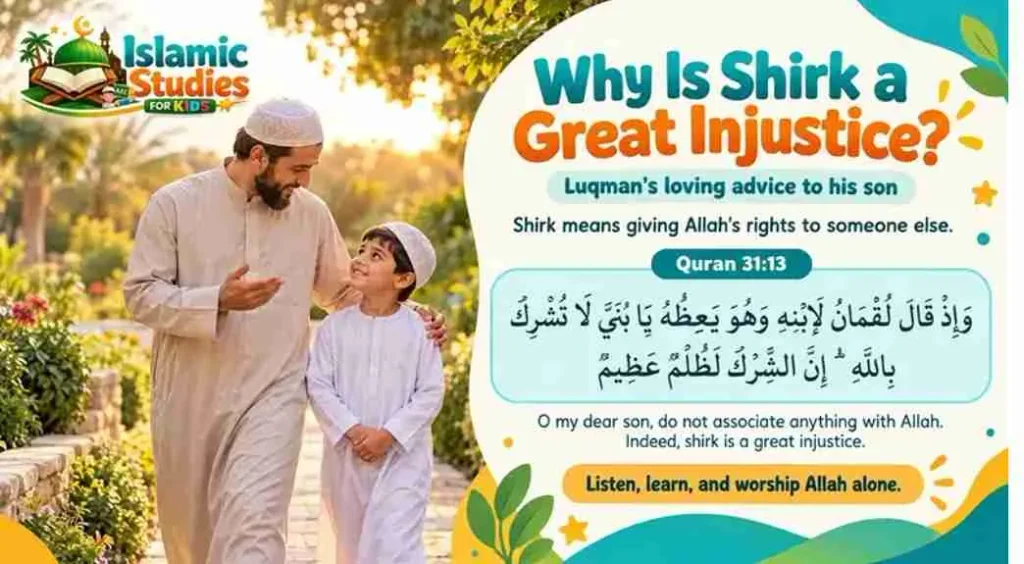
The Quran tells the story of Luqman, a wise man who gave loving advice to his son. The very first lesson Luqman taught his child was to never commit shirk, and he explained that shirk is a great injustice (dhulmun ‘adheem):
وَإِذْ قَالَ لُقْمَانُ لِابْنِهِ وَهُوَ يَعِظُهُ يَا بُنَيَّ لَا تُشْرِكْ بِاللَّهِ ۖ إِنَّ الشِّرْكَ لَظُلْمٌ عَظِيمٌ “And [mention, O Muhammad], when Luqman said to his son while he was instructing him, ‘O my son, do not associate [anything] with Allah. Indeed, association [with him] is great injustice.’” Surah Luqman (31:13)
In his well-known Tafsir, Shaykh Abdur-Rahman as-Sa’di explained why shirk is the worst injustice. Treating a weak creation made from dust as equal to the Lord who owns everything, has complete power, and gives every blessing is the most unfair thing a person could do. This is scholarly interpretation, not Quranic text.
Types of Shirk for Kids
There are two main types of shirk that children should learn about: major shirk (ash-shirk al-akbar) and minor shirk (ash-shirk al-asghar). Although both are serious matters in Islam, they differ in their meaning and consequences.
Scholars explain that major shirk takes a person out of Islam because it involves directing acts of worship to someone or something other than Allah. Minor shirk, on the other hand, is a serious sin that weakens a Muslim’s Tawheed (belief in the oneness of Allah) but does not take them out of Islam.
Teaching children the difference between these two types helps them understand the importance of worshipping Allah alone, keeping their intentions sincere, and avoiding actions or words that may contradict the teachings of Islam.
A. Major Shirk (Ash-Shirk Al-Akbar)
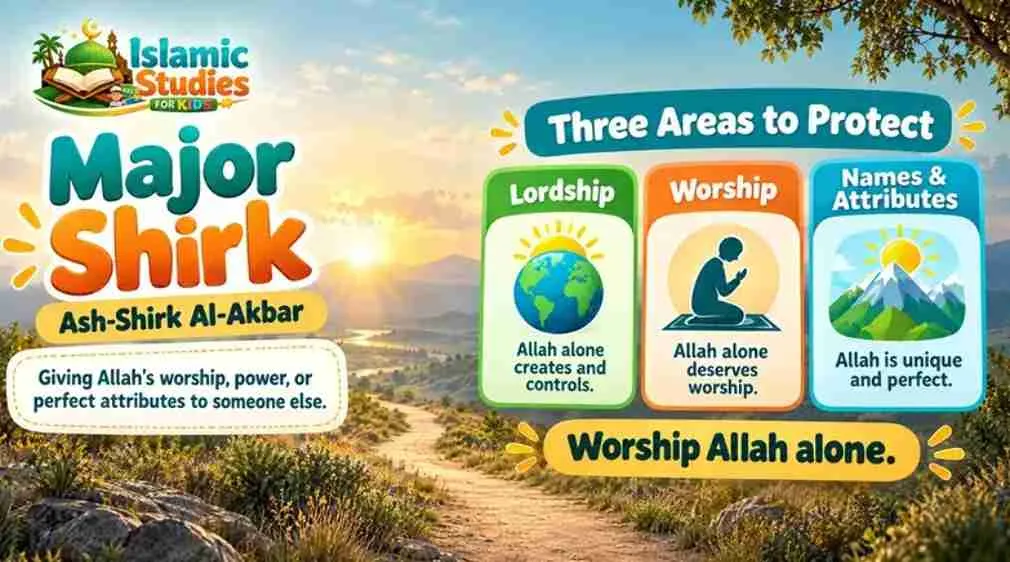
Major shirk (ash-shirk al-akbar) means directing any act of worship to someone or something other than Allah, or believing that another being shares in Allah’s power, authority, or perfect attributes. It is the greatest form of shirk because it contradicts the basic principle of Islam: worshipping Allah alone without associating any partners with Him.
Scholars of Aqeedah explain that major shirk comes in three forms, which correspond to the three categories of Tawheed: Tawheed ar-Rububiyyah (Oneness of Lordship), Tawheed al-Uluhiyyah (Oneness of Worship), and Tawheed al-Asma wa as-Sifat (Oneness of Allah’s Names and Attributes).
1. Shirk in Lordship (Ar-Rububiyyah)
Shirk in lordship (ar-rububiyyah) is believing that someone other than Allah creates, controls, or runs the universe alongside Him. The Quran tells us that Pharaoh (Fir’awn) made this false claim about himself when he spoke to his people:
فَقَالَ أَنَا رَبُّكُمُ الْأَعْلَىٰ “And said, ‘I am your most exalted lord.’” Surah An-Nazi’at (79:24)
Pharaoh’s claim to lordship was proven false when Allah drowned him in the sea. A real lord could never be defeated inside the kingdom he claims to control. This story teaches kids that only Allah is the true Lord who creates and controls everything.
2. Shirk in Worship (Al-Uluhiyyah)
Shirk in worship (al-uluhiyyah) is giving any act of worship to someone other than Allah, such as praying to idols, making dua to the dead, or sacrificing an animal for anyone besides Allah. Every Muslim renews the promise to worship Allah alone in every rak’ah of prayer:
إِيَّاكَ نَعْبُدُ وَإِيَّاكَ نَسْتَعِينُ “It is You we worship and You we ask for help.” Surah Al-Fatihah (1:5)
Worship (ibadah) in Islam includes prayer, dua, fasting, charity, sacrifice, and the love, hope, and fear we feel toward Allah. Children practice pure worship every day through the 5 Pillars of Islam in order, which are all performed for Allah alone.
3. Shirk in Allah’s Names and Attributes (Al-Asma’ wa As-Sifat)
Shirk in Allah’s names and attributes is believing that a creation has a quality that belongs only to Allah, in the same perfect way Allah has it. For example, believing that a person knows the unseen future like Allah does, or has unlimited power, is shirk.
Allah has beautiful names such as Al-‘Aleem (the All-Knowing) and Al-Qadeer (the All-Powerful), and no creation shares these qualities the way Allah does. Learning the 99 Names of Allah for kids helps children see how perfect and unique Allah truly is.
B. Minor Shirk (Ash-Shirk Al-Asghar)
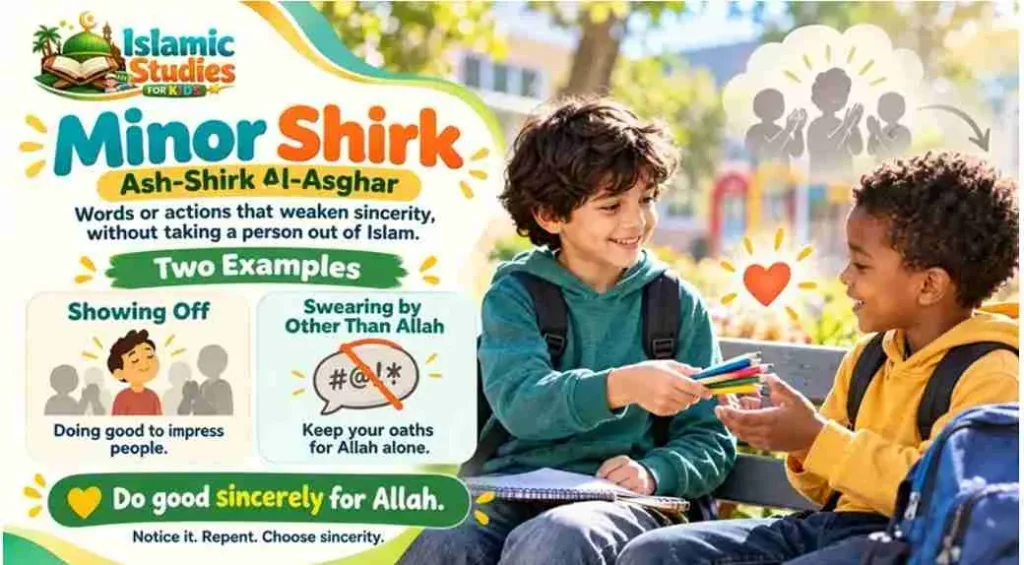
Minor shirk (ash-shirk al-asghar) refers to actions or words that weaken the completeness of a Muslim’s Tawheed (belief in the oneness of Allah) without taking the person out of Islam. Although it is not as severe as major shirk, scholars explain that it is still a serious sin that every Muslim should avoid and sincerely repent from.
Minor shirk can affect a person’s sincerity and the purity of their worship, especially when they seek people’s praise instead of Allah’s pleasure. Two common examples are showing off (doing good deeds to impress others) and swearing by someone or something other than Allah.
Teaching children about these examples helps them understand the importance of having sincere intentions, relying on Allah, and making sure that their words and actions reflect their belief in Him alone.
1. Riya: Showing Off in Worship
Riya (رِيَاء) is doing an act of worship so that people will see and praise you, instead of doing it for Allah. For kids, riya could mean praying extra carefully only when guests are watching, or reciting Quran just to hear people say, “What a beautiful voice!”
قُلْ إِنَّمَا أَنَا بَشَرٌ مِّثْلُكُمْ يُوحَىٰ إِلَيَّ أَنَّمَا إِلَٰهُكُمْ إِلَٰهٌ وَاحِدٌ ۖ فَمَن كَانَ يَرْجُو لِقَاءَ رَبِّهِ فَلْيَعْمَلْ عَمَلًا صَالِحًا وَلَا يُشْرِكْ بِعِبَادَةِ رَبِّهِ أَحَدًا “Say, ‘I am only a man like you, to whom has been revealed that your god is one God. So whoever would hope for the meeting with his Lord – let him do righteous work and not associate in the worship of his Lord anyone.’” Surah Al-Kahf (18:110)
This verse teaches children that good deeds must be done sincerely for Allah alone. The Arabic word for this sincerity is ikhlas (إِخْلَاص), and scholars explain that ikhlas is one of the conditions for good deeds to be accepted by Allah.
2. Swearing by Anything Other Than Allah
Swearing by other than Allah means taking an oath using a name other than Allah’s, such as saying “I swear by my life,” “by my mother,” or “by the Kaaba.” The Prophet ﷺ taught Muslims to swear only by Allah, as this authentic Hadith shows:
أَلاَ إِنَّ اللَّهَ يَنْهَاكُمْ أَنْ تَحْلِفُوا بِآبَائِكُمْ، مَنْ كَانَ حَالِفًا فَلْيَحْلِفْ بِاللَّهِ، أَوْ لِيَصْمُتْ “Lo! Allah forbids you to swear by your fathers, so whoever has to take an oath, he should swear by Allah or keep quiet.” Sahih al-Bukhari 6646
Scholars explain that swearing by other than Allah is usually minor shirk. However, if a person believes the thing they swear by deserves the same honor as Allah, it becomes major shirk. Kids can remember an easy rule: if you need to swear, say “Wallahi” (by Allah), or stay quiet.
Help Your Child Build Strong Islamic Beliefs Our Aqeedah course teaches kids Tawheed, the meaning of shirk, and the pillars of faith through clear and joyful lessons. Explore the Aqeedah Course
Common Examples of Shirk Kids Should Know
Learning about real-life examples of shirk helps children understand how it can appear in everyday situations and recognize the actions or words they should avoid. Instead of memorizing definitions alone, children need simple, relatable examples that connect Islamic teachings to their daily lives.
Parents can use everyday situations, stories, and gentle explanations to show children why Muslims should worship Allah alone, trust Him, and avoid associating anyone or anything with Him.
Below are some common actions that scholars warn against, explained in a clear, child-friendly way to help young Muslims understand their meaning, remember them easily, and strengthen their belief in Allah’s oneness (Tawheed).
1. Making Dua to Anyone Other Than Allah
Dua (supplication) is one of the greatest acts of worship. Asking a dead person, a saint, a grave, or any creation for something only Allah can give is shirk. Muslims ask Allah directly, without any middleman, because He hears every dua.
Prophet Muhammad ﷺ taught this lesson to a young boy, Abdullah ibn Abbas, while they were riding together. This Hadith is perfect for kids, because the Prophet ﷺ first taught it to a child:
يَا غُلاَمُ إِنِّي أُعَلِّمُكَ كَلِمَاتٍ: احْفَظِ اللَّهَ يَحْفَظْكَ، احْفَظِ اللَّهَ تَجِدْهُ تُجَاهَكَ، إِذَا سَأَلْتَ فَاسْأَلِ اللَّهَ، وَإِذَا اسْتَعَنْتَ فَاسْتَعِنْ بِاللَّهِ “O boy! I will teach you a statement: Be mindful of Allah and He will protect you. Be mindful of Allah and you will find Him before you. When you ask, ask Allah, and when you seek aid, seek Allah’s aid.” Jami’ at-Tirmidhi 2516 (excerpt), graded hasan sahih by Imam at-Tirmidhi
2. Believing Fortune Tellers, Palm Readers, and Horoscopes
Believing that a fortune teller, palm reader, cup reader, or horoscope can know the future goes against the basic teachings of Tawheed. In Islam, knowledge of the unseen (al-ghayb), including what will happen in the future, belongs only to Allah, and no human being can know it independently.
Scholars warn Muslims against visiting fortune tellers, asking them about future events, or believing their claims. They also explain that believing someone has independent knowledge of the unseen contradicts the belief in Allah’s unique attributes.
Parents should teach children that horoscopes and fortune-telling are not reliable sources of knowledge and that Muslims should place their trust in Allah, ask Him for guidance, and avoid believing such predictions.
3. Wearing Lucky Charms and Amulets for Protection
Wearing a lucky charm, bead, or amulet (tamimah) while believing that it can protect someone from harm, illness, or bad luck is considered a form of shirk according to scholars. This is because protection comes from Allah alone, and no object has independent power to keep people safe or prevent harm.
Parents should explain to children that carrying special stones, bracelets, or charms for protection is not the right way to seek safety in Islam.
Instead, children can ask Allah for protection by reciting the morning and evening adhkar, Surah Al-Falaq, and Surah An-Nas. These simple daily practices help children develop a stronger connection with Allah and learn to rely on Him in every situation.
4. Sacrificing or Making Vows for Other Than Allah
Sacrificing an animal or making a vow (nadhr) as an act of worship for a grave, a saint, or anyone other than Allah is a form of major shirk because acts of worship must be directed to Allah alone. In Islam, sacrifices such as the Eid al-Adha udhiyah are offered only for Allah and in His name.
Children should learn that making promises or offering sacrifices as acts of worship to seek help, blessings, or protection from someone other than Allah goes against Tawheed.
Parents can explain that Muslims show their love, gratitude, and devotion through worshipping Allah alone, making du’a to Him, and following His guidance.
Watch a Sample Lesson from Our Academy Get a firsthand look at how our students learn Islamic values, Quran, and essential knowledge through engaging and interactive online classes. See why families trust Islamic Studies for Kids Academy.
Fun & Engaging Islamic Classes for Kids
Start your child’s journey today with interactive lessons designed to make learning Islam loved and easy.
Shirk is considered the greatest sin in Islam because it violates Allah’s most important right: to be worshipped alone without associating any partners with Him. It goes against the very foundation of Tawheed and the purpose for which Allah created human beings.
Allah clearly explains in the Quran that He does not forgive shirk if a person dies without repenting from it, while He may forgive other sins for whomever He wills. This shows how serious shirk is and why every Muslim should learn about it, avoid anything that may lead to it, and keep their faith in Allah pure.
Teaching children about the seriousness of shirk helps them understand the importance of worshipping Allah alone and seeking His forgiveness whenever they make mistakes.
إِنَّ اللَّهَ لَا يَغْفِرُ أَن يُشْرَكَ بِهِ وَيَغْفِرُ مَا دُونَ ذَٰلِكَ لِمَن يَشَاءُ ۚ وَمَن يُشْرِكْ بِاللَّهِ فَقَدِ افْتَرَىٰ إِثْمًا عَظِيمًا “Indeed, Allah does not forgive association with Him, but He forgives what is less than that for whom He wills. And he who associates others with Allah has certainly fabricated a tremendous sin.” Surah An-Nisa (4:48)
Avoiding Shirk: Simple Tips for Kids
Avoiding shirk becomes easier when children develop good daily habits that strengthen their faith and keep their hearts connected to Allah. Parents play an important role in guiding them through simple Islamic practices and helping them understand the meaning behind each one.
Teaching children to worship Allah alone, make du’a, remember Him throughout the day, and place their trust in Him helps build a strong foundation of Tawheed.
With gentle reminders, positive examples, and consistent encouragement, these habits can become a natural part of their daily lives. Here are some practical steps children can follow every day to protect their faith and grow closer to Allah.
Ask Allah for everything. Make dua directly to Allah for big and small needs, like help with a test or healing for a sick family member.
Do good deeds for Allah. Before praying or helping someone, remind yourself: “I am doing this to please Allah.”
Swear only by Allah. If you must swear, say “Wallahi,” and never swear by your life, your parents, or anything else.
Say “In sha Allah.” When talking about the future, remember that only Allah knows what will happen.
Stay away from lucky charms and fortune telling. Trust Allah instead of horoscopes, amulets, or “lucky” objects.
Keep learning about Allah. The more children know Allah’s names and blessings, the more they love worshipping Him alone.
Want Your Child to Learn Islam Faster? Our Intensive Islamic Studies program gives kids more lessons each week, deeper understanding of Tawheed, and steady progress with caring teachers. Discover the Intensive Program
How Parents Can Teach Children About Shirk
Parents can teach children about shirk by starting with love for Allah before warnings. When kids first understand Allah’s mercy, blessings, and greatness, the idea of worshipping anyone else naturally feels wrong to them.
Stories are powerful teaching tools for young learners. The advice of Luqman to his son, the story of Prophet Ibrahim and the idols, and the lesson the Prophet ﷺ gave young Ibn Abbas all show children that Tawheed is taught with patience and care.
Connecting Tawheed with daily worship makes lessons practical. Enrolling your child in a structured 5 Pillars of Islam course for kids helps them see that prayer, fasting, and charity are acts of worship done for Allah alone.
Keep conversations about shirk age-appropriate. Younger children need simple ideas like “We pray only to Allah,” while older children can learn the types of shirk, the difference between major and minor shirk, and the evidence from the Quran and Sunnah.
Fun & Engaging Islamic Classes for Kids
Start your child’s journey today with interactive lessons designed to make learning Islam loved and easy.
Book a Free Islamic Studies Trial Class for Your Child
Give your child a strong foundation in Tawheed and Islamic knowledge through live, interactive lessons with qualified teachers at Islamic Studies for Kids.
Our engaging classes introduce children to important topics such as shirk, Aqeedah, and the pillars of Islam in a simple, age-appropriate way that makes learning enjoyable and memorable.
Ready to help your child grow in faith and Islamic knowledge?Book a free trial class todayand let your child experience the joy of learning Islam with us!
Understanding shirk is essential for children because it helps protect the most important part of their faith: Tawheed (belief in the oneness of Allah). Shirk means associating partners with Allah in His Lordship, worship, or names and attributes. It is the greatest sin in Islam because Allah alone created us, provides for us, and deserves to be worshipped without any partners.
Teaching children about shirk from an early age helps them understand why Muslims must direct all acts of worship to Allah alone and avoid anything that contradicts this belief.
Throughout this guide, children have learned about the two main types of shirk: major shirk and minor shirk, as well as common examples such as making du’a to others besides Allah, showing off in worship, swearing by someone or something other than Allah, and relying on lucky charms for protection.
By developing sincere worship, making du’a to Allah alone, remembering Him regularly, and continuing to learn about Islam, children can build a strong foundation of faith, grow closer to Allah, and learn how to stay away from shirk throughout their lives.
Frequently Asked Questions About Shirk for Kids
What is shirk in simple words for kids?
Shirk is worshipping someone or something along with Allah, or giving a creation a right that belongs only to Allah. For example, praying to an idol or asking a dead person for help is shirk.
What are the two types of shirk?
The two types of shirk are major shirk and minor shirk. Major shirk takes a person out of Islam, while minor shirk, such as showing off (riya), is a serious sin that weakens faith but does not take a person out of Islam.
Does Allah forgive shirk?
Yes, Allah forgives shirk when a person sincerely repents before death. According to Surah An-Nisa (4:48), Allah does not forgive shirk for someone who dies upon it without repenting.
Is showing off a type of shirk?
Yes, showing off (riya) is a form of minor shirk. It means doing an act of worship so that people praise you, instead of doing it sincerely for Allah.
Is saying “I swear on my mom” shirk?
Swearing by anyone other than Allah, including parents, is forbidden, and scholars classify it as minor shirk. Muslims should swear only by Allah or stay silent, as the Prophet ﷺ taught in Sahih al-Bukhari.
At what age should kids learn about shirk?
There is no fixed age, but children can learn that we worship Allah alone as soon as they understand simple words. Details such as the types of shirk can be introduced gradually as they grow older.

 Islamic Studies


Leave a Reply