 Islamic Studies
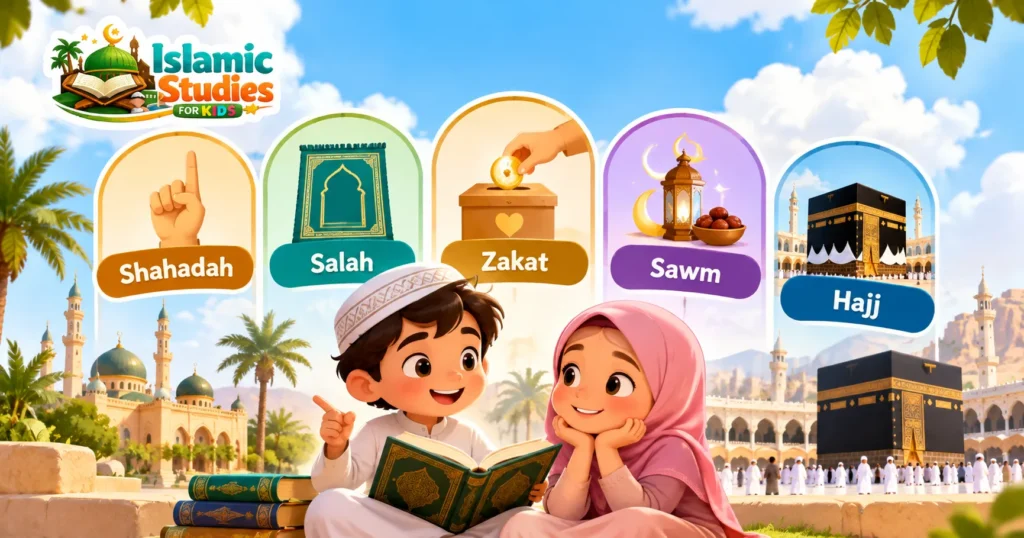
The 5 pillars of Islam KS2 are Shahadah (declaration of faith), Salah (prayer), Zakat (obligatory charity), Sawm (fasting during Ramadan), and Hajj (pilgrimage to Makkah). These five foundations of Islam help pupils understand how Muslims worship Allah, practise their faith, and fulfil their religious responsibilities.
For children in Key Stage 2 (Years 3–6), learning the Five Pillars goes beyond memorising their names. Why do Muslims pray five times a day? How does Zakat help people in need? What makes Ramadan and Hajj so important? Exploring these questions helps pupils connect Islamic beliefs with everyday life while developing their understanding of different religious practices.
This Five Pillars of Islam KS2 guide provides clear explanations supported by the Quran and Hadith, engaging classroom activities, and a practical worksheet with answers. Whether you’re a primary school teacher planning an RE lesson or a parent supporting learning at home, you’ll find useful resources to help children understand each pillar and its significance in Islam.
1. Shahadah: The Muslim Declaration of Faith
The Shahadah is the Muslim statement of faith: “There is no god but Allah, and Muhammad is the Messenger of Allah.” Muslims believe in tawhid, the idea that Allah is One and has no partners.
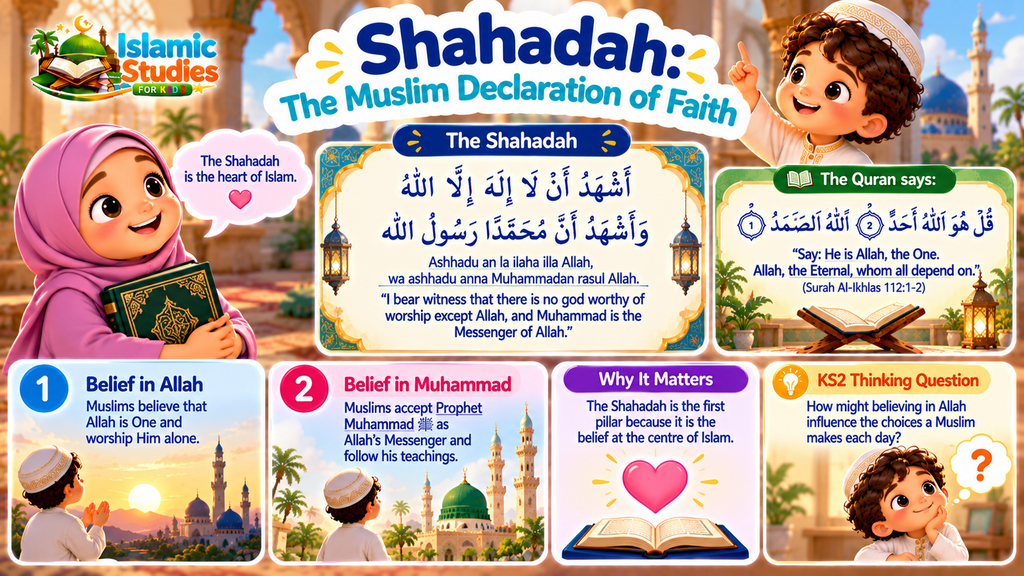
This belief sits at the centre of Islam, which is why the Shahadah is the first pillar. A short chapter of the Quran that many Muslim children learn early sums it up:
قُلْ هُوَ اللَّهُ أَحَدٌ اللَّهُ الصَّمَدُ
“Say: He is Allah, the One. Allah, the Eternal, whom all depend on.” (Surah Al-Ikhlas, 112:1-2)
What Should KS2 Pupils Understand About Shahada?
There are two parts to remember:
- Belief in Allah: Muslims believe that Allah is One and worship Him alone.
- Belief in Muhammad: Muslims accept Prophet Muhammad as Allah’s Messenger.
For a classroom discussion, ask pupils why a declaration of belief might be important to someone’s religious identity.
KS2 thinking question: How might believing in Allah influence the choices a Muslim makes each day?
2. Salah: Praying Five Times a Day
Muslims pray five times a day: Fajr, Dhuhr, Asr, Maghrib and Isha. Before praying they perform wudu, a set way of washing, and they face the qiblah, the direction of the Kaaba in Makkah.
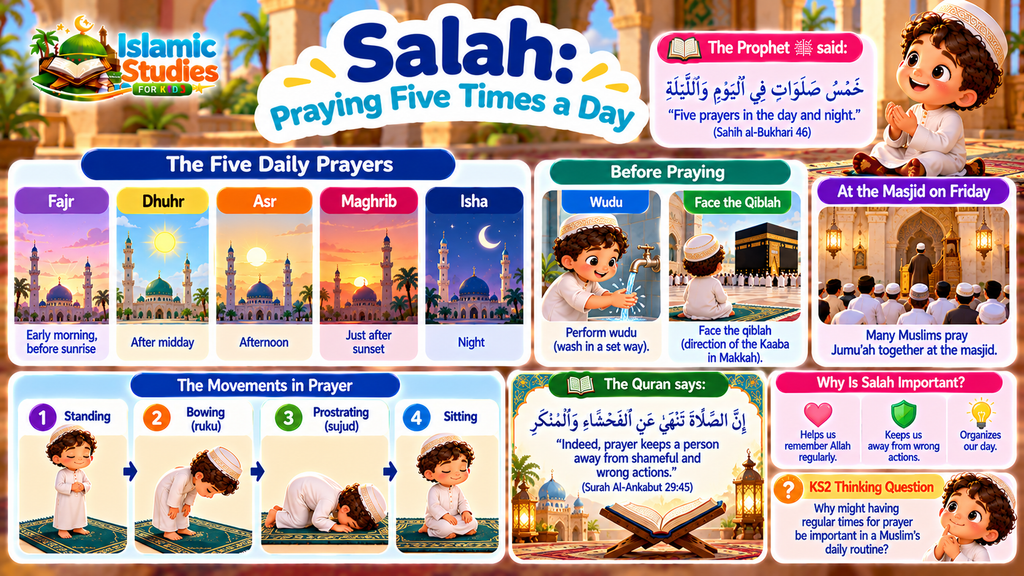
Each prayer is made up of rak’ahs, which include standing, bowing (ruku) and prostrating with the forehead on the ground (sujud). On Fridays, many Muslims pray Jumu’ah together at the masjid.
The number of daily prayers is set out in the Sunnah. When a man from Najd came to ask the Prophet ﷺ what Islam required of him, the first thing he was told was:
خَمْسُ صَلَوَاتٍ فِي الْيَوْمِ وَاللَّيْلَةِ
“Five prayers in the day and night.” (Sahih al-Bukhari 46)
The man then asked whether he had to pray anything else, and the Prophet ﷺ told him no, unless he chose to pray extra voluntary prayers. This is a helpful point for pupils: five prayers are required, and Muslims are free to add more.
The Quran explains that prayer also affects how a person behaves:
إِنَّ الصَّلَاةَ تَنْهَىٰ عَنِ الْفَحْشَاءِ وَالْمُنكَرِ
“Indeed, prayer keeps a person away from shameful and wrong actions.” (Surah Al-Ankabut, 29:45)
The Five Daily Prayers KS2 Pupils Should Know
Muslims perform five obligatory prayers each day, beginning before sunrise and continuing into the night. Each prayer has its own name and specific time, helping Muslims organize their day around worship and remembrance of Allah.
| Prayer | Time of Day |
| Fajr | Early morning, before sunrise |
| Dhuhr | After midday |
| Asr | Afternoon |
| Maghrib | Just after sunset |
| Isha | Night |
Prayer involves standing, bowing, prostrating, and reciting prescribed words and Quranic passages.
Rather than thinking of Salah as an ordinary conversation, pupils should understand that it is a specific act of worship with established rules.
KS2 thinking question: Why might having regular times for prayer be important in a Muslim’s daily routine?
3. Zakat: Giving 2.5% of Savings to People in Need
Zakat is a form of worship through giving. Muslims who have savings above a minimum amount, called nisab, give 2.5% of those savings each year to people in need.
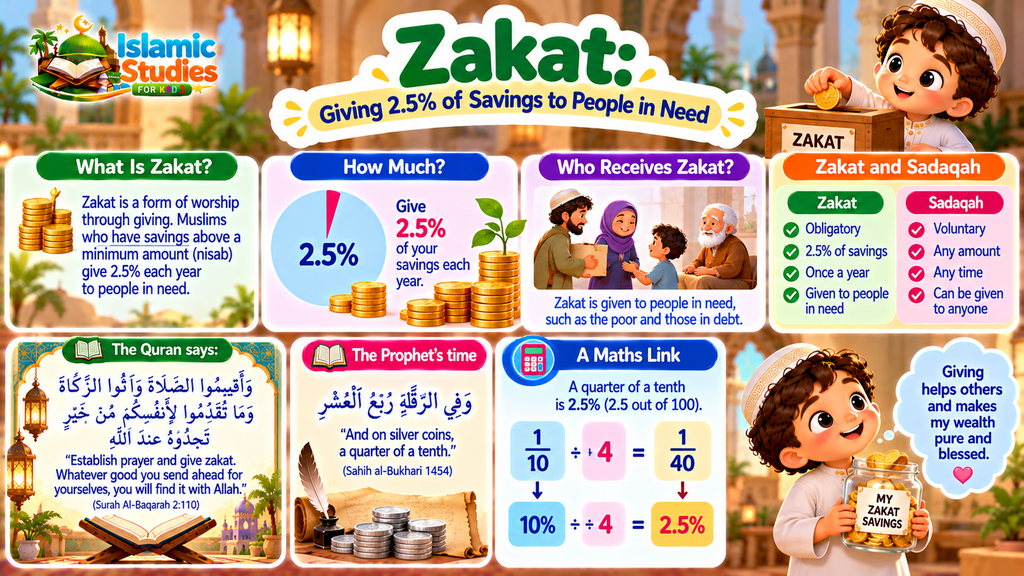
Zakat is different from sadaqah, which is any extra charity given freely at any time. Pupils often find it interesting that zakat is mentioned alongside prayer many times in the Quran:
وَأَقِيمُوا الصَّلَاةَ وَآتُوا الزَّكَاةَ ۚ وَمَا تُقَدِّمُوا لِأَنفُسِكُم مِّنْ خَيْرٍ تَجِدُوهُ عِندَ اللَّهِ
“Establish prayer and give zakat. Whatever good you send ahead for yourselves, you will find it with Allah.” (Surah Al-Baqarah, 2:110)
The figure of 2.5% comes from a letter written by Abu Bakr, the first caliph, recording the zakat that the Prophet ﷺ had set. One line of it reads:
وَفِي الرِّقَّةِ رُبْعُ الْعُشْرِ
“And on silver coins, a quarter of a tenth.” (Sahih al-Bukhari 1454)
A quarter of a tenth is 2.5%. This gives a neat link to maths: ask pupils to show why one quarter of one tenth works out as 2.5 out of every 100.
4. Sawm: Fasting from Dawn to Sunset in Ramadan
During Ramadan, adult Muslims fast from dawn until sunset, which means no food or drink during daylight hours. People who are ill, travelling, pregnant, elderly or still young do not have to fast.
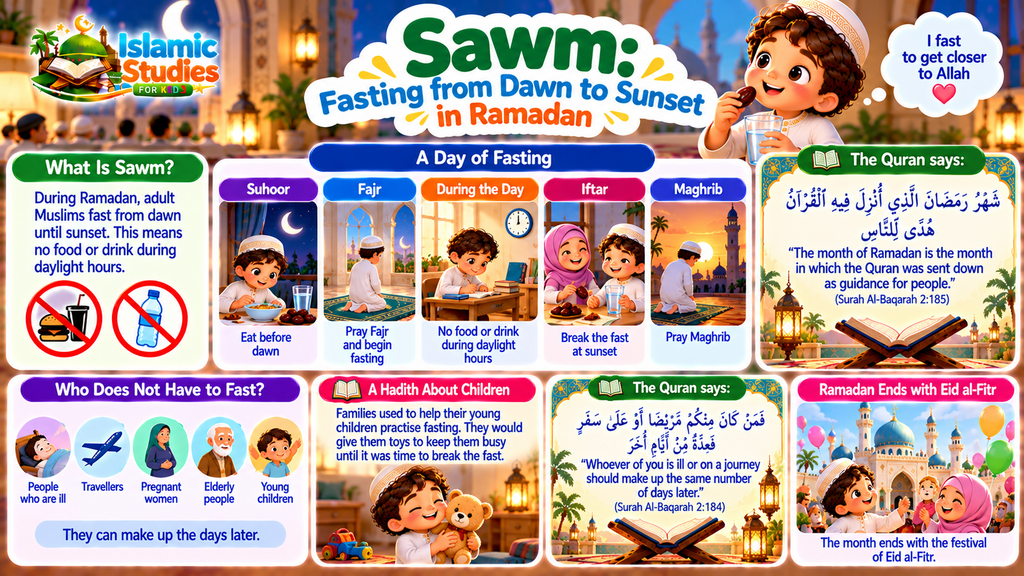
Families eat suhoor before dawn and break the fast at sunset with iftar. The month ends with the festival of Eid al-Fitr. Ramadan is special because it is the month the Quran was first revealed:
شَهْرُ رَمَضَانَ الَّذِي أُنزِلَ فِيهِ الْقُرْآنُ هُدًى لِّلنَّاسِ
“The month of Ramadan is the month in which the Quran was sent down as guidance for people.” (Surah Al-Baqarah, 2:185)
The exceptions for people who are ill or travelling come from the verse just before it:
فَمَن كَانَ مِنكُم مَّرِيضًا أَوْ عَلَىٰ سَفَرٍ فَعِدَّةٌ مِّنْ أَيَّامٍ أُخَرَ
“Whoever of you is ill or on a journey should make up the same number of days later.” (Surah Al-Baqarah, 2:184)
Children practising fasting is not a new idea either. Ar-Rubayyi bint Mu’awwidh, a woman from the Ansar of Madinah, described how families helped their young children with the fast of Ashura:
وَنُصَوِّمُ صِبْيَانَنَا، وَنَجْعَلُ لَهُمُ اللُّعْبَةَ مِنَ الْعِهْنِ، فَإِذَا بَكَى أَحَدُهُمْ عَلَى الطَّعَامِ أَعْطَيْنَاهُ ذَاكَ، حَتَّى يَكُونَ عِنْدَ الإِفْطَارِ
“We would have our young children fast, and we made toys of wool for them. If one of them cried for food, we gave him the toy until it was time to break the fast.” (Sahih al-Bukhari 1960)
Pupils usually enjoy this hadith because it shows children much like themselves, distracted with toys until sunset. It also reflects how many Muslim families still approach fasting today: a little at a time, with encouragement rather than pressure.
5. Hajj: The Once-in-a-Lifetime Pilgrimage to Makkah
Hajj is the pilgrimage to Makkah in Saudi Arabia, which takes place over several days in the month of Dhul Hijjah. Every Muslim who is healthy and can afford it should go once in their lifetime.
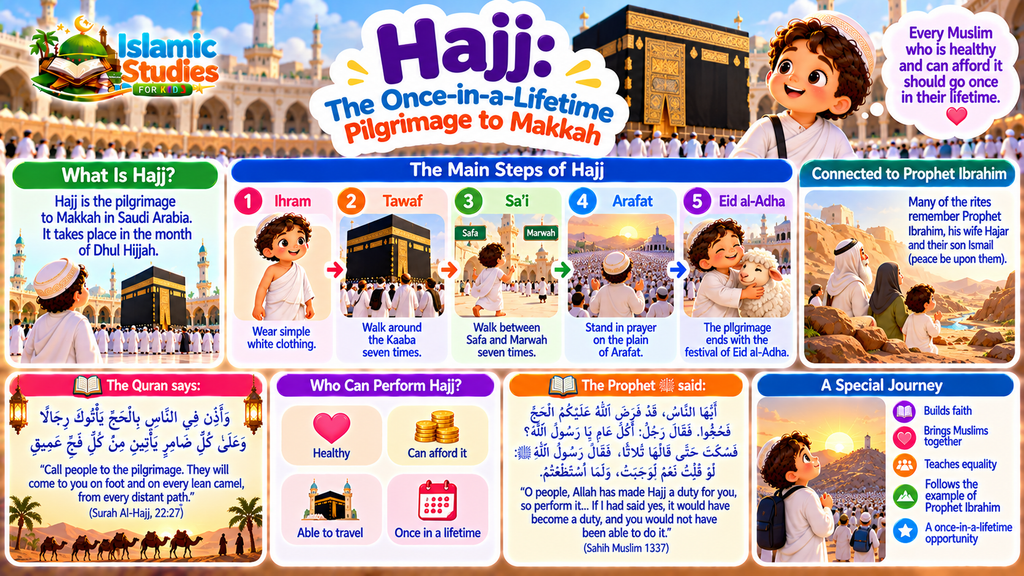
Pilgrims wear simple white clothing called ihram, walk around the Kaaba (tawaf), and spend a day in prayer on the plain of Arafat. Many of the rites remember Prophet Ibrahim, his wife Hajar and their son Ismail, whose stories you can read in our Islamic history lessons for kids. The Quran describes Ibrahim being told to call people to Hajj:
وَأَذِّن فِي النَّاسِ بِالْحَجِّ يَأْتُوكَ رِجَالًا وَعَلَىٰ كُلِّ ضَامِرٍ يَأْتِينَ مِن كُلِّ فَجٍّ عَمِيقٍ
“Call people to the pilgrimage. They will come to you on foot and on every lean camel, from every distant path.” (Surah Al-Hajj, 22:27)
Why only once in a lifetime? Abu Hurairah reported that the Prophet ﷺ gave a sermon in which he said:
أَيُّهَا النَّاسُ، قَدْ فَرَضَ اللَّهُ عَلَيْكُمُ الْحَجَّ فَحُجُّوا.
فَقَالَ رَجُلٌ: أَكُلَّ عَامٍ يَا رَسُولَ اللَّهِ؟ فَسَكَتَ حَتَّى قَالَهَا ثَلاَثًا، فَقَالَ رَسُولُ اللَّهِ ﷺ: لَوْ قُلْتُ نَعَمْ لَوَجَبَتْ، وَلَمَا اسْتَطَعْتُمْ
“O people, Allah has made Hajj a duty for you, so perform it.” A man asked, “Every year, O Messenger of Allah?” He stayed silent until the man had asked three times, then said: “If I had said yes, it would have become a duty, and you would not have been able to do it.” (Sahih Muslim 1337)
The hadith shows that Islam takes people’s ability into account. Hajj is a long and expensive journey, so it is required only once, and only from those who can manage it. Older pupils can compare this with the condition of being “able” in Surah Aal Imran, 3:97.
Experience a Real Classroom
Curious about how we teach? This video offers a glimpse into a real class, showcasing our interactive approach, qualified teachers, and child-friendly learning experience.
Fun & Engaging Islamic Classes for Kids
Start your child’s journey today with interactive lessons designed to make learning Islam loved and easy.
Get Your Child a Free TrialWhat Should KS2 Pupils Know About the Five Pillars of Islam?
By the end of a KS2 unit, most pupils should be able to name the five pillars, explain each one in a sentence or two, and use the key words below with confidence.
| Pillar | What it is | Key vocabulary |
| Shahadah | The declaration of faith | Tawhid (the oneness of Allah), Rasul (messenger) |
| Salah | Prayer five times a day | Wudu, qiblah, rak’ah, sujud, masjid |
| Zakat | Giving 2.5% of savings to those in need | Nisab, sadaqah |
| Sawm | Fasting during Ramadan | Suhoor, iftar, Eid al-Fitr |
| Hajj | Pilgrimage to Makkah | Kaaba, ihram, tawaf, Arafat, Eid al-Adha |
Older pupils in Years 5 and 6 can go a step further and discuss why Muslims follow the pillars, and what they show about Muslim beliefs such as gratitude, equality and caring for others. Our 5 pillars of Islam course covers each pillar in more depth if your class or child wants to explore further.

5 Pillars KS2 Activities
These activities work well across Years 3 to 6, and several link nicely to other subjects.
| Activity | Best for | Links to |
| Pillar sorting cards | Years 3 and 4 | RE vocabulary |
| Zakat maths | Years 5 and 6 | Maths (percentages) |
| Prayer times and the sun | Years 5 and 6 | Science (day length) |
| Hajj journey map | Years 4 to 6 | Geography |
| Big question debate | Year 6 | Oracy, PSHE |
Pillar Sorting Cards
Write short statements on cards, for example, “Muslims face the Kaaba” or “Families eat dates at sunset”, and ask pupils to sort them under the correct pillar. It is a quick way to check vocabulary at the start or end of a lesson.
Teachers can divide pupils into small groups and encourage them to explain their choices. This helps children remember the Five Pillars while practising teamwork and communication skills.
Zakat Maths
Give pupils a few amounts of savings, such as £400, £1,000 and £2,500, and ask them to work out 2.5% of each. Then talk about why a small percentage from many people can make a big difference to a community.
For example, 2.5% of £1,000 is £25. Explain that these are maths exercises, as actual Zakat obligations depend on conditions such as the Nisab threshold and the lunar-year requirement.
Prayer Times and the Sun
Show pupils a printed prayer timetable from a local masjid for one week in June and one in December. Ask them to explain why Fajr and Isha move so much between the seasons. This links Salah to what they learn about the Earth’s orbit in science.
Encourage pupils to compare the times and record the differences in a simple table. Explain how Earth’s tilted axis and its orbit around the Sun cause seasonal changes in daylight hours.
Hajj Journey Map
Using a simple map of Makkah and the surrounding area, pupils mark the main places associated with Hajj: the Kaaba, Safa and Marwah, Mina and Arafat. They add one sentence for what happens at each place.
Pupils can use arrows and labels to illustrate a simplified pilgrimage journey. Teachers can also introduce Muzdalifah and explain that the complete sequence of Hajj rituals involves additional steps.
Big Question Debate
In Year 6, try a question with no single right answer: “Which pillar do you think helps a community the most, and why?” Pupils should back up their view using what they have learned.
Encourage pupils to give examples, listen respectfully, and explain their opinions. Remind them that all Five Pillars are fundamental to Islam, even though each contributes to Muslim life in different ways.
5 Pillars of Islam KS2 Worksheet
You can copy this worksheet into a document and print it, or use it as a starter on the board. Answers are at the end.
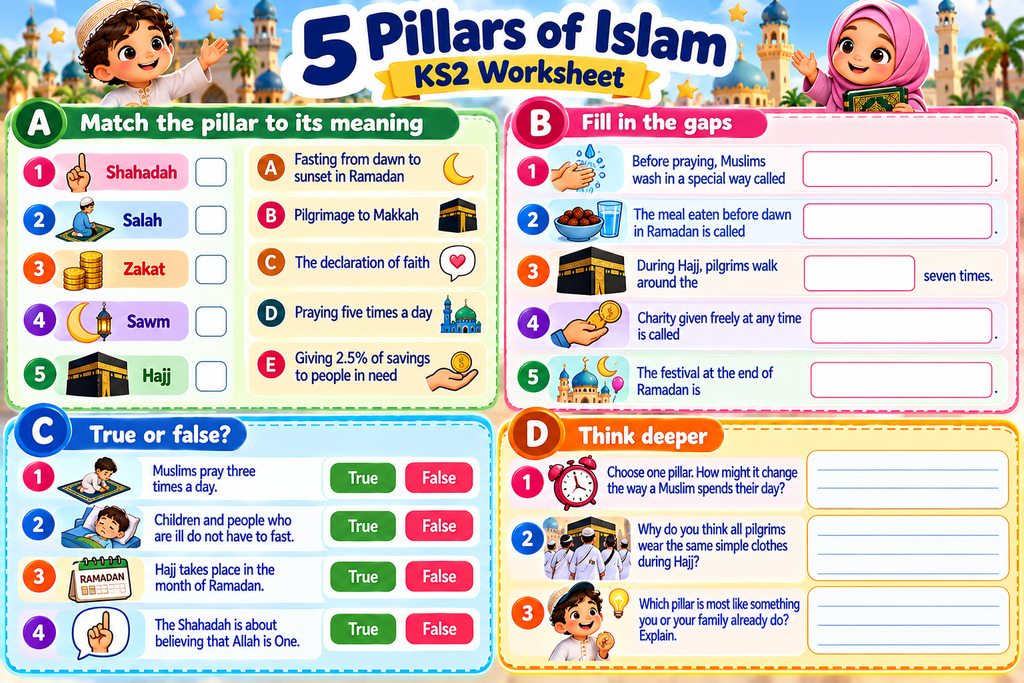
Part A: Match the pillar to its meaning
The Five Pillars of Islam each represent an important act of worship. Match every pillar in the first column with its correct meaning in the second column by writing the matching letter next to the pillar.
| Pillar | Meaning |
| 1. Shahadah | A. Fasting from dawn to sunset in Ramadan |
| 2. Salah | B. Pilgrimage to Makkah |
| 3. Zakat | C. The declaration of faith |
| 4. Sawm | D. Praying five times a day |
| 5. Hajj | E. Giving 2.5% of savings to people in need |
Part B: Fill in the gaps
- Before praying, Muslims wash in a special way called ________.
- The meal eaten before dawn in Ramadan is called ________.
- During Hajj, pilgrims walk around the ________ seven times.
- Charity given freely at any time is called ________.
- The festival at the end of Ramadan is ________.
Part C: True or false?
- Muslims pray three times a day.
- Children and people who are ill do not have to fast.
- Hajj takes place in the month of Ramadan.
- The Shahadah is about believing that Allah is One.
Part D: Think deeper
- Choose one pillar. How might it change the way a Muslim spends their day?
- Why do you think all pilgrims wear the same simple clothes during Hajj?
- Which pillar is most like something you or your family already do? Explain.
Answers
- Part A: 1-C, 2-D, 3-E, 4-A, 5-B
- Part B: wudu, suhoor, Kaaba, sadaqah, Eid al-Fitr
- Part C: false (five times), true, false (it is in Dhul Hijjah), true
- Part D: open answers. Look for correct vocabulary and a clear reason.
5 Practical Tips for Teaching the Five Pillars of Islam in Primary School
Teaching the Five Pillars of Islam in a KS2 classroom requires clear explanations, engaging resources, and respect for pupils from different religious backgrounds. These five tips can help teachers create an inclusive learning environment.
1. Introduce the Five Pillars Using Arabic and English Terms
Teach Shahadah, Salah, Zakat, Sawm, and Hajj alongside their English meanings. Display the words on a classroom vocabulary wall to help pupils remember them.
Use simple flashcards with Arabic terms, English translations, and small illustrations. Regular matching activities can help pupils become familiar with Islamic vocabulary.
2. Encourage Muslim Pupils to Share Experiences Voluntarily
Allow Muslim pupils to talk about their experiences of Ramadan, Salah, or other Islamic practices if they wish. Avoid expecting them to represent all Muslims or answer questions on behalf of their religion.
Teachers can also use children’s books or short educational videos to introduce different Muslim experiences without placing pressure on individual pupils.
3. Use Visual Resources to Explain Islamic Worship
Show pupils a prayer mat, a Qiblah compass, or photographs of the Kaaba to illustrate religious practices. Avoid requiring children to perform acts of worship as classroom activities.
Visual materials help pupils understand unfamiliar concepts and encourage thoughtful questions about how Muslims practise their faith in everyday life.
4. Explain Why Muslims Say “Peace Be Upon Him”
Teach pupils that Muslims often say “peace be upon him” or use the symbol ﷺ after mentioning Prophet Muhammad. Explain that this is an expression of respect.
Encourage pupils to recognise this phrase when reading Islamic texts and understand why it is meaningful to Muslims.
5. Connect Ramadan Lessons With the Islamic Calendar
Where practical, teach Sawm around Ramadan. Use age-appropriate discussions to explore fasting, Suhoor, Iftar, and the importance of the month in Muslim family life.
A simple Islamic calendar activity can help pupils understand why Ramadan begins on different dates each year and how Muslim families prepare for the month.
These approaches help KS2 pupils understand the Five Pillars of Islam while developing religious literacy, respectful discussion skills, and awareness of different beliefs.
For Muslim families who want their children to build on what they learn at school, our intensive Islamic studies program offers a more structured path.

Watch a Sample Lesson from Our Academy
Get a firsthand look at how our students learn Islamic values, Quran, and essential knowledge through engaging and interactive online classes. See why families trust Islamic Studies for Kids Academy.
Fun & Engaging Islamic Classes for Kids
Start your child’s journey today with interactive lessons designed to make learning Islam loved and easy.
Get Your Child a Free TrialSupport Your Child’s Islamic Learning With Islamic Studies for Kids Academy
Learning about the Five Pillars in KS2 is an excellent introduction to Islam, but children often want to explore their faith beyond what is covered in the classroom. At Islamic Studies for Kids Academy, we help young learners develop a clearer understanding of Islamic beliefs, worship, and values through engaging, age-appropriate education.
Our academy offers a welcoming online learning environment where children can ask questions, explore Islamic teachings, and strengthen their connection with Allah. With personalised guidance and supportive teaching, we help children move beyond memorising religious terms to understanding how Islamic principles relate to everyday life.
Whether your child is studying the Five Pillars at primary school or developing their Islamic knowledge at home, Islamic Studies for Kids Academy provides encouragement and guidance suited to their learning needs. Our goal is to help children grow in knowledge, confidence, and appreciation of their Muslim identity.
Give your child the opportunity to learn Islam with confidence — Book a Free Trial Lesson Today!
Our Islamic Studies Courses Include:
- Islamic Studies Course for Kids
- Islam Basics Course for Kids
- 5 Pillars of Islam Course for Kids
- 6 Pillars of Iman (Faith) Course for Kids
- Salah (Prayer) Course for Kids
- Wudu Course for Kids
- Dua Course for Kids
- Ramadan Course for Kids
- Zakat & Sadaqah Course for Kids
- Hajj Course for Kids
- Aqeedah (Islamic Belief ) Course for Kids
Conclusion
Learning the 5 pillars of Islam KS2 helps primary school pupils understand the essential practices that shape Muslim faith and daily life. From Shahadah and Salah to Zakat, Sawm, and Hajj, each pillar introduces an important aspect of Islamic worship and religious responsibility.
Through clear explanations, classroom discussions, and practical activities, pupils can develop a deeper understanding of why Muslims follow these practices. Worksheets, vocabulary exercises, and cross-curricular tasks also make the topic accessible to children with different learning abilities and backgrounds.
Whether taught in a primary school classroom or explored at home, the Five Pillars provide a valuable opportunity to develop religious literacy, critical thinking, and respect for different beliefs. The aim is to help children understand not only what Muslims practise, but also the meaning behind their actions.
Frequently Asked Questions About the 5 Pillars of Islam KS2
1. What Are the 5 Pillars of Islam for KS2 Pupils?
The five pillars are Shahadah (declaration of faith), Salah (five daily prayers), Zakat (obligatory charity), Sawm (fasting during Ramadan), and Hajj (pilgrimage to Makkah). They form the foundation of Islamic worship and help pupils understand how Muslims practise their faith.
2. Why Are the Five Pillars Important in KS2 Religious Education?
Learning about the Five Pillars helps KS2 pupils understand how Islamic beliefs influence daily life, religious responsibilities, and community traditions. It also develops religious vocabulary and encourages respectful discussions about different beliefs and practices.
3. What Is the Difference Between Shahadah and Salah?
Shahadah is the declaration that Allah is One and Muhammad (peace be upon him) is His Messenger. Salah is the prescribed prayer Muslims perform five times a day. Shahadah expresses the foundation of Muslim belief, while Salah is an act of worship.
4. How Can Teachers Assess Pupils’ Understanding of the Five Pillars?
Teachers can use vocabulary matching, short-answer questions, sorting activities, and written explanations. For Years 5–6, ask pupils to compare two pillars or explain how a particular practice influences Muslim life.
5. Are the Five Pillars of Islam Taught Differently in KS1 and KS2?
Yes. KS1 teaching usually introduces the names and basic meanings through simple examples. KS2 lessons can explore Quranic references, religious vocabulary, the purpose of each pillar, and how Muslims practise their faith in different circumstances.
6. What Resources Are Useful for Teaching the Five Pillars in Primary School?
Useful resources include prayer timetables, images of the Kaaba, maps of Makkah, Arabic vocabulary cards, Zakat maths exercises, and a 5 pillars of Islam KS2 worksheet. These help pupils connect religious concepts with practical learning activities.


Leave a Reply