20 Interesting Facts About The 5 Pillars Of Islam For Kids
The 5 pillars of Islam facts for kids begin with five essential practices: Shahada (faith), Salah (prayer), Zakat (obligatory charity), Sawm (fasting during Ramadan), and Hajj (pilgrimage to Makkah). These pillars are the foundations of Islamic worship, but each has some fascinating details that children may not know.
Did you know that Muslim prayer times change with the seasons, Ramadan moves through the calendar, and Hajj brings Muslims from different countries to the same sacred places? Even the way Zakat is distributed follows specific instructions in the Quran.
Here are 20 interesting facts about the Five Pillars of Islam for children, with simple explanations, Quranic references, and surprising details to help young readers learn something new.
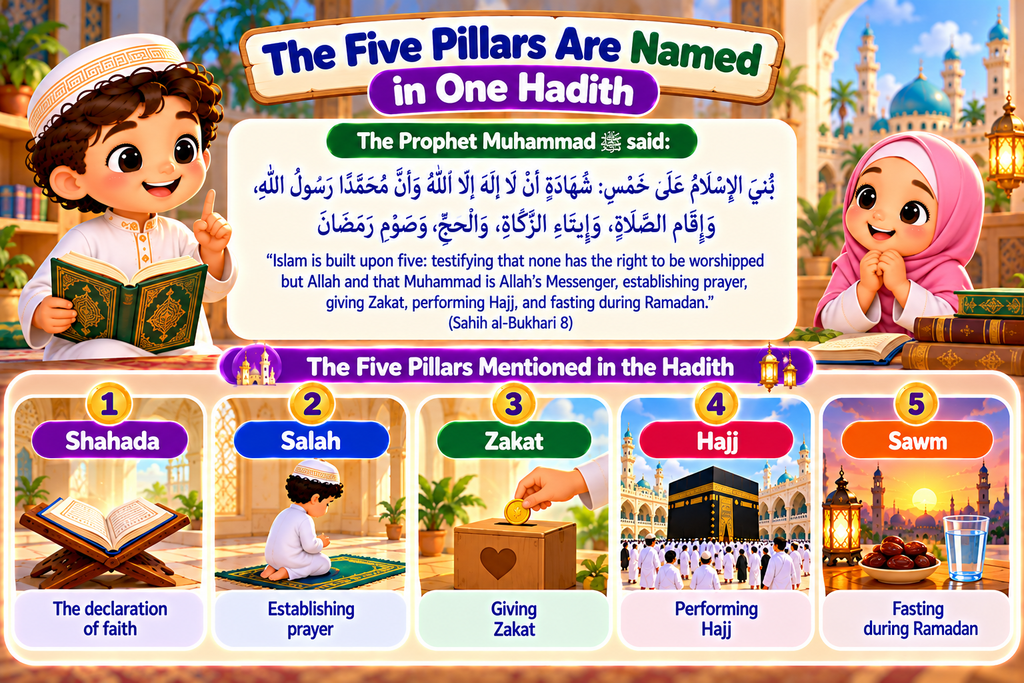
1. The Five Pillars Are Named in One Hadith
Prophet Muhammad ﷺ identified all five foundations of Islam in a single hadith. He said:
“Islam is built upon five: testifying that none has the right to be worshipped but Allah and that Muhammad is Allah’s Messenger, establishing prayer, giving Zakat, performing Hajj, and fasting during Ramadan.” (Sahih al-Bukhari 8)
The Prophet ﷺ named all five pillars in one hadith, making it an important reference for learning the foundations of Islam.
2. The Shahada Contains Two Statements of Belief
The first pillar of Islam, Shahada, is a declaration of faith that contains two essential beliefs:
Belief in Allah: Allah alone deserves worship.
Belief in His Messenger: Muhammad ﷺ is Allah’s Messenger.
The Shahada is one declaration containing two connected beliefs. Children should understand both meanings, not just memorise the Arabic words.
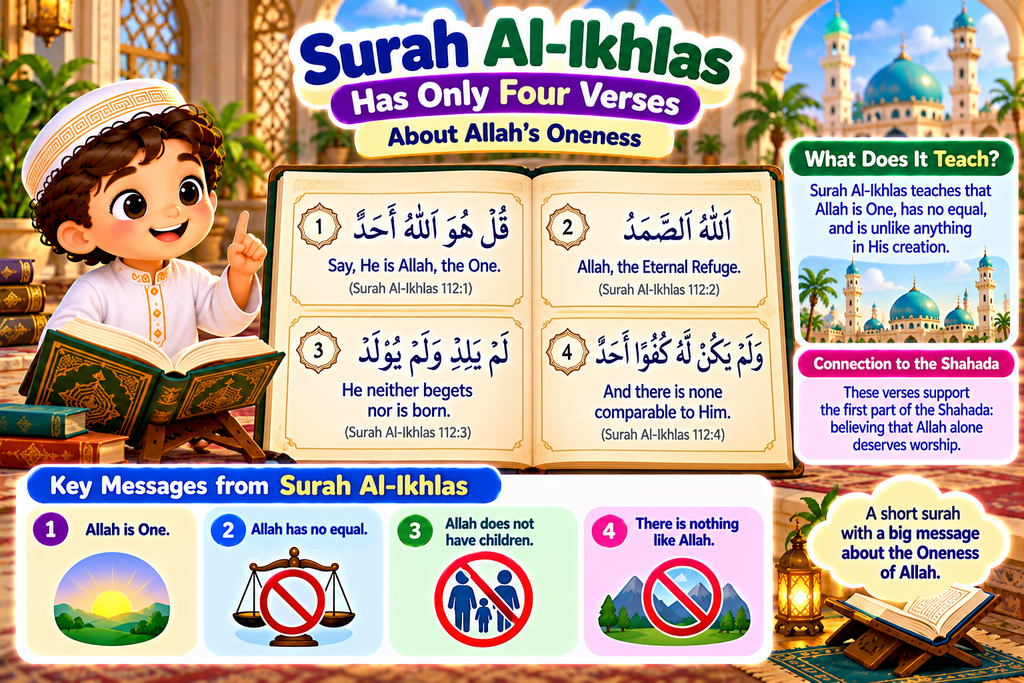
3. Surah Al-Ikhlas Has Only Four Verses About Allah’s Oneness
Surah Al-Ikhlas is one of the shortest chapters in the Quran, containing just four verses. It teaches that Allah is One, has no equal, and is unlike anything in His creation.
This connects directly to the first part of the Shahada: believing that Allah alone deserves worship.
Even though Surah Al-Ikhlas has only four verses, it teaches one of the most important beliefs in Islam: the Oneness of Allah.
Young children can become familiar with this short surah through listening and repetition. At Islamic Studies for Kids Academy, our Quran for Toddlers programme introduces Surah Al-Ikhlas and other short surahs through age-appropriate Quran learning activities.
4. The Five Daily Prayers Have Specific Times
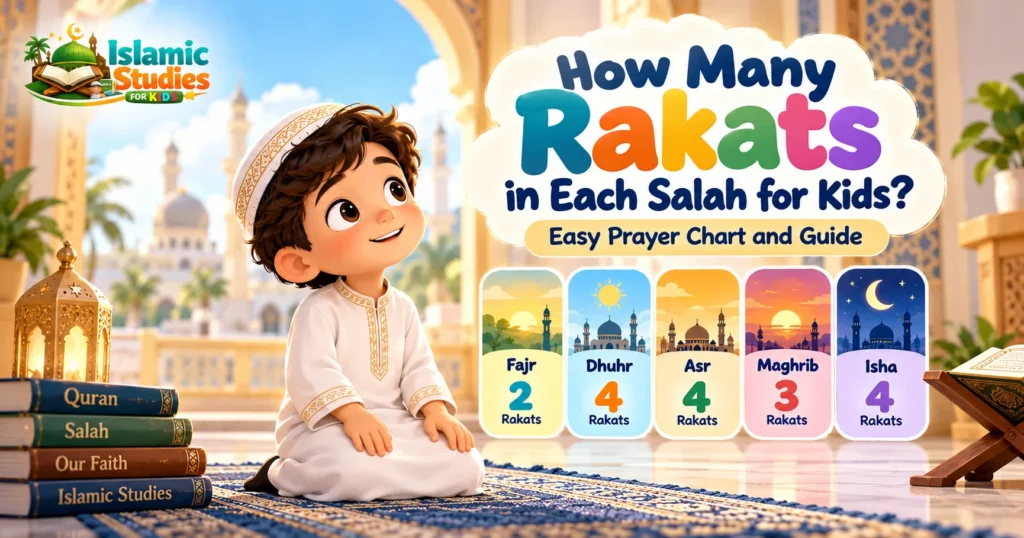
Salah is the second pillar of Islam, and Muslims perform five obligatory prayers each day: Fajr, Dhuhr, Asr, Maghrib, and Isha. Each prayer has a specific time set by Islamic teachings, which Muslims must observe.
“Indeed, prayer has been decreed upon the believers a decree of specified times.” (Surah An-Nisa 4:103)
These prayer times are determined by the sun’s position, so their clock times vary depending on the season and geographical location.
Prayer
When Its Time Begins
Fajr
At true dawn
Dhuhr
After the sun passes its highest point
Asr
When its prescribed afternoon shadow condition is met
Maghrib
At sunset
Isha
When the evening twilight disappears
Muslims in different countries may pray at different clock times, but they all follow the prescribed prayer times established in Islam.
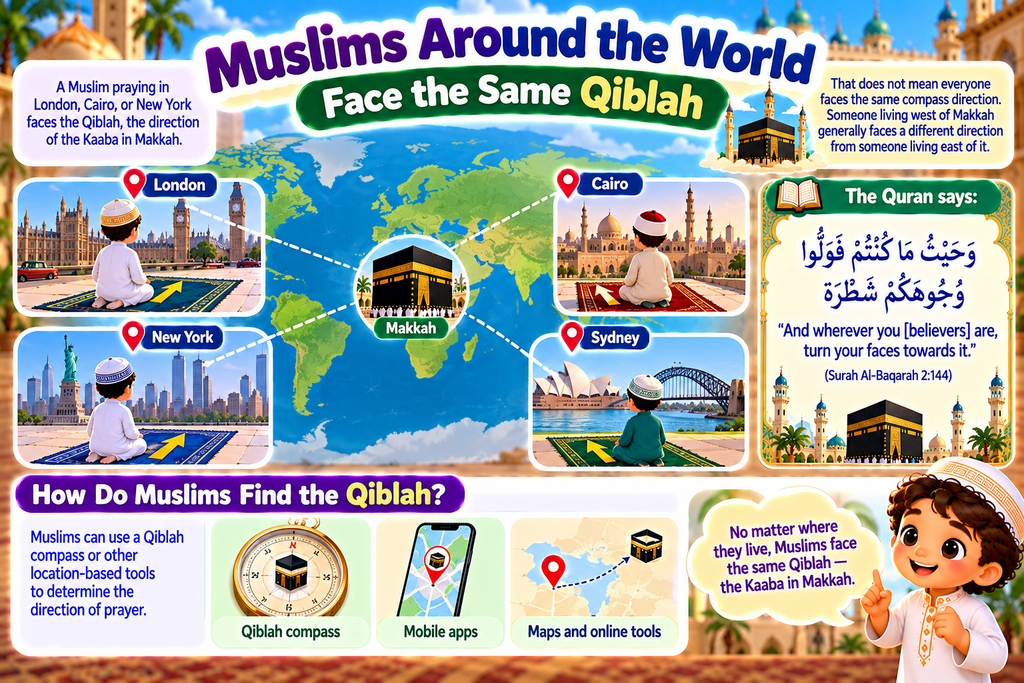
5. Muslims Around the World Face the Same Qiblah
A Muslim praying in London, Cairo, or New York faces the Qiblah, the direction of the Kaaba in Makkah.
That does not mean everyone faces the same compass direction. Someone living west of Makkah generally faces a different direction from someone living east of it.
Muslims can use a Qiblah compass or other location-based tools to determine the direction of prayer.
6. Salah Includes Standing, Bowing, and Prostrating
Muslim prayer is more than spoken words. It includes prescribed physical movements and Quranic recitation.
Three movements children may recognise are:
Qiyam: Standing during prayer.
Ruku: Bowing.
Sujud: Prostrating with the forehead on the ground.
These movements are performed within units of prayer called rak’ahs.
Children learning about Salah can discover the meanings of these words before studying the complete prayer in detail. Our Salah for Kids lessons explain the steps of prayer and how to prepare for them.
7. Muslims Can Pray in Many Clean Places
A mosque is an important place for Muslim worship, but Salah is not limited to a mosque building. Muslims can pray at home, at school, at work, or while travelling, as long as the place is suitable for prayer and free from impurities.
The Prophet Muhammad ﷺ said:
وَجُعِلَتْ لِيَ الأَرْضُ مَسْجِدًا وَطَهُورًا
“The earth has been made for me a place for praying and a thing to perform purification.” (Sahih al-Bukhari 335)
Before praying, Muslims make sure they are ritually purified, their bodies and clothing are clean from impurities, and they face the Qiblah towards the Kaaba in Makkah. A prayer mat can provide a clean surface, but it is not required if the place is already suitable.
Muslims do not need a special building or a prayer mat to perform Salah. They can worship Allah in many suitable clean places while following the rules of prayer.
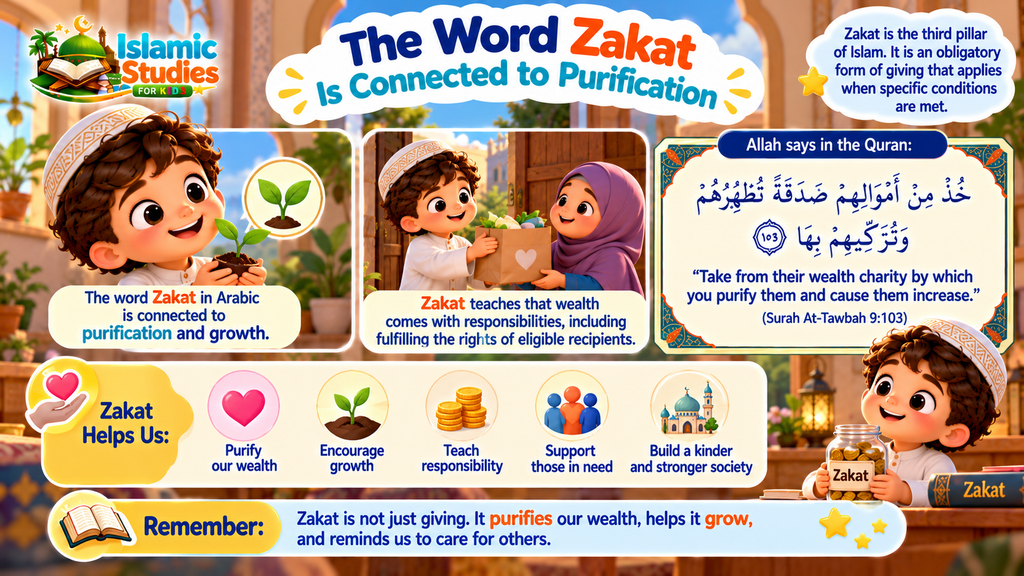
8. The Word Zakat Is Connected to Purification
Zakat is the third pillar, and its Arabic name is associated with purification and growth It is an obligatory form of giving that applies when specific conditions are met.
The Quran describes charitable giving as a means of purification:
“Take from their wealth charity by which you purify them and cause them increase.” (Surah At-Tawbah 9:103)
Zakat teaches that wealth comes with responsibilities, including fulfilling the rights of eligible recipients.
Experience a Real Classroom
Curious about how we teach? This video offers a glimpse into a real class, showcasing our interactive approach, qualified teachers, and child-friendly learning experience.
Fun & Engaging Islamic Classes for Kids
Start your child’s journey today with interactive lessons designed to make learning Islam loved and easy.
For many forms of qualifying savings, Zakat is calculated at 2.5% That means £2.50 out of every £100 of wealth subject to that rate.
Here is a simple maths example:
Qualifying Wealth
Zakat at 2.5%
£100
£2.50
£500
£12.50
£1,000
£25
£2,000
£50
These figures are examples for understanding percentages, not a complete Zakat calculation. Actual Zakat depends on the type of wealth and the relevant conditions, including the Nisab threshold.
10. The Quran Identifies Eight Categories of Zakat Recipients
Zakat cannot simply be spent on any good cause someone chooses. Allah clearly identifies eight categories of eligible Zakat recipients in the Quran.
“Alms-tax is only for the poor and the needy, for those employed to administer it, for those whose hearts are attracted to the faith, for freeing slaves, for those in debt, for Allah’s cause, and for needy travellers. This is an obligation from Allah. And Allah is All-Knowing, All-Wise.” (Surah At-Tawbah 9:60)
These eight categories include people experiencing poverty, those struggling with debt, and travellers in need. This shows children that Zakat follows specific Islamic rules about who can receive it.
Unlike voluntary charity (Sadaqah), which can support a wider range of good causes, Zakat must be distributed according to the categories established in the Quran.
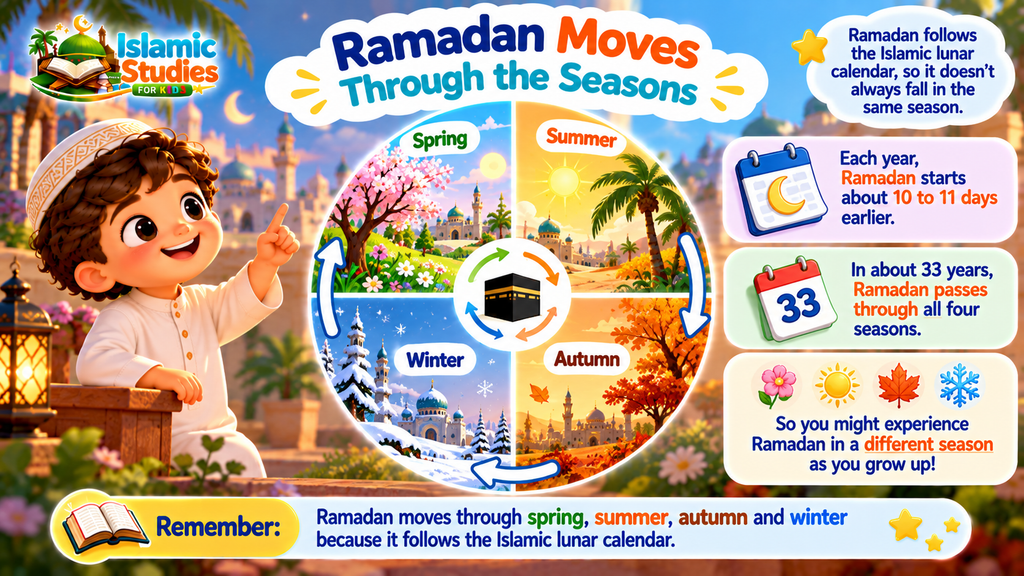
11. Ramadan Moves Through the Seasons
Ramadan doesn’t always fall in the same season. It follows the Islamic lunar calendar, which has 12 months, each lasting 29 or 30 days.
Because the Islamic year is about 10 to 11 days shorter than the Gregorian year, Ramadan generally begins 10 to 11 days earlier each year on the Gregorian calendar. This means it gradually moves through spring, summer, autumn, and winter.
Over approximately 33 years, Ramadan passes through all four seasons and returns to around the same time of the solar year. A child who experiences Ramadan in winter may celebrate it during summer when they are older.
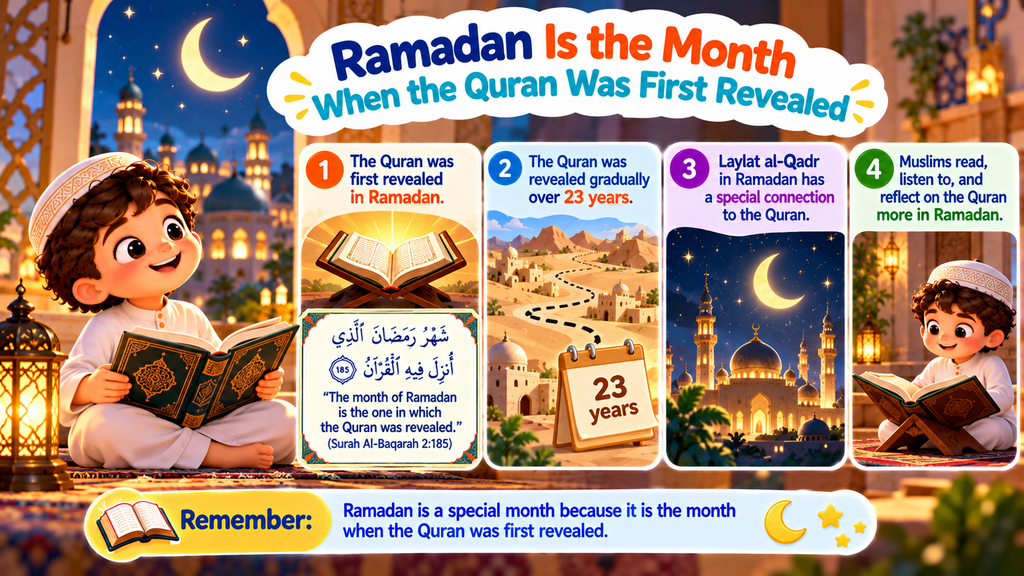
12. Ramadan Is the Month When the Quran Was First Revealed
Ramadan is not only the month of fasting. It is also the month in which the Quran was first revealed, making it especially important to Muslims.
Allah says:
شَهْرُ رَمَضَانَ الَّذِي أُنزِلَ فِيهِ الْقُرْآنُ
“The month of Ramadan is the one in which the Quran was revealed.” (Surah Al-Baqarah 2:185)
The Quran was revealed to Prophet Muhammad ﷺ gradually over approximately 23 years. Muslims also believe that Laylat al-Qadr (the Night of Decree), which occurs during Ramadan, has a special connection to the Quran’s revelation.
Although the Quran was revealed over many years, its revelation is closely connected to Ramadan. This is one reason Muslims spend extra time reading, listening to, and reflecting on the Quran during this month.
13. Fasting Begins at Dawn, Not Sunrise
One important fact children sometimes misunderstand is when the Ramadan fast begins The fast starts at true dawn (Fajr) and ends at sunset (Maghrib).
That means Muslims stop eating and drinking before sunrise, not when the sun becomes visible.
Two meals associated with fasting are:
Suhoor: The pre-dawn meal.
Iftar: The meal that breaks the fast after sunset.
Children can explore these and other Ramadan traditions through our Ramadan for Kids programme.
14. Young Children Are Not Required to Fast
Although Sawm is one of the Five Pillars of Islam, fasting during Ramadan is not obligatory for children before puberty. In Islam, religious accountability begins when a person reaches maturity.
“The pen has been lifted from three: the sleeping person until he awakens, the child until he reaches puberty, and the person who is mentally incapacitated until he regains reason.” (Sunan Abi Dawud 4403)
This hadith explains why children are not held accountable for obligatory fasting before puberty. However, they can gradually learn about Ramadan by helping prepare Iftar, listening to the Quran, and joining family activities.
Children can take part in the blessings of Ramadan without being required to fast. Learning about worship begins before religious obligations become compulsory.
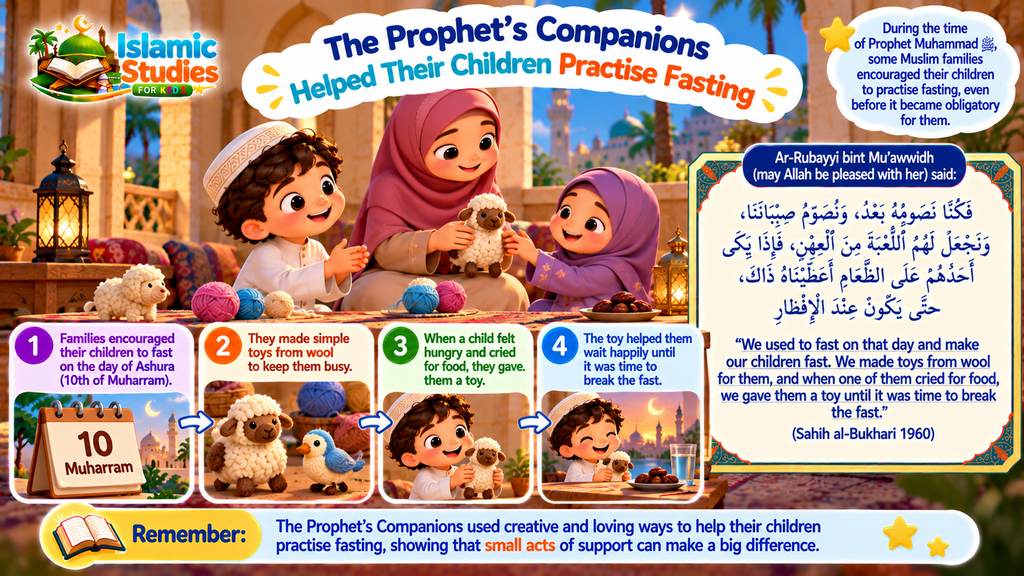
15. The Prophet’s Companions Helped Their Children Practise Fasting
During the time of Prophet Muhammad ﷺ, some Muslim families encouraged their children to practise fasting, even before it became obligatory for them.
Ar-Rubayyi bint Mu’awwidh (may Allah be pleased with her) described how families helped their children fast on the day of Ashura, the 10th of Muharram.
“We used to fast on that day and make our children fast. We made toys from wool for them, and when one of them cried for food, we gave them a toy until it was time to break the fast.” (Sahih al-Bukhari 1960)
More than 1,400 years ago, Muslim families used handmade woollen toys to keep children occupied while they practised fasting.
16. Hajj Takes Place During a Specific Month
Hajj is the fifth pillar and takes place during Dhul-Hijjah, the twelfth month of the Islamic calendar.
Unlike Umrah, which can be performed at different times of the year, Hajj has prescribed days and rituals Hajj is obligatory once in a lifetime for Muslims who meet its conditions of ability.
“Pilgrimage to this House is an obligation by Allah upon whoever is able among the people.” (Surah Ali ‘Imran 3:97)
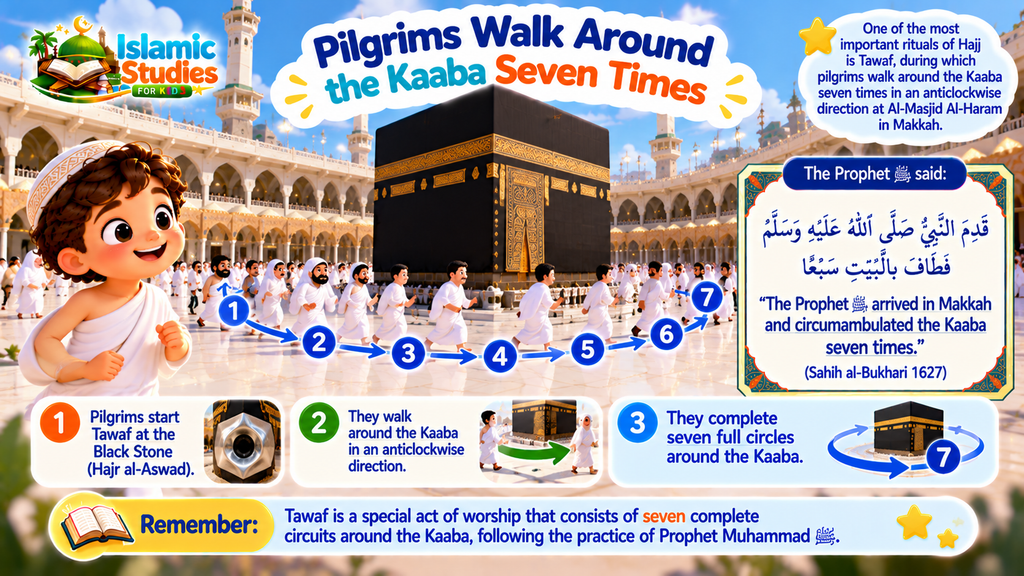
17. Pilgrims Walk Around the Kaaba Seven Times
One of the most important rituals of Hajj is Tawaf, during which pilgrims walk around the Kaaba seven times in an anticlockwise direction. This sacred act of worship takes place at Al-Masjid Al-Haram in Makkah.
Abdullah ibn Umar (may Allah be pleased with him) reported:
“The Prophet ﷺ arrived in Makkah and circumambulated the Kaaba seven times.” (Sahih al-Bukhari 1627)
Tawaf consists of seven complete circuits around the Kaaba, following the practice of Prophet Muhammad ﷺ.
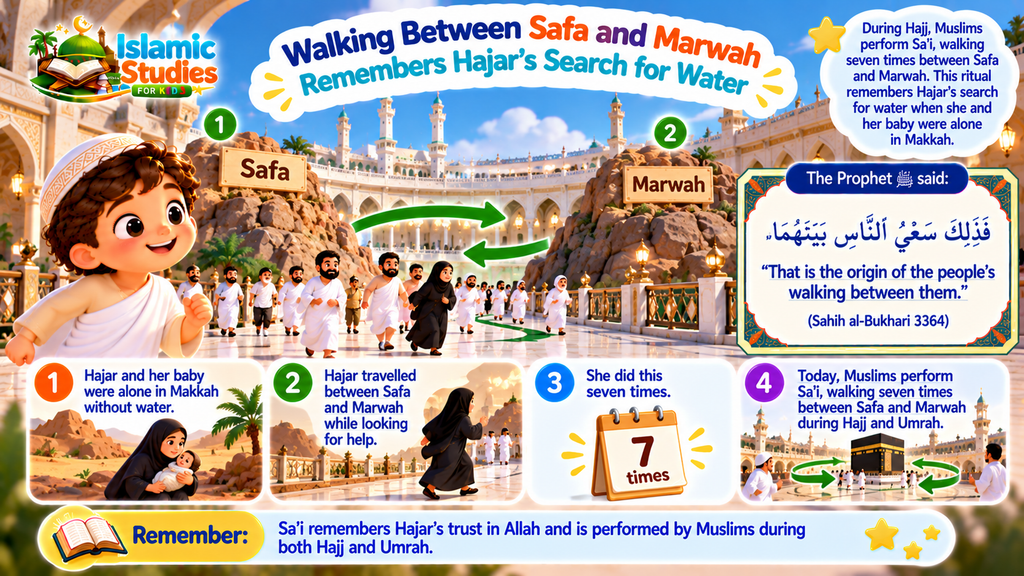
18. Walking Between Safa and Marwah Remembers Hajar’s Search for Water
During Hajj, Muslims perform Sa’i, walking seven times between Safa and Marwah. This ritual remembers Hajar, the mother of Prophet Ismail (peace be upon him), who searched for help when she and her baby were alone in Makkah without water.
Ibn Abbas (may Allah be pleased with him) narrated that Hajar travelled between the two hills while looking for someone to help her:
Hajar’s seven journeys between Safa and Marwah are remembered today through Sa’i, a ritual performed by Muslims during both Hajj and Umrah.
19. The Day of Arafat Is a Central Part of Hajj
The Day of Arafat falls on the ninth day of Dhul-Hijjah, when pilgrims gather at Arafat near Makkah to worship Allah, make Dua, and seek His forgiveness. Standing at Arafat is an essential part of Hajj.
Standing at Arafat is so important that Hajj is not valid without it. This is why the Prophet ﷺ emphasised its importance in this short but meaningful hadith.
20. The Five Pillars Have Different Times and Conditions
Perhaps the most useful fact to remember is that Muslims do not perform all five pillars in the same way or at the same frequency.
Pillar
When It Is Practised
Shahada
The declaration of faith, affirmed throughout Muslim life
Salah
Five times every day
Zakat
When its financial conditions are met
Sawm
During Ramadan, for those required and able to fast
Hajj
Once in a lifetime for those who meet its conditions
Children can learn about every pillar long before they become responsible for carrying out all of its obligations.
The Five Pillars are foundations of Islam, but understanding them also means knowing how their rules and requirements differ.
Watch a Sample Lesson from Our Academy
Get a firsthand look at how our students learn Islamic values, Quran, and essential knowledge through engaging and interactive online classes. See why families trust Islamic Studies for Kids Academy.
Fun & Engaging Islamic Classes for Kids
Start your child’s journey today with interactive lessons designed to make learning Islam loved and easy.
Turn Your Child’s Curiosity Into Islamic Knowledge With Islamic Studies for Kids Academy
Has your child ever asked why Muslims pray towards Makkah or what makes Ramadan different from other months? Questions like these are often where meaningful Islamic learning begins. At Islamic Studies for Kids Academy, we welcome children’s curiosity and help them find clear, age-appropriate answers rooted in Islamic teachings.
Our online learning environment gives children the opportunity to explore the Quran, Islamic beliefs, and acts of worship with supportive teachers. Instead of rushing through unfamiliar concepts, we encourage questions, careful explanations, and steady progress so children can understand what they learn and remember it with confidence.
Every child approaches Islamic learning differently. Some enjoy discovering stories from Islamic history, while others want to understand the prayers they hear at home or the traditions they experience during Ramadan. Islamic Studies for Kids Academy supports these individual interests while helping children develop a well-rounded understanding of their faith.
The most interesting thing about the 5 pillars of Islam facts for kids is how much children can discover beyond the five familiar names. From the movements of Salah to the story of Hajar during Hajj, each fact reveals something about the beliefs, history, and worship of Muslims.
These discoveries can turn simple questions into meaningful conversations. A child might wonder why Ramadan changes seasons, how Muslims find the Qiblah, or why Zakat has specific recipients. Exploring the answers helps them understand Islamic teachings through real examples rather than memorising definitions alone.
You don’t need to teach all 20 facts in one sitting. Pick a few that interest your child, read the related Quranic verses or Hadith together, and encourage further questions. Even one new discovery can open the door to a deeper understanding of Islam.
Frequently Asked Questions About the Five Pillars of Islam
1. What Are Five Simple Facts About the Five Pillars of Islam?
Shahada declares Muslim faith, Salah is performed five times daily, Zakat is obligatory giving under specific conditions, Sawm involves fasting during Ramadan, and Hajj is the pilgrimage to Makkah for Muslims who are able.
2. Which Pillar of Islam Is Performed Most Frequently?
Salah is performed five times every day. Its prescribed times occur from dawn until night, making it a regular part of Muslim daily life.
3. Which Five Pillars Are Connected to the Islamic Calendar?
Sawm is connected to Ramadan, while Hajj is performed during Dhul-Hijjah. Zakat also has timing rules for certain types of wealth, often involving a lunar year.
4. Is Giving Toys to Charity the Same as Paying Zakat?
No. Donating toys can be a voluntary charitable act, but it does not automatically fulfil the obligation of Zakat, which has specific rules about eligible wealth and recipients.
5. Do All Muslims Wear White During Hajj?
Male pilgrims wear prescribed Ihram garments, typically two unstitched white cloths. Women wear modest clothing that meets the requirements of Ihram; they are not required to wear the same white garments as men.
6. What Is the Most Surprising Fact About the Five Pillars of Islam?
One interesting fact is that Ramadan changes seasons over time because it follows the Islamic lunar calendar. Another is that Muslims around the world face the same Kaaba during prayer, even though they may face different compass directions.
 Islamic Studies





Leave a Reply