 Quran
Quran
Have you ever tried to explain the Quran to a child and found yourself wondering where to start? You know it matters deeply, but turning something so vast and sacred into a conversation a seven-year-old can follow — and love — is its own kind of skill.
This guide gives you the most important information about the Quran for kids, explained in a way children genuinely understand, alongside the practical tools parents need to turn that knowledge into a lifelong connection.
What You’ll Learn in This Article
- What the Quran is, explained simply enough for young children
- Key Quran facts for kids: structure, revelation, and fascinating details
- Why children learn faster when they understand the Quran’s meaning first
- Age-by-age guidance on what to teach and when
- How to introduce Quranic values into everyday family moments
- Practical ways to begin your child’s Quran journey at home
What Is The Quran For Kids?
The Quran is the holy book of Islam — the direct word of Allah, revealed to Prophet Muhammad ﷺ through the Angel Jibreel (Gabriel) over approximately 23 years.
For a young child, the simplest explanation is this: “The Quran is Allah’s message to us. He loves us so much that he sent us a book to teach us how to live a good, happy life.”
That one sentence does more to motivate a child than any list of facts — because it answers the question every child asks first: why does this matter to me?
Children who understand the Quran’s purpose before they begin memorizing it learn faster, retain more, and develop a genuine love for what they are reciting. Teaching the “why” is not a soft extra — it is the most effective first step.
Read Also: Juz Amma Memorization for Kids
Quran Basics for Kids
The Quran is rich with details that children find genuinely fascinating when presented the right way. Here is the essential Quran knowledge for kids, organized clearly for parents to share.
1. The Quran’s Structure
The Quran contains 114 Surahs (chapters) of different lengths, organized into 30 Juz (parts). Each Surah is made up of Ayaat (verses). The table below gives children a clear picture:
| Part of the Quran | Arabic Term | Simple Meaning |
| Chapter | Surah | A named section |
| Verse | Ayah | A single line or sentence |
| Section | Juz | One of 30 equal parts |
| Opening Chapter | Al-Fatiha | The first and most important Surah |
The shortest Surah is Al-Kawthar (3 verses). The longest is Al-Baqarah (286 verses). The first word ever revealed was “Iqra” — meaning “Read” — in Surah Al-Alaq, which tells children something important: Islam values learning from its very first moment.
2. How the Quran Was Revealed
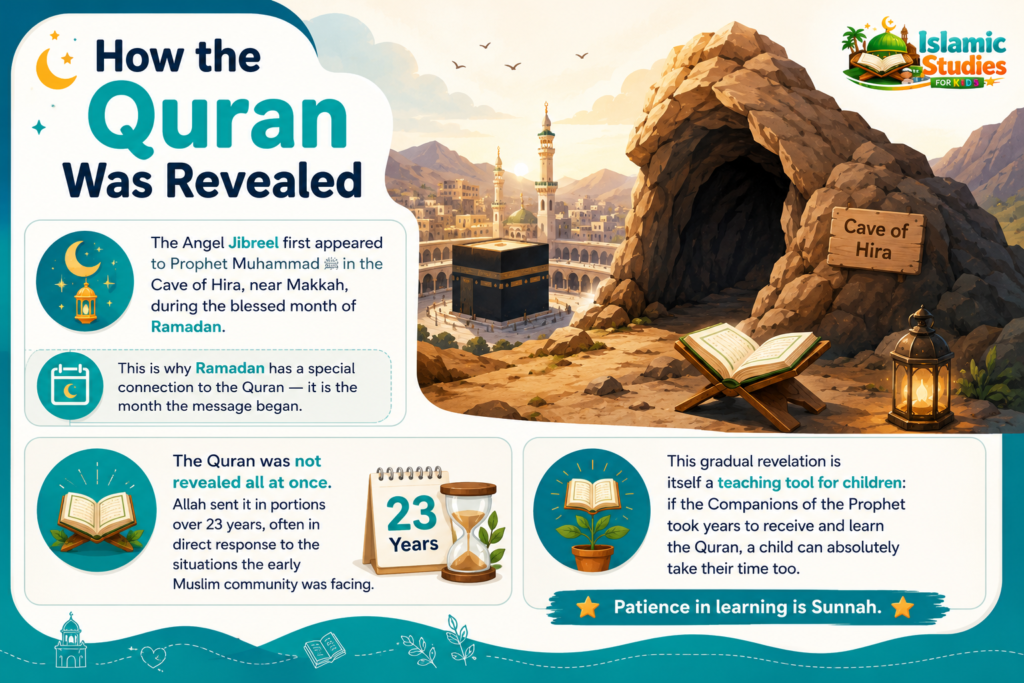
The Angel Jibreel first appeared to Prophet Muhammad ﷺ in the Cave of Hira, near Makkah, during the blessed month of Ramadan. This is why Ramadan has a special connection to the Quran — it is the month the message began.
The Quran was not revealed all at once. Allah sent it in portions over 23 years, often in direct response to the situations the early Muslim community was facing.
This gradual revelation is itself a teaching tool for children: if the Companions of the Prophet took years to receive and learn the Quran, a child can absolutely take their time too. Patience in learning is Sunnah.
3. A Quran Fact for Kids That Always Gets a Reaction
Every Surah in the Quran opens with “Bismillah ir-Rahman ir-Raheem” (In the name of Allah, the Most Gracious, the Most Merciful) — except one. Surah At-Tawbah (chapter 9) is the only Surah without it at the start. Scholars explain this because Surah At-Tawbah was revealed as a declaration, not a blessing. Children aged 7 and above find this detail genuinely surprising and tend to remember it for years.
Read Also: Best Quran Learning Tools for Kids
Experience a Real Classroom
Curious about how we teach? This video offers a glimpse into a real class, showcasing our interactive approach, qualified teachers, and child-friendly learning experience.
Fun & Engaging Islamic Classes for Kids
Start your child’s journey today with interactive lessons designed to make learning Islam loved and easy.
Get Your Child a Free TrialWhy Is the Quran a Miracle?
One of the most important pieces of Quran knowledge for kids is understanding why Muslims trust it completely and why they should feel proud of it.
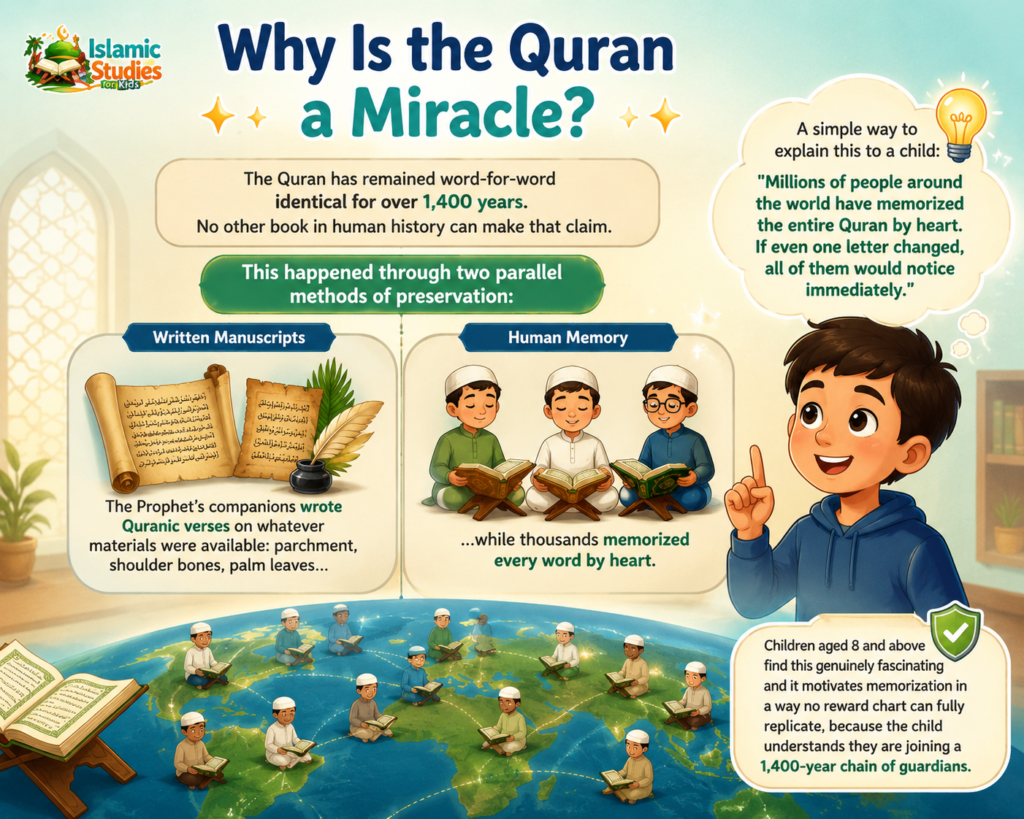
The Quran has remained word-for-word identical for over 1,400 years. No other book in human history can make that claim.
This happened through two parallel methods of preservation: written manuscripts and human memory.
The Prophet’s companions wrote Quranic verses on whatever materials were available: parchment, shoulder bones, palm leaves while thousands memorized every word by heart.
A simple way to explain this to a child: “Millions of people around the world have memorized the entire Quran by heart.
If even one letter changed, all of them would notice immediately.” Children aged 8 and above find this genuinely fascinating and it motivates memorization in a way no reward chart can fully replicate, because the child understands they are joining a 1,400-year chain of guardians.
The University of Birmingham holds some of the oldest known Quranic manuscripts, dated between 568 and 645 CE using radiocarbon analysis — placing them within the lifetime of the Prophet himself.
Quran For Kids Explained Through Values
The Quran is not only a book of worship. It contains guidance on honesty, kindness, patience, caring for parents, and how to treat others well. Children who understand this see the Quran as relevant to their actual lives, not just something recited on Friday.
The most effective way to bring this to life is connecting Quranic values to real moments in your child’s day:
- When your child tells the truth even when it’s hard → “Allah says in the Quran: ‘Be with the truthful ones.’ You just did exactly that.”
- When your child is patient waiting for something → “Allah mentions patience over 90 times in the Quran. He loves it when we are patient.”
- When your child mocks a sibling → “Allah says in the Quran: ‘Do not let one person mock another.’ Let’s remember that.”
This approach called Tarbiyah bil-Quran (raising through the Quran) — turns the book from a recitation exercise into a living guide. Parents who do this consistently report that children develop a personal relationship with the Quran that memorization alone never produces.
Islamic Studies for Kids Academy offers structured online classes that teach children not just how to recite the Quran, but what it means and how it connects to their daily choices — building the whole picture, not just one piece.
Age-By-Age Guide (What To Teach When)
Most guides tell parents to “start early” without explaining what early actually looks like. Here is a practical breakdown based on how children develop at different stages.
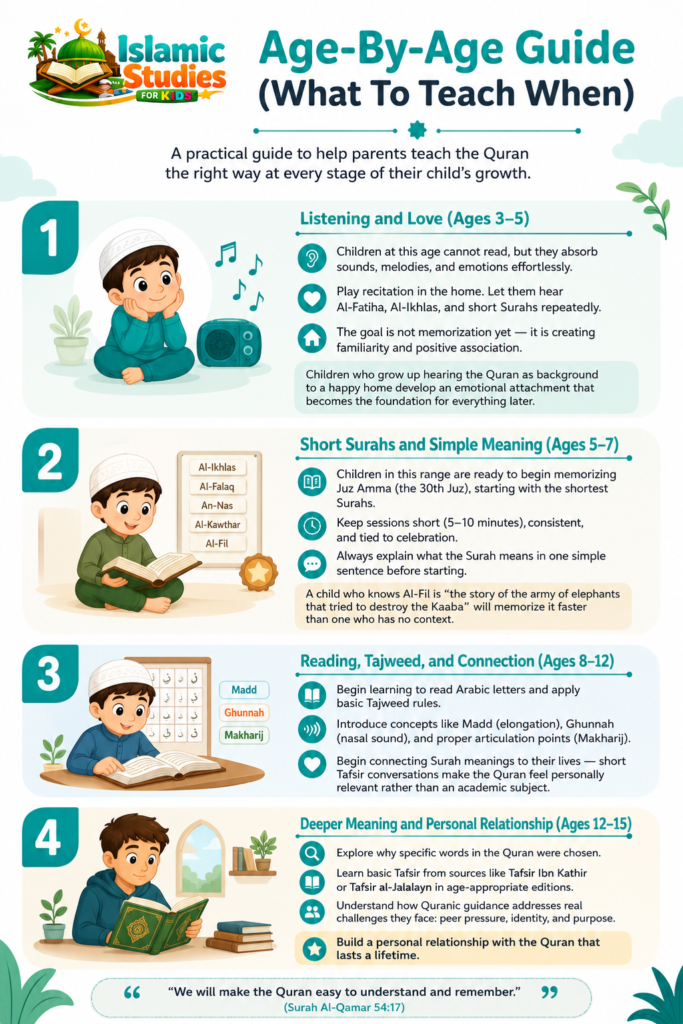
1. Listening and Love (Ages 3–5)
Children at this age cannot read, but they absorb sounds, melodies, and emotions effortlessly. Play recitation in the home.
Let them hear Al-Fatiha, Al-Ikhlas, and short Surahs repeatedly. The goal is not memorization yet — it is creating familiarity and positive association.
Children who grow up hearing the Quran as background to a happy home develop an emotional attachment that becomes the foundation for everything later.
2. Short Surahs and Simple Meaning (Ages 5–7)
Children in this range are ready to begin memorizing Juz Amma (the 30th Juz), starting with the shortest Surahs: Al-Ikhlas, Al-Falaq, An-Nas, Al-Kawthar, Al-Fil. Keep sessions short (5–10 minutes), consistent, and tied to celebration.
A structured starting point like the Noorani Qaida course for Kids Online gives children a proven letter-by-letter foundation before moving into full Surah memorization. Always explain what the Surah means in one simple sentence before starting.
Always explain what the Surah means in one simple sentence before starting. A child who knows Al-Fil is “the story of the army of elephants that tried to destroy the Kaaba” will memorize it faster than one who has no context.
3. Reading, Tajweed, and Connection (Ages 8–12)
At this stage, children can begin learning to read Arabic letters and apply basic Tajweed rules.
Introduce concepts like Madd (elongation), Ghunnah (nasal sound), and proper articulation points (Makharij). through the Tajweed Course for Kids Online, which teaches these rules through age-appropriate activities rather than dry drills.
More importantly, begin connecting Surah meanings to their lives — short Tafsir conversations make the Quran feel personally relevant rather than an academic subject.
4. Deeper Meaning and Personal Relationship (Ages 12–15)
Older children and teenagers benefit from exploring why specific words in the Quran were chosen, learning basic Tafsir from sources like Tafsir Ibn Kathir or Tafsir al-Jalalayn in age-appropriate editions, and understanding how Quranic guidance addresses real challenges they face: peer pressure, identity, and purpose.
Read Also: Benefits Of Reading Quran For Kids
How to Begin Your Child’s Quran Journey?
Starting is the part most parents find hardest. These three steps work regardless of the parent’s own level of Quranic knowledge.
1. Create a consistent listening environment
Before your child reads a single letter, let them hear the Quran every day — during meals, during car rides, before sleep. Familiarity with the sounds of Arabic is the invisible foundation everything else is built on. Reciters like Sheikh Mishary Rashid Al-Afasy and Sheikh Abdul Basit are widely used for children due to their clarity and measured pace.
When your child is ready to move from listening to reading aloud, the Quran Recitation Course for Kids Online builds correct pronunciation from the very first session.
2. Start with Al-Fatiha, explained
Al-Fatiha is seven verses and is recited in every unit of every prayer — meaning a Muslim who prays five times a day recites it at least 17 times daily.
Teach your child what each verse means before asking them to memorize it. Children who understand Al-Fatiha have a personal relationship with the Quran from day one.
For families ready to take memorization further, the Quran Memorization Course for Kids Online provides a structured, teacher-guided path through Juz Amma and beyond.
Read Also: Best Quran Learning Tools For Kids
3. Build a simple routine, not a long one
Five consistent minutes daily outperforms a one-hour session once a week every time. Choose the morning when possible — children’s memory and focus are sharpest after sleep, and starting the day with the Quran creates a positive habit anchor that lasts into adulthood.
If you are not confident in teaching the Quran yourself, a qualified online teacher removes that pressure entirely — your child gets expert guidance while you focus on creating the loving home environment that makes learning stick.
Read Aslo: How to Learn Quran for Kids?
Watch a Sample Lesson from Our Academy
Get a firsthand look at how our students learn Islamic values, Quran, and essential knowledge through engaging and interactive online classes. See why families trust Islamic Studies for Kids Academy.
Fun & Engaging Islamic Classes for Kids
Start your child’s journey today with interactive lessons designed to make learning Islam loved and easy.
Get Your Child a Free TrialGive Your Child the Best Start in Quran Learning
Your child does not need to wait until they are older, or until you feel “ready,” or until you find the perfect method. The best time to start is now, with whatever you have.
Islamic Studies for Kids Academy offers live, one-on-one online Quran classes for children from age 4, taught by qualified, child-specialist teachers who make learning engaging, correct, and genuinely fun.
Here is where your child can begin:
- Noorani Qaida Course for Kids Online: Learn the Arabic alphabet and basic pronunciation from scratch.
- Quran Recitation Course for Kids Online: Read full Surahs correctly with proper fluency and articulation.
- Quran Memorization Course for Kids Online: A structured Hifz path from Juz Amma and beyond.
Our Islamic Studies Courses Include:
- Islamic Studies for Kids
- Islam Basics for Kids (Beginners)
- 5 Pillars of Islam for Kids
- 6 Pillars of Iman (Faith) for Kids
- Salah (Prayer) for Kids
- Wudu for Kids
- Dua for Kids
- Ramadan for Kids
- Zakat & Sadaqah for Kids
- Hajj for Kids
- Aqeedah (Islamic Belief) for Kids
- Islamic Manners & Akhlaq for Kids
- Good Deeds for Kids
- Cleanliness (Taharah) in Islam for Kids
- Angels in Islam for Kids
- Islamic History for Kids
- Seerah (Prophet’s Life) for Kids
- Prophets Stories for Kids
- Islamic Stories & Morals for Kids
- Fiqh for Kids (Islamic Jurisprudence Basics)
- Hadith for Kids
- Quran Tafseer Course for Kids
- Islamic Holidays & Events for Kids
- Islamic Identity for Kids
- Intensive Islamic Course for Kids
Enroll today and give your child the knowledge, values, and confidence to grow as a practicing Muslim with a strong connection to Allah and His teachings.
Conclusion
The Quran is Allah’s direct message to humanity — 114 Surahs, 30 Juz, revealed over 23 years, preserved perfectly for over 1,400 years.
For children, the most important information about the Quran is not the numbers, it is the meaning: this is a book that was sent for them, that guides their daily choices, and that rewards every single letter they read.
The parents who succeed in raising Quran-connected children share one thing: they start with love and meaning before they start with memorization. When a child understands why the Quran matters, everything else follows naturally.
Frequently Asked Questions
These are the questions parents ask most often when introducing the Quran to their children. Whether you are just getting started or looking to deepen your child’s understanding, the answers below give you clear, practical guidance.
1. What is the Quran for kids in simple words?
The Quran is Allah’s message to all humans, revealed to Prophet Muhammad ﷺ through the Angel Jibreel. It contains 114 chapters (Surahs) and teaches people how to live with kindness, honesty, and purpose.
2. At what age should a child start learning the Quran?
Children can begin listening to Quran recitation as early as age 3, and start memorizing short Surahs around age 5. The right age varies by child, but earlier exposure — even before formal learning — builds familiarity with Arabic sounds and creates a natural love for the Quran.
3. What are some fun Quran facts for kids?
The first word revealed was “Iqra” (Read). The shortest Surah is Al-Kawthar with just 3 verses. Surah At-Tawbah is the only chapter not beginning with Bismillah. Millions of people worldwide have memorized the entire Quran by heart. Every letter recited earns ten good deeds.
4. What is the best Surah for kids to memorize first?
Al-Ikhlas (4 verses) is often recommended first because it is short, easy to memorize, and explains the most important concept in Islam — that Allah is One. Al-Fatiha is equally important as it is recited in every prayer.
5. How do I explain the basics of the Quran to my child without making it boring?
Connect the Quran to real moments in your child’s day rather than treating it as a separate “school subject.” Tell the stories of prophets like Musa and Yusuf. Ask your child what they think a verse means. Celebrate every Surah they memorize. The goal is curiosity and love first — perfect recitation comes with time.
6. Does my child need to understand Arabic to learn the Quran?
No. Children learn to recite the Quran in Arabic even without knowing the language — just as children learn national anthems or songs before understanding every word. However, pairing recitation with simple meaning explanations makes learning significantly faster and more meaningful.


Leave a Reply