 Quran
Quran
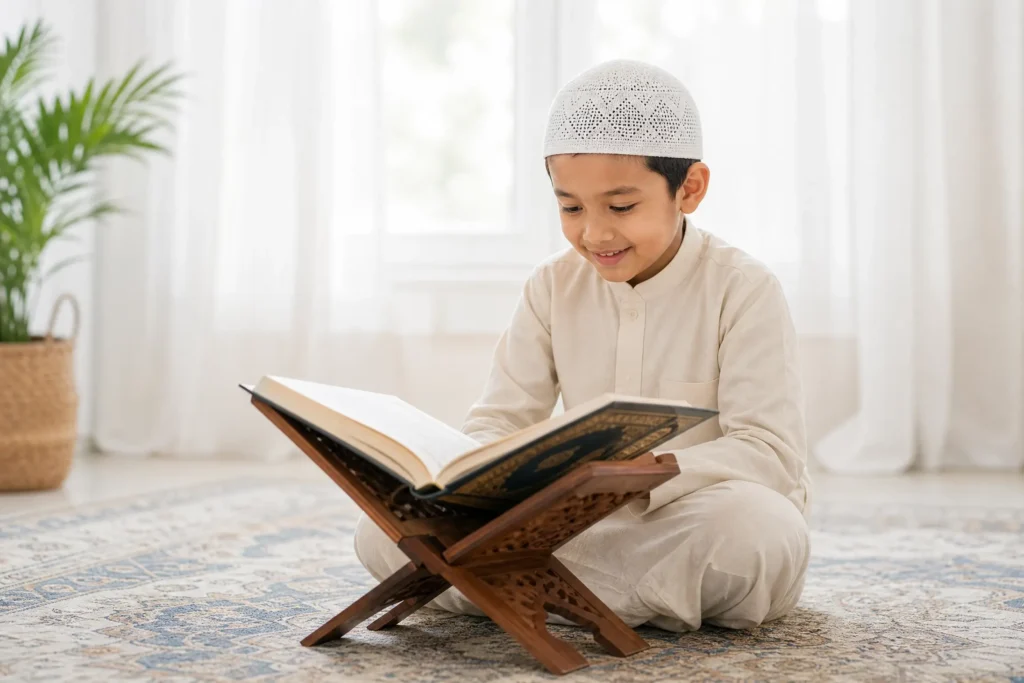
Every Muslim parent shares the same dream — watching their child recite the Quran with confidence, understanding, and love. But turning that dream into a daily habit requires more than good intentions. It requires the right approach, the right timing, and an environment where the Quran feels like a joy, not a chore.
How to learn Quran for kids is one of the most searched questions among Muslim parents today — and for good reason. Children have a window of learning ability between ages 4 and 10 that is, according to modern cognitive research, more than ten times more powerful than what they’ll have as teenagers.
Miss that window, and you’re making the journey much harder. Use it wisely, and you’re giving your child a lifelong gift.
What You’ll Learn in This Article?
- The ideal age to start Quran learning for kids — and why earlier is better.
- How to build a genuine love for the Quran before memorization even begins.
- A practical, step-by-step method for teaching your child a new surah.
- How to handle children who forget quickly or resist sitting still
- What to look for in an online Quran academy for kids.
- Answers to the most common questions parents ask about Quran learning.
A Step-by-Step Method to Learn Quran for Kids
Once your child is ready and motivated, the method matters enormously. Here is a proven, sequential approach used by experienced Quran teachers for young children.
For a deeper dive into the memorization process specifically, see our guide on How to Make Your Child Memorize Quran.
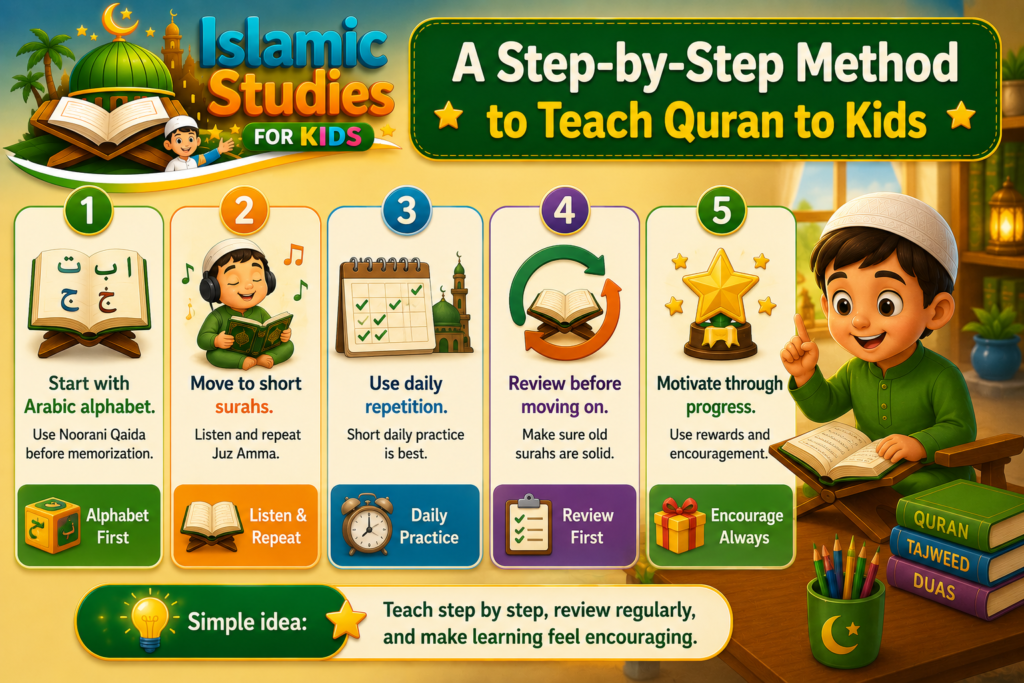
Step 1: Start With the Arabic Alphabet, Not Memorization
Before your child can read Quran independently, they need to recognize the Arabic letters and their sounds.
Use the Noorani Qaida or Qa’idah Baghdadiyyah — both are designed for young children and available with colorful illustrations that make letters feel like characters rather than symbols.
Our Noorani Qaida Course for Kids guides children through this foundation with qualified teachers.
This step takes 4–8 weeks for most children aged 4–6. Don’t rush it. Every mispronounced letter in the alphabet stage becomes a mispronounced word in the memorization stage. Getting pronunciation right at the foundation level saves months of correction later.
Step 2: Move to Short Surahs Through Listening and Repetition
Begin with Juz Amma — the 30th part of the Quran — starting from the shortest surahs (Al-Naas, Al-Falaq, Al-Ikhlas, Al-Kawthar). These have short verses, strong rhythmic patterns, and frequent rhyme endings that make them naturally easy for children to hold in memory.
See our full guide on Juz Amma Memorization for Kids for a surah-by-surah approach.
The method:
- Read one verse clearly and correctly.
- Ask the child to repeat it.
- Read it again together.
- Move to the next verse.
Once two verses are solid, combine them. Build the surah piece by piece until the child can recite it from beginning to end without support.
Step 3: Use Daily Repetition as the Core Tool
Repetition is not a punishment — it is the mechanism of memory. Children’s brains consolidate memory during sleep, which is why a verse that seemed “stuck” in an afternoon session often flows naturally the next morning.
15–20 minutes of daily review is more effective than a 90-minute session twice a week.
At Islamic Studies for Kids Academy, our Quran Memorization Course for Kids uses structured daily repetition with qualified teachers who track each child’s progress personally.
Experience a Real Classroom
Curious about how we teach? This video offers a glimpse into a real class, showcasing our interactive approach, qualified teachers, and child-friendly learning experience.
Fun & Engaging Islamic Classes for Kids
Start your child’s journey today with interactive lessons designed to make learning Islam loved and easy.
Get Your Child a Free TrialStep 4: Build Consistent Review Before Adding New Material
The most common mistake parents and teachers make is adding new surahs before old ones are secure. Schedule one review day per week — ideally Friday or the weekend — where no new material is introduced.
The child recites everything already memorized from beginning to end. Only when old surahs flow without hesitation should new ones be added.
Step 5: Motivate Through Progress, Not Pressure
- Use a simple star chart or sticker board at home — one star per correct daily recitation, a small reward when the chart is full.
- Celebrate completing each surah as a genuine achievement.
- Record your child reciting and play it back to them — children are naturally motivated by hearing their own voice improve.
- Never show frustration when a child forgets — forgetting is normal, even adult Huffadh need regular revision.
The Islamic tradition is clear on this: the one who struggles with the Quran and persists gets two rewards, not fewer.
Quran Learning Methods for Kids Based on Research and Islamic Tradition
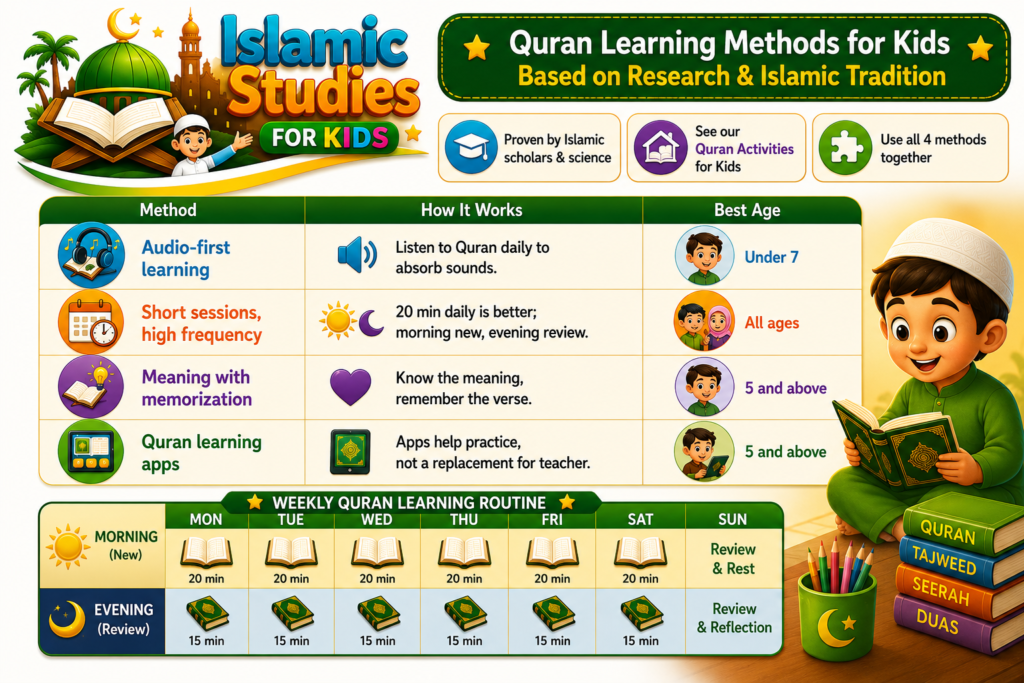
Not all teaching methods are equally effective for young children. The approaches below are consistently supported by both Islamic scholarly tradition and modern cognitive science.
For age-appropriate activities that bring these methods to life at home, see our Quran Activities for Kids guide.
The following four methods work best in combination — no single approach is sufficient on its own.
| Method | How It Works | Best Age |
| Audio-first learning | Play certified recitation (Mishary Al-Afasy, Maher Al-Muaiqly) daily so children absorb Quranic sounds before formal instruction begins | Under 7 |
| Short sessions, high frequency | 20 minutes daily outperforms 2 hours weekly; morning suits new memorization, evening suits review | All ages |
| Meaning alongside memorization | Brief, age-appropriate surah explanations anchor memory — a child who knows the story remembers the verse | 5 and above |
| Quran learning apps | Apps like Al-Mushaf Al-Muallem for kids supplement practice between sessions — they reinforce but cannot replace a qualified teacher | 5 and above |
The Best Time Should a Child Start Learning Quran
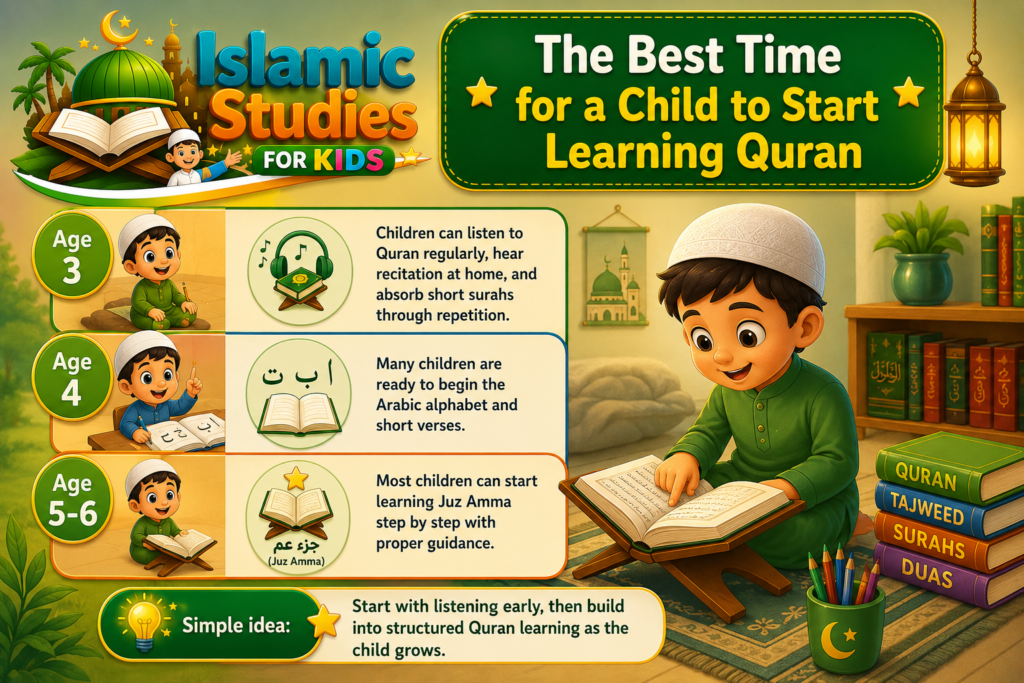
The ideal age to begin Quran learning for kids is between 4 and 5 years old — but the preparation starts before that.
- Children as young as 3 can begin listening to Quran regularly, hearing their parents recite, and picking up short surahs through natural repetition.
- By age 4, many children are ready to begin structured learning of the Arabic alphabet and short verses.
- By age 5 or 6, most children can begin working through Juz Amma systematically with proper guidance — and our Quran Course for Toddlers is specifically designed for this earliest stage.
Read also: Benefits Of Reading Quran For Kids – Why Every Child Should Start Early
5 Steps to Build Your Child’s Love for the Quran Before Memorization Begins
This is the step most parents skip — and it’s the most important one. A child who loves the Quran memorizes it easily. A child who sees it as an obligation resists it at every turn.
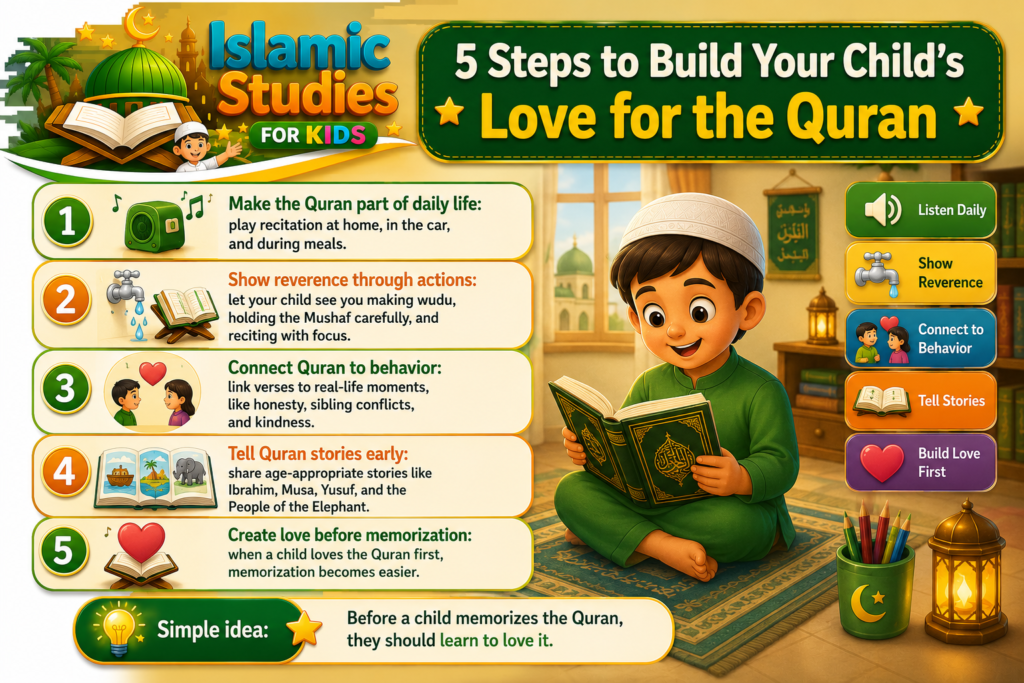
There are four things parents can do at home that shape a child’s relationship with the Quran long before any formal lesson begins.
1. Make the Quran Part of the Air Your Home Breathes
Play Quran recitation in the background during play, in the car, and at meal times. Channels like Dawood Kids TV offer child-friendly recitation with visual engagement.
Children who hear the Quran constantly develop an ear for its rhythms and often begin humming along before they can read a single letter.
Scholars and child development researchers agree: children raised in homes where the Quran is recited regularly memorize faster and retain longer than children who only encounter it in formal lessons.
2. Show Your Child That the Quran Is Sacred — Through Actions, Not Just Words
Children observe everything. When a parent makes wudu before touching the Mushaf, holds it with both hands, places it in a special spot, and recites with focus and reverence — the child registers all of this. They conclude, through observation rather than instruction, that this book is unlike any other.
Don’t just tell your child the Quran is special. Let them watch you treat it that way.
3. Connect the Quran to Everyday Life and Behaviour
When your child tells the truth, mention that Allah says “Be with the truthful.” When they argue with a sibling, recall the verse about believers being brothers.
This is what the scholars of the past called tarbiyah bil-Quran — raising a child through the Quran’s guidance, not just its recitation. Our Islamic Manners and Akhlaq for Kids Course and Good Deeds for Kids Course are built around this same principle — connecting what children learn to how they live.
A child who sees the Quran as a living guide for real situations develops a relationship with it that lasts far beyond their memorization years.
4. Tell Them Stories From the Quran in Age-Appropriate Language
The Quran is full of narratives — Ibrahim in the fire, Musa parting the sea, Yusuf’s patience in the well. These are exactly the kinds of dramatic, meaningful stories that children love.
Tell them before memorization begins. When a child already knows the story of the People of the Elephant (Surah Al-Fil), memorizing those five verses becomes a way to relive a story they already love.
Our Quran Stories Course for Kids brings these narratives to life in a structured, age-appropriate way.
Why It Matters to Learn Quran for Kids?
The Prophet ﷺ said: “«خَيْرُكُمْ مَنْ تَعَلَّمَ الْقُرْآنَ وَعَلَّمَهُ» “, “The best of you are those who learn the Quran and teach it.” That hadith applies to children just as much as adults — and science backs up what our tradition has long understood.
A child who grows up connected to the Quran develops something that classroom subjects alone cannot provide:
- Moral clarity
- Emotional stability
- A relationship with Allah
…..that shapes every decision they’ll make as adults.
Research consistently shows that children who memorize structured text at a young age develop stronger working memory, better focus, and higher academic performance across subjects.
What Quran Learning Does for a Child’s Development?
Quran memorization and recitation builds four dimensions of a child’s development simultaneously — dimensions that most parents don’t realize are connected.
1. Memory and cognitive strength
Memorizing Quranic verses trains the brain’s recall pathways in a structured, musical way. Children who memorize Quran regularly retain information faster across all their studies.
2. Arabic language and pronunciation
Correct Quranic recitation trains the tongue and ear for precise Arabic phonetics — including letters like ع, ح, and ق that don’t exist in English. Children who recite Quran with Tajweed naturally speak Arabic with better accuracy and fluency than peers who study grammar alone.
3. Character and values
A child who understands that Allah says: “كُونُوا مَعَ الصَّادِقِينَ ““Be with the truthful” (9:119) has a moral reference point that no rulebook can replace.
Teaching Quran for kids means teaching them to live its values, not just recite its words. Our Islamic Manners and Akhlaq for Kids Course builds exactly this character foundation alongside Quran learning.
4. Spiritual connection
A child raised hearing beautiful recitation develops a heart that is drawn to the Quran throughout life. That pull is formed young — or it often isn’t formed at all.
Islamic Studies for Kids Academy offers structured, age-appropriate Quran learning programs designed specifically for young children worldwide. Start your child’s free trial today

How to Know If Your Child Is Ready?
Not every 4-year-old is at the same stage. Readiness for Quran learning shows in a few clear signs:
- The child can repeat short phrases accurately after hearing them.
- The child can sit and focus for 10–15 minutes on an engaging activity.
- The child shows curiosity about words and sounds.
If those signs are present, your child is ready — regardless of exact age. Children who start later (ages 7–9) can absolutely learn Quran successfully, but they typically require more structured motivation and consistent routine to build momentum.
Read Also: Information About Quran For Kids
Choosing the Right Online Quran Learning Program for Kids
Online Quran learning for kids has become the preferred choice for many Muslim families — and for good reasons. Children learn from a familiar, comfortable environment.
Parents can observe sessions live. Qualified teachers who specialize in children’s education can be found anywhere in the world without geographical restriction.
a. Key Features of an Effective Online Quran Program
The quality of your child’s experience online depends almost entirely on the instructor. Qualifications in Islamic studies alone are not enough — the teacher must have documented experience working specifically with young children, using engagement methods beyond simple repetition.
Look for the following before enrolling:
- Session lengths of 20–30 minutes for ages 4–7 (not one-hour adult-style lessons).
- Regular written progress reports shared with parents.
- A structured curriculum with clear, measurable milestones.
- A free trial lesson before any financial commitment is required.
- Teachers trained in child development, not just Islamic sciences.
b. The Advantage of 1-on-1 vs. Group Quran Classes for Kids
Both formats work — the right choice depends on your child’s personality and learning style.
- Group classes offer social motivation and healthy competitive spirit — children often memo.rize faster when they see peers progressing alongside them
- Individual (1-on-1) sessions allow the teacher to address each child’s specific pronunciation challenges at their own pace, without other students waiting.
Islamic Studies for Kids Academy offers both individual and group online Quran classes for kids, taught by qualified instructors experienced in child-centered teaching methods.
c. A Note for Mothers Learning Alongside Their Children
Many mothers find that learning Quran together with their child is one of the most powerful motivators for both of them.
When a child sees their mother revising, reciting, and working on her own Tajweed, the message is clear: this is something our family values at every age. Islamic Studies for Kids Academy also offers dedicated:
— so the whole family can grow together.
Read Also: Benefits Of Reading Quran For Kids
Watch a Sample Lesson from Our Academy
Get a firsthand look at how our students learn Islamic values, Quran, and essential knowledge through engaging and interactive online classes. See why families trust Islamic Studies for Kids Academy.
Fun & Engaging Islamic Classes for Kids
Start your child’s journey today with interactive lessons designed to make learning Islam loved and easy.
Get Your Child a Free TrialStart Your Child’s Quran Journey with Islamic Studies for Kids Academy
You’ve read the methods. You know the right age. Now the only question is: who’s going to teach your child?
At Islamic Studies for Kids Academy, every program is built around one conviction — children learn the Quran best when lessons feel like the best part of their day, not the hardest part.
Here’s what your child gets from day one:
- A teacher who speaks their language — experienced with children from English-speaking, non-Arabic households. They know exactly where kids stumble and how to bring them back.
- Lessons built for young attention spans — 20–30 minutes per session. Short enough to end before boredom, long enough to make real progress.
- A complete learning path — from the Arabic alphabet and Noorani Qaida through Quran recitation, Tajweed, and Hifz, with clear milestones at every stage.
- Progress you can see — regular feedback after every session, so you always know where your child stands.

What Graduates Are Saying
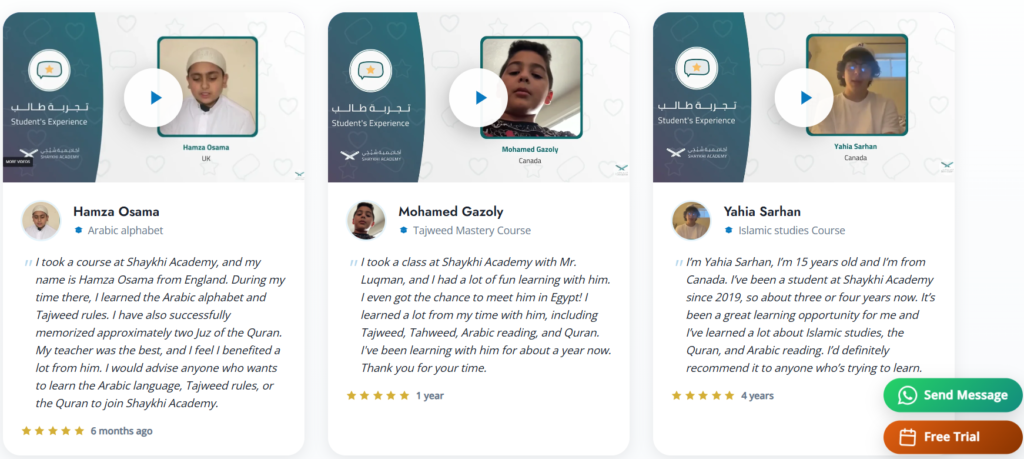
⭐⭐⭐⭐⭐ — [Hamza Osama], [ England ]
“[I took a course at Shaykhi Academy, and my name is Hamza Osama from England. During my time there, I learned the Arabic alphabet and Tajweed rules. I have also successfully memorized approximately two Juz of the Quran. My teacher was the best, and I feel I benefited a lot from him. I would advise anyone who wants to learn the Arabic language, Tajweed rules, or the Quran to join Shaykhi Academy. ]”
⭐⭐⭐⭐⭐ — [Mohamed Gazoly], [Egypt ]
“[I took a class at Shaykhi Academy with Mr. Luqman, and I had a lot of fun learning with him. I even got the chance to meet him in Egypt! I learned a lot from my time with him, including Tajweed, Tahweed, Arabic reading, and Quran. I’ve been learning with him for about a year now. Thank you for your time. ]”
⭐⭐⭐⭐⭐ — [Yahia Sarhan], [Canada ]
“[’m Yahia Sarhan, I’m 15 years old and I’m from Canada. I’ve been a student at Shaykhi Academy since 2019, so about three or four years now. It’s been a great learning opportunity for me and I’ve learned a lot about Islamic studies, the Quran, and Arabic reading. I’d definitely recommend it to anyone who’s trying to learn. ]”
Your Child’s First Lesson Is Free
No commitment. No pressure. One session — so you can see for yourself what the right teaching environment actually looks like for your child.

Our Islamic Studies Courses Include:
- Islamic Studies for Kids
- Islam Basics for Kids (Beginners)
- 5 Pillars of Islam for Kids
- 6 Pillars of Iman (Faith) for Kids
- Salah (Prayer) for Kids
- Wudu for Kids
- Dua for Kids
- Ramadan for Kids
- Zakat & Sadaqah for Kids
- Hajj for Kids
- Aqeedah (Islamic Belief) for Kids
- Islamic Manners & Akhlaq for Kids
- Good Deeds for Kids
- Cleanliness (Taharah) in Islam for Kids
- Angels in Islam for Kids
- Islamic History for Kids
- Seerah (Prophet’s Life) for Kids
- Prophets Stories for Kids
- Islamic Stories & Morals for Kids
- Fiqh for Kids (Islamic Jurisprudence Basics)
- Hadith for Kids
- Quran Tafseer Course for Kids
- Islamic Holidays & Events for Kids
- Islamic Identity for Kids
- Intensive Islamic Course for Kids
Enroll today and give your child the knowledge, values, and confidence to grow as a practicing Muslim with a strong connection to Allah and His teachings.
Conclusion
Teaching Quran to kids is one of the greatest gifts a parent can give — and it is far more achievable than most families realize. The key is starting with love before structure, building the right foundation in Arabic letters and pronunciation, using daily repetition as the primary tool, and connecting the Quran’s meaning to your child’s everyday life.
The method matters, but the environment matters more. A child who sees Quran recitation as part of family life — not a separate obligation — will carry that relationship into adulthood. Start early, be consistent, and seek qualified guidance when you need it.
As the scholars have said: “Teach your child the Quran, and the Quran will teach them everything.”
Frequently Asked Questions About Learning Quran for Kids
Parents come to this topic with many of the same questions — about timing, resistance, online learning, and what to do when things don’t go as planned.
Below are clear, direct answers to the questions asked most often. If you’re also looking to complement your child’s Quran education with Islamic studies, explore our full range of courses for kids.
How Early Can a Child Start Learning the Quran?
Age 4 to 5 is widely considered the ideal starting point for structured Quran learning. At this age, children can recognize the Arabic alphabet, repeat short verses accurately, and begin building the habit of daily recitation.
Children as young as 3 can begin through passive listening and simple verse repetition. Starting later is absolutely possible, but the natural ease of early childhood memorization is strongest in these first years. Our Quran Course for Toddlers is designed specifically for the youngest learners.
How long should a Quran learning session be for young kids?
Sessions of 15 to 20 minutes are most effective for children under 7, and 20 to 30 minutes for children aged 7 to 12. Short, daily sessions produce far better results than long, infrequent ones.
Children’s working memory consolidates during sleep, so a short daily lesson followed by sleep consistently outperforms a longer weekly session.
How do I motivate my child to memorize Quran when they resist?
Never force or punish — this creates lasting negative associations with the Quran. Instead, use a visual reward chart, celebrate each completed surah as a milestone, and make lessons engaging through storytelling, games, and sessions that end before boredom sets in.
Children who understand what they are reciting — even at a basic level — are far more motivated than children reciting sounds they don’t connect to meaning. See also: Tajweed Rules for Kids and Quran Activities for Kids for ways to make learning more interactive.
Can my child learn Quran online effectively?
Yes. Online Quran classes for kids are highly effective when taught by instructors experienced in child pedagogy, using short sessions and interactive methods.
Children aged 5 and above typically adapt well to screen-based learning. The critical factor is teacher quality — not the platform. Look for instructors who provide regular parent feedback and follow a structured curriculum rather than open-ended repetition.
What should I do if my child keeps forgetting what they’ve memorized?
Forgetting is a normal and expected part of memorization — not a sign that your child can’t do it. The solution is consistent review before adding new material. Dedicate one session per week exclusively to revising already-memorized surahs.
Reduce the daily memorization target to a size the child can reliably recall the following morning. Patience here is not passive — it is the active work of trusting a process that takes time.
Should my child learn Tajweed rules while memorizing Quran?
Children should learn correct pronunciation from the very beginning — this is non-negotiable. Formal Tajweed rules (names, categories, and theory) can wait until ages 7–9 when children have more cognitive capacity for rule-based learning.
The practical approach: model correct recitation from a qualified teacher or certified audio source from day one, and the child will naturally absorb Tajweed through imitation before needing to learn the rules formally. Our Tajweed Course for Kids introduces rules progressively in exactly this way.


Leave a Reply