 Quran
Quran
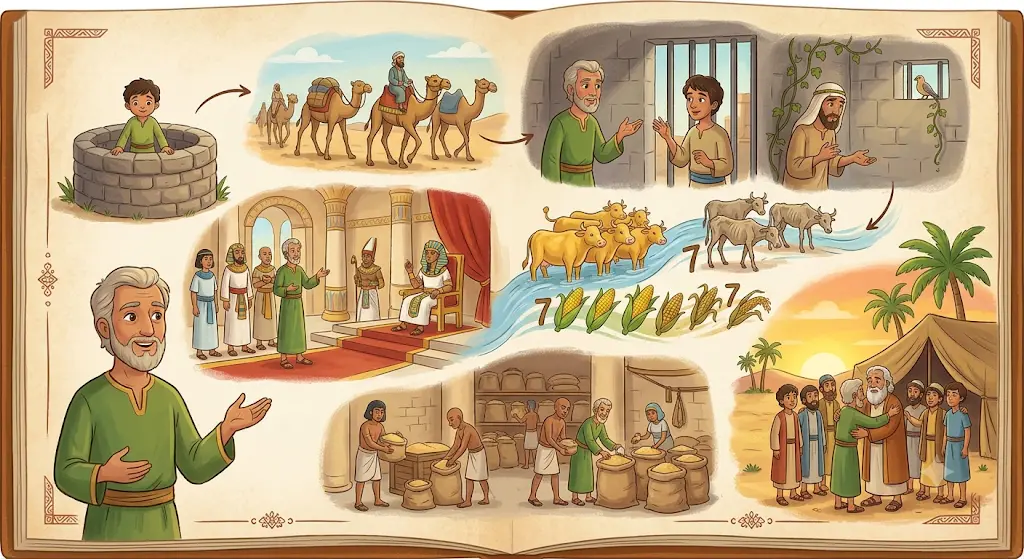
Envy, injustice, patience, forgiveness — the Prophet Yusuf story carries more emotional weight than almost any other story your child will ever hear. And Allah described it, directly in the Quran, as ahsanal qasas — the best of all stories (Surah Yusuf, 12:3).
This is not a fairy tale with a tidy moral at the end. It is a layered, true account of a young boy who faced betrayal by his own family, slavery, false accusation, years in prison — and came out the other side with his faith and character intact. That journey is exactly what makes the Prophet Yusuf story for kids so powerful: children feel every rise and fall, and they learn, without being lectured, that Allah never abandons those who hold on.
This guide walks through the complete story in simple language your child can follow, with lessons you can discuss together at each stage. Whether your child is 5 or 12, this story has something for them.
What You’ll Learn in This Article
- Who Prophet Yusuf (AS) was and where his story appears in the Quran
- The full Prophet Yusuf story told simply for children, chapter by chapter
- The four key trials Yusuf faced and what each one teaches
- Lessons you can discuss with your child after each part of the story
- Frequently asked questions about the story
Who Was Prophet Yusuf (AS)?
Prophet Yusuf (AS) is one of the most beloved prophets in Islam. He was the son of Prophet Yaqub (AS), the grandson of Prophet Ishaq (AS), and the great-grandson of Prophet Ibrahim (AS) — making him part of a family in which Allah placed prophethood in four consecutive generations. That lineage earned him a title rarely given: al-kareem ibn al-kareem ibn al-kareem — the noble son of the noble son of the noble.
His story is told entirely in one surah — Surah Yusuf, the 12th chapter of the Quran — which is unique; no other prophet has an entire surah dedicated solely to their story from beginning to end.
Yusuf had eleven brothers. Two of them — Yusuf and his younger full brother Binyamin — shared the same mother, who passed away when they were young. Their father Yaqub (AS) was especially tender with them because of this. That tenderness, as we will see, became the spark that set everything in motion.

The Dream That Started Everything
One night, young Yusuf saw a remarkable vision in his sleep: eleven stars, and the sun, and the moon — all bowing down to him.
He went to his father and described exactly what he had seen. Yaqub (AS), a prophet himself, immediately understood what it meant: his son would one day be a great man, honoured by those around him, and chosen by Allah for something extraordinary. He interpreted the eleven stars as Yusuf’s eleven brothers, the sun as himself, and the moon as Yusuf’s mother.
Why Did Yaqub Tell Yusuf to Keep the Dream Secret?
Yaqub gave Yusuf a direct instruction: do not tell your brothers what you have seen. He was not being secretive without reason. He knew that his other sons were already struggling with feelings of jealousy toward Yusuf. Hearing that their younger brother had dreamed of them bowing to him would only make that jealousy worse — and Yaqub feared it would lead them to harm Yusuf.
This is the first practical lesson parents can draw from the story: not every truth needs to be shared in every moment. Sharing the wrong thing with the wrong people at the wrong time can cause harm — even when the thing itself is true and good.
The Brothers’ Jealousy and the Plot Against Yusuf
The brothers saw that their father loved Yusuf deeply and gave him special attention. Rather than understanding that a younger child who had lost his mother naturally needed extra care, they felt overlooked. They said among themselves: “Yusuf and his brother are more beloved to our father than us, even though we are a strong group. Our father is clearly mistaken.”
That resentment grew, and Shaytan fed it. They moved from jealousy to a plan to harm their own little brother — something they knew was wrong, yet they told themselves they would repent afterward. This is one of the most important moments for children to hear about: how Shaytan makes a terrible decision feel manageable by convincing us we can just say sorry later.
What Did the Brothers Do?
They went to their father and asked permission to take Yusuf with them for a day of play. Yaqub hesitated — he feared for his son’s safety. But they pressed him, made promises, and eventually he agreed.
Once they were far from home, they took Yusuf’s shirt, threw him into a deep, dark well, and left. Then they killed an animal, smeared its blood on the shirt, and brought it back to Yaqub as “proof” that a wolf had eaten his son.
Here is a detail many retellings skip: Yaqub (AS) was not deceived. He looked at the shirt and noticed it was not torn. A wolf that had attacked and killed a boy would have shredded the shirt. The blood was fake evidence — and the intact shirt gave it away. Yaqub said quietly: “Rather, your souls have tempted you into something. So patience is most fitting. And Allah is the one sought for help against what you describe.” He did not accuse them directly. He kept his grief between himself and Allah.

The Four Trials of Yusuf — A Framework for Children
The story of Prophet Yusuf from this point follows four distinct trials.
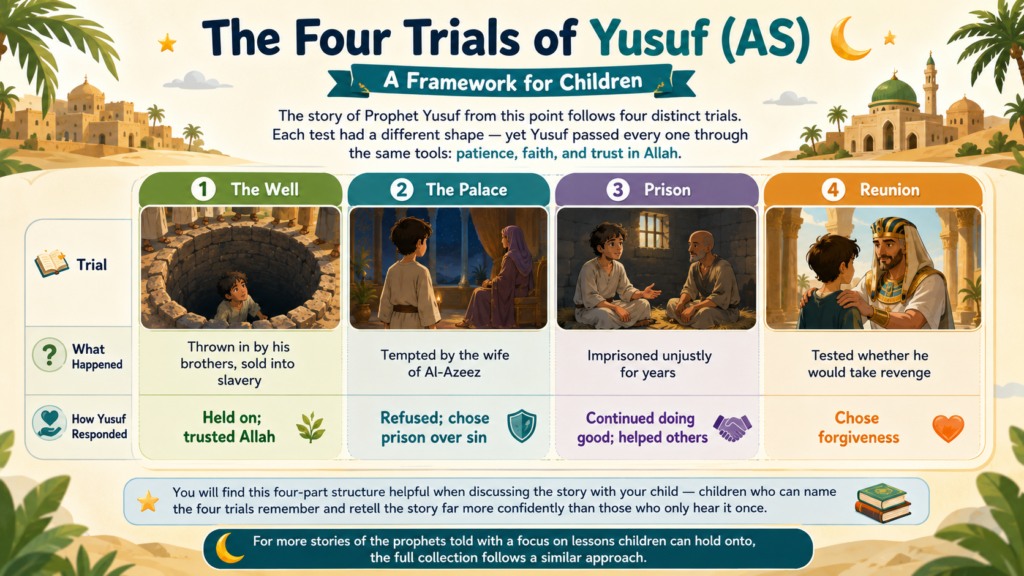
Presenting them this way helps children track the story and understand that each test had a different shape — yet Yusuf passed every one through the same tools: patience, faith, and trust in Allah.
| Trial | What Happened | How Yusuf Responded |
| 1. The Well | Thrown in by his brothers, sold into slavery | Held on; trusted Allah |
| 2. The Palace | Tempted by the wife of Al-Azeez | Refused; chose prison over sin |
| 3. Prison | Imprisoned unjustly for years | Continued doing good; helped others |
| 4. Reunion | Tested whether he would take revenge | Chose forgiveness |
You will find this four-part structure helpful when discussing the story with your child — children who can name the four trials remember and retell the story far more confidently than those who only hear it once.
For more stories of the prophets told with a focus on lessons children can hold onto, the full collection follows a similar approach.
The Prophet Yusuf Story for Kids: The Complete Guide for Parents
A trade caravan traveling toward Egypt stopped near the well. A man lowered a bucket to draw water — and found a boy holding on. He pulled Yusuf up, and the group decided to take him and sell him as a servant in Egypt, where they could get a good price.
Yusuf was sold for a low sum to a powerful man in Egypt known as Al-Azeez — one of the king’s senior ministers. Al-Azeez brought Yusuf home and told his wife to treat him well, sensing that this boy had something special about him.
Read also: The Prophet Yunus Story for Kids: The Man Swallowed by a Whale
Experience a Real Classroom
Curious about how we teach? This video offers a glimpse into a real class, showcasing our interactive approach, qualified teachers, and child-friendly learning experience.
Fun & Engaging Islamic Classes for Kids
Start your child’s journey today with interactive lessons designed to make learning Islam loved and easy.
Get Your Child a Free TrialWhat Happened in the Home of Al-Azeez?
Yusuf grew up in the palace of Al-Azeez. He was given good food, good shelter, and a position of trust. Allah gave him wisdom, knowledge, and outstanding character that showed in everything he said and did.
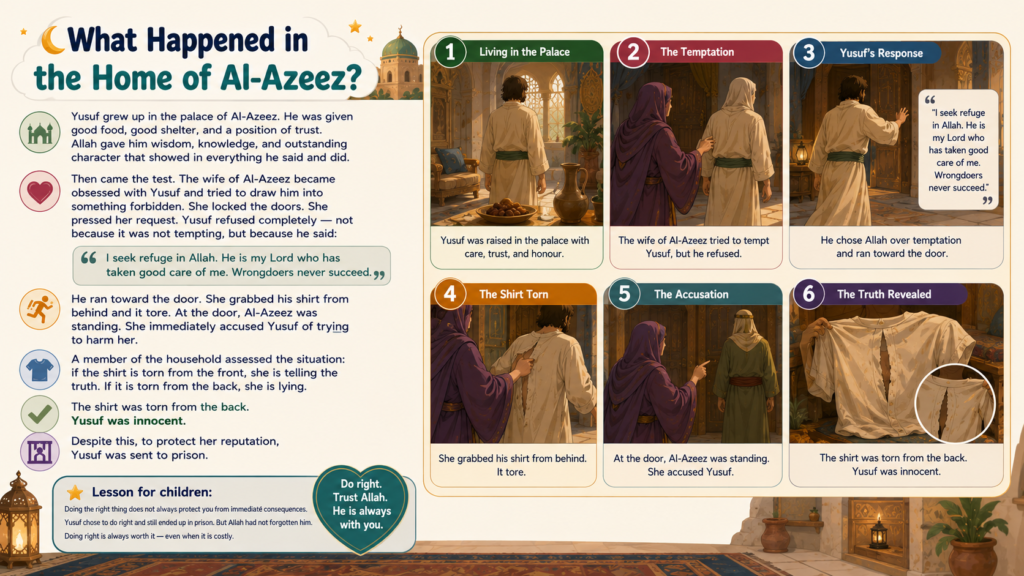
Then came the test. The wife of Al-Azeez became obsessed with Yusuf and tried to draw him into something forbidden. She locked the doors. She pressed her request. Yusuf refused completely — not because it was not tempting, but because he said: “I seek refuge in Allah. He is my Lord who has taken good care of me. Wrongdoers never succeed.”
He ran toward the door. She grabbed his shirt from behind and it tore. At the door, Al-Azeez was standing. She immediately accused Yusuf of trying to harm her. A member of the household assessed the situation: if the shirt is torn from the front, she is telling the truth. If it is torn from the back, she is lying.
The shirt was torn from the back. Yusuf was innocent.
Despite this, to protect her reputation, Yusuf was sent to prison.
Lesson for children: Doing the right thing does not always protect you from immediate consequences. Yusuf chose to do right and still ended up in prison. But Allah had not forgotten him. Doing right is always worth it — even when it is costly.
What Did Yusuf Do in Prison?
Even in prison, Yusuf did not become bitter or withdrawn. He kept calling people to Allah, answering their questions about faith with patience and wisdom, and giving good counsel to those around him.
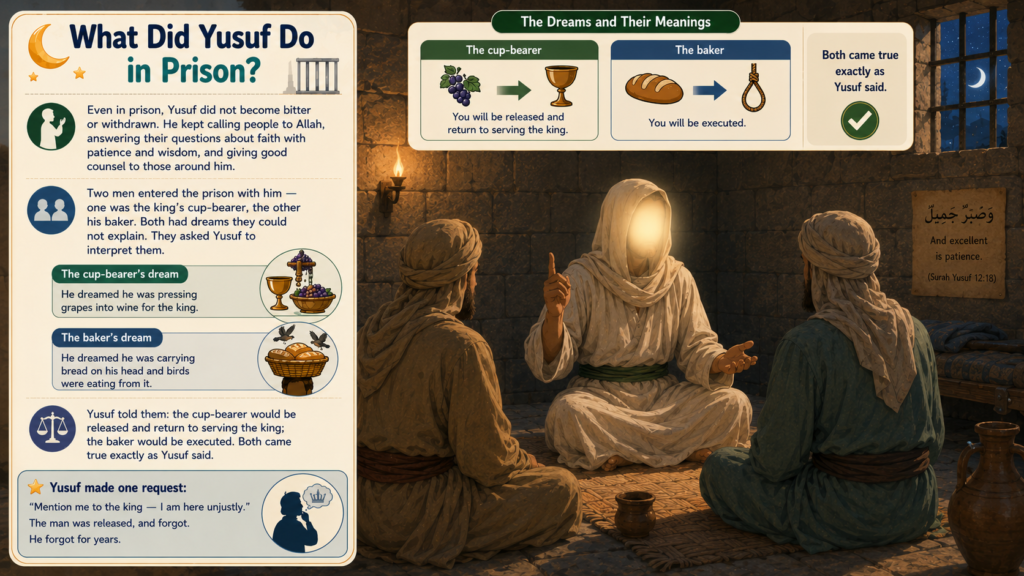
Two men entered the prison with him — one was the king’s cup-bearer, the other his baker. Both had dreams they could not explain. They asked Yusuf to interpret them.
The cup-bearer dreamed he was pressing grapes into wine for the king. The baker dreamed he was carrying bread on his head and birds were eating from it.
Yusuf told them: the cup-bearer would be released and return to serving the king; the baker would be executed. Both came true exactly as Yusuf said.
Before the cup-bearer was released, Yusuf made one request: mention me to the king — I am here unjustly. The man was released, and forgot. He forgot for years.
How Did Yusuf Eventually Leave Prison?
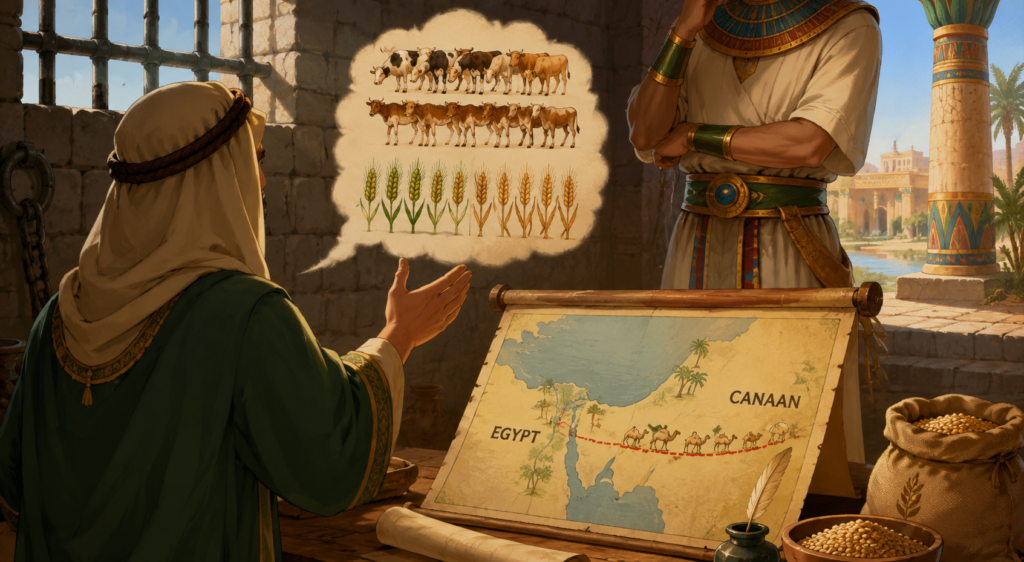
The king of Egypt had a disturbing dream: seven fat cows being devoured by seven thin ones, and seven green stalks of grain and seven dry ones. His advisers could not explain it. The cup-bearer, hearing this, suddenly remembered Yusuf.
He went to the prison and asked Yusuf to interpret the dream. Yusuf explained it precisely: Egypt would have seven years of great harvest, followed by seven years of drought. His practical advice was equally clear — store grain in its stalks during the good years, leaving only what people need to eat, so the reserves last through the drought years.
This is a detail worth pausing on with children: Yusuf was not just a dream interpreter. He immediately offered a solution. He knew what he was capable of, and he used his skill in service of others — even from a prison cell.
How Did Yusuf Rise to Power?
The king sent for Yusuf. But Yusuf refused to leave the prison until his name was cleared publicly. He said, in effect: I will not walk out of here as if I were guilty and simply pardoned. The accusation must be examined and the truth established.
The king questioned the women of the city — including the wife of Al-Azeez. She admitted, in public: “I tried to seduce him, and he was truthful. I was the one who lied.” Yusuf’s innocence was now on record.
Then Yusuf made a move that surprises many readers of this story. He asked the king directly: “Place me in charge of the storehouses of the land. I am a knowing guardian.”
He did not wait to be appointed. He recognized his own abilities and offered them. This is a lesson children benefit from hearing: it is not arrogant to know what you are good at and offer it in service to others.
The king agreed, and Yusuf became effectively the finance minister of Egypt — responsible for managing the food supply of an entire nation. He was given authority, a new name, and full trust.
How Did Yusuf Reunite with His Brothers?
When the famine struck, people came from all surrounding lands to buy grain from Egypt’s stores. Among those who came: ten of Yusuf’s brothers. They did not recognize him — they had last seen him as a small boy in Canaan, and years had passed. Yusuf recognized them immediately.
He gave them their supplies and asked them to bring their youngest brother — Binyamin — on their next visit. They explained their father was an old man who would not easily let Binyamin travel. Yusuf quietly arranged for their payment to be placed back in their bags, so they would have to return.
When they arrived again — this time with Binyamin — Yusuf privately revealed himself to his full brother. He then devised a plan to keep Binyamin in Egypt: a royal measuring cup was placed in Binyamin’s bag. When the caravan was searched, it was found there. By Egyptian law, the person in whose possession stolen goods were found could be held as a servant.
The brothers were devastated. They tried everything to persuade the Egyptian official to take one of them instead. He refused. They returned to Canaan without Binyamin.
Read also: Prophet Musa Story for Kids: Miracles, Lessons & Complete Quranic Guide
What Did the Grief of Yaqub Teach?
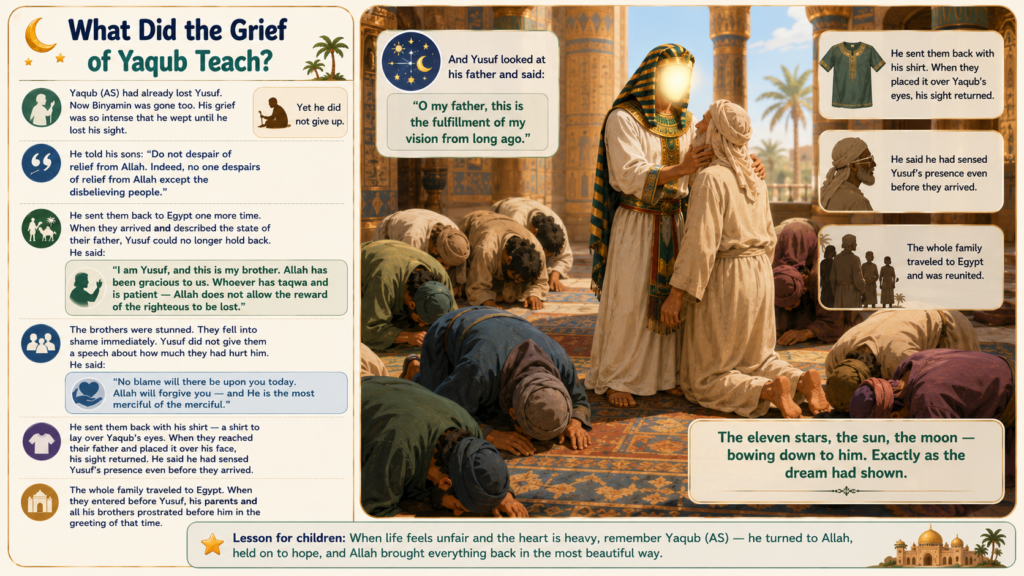
Yaqub (AS) had already lost Yusuf. Now Binyamin was gone too. His grief was so intense that he wept until he lost his sight. Yet he did not give up. He told his sons: “Do not despair of relief from Allah. Indeed, no one despairs of relief from Allah except the disbelieving people.”
He sent them back to Egypt one more time. When they arrived and described the state of their father, Yusuf could no longer hold back. He said: “I am Yusuf, and this is my brother. Allah has been gracious to us. Whoever has taqwa and is patient — Allah does not allow the reward of the righteous to be lost.”
The brothers were stunned. They fell into shame immediately. Yusuf did not give them a speech about how much they had hurt him. He said: “No blame will there be upon you today. Allah will forgive you — and He is the most merciful of the merciful.”
He sent them back with his shirt — a shirt to lay over Yaqub’s eyes. When they reached their father and placed it over his face, his sight returned. He said he had sensed Yusuf’s presence even before they arrived.
The whole family traveled to Egypt. When they entered before Yusuf, his parents and all his brothers prostrated before him in the greeting of that time. And Yusuf looked at his father and said: “O my father, this is the fulfillment of my vision from long ago.”
The eleven stars, the sun, the moon — bowing down to him. Exactly as the dream had shown.
Watch a Sample Lesson from Our Academy
Get a firsthand look at how our students learn Islamic values, Quran, and essential knowledge through engaging and interactive online classes. See why families trust Islamic Studies for Kids Academy.
Start Your Child’s Islamic Learning Journey Today
Your child has just heard one of the greatest stories in human history — and there are dozens more waiting for them in the Quran and Seerah. The stories of Prophet Ibrahim, Prophet Musa, Prophet Isa, and of course the life of Prophet Muhammad ﷺ carry the same depth, the same drama, and the same character-shaping power.
If you want your child to engage with these stories in a structured, age-appropriate Islamic learning environment — with qualified teachers, interactive lessons, and a curriculum designed around how children actually learn — explore the full range of Islamic studies resources for children available here.
[Explore Islamic Studies for Kids — Start Today]

Our Islamic Studies Courses Include:
- Islamic Studies for Kids
- Islam Basics for Kids (Beginners)
- 5 Pillars of Islam for Kids
- 6 Pillars of Iman (Faith) for Kids
- Salah (Prayer) for Kids
- Wudu for Kids
- Dua for Kids
- Ramadan for Kids
- Zakat & Sadaqah for Kids
- Hajj for Kids
- Aqeedah (Islamic Belief) for Kids
- Islamic Manners & Akhlaq for Kids
- Good Deeds for Kids
- Cleanliness (Taharah) in Islam for Kids
- Angels in Islam for Kids
- Islamic History for Kids
- Seerah (Prophet’s Life) for Kids
- Prophets Stories for Kids
- Islamic Stories & Morals for Kids
- Fiqh for Kids (Islamic Jurisprudence Basics)
- Hadith for Kids
- Quran Tafseer Course for Kids
- Islamic Holidays & Events for Kids
- Islamic Identity for Kids
- Intensive Islamic Course for Kids
Enroll today and give your child the knowledge, values, and confidence to grow as a practicing Muslim with a strong connection to Allah and His teachings.
Fun & Engaging Islamic Classes for Kids
Start your child’s journey today with interactive lessons designed to make learning Islam loved and easy.
Get Your Child a Free TrialConclusion
The Prophet Yusuf story is not just a story about a prophet. It is a story about what happens when a person keeps their faith through four different kinds of pain: betrayal by family, temptation, injustice, and the long wait for relief that seems like it will never come.
Yusuf did not become bitter. He did not take revenge when he finally had the power to do so. He forgave people who had done him serious harm, and he credited everything — his freedom, his authority, his reunion with his family — to Allah alone.
That is what makes the Prophet Yusuf story for kids so important to share early. Children who grow up knowing this story have a model for patience that is not passive, for faith that survives real difficulty, and for forgiveness that is not weakness. It is arguably the most complete single-story character education a child can receive in Islamic tradition.
Frequently Asked Questions
Where is the Prophet Yusuf story found in the Quran?
The Prophet Yusuf story is told in Surah Yusuf — the 12th chapter of the Quran. It is the only surah dedicated entirely to one prophet’s story from beginning to end, and Allah describes it in the surah’s opening verses as “the best of stories.”
How many brothers did Prophet Yusuf have?
Prophet Yusuf had eleven brothers in total. Ten of them were half-brothers, and one — Binyamin — was his full brother, sharing both the same father (Yaqub AS) and the same mother.
Why did Prophet Yusuf end up in prison?
Yusuf was sent to prison after refusing the advances of the wife of Al-Azeez, his master in Egypt. When she could not convince him, she falsely accused him of wrongdoing to protect herself. Despite evidence of his innocence — his shirt was torn from the back, not the front — he was imprisoned to avoid a public scandal.
What is the lesson of the Prophet Yusuf story for kids?
The core lesson is that sabr (patience) combined with taqwa (God-consciousness) produces a life of dignity, even through great suffering. Yusuf’s story also teaches children about the dangers of jealousy, the importance of resisting temptation, and the power of forgiveness over revenge.
How long was Prophet Yusuf in prison?
Most Islamic scholars place the length of Yusuf’s imprisonment at between seven and fourteen years, based on the timeline described in Surah Yusuf and narrations from the companions of the Prophet ﷺ. The Quran refers to it as “a number of years” (biḍʿa sinīn — which in classical Arabic means between three and nine, though scholars extend the estimate based on contextual evidence).
What age is the Prophet Yusuf story appropriate for?
The basic narrative — the dream, the brothers, the well, the reunion — is suitable for children from age 5 upward. The details around the wife of Al-Azeez can be introduced simply as “a woman in the house tried to get Yusuf to do something wrong and he refused” for young children, with fuller context given to children aged 10 and above. The emotional and moral depth of the story grows with the child.



Leave a Reply