 Quran
Quran

Every child loves a story with adventure, impossible odds, and a hero who never gives up. The prophet Musa story for kids has all of that — plus something even more powerful: it’s true, it’s Quranic, and every single twist in it was planned by Allah.
Musa (peace be upon him) is the most-mentioned prophet in the Quran — named 136 times across more than 30 surahs. That alone tells you how important this story is. From a baby placed in a basket on the Nile, to a man who split the sea with his staff, his life is one long lesson in what happens when you trust Allah completely.
This guide walks through the prophet Musa story for kids in clear, connected stages, with Quranic verses, child-friendly explanations, and lessons parents can discuss at home.
What You’ll Learn in This Article
- How baby Musa was saved from Pharaoh’s cruelty
- Why Musa fled Egypt and what happened in Madyan
- How Allah spoke to Musa at the sacred valley
- The miracles Allah gave Musa to face Pharaoh
- The miracle of the parting sea — and what it teaches children
- The lessons from the golden calf and Mount Sinai
- Key Islamic lessons every child can take from this story
The Prophet Musa Story for Kids: Phase by Phase
The story of Prophet Musa for kids is not a single event — it is a complete life journey with eight major turning points, each carrying a distinct lesson. Understanding it in phases helps children follow and remember it far better than hearing it all at once.
Phase 1: A Brave Mother Places Her Baby in the Nile
Baby Musa was born at one of history’s darkest moments. Pharaoh, the tyrant ruler of Egypt, had ordered that every newborn Israelite boy be killed — driven by a prophecy that a boy from Bani Israel would one day end his reign.
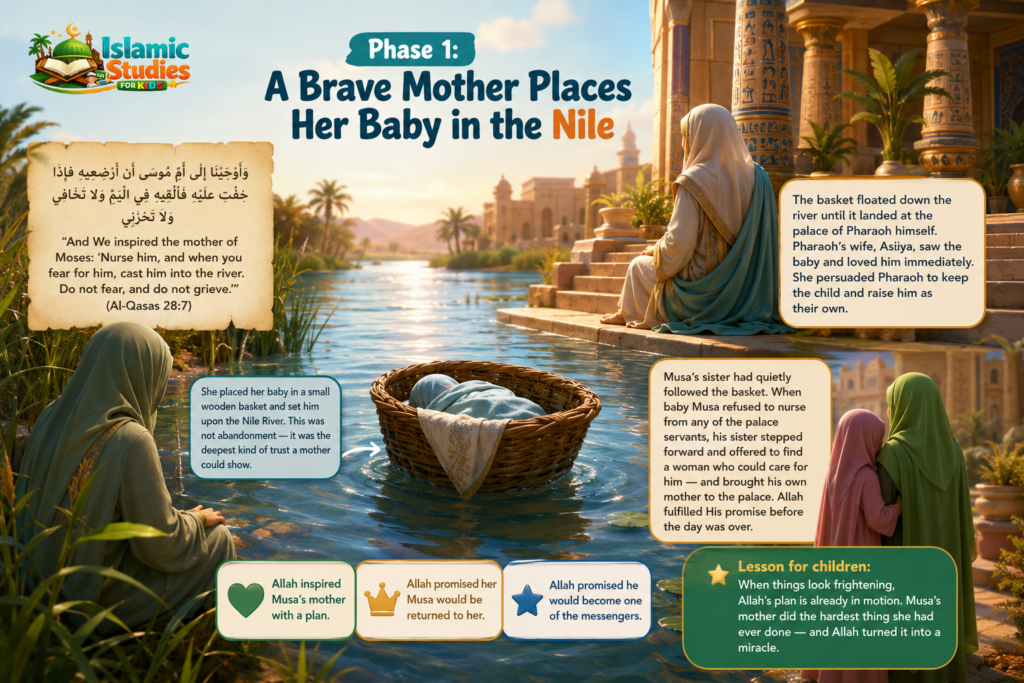
Musa’s mother was terrified. But Allah inspired her directly with a plan:
وَأَوْحَيْنَا إِلَىٰ أُمِّ مُوسَىٰ أَنْ أَرْضِعِيهِ فَإِذَا خِفْتِ عَلَيْهِ فَأَلْقِيهِ فِي الْيَمِّ وَلَا تَخَافِي وَلَا تَحْزَنِي
“And We inspired the mother of Moses: ‘Nurse him, and when you fear for him, cast him into the river. Do not fear, and do not grieve.'” — (Al-Qasas 28:7)
She placed her baby in a small wooden basket and set him upon the Nile River. This was not abandonment — it was the deepest kind of trust a mother could show. Allah promised her two things in that same verse: Musa would be returned to her, and he would become one of the messengers.
The basket floated down the river until it landed at the most unexpected place: the palace of Pharaoh himself — the very man who had ordered every Israelite boy’s death. Pharaoh’s wife, Asiya, a righteous woman unlike her cruel husband, saw the baby and loved him immediately. She persuaded Pharaoh to keep the child and raise him as their own.
Musa’s sister had quietly followed the basket. When baby Musa refused to nurse from any of the palace servants, his sister stepped forward and offered to find a woman who could care for him — and brought his own mother to the palace. Allah fulfilled His promise before the day was over.
Lesson for children: When things look frightening, Allah’s plan is already in motion. Musa’s mother did the hardest thing she had ever done — and Allah turned it into a miracle.
Phase 2: Musa Grows Up and Flees Egypt
Musa grew up inside Pharaoh’s palace, gifted by Allah with wisdom and strength. One day, he witnessed an Egyptian man attacking an Israelite and stepped in to help. He struck the Egyptian — and the man died.
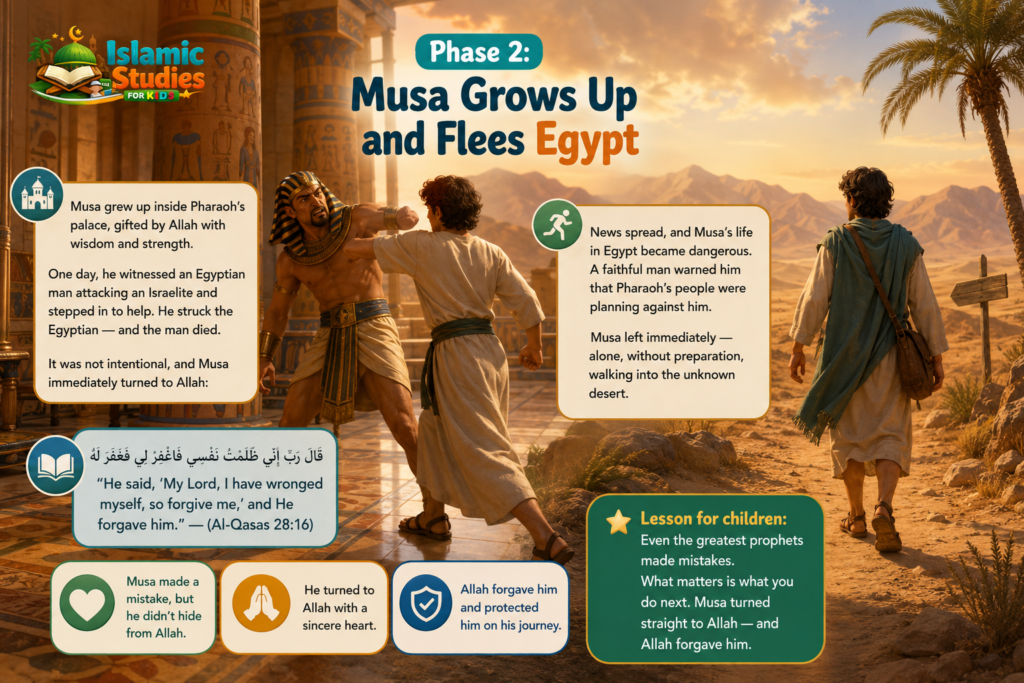
It was not intentional, and Musa immediately turned to Allah:
قَالَ رَبِّ إِنِّي ظَلَمْتُ نَفْسِي فَاغْفِرْ لِي فَغَفَرَ لَهُ
“He said, ‘My Lord, I have wronged myself, so forgive me,’ and He forgave him.” — (Al-Qasas 28:16)
News spread, and Musa’s life in Egypt became dangerous. A faithful man warned him that Pharaoh’s people were planning against him. Musa left immediately — alone, without preparation, walking into the unknown desert.
Lesson for children: Even the greatest prophets made mistakes. What matters is what you do next. Musa turned straight to Allah — and Allah forgave him.
Phase 3: Kindness in the Desert Changes Everything
Musa walked until he reached Madyan, exhausted and far from home. He found a well crowded with men watering their animals, and nearby two young women waiting patiently with their flock, unable to push through the crowd. Without being asked, Musa helped them draw water.
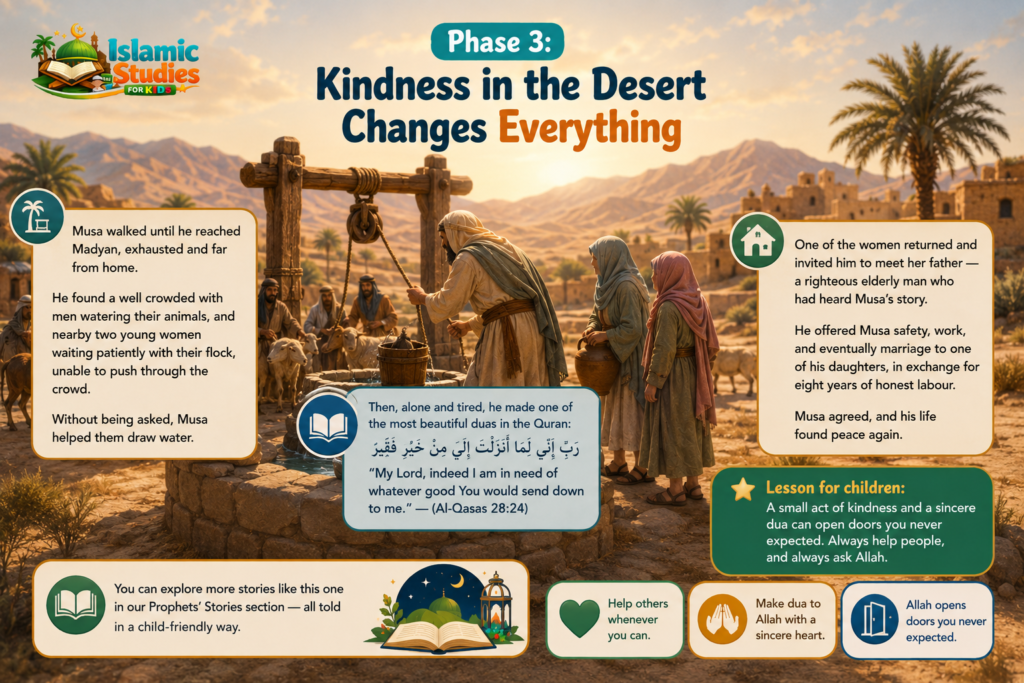
Then, alone and tired, he made one of the most beautiful duas in the Quran:
رَبِّ إِنِّي لِمَا أَنزَلْتَ إِلَيَّ مِنْ خَيْرٍ فَقِيرٌ
“My Lord, indeed I am in need of whatever good You would send down to me.” — (Al-Qasas 28:24)
One of the women returned and invited him to meet her father — a righteous elderly man who had heard Musa’s story. He offered Musa safety, work, and eventually marriage to one of his daughters, in exchange for eight years of honest labour. Musa agreed, and his life found peace again.
Lesson for children: A small act of kindness and a sincere dua can open doors you never expected. Always help people, and always ask Allah.
You can explore more stories like this one in our Prophets’ Stories section — all told in a child-friendly way.
Phase 4: Allah Speaks to Musa at the Sacred Valley
Years passed in Madyan. Then came the night that changed everything. Travelling back toward Egypt with his family, Musa saw a fire in the distance and went to investigate, hoping to bring back a burning branch for warmth.
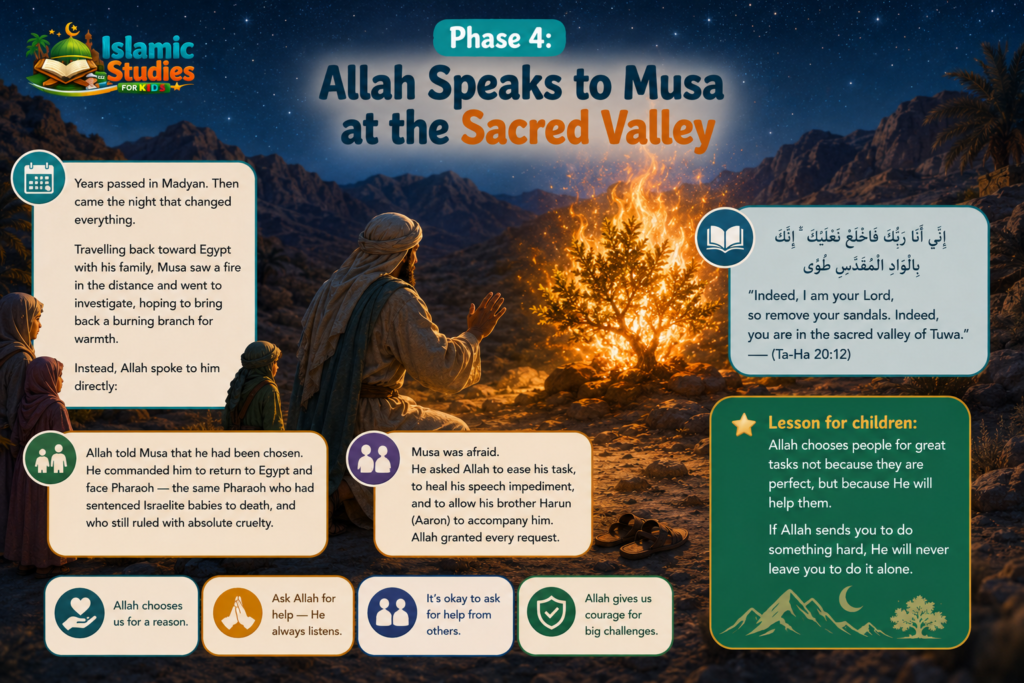
Instead, Allah spoke to him directly:
إِنِّي أَنَا رَبُّكَ فَاخْلَعْ نَعْلَيْكَ ۖ إِنَّكَ بِالْوَادِ الْمُقَدَّسِ طُوًى
“Indeed, I am your Lord, so remove your sandals. Indeed, you are in the sacred valley of Tuwa.” — (Ta-Ha 20:12)
Allah told Musa that he had been chosen. He commanded him to return to Egypt and face Pharaoh — the same Pharaoh who had sentenced Israelite babies to death, and who still ruled with absolute cruelty.
Musa was afraid. He asked Allah to ease his task, to heal his speech impediment, and to allow his brother Harun (Aaron) to accompany him. Allah granted every request.
Lesson for children: Allah chooses people for great tasks not because they are perfect, but because He will help them. If Allah sends you to do something hard, He will never leave you to do it alone.
Phase 5: Musa Stands Before Pharaoh
Musa and Harun arrived at Pharaoh’s court and called him to worship Allah alone and free the Children of Israel. Pharaoh laughed. He called Musa a liar and a magician.
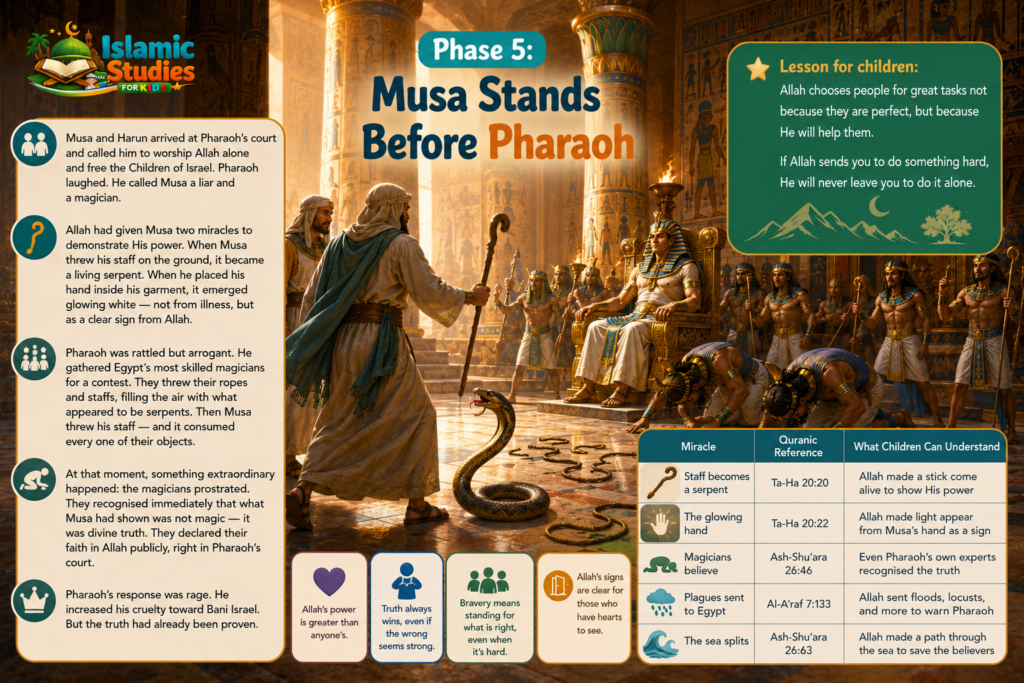
Allah had given Musa two miracles to demonstrate His power. When Musa threw his staff on the ground, it became a living serpent. When he placed his hand inside his garment, it emerged glowing white — not from illness, but as a clear sign from Allah.
Pharaoh was rattled but arrogant. He gathered Egypt’s most skilled magicians for a contest. They threw their ropes and staffs, filling the air with what appeared to be serpents. Then Musa threw his staff — and it consumed every one of their objects.
At that moment, something extraordinary happened: the magicians prostrated. They recognised immediately that what Musa had shown was not magic — it was divine truth. They declared their faith in Allah publicly, right in Pharaoh’s court.
Pharaoh’s response was rage. He increased his cruelty toward Bani Israel. But the truth had already been proven.
Read also: The Prophet Yunus Story for Kids: The Man Swallowed by a Whale
Experience a Real Classroom
Curious about how we teach? This video offers a glimpse into a real class, showcasing our interactive approach, qualified teachers, and child-friendly learning experience.
Fun & Engaging Islamic Classes for Kids
Start your child’s journey today with interactive lessons designed to make learning Islam loved and easy.
Get Your Child a Free Trial| Miracle | Quranic Reference | What Children Can Understand |
| Staff becomes a serpent | Ta-Ha 20:20 | Allah made a stick come alive to show His power |
| The glowing hand | Ta-Ha 20:22 | Allah made light appear from Musa’s hand as a sign |
| Magicians believe | Ash-Shu’ara 26:46 | Even Pharaoh’s own experts recognised the truth |
| Plagues sent to Egypt | Al-A’raf 7:133 | Allah sent floods, locusts, and more to warn Pharaoh |
| The sea splits | Ash-Shu’ara 26:63 | Allah made a path through the sea to save the believers |
Phase 6: The Parting of the Sea
Pharaoh refused every warning. Allah sent plagues — famine, locusts, floods, and more — each time with the same result: the Egyptians would beg Musa to ask Allah to stop the punishment, and when it lifted, they returned to their oppression.
Finally, Allah commanded Musa to lead Bani Israel out of Egypt by night. When Pharaoh discovered their departure, he pursued them with his entire army.
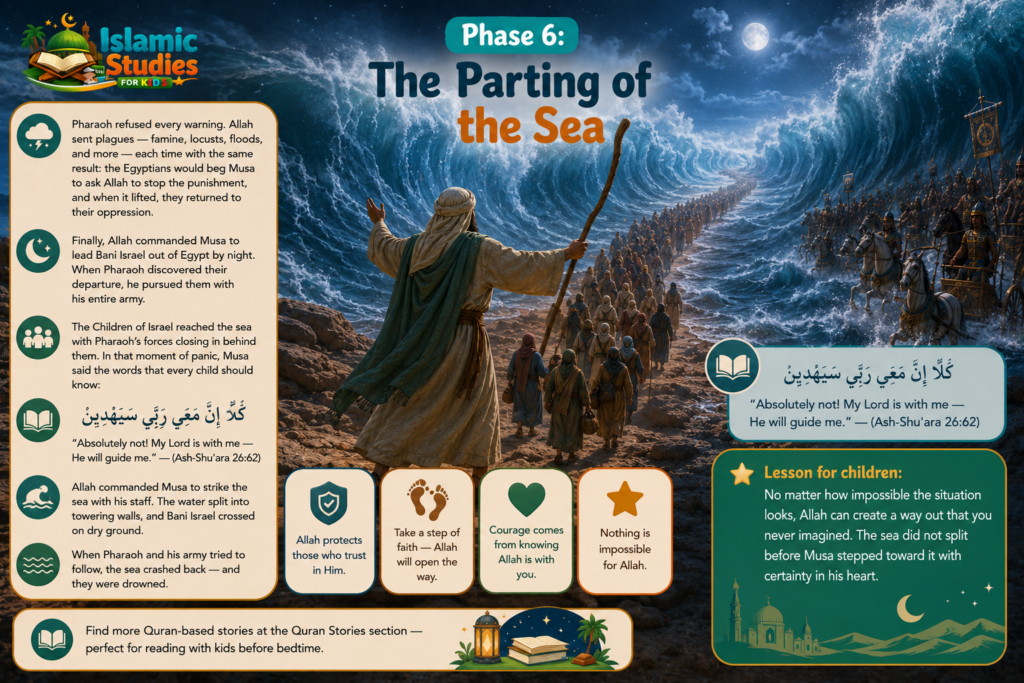
The Children of Israel reached the sea with Pharaoh’s forces closing in behind them. In that moment of panic, Musa said the words that every child should know:
كَلَّا ۖ إِنَّ مَعِيَ رَبِّي سَيَهْدِين
“Absolutely not! My Lord is with me — He will guide me.” — (Ash-Shu’ara 26:62)
Allah commanded Musa to strike the sea with his staff. The water split into towering walls, and Bani Israel crossed on dry ground. When Pharaoh and his army tried to follow, the sea crashed back — and they were drowned.
Lesson for children: No matter how impossible the situation looks, Allah can create a way out that you never imagined. The sea did not split before Musa stepped toward it with certainty in his heart.
Find more Quran-based stories at the Quran Stories section — perfect for reading with kids before bedtime.
Phase 7: Mount Sinai and the Torah
After the crossing, Allah called Musa to Mount Sinai for forty days, during which He revealed the Torah — a book of guidance and law for the Children of Israel.
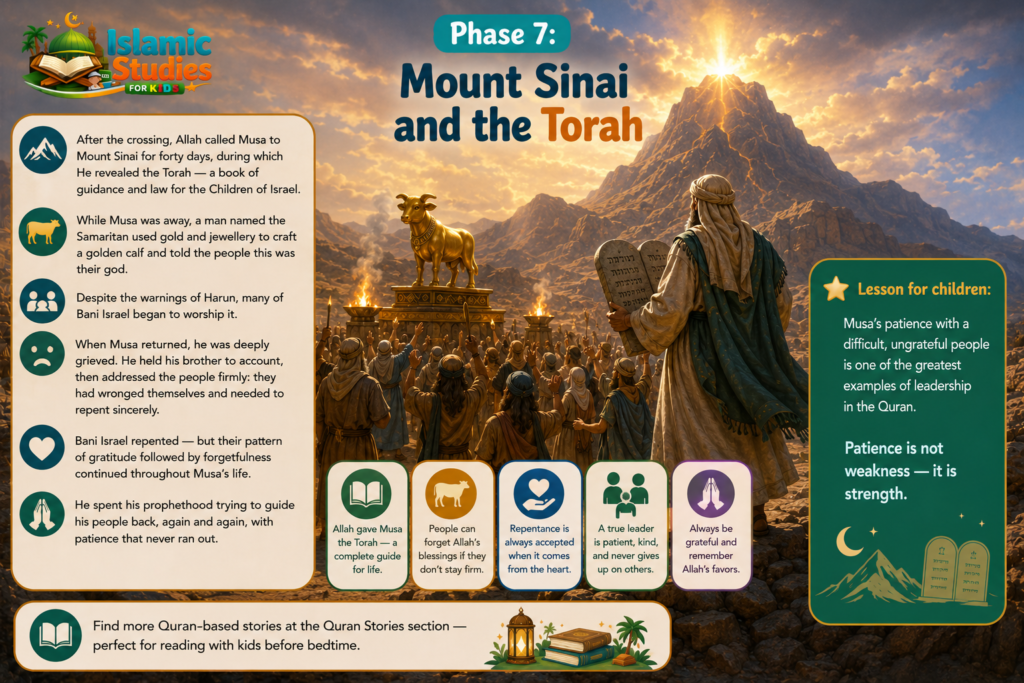
While Musa was away, a man named the Samaritan used gold and jewellery to craft a golden calf and told the people this was their god. Despite the warnings of Harun, many of Bani Israel began to worship it. When Musa returned, he was deeply grieved. He held his brother to account, then addressed the people firmly: they had wronged themselves and needed to repent sincerely.
Bani Israel repented — but their pattern of gratitude followed by forgetfulness continued throughout Musa’s life. He spent his prophethood trying to guide his people back, again and again, with patience that never ran out.
Lesson for children: Musa’s patience with a difficult, ungrateful people is one of the greatest examples of leadership in the Quran. Patience is not weakness — it is strength.
Key Lessons from the Prophet Musa Story for Kids
The musa story quran for kids is not just a history lesson — it is a practical guide to how a Muslim child can live. Each phase of the story maps directly onto challenges children face every day.
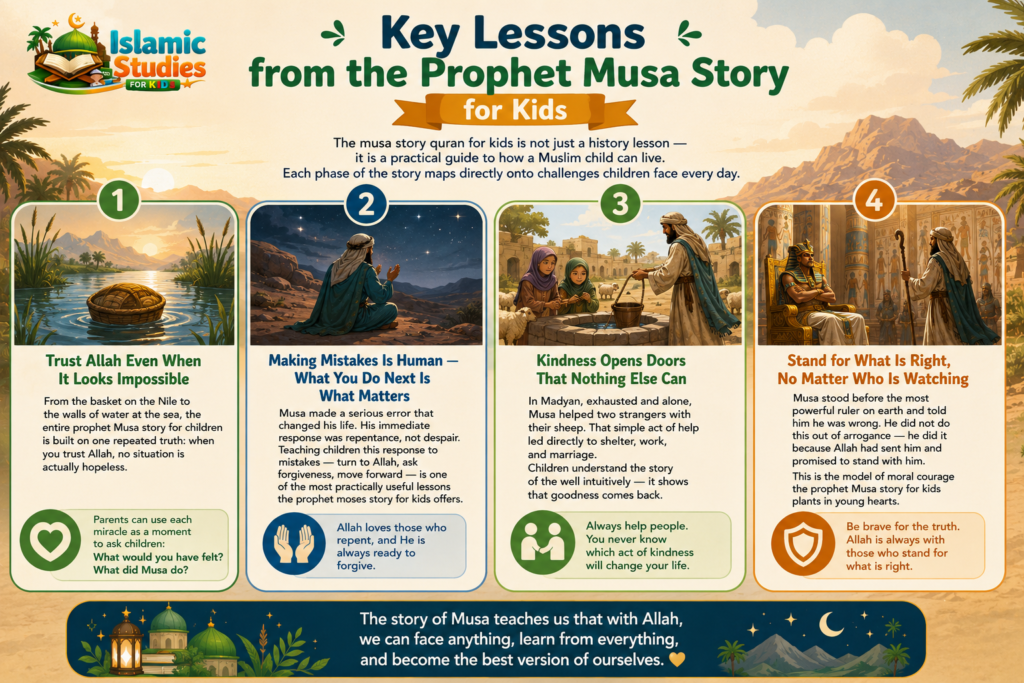
Trust Allah Even When It Looks Impossible
From the basket on the Nile to the walls of water at the sea, the entire prophet Musa story for children is built on one repeated truth: when you trust Allah, no situation is actually hopeless. Parents can use each miracle as a moment to ask children: What would you have felt? What did Musa do?
Making Mistakes Is Human — What You Do Next Is What Matters
Musa made a serious error that changed his life. His immediate response was repentance, not despair. Teaching children this response to mistakes — turn to Allah, ask forgiveness, move forward — is one of the most practically useful lessons the prophet moses story for kids offers.
Kindness Opens Doors That Nothing Else Can
In Madyan, exhausted and alone, Musa helped two strangers with their sheep. That simple act of help led directly to shelter, work, and marriage. Children understand the story of the well intuitively — it shows that goodness comes back.
Stand for What Is Right, No Matter Who Is Watching
Musa stood before the most powerful ruler on earth and told him he was wrong. He did not do this out of arrogance — he did it because Allah had sent him and promised to stand with him. This is the model of moral courage the prophet Musa story for kids plants in young hearts.
Read also: The Prophet Yusuf Story for Kids: The Complete Guide for Parents
Watch a Sample Lesson from Our Academy
Get a firsthand look at how our students learn Islamic values, Quran, and essential knowledge through engaging and interactive online classes. See why families trust Islamic Studies for Kids Academy.
Start Your Child’s Journey with the Prophets’ Stories
If the prophet Musa story has captured your child’s attention, there are twenty-four other prophets mentioned in the Quran — each with equally extraordinary stories. The best time to introduce them is now, while your child is curious and their love of stories is strongest.
Every prophet’s story carries a different lesson — patience, gratitude, courage, forgiveness. At Islamic Studies for Kids Academy, children ages 4–15 learn these stories through engaging, interactive sessions delivered by Al-Azhar certified tutors who know exactly how to bring them alive for young minds.
Start with the prophets your child already knows by name, then let their curiosity lead the way.
[Book your child’s free trial lesson today →]

Our Islamic Studies Courses Include:
- Islamic Studies for Kids
- Islam Basics for Kids (Beginners)
- 5 Pillars of Islam for Kids
- 6 Pillars of Iman (Faith) for Kids
- Salah (Prayer) for Kids
- Wudu for Kids
- Dua for Kids
- Ramadan for Kids
- Zakat & Sadaqah for Kids
- Hajj for Kids
- Aqeedah (Islamic Belief) for Kids
- Islamic Manners & Akhlaq for Kids
- Good Deeds for Kids
- Cleanliness (Taharah) in Islam for Kids
- Angels in Islam for Kids
- Islamic History for Kids
- Seerah (Prophet’s Life) for Kids
- Prophets Stories for Kids
- Islamic Stories & Morals for Kids
- Fiqh for Kids (Islamic Jurisprudence Basics)
- Hadith for Kids
- Quran Tafseer Course for Kids
- Islamic Holidays & Events for Kids
- Islamic Identity for Kids
- Intensive Islamic Course for Kids
Enroll today and give your child the knowledge, values, and confidence to grow as a practicing Muslim with a strong connection to Allah and His teachings.
Fun & Engaging Islamic Classes for Kids
Start your child’s journey today with interactive lessons designed to make learning Islam loved and easy.
Get Your Child a Free TrialConclusion
The prophet Musa story for kids is the Quran’s most detailed prophet narrative for a reason. It covers every stage of life — infancy, youth, making mistakes, finding purpose, facing fear, and leading others — and in every stage, the same lesson reappears: Allah is with the one who trusts Him.
Musa was not a perfect man. He was afraid, he made errors, and he carried a speech impediment into the court of the world’s most powerful king. But he turned to Allah at every turn, and Allah answered him every time.
That is the story children need. Not a story of a flawless hero they cannot relate to — but the story of a man who was chosen precisely because he kept turning back to Allah.
Share the prophet Musa story with your child today. Read it together, ask questions, connect it to their daily life. The lessons in it are not ancient — they are for right now.
Frequently Asked Questions
Who is Prophet Musa in Islam?
Prophet Musa (peace be upon him), known in English as Moses, is one of the most important prophets in Islam. He is the most-mentioned prophet in the Quran, named 136 times across more than 30 surahs. He was sent by Allah to deliver the Children of Israel from Pharaoh’s oppression and received the Torah on Mount Sinai.
What is the main lesson of the prophet Musa story for kids?
The central lesson is trust in Allah. From his mother placing him in the Nile, to Musa standing before Pharaoh, to the parting of the sea, every chapter of Musa’s life demonstrates that when a person relies on Allah fully, no obstacle — no matter how enormous — can stand permanently.
How many miracles did Prophet Musa have?
Allah gave Prophet Musa multiple miracles, including a staff that turned into a serpent, a hand that glowed with light, and the parting of the Red Sea. The Quran also records water springing from a rock when Musa struck it, and the Torah being revealed to him on Mount Sinai.
Why is the prophet Musa story important for children?
The prophet Musa story for children covers experiences children instinctively understand — fear, being different, making mistakes, needing help, and learning courage. Each episode models a response rooted in faith and dua, giving children a concrete, memorable framework for how to handle difficulties in their own lives.
How can I teach my child the story of Prophet Musa at home?
The most effective approach is to tell the story in stages rather than all at once — one phase per sitting, followed by a short discussion question. Ask: What would you have done? What did Musa feel? Why did Allah choose this plan? Connecting the story to your child’s own experiences makes the lessons stick.
Is the Prophet Musa story the same as the story of Moses in the Bible?
Prophet Musa and Moses are the same historical figure. However, the Quranic narrative has important differences in emphasis and detail — focusing on the lessons of faith, reliance on Allah, and the repeated pattern of divine rescue. The Quran’s account is the one Muslims follow, and it contains episodes not found in the Biblical text.



Leave a Reply