 Stories

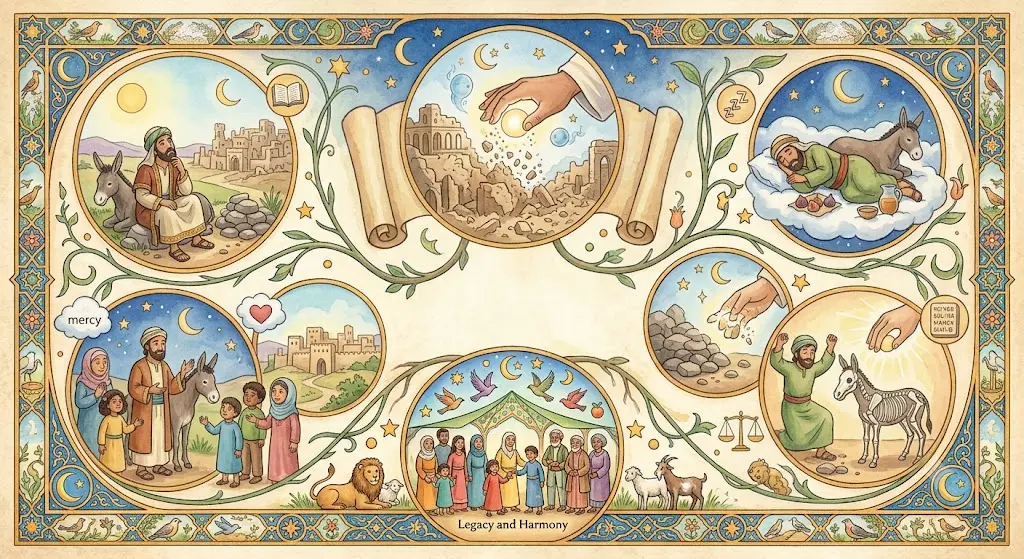
Have you ever felt so frustrated that you just wanted to walk away from everything? Prophet Yunus (peace be upon him) did exactly that — and what happened next is one of the most extraordinary stories in the Quran. He ended up inside the belly of a giant whale, alone in three layers of darkness, calling out to Allah with all his heart.
The Prophet Yunus story for kids teaches children that no matter where you are or what mistake you’ve made, Allah is always listening — and always ready to forgive.
What You’ll Learn in This Article
- Who Prophet Yunus was and where he was sent
- Why he left his people without Allah’s permission
- How he ended up inside the whale — and what he did there
- How Allah rescued him and what happened to his people
- The lessons children can take from this powerful story
Who Was Prophet Yunus?
Prophet Yunus (peace be upon him) is one of Allah’s chosen messengers, mentioned in the Quran by several names. He is called Yunus, Yunus ibn Matta (his mother’s name was Matta), Dhul-Nun (meaning “the man of the whale”), and Sahib al-Hut (companion of the fish).
He lived around the 8th century BCE and was sent to the people of Nineveh, a city in what is now Mosul, Iraq. The Quran confirms his high rank in Surah As-Saffat: “And indeed, Yunus was among the messengers.”
Unlike most prophets who are mentioned only in classical religious texts, Yunus’s story appears in the Quran, the Bible, and the Torah — making him one of the few prophets acknowledged across all three Abrahamic faiths.
Prophet Yunus and the People of Nineveh: His Mission to Call Them Away from Idol Worship
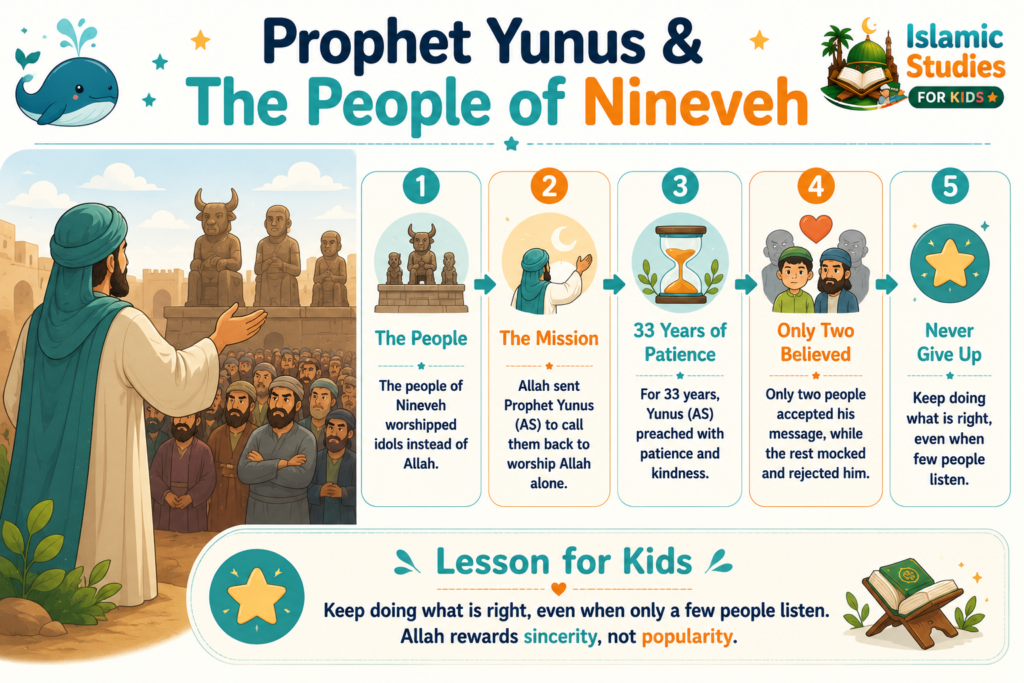
Prophet Yunus was sent to a people who had turned away from Allah entirely. The people of Nineveh worshipped idols — statues they believed could help them or harm them — and had no belief in the One God. Allah sent Yunus to guide them back to the truth.
Yunus (AS) preached to them with patience and dedication for 33 years, calling them to worship Allah alone and abandon their idols. Only two people accepted his call in all that time. The rest refused, mocked him, and doubled down on their disbelief.
Why Prophet Yunus Left Without Permission?
After decades of preaching to closed hearts and deaf ears, something broke inside Prophet Yunus. He became frustrated and heartbroken, and made a decision that would change his life completely: he left Nineveh without waiting for Allah’s permission.
This is the key mistake in the story — and it’s an important lesson. Even a prophet, in a moment of human frustration, can act without proper patience. The Quran describes this moment in Surah Al-Anbiya: “And [mention] the man of the whale, when he went off in anger and thought that We would not decree [anything] upon him.”
Before leaving, Yunus had warned his people that punishment would arrive in three days if they did not repent.
What Happened After Prophet Yunus Left?
Something remarkable happened the morning after Yunus walked away. Dark storm clouds gathered over Nineveh. Black smoke filled the sky and descended over the city. The people looked up and understood — the punishment Yunus had warned them about was coming.
Terrified and desperate, the people searched for Prophet Yunus. They couldn’t find him. So they went to a wise elder and asked what they should do.
The elder told them to repent sincerely to Allah. And they did — together. Every man, woman, child, and even the animals gathered outside the city. They wore rough clothing, placed ashes on their heads as a sign of humility, and cried out to Allah to forgive them and lift the punishment.
Allah accepted their repentance. The punishment was removed. The Quran mentions this in Surah Yunus: “Then has there not been a [single] city that believed so its faith benefited it except the people of Yunus?”
The people of Nineveh are unique in all of Quranic history — they are the only people who repented as a community before the punishment actually struck, and whose repentance was accepted.
Read more stories of the prophets for kids here.

The Story of Prophet Yunus and the Whale: How He Ended Up Inside It
After leaving Nineveh, Yunus walked to the shore and found a boat preparing to sail. He asked to join the passengers, and they agreed. The ship set off to sea.
In the middle of the ocean, a violent storm rose. The waves crashed and the ship began to rock dangerously. The passengers believed that someone on board had committed a wrong and was causing bad luck for them all. They decided to hold a lottery — whoever’s name was drawn would be thrown overboard to lighten the load.
The lot fell on Prophet Yunus — not once, but three times. The passengers liked him and didn’t want to throw him in the water, so they drew again and again. Each time, his name came up. Recognising that Allah’s decree was being made clear, Yunus himself chose to jump into the sea.
Prophet Yunus Inside the Belly of the Whale
The moment Yunus entered the water, Allah commanded a great whale to swallow him whole. Inside the whale, Yunus (AS) found himself surrounded by three layers of darkness: the darkness of the night, the darkness of the sea, and the darkness of the whale’s belly.
Here is where the story becomes truly extraordinary: Yunus was not harmed. Not a scratch, not a broken bone. He was alive — kept safe by Allah’s mercy inside the belly of the whale as it swam through the deep sea.
He could hear sounds around him — strange and unfamiliar. Allah revealed to him that he was hearing the glorification (tasbih) of the sea creatures, who were all making dhikr to Allah in their own language.
Read also: The Best Bedtime Quran Stories for Kids: Timeless Lessons for Little Hearts
Experience a Real Classroom
Curious about how we teach? This video offers a glimpse into a real class, showcasing our interactive approach, qualified teachers, and child-friendly learning experience.
Fun & Engaging Islamic Classes for Kids
Start your child’s journey today with interactive lessons designed to make learning Islam loved and easy.
Get Your Child a Free TrialThe Dua That Changed Everything
In those three layers of darkness, with no escape and no one to call to except Allah, Prophet Yunus made one of the most powerful duas in all of the Quran:
لَّآ إِلَٰهَ إِلَّآ أَنتَ سُبْحَٰنَكَ إِنِّى كُنتُ مِنَ ٱلظَّٰلِمِينَ
“La ilaha illa anta subhanaka inni kuntu mina adh-dhalimeen.”
“There is no god but You. Glory be to You. Indeed, I have been among the wrongdoers.”
— Surah Al-Anbiya, 21:87
He acknowledged his mistake. He glorified Allah. He did not make excuses. And Allah responded.
The Quran states in Surah As-Saffat: “And had he not been of those who glorify Allah, he would have remained inside its belly until the Day they are resurrected.” His tasbih and sincere repentance were what saved him.

This is why scholars and parents often teach children this dua as the dua of relief from hardship — it is the call that opened the darkest prison in the world. You can find this dua and its context in Quranic stories for children, where it comes alive with emotional meaning for young learners.
How Allah Rescued Prophet Yunus Cast onto the Shore?
After Yunus made his dua and Allah accepted it, He commanded the whale to carry Yunus to shore and release him. The whale swam to the coast and Yunus was placed gently on the land.
But he was weak. The digestive acids inside the whale’s stomach had left his skin raw and sensitive. He lay in the open sun with no shade and no shelter, exhausted and unwell. He had been in the whale for three days according to some narrations, seven according to others.
The Miracle of the Gourd Tree
Allah did not leave His prophet to suffer. He caused a gourd tree (yaqteen) to grow up immediately over the spot where Yunus lay — providing shade to protect his skin from the sun, large leaves to keep flies away, fruit he could eat straight away, and a cool and comfortable shelter while he healed.
This detail is specific and meaningful. The gourd plant was chosen because its leaves are large enough to provide real shade, its fruit is edible raw without preparation, and flies naturally avoid it. It was the perfect provision for a sick man with nowhere to go. This small, botanical detail is the kind of expert knowledge embedded quietly in the Quran’s account.
Allah also sent a female wild goat to provide Yunus with milk morning and evening until he had fully recovered.
Prophet Yunus Returns to His People
When Yunus had healed completely, Allah sent him back to Nineveh with a renewed mission. He returned to find his people completely transformed — they were already believers, already worshipping Allah, already living by faith.
The people of Nineveh welcomed him and gathered around him to learn their religion properly. The Quran describes this in Surah As-Saffat: “And We sent him to [his people of] a hundred thousand or more, and they believed, so We gave them enjoyment [of life] for a time.”
Lessons from the Prophet Yunus Story for Kids
The Prophet Yunus story for kids is packed with lessons that children can carry into their daily lives — not just spiritual lessons, but practical ones about emotions, decisions, and turning back to Allah.
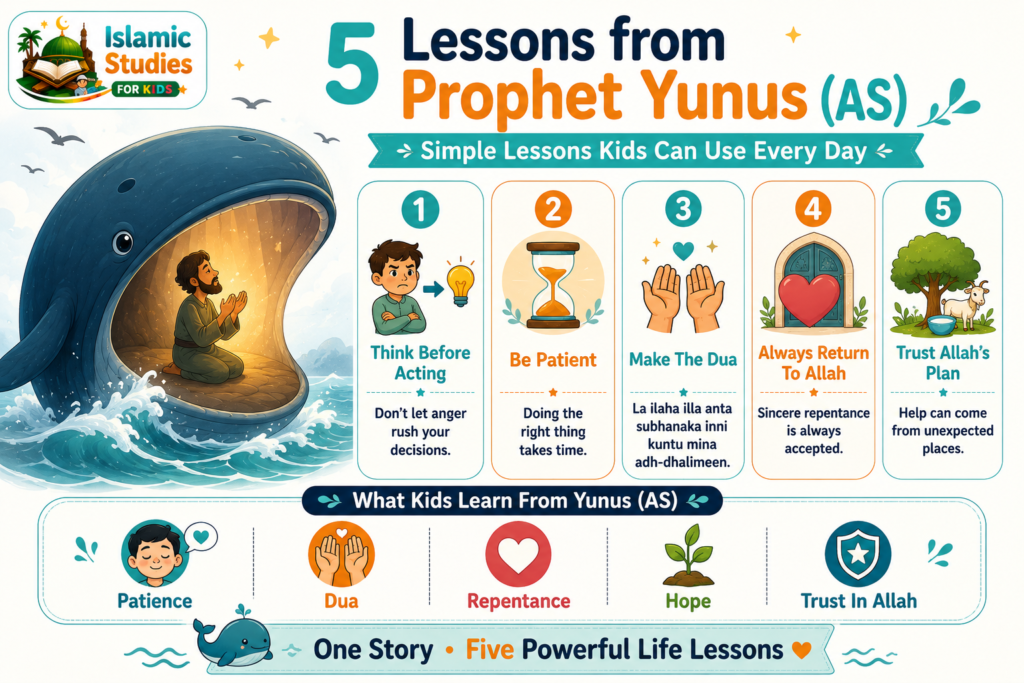
1. Don’t let anger rush your decisions. Prophet Yunus left his people in a moment of frustration without waiting for Allah’s instruction. Even one of Allah’s chosen messengers experienced impatience — and the story shows us the consequence of acting on anger alone.
2. Patience in dawa is long and hard. Thirty-three years is a lifetime of effort. Children learn that doing the right thing doesn’t always bring fast results — but that doesn’t mean giving up.
3. The dua of darkness works. The phrase “La ilaha illa anta subhanaka inni kuntu mina adh-dhalimeen” is specifically mentioned in Hadith as a dua that relieves distress. Teaching children to say this when they are upset, scared, or in trouble connects them directly to this story.
4. Sincere repentance is always accepted. Yunus repented genuinely. The people of Nineveh repented genuinely. Allah accepted both. Children learn that making mistakes doesn’t mean being abandoned by Allah — it means turning back sincerely.
5. Allah provides in unexpected ways. A whale that doesn’t harm. A tree that appears overnight. A goat that brings milk. Allah’s help comes in forms we could never predict or plan for.
Read also: Prophet Stories for Kids – 14 Prophets
Watch a Sample Lesson from Our Academy
Get a firsthand look at how our students learn Islamic values, Quran, and essential knowledge through engaging and interactive online classes. See why families trust Islamic Studies for Kids Academy.
Start Your Child’s Islamic Journey Today
Your child deserves to grow up knowing these stories in their hearts — not just as history, but as living lessons about patience, dua, and trusting Allah.
Browse a growing collection of prophet stories, Islamic studies resources, and Quran activities — all written for children and parents together.
Explore Prophets Stories for Kids →

Our Islamic Studies Courses for Kids:
- Quran for Kids
- Noorani Qaida for Kids
- Quran Recitation for Kids
- Tajweed for Kids
- Quran Memorization (Hifz) for Kids
- Quran for Toddlers
- Quranic Arabic for Kids
- Quran Stories for Kids
Fun & Engaging Islamic Classes for Kids
Start your child’s journey today with interactive lessons designed to make learning Islam loved and easy.
Get Your Child a Free TrialConclusion
The Prophet Yunus story for kids is one of the most human stories in the Quran. A prophet grew tired. He made a mistake. He found himself alone in the deepest darkness imaginable — and he turned back to Allah with complete honesty.
What makes this story so powerful for children is not the whale. It’s the dua. Three words of acknowledgement — “I was among the wrongdoers” — opened the darkest prison in the world. That is the lesson children carry forward: not that they must be perfect, but that when they fall short, they know exactly what to do.
The people of Nineveh add another dimension entirely. They had ignored their prophet for 33 years — and yet, when they turned to Allah sincerely, He forgave every single one of them. No mistake is too big. No delay is too long. Repentance is always open.
Frequently Asked Questions About the Prophet Yunus Story for Kids
Who is Prophet Yunus in the Quran?
Prophet Yunus (peace be upon him) is one of Allah’s messengers, mentioned in the Quran by four names: Yunus, Yunus ibn Matta, Dhul-Nun, and Sahib al-Hut. He was sent to the people of Nineveh in ancient Iraq and is known primarily for the miracle of surviving inside a whale after leaving his people without Allah’s permission.
Why did Prophet Yunus get swallowed by the whale?
Prophet Yunus was swallowed by the whale as a consequence of leaving his people without waiting for Allah’s command. He boarded a ship, and when a storm arose, a lottery placed him in the sea. Allah commanded the whale to swallow him as a test and a lesson — not to punish him permanently, but to bring him back to patience and submission.
What did Prophet Yunus say inside the whale?
Inside the whale, Prophet Yunus called out: “La ilaha illa anta subhanaka inni kuntu mina adh-dhalimeen” — meaning “There is no god but You, glory be to You, indeed I was among the wrongdoers.” This dua is recorded in Surah Al-Anbiya (21:87) and is taught to children as the dua of relief from hardship.
How long was Prophet Yunus inside the whale?
Scholars differ on this point. Some narrations say three days, others say seven, and some suggest up to forty days. The Quran does not specify the exact duration but makes clear that had Prophet Yunus not glorified Allah, he would have remained until the Day of Judgment.
What is the miracle of the gourd tree in the Prophet Yunus story?
When the whale released Prophet Yunus onto the shore, he was weak and his skin was sensitive. Allah caused a gourd tree to grow over him instantly, providing shade, large leaves to keep flies away, and ready-to-eat fruit. This miracle is mentioned directly in Surah As-Saffat (37:146) and is considered one of the signs of Allah’s mercy toward His prophet.
What happened to the people of Nineveh after Prophet Yunus left?
The people of Nineveh saw the signs of approaching punishment — dark clouds, thick smoke — and repented sincerely before it struck them. They gathered together, wore rough clothing, placed ashes on their heads, and called to Allah. Allah accepted their repentance and removed the punishment. They are the only community in the Quran to have repented collectively before punishment arrived and had it accepted.



Leave a Reply